Places to go and things to see by Gypsy Bev

Archive for the ‘Ohio’ Category

National First Ladies’ Library Chronicles Hostesses at the White House
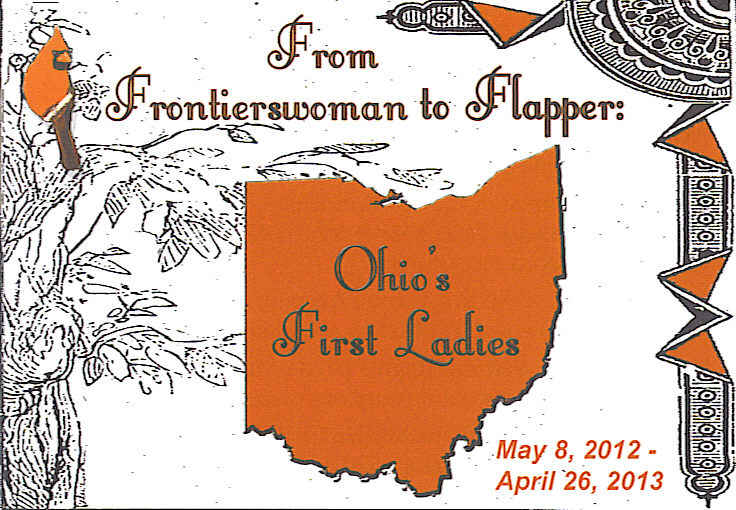
First Ladies have always played important roles during their husband’s presidency from hostess at the White House to diplomat.  At this time Ohio’s First Ladies are the featured presentation at the National First Ladies’ Library Education and Research Center in downtown Canton, Ohio. The title, From Frontierswoman to Flapper, describes the transition during their life times from colonial living to the beginning of the Jazz Age.  The present day home of the library, an 1895 City National Bank Building, has beautiful original marble floors and walls , thus giving an elegant feeling to the library.

The visit began with a video introducing the First Ladies of Ohio.  While Ohio lays claim to eight presidents, only seven first ladies called the state home.  That still puts Ohio at the top of the list for First Ladies from any one state. Following the video, an excellent tour guide explained the numerous items on display, which led to many interesting stories about the First Ladies and their husbands. Each first lady had her own special interests and talents, making her a unique individual. These are a few interesting stories about the Ohio First Ladies that caught my attention during a recent visit.
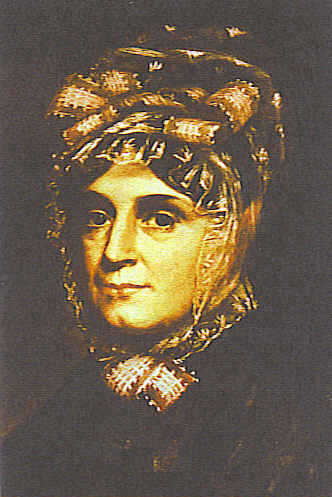
Anna Harrison (1775-1864) first enjoyed being hostess at the Governor’s Mansion where she entertained  prominent figures such as Vice President Aaron Burr and Tecumseh.  Anna was too ill to travel when her husband went for his presidential inauguration. However, one month later, William Henry Harrison died at the White House so Anna never made the journey to Washington D.C.
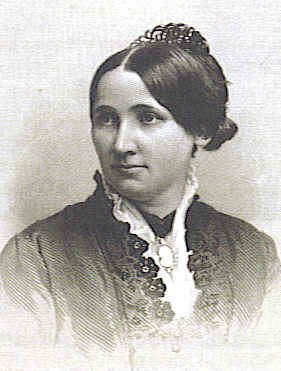
Lucy Hayes (1831-1889) enjoyed entertaining as she liked being surrounded by people.  Her receptions and dinners were always admired, and her china dinner plates each contained a different scene. Lucy was actually the first First Lady with a college diploma.  After she spent time with her husband when he was wounded in the Civil War, she traveled to various camps where she visited, and attended to, wounded soldiers.
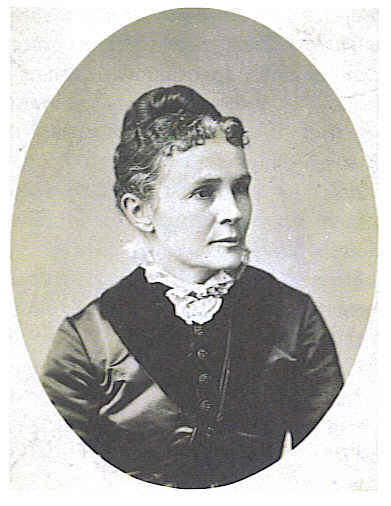
Lucretia Garfield (1832-1918)  stayed by her husband after he was shot by an assassin through the eighty days that he wasted away.  Perhaps she was one of those early promoters of women’s rights as Garfield needed constant attention from his doctors during this time. The male doctors were paid $10,000 while the female doctor was only paid $5,000. Lucretia was adamant about having that changed so the female doctor also received $10,000.
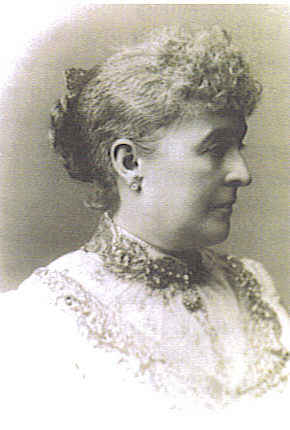
Caroline Harrison (1832-1892) was a star pupil of the German artist, Paul Putzki, and her designs painted on china were on display at the library. Although she was not very well, she enjoyed growing exotic plants and flowers. Her husband never left her side during her bout with tuberculosis and she died in the White House.
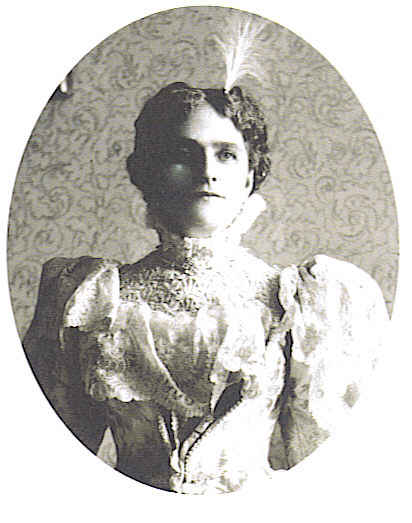
Ida McKinley (1847-1907) suffered from blinding headaches and epileptic seizures after the death of her daughter. Therefore, the only way she could fulfill her role as First Lady was often seated in a chair holding a bouquet of flowers to hide her trembling hands.  One of her beautiful garnet gowns with black lace and beading on the collar was featured at the library. When she was able, crocheting was one of her forms of relaxation and many crocheted slippers were given as gifts.
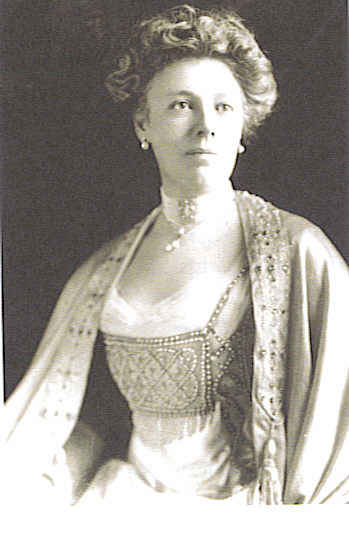
Helen Taft (1861-1943) was the first First Lady to donate her gown to the Smithsonian Institute. One of the most beautiful gowns at the library was Helen’s soft pink dress trimmed with lace and a velvet bow.  A beautiful embroidered fan featuring a cherry blossom tree was only one of her collection of fans, but a definite favorite. Because of Helen’s admiration for the Japanese cherry trees, three thousand trees were donated to the United States by the mayor of Tokyo.
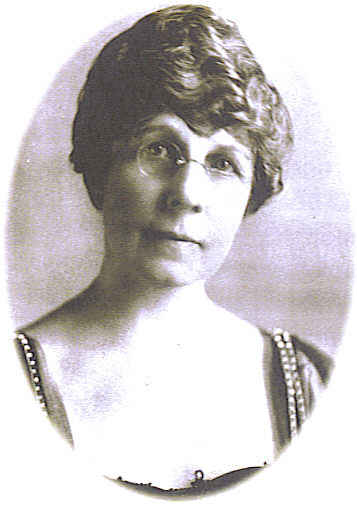
Florence Harding (1861-1924) did not have many positive experiences in her life and had a very unhappy marriage suffering the many affairs of a wayward husband – some even claim she poisoned him. The piano was her source of comfort as she had studied piano at the Cincinnati Conservatory of Music. She wrote many notes about her unhappy life and this one had a definite piece of advice to married women:

The Happy Wife is not the woman who marries the best man on earth,                     But one who is philosophical enough to make the best of what she has got.

National First Ladies’ Library has many events for the community and the surrounding area all year long.  During the summer they sponsored a Summer Reading Program for K-5 discussing these books this year:  First Garden, Miss Lady Bird’s Wildflowers, and Through Georgia’s Eyes. Their Victorian theater shows documentaries on the First Ladies,  presents author talks and shares many interesting movies and performances.

The First Lady in her Hostess role helps determine how successful her husband’s presidency is going to be. If you would like to learn more about the First Ladies, visit them downtown Canton Ohio. These beautiful doors will open to welcome you!
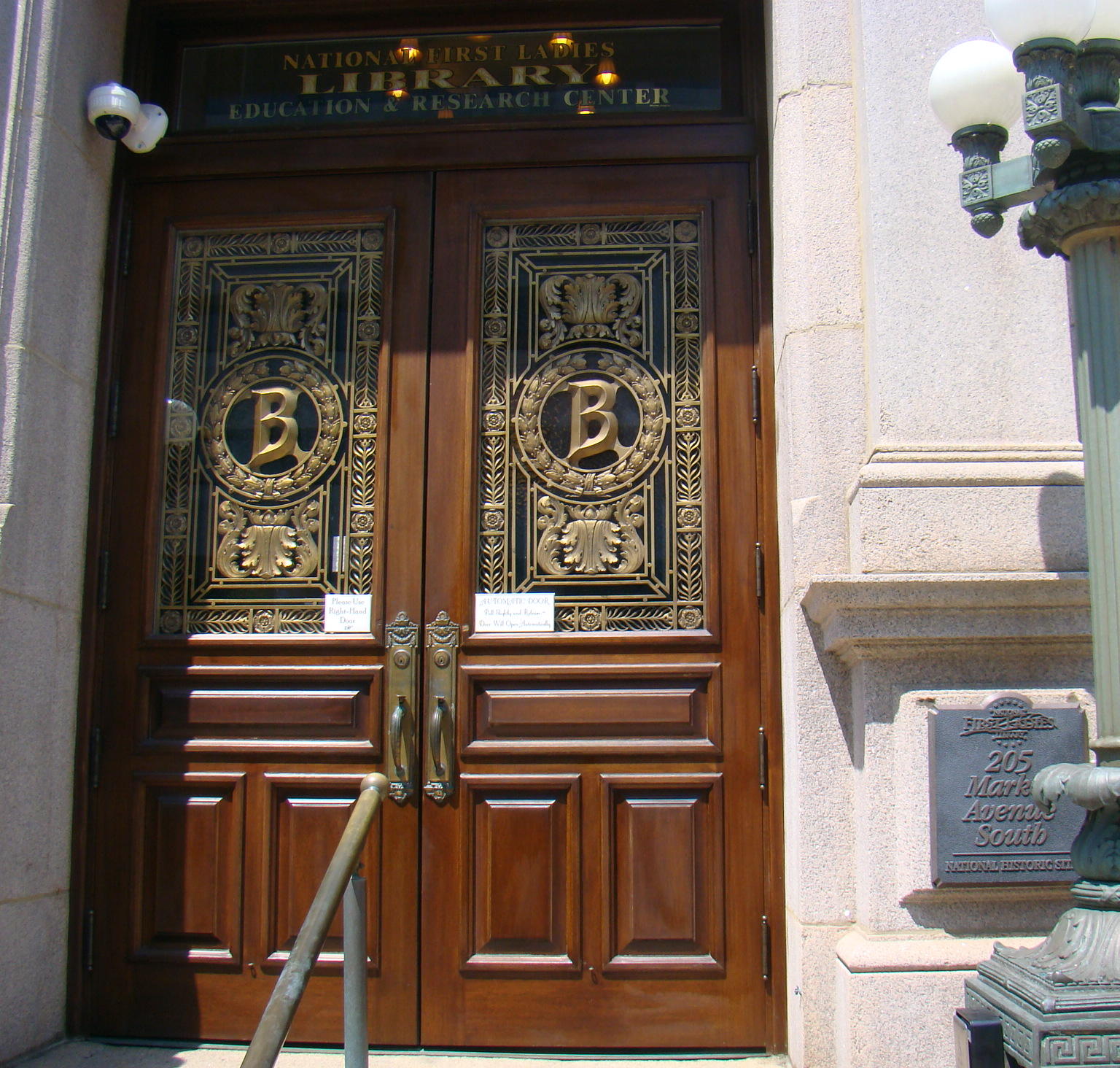
National First Ladies’ Library Education and Research Center is located in downtown Canton, Ohio just off I-77 at 205 Market Street South.  All tours of the facility are guided, and price is reasonable at $7 for adults, $6 for seniors, and $5 for children under 18. This admission price also includes entrance into the Ida Saxton McKinley House next door, which we will visit at another time.

Buffalo Hills Resort Welcomes Native American Pow Wow

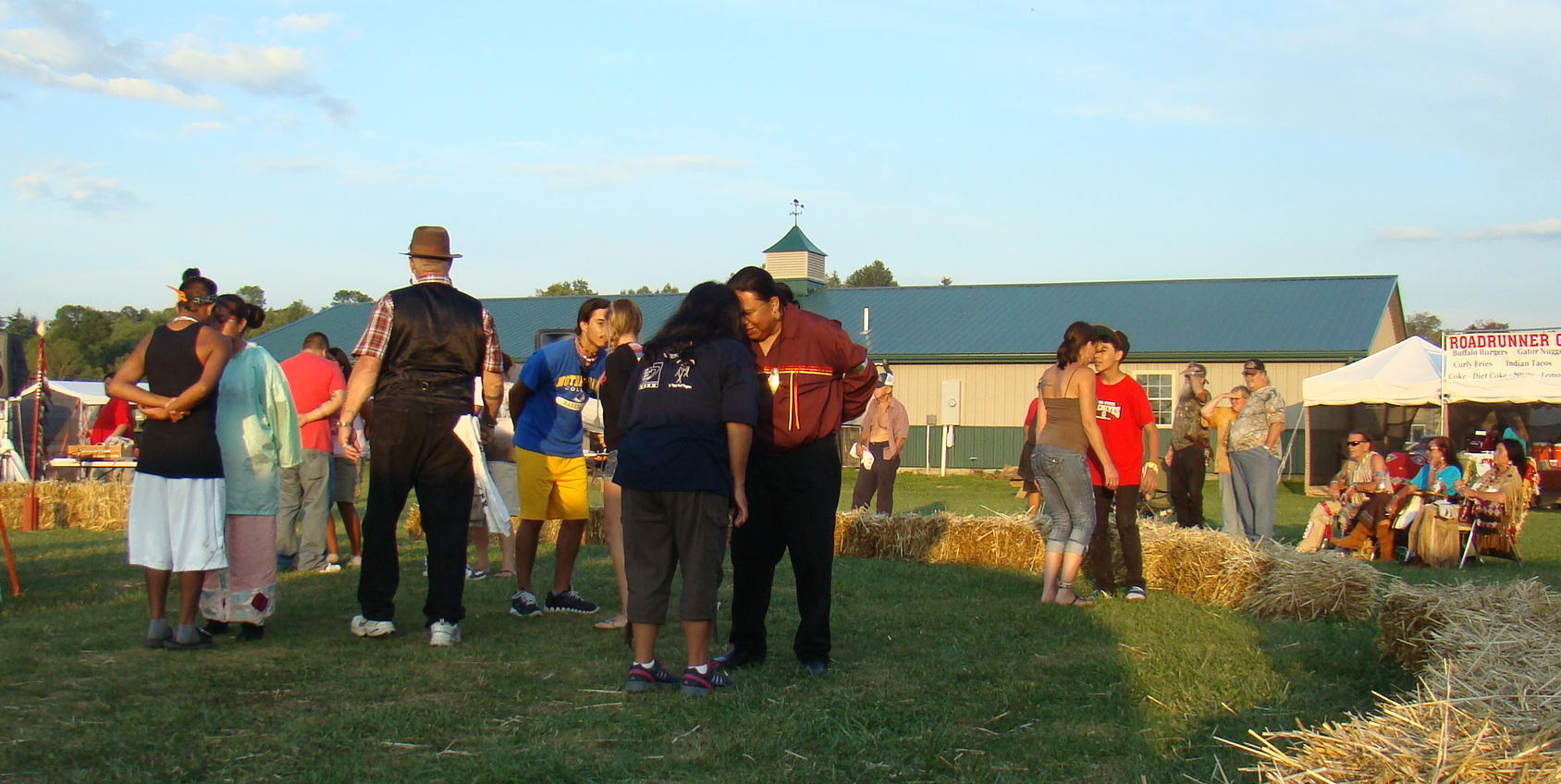
Native Americans are proud of their heritage as was witnessed at the gathering of tribes near Senecaville, Ohio at Buffalo Hills Resort.  Indian Pow Wows join together tribe members  for dancing, singing, socializing, and most of all, honoring their Indian culture. This seemed like the “real thing” as Native Americans congregated for their own enjoyment, not just entertainment. Any lessons learned by White Man were considered a bonus.

Did you ever taste Frybread? Native Americans will often remark, “Frybread is the story of our survival.”  Over a hundred years ago when the US forced Indians to take “The Long Walk” from Arizona to New Mexico, they nearly starved in their new landscape. To keep them from starving, the US government gave them flour, sugar, and lard – the makings of frybread, which later led to various health problems. At the Pow Wow, authentic Indian food was served by concessions and Frybread was delicious either served as the base for an Indian Taco, or covered with sugar and cinnamon. Also on the menu were Buffalo Burgers and Gator Nuggets on a Stick, with Snowballs for dessert.

Native costumes caught the eye of visitors as Indian maidens seemed to float over the ground with their smooth movements.  Delicate woodland flowers and vines added beauty to the deerskin dresses, as did the unusual jewelry made with the help of Mother Nature. Necklaces and bracelets were designed from acorns, spices, dried corn and seeds. This beautiful maiden was called Gentle Dove and said to be a Messenger for Love and Peace.

A circle of baled hay made a comfortable place to observe the Indians’ presentations. In the afternoon an entertaining storyteller told traditional Indian legends, most of which centered around animals.  All their stories have special meaning, and hopefully an effect on the listeners. The story of a Snake taught children to beware of wild animals, while the adventures of Bear and Rabbit with Buzzard described why Buzzard has a deep mark on his face to this day.

John Red Deer filled the spot of medicine man for the day with his extensive knowledge of herbs for healing. While there were many interesting items in his display, the popular 7 Grandfathers All Purpose Salve topped the list. As you can see from the sign, it can be used for many different ailments as well as a detox. John Red Deer feels inspired to make this in cream, liquid for detox, and even in stick form to carry with you for cuts and bites.

Peppermint and Spearmint form the base of this magical salve plus seven other herbs, which he feels he will reveal soon so others can carry on his work. Plants are harvested as he is guided by the voice of Spirit, and later the herb combination is brewed during the Summer Solstice.  This time of solar and lunar infusion gives the perfect blending of the herbs. A severe storm this year, while he was making the salve, produced two hours of intense energy, which John Red Deer felt increased the strength and effectiveness of that salve. His plans are to make a medicinal soap in the near future.

With the drums and flutes of Southern Pine in the center of the circle, the evening dance was a pleasure to watch.  Leading the procession of dancers were Native Americans carrying the USA flag, an MIA flag, as well as their traditional eagle staff with an eagle head on the top. The opening prayer was given first in Choctaw language, followed by English.

Songs were sung to relatives who had passed on to another world and veterans were honored with the blowing of the eagle whistle. Beautiful dresses filled the center and individual dances were performed.  The Jingle Dress glistened in the sunlight and jingled to the beat of the drums.

To close the evening, couples did a Potato Dance with a potato held between their foreheads as they constantly moved to the music. The last couple to keep the potato from dropping to the ground was the winner of a small monetary prize.

Find an Indian Pow Wow in your area to attend so you, too, can learn of the American Indian traditions. While sometimes stories are heard about the Indian attacks long ago, they basically wanted to be peaceful people and enjoy their style of life in the quiet of their homes.  Imagine sitting in the woods with the drums beating, chants filling the air, and the Spirit surrounding you. That’s the way life is meant to be!

Buffalo Hills Resort encompasses over 300 acres in southeastern Ohio making it one of Ohio’s largest campgrounds. Campers have their choice of primitive camping, parking for their RV, as well as cabin or perhaps teepee rental.  While it isn’t far from the interstate, it is definitely peaceful country and near Seneca Lake. Leaving I-77, take exit 37 to the East  (State Route 313) until you come to the four-way stop at Senecaville.  Make a right hand turn on State Route 285  then shortly a left at the fork on State Route 566, also called Opossum Run Road. After a couple miles, campers will find Buffalo Hills Resort on the left hand side.  

Civil War Encampment Days Beyond the Skirmish

Will the Yanks run the Rebels out of town? Reenactors lined the streets of McConnelsville, Ohio for their 25th Annual Civil War Encampment Days, Ohio’s longest consecutive running reenactment.  What a great place to observe the living history of the Civil War.

Everyone dressed in period costume in the soldier camps seemed eager to discuss their life style, and patiently answered all questions.  Their canvas tents provided great cover from rain storms.  However, they reminded those in attendance that it was important not to touch the canvas with your fingers during a rain.  Seems the oil on your fingers would make the canvas leak. Rains were important for their War Gardens, which provided food for the army as well as land owners.

Since death was frequently a visitor during this time, ladies told about the cemeteries where they often held picnics. Union stones were flat so you might sit on them, but the Confederate stones had a pointed top so “Yankees” couldn’t sit on their tombstones. The ladies also mentioned that black wreaths were hung on doors when someone died as a notice of death, since it was the only method of letting the neighbors know.

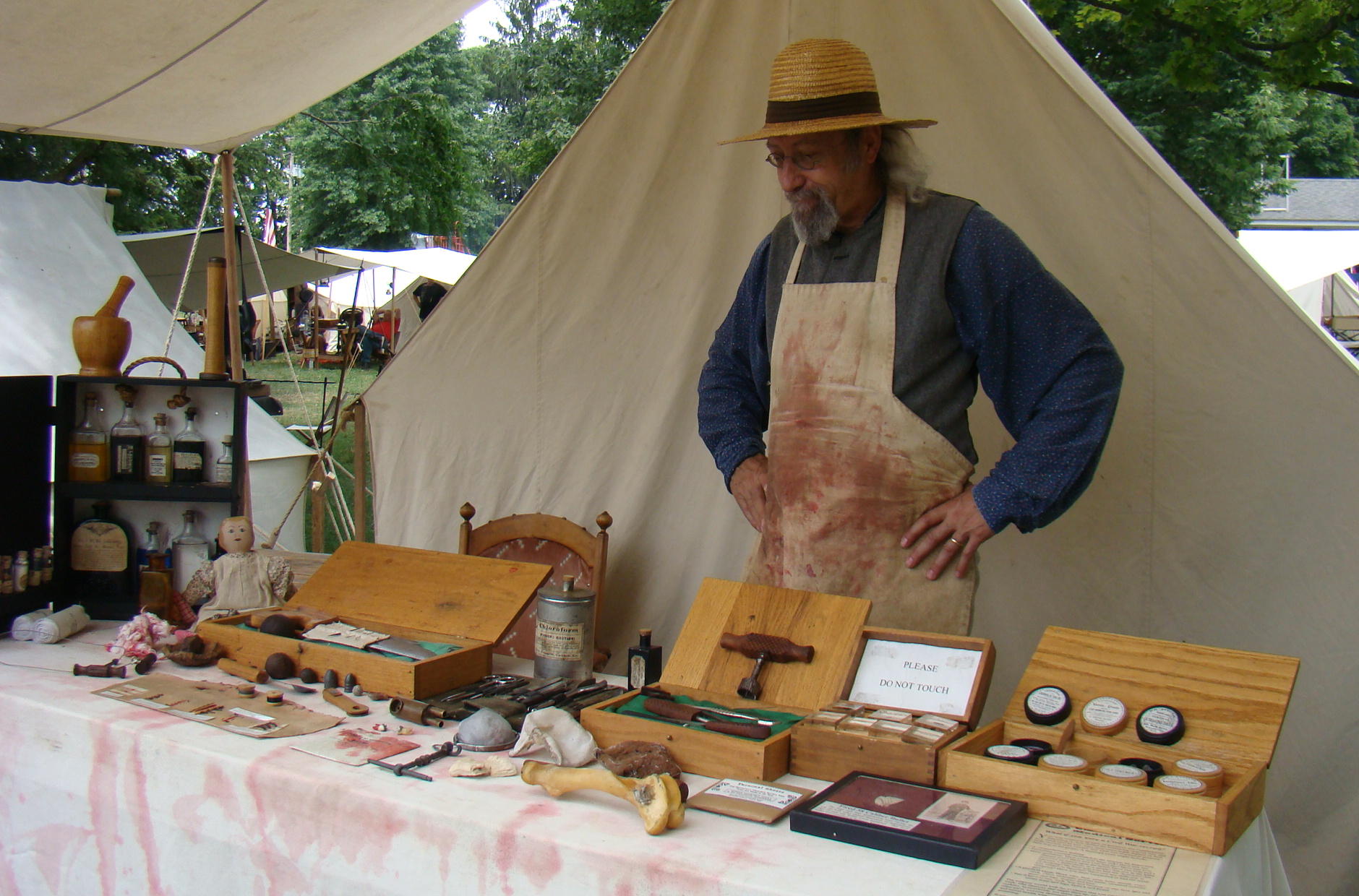
Many medical treatments were explained by the blood stained Head Surgeon of the Confederate regiment. When asked what might be used to help a headache, the major informed visitors that opium would be used if it was severe, while a relaxing morphine or sassafras would be used  for minor headaches. If the headache was too bad, they would just bore a hole in the head to release the evil spirits. Upset stomachs were treated with licorice or ketchup, and beef extract provided a soothing soup for many ailments. They even had a hollow doll that was used to smuggle medicine through the opposing lines.  Later in the afternoon at the field hospital, the surgeon cured a case of gangrene and subsequent blood poisoning by sawing off the leg of the victim.

Walked down to the Courthouse for “Squirmish on the Square”, where a staged battle occurred between soldiers from the North and South. Much ceremony was involved in the presentation of the battle both before and afterwards. There was even a bit of humor thrown in as they robbed a Wells Fargo box and then blew it up. The closing ceremony showed soldiers from both sides presenting arms, taps were played and a wreath was placed on the Civil War Private monument standing in the center of Main Street.  The base of this monument is made of stone from Gettysburg and the Gettysburg Address is engraved on one side of the monument.

After a hot afternoon on the square, it was time for a drink. As Yosemite Sam would have said, “Sasparilly, and make it snappy!” Sarsaparillo was a popular drink of the Civil War era and a cold bottle hit the spot.  Made from sarsaparilla roots, this drink is  called “The Granddaddy of All Root Beers”.  Originally the bitter root brew was used for medicinal purposes treating digestive problems, but later sugar water was added to make it more palatable. ..and a soft drink was born.

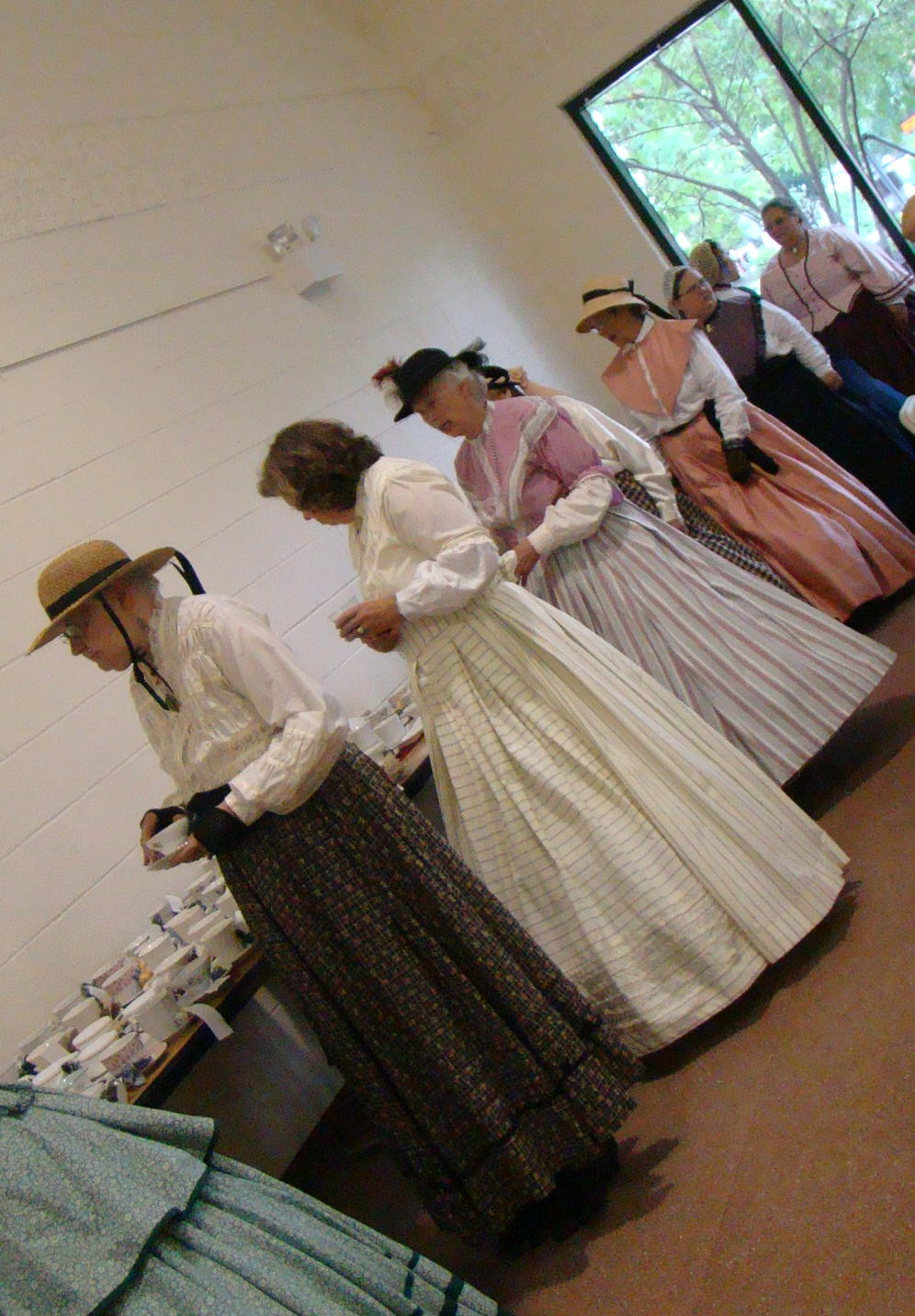
Ladies’ Tea was served amid beautiful hooped gowns and lovely flowered hats. Cucumber sandwiches, fresh fruit, and small cakes were part of the traditional menu. After tea, Verna Owens of St Mary’s, West Virginia told tea drinkers about Women During the War…from the Confederate viewpoint. Her leader was President Jefferson Davis, who had his Confederate White House at Richmond.

She described the proper dress and manners for a Southern lady, who always carried a parasol and wore a hat.  Her cooling fan accomplished an additional task as a means of expressing her thoughts without saying a word.  For example a fan closed in a snap meant she was angry with what was being said, while fanning quickly might mean she couldn’t believe what was happening, or as we might say, “Oh, my!” Many toys of the time were explained and on display. Quiet dolls for church were made out of handkerchiefs, and there was a cow’s jaw for musical entertainment. When soldiers were leaving for battle they gave their sweethearts a tear bottle to collect their tears while they were gone.  Upon their return, they hoped to find it at least half full. Verna closed by saying one truth learned from the war was that we definitely should learn to get along.

In the evening, a Civil War Ball captured the beauty that sometimes appears in the midst of turmoil. Ladies were dressed in their finest, but few hats were worn to the ball…just ribbons or flowers in their hair. Some men wore their uniforms while others were dressed in their best tailcoat. Dancers swirled around the floor doing The Promenade, Waltz, Virginia Reel, and Patty Cake Polka with music provided by Back Porch Swing Band.  What a great ending to a Civil War Day.

This particular Civil War Encampment occurred in McConnelsville, Ohio which is just South of Zanesville, Ohio on Route 669 following the beautiful Muskingum River.  Located riverside just north of town is The Boondocks, one of Ohio’s best small-town eateries being featured in many magazines across the state. Their specialties are their award winning BBQ as well as their great and friendly service.  Could be worth a Sunday drive for a nice meal even if there isn’t an encampment happening!

Ohio’s Johnny Appleseed Ap*peel*ing to the Core

An apple a day keeps the doctor away is a saying we have heard most of our lives. But John Chapman, better known as Johnny Appleseed, has a slightly different version:  Eat an apple before you go to bed, and make the doctor beg his bread.

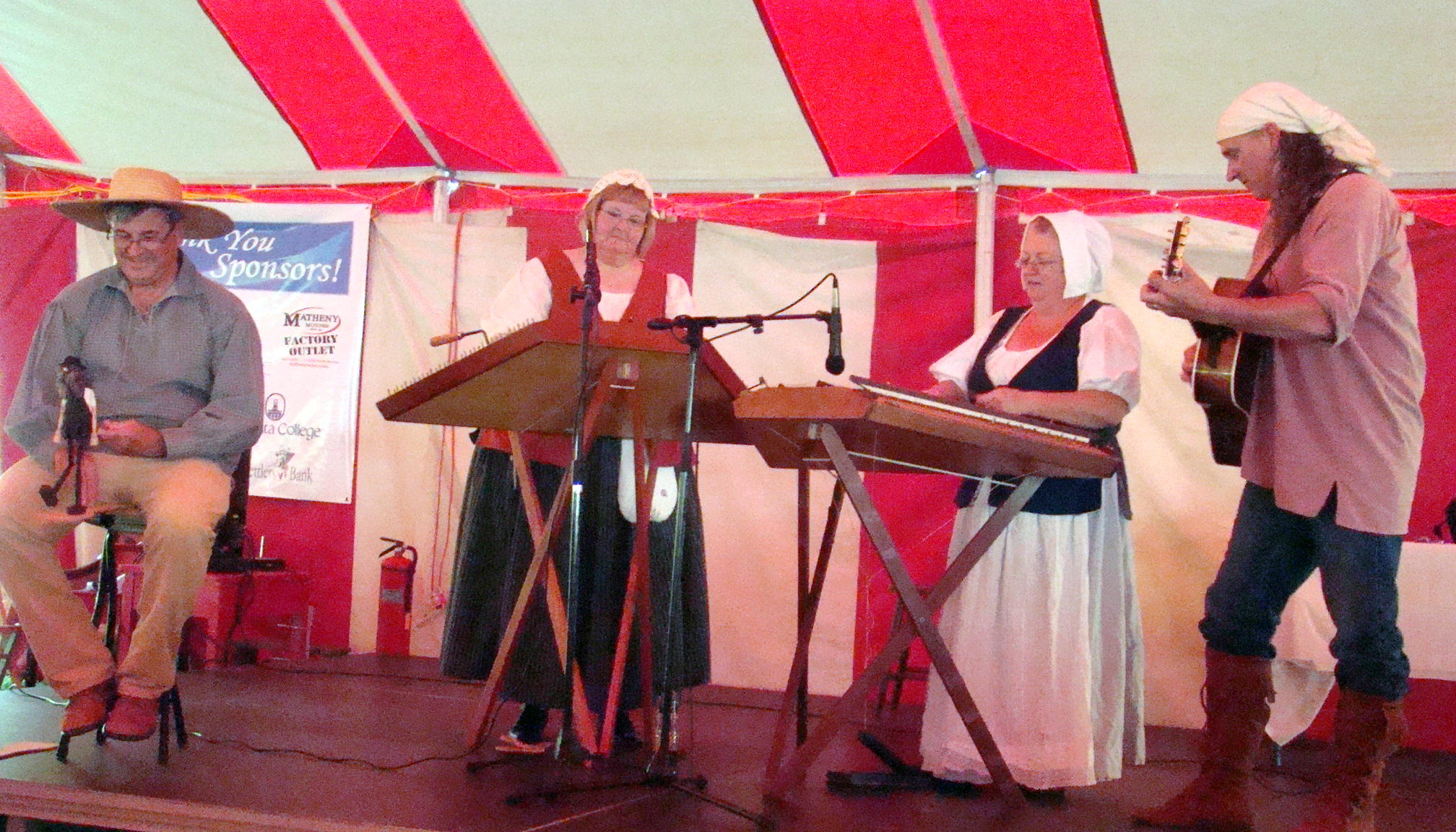
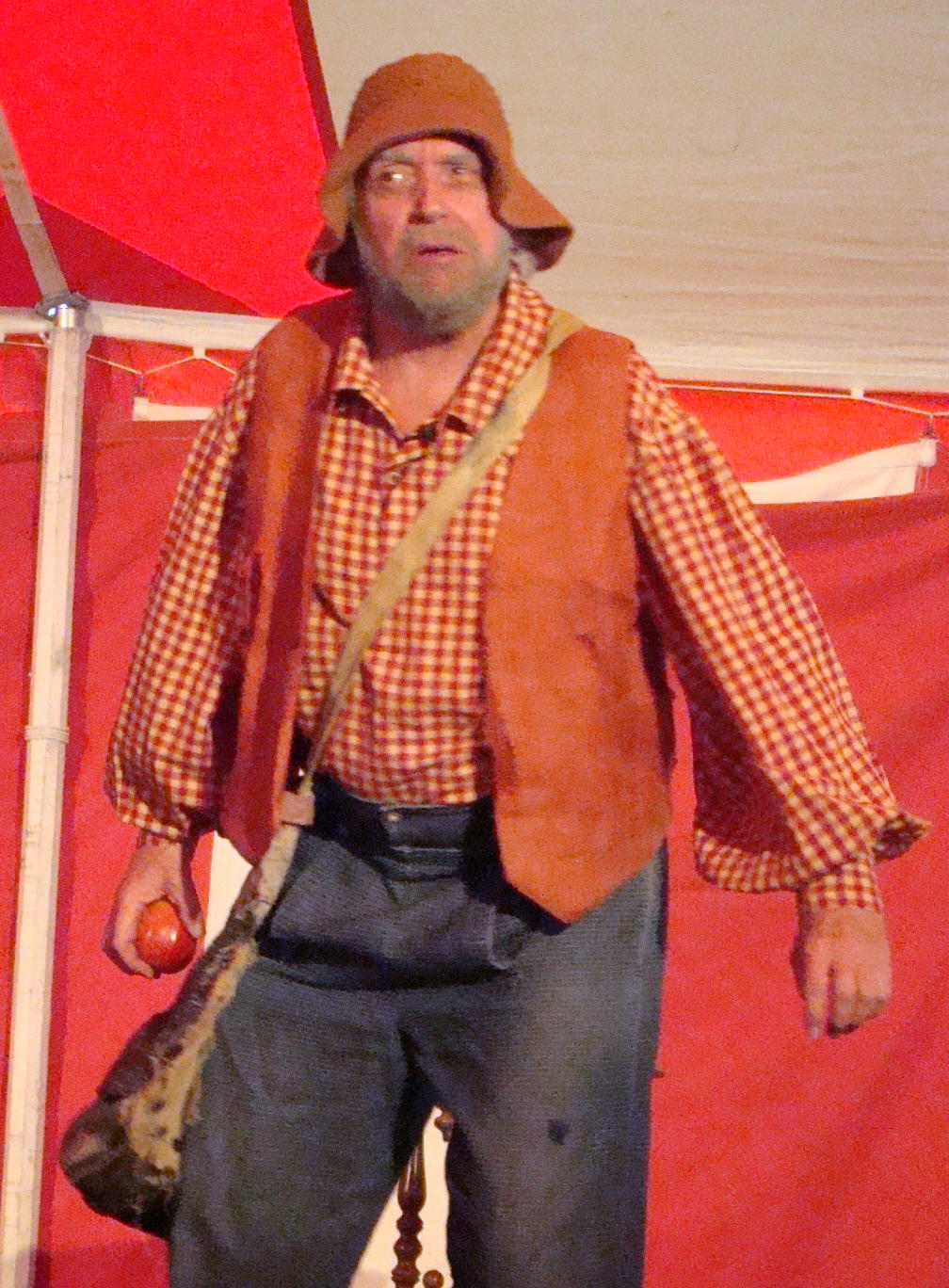
Each evening before the appearance of historical scholars, local musical groups entertained with songs from frontier times.  This particular evening a group called Unwound presented lively music on two hammer dulcimers accompanied by guitar and tapping Limberjacks.  They got the crowd in the Chautauqua tent at Marietta Ohio ready for the appearance of Johnny Appleseed, an excellent yarn spinner.

John Chapman wanted to do something useful with his life that would also support his ministry. Apples seemed to be the perfect tool as they were the only fruit that could stay fresh for an extended time. There was a litany of uses given by John regarding his favorite fruit: apple chips, apple butter, apple brandy, and even payment for taxes…to name a few. Would you believe his favorite color is apple red?

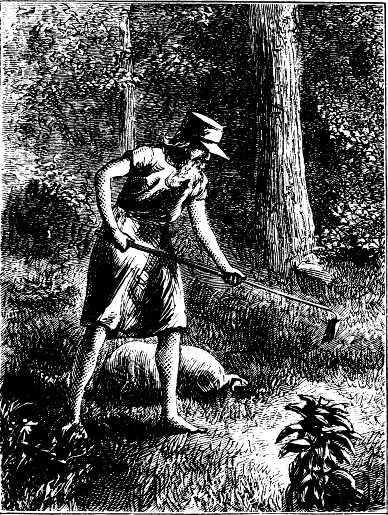
Starting a nursery for Johnny was a simple affair: poke a hole, plant a seed, cover it up. He tried to anticipate where people would be settling in two or three years and would start a nursery in that vicinity. Johnny said that in order to claim the land, the homestead law required settlers to plant fifty apple trees during the first year. Sometimes you might see him going down the Ohio River with two canoes:  Johnny in the first one, 50 apple seedlings or apple seeds in the second.

In 1812 when troubles in America erupted with the British and the Indians, Johnny said the fear grew deeper than the snow. These war years were painful for Johnny, as he had always been friends with both Indians and whites.  Trying to make peace was like trying to put out a fire – while you were stomping on one, you were fanning the rest. At this time, he felt the Indians were like a tornado – you never knew where they were going to strike.  But you couldn’t always trust the British either as they burned whole villages – another white man’s promise up in smoke!

With his constant good humor, he admonished listeners not to believe everything they heard about him, “Gossip is like the measles, sooner or later it will turn your face red.”  For example, barefoot Johnny Appleseed did not walk over the entire country.  His travels and consequent apple tree plantings only occurred in New York, Pennsylvania, Virginia, Ohio, Michigan, Indiana, Illinois and often in a State of Confusion.

Johnny was deeply religious and felt his religion gave him a peaceful path to tread. His was the perfect life in his eyes because sometimes he was with people… but sometimes by himself.  He often enjoyed being alone and said he was not “the marrying kind”.

He spent his life doing good deeds for others and planted more than just apple trees. He also planted spiritual seeds that nourished the soul.

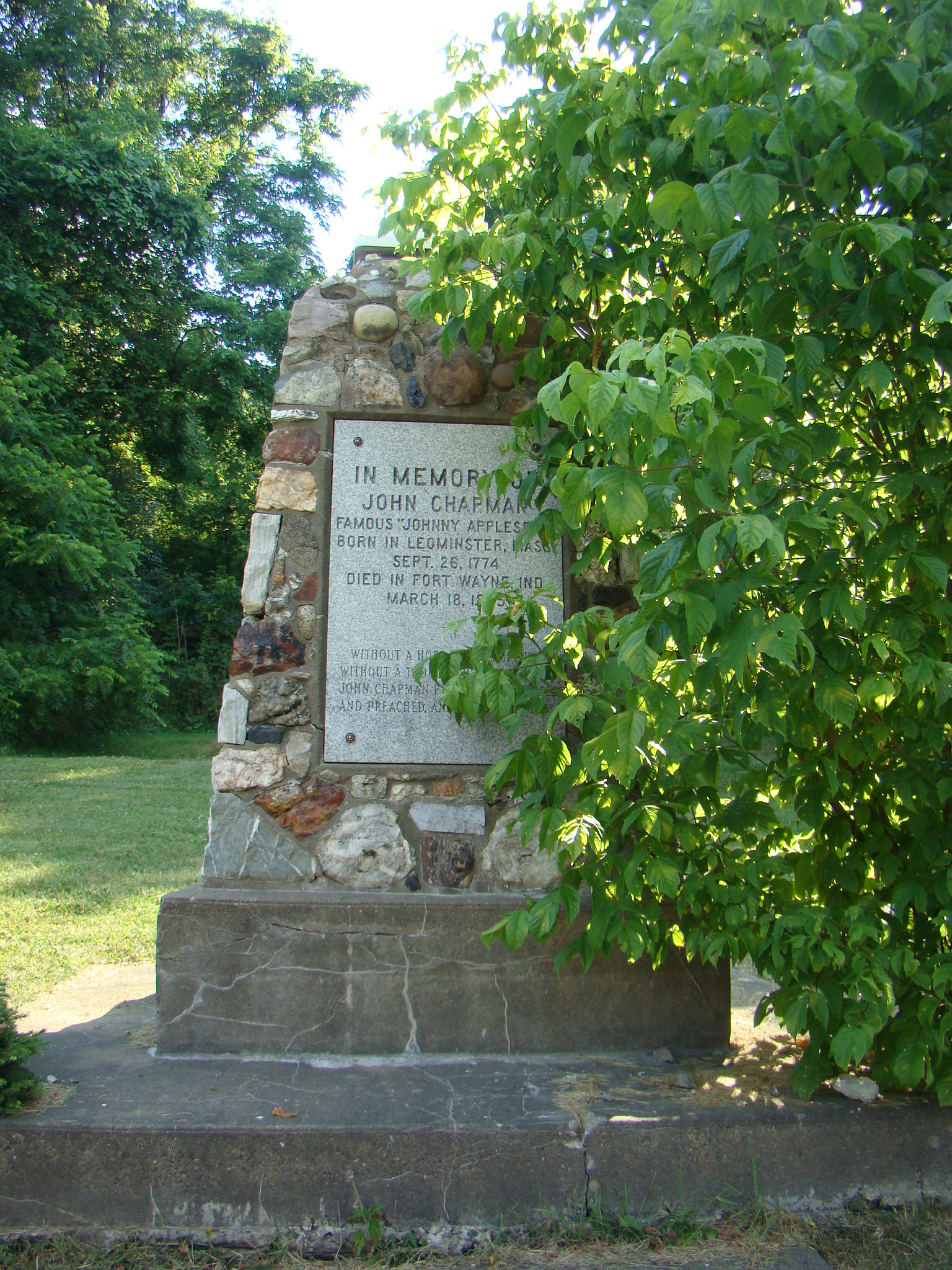
Along the way to Marietta, stopped just south of Dexter City on SR 821 to see a monument dedicated to Johnny Appleseed.  It is made of small rocks contributed by people in areas where Johnny planted apple tree.  The grave sites of his family are located nearby.  The tree to the right behind it is, of course, an apple tree.

Hank Fincken displayed a great sense of humor in his portrayal of Johnny Appleseed /John Chapman.  Johnny was the first historic figure that Hank ever developed. He feels it opened doors for him much the way Johnny’s seedlings opened doors for early settlers.

2012 Ohio Chautauqua continues throughout the summer with week long performances and workshops in Gallipolis (July 17-21) and Warren (July 24-28). Hope you find time to join them and learn a little more about “When Ohio Was the Western Frontier”.

Peaceful Chief John Logan Propelled to Revenge

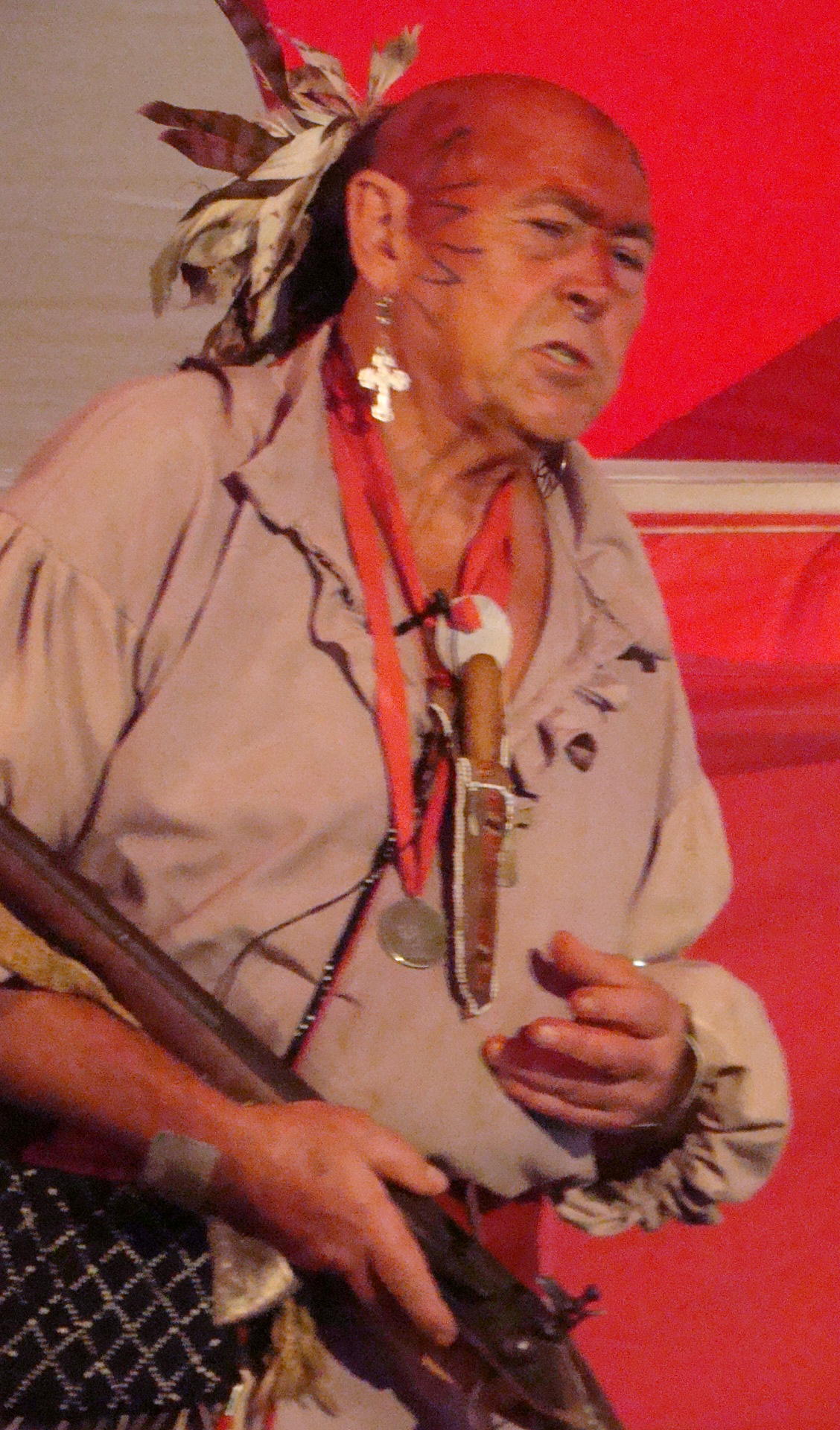
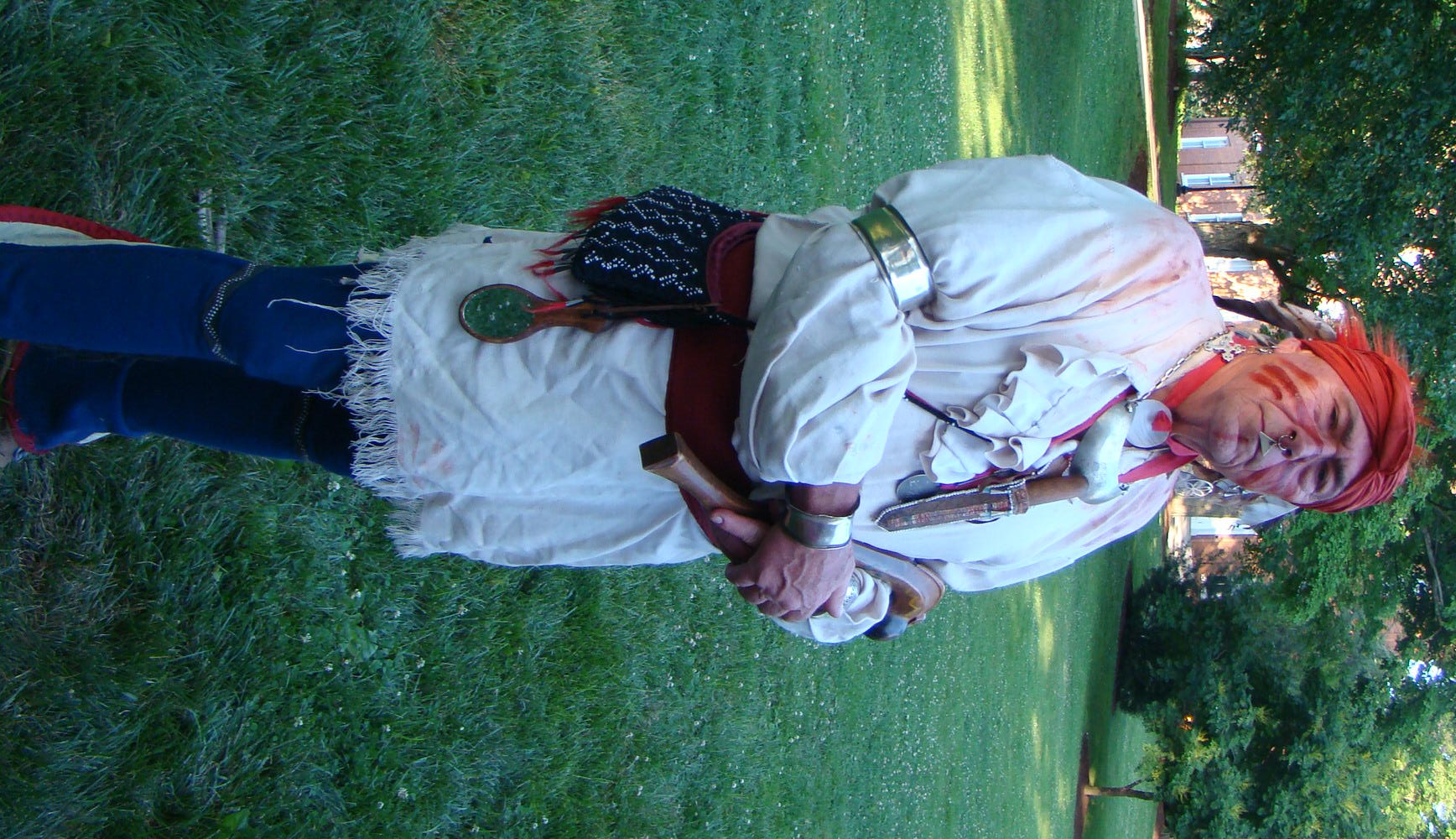
Dressed in buckskin clothes, the appearance of Chief Logan transported the audience back to frontier times. Silver armbands, bracelets, a nose ring and earrings – one a cross- glittered in the sunlight as he took the stage at the Ohio Chautauqua during the 225th Anniversary of Marietta – The Crown Jewel of the Appalachians.   Tattoos also adorned his body with a tobacco leaf tattoo on his ear symbolizing “truthful hearing” while a red hawk on his head denoted his tribal connection.

John Logan began his life on the Susquehanna River and followed his father’s Jesuit teachings where John’s “sins were washed away”. Friendly with the white settlers, John was always a peacemaker for the Iroquois, who were usually called Mingos when settling in the Ohio Country, and John Logan is most often referred to as Chief of the Mingos. Perhaps his role as peacemaker gave him reason to learn eight different Indian dialects as well as English, French, Dutch and even Latin. However, Chief Logan could neither read nor write.

The Ohio Land Company kept expanding their boundaries to include more and more of the Indian lands. The Mingos ignored the marks of surveyors saying, “You can’t sell the wind in the sky or the water in the river.”

Along the Ohio River, settlers frequently met at the tavern for stories, nourishment and ale.  One evening, Logan’s camp along Yellow Creek, near present day Wellsville, Ohio, was invited by a nasty frontiersman, Jacob Greathouse, to a tavern across the Ohio River.  During the course of the evening, some of Logan’s family was shot and killed in an ugly massacre.  This changed Logan’s peaceful ways in a hurry.  In the words of Logan, “It made me want to raise my hatchet that had long been buried and color it with the blood of the English.” Sometime during this period, he walked away from the Christian teachings.

While he told the settlers of his anger, he also said the Indians were not all angry…just Logan, as they had killed his people.  Known as Logan’s Revenge, he vowed to take ten white man’s scalps for every Indian that had been murdered on the Ohio River that evening. Every time he took a scalp, he made a mark on his hatchet. According to Native American custom, he had a right to this retaliation.

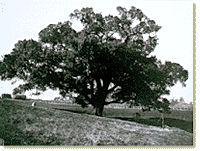
Chief Logan refused to attend peace talks in 1774 at Camp Charlotte on the Scioto River, but issued his now famous speech, Logan’s Lament, under an elm tree. While the beautiful old elm no longer exists, the words of his speech can be found today engraved on his memorial at Logan Elm State Memorial near Circleville, Ohio. His speech concluded:

“Logan feels not fear. He would not turn on his heel to save his life for who is there left to mourn Logan? Not one.”

The remainder of his life was spent as a kind man who sold deer skins for a dollar each, so he could bury his sorrows in the taverns he visited.  In 1781, he was killed by his nephew, because John Logan was no longer considered an asset to his people. Today there is not a drop of Logan’s blood in any living creature.

Dan Cutler portrayed Chief Logan with ease as he has spent about a dozen years in that role in West Virginia as well as the Ohio Valley.  Frequently he also slips into the roles of The Cornstalk Warrior, Tecumseh and Simon Girty. Dan is currently active in a new outdoor drama, “Drums Along the Mohawk”, which will premier late this summer in New York.

2012 Ohio Chautauqua continues throughout the summer with week long performances and workshops in Gallipolis (July 17-21) and Warren (July 24-28). Hope you find time to join them and learn a little more about “When Ohio Was the Western Frontier”.

York, Slave of William Clark, Once Felt Freedom

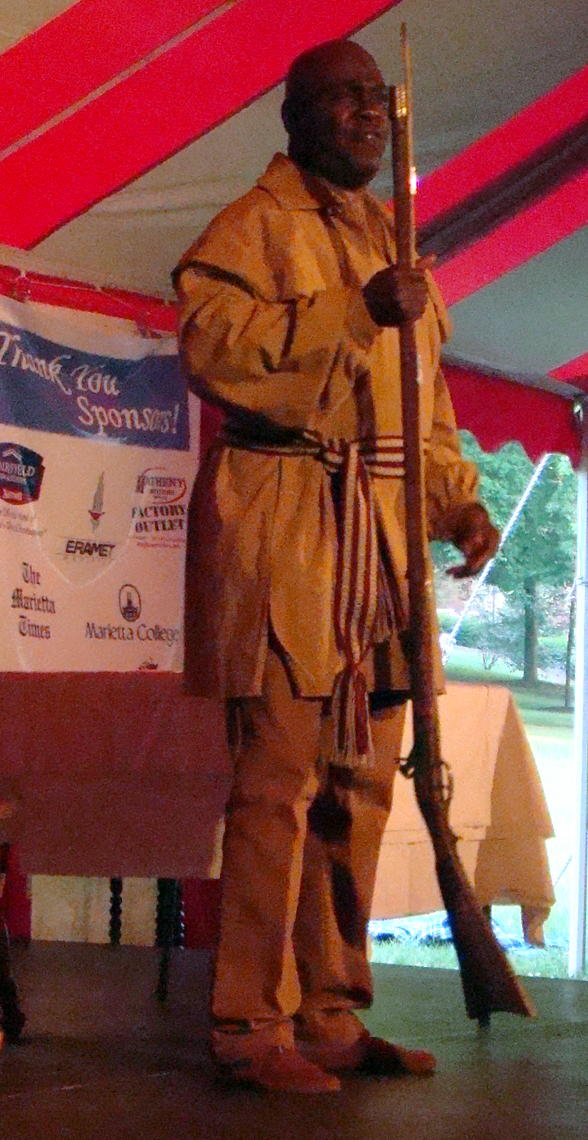
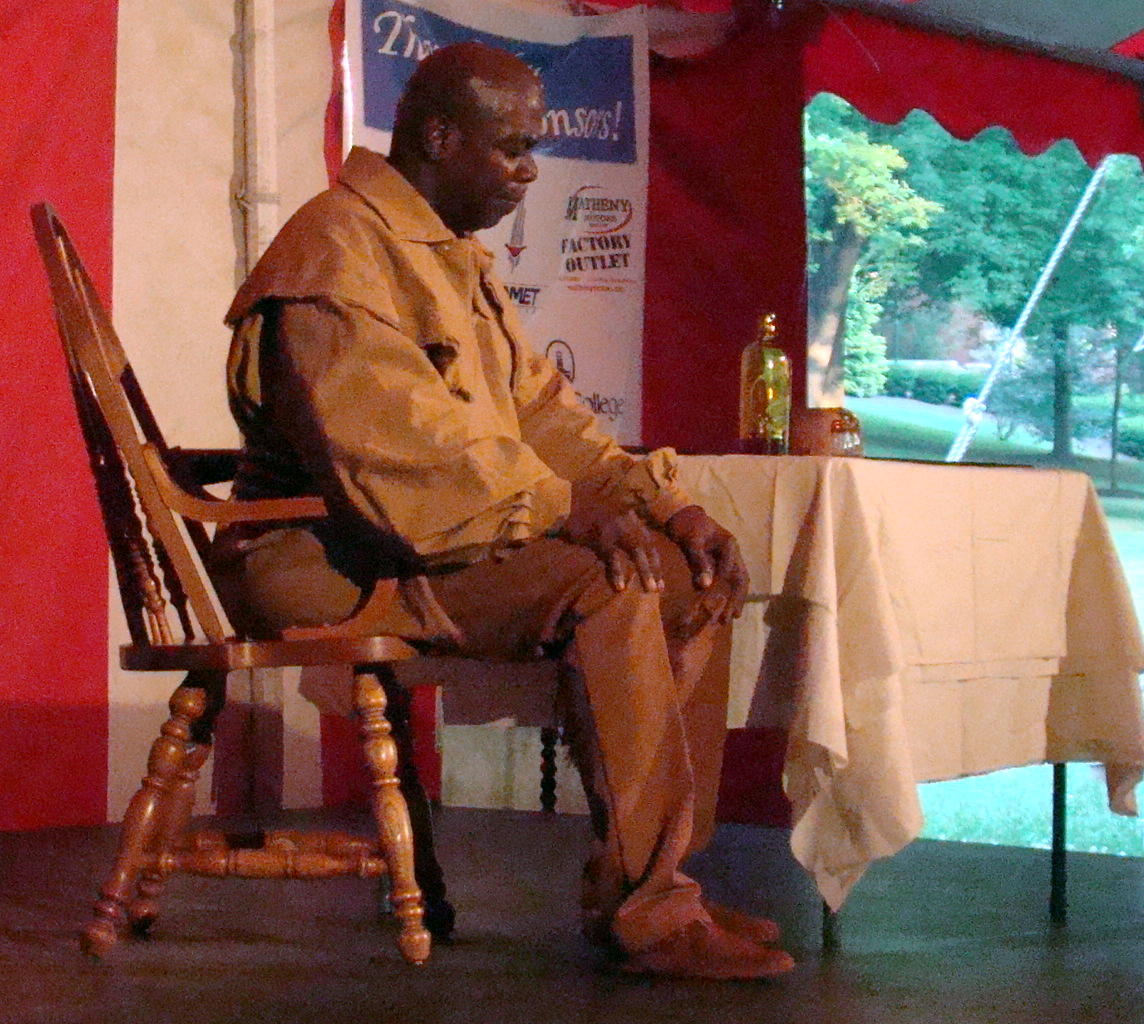
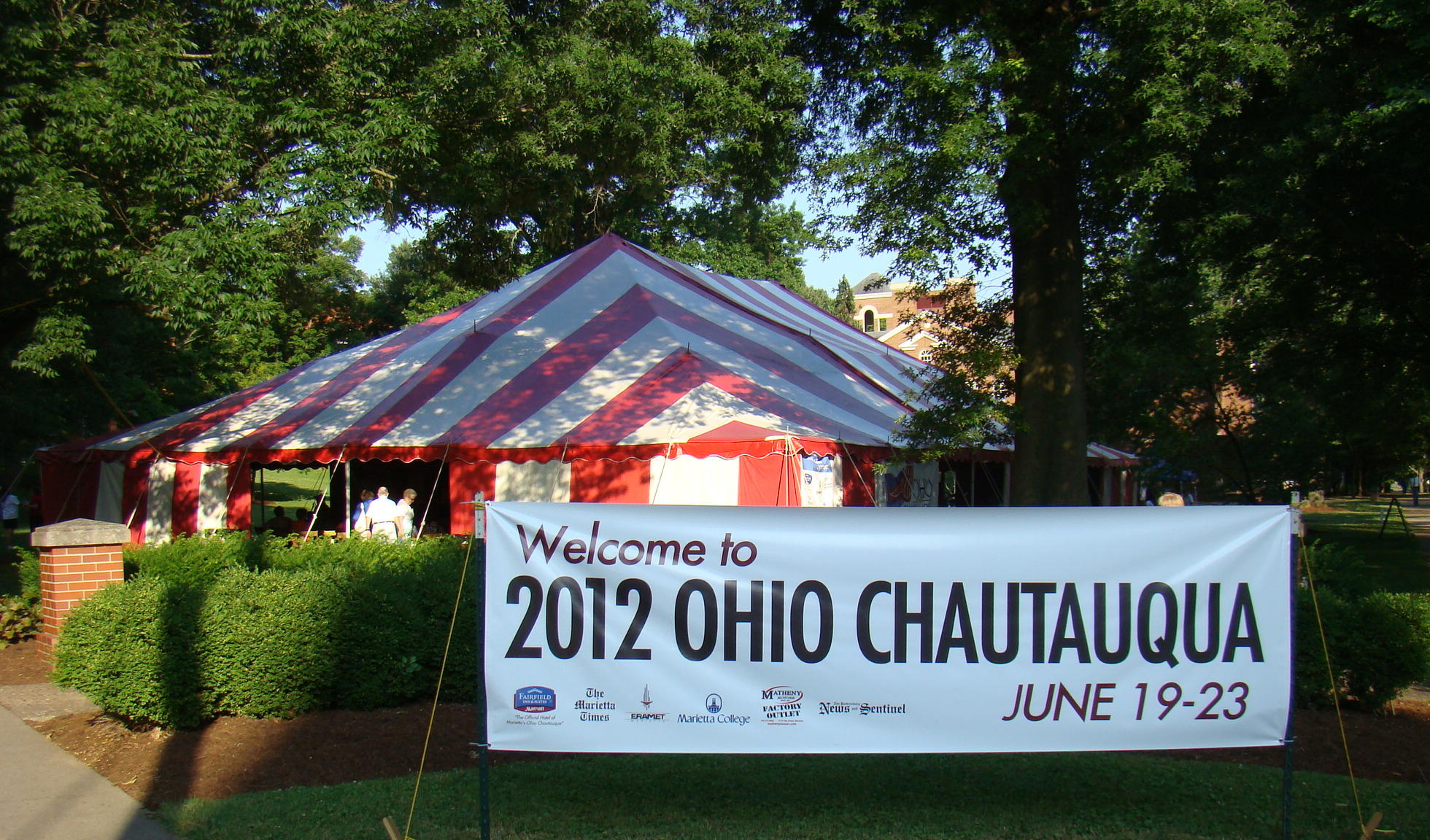
Tracker… Negotiator…Ambassador…Doctor.  All these words were used at one time or another to describe York, Captain William Clark’s black manservant, who was part of the Lewis and Clark expedition to the Pacific Ocean and back to the East. York’s story was told under the red and white striped tent at the 2012 Chautauqua celebration in Marietta, Ohio on the campus of Marietta College. This year’s theme, “When Ohio Was the Western Frontier”, introduced characters that played a role in Ohio’s early history. York, being from Virginia, spent much time on and along the Ohio River.

As the first recorded black explorer, York created much excitement as he traveled across the Western frontier.  Due to his large size and black skin, his presence amazed and intrigued the Indians along the way. Thinking perhaps that he was painted black, at many stops the Indians would spit on their fingers and try to rub the black color from his skin. Indian tribes considered him a friend and referred to him as Big Medicine, since he frequently gave them liniments and herbs to heal their ailments. Some even called him Giant Medicine due to his size, and felt that his skin had sacred power.  This was a time in York’s life when he said, “How great it felt to be admired.  I felt ten feet tall.”

Because he enjoyed storytelling and drinking, York was very popular in taverns wherever he went. His speech was much like “the white man’s” since he had grown up in his master’s household. Never having been taught to read or write, he relied on his tall tales, some higher than the mountains, to entertain the explorers and those he met along the way. The Indian squaws favored him with special treatment, and he entertained the children with stories of being wild. His contribution as a peace maker with the Indians helped make the expedition more successful.

Life was not easy on the journey as they were often cold and hungry. They drank bear fat and even ate candles to survive. At times when food was scare, York was entrusted with a musket, something that never would have been permitted this slave while in Virginia. There were times when they were fortunate to encounter a herd of elk.  Then they ate elk, elk, and more elk all day long. If no other meat was available, they even ate their dogs and found them quite tasty. The children in the tent at Marietta that evening were quite concerned about the expedition eating dogs, and were assured it was only done during an emergency when no other food was available.

When they returned to the East, York reverted to his position as a manservant. He only wanted freedom to be with his wife but this was not to be. Instead he was flogged, even jailed and then hired out to a severe master where he was given spoiled food and further mistreated.

Even though York was married, he seldom saw his wife as she too was a slave. They lost contact completely when she was sent to Mississippi to work on a plantation. So even though he knew she was expecting their child, he never got to see the child or even know of its whereabouts. When he asked Captain Clark if he could be sold as a slave with his wife, Clark said it was out of the question. York said the most painful time he encountered in his life was saying goodbye to his wife.

What really happened to York? Some accounts say that he was eventually freed, but given the fact that he had no knowledge of business was not able to make his way in the world.  Other accounts say he was spotted later with the Crow Indians in the Rocky Mountains. Hope it was the later!

As York sat at the tavern on the Chautauqua stage, he said he was thankful for the Expedition as for a short time he knew what freedom felt like. There his color was not a curse but a blessing. His dream was to eventually go back to the Indians.  His presentation concluded with a toast to the Great Expedition, the beauty and majesty of our great nation, Captain Clark, the Indians, and Big Medicine.

Marvin Jefferson did a very believable portrayal of York. His background as an educator and historical scholar has given him incite into Civil Rights issues and he frequently portrays Martin Luther King, Jr and Paul Robeson in his stage performances.

2012 Ohio Chautauqua continues throughout the summer with week long performances and workshops in Urbana (June 26-30), Gallipolis (July 17-21) and Warren (July 24-28).  Hope you find time to join them and learn a little more about “When Ohio Was the Western Frontier”.

Margaret Blennerhassett Prosperity to Poverty

More is better! That was the feeling of Harman and Margaret Blennerhassett as they came to the United States from England in 1797. Their marriage was frowned upon by friends and family in England since Harman was Margaret’s uncle; therefore, their best chance at a happy life together would have to be in a far away country.  Having sold his castle in England, the Blennerhassetts arrived in the United States with lots and lots of money…$140,000! While this fortune seemed limitless at that time, the Blennerhassetts spent their fortune recklessly and unwisely, always wanting more.

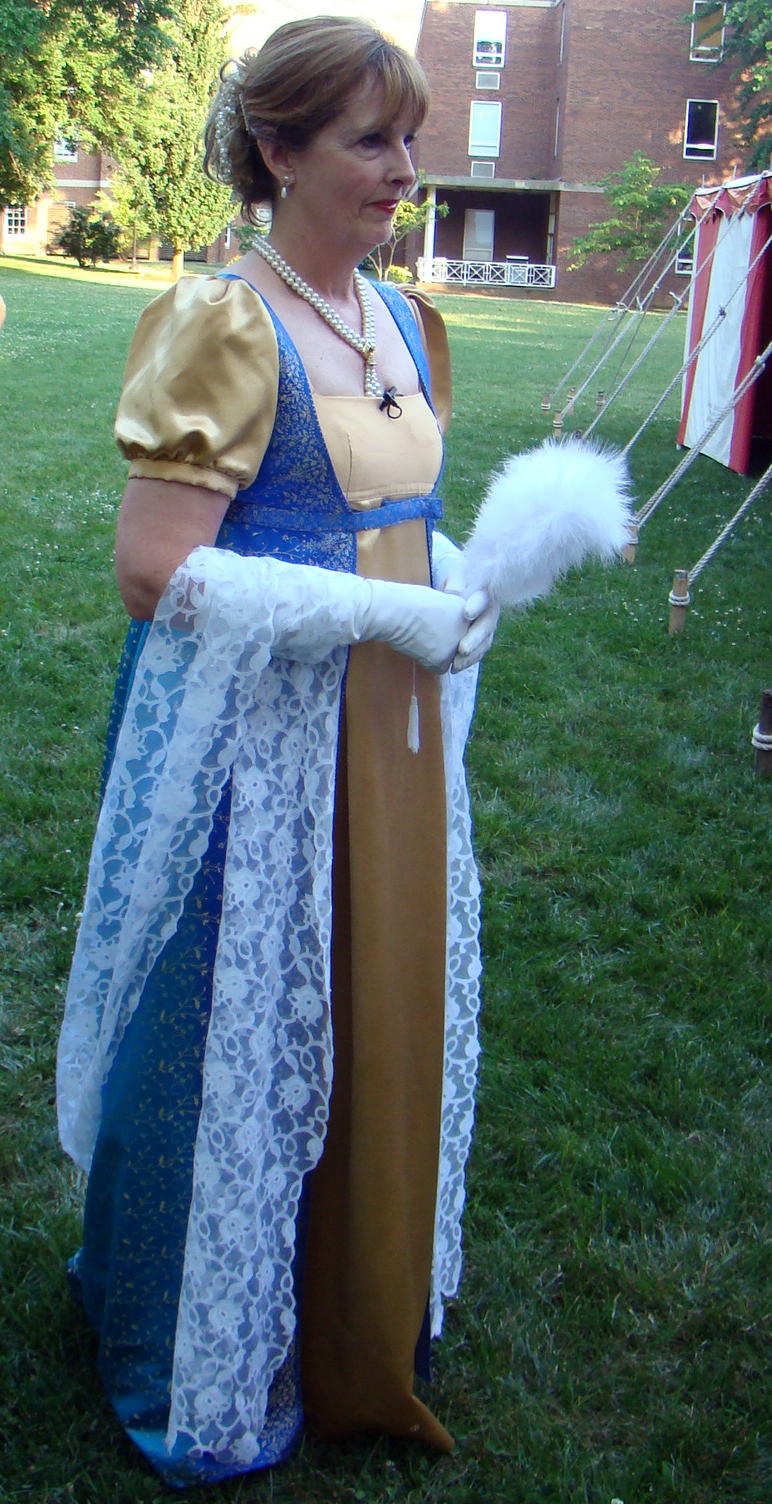
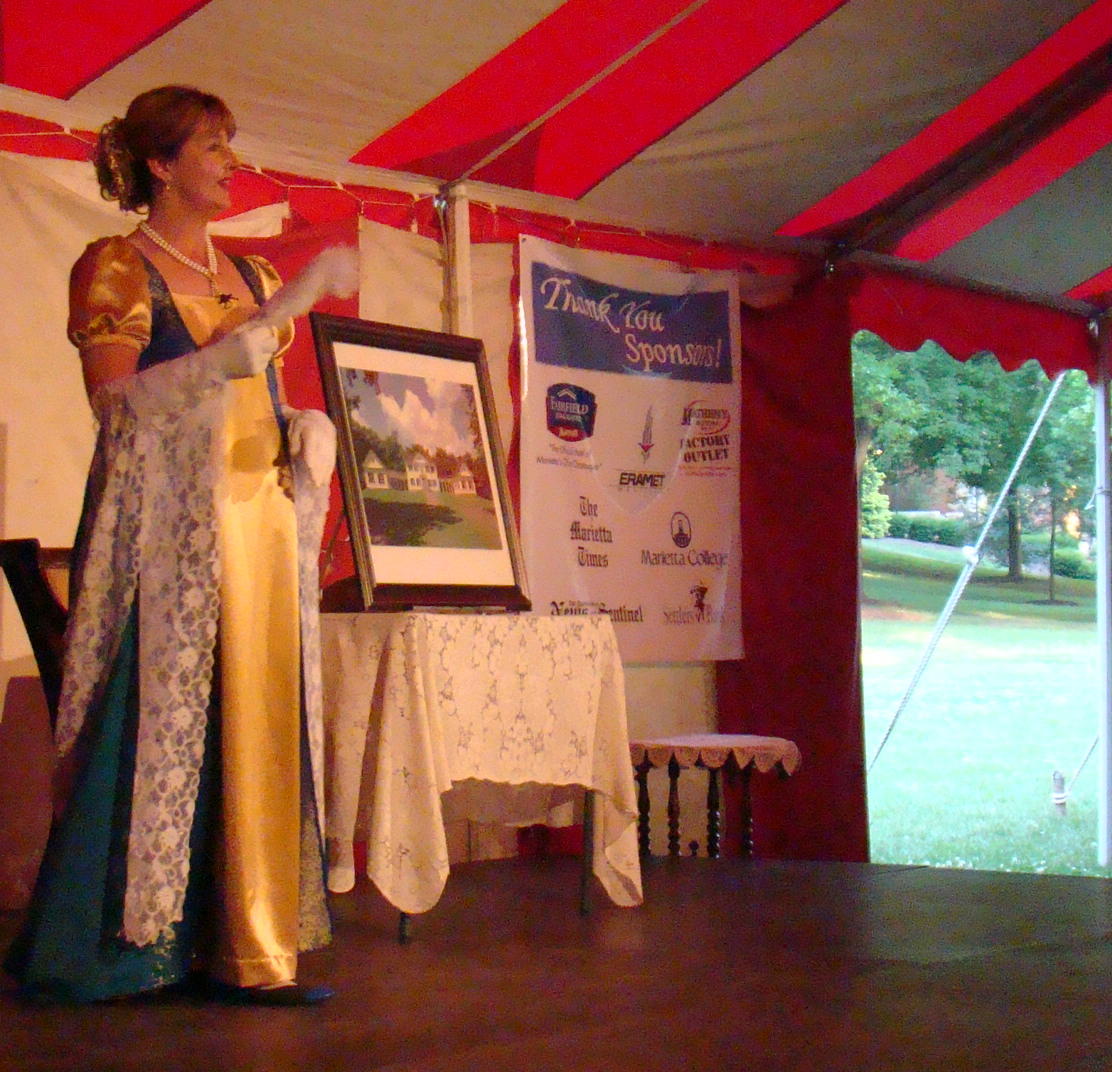
The aristocratic Margaret Blennerhassett was the first historic character for  “When Ohio Was the Western Frontier”, the theme for  2012 Ohio Chautauqua in Marietta, Ohio on the campus of Marietta College.  She received a warm welcome as temperatures soared to near 100 in the red and white striped tent.

Margaret’s story continued with their search for a place to built their new home, and ultimate discovery of  a beautiful tree covered island in the middle of the Ohio River. Margaret thought this would be the perfect place for the elegant home she had in mind so they bought half of the island, approximately 180 acres, for $4500.

One corner of the island was cleared of the huge trees so the mansion would appear as a pearl against green velvet as the boats passed by on the Ohio River. Here they built a luxurious twelve room mansion that had thirty-six glass windows, something not common at that time of log cabins with tar paper windows. Two covered porticos flanked the main house leading to its two appendages: Harman’s office and the summer kitchen.

Not only was the house a beautiful spot but there were acres of gardens and a greenhouse where citrus fruits grew all winter long. There was even special shrubbery trimmed in the shape of the original thirteen colonies.  Margaret especially enjoyed riding her white horse, Robin, over the island appearing as an exotic bird in her scarlet riding cape and feathered hat. Yes, more was definitely better.

But their happy life was short-lived here on the spot they called Blennerhassett Island. Some compared it to the beautiful Garden of Eden, but both seemed to have a snake that spoiled their pleasure. This time it was a snake in the form of Aaron Burr that wanted something forbidden.

Margaret said that Aaron Burr was a genius who applied to college at the age of eleven and graduated from Princeton at an early age. Burr was a very handsome man who loved fine things especially when procured through other people’s money. After a tie in a presidential election between Thomas Jefferson and Aaron Burr, the recount made Jefferson the President, and the loser, Aaron Burr, the vice-president. Things did not start out on a good foot here, and Burr was more than a little dissatisfied.

In 1805, Burr visited Blennerhassett Island for dinner as he was curious about the eccentric foreigner … or perhaps he had heard of the money Blennerhassett had available to “invest” in his plans. Burr led them to believe that this was an easy way for them to increase their fortune.  These events took place at a time when the Blennerhassett funds were running low.

Margaret felt that Thomas Jefferson was the real serpent that crawled into their Garden of Eden in order to destroy them. There was a lot of animosity between Jefferson and Burr.  Margaret said that Jefferson was not the wonderful president that many thought he was.  She felt the Louisiana Purchase was illegal, and while considered an inventor said he only had invented two things: a wheel cypher secret decoder and a plow. Thomas Jefferson was said to even cut parts out of the Bible that he didn’t like or wish to follow in his life. It was quite obvious that Margaret did not have fond feelings for President Jefferson.

Jefferson tried to destroy Aaron Burr and by association, Harman Blennerhassett. He attempted to use his power to have Burr found guilty of treason.  However, Chief Justice John Marshall stood up to Jefferson, and the jury found Aaron Burr not guilty. Burr and Blennerhassett were both released from prison.

By this time, their house on the island had been looted with most of the fine things being carried off. The remainder of the items were sold at auction to pay off debts accumulated by the Blennerhassetts. In 1811, their beautiful mansion was burned to the ground. At this point, the Blennerhassett family fell into hardships and eventual poverty for the remainder of their lives.  Their hopes and dreams were shattered.

Debra Conner’s portrayal of Margaret Blennerhassett was outstanding. Debra actually spent much of her youth in the Marietta community and graduated from Marietta High School.  Often during the year, she presents similar programs to the area schools on both sides of the Ohio River as part of their Ohio or West Virginia history curriculum.

2012 Ohio Chautauqua continues throughout the summer with week long performances and workshops in Urbana (June 26-30), Gallipolis (July 17-21) and Warren (July 24-28).  Hope you find time to join them and learn a little more about “When Ohio Was the Western Frontier”.

Colorful Hot Air Balloon Festival Up, Up and Away

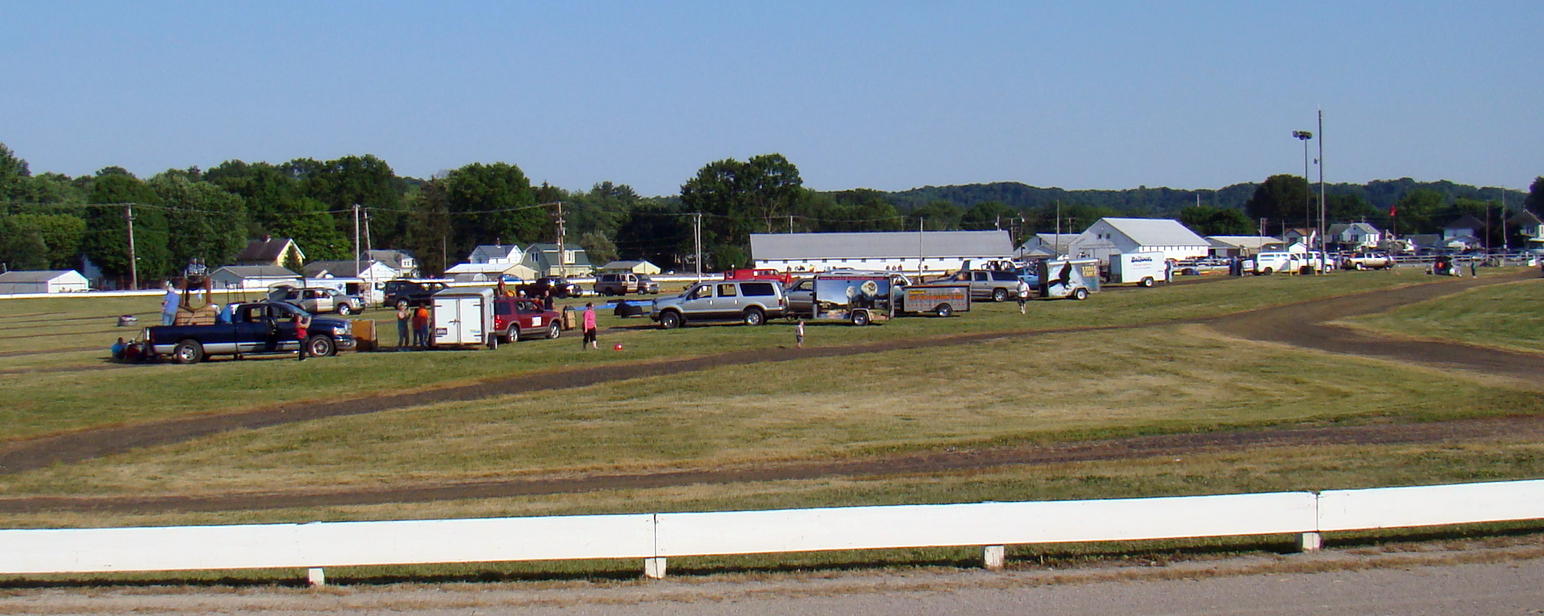
“Up, up and away, my beautiful, my beautiful balloon” could be the theme song for any hot air balloon festival.  Even though there wasn’t a chance to hit the skies personally, it still was a pleasure to watch the colorful balloons take to the air at the 31st annual Coshocton Hot Air Balloon Festival. The scene in the middle of the Coshocton Fairgrounds doesn’t appear very exciting at first glance…just filled with trucks and trailers. But this would all change before the evening was over.  This scene could occur at two times of the day since just before sunset or near sunrise are the best two times for flying.

Seems that man has always wanted to fly! The first hot air balloon ascended way back in 1783 in France.  The Montgolfier brothers, paper manufacturers, created a special balloon using a combination of linen and paper. Capturing the magical smoke from the fire, they were able to  lift a basket, for about fifteen minutes, carrying animals: a sheep, duck and rooster. At Coshocton Fair Grounds, the Montgolfier name lives on through a business called Montgolfier Balloon Gift Shoppe, where you can find everything imaginable for the balloon enthusiast.

The father of modern day ballooning, Ed Yost, made the sport more practical by building the balloon from nylon, later taffeta, and heating the air inside with a propane burner. The Balloon Works developed a parachute valve so the amount of air inside could be controlled to vary altitude and even land. Rattan wicker baskets carry pilot, passengers, propane tanks, and equipment needed to control the balloon. A variometer shows vertical speed, a digital temperature gauge reflects balloon and air temperatures, and an altimeter tells how high the balloon is above sea level.

In the center of the track is a flag pole with a red flag hanging, which indicates the launch isn’t ready to proceed. Sometimes shows must be cancelled if weather analysis determines there is either not enough wind to fly or if the wind direction is constantly changing. But tonight the wind blows favorably and the crowd cheers as the flag is changed to green. It’s  time for the men to start blowing up the balloons with their handy propane tanks. Anticipation is the name of the game as each balloon is stretched out on the ground, slowly filled with gas, and finally launched into the sky.

Out in the countryside, two targets have been placed to make the evening a little more challenging. Whoever comes the closest to these targets will receive the highest score. Just being part of this spectacular balloon launch would be reward enough. Approximately twenty balloons headed for the hills to see where they would land, which basically depends on where the wind takes them. The only real control the pilot has is to either make the balloon ascend or descend by controlling the heat in the balloon.

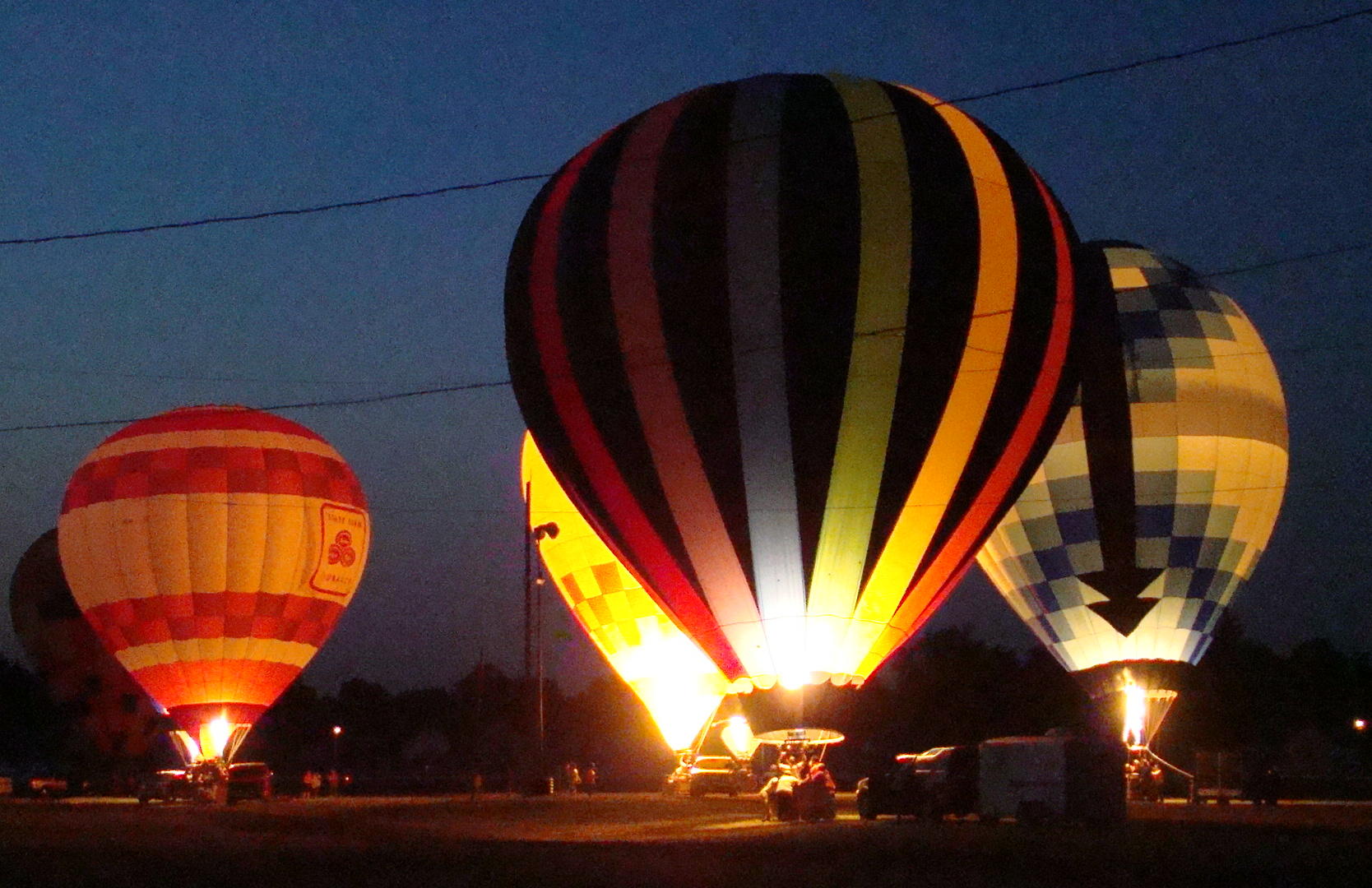
At dusk,  a special Night Glow lit up the evening sky while the balloons were anchored instead of being launched. This spectacular sight is created as the  hot air balloon burners illuminate the colorful fabrics of the balloons against the twilight sky. Only six groups participated in the finale here, but displayed some beautiful synchronized lighting patterns.

The only way this day could have been more spectacular is to have been riding in one of the baskets below the hot air balloons. Perhaps someday you can experience the thrill of soaring through the air as there are places in Ohio. such as Hot Air Balloon Rides, that have some pretty exciting trip packages. Look for a hot air balloon launching wherever you happen to live or visit.

The Irish, in typical tradition, added this toast to hot air ballooning, which describes the journey very accurately:

The winds have welcomed us with softness.                                                                           The sun has blessed us with it’s warm hands.                                                                         We have flown so high and so well                                                                                             that God has set us gently back                                                                                                           into the loving arms of mother earth.        

Come fly with me!. As you soar into the air like a bird on the wing and feel the touch of the air on your skin, relax and enjoy the serenity of this beautiful adventure.

Every June, The Coshocton Hot Air Balloon Festival is held at the Fairgrounds in Coshocton, Ohio. Coming into Coshocton on Route 36 , exit at Roscoe Village then proceed over the bridge on Chestnut Street past the courthouse. Make a left turn on 7th Street and after several blocks you will arrive at the Coshocton Fair Grounds on the left side of the street. 

Mysterious Bigfoot Legend – Skeptic or Believer?

“Absence of evidence is not evidence of absence.” This quote from distinguished astronomer, Dr Carl Sagan, is popular with Bigfoot investigators. They are still searching for more clues that will prove their Bigfoot theory.

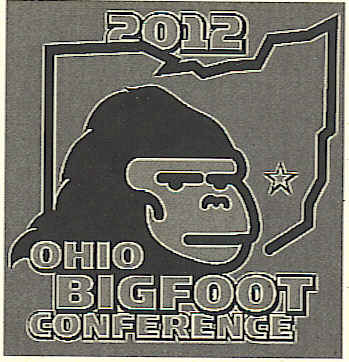
Guernsey County, Ohio is one of those “hot spots” for Bigfoot investigators.  Annually, the Ohio Bigfoot Conference gathers informative speakers to share their adventures with the gathering crowd.  The 2012 conference was held at Pritchard Laughlin Civic Center near Cambridge, Ohio after previously being held at Newcomerstown and then Salt Fork Lodge. The move was partially made to accommodate the growing attendance as last year at Salt Fork they overflowed the conference room and many were  forced to watch the program on big screen TVs in the lobby.  The Bigfoot enthusiasts have increased from less than a hundred in 1989 to over seven hundred at present.

The goal of the Ohio Bigfoot Organization is to find, recognize, and protect what many believe to be an unclassified primate, commonly known as Bigfoot, and residing in North America.

A highlight of the meeting this year was the appearance of legendary Bigfoot seeker, Peter Byrne, who fascinated visitors in the lobby with his Bigfoot stories. Peter, the star of the show, has led professional expeditions in search of Yeti and Bigfoot.  His book, The Search for Bigfoot, tells of his fascinating life exploring since 1946 in the Himalayas for Yeti, the Himalayan version of Bigfoot.  Even though he is 86 years old, Peter still has a curious mind and continues his search for Bigfoot on the Oregon Coast.

Before the scheduled speakers, curious visitors checked out tables in the lobby with lots of unusual items. Of course, there were videos of possible sightings as well as plaster casts of large footprints left behind by something or someone. Lengths of these footprints average about 16″ long, but some range up to 22″, and are much wider than a human footprint.

Soaps and lotions carried the name Sasquatch, the Canadian Bigfoot rendition. One popular soap made in Canada bore the title Sasquatch Sweat Soap – Guaranteed not to grow hair. Sasquatch Sweat Cream was also available. Not certain if their purpose was to repel or attract Bigfoot.   There were even cookies for sale shaped like…yes, you guessed it, Bigfoot.

The first speaker of the day was past president, Don Keating, who led this conference for 23 years. He first heard of Bigfoot in 1984 from a story in the Newcomerstown News that told of strange sightings of a large, hairy creature in and around the Newcomerstown area. Later Don began investigating some of the unusual sightings he heard from neighboring Guernsey County as well – glowing red eyes, large footprints, and very tall creatures.

Salt Fork Lake area became one of those places where frequent strange events seemed to occur. Often something eerie seemed to be happening at Hosak’s Cave in the late evening hours, especially when there was a full moon.  For their safety, people were even strongly advised to leave the area by park rangers.

When Don Keating said he was leaving his president’s position to devote more time to his weather research, someone in the audience asked an interesting question: “Do you find predicting the weather a lot like investigating Bigfoot?” To which Don answered, “With both, you put your neck on the line.”

Grabbed a Bigfoot cookie to munch while listening to additional speakers which included: Dr John Bindernagel, wildlife biologist; Bill Draginis, surveillance and security expert; and Mike Esordi, crypto zoologist with artistic abilities. All are active in Bigfoot research and frequently share their knowledge through lectures around the world.

Whether you believe in the existence of Bigfoot or not, you could hear some interesting adventures at the conference. Maybe some evening you will want to spend the night at Salt Fork State Park. If you listen carefully, you might hear strange calls, branches breaking in the woods, or rocks being thrown into the lake. Could these sounds be made by Bigfoot?  Keep your eyes and ears open!

Salt Fork State Park is located just five miles north of Cambridge, Ohio just off Route 22. I-70 and I-77 intersect close by so you will have easy access to the area.  While in town, stop at Mr. Lee’s or Theo’s Restaurant as both have delicious home cooked meals at reasonable prices.

Relax at Salt Fork State Park

Warm weather in Ohio sends people outdoors, even on an overcast day.  One of their favorite spots near Cambridge in southeastern Ohio is Salt Fork State Park, Ohio’s largest state park. This lake is a rather recent creation and those past fifty can still remember when farm land covered this area with  Salt Fork Creek running through it. Back in 1967, the earthen dam was completed here and the filling of the lake began.

Vacationing at the lake has many possible accommodations: camping, renting a cottage or staying at the lodge. The campground sites all supply electrical hook-ups and nearby is a heated shower house.  Only a few sites provide sewer and water hook-ups as well. If you prefer a cottage, several are available with hillside and lakeside locations.  All of the cottages are completely furnished with a screened-in porch, and even include kitchen utensils.

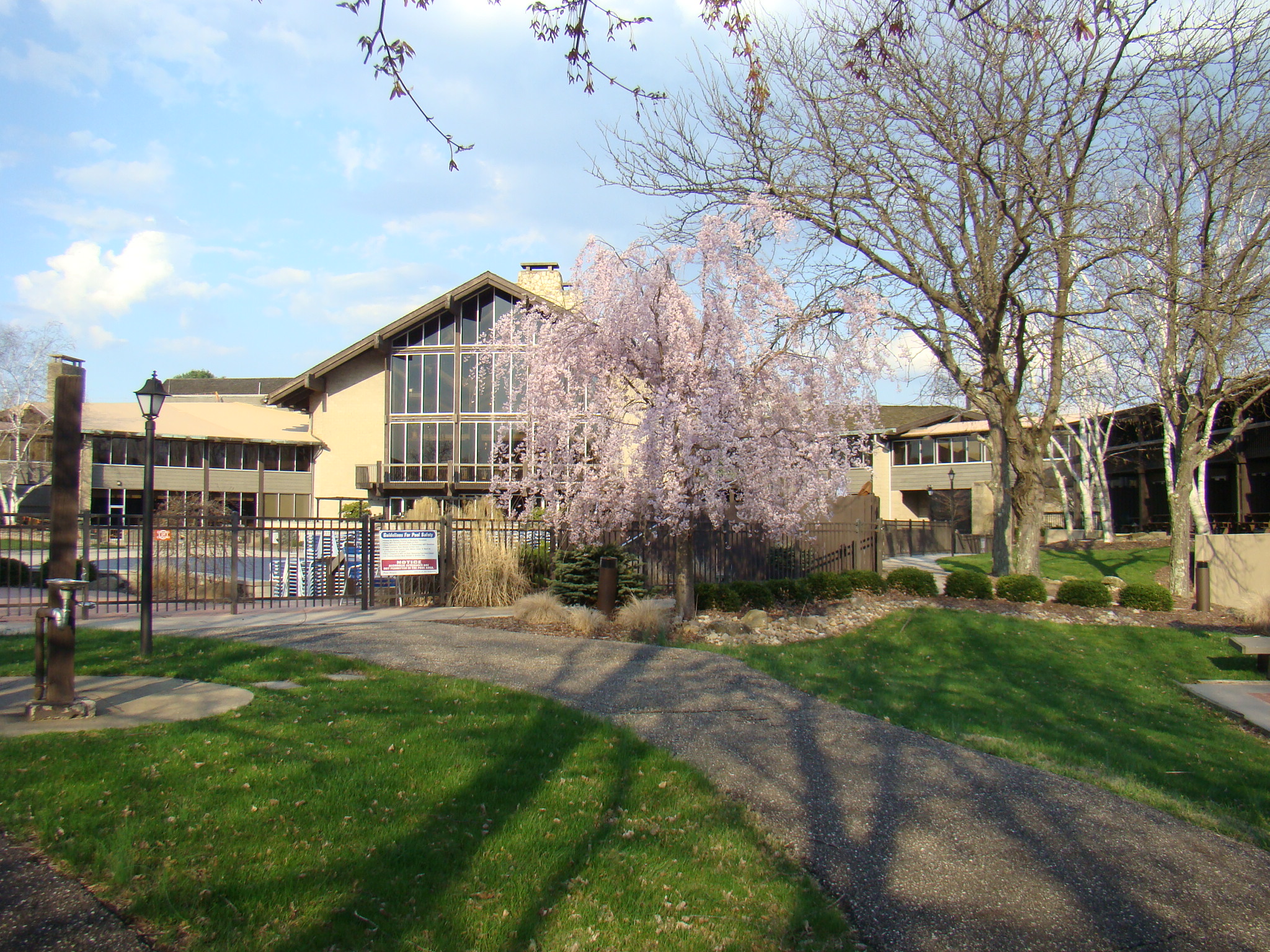
Others prefer the comfort and convenience of Salt Fork Lodge. This beautiful stone lodge with its pine beams sets high above the lake in the rolling hills of Southeastern Ohio. Frequently used for meetings as well as vacations, the lodge contains a wonderful dining area as well as beautiful stone fireplaces that give you a warm feeling no matter what the season. Indoor and outdoor swimming pools provide entertainment all year long. Outside you will find a fantastic playground for the youngsters as well as tennis, volleyball, basketball and shuffleboard courts, so there is little excuse for anyone to be bored.

Just a half mile down the road is the entrance to the 18-hole championship golf course, which is a challenge in these rolling hills so a golf cart is highly recommended.  Deer are frequent visitors on the golf course and don’t seem the least bit afraid of golfers. Here you will also find a pro shop, putting green, and driving range.

Of course, no lake would be complete without a beach and Salt Fork’s 2500 foot beach is one of the longest inland beaches in Ohio.  Everyone has plenty of room to enjoy swimming or building castles in the sand. When you want a break from the beach, stop by the concession stand, grab some clubs to play miniature golf, or tour the nice Nature Center in the main bathhouse building.

Two marinas provide storage for boats year round and some years you must get your reservations in early to claim a spot. Otherwise, ten easy access ramps   accommodate boat trailers.  No boat of your own? Be assured a variety of rental boats are available. There is even a pontoon tour boat to take you and your guests around the lake for an enjoyable time on the water.

Fourteen hiking trails range from easy to moderate in difficulty, so just about everyone can enjoy the hike. One popular trail leads to Hosak’s Cave formed by interesting rock layer erosion, which has also created small waterfalls. Along the path you will find beautiful wildflowers, hear the songs of many birds and relax to the calming sound of the bubbling brook. If you are lucky, a wild turkey might cross your path or even a deer.

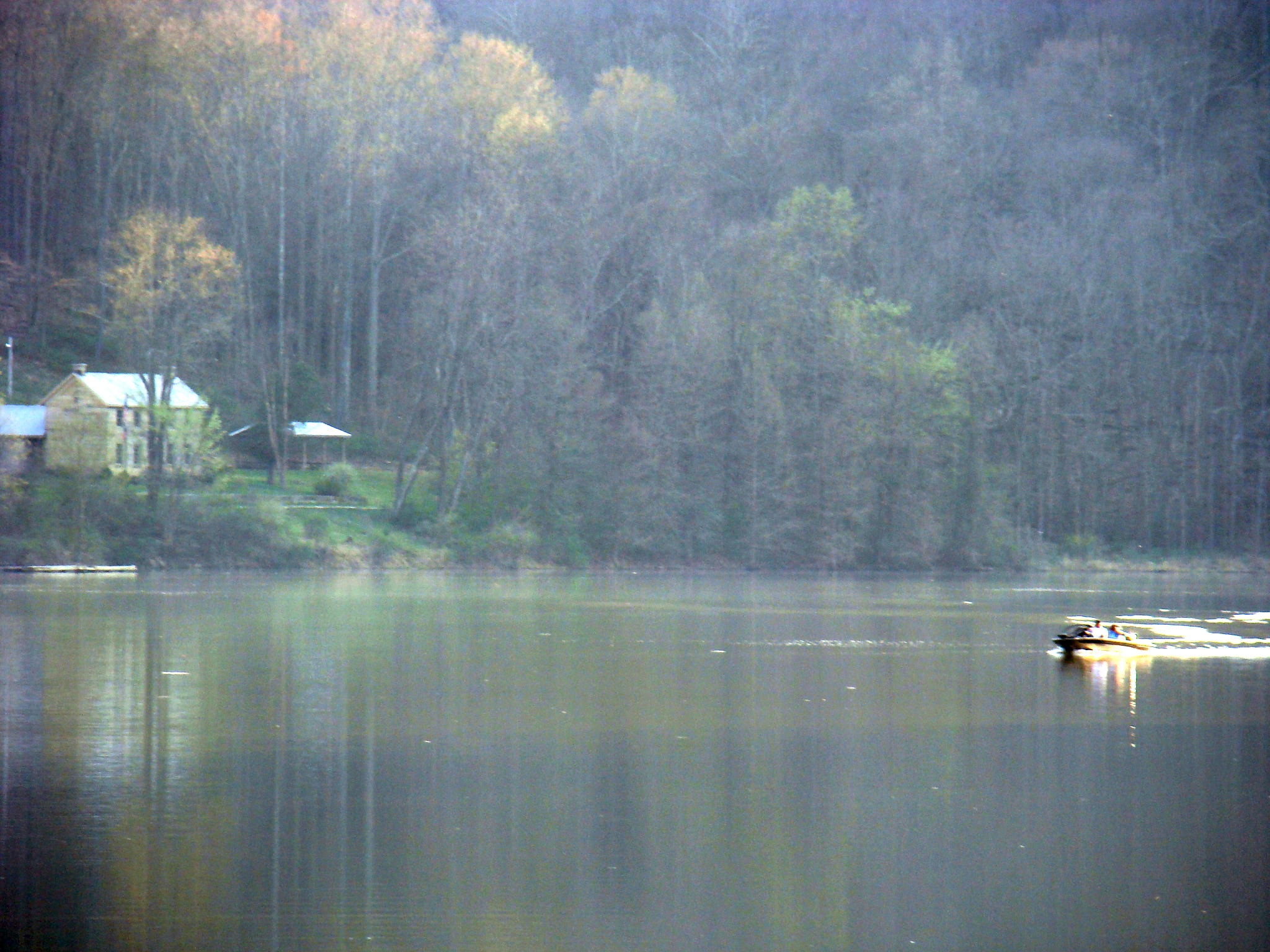
A longer trail leads to Kennedy Stone House where they have restored the only house left standing when Salt Fork Park was created.  This historic stone structure was built in 1837 through the plans of Benjamin Kennedy of Ireland. Stones used were quarried from the hills nearby and shaped with detail so they fit tightly together to make a sturdy structure that still stands after 175 years. Original cost was only $600, which was quite a bargain even long ago. Recently a road has been cut down to the house so you can now drive there also, but most find it more exciting to approach from the trail or even from a boat.  Call ahead and see if you can schedule a tour.

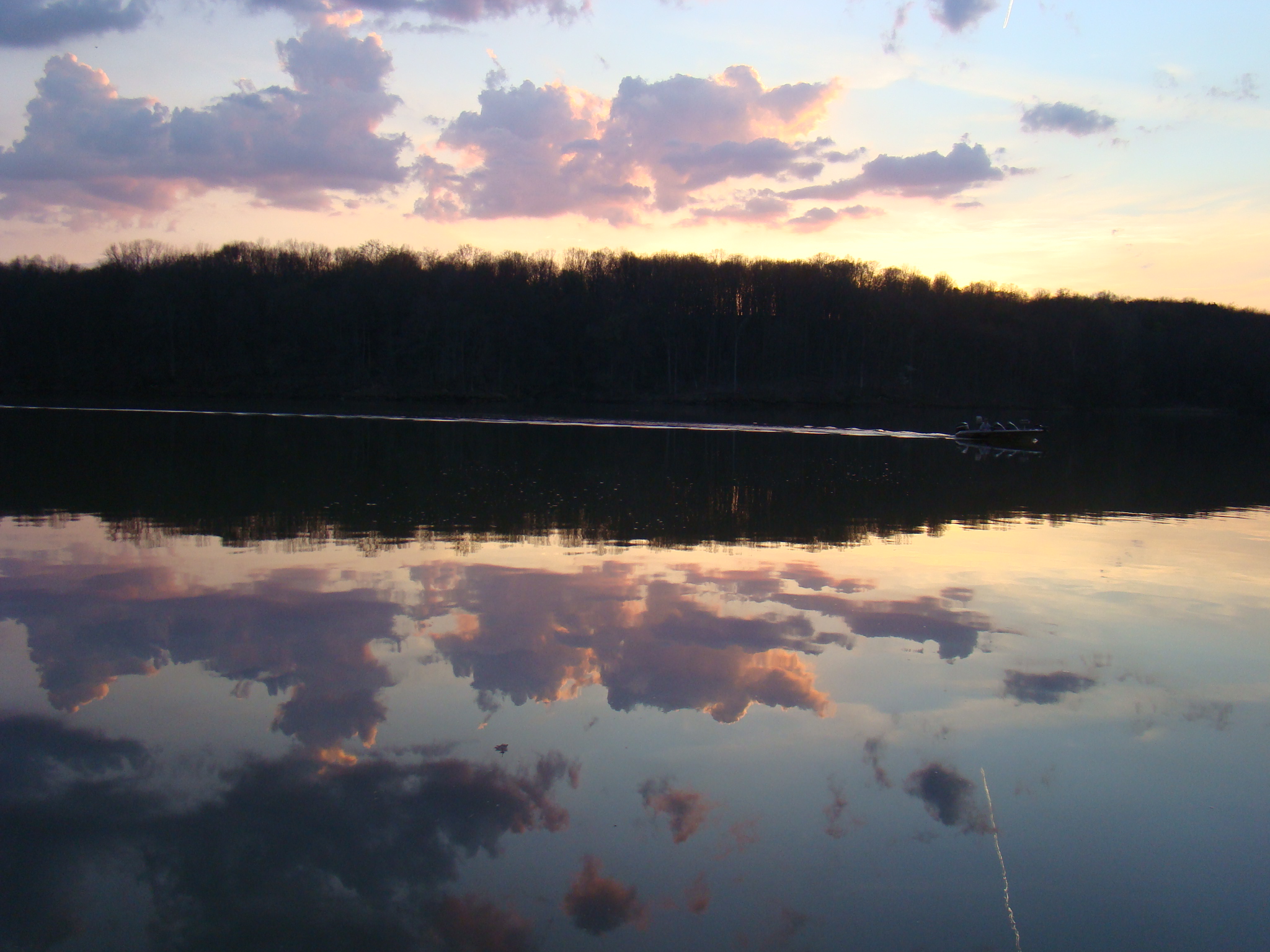
Sunsets are always beautiful over the water and Salt Fork Lake is no exception. What a great way to end the day or begin the evening.  Salt Fork State Park is a fun filled place for a family vacation as it has varied activities for all age groups. If you are lucky enough to live in the area, enjoy a day at the beach or a ride on the lake anytime. The lake is also a great place to do nothing – just sit by the water and watch the waves from the boats passing by, or the motion of tree branches blowing in the wind.  Relax and enjoy!
Salt Fork State Park is located just six miles north of Cambridge, Ohio on Route 22. Once you turn left into the main entrance of the park, watch for wooden signs along the way that lead you to the various places of interest.