Places to go and things to see by Gypsy Bev

Archive for the ‘Uncategorized’ Category

Great Western Schoolhouse Keeps One-Room School Memories Alive

Reading ‘Riting and ‘Rithmetic, the three Rs, were the basics taught in those early one-room schools that stretched across Ohio in the 1800s. Not many are still left standing today but those that are, hold special memories and can teach us lessons from another era.

Great Western School

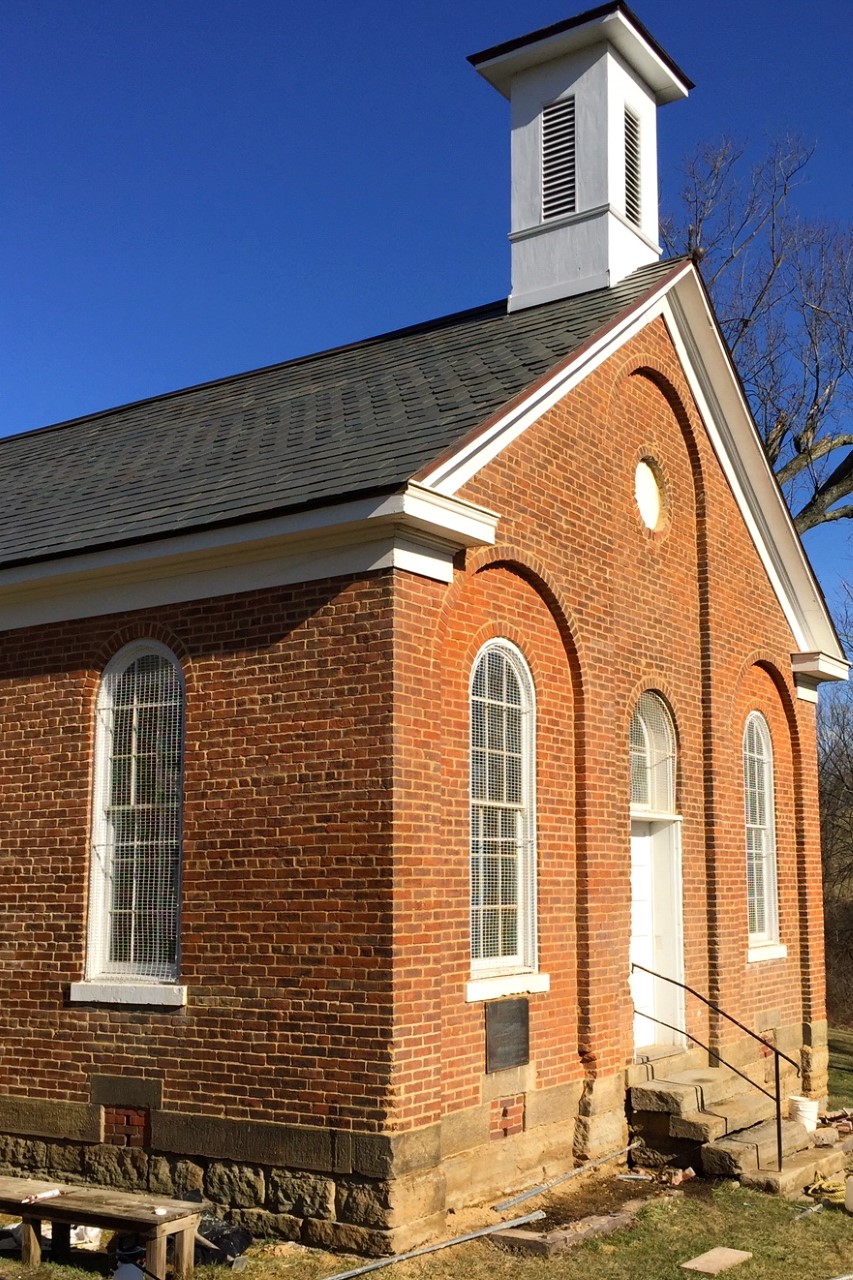
On the campus of Ohio University-Eastern near St. Clairsville, Great Western Schoolhouse has been restored for just that purpose and still stands in its original place 150 years later. Back in 1870, this school was built by Clark Construction Company of bricks made from the clay found on the banks of a nearby farm pond. The walls are three bricks thick with roughly 30,000 bricks used. It was proudly named for the first steamship, “The Great Western” which crossed the Atlantic in 15 days.

During those early days, attendance was not required but encouraged nevertheless. Most of the time, there were eight grades in one room taught by one teacher. Classes were often held from October through April, a time when students were not needed as frequently for farm work.

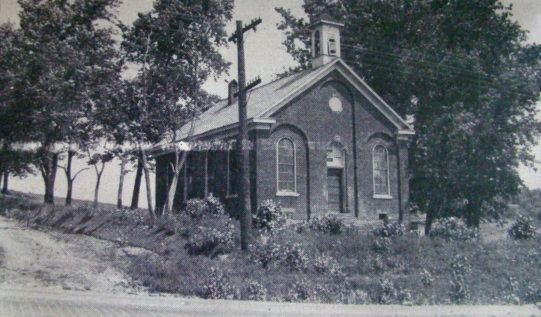
Great Western School - 1940 when brick road ran below it
The brick Old National Trail ran below the schoolhouse in 1940.

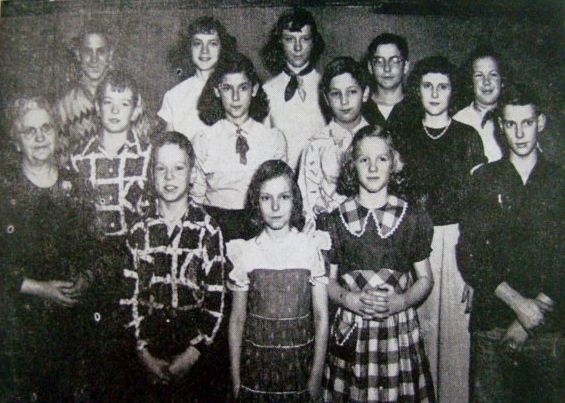
Great Western School was continually used until 1952. It is one of the very few one-room schools still standing on the National Road. Ohio University-Eastern uses this school to help students and children understand the schools of pioneer times.

These students were the last class to attend Great Western School.

In 1975, Dr. Robert Bovenizer of Ohio University asked the National Trail #348 of International Questers to consider restoring the building. They receive donations from former students and area residents as well as the use of grant money to complete the restoration project. An open house was held in 1976 during our country’s bicentennial.

Great Western - Finished Repairs
Repairs on the brickwork of two sides of Great Western School have been completed.

Improvements continue to be made each year. Recently a new tin ceiling was installed in the school, and the interior walls were restored and painted along with some of the schoolhouse benches. This considerably brightened the classroom. Two sides of the exterior brickwork were restored last fall and look wonderful.

great-western-mrs.-skaggs
Mrs. Skaggs taught at Great Western for many years.

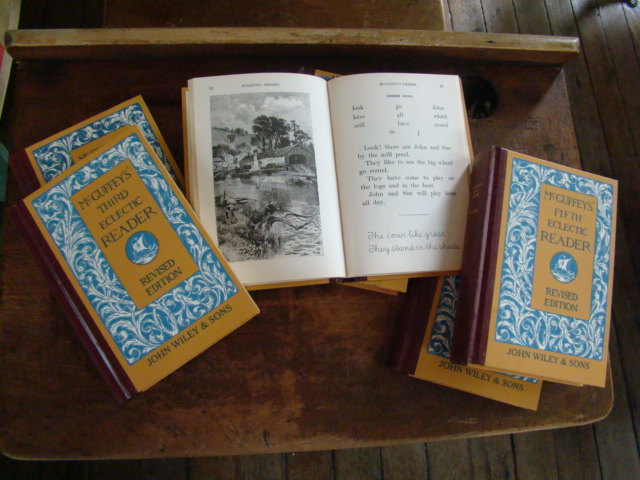
The school still has recitation benches, chalkboards, McGuffey Readers, the original schoolmaster’s desk, two outhouses, and a potbelly stove which was fired by the stronger male students. The wooden students’ desks were donated by another school.

Ann Rattine, schoolmarm, teaches students

When Ann Rattine began teaching in St. Clairsville in 1976, she visited the newly restored Great Western Schoolhouse. Ann recalled, “When I stepped over the threshold, I thought this would make a nice field trip.” At that point, she became an important supporter of the school’s development.

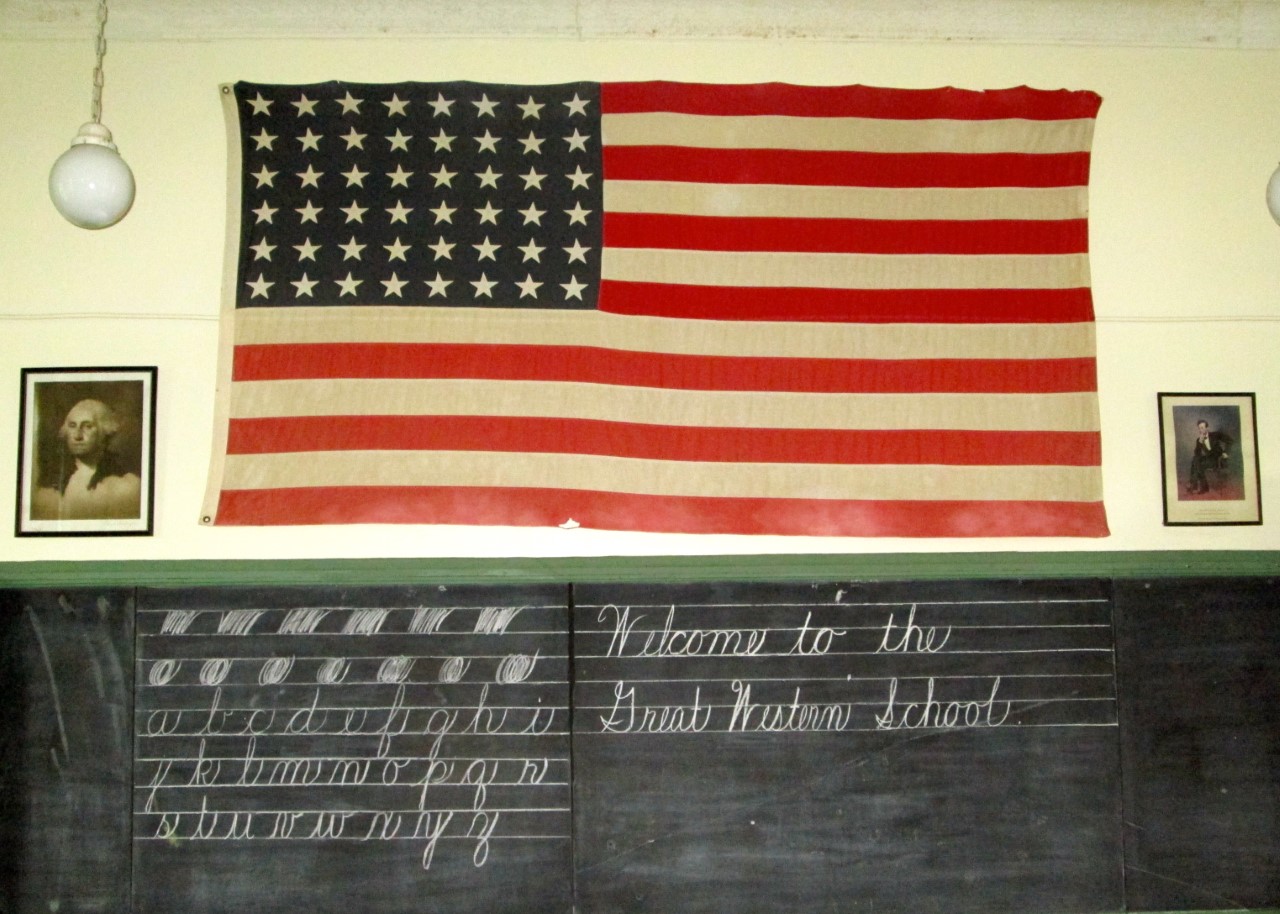
One-Room School Flag
Most one-room schools had a flag above the chalkboard as well as pictures of Presidents Washington and Lincoln.

When Ann retired, she accepted the role of schoolmarm in the restored school. Visiting groups spend most of the day at the school, beginning the day with the Pledge of Allegiance, the Lord’s Prayer, and a Bible story – all things that were done in those early days.

Great Western - typical child
This young lady appears as a typical child at a one-room school.

Large groups of children visit here each spring to have spelling and arithmetic lessons on the old-fashioned slates. Last year nearly 500 students attended. Students are introduced to the ‘dunce hat’, which originally was used if a student didn’t know his lessons.

McGuffey Readers were used by students at all grade levels.

Old-fashioned games are also played. A Spelling Bee gives a break from traditional studies. Outside students might play Jacks, Tug of War, Drop the Handkerchief, or LeapFrog.

One-Room School Desks
The schoolmarm keeps the school in perfect order.

Ann Rattine gives new meaning to the word ‘dedication.’ Not only is she the schoolmarm, but she also does all the jobs that a schoolmarm did at the one-room school. She sweeps the floor, cleans the desks with Murphy Oil soap to have them shining, and puts the classroom in perfect order. Even the pot-bellied stove shines, although it is no longer in use.

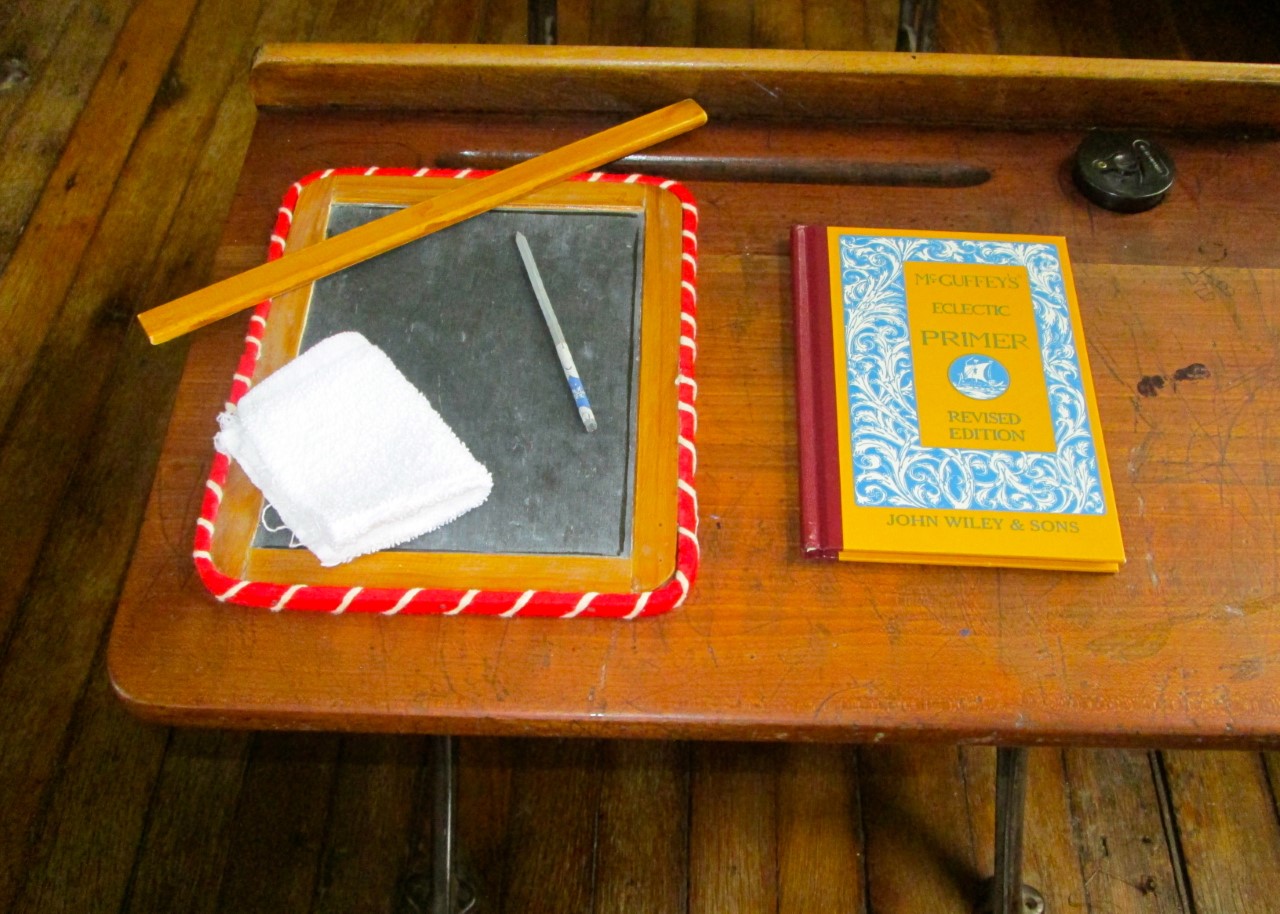
One-Room School slate and reader
A typical student’s desk would contain slate, chalk, eraser, and reader.

Former students are encouraged to reminisce about lessons learned, pranks played on teachers and other students, lunch boxes, and stories of how they got to school. Many remember the ‘hot school lunch’ provided by parents during the cold winter months. A large pot would be placed on the pot-bellied stove, and parents would contribute meat, potatoes, and vegetables. At lunchtime, students would fill their water cup with a dipper of warm stew.

Great Western School -Lentz Tavern front
Lentz Tavern, next to the school, provided a place to get water and also a place for teachers to get their room and board.

Drinking water had to be carried from the nearby tavern, where teachers often had their room and board. The water was poured into a large container at the rear of the class. Some students drank out of the same dipper, but most had their own cups to be used for water and stew. The boys often had collapsible cups in their pockets and would get a drink of water at recess from the pond.

Great Western 192 0
Students dressed their best for a 1920s class picture.

Christmas celebrations included the entire community, not just students and parents. This was always a grand occasion. Last Christmas, Great Western Schoolhouse took part in the Noon Rotary Tour of Homes in St. Clairsville to show community members how Christmas was celebrated in the one-room school. Decorations consisted simply of a Christmas tree and lanterns in the windows.

When folks traveled to school in their buggies, they would use a lantern to light the way. Once arriving at the school, those lanterns were set in the windows to give light to the Christmas celebration since there was no electricity. Decorations for the tree were made by the students and included strings of popcorn, homemade gingerbread men, and dried apple slices. 

Great Western School - Lesson Plans
The teacher’s lesson plan was divided into very short segments.

Perhaps you will want to pay the school a visit in 2020 when it celebrates its 150th Anniversary. If you have a group that would enjoy the experience of attending a one-room school at any time, please contact Ann at schoolmarm2009@gmail.com . You may also receive information by contacting Ohio University Eastern at 740-695-1720.

The modern schools are large and grand and beautiful to see,

But many love the country school treasured in memory.

~Helen E. Middleton

Great Western Schoolhouse can be found on the campus of Ohio University – Eastern just off I-70 at Exit 213 to Route 40. Turn left on US 40 West and the school will be on the right hand side.

Road Trippin’ in the USA at McPeek’s Mighty Maze

If you want to get lost, McPeek’s Mighty Maze is the perfect place with Roadtrippin’ USA as the theme of their corn maze for 2020. Located at the Coshocton KOA Campground on County Road 10, it’s more than just a maze. They have many activities that those young at heart from 0 – 99 will enjoy.

This all began in 2015 after Ryan McPeek had purchased a campground near Coshocton and was trying to create something extra that campers and area residents would enjoy. A corn maze came to mind.

That first year was a learning year and a busy one for Ryan as he married Camille in August. They spent their honeymoon at McPeek’s Mighty Maze! This was a new experience for both of them as they had never created a corn maze before.

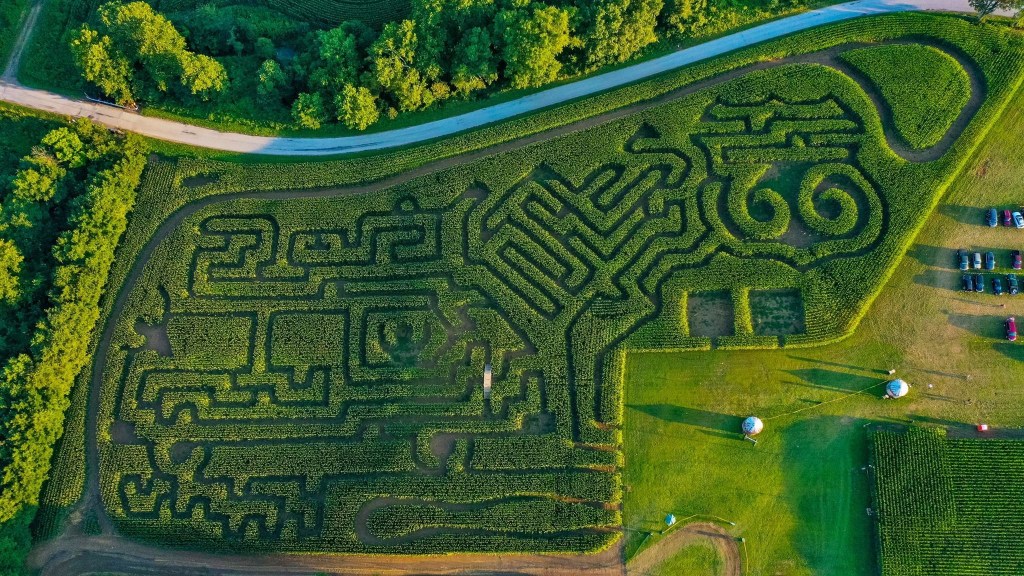
The entire Mighty Maze is shown in this overhead view.

The maze is more difficult to create than you might think. First, Dave Phillips of Maize Quest draws the maze for the year. After the corn is planted by Brian Mason in the spring, about July 4 the maze is created while the corn is knee-high, young, and tender making it easy to cut down.

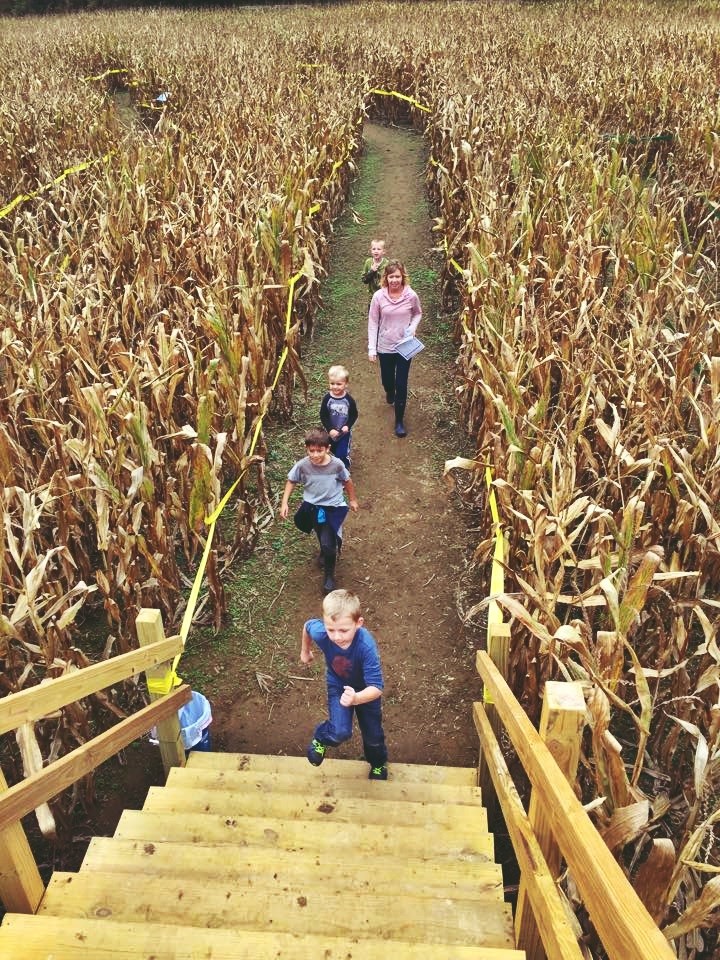
Climb the steps to the platform for a great view of the maze.

Tim Day of Maize Quest then arrives with his tractor, rototiller, and GPS unit. Phillips’ Road Trippin’ USA maze is placed into the GPS and the tractor cuts out the maze in a few hours. Day is very busy as cuts about sixty corn mazes each year around the country.

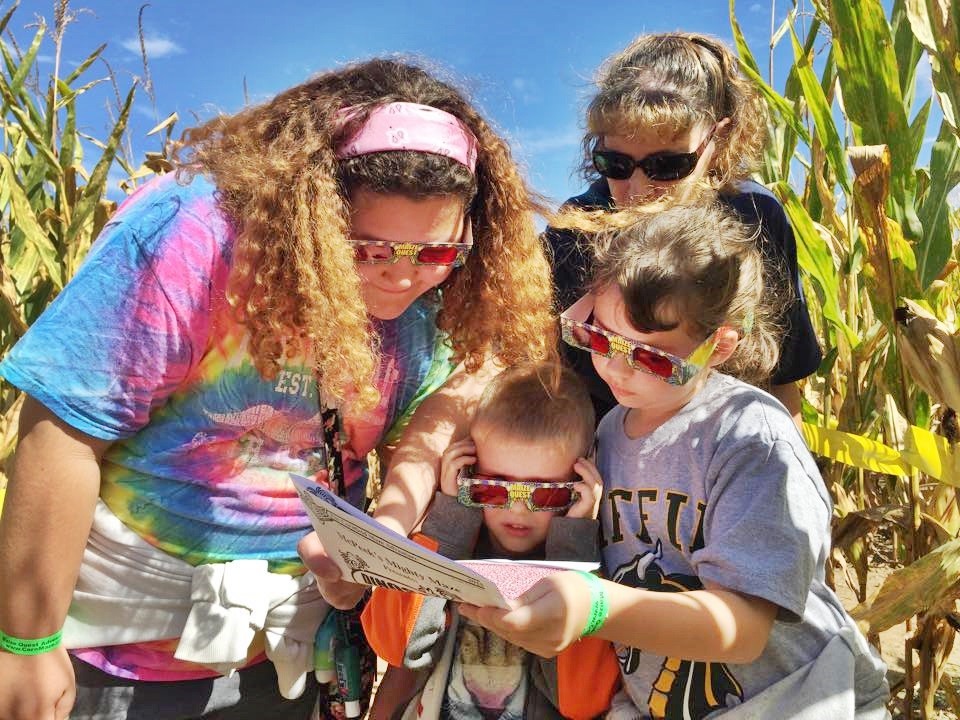
Maize-O-Vision glasses help you see a special map of the maze.

Since the pandemic has made traveling on vacations a bit more difficult this year, the maze takes the shape of Road Trippin’ USA . You can take a fun road trip right here in Coshocton. The Route 66 logo is in one corner of the maze. Another section features a camper and you’ll find a few mountains along the edge.

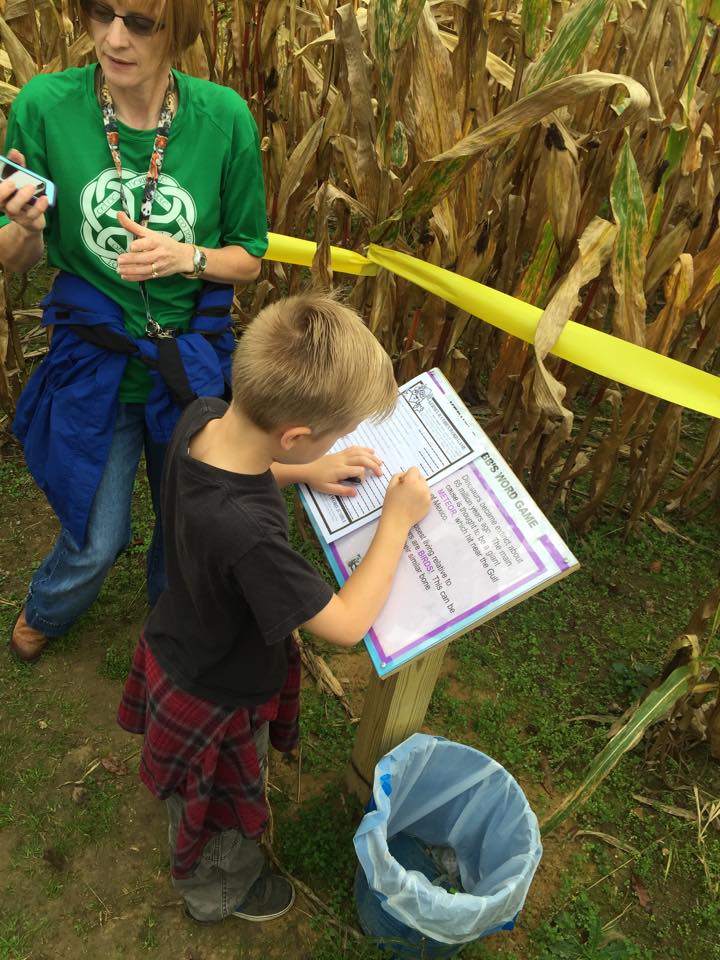
Along the way, you’ll find stations to help you explore the USA.

At the end of August, holes were drilled to set up nine game stations. Colored ribbons were placed along the miles of pathways inside to help people find their way. Each section has a different color ribbon to help people know where they are. While at this giant corn maze you will learn a bit of history as you play the games and travel through the cornstalks for answers. Play Word Game and learn about 18 different National Parks.

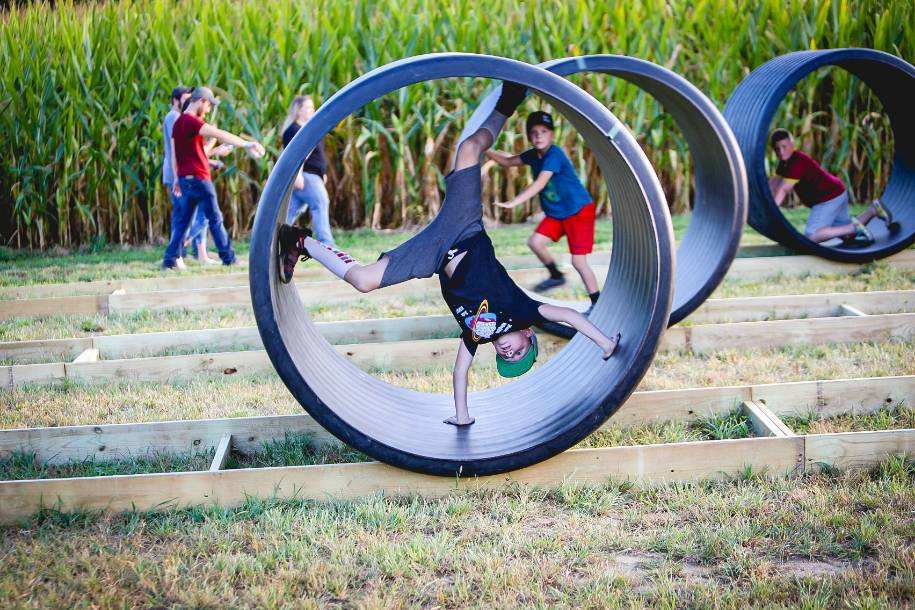
Enjoy the challenge of the Rat Wheel – similar to what a hamster might use.

There’s also a Kid’s Corn Maze for little ones who don’t want to get too lost. Cornelius M. Quest’s Picture Find has children discovering nine Ohio animals hidden at picture stations inside the maze.

McPeek’s Giant Corn Maze is the best place to get lost in the stalks for the 6th season. Enjoy a tasty treat from their three food carts – mini donuts, ice cream, and special favorites like hot dogs and french fries or lumpia and chicken fried rice.

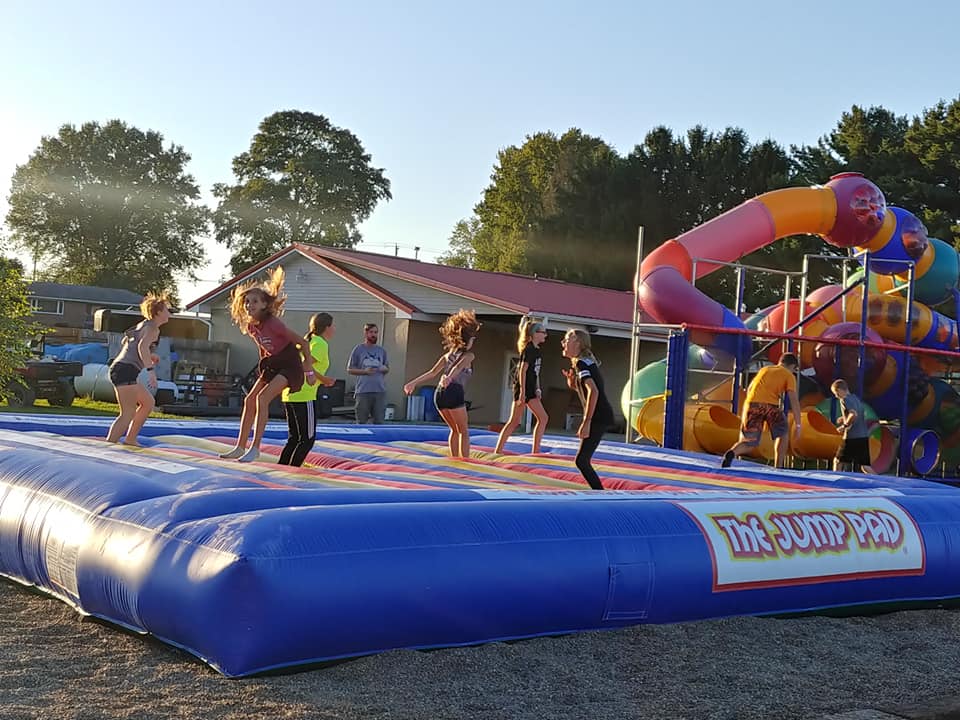
The Jump Pad is the perfect place to use up some extra energy.

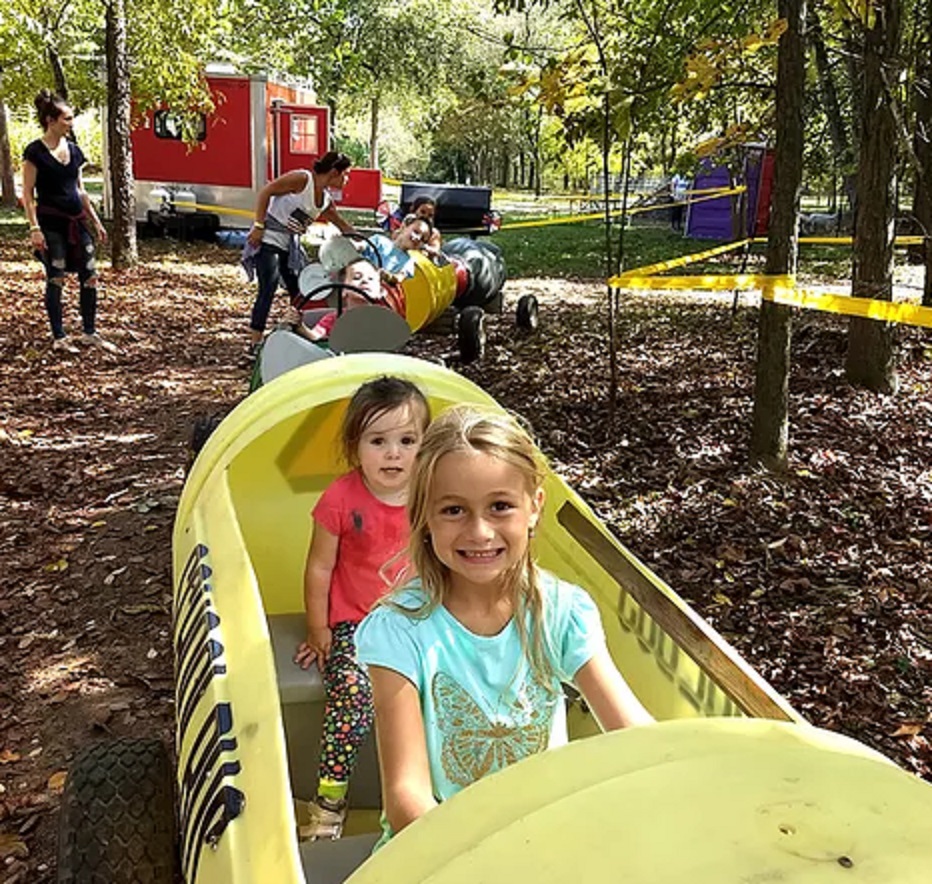
There’s all kinds of Fall Fun available as well as the maze. Their giant Jump Pad will have you bouncin’ for joy. Or you might try your luck in a Rat Roll, which is similar to a hamster wheel. Even adults have fun with these! There’s also a Barrel Train ride for the youngsters. Don’t forget all the pumpkins.

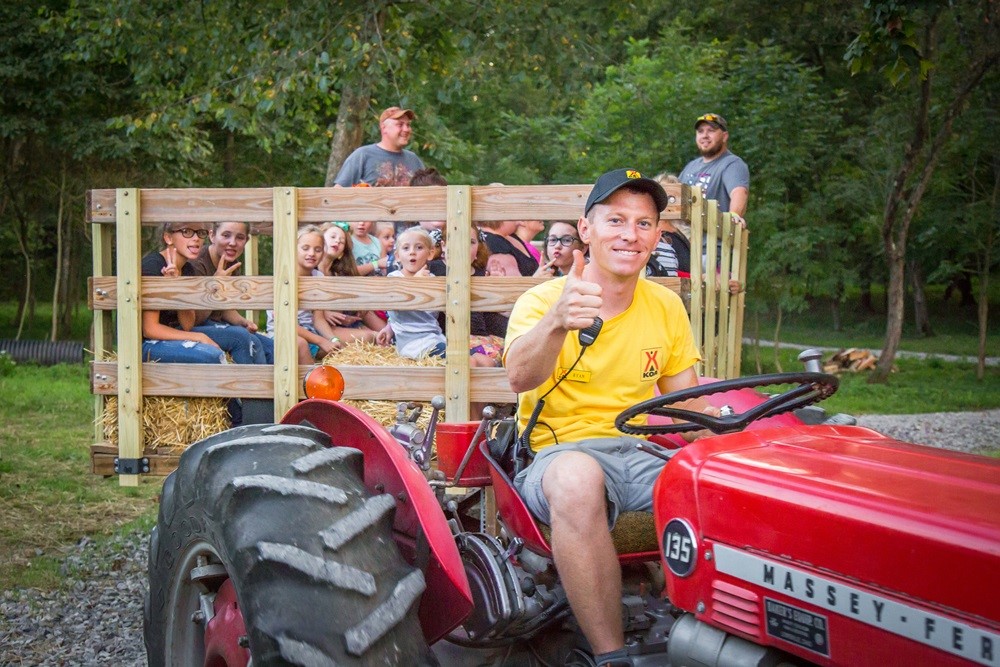
Ryan McPeek enjoys driving the tractor for the hayrides.

A hayride winds through the corn maze as it heads to the top of Mt. Everest. Seating will be limited for each ride to assure social distancing. Some traditional events will not be held this year due to pandemic guidelines. The corn box is closed as well as the playground.

Have a different kind of experience at Flashlight Night, which was held earlier this season. Imagine the darkness surrounding you as the cool night breeze moves the cornstalks with eerie sounds. Be sure to pick up a map so you don’t get lost for the night. Take a Glow Hayride that same evening. You’ll have to come back another year for all the fun!

The barrel train ride is great fun for youngsters.

McPeek’s Mighty Maze will be open four weekends in October on Saturday and Sunday from 12 – 6 so plan ahead for a time of family fun roadtrippin’ through the corn or maybe gettin’ lost in the stalks.

Ryan and Camille will help make your adventure a memorable one. Check their website for further information and additional events at www.mcpeeksmightymaze.com or visit them on Facebook.

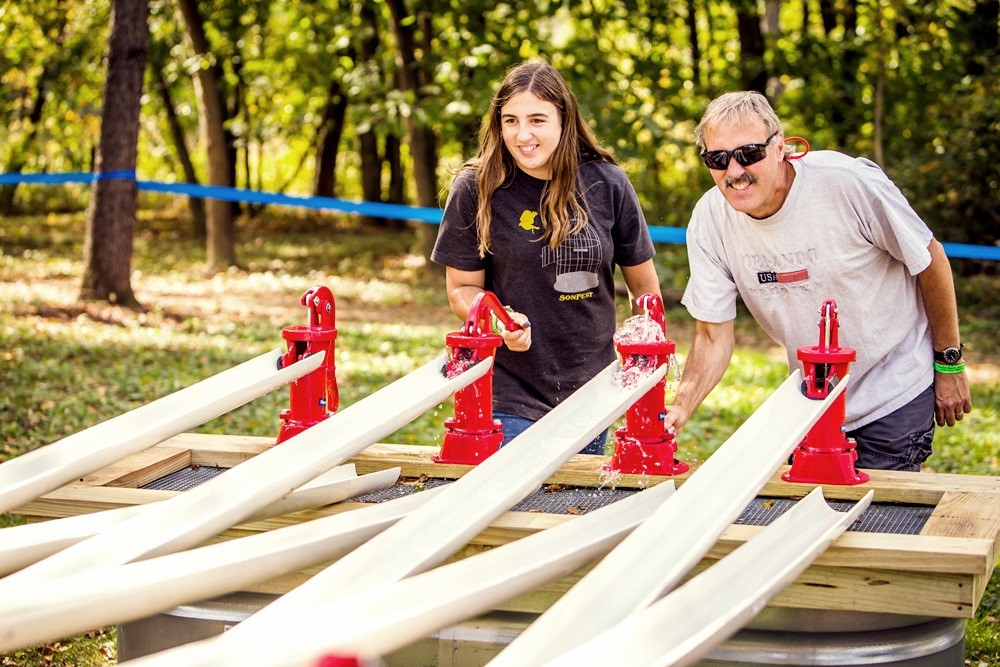
All ages enjoy the Duck Race to see whose duck will win the water race.

Admission at the gate is $10 per person with children under 2 free. If you register online ahead of time, admission is $8 per person. Staying at the KOA Campground in Coshocton gets you free admission to the Mighty Maze and a chance to enjoy the night air sitting around a campfire.

Sounds like Roadtrippin’ USA could be great fun for everyone at McPeek’s Mighty Maze. Get lost in the stalks!

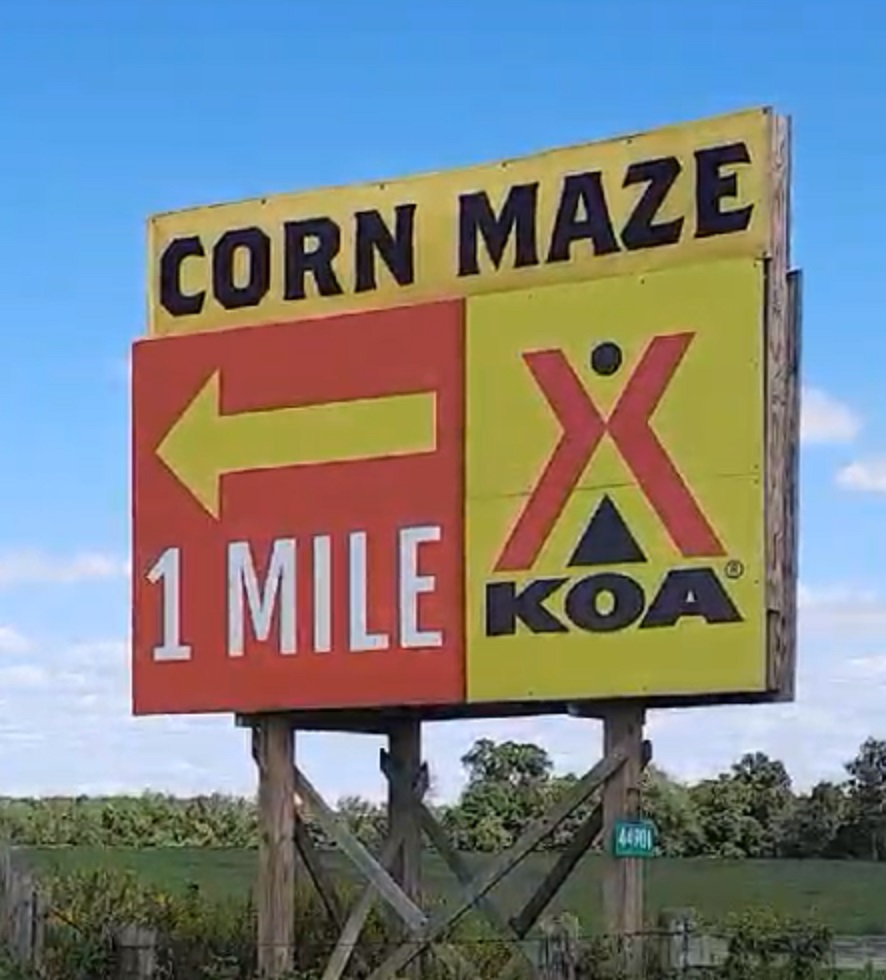
​McPeek’s Mighty Maze is located at the Coshocton KOA Campgrounds on County Road 10 just east of Coshocton. You can’t miss their signs!

Marbles Made in America at Marble King

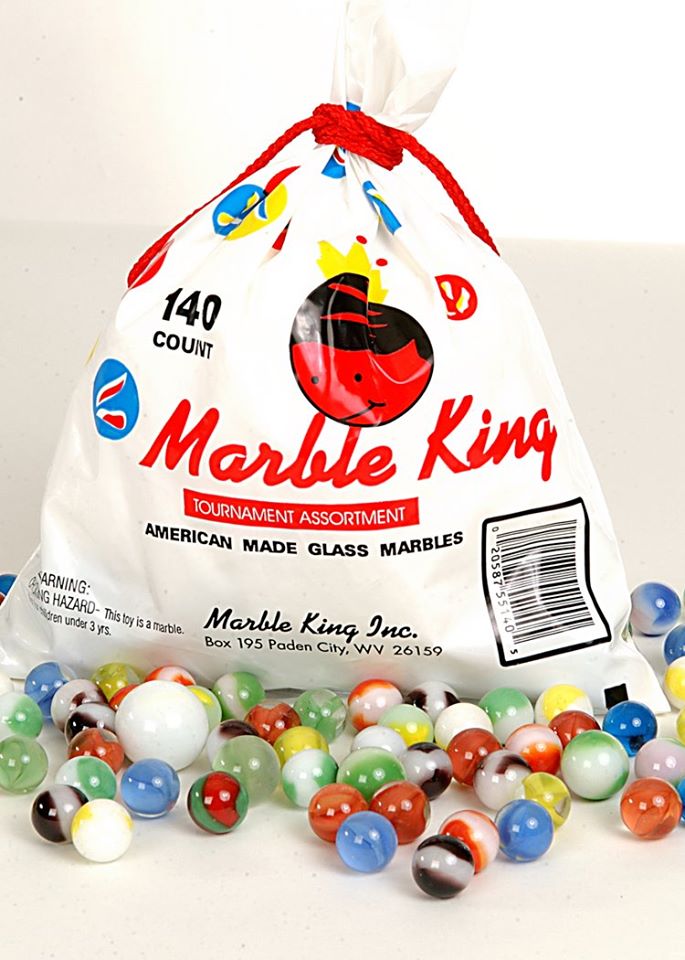
Marlbe King bag of marbles    Many will remember going to school with your bag of marbles so you could join a game at recess. Someone drew a large circle on the playground, participants knuckled down, and the game began. Each player had their own special shooter marble which was usually their largest marble. Mine had a light blue swirl.

   The goal was to shoot a marble outside the circle. You then kept that marble for the rest of the game. Then students either played “for fair” in which marbles were all returned to their owner or “for keeps” – no explanation needed.

Marble King Berry

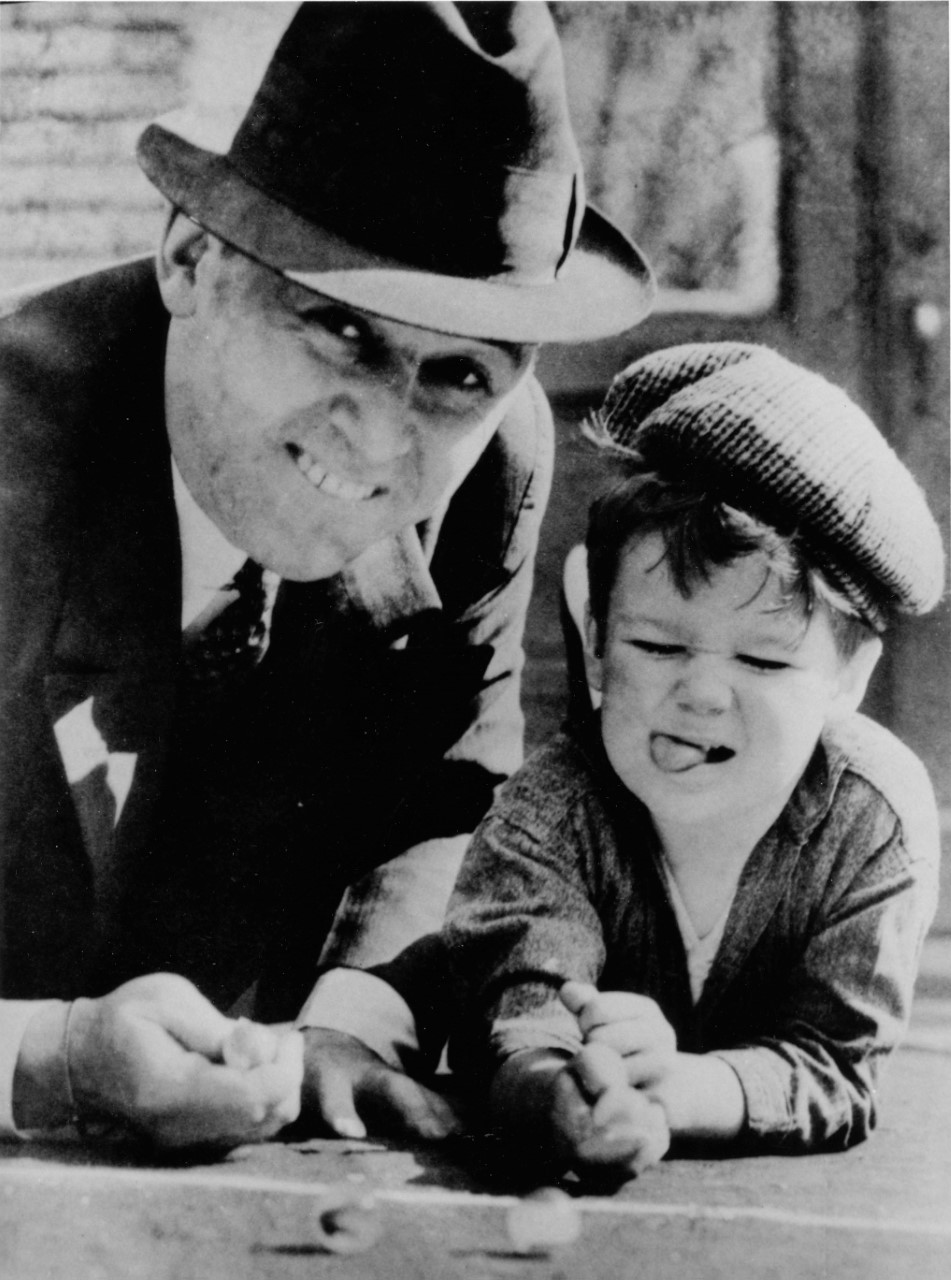
“Marble King” Berry Pink began selling marbles in the 1930s.

   Someone had to make those special marbles and this is their story. It all began in the 1930s when Berry Pink was selling marbles manufactured by Peltier Glass. By the 1940s, Pink was selling more marbles than Sellers Peltier could produce so they decided to combine their talents of manufacturing and salesmanship in a new company.

   Berry Pink gave away marbles as he traveled around the country hosting marble tournaments. He became known as the “The Marble King” to the children along the way. When the company was founded in 1949, Marble King seemed a fitting name for this new organization.

Marble King Building

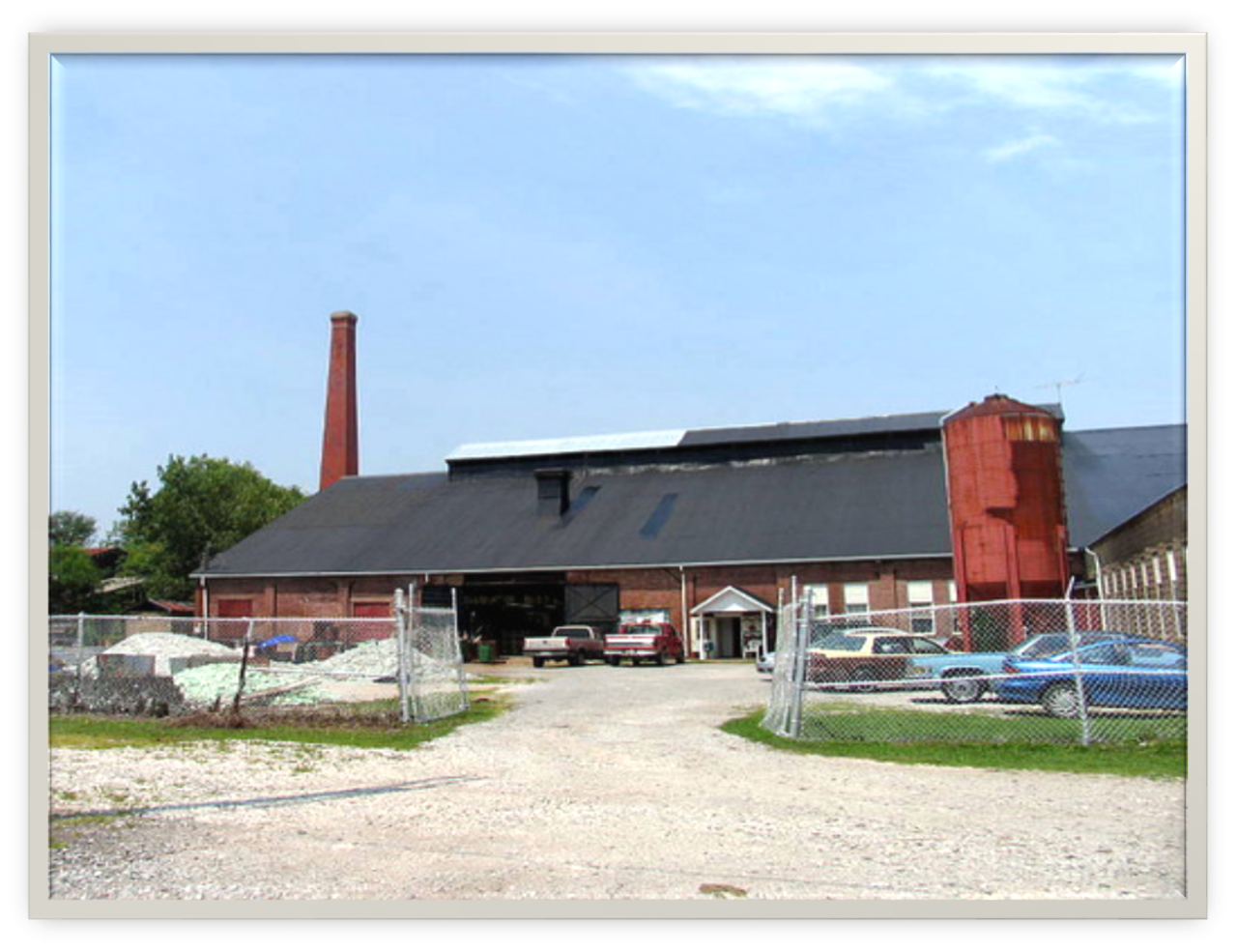
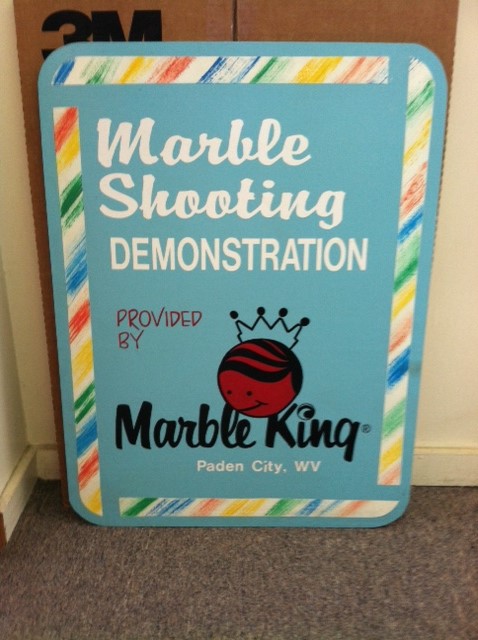
The marble factory is located in Paden City, West Virginia.

   At that time the company was located in St. Mary’s, West Virginia. But in 1958, a fire destroyed the factory and the manager, Roger Howdyshell moved the plant to Paden City where it remains today.

Marble King Dad

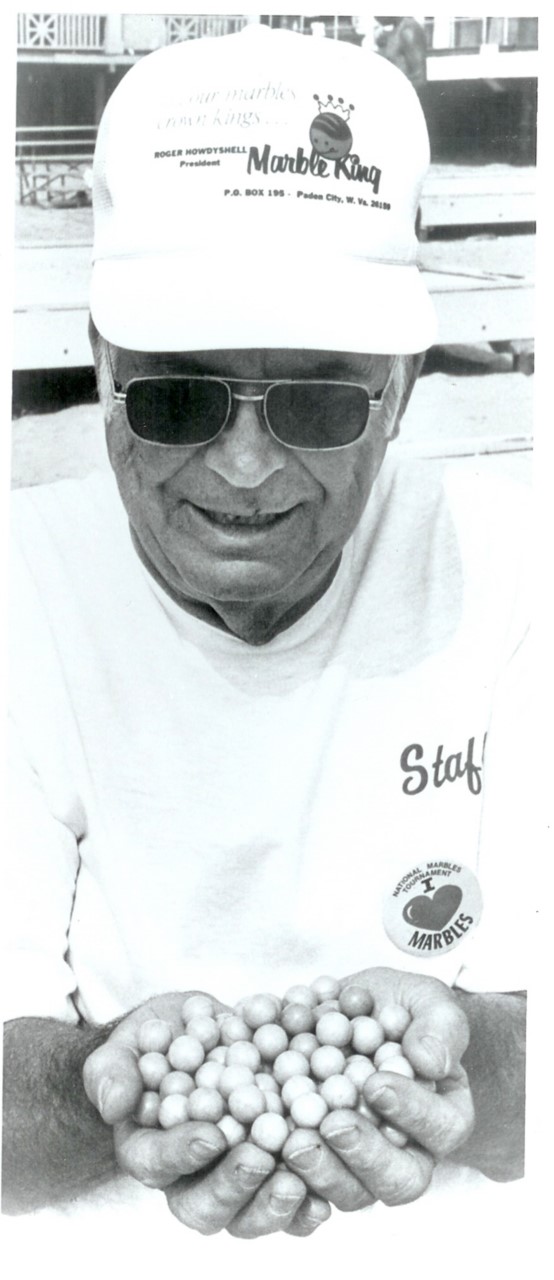
When he was manager, Roger Howdyshell purchased Marble King in 1963 and his family still owns it today.

   Howdyshell left his mark on the marble industry in several ways. He led Marble King to the top of marble manufactures when he designed the first American made Cat’s Eye marbles. In 1983, Roger Howdyshell purchased Marble King and dedicated his life to making it a success. While Roger died in 1991, the Howdyshell family still operates Marble King and carries on that fine tradition set by Roger.

Marble Rollers

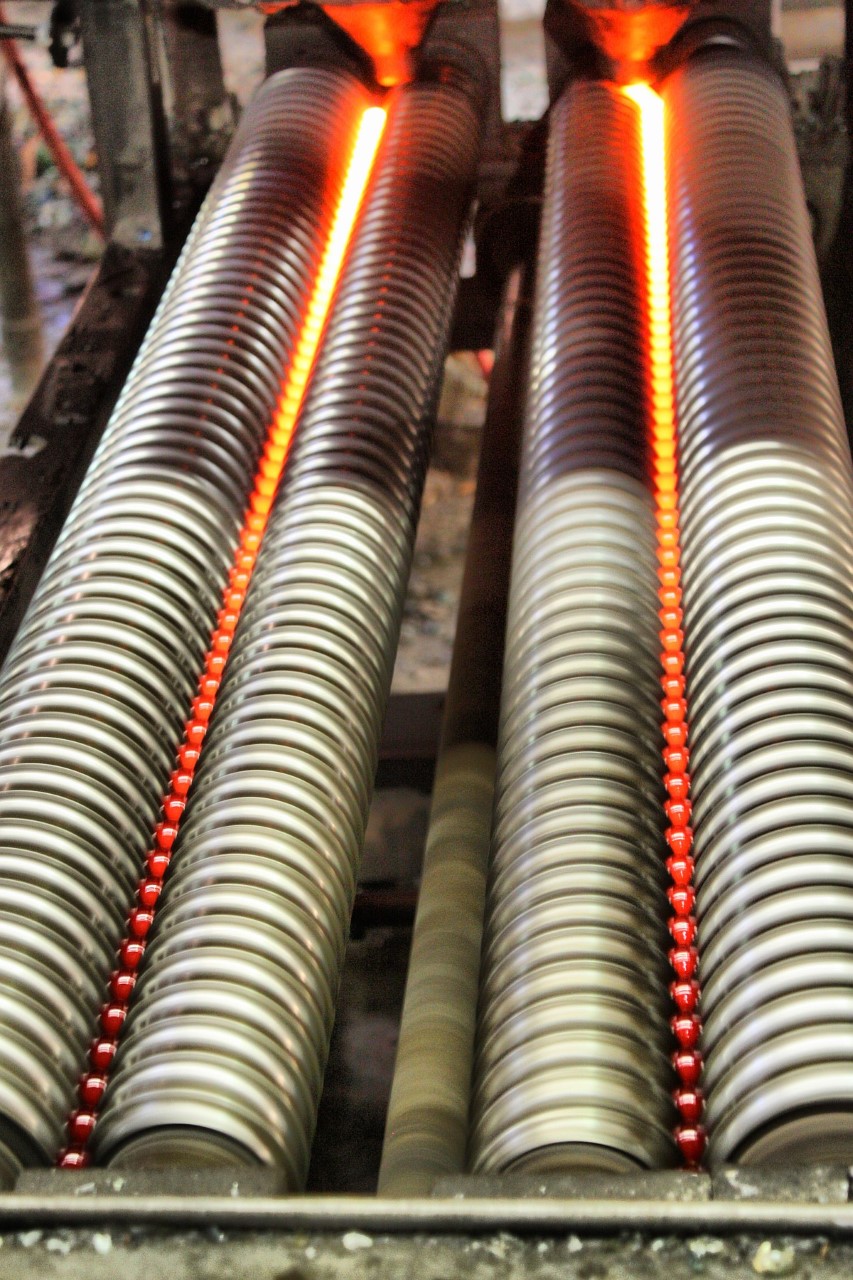
Hot glass is cut into small pieces and rolled into marbles.

   Today, Beri Fox presides over Marble King, the only factory in the United States that manufactures marbles. She was named for Berry Pink and worked at Marble King with her mom and dad all of her life. On summer vacations from college, Beri worked in the family business.

   At that time, most marbles were used in games and toys for companies like Mattel and Ideal. But when video games became popular, Marble King had to make the transition to other uses for their beautiful glass gems. Now, marbles are being used in floral designs, jewelry, architecture, and industrial applications.

Marble King Walt filling the furnace

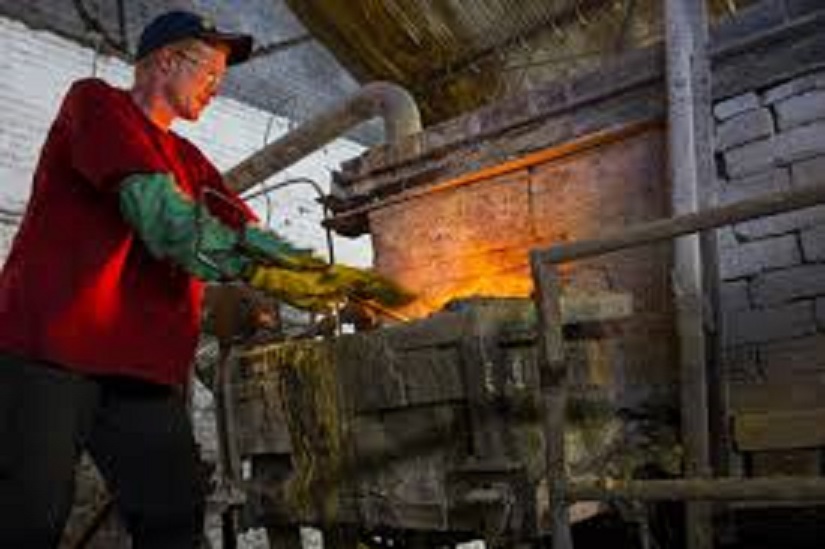
Wal Lancaster fills the furnace with recycled glass.

   Beri explained, “You can be a broken piece of glass and we can transition you into something new again.” 90% of their marbles are made from cullet glass, which is scrap glass melted down for reuse from several area glass companies. They can make a million marbles a day when in full production.

Marble King Champions

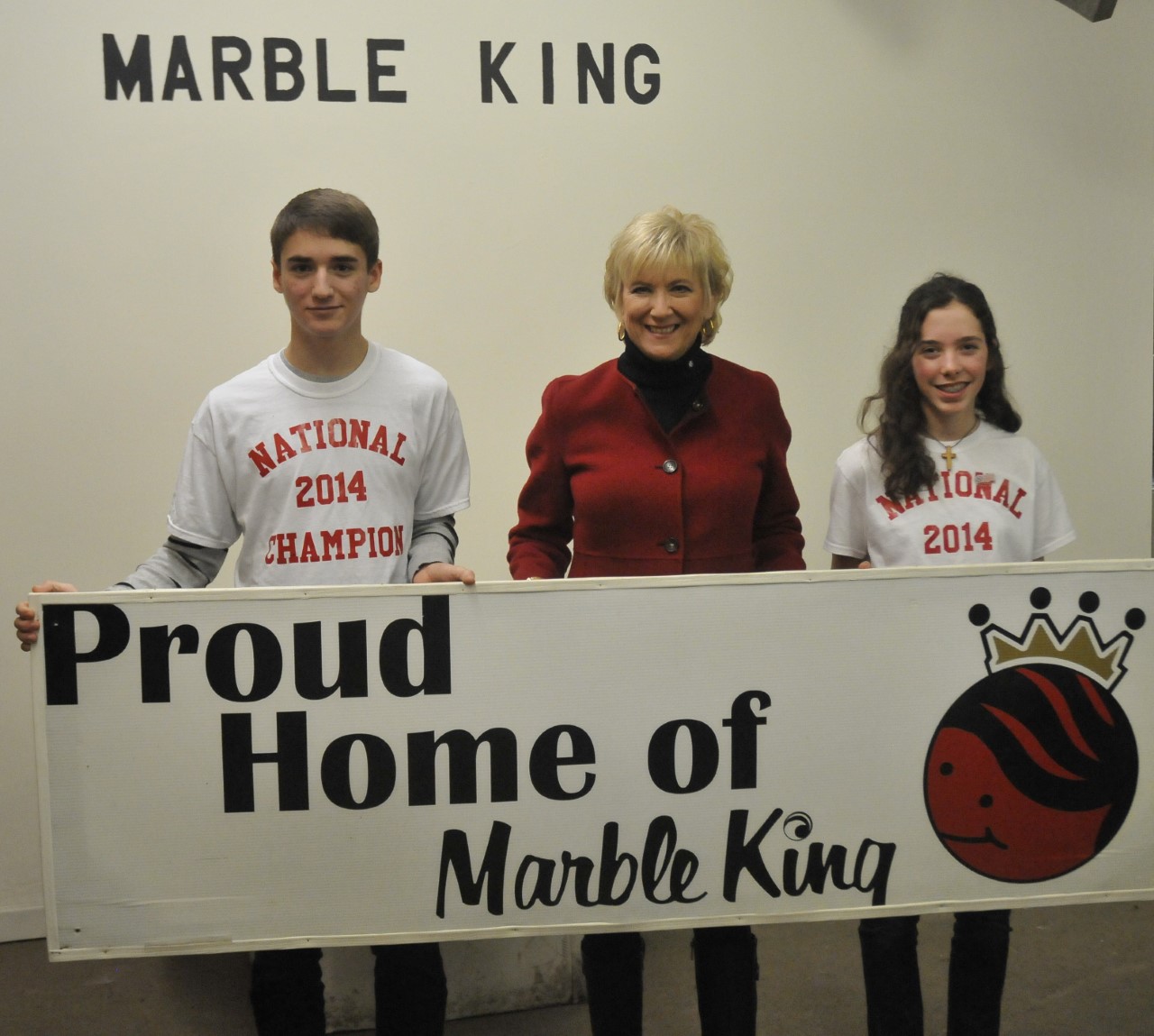
National Marble King champions visit with Beri at the factory.

   This is a frequent stop for tour buses and school groups as they come to learn the history of marbles and have fun along the way. The gift shop includes a 12-foot ring like the one that is used at the National Marbles Tournament in Wildwood, New Jersey. Marble King has been a proud tournament sponsor since 1968. Winners are presented with a $2,000 scholarship for post-secondary education. This year, a virtual tournament was held due to the coronavirus; next year, Marble King will sponsor the West Virginia Marble Festival in Paden City.

Marble King Beri with children

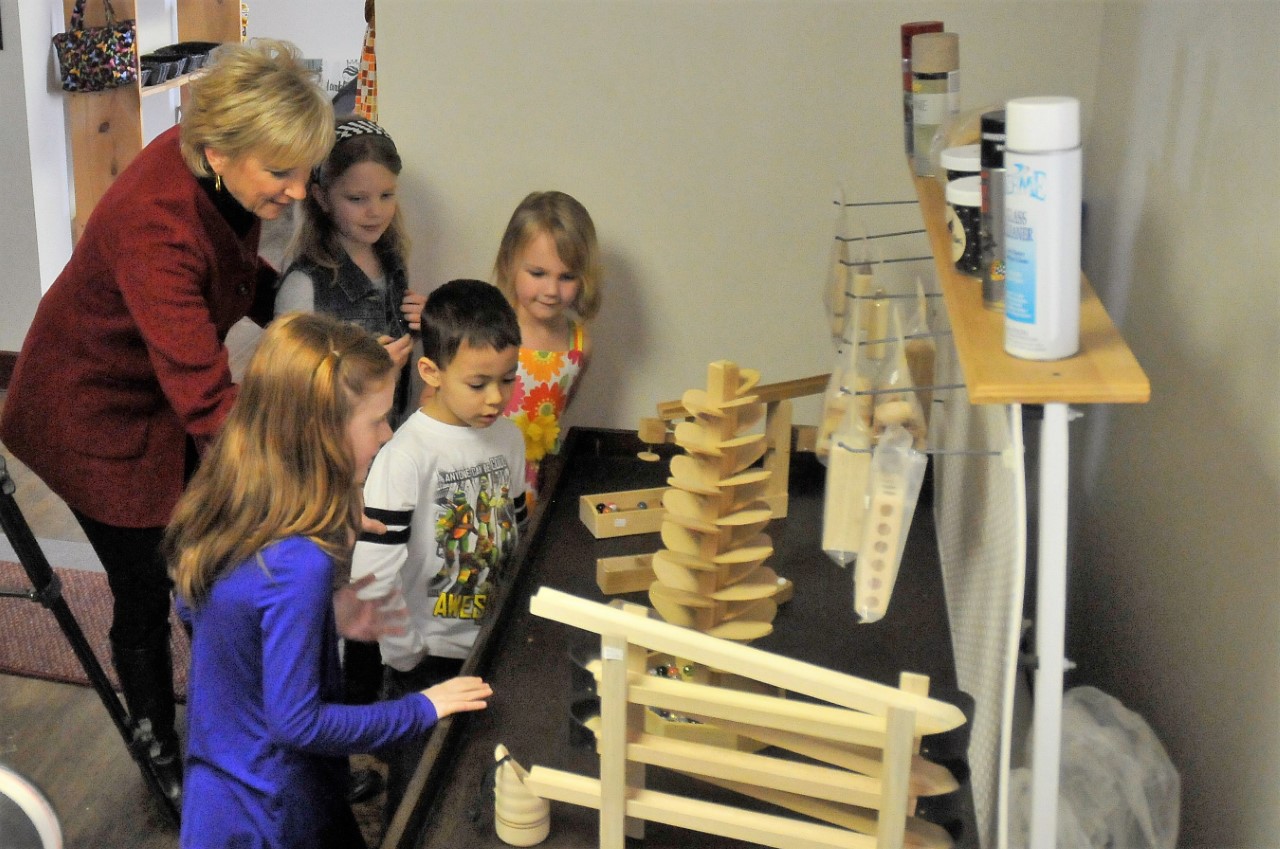
Beri enjoys visiting with children as they play with marble games in the gift shop.

   Kids have a chance to play Ringer in the gift shop. This is one of the traditional marble games where 13 marbles are placed in an X inside a circle. The challenge is to see who can be the first one to knock out seven marbles. “The opportunity to work in an industry that involves kids is what is truly important,” stated Beri. She always enjoys a chance to play Ringer with the kids when they stop by.

Marble King demonstration

   Most people think of marbles being used in toys and games. However, there are many other uses for marbles. Some are used as decorations for weddings, jewelry, fish tanks, and infiltration systems. When you shake a can of spray paint, that rattle you hear is an industrial use of a marble. Special marbles are even used in making wine and beer. They have even been used by NASA for testing in their space balloons. The list of uses is amazing.

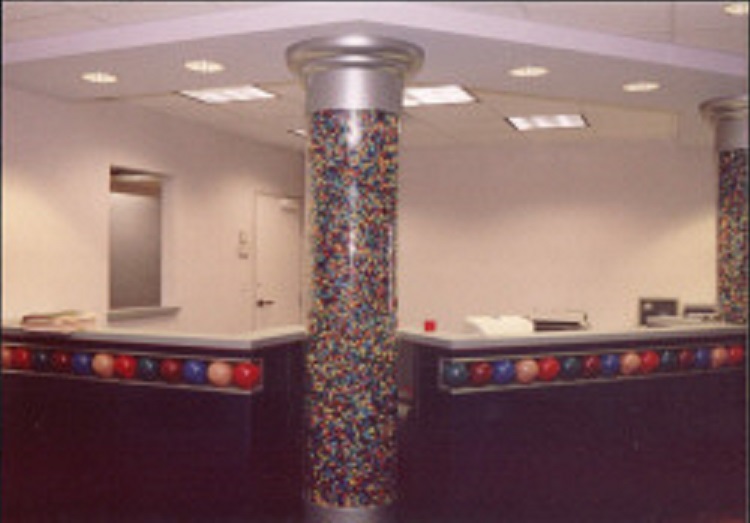
Marble King Marble Tower

Towers filled with Marble King marbles create a great conversation piece.

   Their marbles have even made the movies! “Goonies”, “Hook”, and “Home Alone” have featured Marble King marbles as props. Robin Williams used Marble King marbles when he recaptured his youth as Peter Pan.

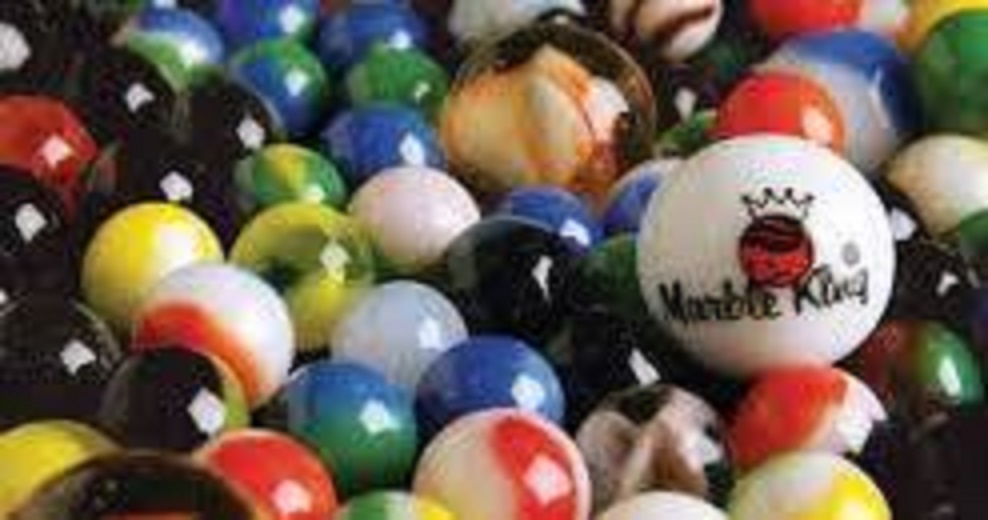
Marble King marbles

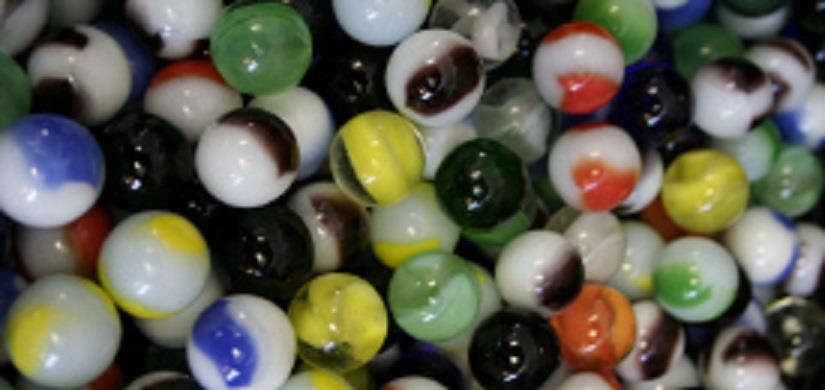
   Marble King marbles are made using recycled glass in the U.S.A. seven days a week, three hundred sixty-five days a year. Marbles have been shipped all over the world to over 17 countries, including Australia, Germany, France, United Kingdom, and Canada. In 2000, Marble King won the Governor’s Award for Excellent in Exporting.

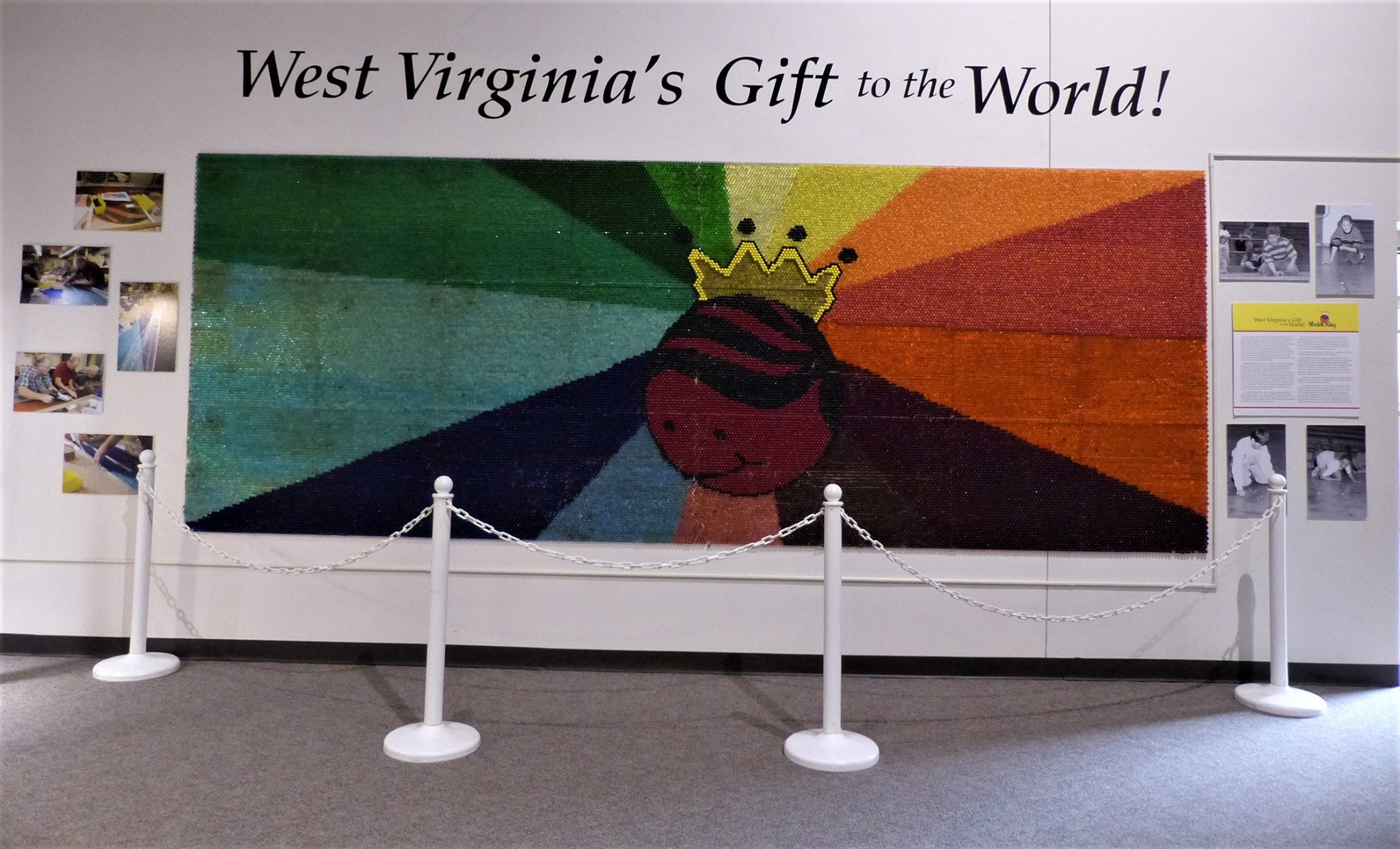
Marble King at Grave Creek Mound

Grave Creek Mound Museum in Moundsville, West Virginia, uses Marble King marbles to create their logo in a large mural.

   In Moundsville, West Virginia at the Grave Creek Mound Archaeological Complex an entire wall displays their beauty in a fantastic, colorful design. Here 47,523 marbles replicate the logo of Marble King.

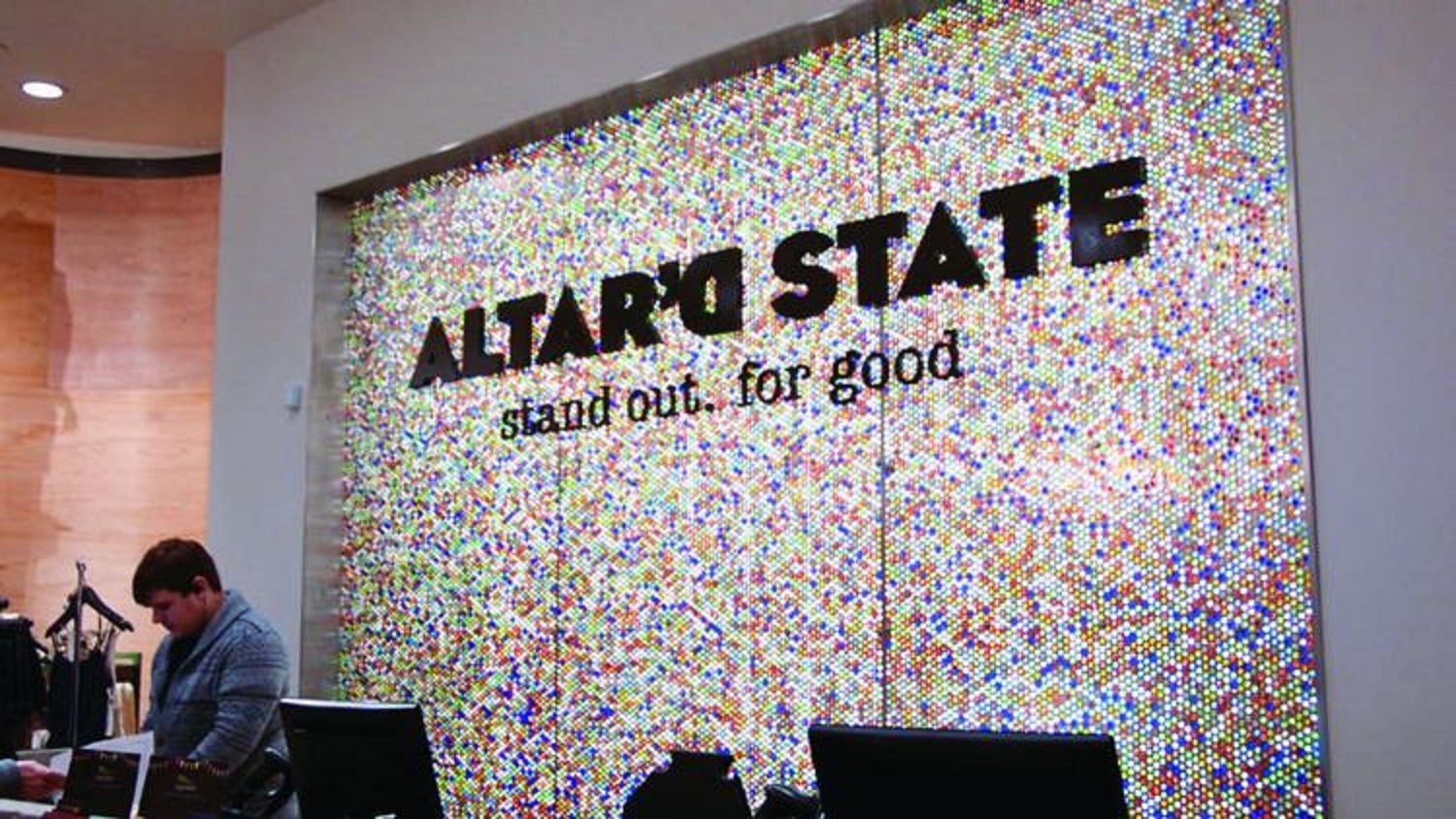
Marble King Altard States

Altar’d State uses Marble King marbles with a lighted background in every store.

   Altar’d State stores use a clear glass panel filled with Marble King marbles as the backdrop in each store. Lighted from behind, this creates a very beautiful and glowing welcome.

Marble King Marbles 2    Visit their interactive museum and gift shop in Paden City to discover why Marble King is known for quality, tradition, and history all over the world. It’s extra special because today they are the only marble company still producing Made in America marbles.

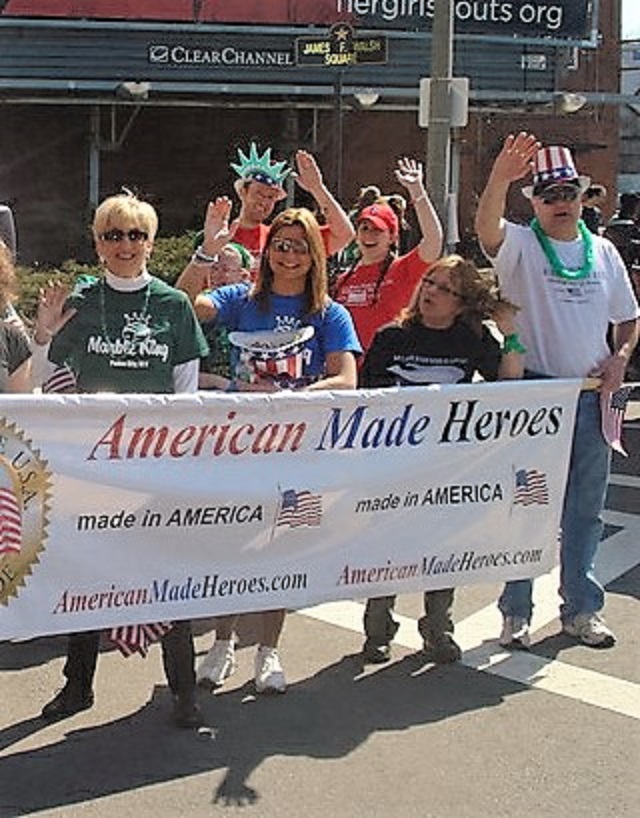
Made in America parade

Marble King was recognized as an American Made Hero and served, along with others, as the Grand Marshall of the St. Patrick’s Day Parade in Boston.

   After 70 years in business, Marble King marbles have earned the right to be called the world’s best-known, and best-loved marbles.

    Marble King is located in Paden City, WV. From Marietta take US-2 North and from Wheeling take US -2 South.  Turn on Park Street and then 1st Avenue. The Gift Shop will be at 401 S 1st Avenue.

Rise and Shine with Lisa Bell

Invest in your health!

Bell Barn

Their barn has become a symbol of her bakery business.

Bell Farmstead Bakery & Products came about as a result of Lisa Bell’s chronic stomach issues. While she tried the advice of many doctors, nothing seemed to relieve her problem. Then in 2014, she met a holistic doctor that had a bit of different advice.

Bell- Strawberry Oat Muffin

People like these strawberry oat muffins so well they buy them by the dozen.

   This doctor suggested she try a gluten free diet for a couple of weeks just to see how she felt. That meant that she was to eat no products with grains such as wheat, barley, and rye. Within three days, she felt better than she had ever felt; however, it took a year for complete healing and recovery. Her husband decided to try the diet with her and found he too felt much better.

   While Lisa started her gluten free business due to her own severe health issues, now she is helping others overcome this problem.  One of the first things they need to do is visit their doctor and schedule a test for Celiac, an immune reaction to eating gluten that damages the small intestine lining and prevents absorption of nutrients.

Bell - eggs, fried potatoes, Zucchini applesaue bread toasted with butter

This gluten free breakfast of eggs, fried potatoes, and toasted applesauuce bread looks mighty appealing.

   Once she found the gluten free diet made her feel so much better, her problem was finding tasty gluten free products. There weren’t any bakeries that offered anything gluten free and what she found in stores was dry, made with preservatives, using mega white rice flour and tapioca starch.  To correct this problem, Bell Farmstead Bakery & Products was born in 2016.

Bell Banana Nut Bread

Get to the Farmer’s Market early if you want some of Lisa’s banana nut bread.

   It became important to Lisa to not only have the products taste better but she wanted them to have nutritional value. She studied the ancient grains that our ancestors would have grown and used, such as amaranth, sorghum, and millet. Then she experimented with flaxseed meal, coconut, almond, and garbanzo bean flours. These flours are what bring the unique flavor and texture to her products.

   Most of the recipes used in her baked goods are ones she has created herself by trial and error for her family. She discovered that by using organic and non-gmo ingredients, products were not only healthier but also more flavorable.

Lisa and chicken

Her chickens provide the perfect eggs for her baked goods.

   Her chickens are even fed organic food. They start out with a feed ordered from Virginia that has no soy and then graduate to layer feed, which has no soy or wheat content. Any extras are organic produce that is grown by Lisa. After all, these eggs are what she uses in her baked goods.

Bell Pancake Mix

Bell pancake mix is Husband tested, Husband approved!

   Lisa is also president of the Cambridge Rise and Shine Farmer’s Market. This market only accepts homegrown produce, herbs, flowers, and plants as well as handcrafted goods. They cannot be purchased in bulk from an auction house but must be from the farmer’s garden. Here you get a chance to talk to the farmers that have produced the crops and get their suggestions for using them.

   Her products are sold at Rise & Shine Farmers’ Market, which is open every Friday morning May through October at the Southgate Hotel parking lot in Cambridge. Her products cater to those with food allergies and are all corn, soy, xanthan gum, gluten, and peanut free. Wheat, rye, or barley are not allowed in any of her products. Many people feel better when they avoid these foods.

Bell - Lisa in her herbs

Lisa can often be found working in her herb garden.

   Correct care of gardens and fields is of utmost importance. Chemical spraying of crops before or after planting contributes harmful substances to the body. Simply, you can’t digest poison! So the importance of pure crops is high on the list.
Lisa at Market Place SFF

Lisa was at one time chairman of the Marketplace for Salt Fork Festival.

   She also participates in the River City Farmers’ Markets in Marietta every other week. In past years, she also has organized the Marketplace for the Salt Fork Arts & Crafts Festival. Each market seems to bring new experiences such as hot sunshine, rain, wind, and even snow has been encountered.

Bell Apple Cinnamon Oat Muffins   Every week Lisa bakes something a little different for the Farmers’ Market crowd. A few of those treats from past weeks have included Zucchini Applesauce Bread, Rhubarb Mint Pie, and Apricot Date Scones. Something delicious always appears from her ovens.

Lisa - Wedding Cake

This gluten free wedding cake  looks and tastes delicious.

   There’s a wide assortment of breads, muffins, and pies available. Try some of her buckwheat or oat flax ginger pancake mixes. About a half dozen different oatmeal mixes include Raisin Cinnamon, Cranberry Almond Ginger, and Plum Vanilla. When talking with her recently, she was baking a vegan birthday cake and has also done wedding cakes.

Lisa - Organic Strawberry Patch

This organic strawberry patch provides fresh fruit for her baked goods.

   Lisa established her bakery because she doesn’t believe that being Celiac or having a food intolerance or allergy should prevent a person from having a tasty meal or a scrumptious dessert. Her goal is to create products that taste awesome and have nutritious value. Good nutrition is the key to a healthy immune system.

Lisa - Paloma chicken coop

Lisa served as local chief humane officer for livestock. Her animals are an important part of her life.

   When asked what advice she would give others, Lisa says without hesitation, “Invest in your health by eating healthy, get plenty of fresh air and sunshine, and practice grounding each day. Have faith in God and let Him be in charge of your life.” Grounding, or earthing, is the process of placing your bare feet on the ground for at least fifteen minutes a day to reconnect your body with the earth’s energy.

Bell Commercial   Right now, Lisa and her husband, Rick, are refurbishing a second house on their property to use as a commercial bakery. This is a very exciting endeavor and promises to give Lisa a place to experiment with her recipes while having a showroom where she can sell her products.

Bell Cooking Outdoors

Cooking outdoors is a year-round favorite for her family.

   She proudly states, “Everything I create is with a purpose and good intention not just for my family, but for you and your family also.” Contact Lisa at Bell Farmstead Bakery at 740-680-1866 or email her at bellfarmstead@yahoo.com. Visit her website at www.bellfarmsteadgfbakery.com .

   If you are having stomach problems and fatigue, Lisa would suggest that you have your doctor run a test for Celiac. Let her know your allergy and food intolerances and Lisa will gladly help you find some delicious foods to add to your diet.

Aaron Swank Projector Operator for Drive-in Movies

Aaron - Lynn Auto Theater

           Watching a movie at a drive-in theater was always great fun.

   Few people would have seen more movies than Aaron Swank of Newcomerstown during the 1956-86 era. He was kept busy running the projector at some drive-in or movie theater every week. Since Aaron served as a relief operator, he worked in Newcomerstown, Newark, Coshocton, Mt. Vernon, and Cambridge for several different companies.

Aaron Projection Room

Operators of projectors could not leave the projection booth during the movie.

   When working, his job was to take care of all equipment at the theaters including projectors, wiring, and speakers at the drive-ins. Only members of the Alliance of Theatrical Stage Employees and Motion Picture Machine Operators were permitted operator responsibility. Knowing when and how to change the lens for different movies was very important.

Starlite Opening Night

Tickets were 44 cents for Opening Night at Starlite. Children under 12 were free!

   35 mm movie reels at that time were received in multiple canisters placed in one box. Since each roll was only 18 minutes long, there were usually five or six large rolls included for a movie. A two-minute warning was given the operator to change rolls so there would be no break in the movie. This consisted of a couple of circles in the upper right-hand corner. Sometimes today you can still see those in an old movie on television.

Aaron - Heath Opening Night

Heath Auto Theatre advertised “Don’t dress up.” “Smoke if you like.” “No Parking Worries.”

   After a reel was run, it then had to be rewound for showing the next evening or to be sent on to its next stop. Some were rewound by hand but later they used an automatic rewinder and then placed the reels in order in compartments for ease of using the following night. Once in a while his young daughter Betsy went to the movies with Dad and had the privilege of rewinding the films.

Aaron Cruise in

        Cruise-In Drive in near Cambridge was a favorite of area youngsters.

   After seeing all those films, it seemed only natural to ask Aaron about his favorites. At the top of his list were Westerns, especially those starring John Wayne and Randolph Scott. The Shootist, the last film Wayne starred in was a favorite.

Aaron - Heath Auto Theatre

                        Heath Auto Theatre could hold 600 cars.

   Drive-ins were popular spots and the Heath Auto Theatre was a favorite of Aaron’s. The projection booth was on top of the concession stand with a 465′ screen and room for 600 cars. When working the drive-ins, dust was always a major factor as the projector and film had to be kept clean to run smoothly. 

Aaron - Starlite Theater

Starlite Drive-in near Newcomerstown was one place Aaron showed many movies.

   Another favorite place to operate the projector was at Starlite Drive-in near Newcomerstown, which opened on June 24, 1949. Their projection room with the popular Brenkert Enarc projector was partially underground. They had a wooden screen tower with a canvas screen and could park 300 cars. A tornado hit town in 1955 and did considerable damage to the screen so a new cement block tower was built.

   Here you could see a movie for 44 cents and children under 12 were free. They continued to operate until the end of the season in 1986 when the screen was demolished. Now it is a housing development with Star Lite Drive running down its center.

Aaron-speaker

            Every car had its own speaker to put in the window.

   At the drive-in theaters, Betsy placed the speakers on the poles in the spring and helped take them off in the fall. Taking them off was a little dangerous as often wasps would make their nests in the speakers during the summer. Betsy said she undid the screw on the top with one hand and had a can of wasp spray in the other.

Aaron and Mary

Aaron was thankful to have Mary for a great supporting wife no matter what he attempted.

   Some evenings, his wife Mary, daughter Betsy and perhaps a friend would go along to the drive-in with him. They would bring along popcorn and kool-aid as they curled up on blankets in the back of their VW van.

Aaron - Teacher

Mr. Swank will be remembered for his years of teaching at Madison High School and Buckeye Vocational School.

   Many will remember Mr. Swank from his twenty-seven years of teaching history and political science at Madison High School and Buckeye Vocational School. Playing trombone in bands on the weekends gave him great pleasure also, especially the good times with the Rich Simcox Band.

Aaron Rich Simcox Band

Playing trombone in the Rich Simcox Band was one of his favorite weekend pasttimes.

   “I got to meet a lot of nice people I never would have met,” smiled Aaron. However, on his musical evenings, he had opportunity to meet Lyndon Johnson and Ronald Reagon. His students always enjoyed hearing of how Mr. Swank passed up by choice almost meeting two men who were to become president of the United States with a simple, “No.”

Aaron - Musical Night

          Aaron played trombone in several different bands on weekends.

   As you can tell, operating the projector at one of these theaters was a busy occupation. You had to stay in the booth the entire time in case there would be a break in the film, a ghost shadow, or another problem. Of course, the best nights were those when everything ran smoothly…but those didn’t happen very often.

Aaron - cider press

    A favorite fall hobby was making delicious apple cider in his own press.

You can still enjoy a drive-in movie close-by today at the Lynn Auto Theatre in Strasburg. They have two screens and great choices for your watching enjoyment. Come as you are in your family car!

Captain Bill Calmly Cruises Through Life

Captain Bill at wheel

Captain Bill takes the wheel of the Lorena Sternwheeler.

When you’ve been a captain for thirty-five years, navigating the waters is something you do with ease no matter the situation. William Page, called Captain Bill by those who know him best, has surrounded himself with life on or near the water for most of his life.

Captain - child

That’s Bill on the right with a diving helmet his dad found in a Pittsburgh River.

   Growing up in Zanesville, he lived close to the Muskingum River and had many daring adventures there as a child while picking up coal along the railroad tracks. Riding a log jam down the river while fishing was one escapade that got him in trouble. Often he and his cousins would climb up under the bridges to catch pigeons – they wanted a carrier pigeon.

Captain - Aquatics Unlimited

Aquatics Unlimited in Zanesville was one of his first business ventures.

   Bill worked for Anchor Hocking Glass for 25 years as an engineering draftsman and mold maker. But the water was calling him and he opened Aquatics Unlimited in Zanesville. Here he designed and built swimming pools and spas, and taught scuba diving.

Captain - Swimming Pool

This swimming pool in Nashville, Tennessee was the last pool he constructed.

   Because of his diving abilities, he was a reserve deputy sheriff in Perry and Muskingum Counties. There he was active doing search and recovery dive team training and rescue missions.

Captain Diving

Giving scuba diving lessons was something Bill truly enjoyed.

   Then he took a vacation and fell in love with the waters of Florida. Soon he moved there, where he owned Knox Bait House Marina. When Bill decides to tackle a project, his persistence has always paid off. Since he had been a commercial diver, he decided to open a scuba diving center where he gave lessons on the Crystal River.

Captain - Manatee

Swimming with the manatee was a favorite Florida pastime.

   He set up a manatee training program at Crystal River because of their abundance at that location. His training program received international recognition. He fell in love with the manatees and enjoyed teaching people how to interact with these large aquatic mammals, who are very friendly when properly treated.

Captain Silver Suit 2

He was honored to wear the Silver Suit of Jacques Cousteau.

   While managing the Port Paradise Dive Center, he was in charge of everything from boat and diving equipment rentals to training divers and giving tours. This is where he was lucky enough to wear one of the famous silver suits of Jacques Cousteau who said, “The best way to observe a fish is to become one.” Bill understood how to do that.

Captain - Video Recorder

Bill still has the underwater video recorder that he used quite often.

   While in Florida, Bill’s life was filled with excitement. He worked at Walt Disney World with the dolphins, was part of the support team for a simulator space capsule with NASA, and directed scuba diving programs at the University of Florida and Bay Point Dive Center.

  There’s a special experience of freedom while diving. The feeling of weightlessness in the water and in the space capsule were pure delights for Bill. One special pleasure was diving to view all the colorful fish, especially at night when some give off a fluorescent glow. “We dive not to escape life but for life not to escape us.”

Captain - Yacht

Sailing his charter yacht Challenge led to many exciting trips in the Caribbean.

   In Florida, he received his captain’s license and took people on cruises from Ft. Lauderdale to the Caribbean. For three years he captained The Challenge, a 52′ charter sailing yacht.

   An old friend from Zanesville, Dorothy Montgomery, pulled some strings and asked him if he would come back and temporarily captain the Lorena. He had never operated a sternwheeler before but decided to accept the challenge. That was fifteen years ago.

Captain and Becky

Bill and his wife, Becky, share a passion for the waterways.

   Since then Captain Bill and his wife “Admiral” Becky, social director on the Lorena, have enjoyed the Muskingum River and the people who ride along with them. They hope to be back on board by the end of May each year.

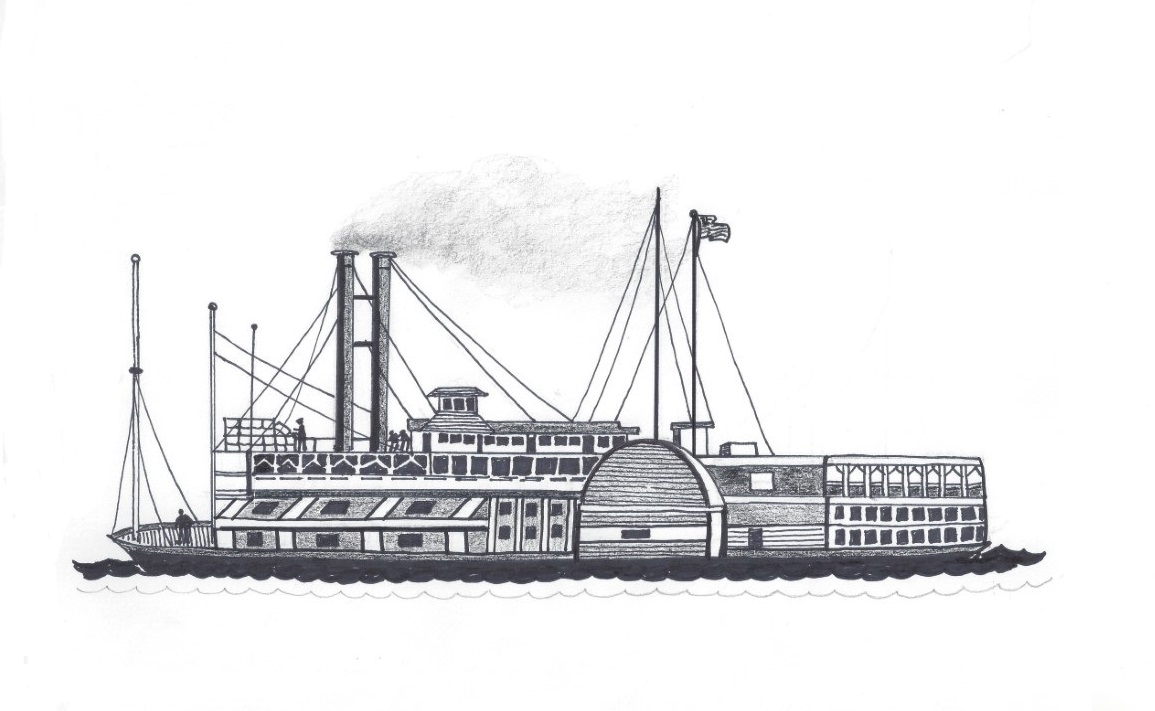
Lorena Paddlewheel

Today Bill is Captain of the Lorena on the Muskingum River.

   While steering the Lorena, he notices his environment. In the sky, he sees many different birds, eagles and an occasional seagull. In the water, herring and other fish make themselves known but he quipped, “I haven’t seen an alligator, but I’m looking.”

   In his spare time, Bill drives tour buses and school buses for West Muskingum. He fills every hour of the day. If he would have one bit of advice for young people, it would be, “Education. Get it all.”

   Everyone has dreams and Bill is no exception. One dive he would still like to make is off the coast of Australia in the Great Barrier Reef, the world’s largest coral reef system.

Captain - Queen of the Lake II

His next project is to direct the restoration of the Queen of the Lake III at Buckeye Lake.

   His next project is fairly close to home as he has been asked to be project manager at Buckeye Lake as they complete the final steps on the restoration of Queen of the Lake III.

Captain at home

The Captain’s home office is filled with nautical memorabilia.

   There’s no doubt that Bill and Becky enjoy life to the fullest these days. Bill enjoys playing keyboard, guitar and accordion but never took a lesson. He’s one of those true musicians that play by ear. Today he’s perfectly happy to just relax in their beautiful home near Zanesville.

   Bill has seen things under the water that most have never seen. Memories float to the surface when he speaks of his adventures.

   “The sea, once it casts its spell, holds one in its net of wonders forever.”

~Jacques Cousteau

Barefoot McCoy Captures Real Life in His Songs


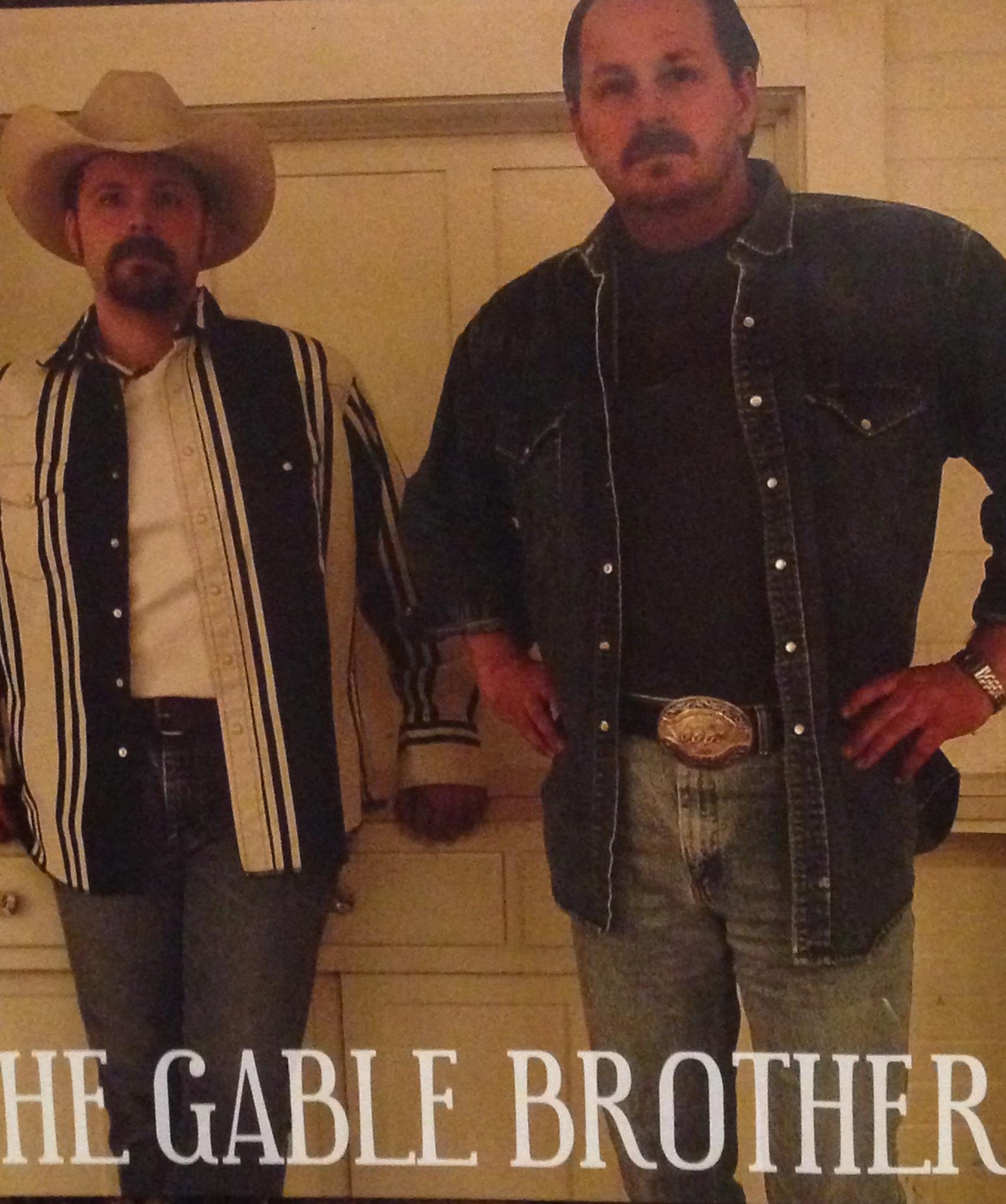
Surrounded by music since childhood, Jake “Barefoot” McCoy of Newark, Ohio now provides musical entertainment all over Ohio and across the United States. His popular folk music developed step by step throughout his life.


Barefoot as a child

Even as a child, Jake attempted to play his dad’s musical instruments.

   His family was homeschooled and piano instruction was part of the curriculum. At the age of five, he began classical piano lessons from a teacher who came to their house every week. A half-hour of practice was required daily.

   Jake feels lucky to have started his musical training at an early age. Music filled his heart and soul so by the time he was eight, he played as much by ear as by reading the music. It wasn’t until age 13 that Jake wrote his first songs using piano and guitar as accompaniment.

Barefoot at Apoxee Trail Florida

The Apoxee Trail in Florida is a great place to go hiking with your guitar.

   When attending Newark High School, Jake also participated in cross country and track. Running and being in nature got in his blood too, and he still gets pleasure from hiking today or taking long walks in the woods.

   Jake attended Asbury College in Kentucky for four years where he earned a degree in music and performance, with minors in accounting and agriculture. In that small town of Wilmore, locals met on the porches or in local clubs and enjoyed sharing music. That’s where he developed as a banjo player.

The same teddy bear is available in multiple, playful settings.

Historic Roscoe Village featured Jake at their grand piano for a Christmas concert.

   It was while enjoying music on those hot summer evenings along the Kentucky River that Jake began playing without wearing shoes. A couple of his friends, Rainwater, a Cherokee, and Gail Roe gave him the Indian name of “Barefoot” at that time and this unique name distinguishes him easily from other performers.

   While in Kentucky, he performed with many local bands from 2010 to 2014 and immersed himself in Appalachian culture, including readings of Thoreau and Wordsworth. If you listen closely, you can hear traces of his beliefs and values in the songs he writes.

Barefoot at South Florida Fair - West Palm Beach

Fairs are a popular venue. Here he performs at the South Florida State Fair in West Palm Beach.

   2015 created a memorable year for Barefoot as he went to California to visit a relative. He stayed the year playing every day as a street performer on the Santa Monica Pier. In the evenings he would play at local clubs and bars. While surrounded by all that music, he wrote over 100 songs that year.

   He began performing solo in 2015 and has since delighted crowds at over 1200 shows in Ohio, Kentucky, Pennsylvania, North Carolina, Florida, Indiana, New Mexico, and California. His most recent festival took place in March at Dawsonville, Georgia.

Barefoot April

Jake Barefoot McCoy writes meaningful lyrics for his folk songs.

   A special relative that influenced his music tremendously was Doc Watson. His folk guitar playing inspired much of Barefoot’s technique today. During the American folk music revival in the 1960s, the award-winning Doc played acoustic guitar and banjo with a special picking style.

   A multi-talented young man, Barefoot is a singer, songwriter, and musician. A specialty he has mastered is putting poetic lyrics together that tell stories of yesterday and tomorrow. Barefoot is a truly great lyricist able to capture beauty, happiness, frustrations, and pure fun.

Barefoot at Keyboard

The keyboard is a central part of his performances.

   He varies his performances by playing guitar, banjo, harmonica, and piano. No matter what instrument he picks up, his skill and feelings come pouring through. Those bare feet keep him in close touch with his foot percussion, which is often his guitar case.

Barefoot at Cherokee, NC

Cherokee Nation in North Carolina has a festival that he thoroughly enjoys.

   While playing around on the piano at home, he often just happens across his next song. He loves telling a story through his music and usually is working on several new songs. Sometimes he might work on a song idea for years, but often it happens in just one day, maybe even ten minutes.

Barefoot Latest Album

His album “Back to Virginia” takes you on a musical adventure from valleys to mountaintops.

   His albums are Bye Bye Bluebird, Ballyhoo, American Lady, and Back to Virginia. At concerts, Take Me Away and Cali top the list of requests. Summer in My Soul is his latest hit.

I will not grow old

While my heart is full

The world outside is so cold

But it’s Summer in My Soul.

Tourism Barefoot McCoy

He was a featured entertainer at Ohio Tourism Day on the Ohio Statehouse steps.

   Some of his favorite concerts have occurred at the Cherokee Festival in Cherokee Nation, the Paul Bunyan Festival at Old Washington, and Apple Butter Festival in Coshocton. My first concert of Barefoot’s occurred on the Ohio State House Lawn at a State Tourism Show and later listened when he performed at the Guernsey County Senior Center Picnic.

Barefoot at Senior Diner

Guernsey County Senior Center asked him to play for their Senior Picnic in the park.

   Like all young men, he has his dreams. One of those would be to go on an international tour. He’d also enjoy playing with Tommy Emmanuel, who he admires for his complex fingerstyle technique on the guitar. The talented Jake “Barefoot” McCoy certainly has a wonderful chance to fulfill his dreams.

Barefoot Tee

This Barefoot tee shirt could be a fun gift.

   Visit his website at www.barefootmccoy.com to hear some of his music. It’s an easy place to order an entertaining CD. Bluegrass fans might like to pick up a Barefoot Raglan Tee Shirt or Hoodie for themselves or a friend.

   Watch his schedule and plan to listen to his delightful musical creations sometime soon. Barefoot McCoy is a pure American Folk Music treasure.

Flag Day is Every Day at Annin Flagmakers in Coshocton

Flags- Sign on Door

This sign appears on all doorways at Annin Flagmakers.

Annin Flagmakers have been making the flag of our country since 1847. The sixth generation of this family now owns and operates the business. Here workers make over three and a half million 4’x6′ flags each year in addition to many other sizes, including stick flags.

   Alexander Annin had been making flags for merchant ships on the waterfront in New York City for several years before beginning Annin Flags in Lower Manhattan on what was called “Old Glory Corner”. Eventually, headquarters was moved to New Jersey with factories in Coshocton, Ohio and South Boston, Virginia.

Flags Headquarters

One branch of Annin Flagmakers remains in Coshocton.

   These flags are Made in America of the highest standards by experienced flag makers. They have learned what long-lasting domestically made fabrics to use and what inks hold their color the longest. Fabrics include everything from nylon and cotton to polyester, with nylon holding up best outside.

Flags - workplace

This view greets your eyes upon entering the work area.

   State, military, national and international flags are made by Annin. However, the Coshocton facility basically makes US flags with a specialty now and then. When visiting, they were also making golf pin flags.

   Local history shows that the Coshocton branch of Annin Flagmakers was started by a family from Newcomerstown in 1968. Vane and Barbara Scott had been in the business of decorating floats for parades all over the country but were ready to settle down back home.

Vane Scott First Flag

Eugene and Francis Waller with owners, Barb and Vane Scott, proudly display the first flag made by Colonial Flag Company in 1968.

   A man with a flagpole company suggested they bid on a contract for 10,000 American flags…and they won! They purchased six sewing machines and a strip cutter to cut the stripes. That was the beginning of Colonial Flag Co. By 1970, they had moved their business to a larger building in Coshocton.

   When the 1976 bicentennial rolled around, Colonial Flag Co. had difficulty keeping up with orders so decided to sell the company. There were two stipulations to the sale: keep the business in Coshocton and keep Vane and Barbara on as managers. Annin Flagmakers purchased the business at that time. The reason there is a flag company in Coshocton today is due to the determination of the Scott family to keep jobs locally.

   Vane and Barb served as plant managers of Annin Flagmakers in Coshocton until 1991. Then Vane III, or Bud as he is often called, served as manager until 2002 when he retired.

Flags- rolls of stick flags

These rolls of stick flags are ready to be processed.

   Over the years, Annin has made flags for many important national events including:

  • 1849 – Inauguration of Zachary Taylor as President
  • 1851 – Queen Victoria’s Great Exhibit in London
  • 1860 – All wartime flags for the Civil War
  • 1969 – NASA’s Apollo II mission to the moon.

flags-dave-manager.jpg

Dave Rogers, DIrector of Operations, is proud to be part of Annin Flagmakers.

   At Annin Flagmakers headquarters, I had a chance to talk with Dave Rogers, Director of Operations, and learn a little more about the way flags are made today. They employ 150 people full-time and also hire temporary workers during their busiest season. Everyone wants the flags to be in their stores for Memorial Day weekend and the Fourth of July.

Flags - Strips being cut

The digital fabric cutter is prepared to cut white stripes for the flag.

   One popular flag is a 3’x5′ sewn nylon flag. They make around 35,000 of them each week. One of the first tasks is to cut the large rolls of fabric into stripes and place them in rolls of various colors. They can cut up to six different sizes at one time on their digital fabric cutter.

Flags- cakes of color strips

The colored stripes are then placed into rolls before heading to the seamstress.

Flags- adding the field of blue

Janet, a 22-year employee, adds the field of blue to the stripes.

   The stripes are then sewn together with six long stripes and seven short stripes. Once they are together, the field of blue is added. Star Field prepares the embroidered star field where the polished white thread gives sparkle to the stars on the field of blue.

Flags- cutting the edges

A 25-year employee, Anita, makes the edges straight.

   These workers take pride in their product. Three of the ladies together had in 88 years at Annin so worked with speed and precision. Everything has to be perfectly straight and their quadruple-stitched fly hem makes them extra durable.

Flags - Memorial Wall

Their lobby displays flags that were brought back after foreign service.

   When a local young man or woman went off to the war in Iraq, Annin gave them two flags. They asked them to return one flag telling where they had taken it, and the other was for their personal use. A display in the lobby shows several of those flags that were returned to Annin.

Flags - Ohio Visitors Bureau

Get your flag locally at the Coshocton Visitors Bureau in Roscoe Village.

   You can find Annin Flags at the Coshocton Visitors Bureau in Roscoe Village, Walmart, Target, Krogers and many other places. The friendly staff at the Visitors Bureau will take special orders for you and show you the large selection available there.

Flags- Walmart display

This display of Annin Flags is ready to ship to Walmart.

   Show your pride in America by displaying its flag and honoring it with a flag made right here in the U.S.A.

Oh say, does that star-spangled banner yet wave,

O’er the land of the free and the home of the brave.

~Francis Scott Key The Star-Spangled Banner

Topiary Garden Inspired by Painting

Topiary - Old Deaf School Park

Topiary Park is located on the grounds of Old Deaf School Park in Columbus, Ohio.

Walk through the Topiary Garden on Town Street near downtown Columbus, Ohio as you let your imagination take you to “A Sunday Afternoon on the Island of La Grande Jatte.” This painting inspired Columbus artists James T. Mason and his wife, Elaine to develop a living reinterpretation of that painting on the grounds of the Old Deaf School Park.

Topiary - Painting Print

“A Sunday Afternoon on the Island of La Grande Jatte” inspired this Topiary Garden.

   Georges-Pierre Seurat was a French painter (1859-1891) and this painting on a ten-foot canvas is considered to be one of the most remarkable paintings of the 19th century. The painting took him two years to complete as he first focused on the park itself before painting people from every social class participating in park activities. No figure encroaches on another’s space. All coexist in peace.

Topiary - Relaxing under the tree

This topiary couple relaxes in the shade while reading a book.

   Topiary is the practice of clipping plants into shapes. James shaped the bronze frames and planted the greenery, while Elaine served as the original topiarist. This small garden was developed with the help of the Columbus Recreation and Parks Department. They pay attention year-round to keeping the plants trimmed and in excellent condition around their wire framework.

   This area actually dates back to 1829 when the Ohio School for the Deaf established educational and residential programs for school-age children who were deaf or hard of hearing. By 1953, the school had outgrown its downtown location and moved to a larger property on Morse Road. Today, the Topiary Garden on those old grounds is the only one of its kind in the world – a park based entirely on the interpretation of one painting.

Topiary - Rowboat on the water

There are eight topiary boats on the pond, which represents the River Seine.

   This was all originally built for the opening of the AmeriFlora exhibit that took place in Columbus in 1992. Special care has been used to create close representations of the painting by Georges Seurat in 1884. The pond represents the River Seine and was developed in the early stages of the garden in 1989. There are even artificial hills that help capture the scene.

Topiary Gift Shop

The gatehouse, resembling a French countryside home, holds their gift shop and information center.

   The gatehouse resembles a French country house to match the park’s theme. Here you will find an information center, museum and gift shop. It is located next to a library which has an outstanding art exhibit.

Topiary - Lady reading outside gift shop

Outside the gatehouse, this topiary lady sits reading a book.

   Highlighted are the sculpted topiaries, hedges trimmed into the shapes of men, women, children, boats, and animals. The frames that support the figures are made of 5/8-inch bronze and set in eighteen inches of concrete.

Topiary - Man with tophat

A man with a top hat is one of 54 topiary characters in the scene.

   There are actually 54 people, eight boats, three dogs, a cat, and a monkey included in the carvings. The largest topiary is 12′ tall. You might see a man with a top hat or a lady with her parasol dressed in the fashion of the 1800s, watching the topiary boats on the pond.

Topiary Bronze

This bronze plaque is situated at the artist’s viewpoint, “As He Saw It.”

   Visit the spot called “As He Saw It” for the exact location of the scene Seurat saw as he was painting it. There is a bronze plaque at this spot so you can compare the topiary to the painting. It’s a quiet place in the middle of the city where you can leisurely wander through the garden and become part of the painting or sit and relax in its tranquil setting.

Topiary - View of painter

This view matches the actual Seurat painting completed in topiaries.

   This garden has been showcased around the world in magazines, periodicals, books, and documentaries. Articles have been found in Life, National Geographic, and The Wall Street Journal.

Topiary - Lady with Monkey and Umbrella

This lady with her monkey is very popular with the children.

   The Topiary Garden Park, situated on seven acres, is open daily from dawn till dusk, and admission is free! Metered parking is just outside the fence. While the Topiary Park is only a couple of acres, the remainder of the area has many scattered picnic tables and benches where families gather.

   A Sunday afternoon spent at Topiary Garden Park is just as relaxing as a visit to The Island of La Grande Jatte. Enjoy the beauty of nature in downtown Columbus.

Topiary Park is located at 480 E. Town Street in downtown Columbus, Ohio. There are parking meters just outside the main gate,

Saving History in Old Ohio Barns

Repairing or restoring an old barn that no longer serves its purpose has been taking place around Ohio with increased frequency. People feel these buildings instill that pioneer spirit and are worth saving.

Cowden Barn

Morrison-Cowden Barn (1869) Pigeon Gap Road

   In Guernsey County, Bill and Sue Cowden decided to renovate an old barn that carried fond memories for many of the neighbors and their children. This barn was originally on the 500 acre Morrison farm and used for horses for many years.

   The Morrison family came to Guernsey County from Ireland in 1855 and Sam purchased a farm on the east side of Pigeon Gap Road. His son, George acquired land on the other side which spanned Coshocton Road, now Route 209.

   It was George’s son, W.C., who is most remembered in the area. He grew record-setting crops of wheat, had an emergency airstrip on the farm, and entertained frequently. Morrison School received its name from W.C., who lived until 1953. Upon his death, his entire estate of 3.2 million dollars was left to Guernsey County charities.

Barn Cornerstone

The barn cornerstone clearly shows the date of construction of 1869.

   When you realize the Morrison barn was built originally in 1869 – only four years after the Civil War, you can understand the desire to put it back to some useful purpose. Bill realized the barn was either going to have to be repaired or torn down. “When the doors no longer open, latches no longer work, and the floor is unsafe because the roof leaks, you have to make a decision.”

Doorway to home

A workman repairs the doorway with the Cowdens’ home in the background.

Getting walls ready

The new walls were being prepared on the ground.

   Some things had to be changed. Big posts by the door had rotted so needed to be replaced. Sadly, the slate roof had so many pieces missing that it received a metal roof. New siding had been put on previously, but now they covered that with metal siding as well.

Barn framing

Inside framing using wooden pegs was still in great original condition.

   Outside the barn looks like a new barn, but inside you can still easily see its history pouring out through all that old timber framing. The amazing craftsmanship of our ancestors without all the tools of today makes it extra special. These barns were built by hand and often in six to eight months. Inside the barn looks pretty much as it did back in 1869. The hand construction used to build the barn can clearly be seen in the rafters. All the beams are wood pegged, no nails were used.

Lift again

A lift was used to atttach new siding to the barn.

   Today, Bill and Sue use this barn for hay and machinery storage. Over the years they have raised chickens and even pigs in the lower level. They are pleased to have been able to preserve this historic barn.

   Three other barns were found that have been treasured by their owners and repaired when needed.

Schumaker Old Barn

Schumaker Barn (1887) West Lafayette

   In nearby Newcomerstown, the Schumakers barn (1887) still has its original slate roof with the date written on it. Their farm has been in the family for over 200 years so Jim and Wendy Schumaker keep striving to make their farm a showplace for others to enjoy through their produce stand and a fall adventure of Pumpkin Patch & Farm Experience to interest children in farming.

Wilson Wells Barn 2

Wilson – Wells Bar (1932) Mantua Road

   Another was built by Carl Wilson (1932) during the Depression. He had purchased the supplies for the barn, but the banks closed before construction began. The contractor asked if he could keep his men working with Carl’s promise to make payment when the banks opened again. Both men fulfilled their promises. Today that barn has been extensively repaired and is owned by Jim and Dot Wells.

Bennett Smith Barn

Bennett-Smith Barn (1960) Pigeon Gap Road

   Across the road from the Cowden farm is the Bennett dairy barn (1960) that was built on the farm of the father, Sam Morrison. Today that barn has been repaired by owners Pete and Martha Smith after a tornado damaged part of the barn heavily back in 1993.

   Many people tend to feel that when something no longer fulfills its original purpose that it should be forgotten because repair takes time, money, and energy. Sue doesn’t agree, “Then you lose a bit of history and the wonderful work that went into it long ago.”

   Enjoy a ride through the country and pay special attention to the barns. You’ll find many large modern barns, those ready to fall down, and some that have been saved as part of our agricultural heritage.

   If you have a wonderful old barn, house, or building on your property that can be repaired, perhaps you will consider preserving it for future generations.

If we don’t care about our past, we cannot hope for the future.

~Jacqueline Kennedy Onassis