Places to go and things to see by Gypsy Bev

Archive for the ‘History’ Category

Early Cambridge City Park History FIlled with Wonderful Memories

Families throughout the area have pleasant memories of times spent at Cambridge City Park. Some have been here from childhood to adulthood and have seen many of the changes in recent years but those early years remain only a memory.

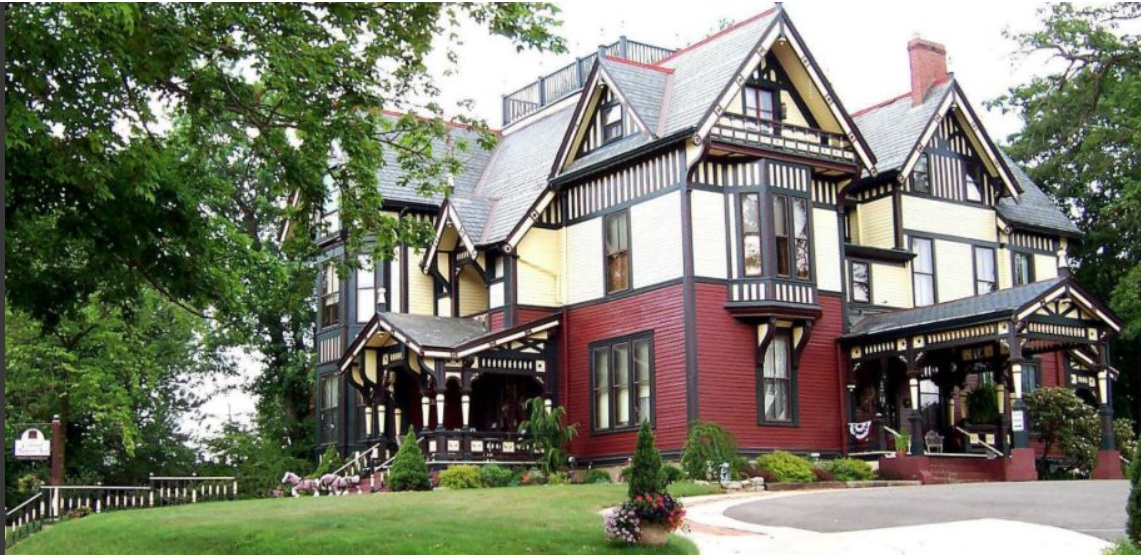
Col. Taylor’s mansion built in 1878 is today a popular Bed & Breakfast.

The area that we call Cambridge City Park today was once part of Col. Taylor’s thousand-acre estate. The home we know today as Taylor Bed & Breakfast was actually the first house to be built on the hill outside of town.

Not only did he build a beautiful home for his wife, but he had a nearby barn where he kept his horses, the only means of transportation at that time. Since the horses needed water, Col. Taylor built Taylor Lake. When the pond froze over in the winter, blocks of ice were cut from it and stored in an underground cellar. Usually, they had ice until sometime in July before it all melted.

The City Pond, where children love to feed the ducks, was the first part of the park.

Taylor Lake today is the duck pond at our Cambridge City Park. In January 1913, Taylor Grove and the lake were sold to the city by Col. Taylor’s heirs for $25,000. Our Cambridge City Park was about to begin.

In July, a Clean-up Day was organized. All men interested in the City Park were to line up at the Courthouse and march to the City Park being led there by the Cambridge Band. A Colored Band was also there to liven the day. Ladies provided a picnic supper in the evening.

Electric Park hosted a Chautauqua celebration and many other activities before Cambridge City Park existed.

The Cambridge City Band began playing at the park in July 1913 when they sponsored the Lincoln Chautauqua, which had previously taken place at Electric Park. The price of a season ticket to enter the performing tent for the six-day event was $1.50 for adults and $1.00 for children 8 -15. There were a number of seats, swings, and tents provided for the patrons. Anyone wishing to do so could pitch their tent there that week.

In July, a lifeguard was appointed to oversee the swimming in the former Taylor Lake with rules laid down for the conduct of boys and girls to be enforced. If the girls were highly interested in swimming there, arrangements would be made to set aside a particular time for them to swim as well as have a woman oversee during that time and give lessons in swimming. A bathhouse has been promised by city council in the near future.

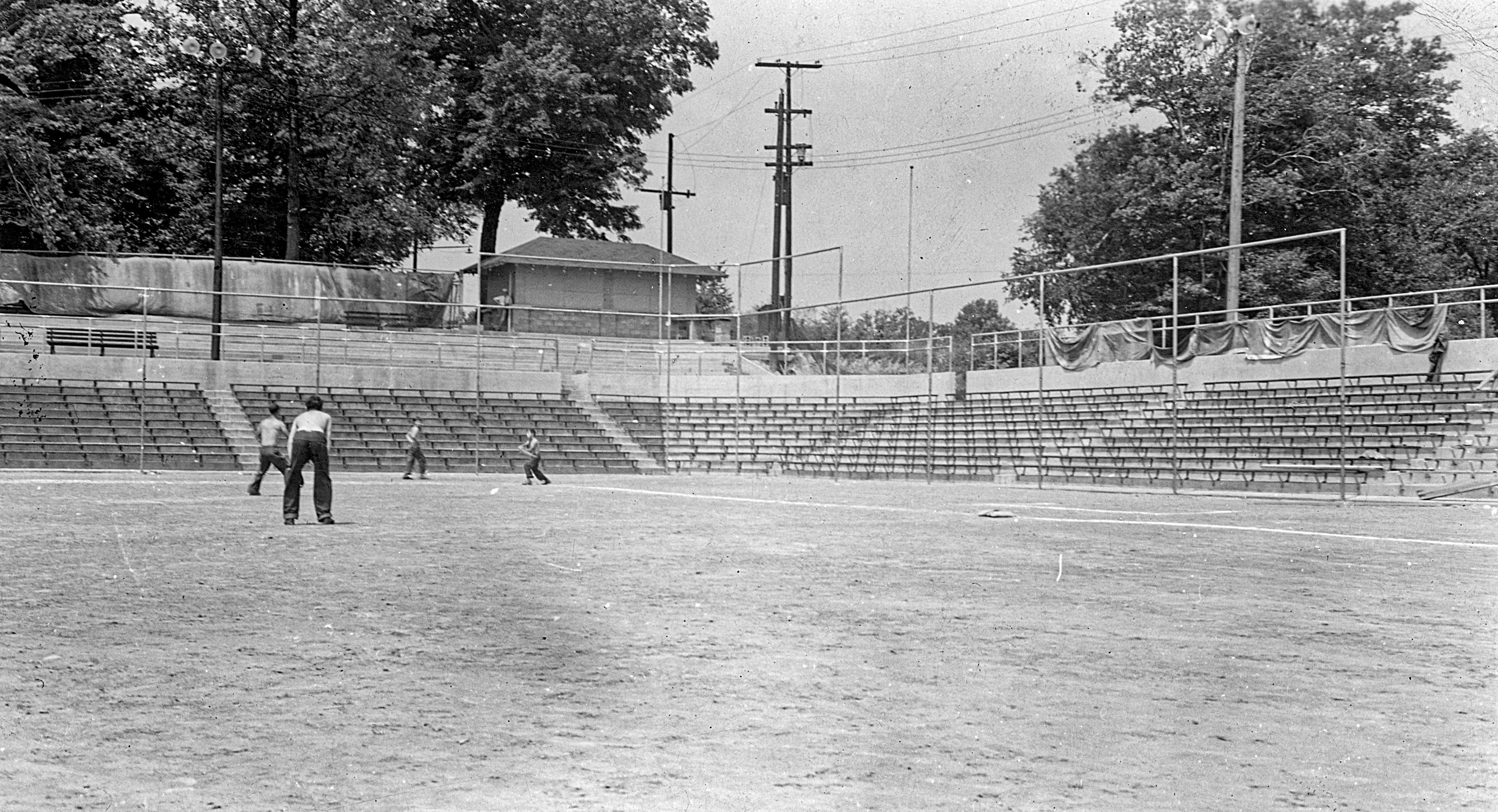
Baseball was played in the park in the summer of 1913.

At about the same time, the first baseball diamond was constructed which brought local teams and their families to the City Park. Money was raised by a group of interested citizens for a stadium called Lakeview Park that seated approximately 1000 people. Many baseball and softball games were played here each summer. It also was the perfect place for the annual Jaycee’s Fireworks on July 4.

By July of that year, families and organizations were already having their picnics there. Some of the first groups were the Mail Carriers Association of Southeastern Ohio and the Welsh-American Society, both of these on Labor Day.

A bathhouse along the pond, where swimming was popular, was an early addition.

Gravel walks were installed, rope swings, a bathhouse on the side of the lake, high and low diving boards, and the lake was enlarged. They wanted it to be the most beautiful recreation ground in Southeastern Ohio.

One of the early buildings to be constructed was the Big Pavilion, which served as a dance floor, concert hall, and speaker’s stand. Often there were six or seven reunions held there in one day.

The Kiddie’s Pool was a popular and safe place to swim.

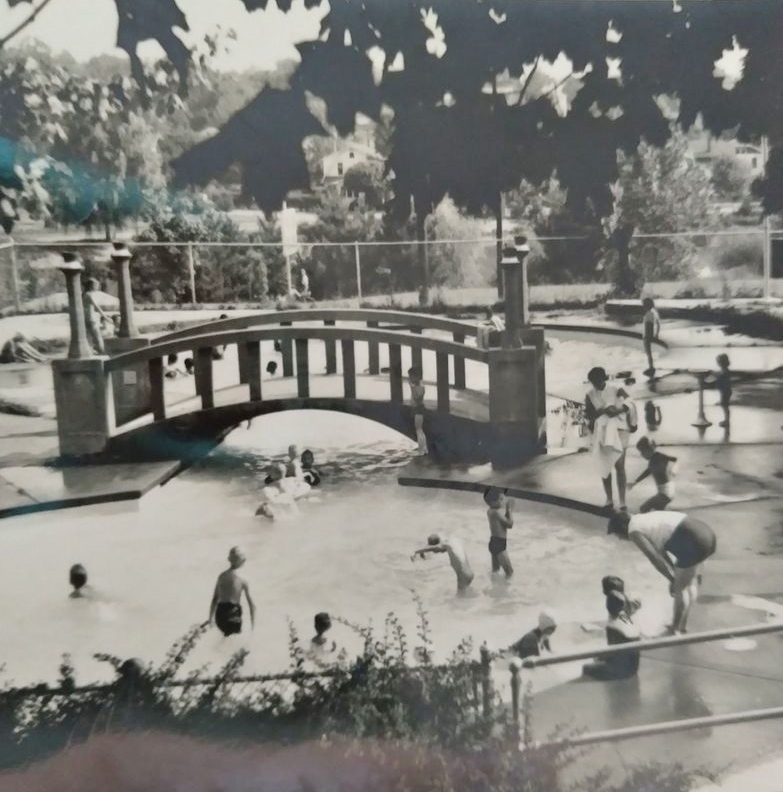
In 1930, the local president of Cambridge Glass Co., A.J. Bennett provided funds to build a Children’s Wading Pool at the park so they had a safe place to swim away from the pond. There were two sides to the pool – a shallow side for wading and a deeper side for swimming. Lifeguards did not like children going under the bridge to get to the deeper side. It was closed in 1973.

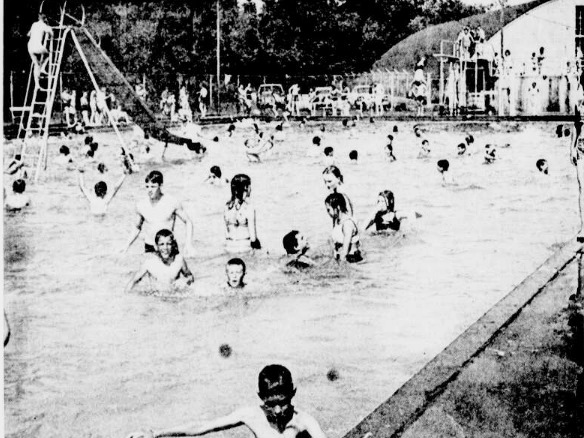
The slide at the big pool was a favorite for a cool ride.

In 1941, Cambridge City Pool was opened after being constructed through a federal grant by the WPA. In 1998, the pool had to be redone to meet current standards. Again, the community supported the project wholeheartedly.

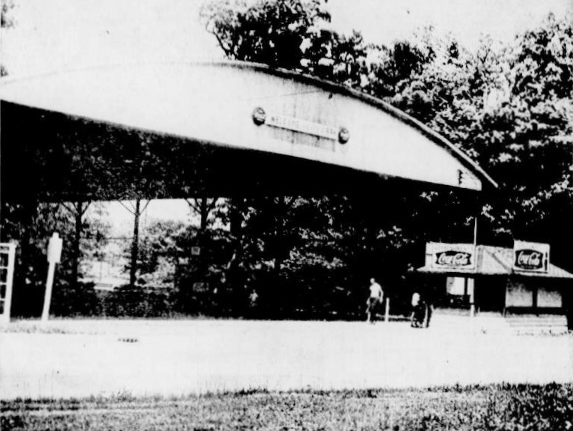
The park pavilion had a Coca Cola concession stand in 1965.

By this time there were several concession stands throughout the park – at the big pavilion, baseball diamond, and swimming pool. One person recalls having keys to all of them and if he happened to be at the park would open whichever one had a crowd. His first summer he made $.75 an hour.

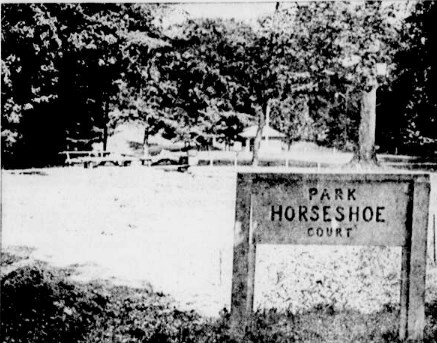
Horseshoe contests were popular at picnics and reunions.

Pitching horseshoes was another important means of entertainment. There were several horseshoe pits at the park and many tournaments were held there usually accompanied by an ice cream social.

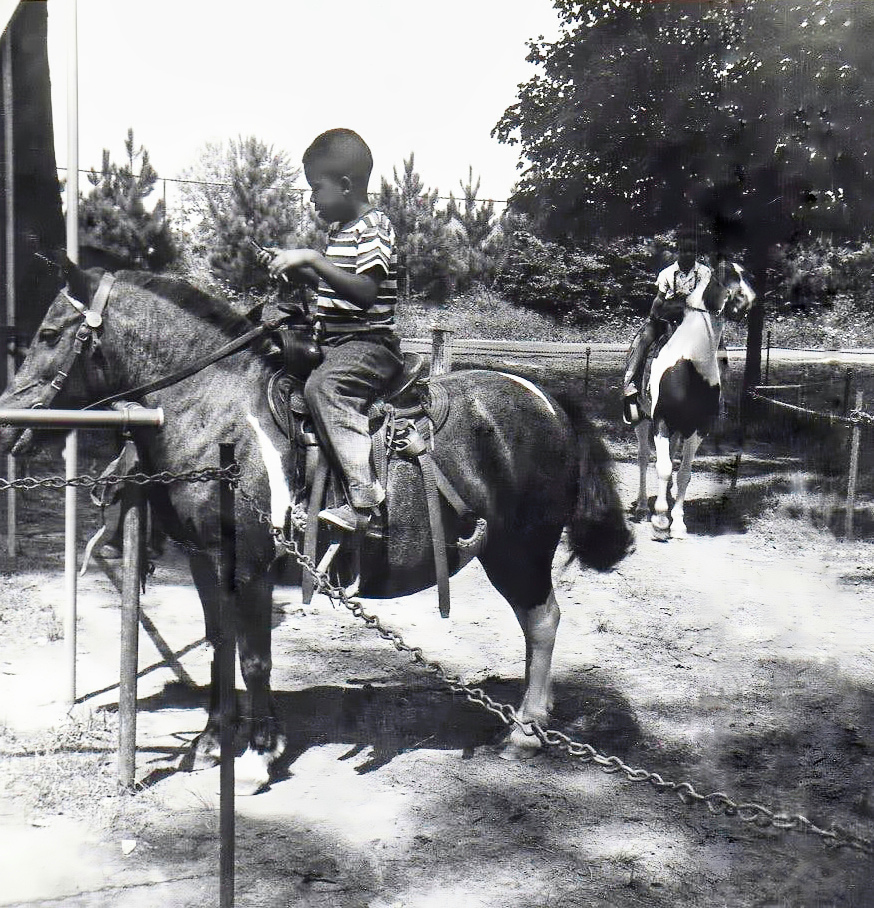
A man who lived close to town brought in his ponies for the children to ride.

Most children have dreams of riding a pony. Someone helped make that dream come alive by bringing several of his ponies to the park and charging a small fee for a ride. Speaking of horses, in those early years, you could hear the musical sound of a carousel at the park. No wonder the park was such a busy place..and still is today.

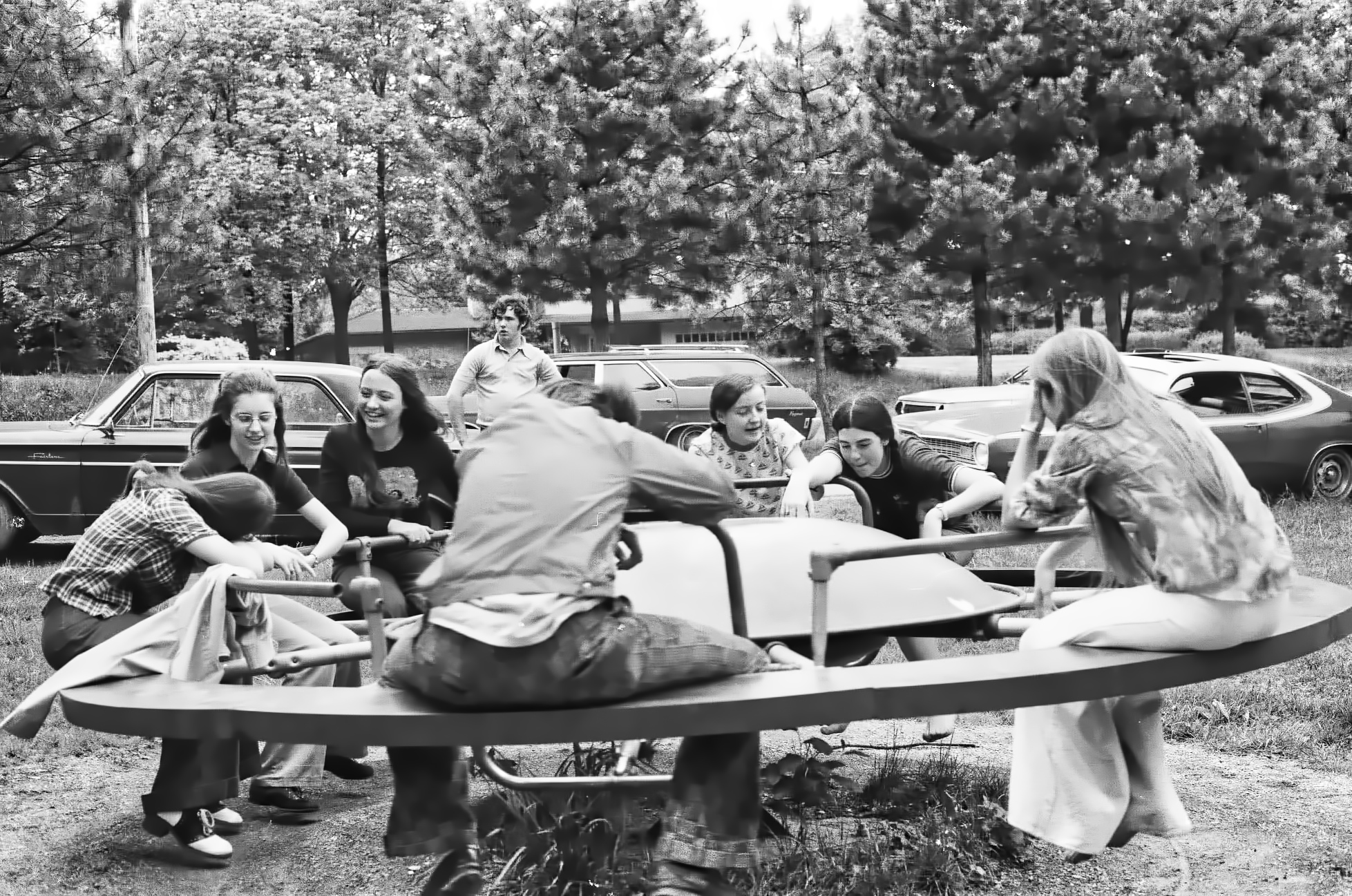
Kids of all ages enjoy a fast spin on the merry-go-round.
The Witch’s Hat was considered the most dangerous ride at the park.

Over the years, the playground has become an important part of the park. The largest section was begun soon after the park opened. A merry-go-round that parents felt was a terror device gave youngsters of all ages a chance to see how fast they could spin. The playground has been upgraded today through the generosity of the Kiwanis and Rotary Clubs.

The firetruck made a great place for climbing and using your imagination.

An old fire truck that out-lasted its usefulness at the city fire department was stripped of all removable parts and placed in the park in 1957 for children to climb on. Not often did children get a chance to play on a fire truck.

The Armstrong Bridge was originally over Salt Fork Creek before the development of Salt Fork Lake.

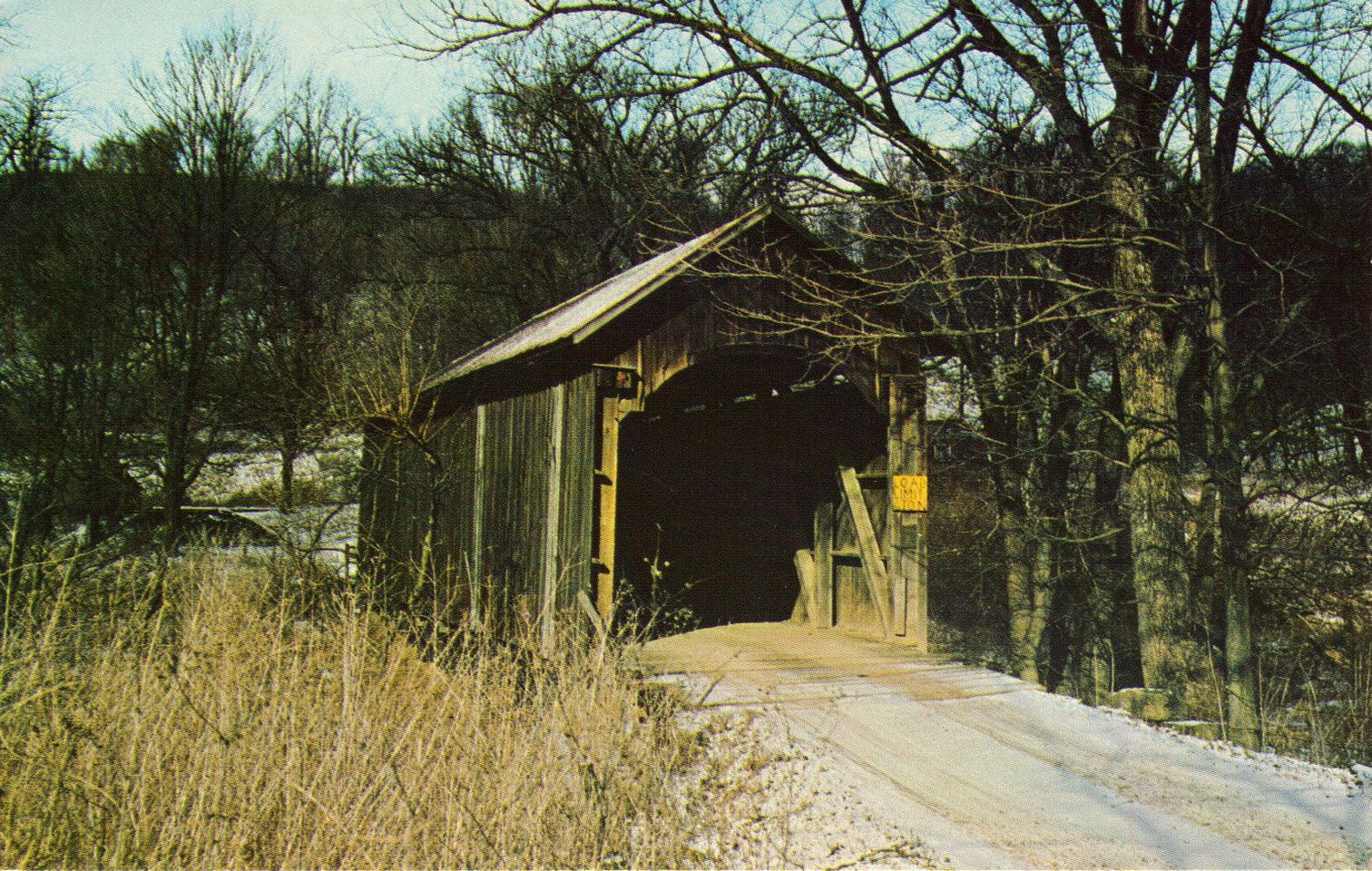
In 1966-67. the Armstrong Bridge was relocated to the City Park. This bridge, built in 1849, originally spanned Salt Fork Creek near the town of Clio. When Salt Fork Lake development was announced, the bridge was moved to preserve it.

This is just a little taste of the history of our Cambridge City Park. This community has been so supportive of the park since its beginning through individual and business financial support and volunteering. May they keep improving and supporting the park to make it even a better place for future generations.

History of Coal in Harrison County

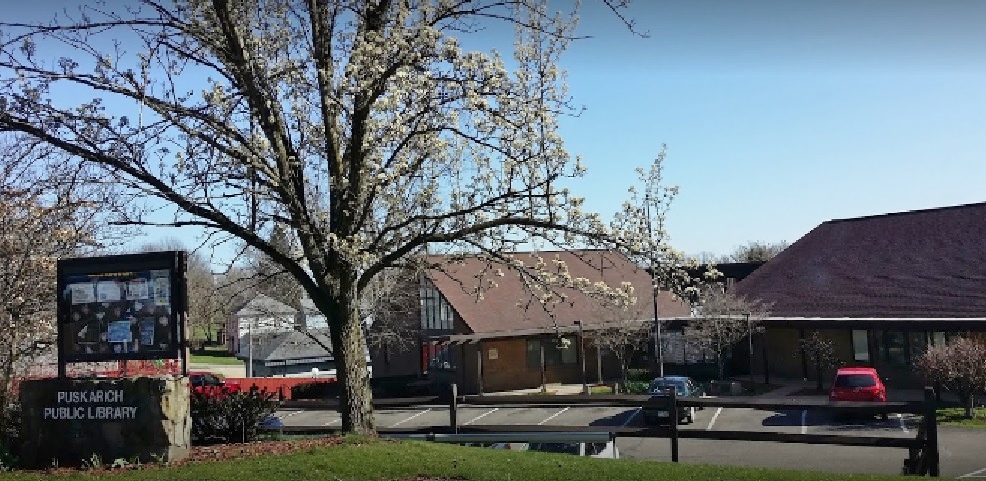
The Coal Mining Museum is in the basement of the Puskarich Public Library.

A Coal Mining Museum has been created to preserve the rich mining heritage of Harrison County Ohio. It can be found on the lower level of the Puskarich Public Library at 200 E. Market St. in Cadiz. Displays are many and detailed with informative signs to describe both the early day and modern mining found in Southeastern Ohio.

After the Puskarich family helped with the half-million-dollar campaign to build the new library in 1986, there was a large area on the lower level that remained empty. Since their family owned and operated the successful Cravat Coal Company, the Puskarichs spearheaded the plan for a Coal Mining Museum. Their family, along with other area coal mining families, presented items for display.

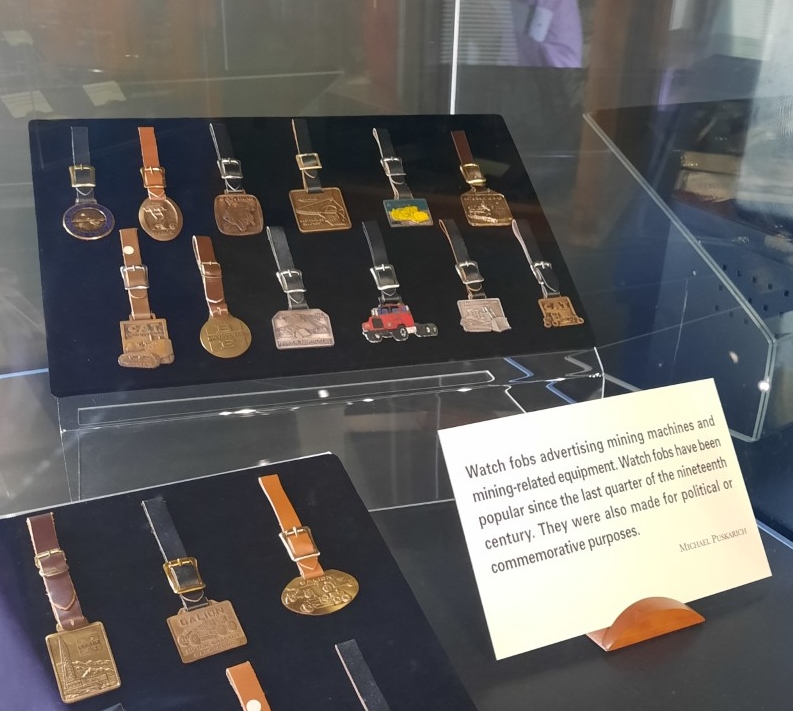
Watch fobs were often gifts from mining companies for advertisement purposes.

During the late 19th century, Harrison County was one of the top coal-producing counties in Ohio until its decline in the 1980s. Items and pictures from those mines plus miners’ tools are on display from various coal companies.

Walking into the museum, you will notice that the walls and ceilings are black, giving you the feeling of being in a dark coal mine.

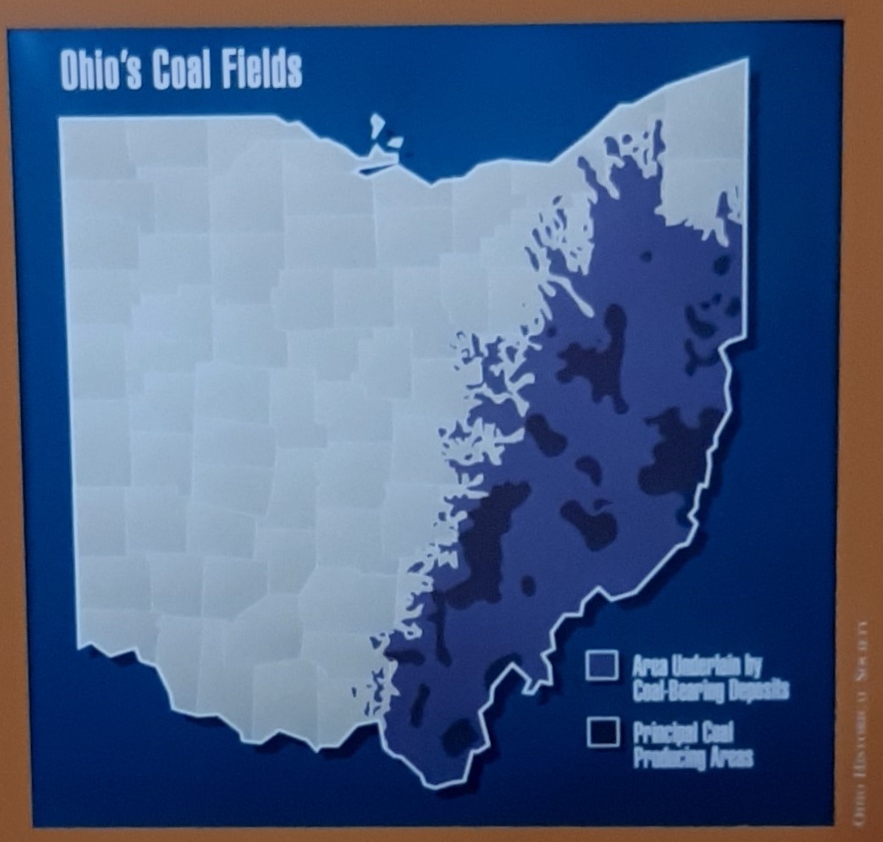
This Ohio map shows the locations of coal fields at a glance.

Coal is sometimes called “buried sunshine” because it came from plants that originally absorbed energy from the sun. When coal is burned, we are using energy that was created millions of years ago. Along with oil and natural gas, coal is considered a fossil fuel since it traces its beginning to plants that were once alive. Often prints of fossils can be found in a piece of coal.

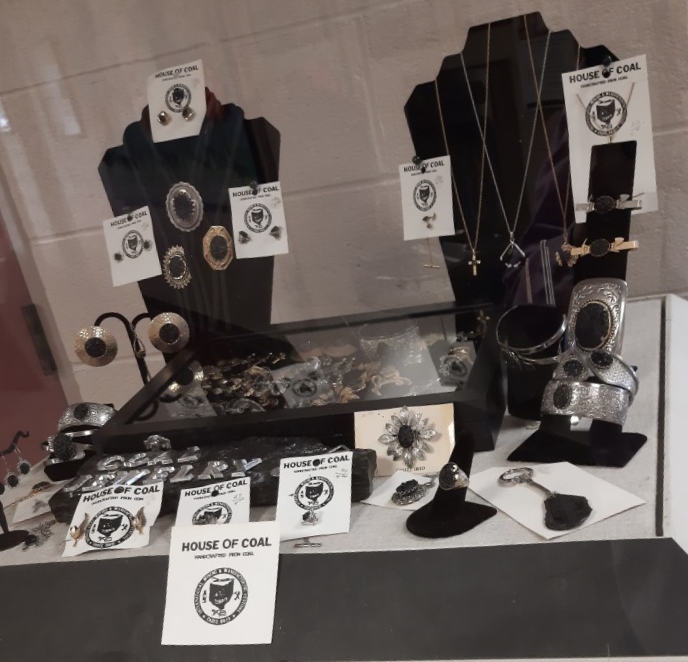
Jewelry made from coal is showcased in their lobby.

The Coal Mining Museum is a great place to learn how coal is formed, the tools used to mine it, and the heavy equipment used in strip mining. Historic photographs line the walls giving you a better understanding of mining and the size of equipment used.

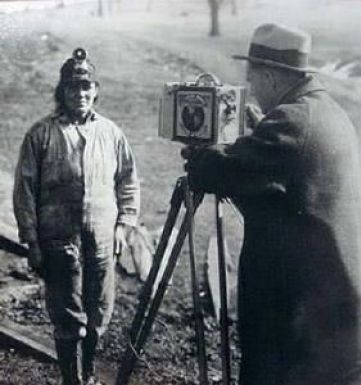
Universal Newsreel photographer captures the moment when Ida Mae is allowed back in the mine.

One of those photos shows Ida Mae Stull, the first woman coal miner, dressed for the mines. Ida was one of 18 children and carried a lantern to the mines for her father when she was six. Ida enjoyed digging coal and mined six or seven cars a day by the age of 30. Her pay for the day was $2 but that paid the mortgage on her property and kept her off charity. Legal action then made it illegal for women to work in the mines but in one year she won her case and was back doing what she loved – digging coal. Ida lived to the age of 84.

The Watts Coal Car made in Barnesville was donated by the Cravat Coal Company.

A featured display shows an actual Watts Car loaded with coal and equipment in front of a large photo of the entrance of a deep mine. Watts Cars were made in nearby Barnesville and this car was donated by the Cravat Coal Company.

Bird cages were an early safety feature in the mines. If a bird died, the men had to leave quickly.

Another interesting display shows safety measures in the mine. A birdcage is displayed which was the earliest way of telling if the mine was safe for miners. If the bird died, they knew the miners had to leave as quickly as possible to escape the deadly gas in the mine. Later methods show rescue kits provided for the miners with oxygen tanks that would last up to an hour that would last up to one hour.

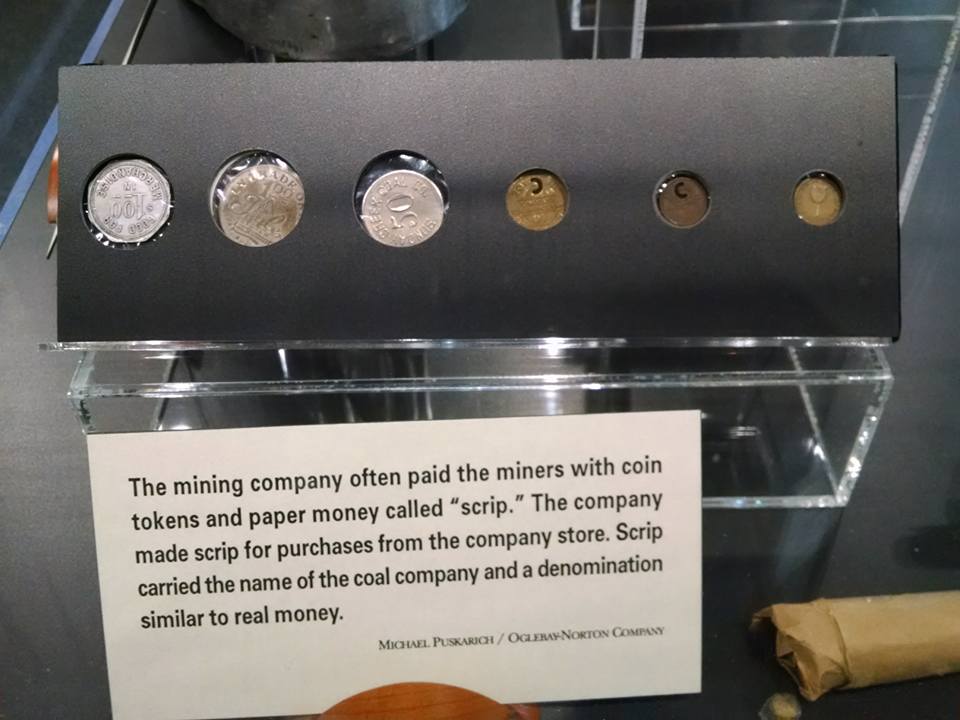
Mines paid in scrip which could only be used at their company store.

Of special interest were the various scrips used as payment to the coal miners. In this way, they had to buy everything from the company store. These people really did “Owe their soul to the company store.”

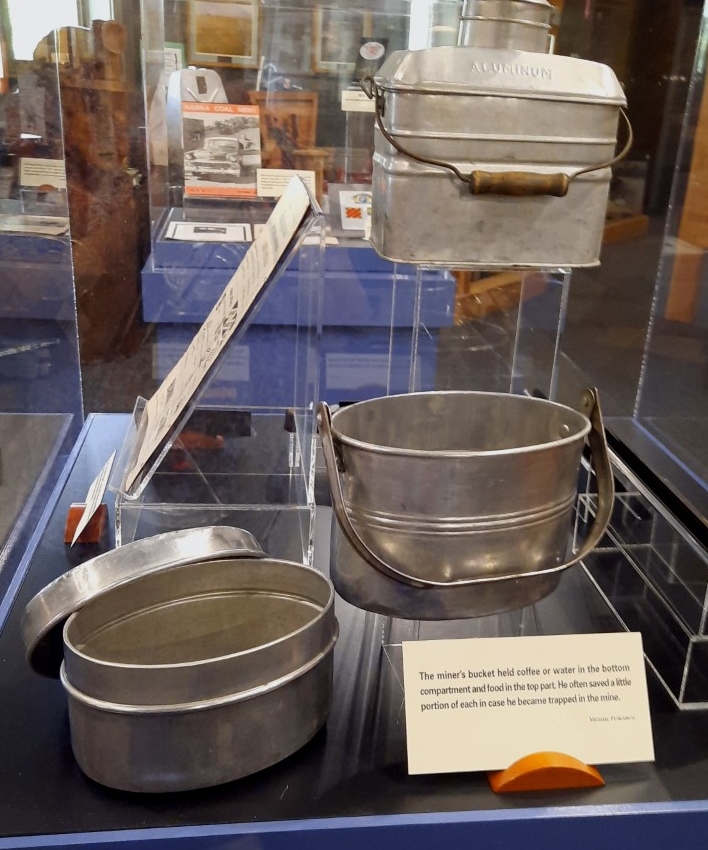
The miner’s dinner pail hung from a nail in the mine to keep the rats out.

Everyone went to work swinging their dinner pail. If they were lucky, they might have a West Virginia ham sandwich inside. By the way, that ham is what we call bologna. Miners always left something in their dinner pail in case there would happen to be a cave-in. If they had a lucky day, on the way home they would give their dinner pail to one of the children so they could have a snack.

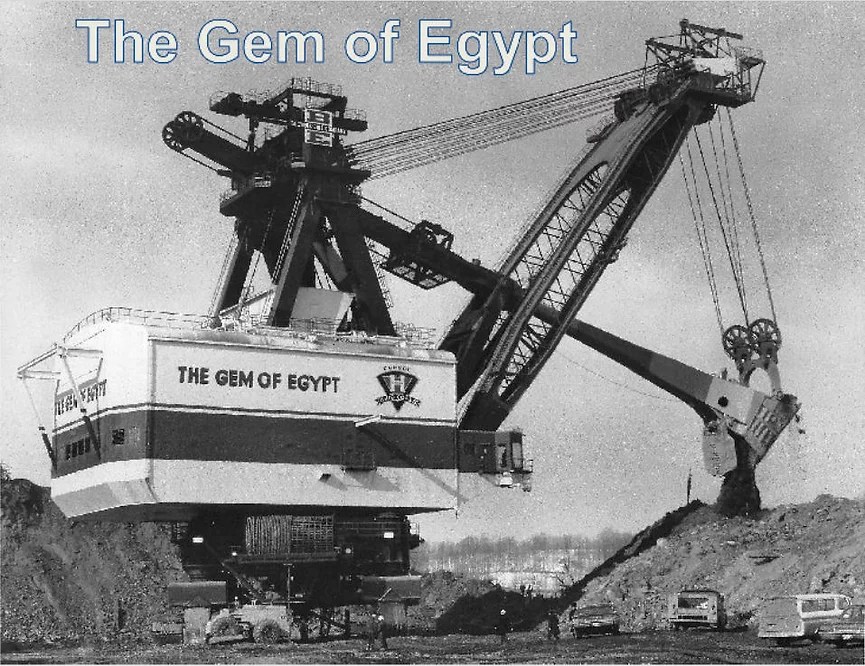
The GEM of Egypt was a power shovel used for strip mining.

Pictures show some of the large machines that mined the coal on ground level. These included the GEM of Egypt (Giant Excavating Machine at Egypt Valley Mine) and the Mountaineer. In 1955, Mountaineer was the first of the super strippers to work in the coalfields around Cadiz.

Tour buses came to see the Mountaineer, the largest mobile land machine ever produced.

A beautiful 99-seat theater shows films about the coal industry and its history. There is a video presentation produced by AEP telling of the conversion of coal to electricity. Students seeing the video realize how much happens before they can turn on their light switch at home.

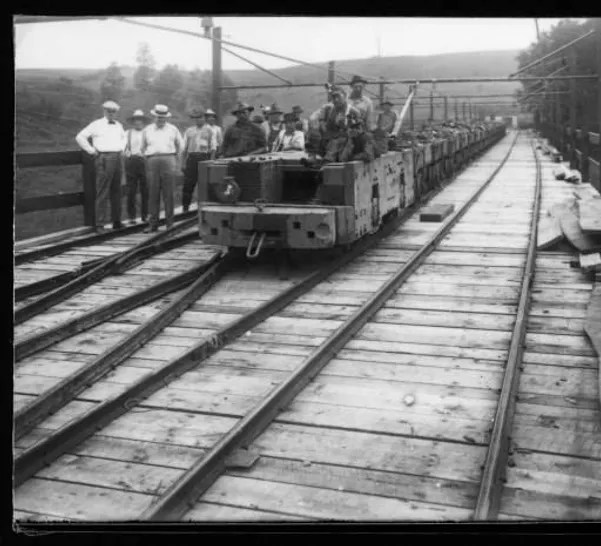
A coal crew works at Short Creek mine in 1910.

A Coal Miners’ Reunion is being planned for May in conjunction with the annual Harrison Coal and Reclamation Park dinner auction. All miners past and present are invited to attend.

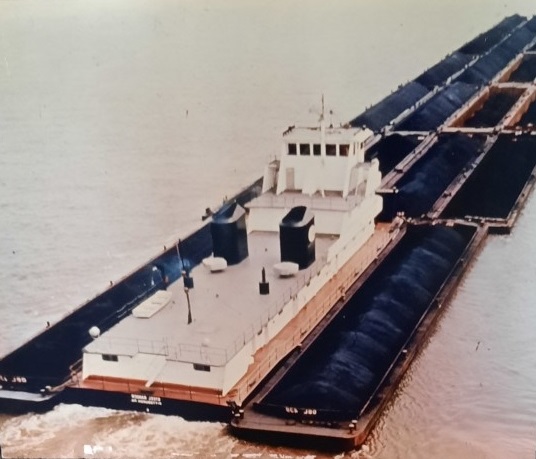
Coal was delivered by barge on the Ohio River.

The Puskarich Public Library and the History of Coal Museum are open Monday through Thursday from 9 am – 8 pm and Friday from 9am – 5pm. Admission is free but donations are appreciated. Check out their website at www.thecoalmuseum.com for more information.

If you enjoy history, you are sure to enjoy all that has been accumulated at the Coal Mining Museum in Cadiz.

General Custer Honored at Birthplace

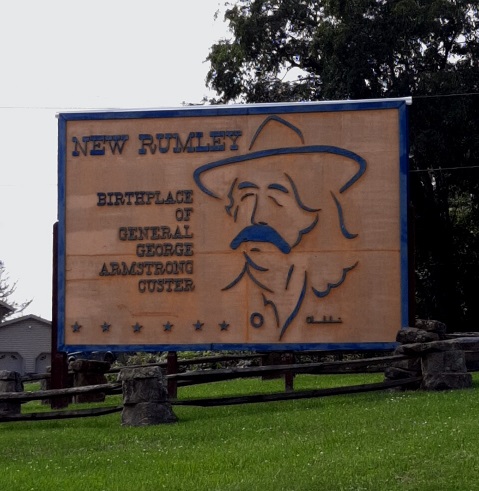
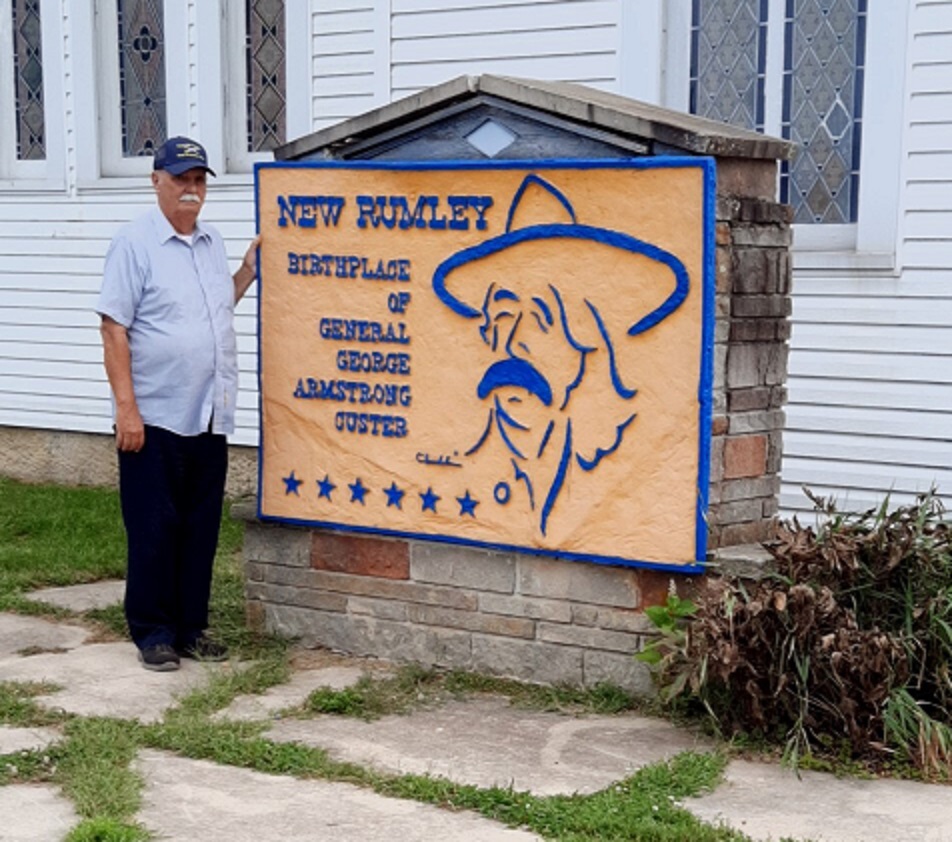
A large outdoor sign points the way to New Rumley and the museum.

New Rumley, Ohio, the birthplace of General George H. Custer, honors him with an annual Custer Observance on the first Saturday of June. This year on June 4, 2022, the day begins with music by JT Thompson of Scio at 11 am by the monument. Members of the Jewett Veterans of Foreign Wars General George Armstrong Custer Post 3071 will raise the flag.

Infantry will demonstrate Civil War-style before Custer Observance Day.

Dr. Mandal Haas of Carrolton returns with his Civil War cannon along with artillery and infantry reenactors to explain the equipment and give demonstrations of their use. Kevin Haney will have his collection of muzzleloaders on display featuring Ager rifles.

Steve and Lisa Ball will sing Civil War songs that tell of life at that time.

After lunch at New Rumley United Methodist Church, Civil War music will be provided by Steve and Lisa Ball. Not only are their songs entertaining, but the stories they tell of their historic significance are always a crowd-pleaser.

The Custer Museum is inside this old church.

An auction of Civil War and Wild West-related items will follow in the sanctuary. The day’s events culminate with remarks from General Custer (aka Rick Williams). Take time to view the museum packed with memorabilia and the historic signs in the pavilion near the monument.

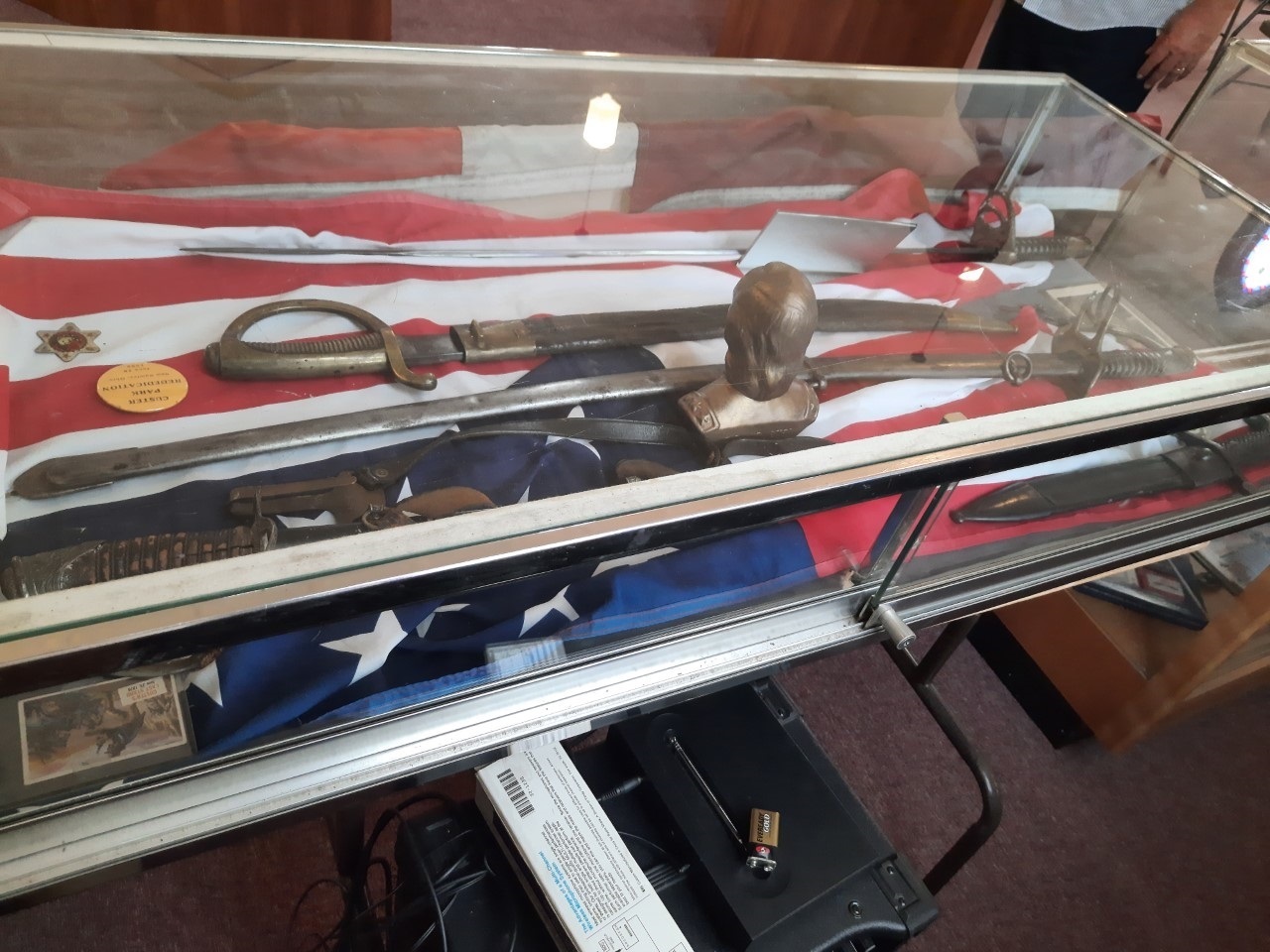
Their collection of Civil War swords is a favorite.

The General Custer Museum in New Rumley, Ohio has a collection of memorabilia from General Custer as well as general Civil War artifacts. One of the most impressive items there is the swords that were used during the Civil War.

Visitors enjoy exploring the museum.

Another impressive piece is a document with the signature of General George H. Custer from 1873 when he was stationed in Memphis, TN. On this particular document, it says that he inspected the horses for the cavalry.

Dave Rose, president, enjoys telling visitors about the museum.

Dave Rose, president of the Custer Museum in New Rumley, has a long-time interest in the Civil War after his great-great-grandfather gave him his Civil War jacket. Dave served in the U.S. Army Cavalry and said they didn’t ride horses but tanks. He spent twenty-four years in Germany serving our country.

When asked to describe General Custer, Dave said, “He was brave…a fighter and hunter.”

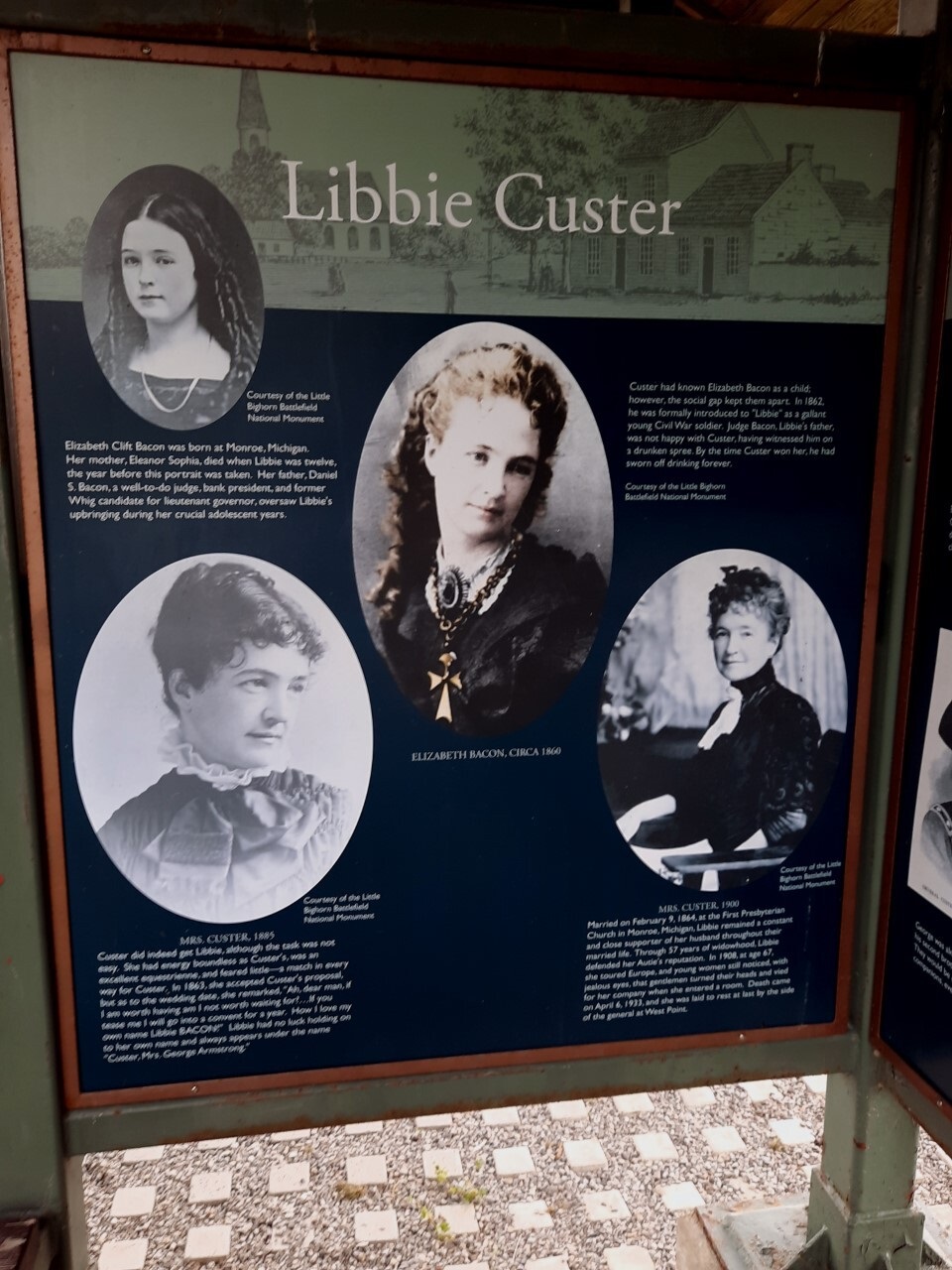
George Custer grew up in a family of several brothers and one sister. George had an attraction to a young lady, whose father was a judge. He didn’t like George’s drinking and forbid his daughter to see him. From that time on George never took another drink as he wanted to marry Elizabeth.

A nearby exhibit tells the story of Libbie, the General’s wife.

George attended West Point and taught school before finally marrying Libbie, who went with him wherever he was sent. George Custer served in the Civil War as Brigadier General and often Libbie stayed in a tent with the military or nearby in a fort. She was always by his side and his biggest cheerleader.

While some feel General Custer wanted to destroy the Indians, everyone does not feel that story to be true. Custer made many friends with the Indians when he was out west and often went hunting with them. General Grant did not like Custer’s affiliation with the Indians and wanted him to leave the Army. At that time many feel Grant sent Custer to Little Big Horn, knowing it would be his downfall. At that final Battle of Little Big Horn, five members of the Custer family died.

George W. Custer statue is a highlight of your visit.

In 1932, the town of New Rumley decided to honor their local hero with a statue. Elizabeth Custer then lived in New York and was unable to attend but through the amazing world of technology even at that early date, she gave a speech from New York that was heard at the dedication ceremony in New Rumley.

The exhibit pavilion near the statue tells the story of General Custer.

Today they have added information boards in a pavilion that tell the history of the general with many pictures included that can be seen throughout the year. It is on the same ground where his birthplace was located and the outline of the bricks shows where the actual house stood.

New Rumley isn’t the only place that holds memories of General George Custer. Monroe, Michigan has a large statue of him on horseback while nearby Cadiz has his signed calling cards and a lock of his hair and Scio has a collection of books and pictures.

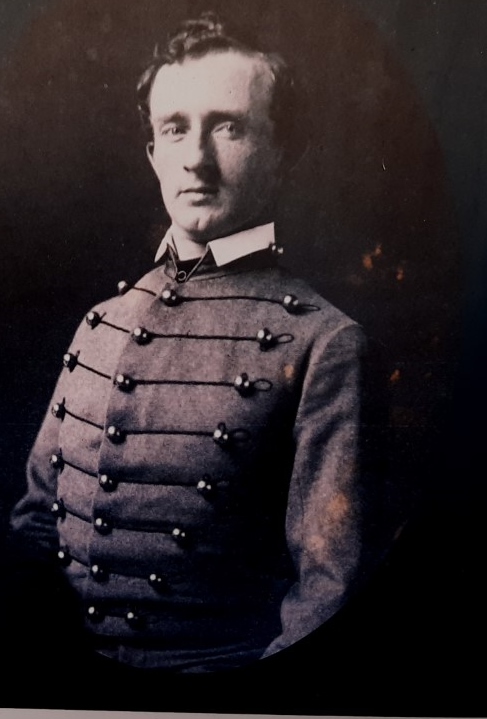
This early picture of George Custer shows him as a West Point cadet.

Visit the Custer Museum in New Rumley on the last Sunday of each month from now until September. The museum will be open on the first Saturday in June from 10 – 5 during the Custer Observance. Enjoy a day learning more about the Civil War and General Custer.

Sistersville West Virginia Oil Well History

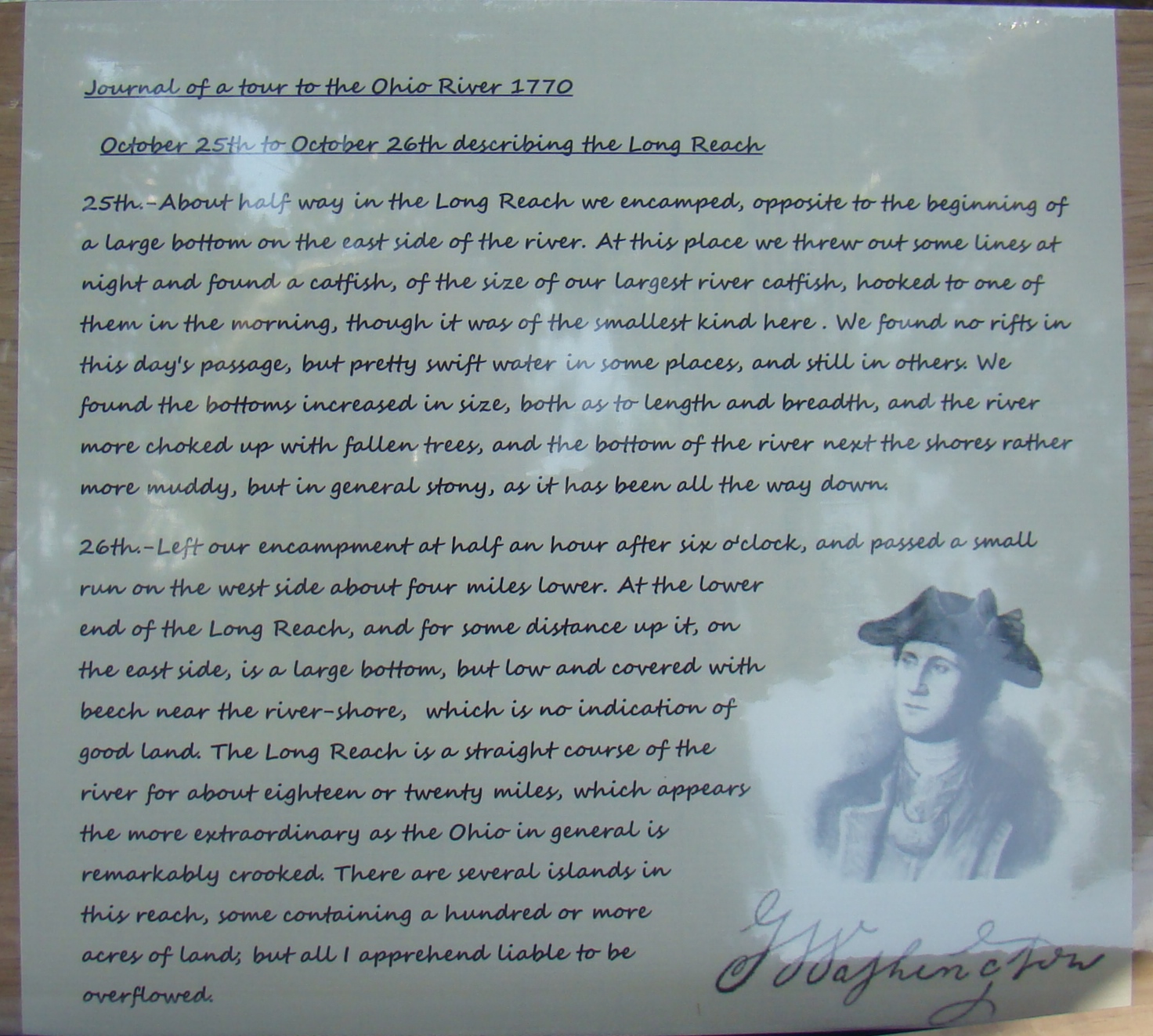
Sistersville’s rich history begins with George Washington really sleeping there in 1770 when he surveyed the Ohio Valley. In his journal, Washington called this stretch of the river “the Long Reach of the Ohio River.”  The river is broad and deep here with hills covered in trees for as far as the eye can see.

Charles Wells was the first to settle here permanently in 1802 naming his settlement Wells’ Landing. While Wells was primarily a farmer, he also served as a representative in the Virginia state legislature. He’s remembered for having fathered 22 children by two wives. Child 20 was named Twenty and 21 Enough. But Betsy came along as child 22.

When he died in 1815, Wells bequeathed the property that makes up much of the business district of the present town to two of his daughters, 17 and 18, named Sarah and Delilah. Each of the children received some property at this time.

The Wells sisters were good businesswomen and laid out the land into 96 lots with eight streets. The town is named for them, Sistersville.

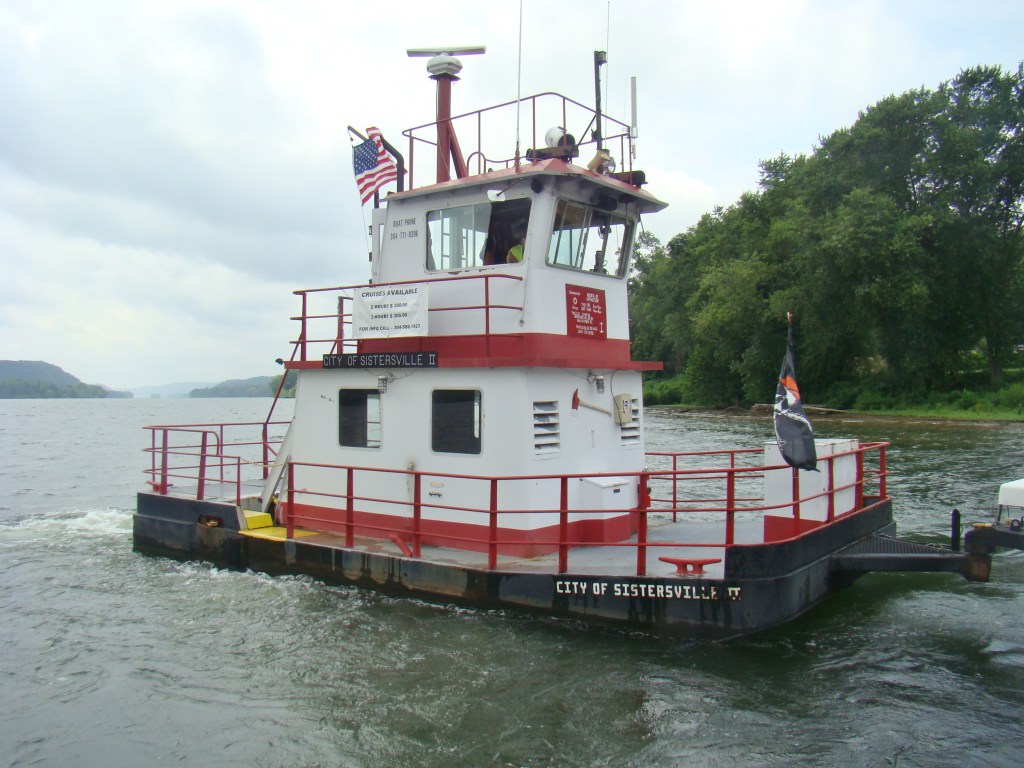
The Sistersville / Fly Ferry still operates to this day across the Ohio River.

In 1817, the Sistersville Ferry was started to take passengers across the Ohio River to Fly, Ohio. It is the oldest ferry in West Virginia and continues to operate until this day.

Before the Civil War, a 51-man military unit, the Sisterville Blues was formed. However, when fighting began, some of these men joined the Confederate Army while others went to the Union Army.  The great-granddaughters of Charles Wells had to hide their Confederate flag behind the wallpaper in their dining room.

When the Civil War ended, Sistersville returned to its quiet farm community. Their first public school was built in 1869 at a cost of $4,000. School lasted only four months then with the teacher being paid  $30 a month.

Peace and quiet came to an end in 1892 when oil was discovered in Pole Cat Hollow just up the river from Sistersville. Quickly, the Sistersville Oil Field began producing over 16,000 barrels of oil a day at 55 cents a barrel. This meant an increase in oil field workers and Sistersville boomed from a town of 600 to one of 12,000. Money flowed in that town as well as the oil wells.

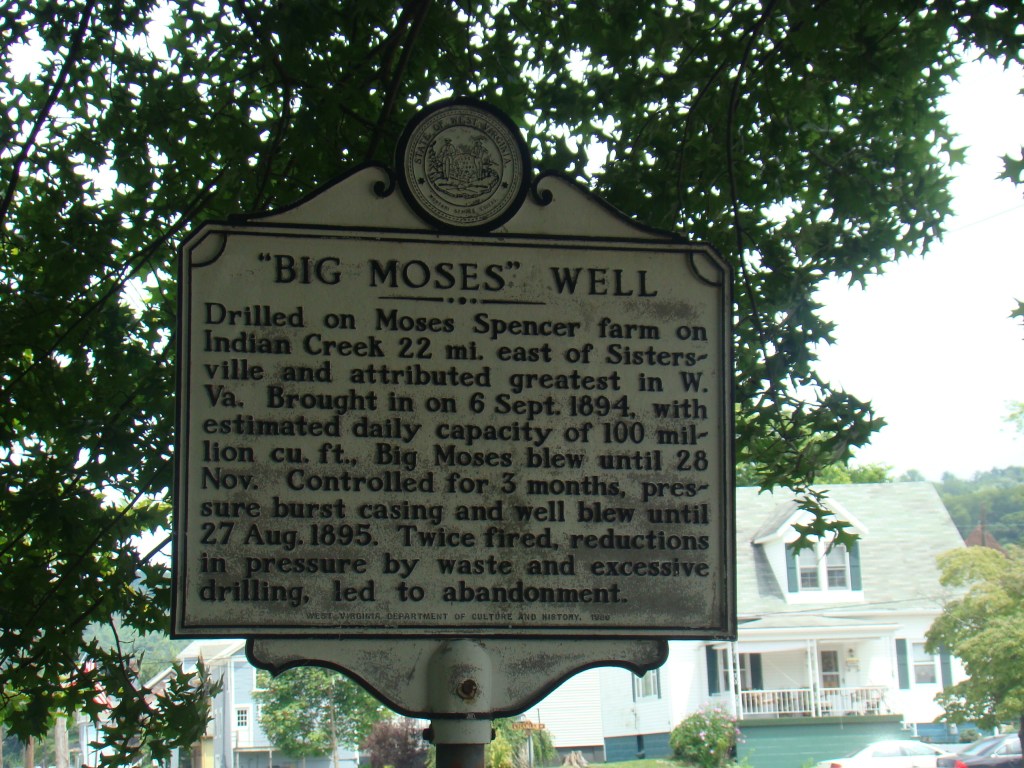
The Big Moses Well is often said to be West Virginia’s greatest oil strike.

Twenty-two miles east of Sistersville, The Big Moses Well drilled on the farm of Moses Spencer is attributed as being the greatest oil well in W.V. Drilled in September 1894, it had a daily capacity of 100 million cu.ft. This well blew until December 1895.

You can imagine all the businesses that opened for so many new residents. Banks, a newspaper, boarding houses and of course, saloons, gambling parlors and brothels, many of which were located on Sinner’s Boulevard. With this quick growth in population, many lived in houseboats called floating shanties along the riverbanks.  Others lived in oil field shacks, which cost about $500. The only inside plumbing was usually a cold water faucet in the kitchen with outdoor toilets on every property.

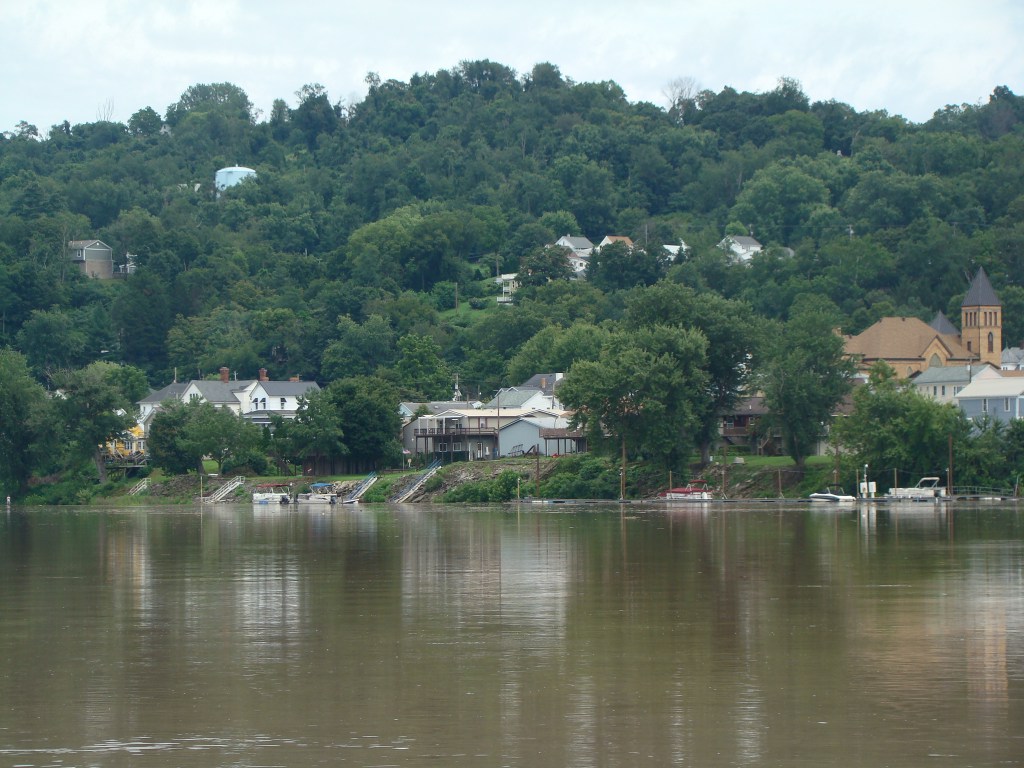
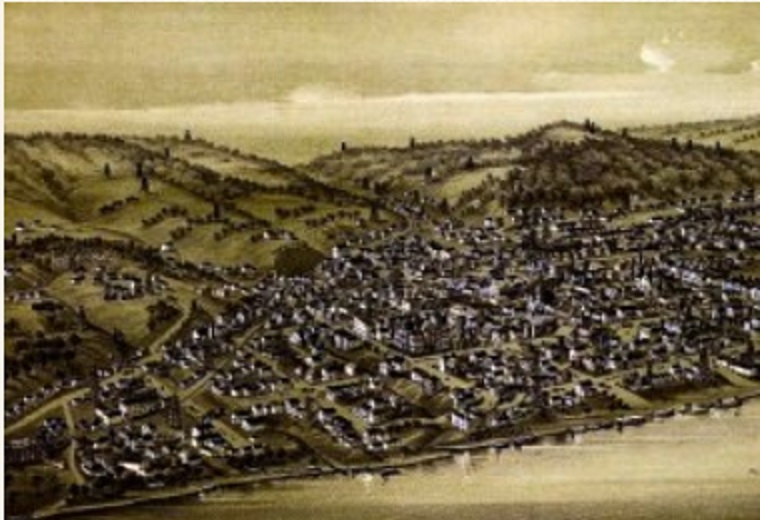
This is the Sistersville view from the other side of the Ohio River.

The well-to-do lived in beautiful homes and five of them are still in existence today in Sistersville on Main Street. As the city grew, new sections opened. Old Rough and Ready, Cow House, and Happy Hollow are a few of the descriptively named neighborhoods. A washerwoman’s house in Happy Hollow bore the sign “Men’s Working Clothes Laundered While You Wait.”

During the oil boom, Sistersville imposed heavy taxes on saloon keepers and gambling house owners. The city also offered bonds for sale to finance improvements. In 1890, water works and a sewer system were installed. All the streets and alleys were paved with brick. A trolley line was built to connect Sistersville with its neighbors, Paden City and New Martinsville to the north and Friendly to the south.

This shows the town of Sistersville during its boom days.

The boom days produced an interesting mix of residents. The original farmers, business people, oil field workers, hooligans, and prostitutes lived side by side among oil derricks and pumping wells. A city resident who was a child during these heady days reported that Madam Stoddard, proprietor of a “sporting house,” was loved by the town’s children. Every year when the circus came to town, Madam Stoddard had her butler round up all the neighborhood children and take them to see the show. The Madam also happened to be the sister of the chief of police.

More respectable forms of entertainment also grew. Private social clubs were formed such as the Americus Club, The Sistersville Music and Literary Club, and the “selective, exclusive” Sistersville Mandolin and Guitar Society.

In the 1890s, Sistersville had three thriving theaters: the Columbia, the Auditorium, and Olsen’s Opera House. The Columbia specialized in vaudeville, and the Auditorium could accommodate 1,000 patrons. For less than a dollar, a person could enjoy a performance by the Boston Lyric Opera Company. Silent film star Ben Turpin performed at the Comique, a nightclub.

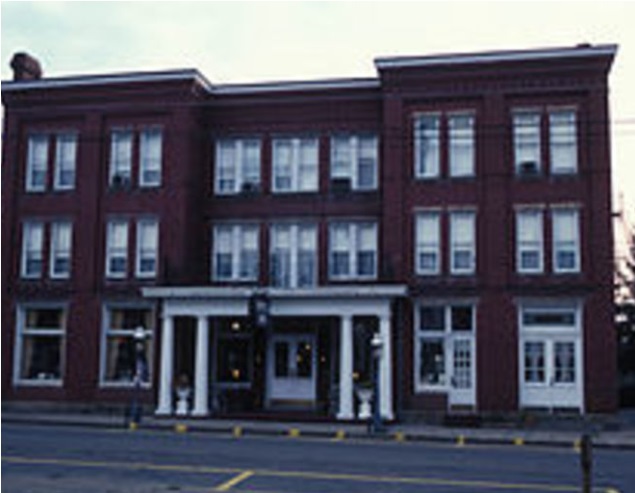
The Wells Inn opened in 1895 to give food and lodging to the oil field workers.

The Wells Inn was built in 1895 by Charles Wells’ grandson, Ephraim. It had 35 rooms, a bar, and a dining room. During boom days, when there were several hotels in Sistersville, the Wells Inn was considered the most elegant. Today it is the only hotel in town, and it has been nicely renovated.

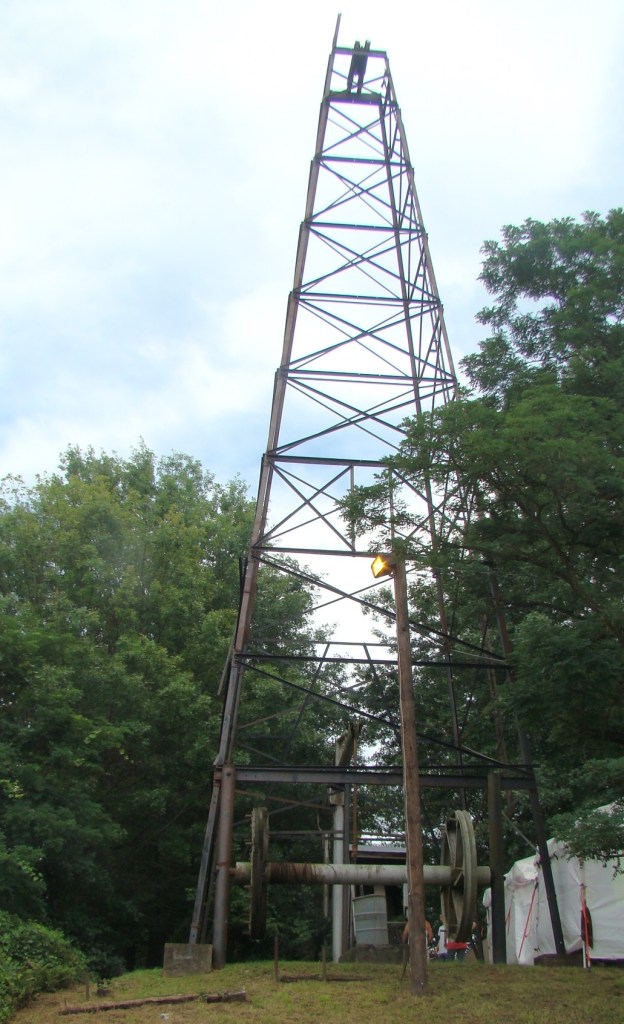
In 1911, the Little Sister well was drilled in the Big Injun Sand to a depth of 1481 feet and was in operation for many years. That derrick is being restored by Quaker State Oil Refining Corp. and The W.V. Oil and Gas Festival, Inc.

Today Sistersville has an excellent display of the Little Sister Well on the banks of the Ohio River. While visiting, you’ll want to be certain to take a ride on the Sistersville/Fly Ferry.

Explore Ohio Art Corridor in Southeastern Ohio

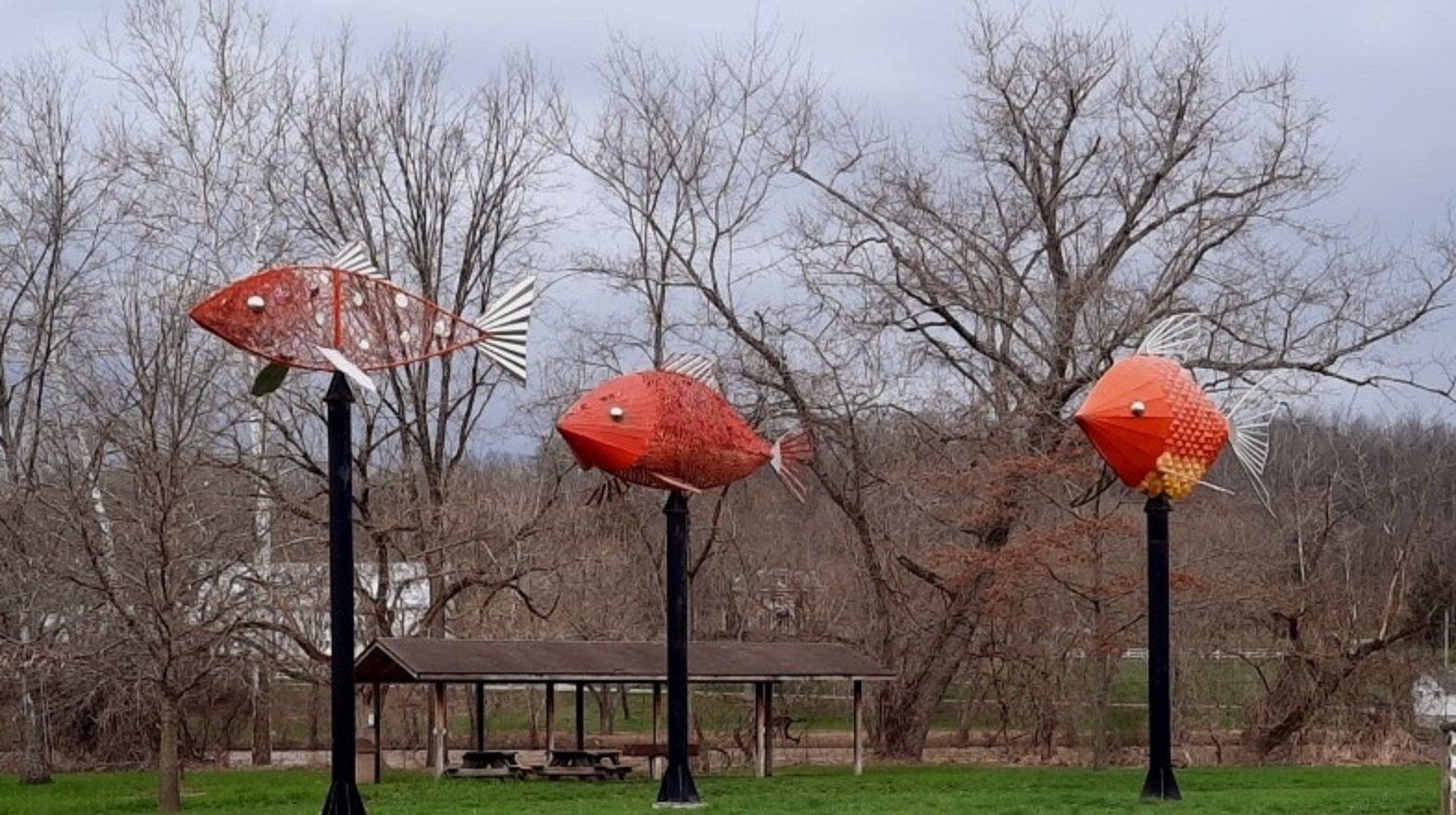
School of Fish along the Muskingum River was the first sculpture made especially for the Ohio Art Corridor.

Sunday drives are the perfect time to explore The Ohio Art Corridor in Southeastern Ohio. There are over 150 miles of road to follow at a leisurely pace so you can enjoy the unique local art. Why, it’s like a Drive-Thru Art Gallery!

This public art trail contains everything from murals to oversized sculptures as it winds through the Appalachian region. It’s open 24 hours a day, 7 days a week.

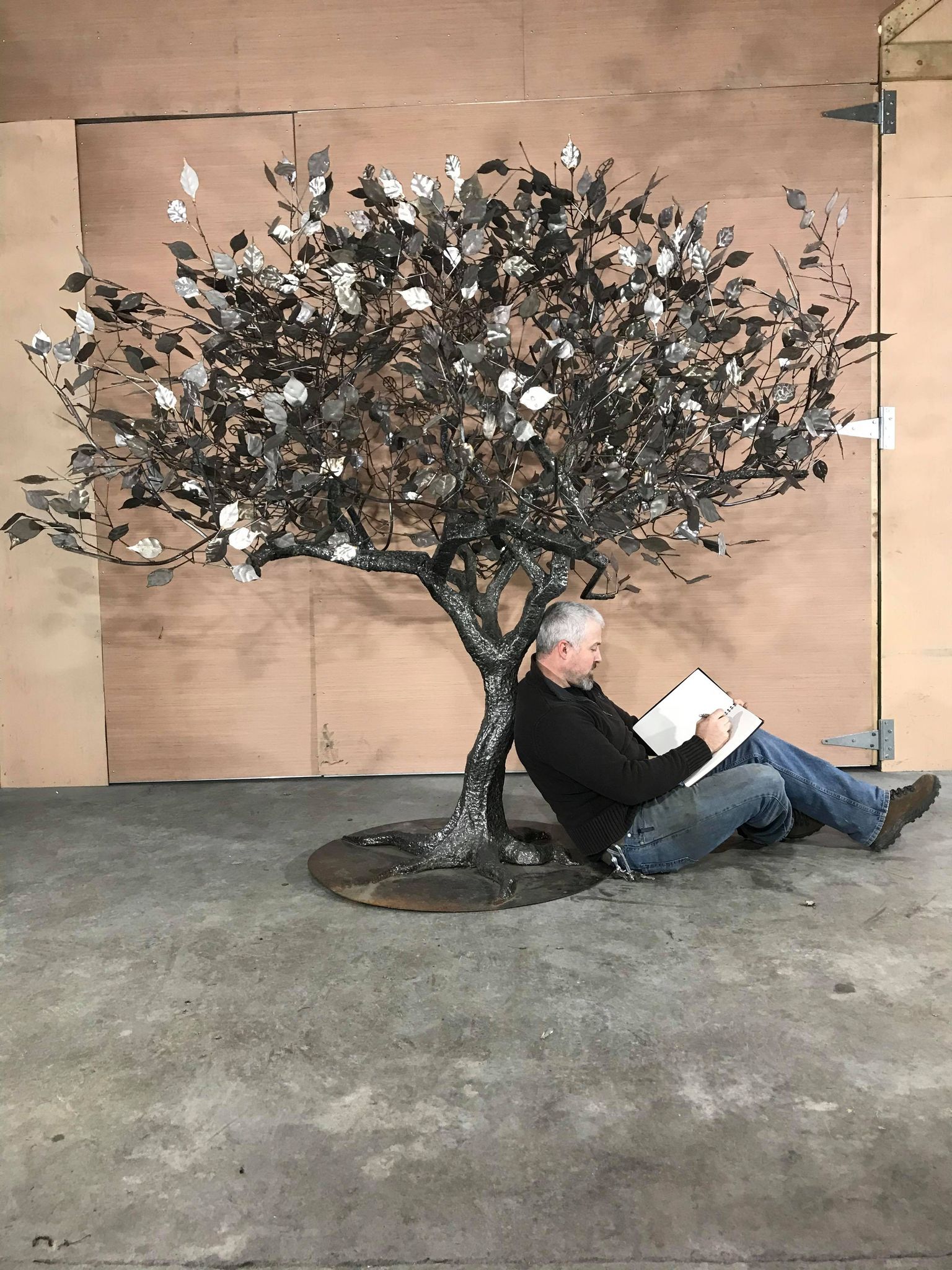
David is pictured under his Tree of Life, which can be found in Lancaster.

David and Rebekah Griesmyer are the masterminds behind the Ohio Art Corridor. David created School of Fish, the first piece of sculpture made just for the art trail. The fish swim through the air along the Muskingum River in McConnelsville across from the fairgrounds. Each fish measures 15- 20 feet in length.

His sister-in-law, Rebekah is the director of this non-profit organization. Their idea was to provide Appalachia access to culture, art, and educational experiences along a trail that would boost tourism in small towns and areas often overlooked.

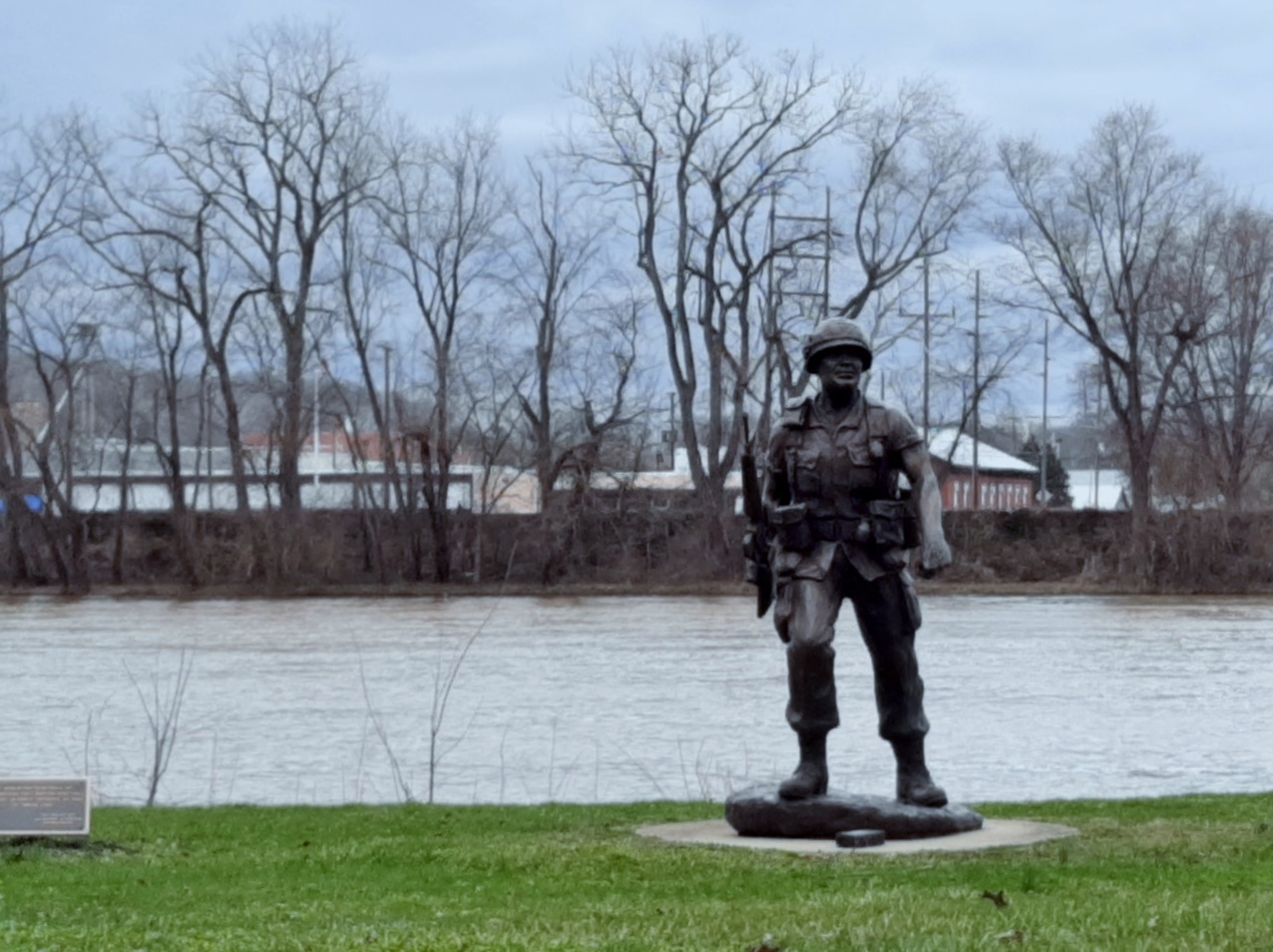
This bronze statue of a soldier stands along the Muskingum River at Zane’s Landing.

The Ohio Art Corridor is working with welding and art programs throughout Southeastern Ohio to teach skills needed to create jobs. Interns are invited to help with creating the giant art sculptures along the corridor. They are hoping to partner with local schools in the future to involve students in designing the sculptures.

Flight of the Hawk Park in Lancaster has objects on the ground as well as in the air.

If you have an art piece you would like included on the trail, it has to meet certain criteria:

  1. The piece must be outdoors and free of charge.
  2. Stand-alone sculptures must be of a generous size.
  3. If the artwork is smaller than12 feet, there must be a collection of three or more sculptures in one location.
  4. Pieces must be accessible to everyone.

At this time the trail winds through Circleville, Lancaster, Athens, Portsmouth, McConnellsville, and Zanesville, and the list continues to grow daily as new pieces are added. These “micro parks” reflect the local history and beauty of that particular area.

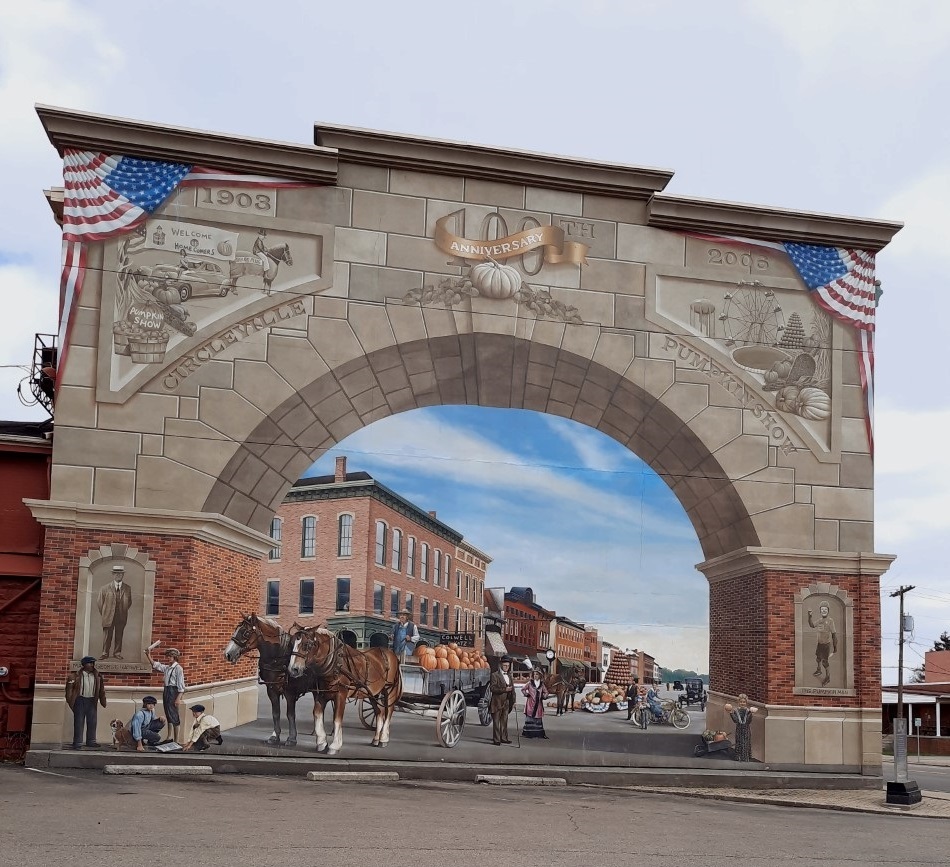
This Circleville mural celebrates 100 years of the Pumpkin Festival there.

Ten large murals by Eric Henn can be found in downtown Circleville. One celebrates the bicentennial of Circleville while another depicts the many activities involved with their annual Pumpkin Festival, which has been celebrated for over 100 years.

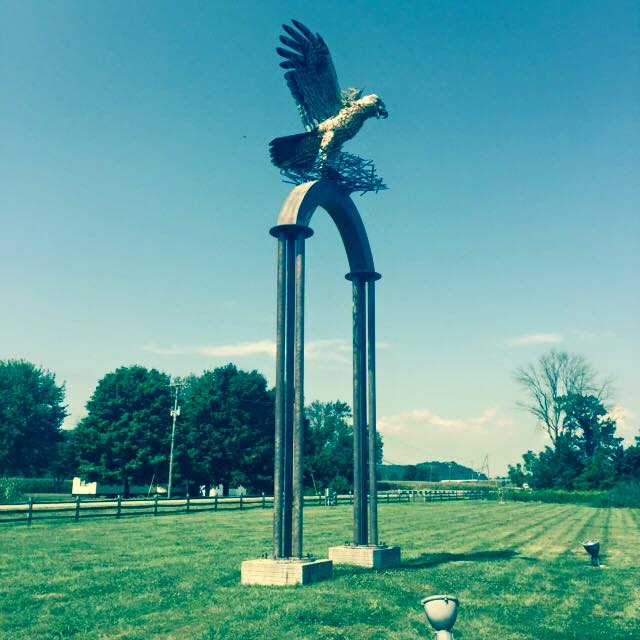
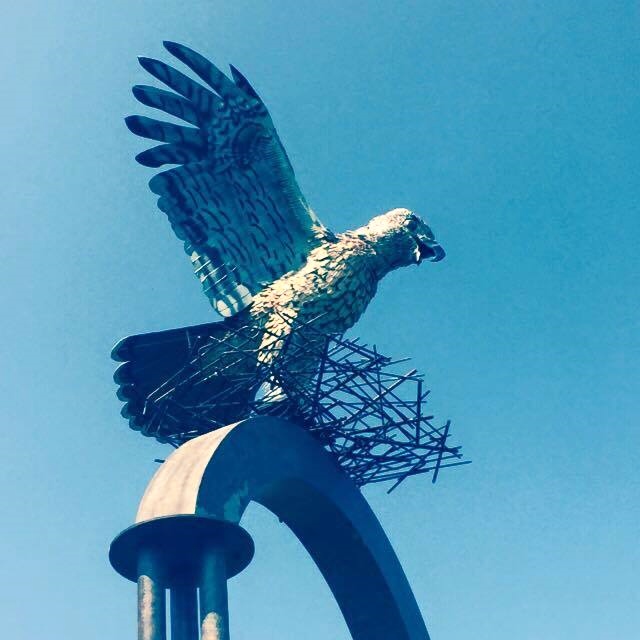
A red-tailed hawk at Flight of the Hawk Park in Lancaster alights on its nest 42′ above the ground.

In Lancaster, Ric Leichliter has sculpted several metal vultures in the branches of a tree in the Flight of the Hawk sculpture park just outside of town on Highway 33.

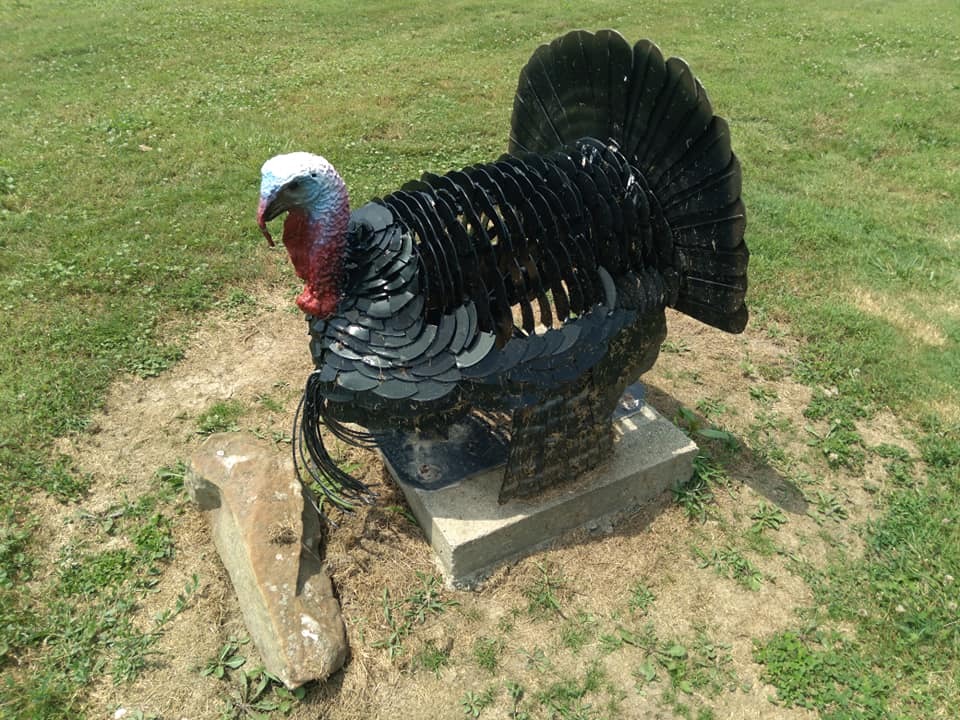
This turkey sculpture joins other turkey and deer sculptures throughout the park.

Turkeys are scattered across the field. The main feature here is a 42-foot tall metal hawk with a wingspan of 14 feet. It’s even lit up at night!

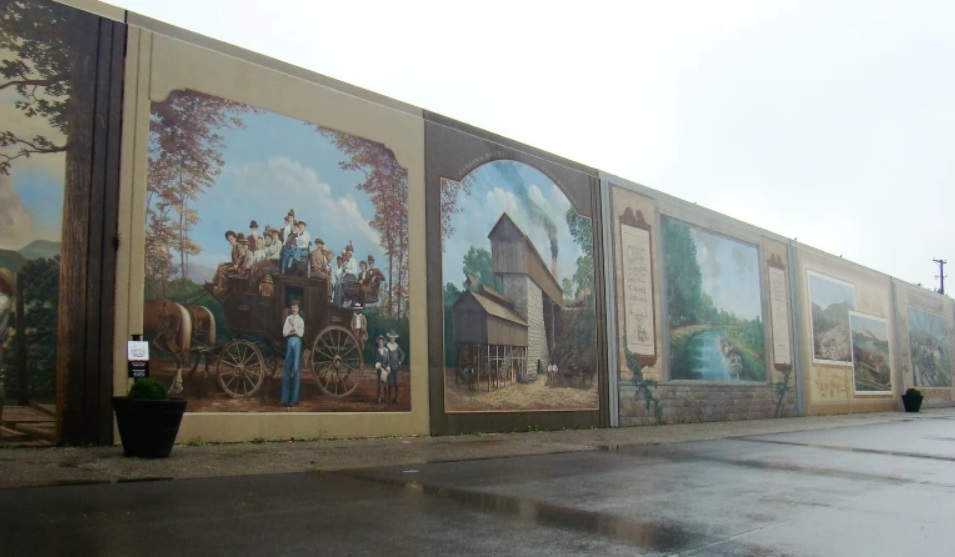
Portsmouth has a Flood Wall over 2000 ‘ long covered with murals.
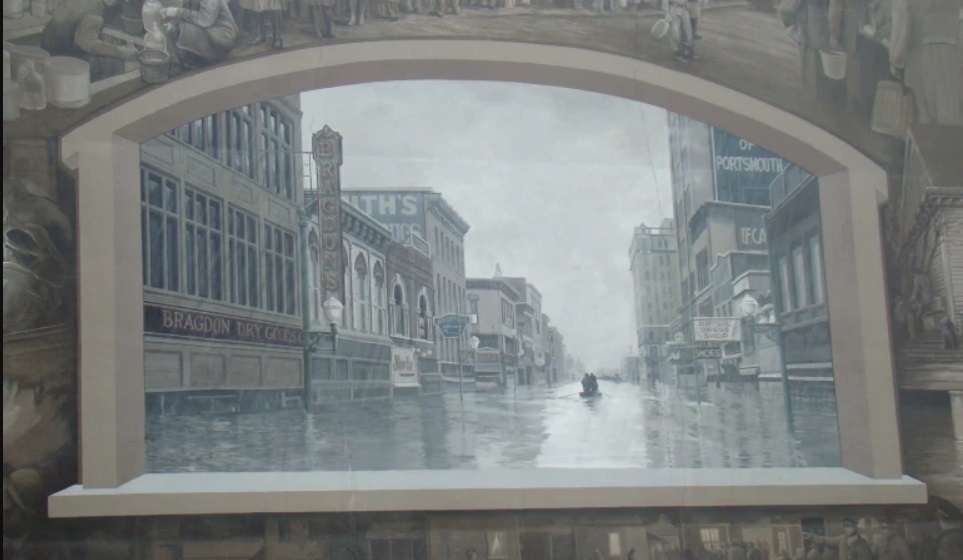
This section of the Flood Wall actually shows the flood of 1937.

Portsmouth has a floodwall, which is 2,200 feet long and covered with murals by Robert Dafford the entire length. It tells the history of Portsmouth during the last two centuries.

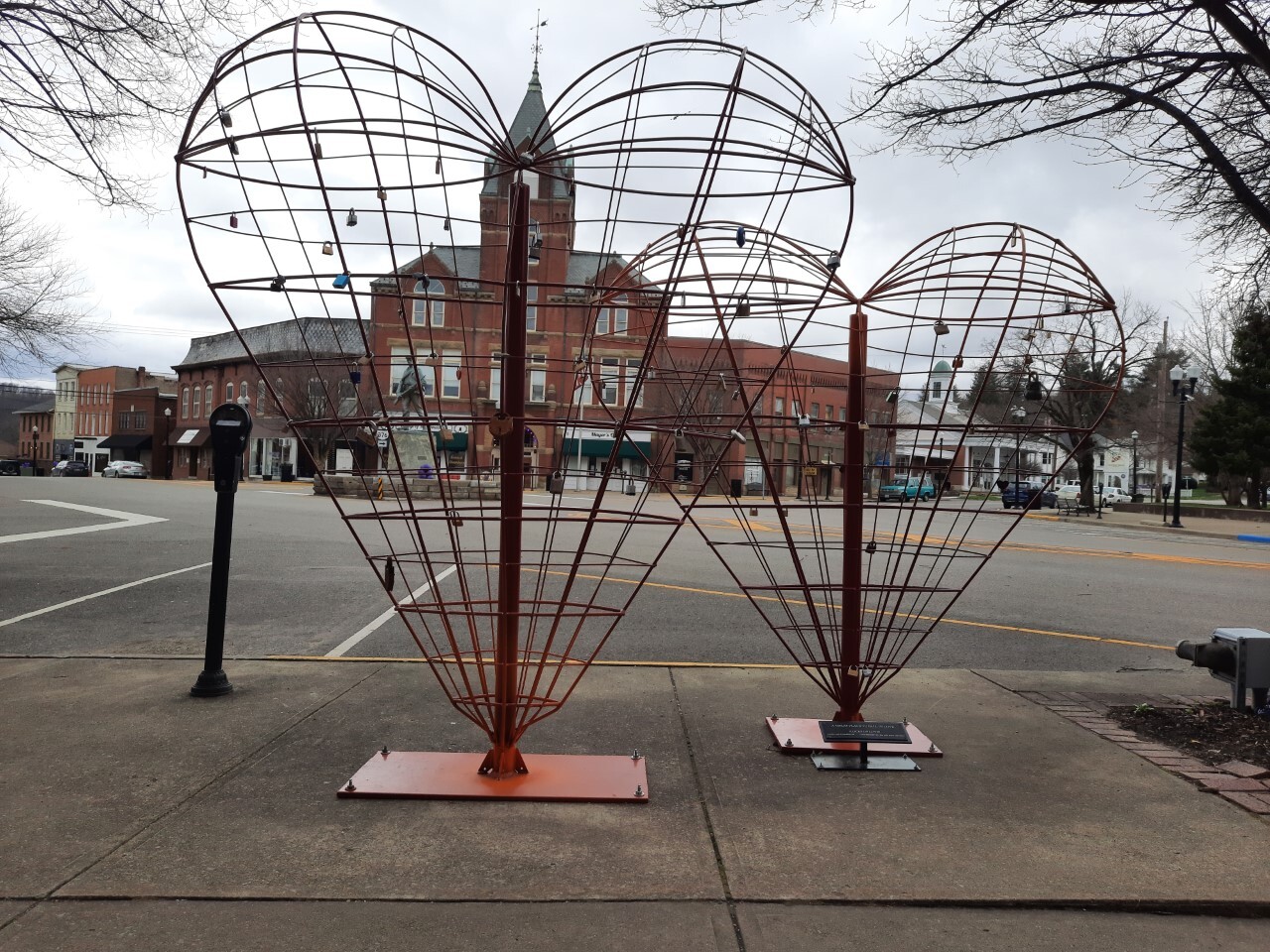
Locks of Love in McConnelsville is the newest addition to the corridor.

A recent addition in McConnelsville is Locks of Love “A Great Place to Fall in Love” created by David Griesmyer. Two large metal hearts are meant to have locks of love put on them just like the bridge in Paris, France. While the hearts have only been in place for a short time, locks are beginning to accumulate.

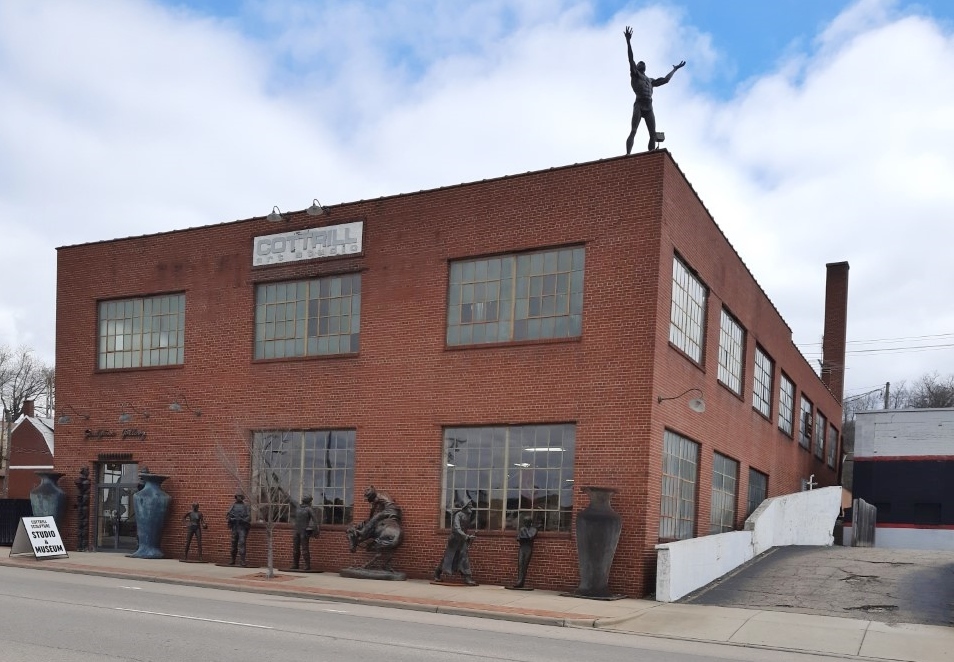
View the sidewalk art at any time at Alan Cottrill’s studio in downtown Zanesville.

Zanesville features Alan Cottrill’s bronze works in a sidewalk display outside his studio with an Indian atop his building to give recognition to his heritage. In Zane’s Landing Park, there are other bronze statues as well as murals that have recently been added.

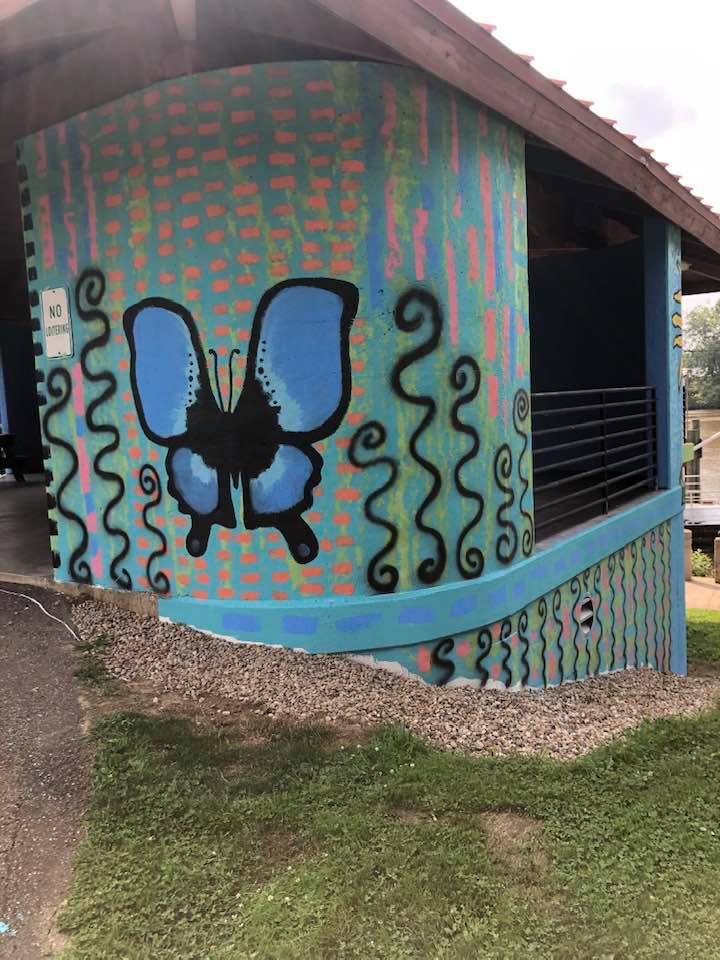
This mural can be found in Zane’s Landing Park.

The Ohio Art Corridor will be the longest and largest outdoor art gallery in the world. It’s over 150 miles long! The other large outdoor gallery in Stockholm is 70 miles in length. Surrounded by parks, tables, and benches, The Ohio Art Corridor will be a place for generations to gather for years to come.

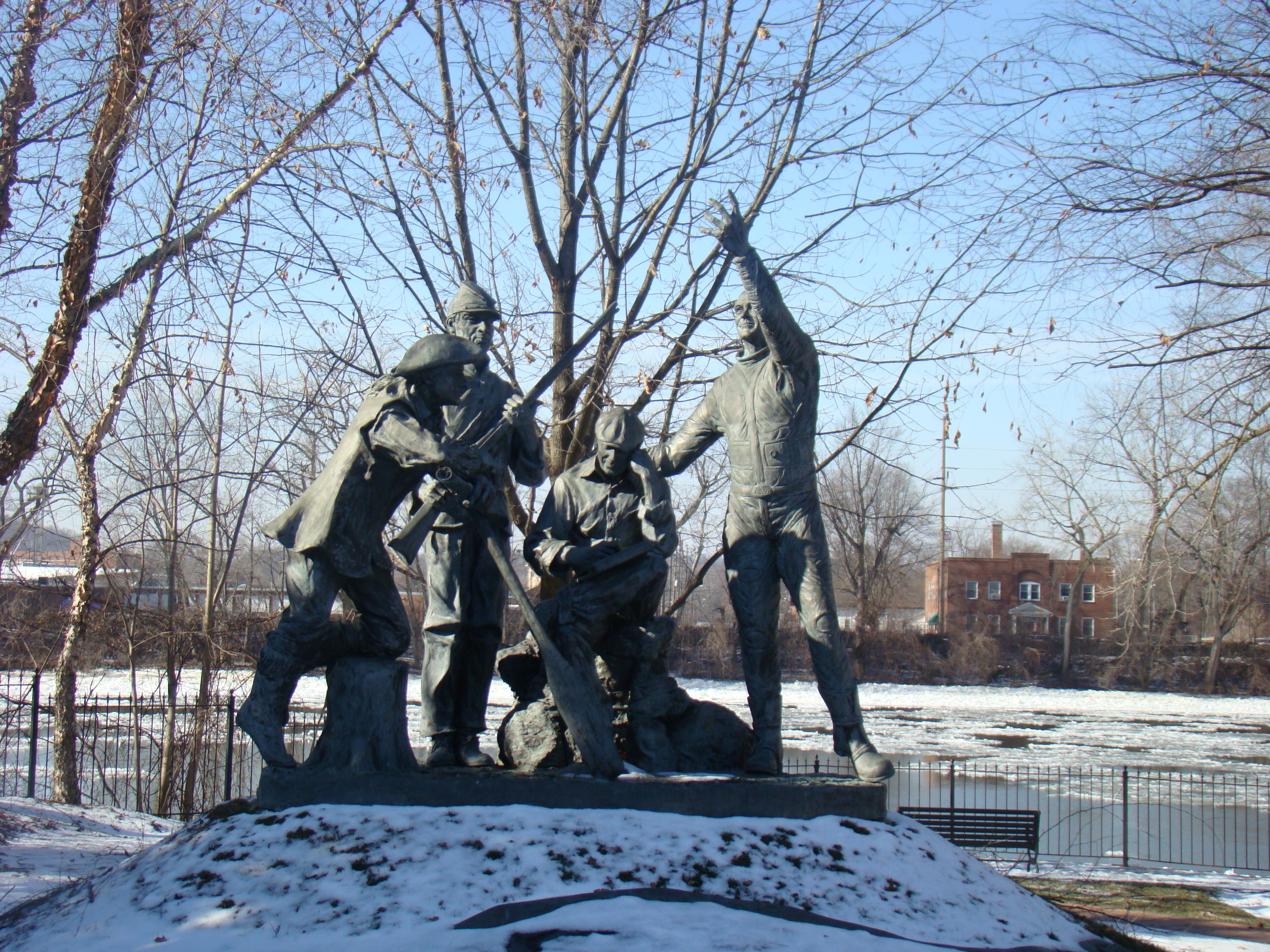
A bicentennial Legacy Monument depicts four notable people in the history of the Zanesville area.

You might want to take a long Sunday drive, or break the corridor up into sections and do several small day trips. That way you’ll be able to spend more time in the communities along the way. Whichever way you choose, if you enjoy art you are certain to find this an enjoyable trail to explore.

Visit The Works in Newark for Science Exploration

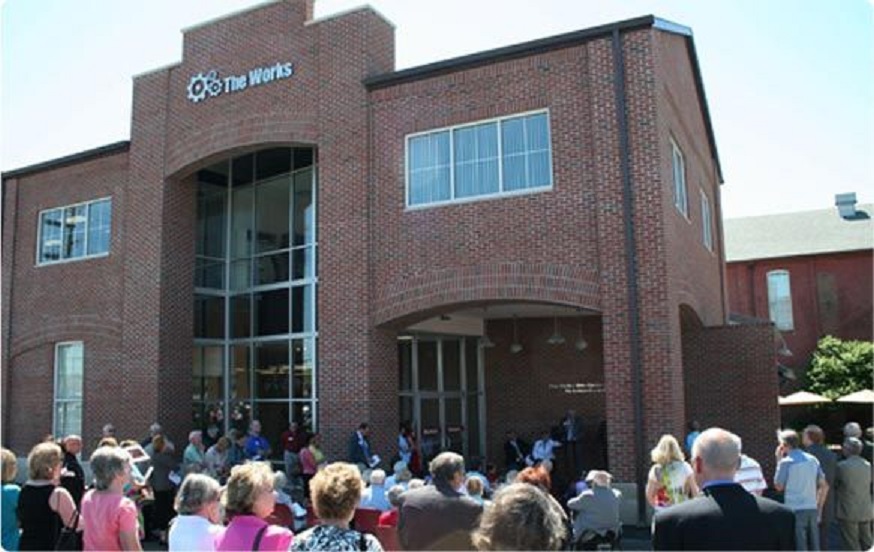
School groups and families enjoy exploring The Works in Newark.

Let your imagination soar at The Works in Newark. Everyone from children to adults will find something they enjoy either in the world of science or the history of Newark. Winter is the perfect time to visit this indoor facility filled with experiments and fun.

The Works began in the early 1990s when Howard LeFevre and a group of local citizens were searching for a way to preserve Licking County’s rich industrial heritage. He wanted to use history to provide the foundation for educational programs.

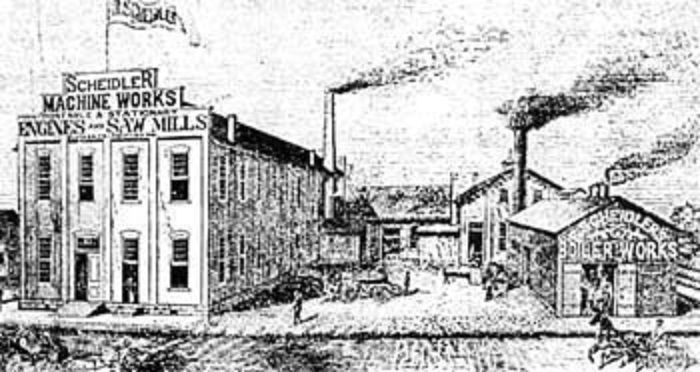
Earliest exhibits were in the Scheidler Machine Works, an 1800s business.

The first exhibits were located in The Scheidler Machine Works, a business from 1882. However, it wasn’t long before several additions were necessary and before you know it The Works Complex filled 6 acres and 11 buildings – an entire city block – very close to the courthouse in downtown Newark.

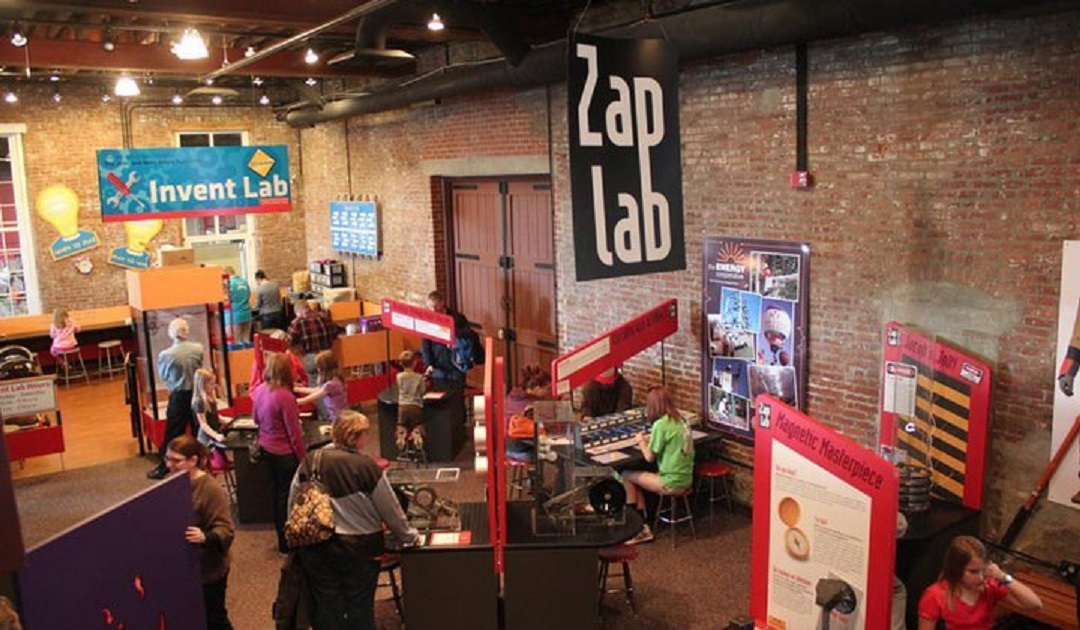
Youngsters learn about electricity in the Zap Lab.

Today the complex is filled with fun and education. On the first floor, there are simulated cars to drive and Legos to build and race, A multitude of craft supplies help kids use their imaginations to make a piece of art they can take home with them. It’s a great place if your child enjoys science with many special labs for hands-on activities for learning and fun.

A glass-blowing exhibit amazes young and old.

A glassblowing exhibit is a favorite of many. A well-supplied room with all the tools needed for blowing glass has adults and children oohing and aahing. Pre-register on certain dates to complete a glass project while visiting. In January and February make a glass heart!

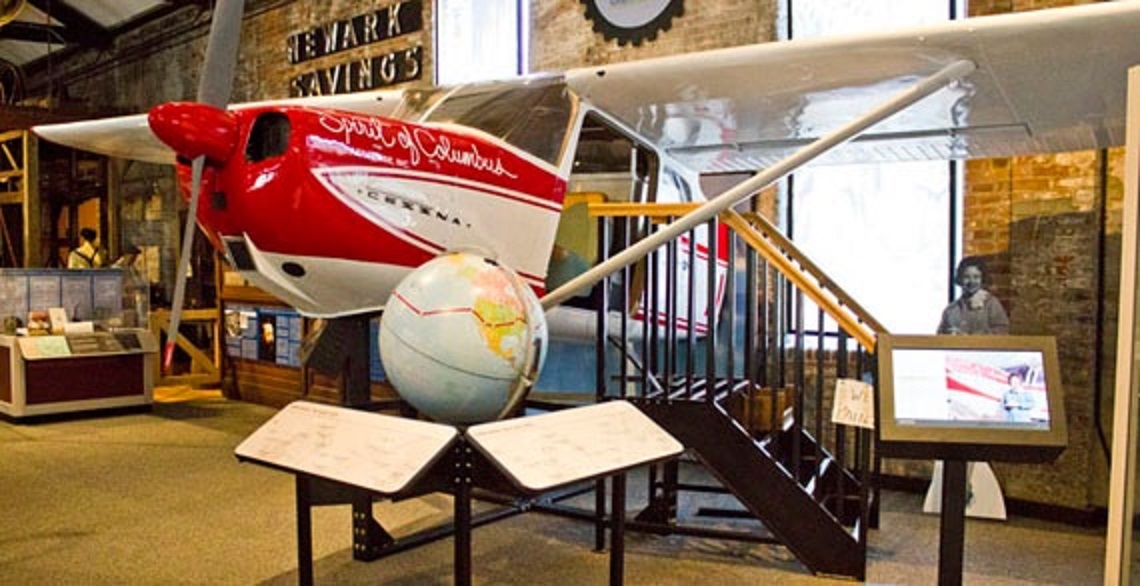
Become a flight simulator in a replica of the Spirit of Columbus.

The second floor overflows with history of the area. Learn about glassmakers Heisey Glass and Corning Owens. See old telephones and typewriters as you explore replicas of local shops that were in the area over a century ago. Some were previously at COSI’s old home. Hear the story of Newark native, Jerrie Mock, the first woman to fly solo around the world. There’s an excellent display of canal history as well.

Don’t forget the Art Gallery featuring national and local artists in a variety of mediums. Gallery exhibits change quarterly to keep artwork fresh and exciting.

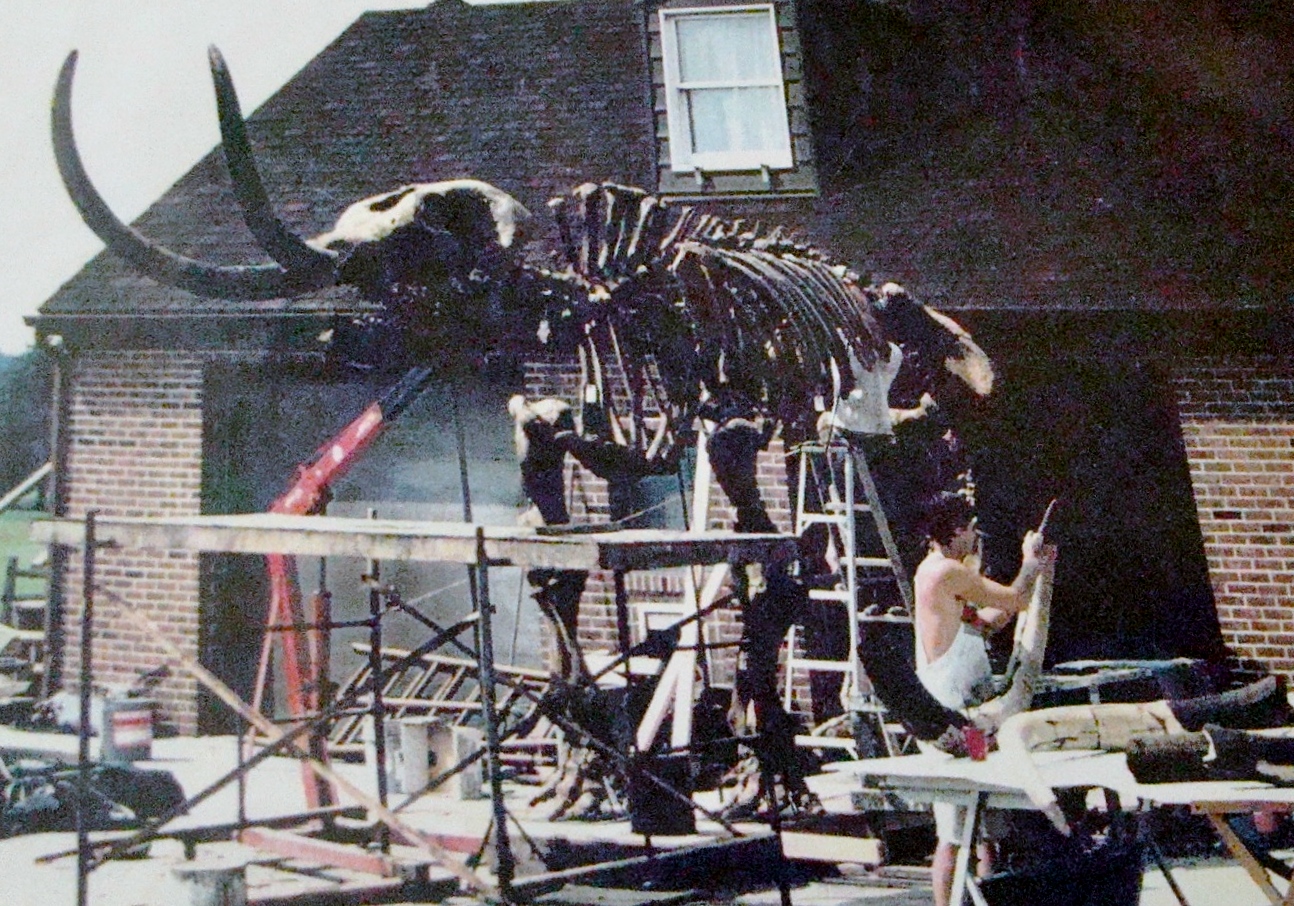
Workers assemble a Mastodon skeleton when digging a pond in Heath.

An amazing exhibit displays parts of a mastodon skeleton discovery in 1989 near Buckeye Lake when they were digging for a new pond on Burning Tree Golf Course in Heath. It’s called the Burning Tree Mastodon, the most complete mastodon skeleton ever found, and is estimated to be 13,300 years old. The original sold in 1993 for $600,000 and now resides in Japan.

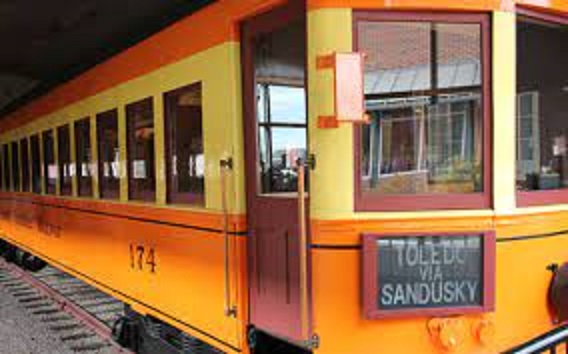
Step into an original interurban car outside the building.

There are places to explore both inside and out. Outside there is an original interurban rail car open for touring or even a birthday party! If you enjoy music, try your hand at the outdoor Pipe Organ where you can perhaps create a tune of your own. The Works’ mission is to enrich people’s lives by providing interactive opportunities that inspire creativity and learning.

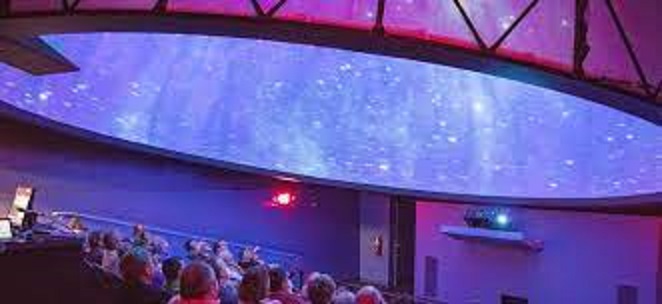
SciDome is a planetarium featuring space-based learning for all ages.

SciDome planetarium is a combined effort between The Works and Ohio State University. A visit is included with your admission so you can enjoy a trip through the nighttime sky, a visit to the solar system, or a journey to Mars. This 30-ft., 4K Projection planetarium includes live planetarium shows as well as full-dome SciDome films. Programs vary so check their schedule before visiting.

They have a traveling program that goes to over fourteen different counties and they provide professional training for area teachers. There is a heavy emphasis on STEM (Science, Technology, Engineering, Math) as it is found in everyday life from measuring ingredients while cooking to launching rockets.

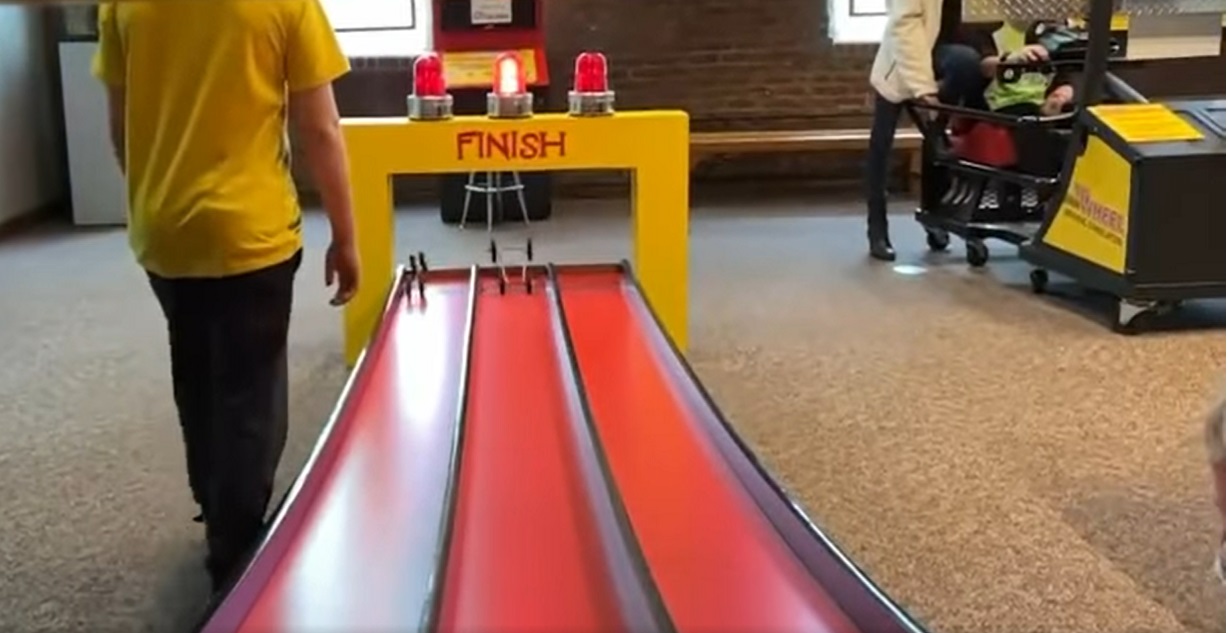
Go Lab encourages building your own vehicle and then racing them.

It’s a great place for a school field trip to learn more about the history of the area as well as experience many hands-on science activities.

See a historical horse-drawn fire hose wagon.

Children especially enjoy the downstairs section, while adults prefer the history on the second floor. Everyone enjoys having a lunch break at the deli, which is connected to the museum by a walkway.

The Works is an affiliate of the Smithsonian Institute in Washington D.C., which gives them access to many exhibits and resources not otherwise available. The museum is open Tuesday through Saturday from 9 – 5 and on Sundays January through March from noon -5 at 55 South First Street in downtown Newark. Admission is very reasonable at $8 for children 3- 17, $12 for adults, and $10 for seniors 55+. There is free and convenient parking in their visitors’ lot very near the front door.

During these winter months, The Works would make a great family outing where there is something everyone would enjoy. Check their calendar of events on their website – http://www.attheworks.org . It’s the perfect place to spark your children’s imagination.

Jerry Thompson Portrays Civil War Santa

Jerry Thompson overflows with the Christmas spirit as he enjoys portraying the Civil War Santa as well as today’s traditional Santa Claus. Usually, it is the adults that enjoy his Civil War stories while the children prefer the modern Santa.

Jerry participated in a Dickens Marathon Reading dressed as Civil War Santa.

While Jerry majored in history at Miami University, his interest in the Civil War began with his great-great-grandfather, Sgt. Major Alfred Weedon. Alfred was born in 1845 on a farm just outside of Liberty, (now Kimbolton) Ohio. In July 1861, he enlisted in the 26th Ohio Volunteer Infantry.

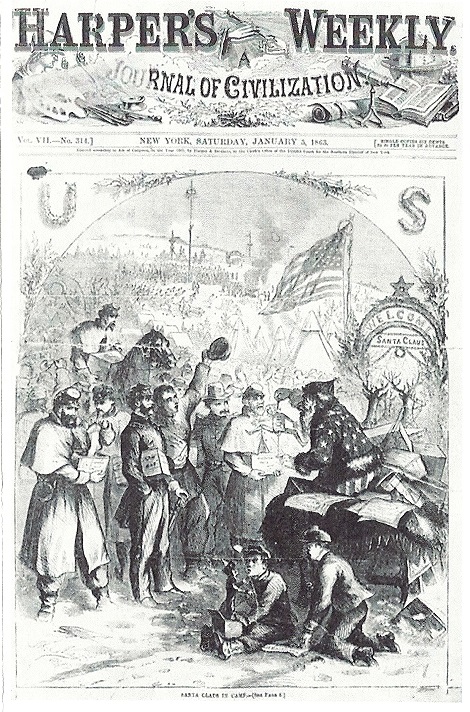
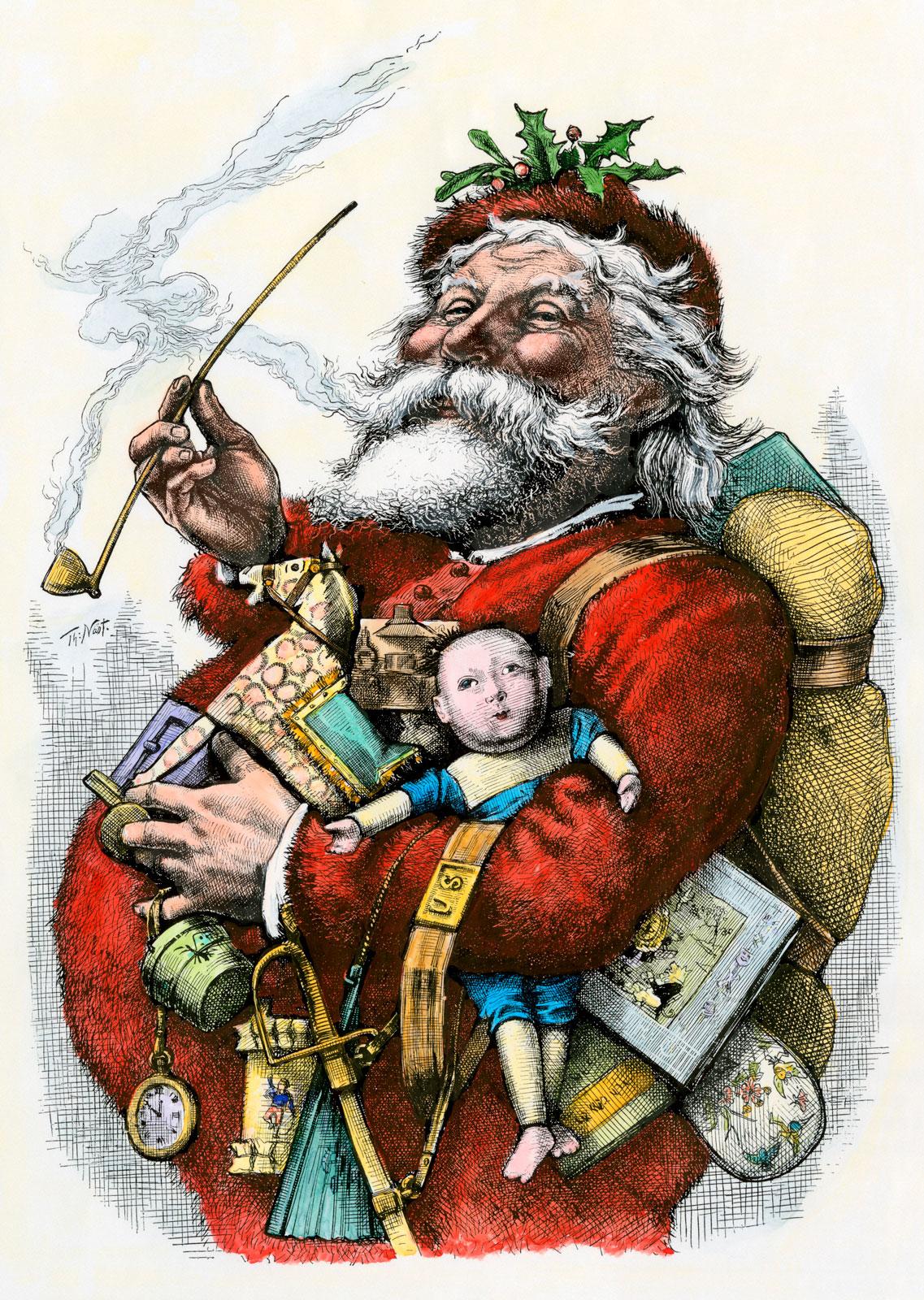
Inspiration was received from a Harper’s Weekly cover by Thomas Nast.

One day, Jerry saw the cover of an old Harper’s Weekly magazine, where they did a story about the Civil War Santa on January 5, 1863. Thomas Nast drew a Civil War Santa distributing gifts to the Union soldiers. It was his first Santa Claus cartoon and the only Civil War Santa he ever drew. From that one publication in Harper’s Weekly, the troops jumped on the idea and it ran through the camps of the Union soldiers.

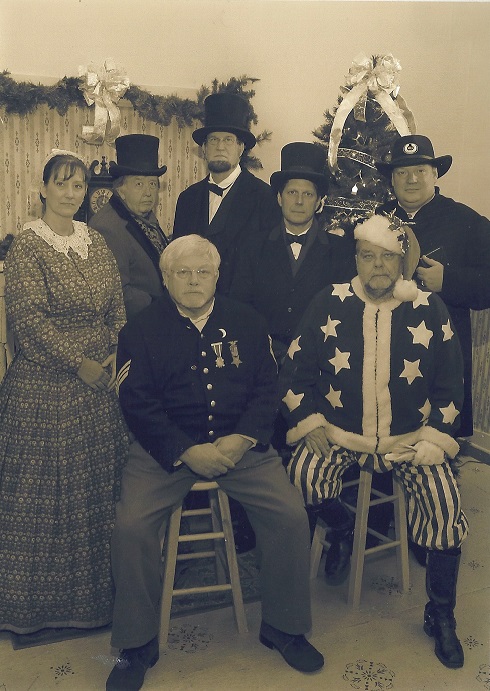
Jerry then jumped on the idea of portraying Civil War Santa to honor his great-great-grandfather. A seamstress from Claysville looked at the picture and designed a costume for Jerry. She used red and white awning material for the pants, and a navy-blue sweatshirt with white stars sewed all over it. The finishing touch was a red hat encircled with holly.

These Civil War historians presented a program at Roscoe Village.

Jerry had been a member of the Southeastern Ohio Civil War Roundtable for many years and served as president. So, it seemed only natural to begin presenting programs at Civil War Roundtables and various Christmas outings. There he told the story of Christmas during the Civil War and especially shared the story of the Civil War experiences of Alfred Weedon, his great-great-grandfather.

You might find interesting some of the highlights he tells. After Alfred enlisted, he fought and was captured in Perrysville, Kentucky, and in 1862 was exchanged and paroled to home for one year, as was a custom at that time. Every week, Alfred had to go to Camp Chase in Columbus by train from Kimbolton to report in.

When his year was up, he was sent to Chatanooga, Tennessee where he participated in the Battle of Missionary Ridge. Even though weak and sickly, Alfred crawled with the rest of the troops to the top of that ridge for a Union victory. Seven months later, during the Battle of Kennesaw Mountain, Alfred was shot in the leg, discharged from the service, and limped through the rest of his life.

Jerry stands by the house on Madison Avenue, where his great-great-grandfather lived a hundred years ago.

When he returned to Ohio, he first went back to his original home in Kimbolton but later moved to Cambridge on Madison Avenue. Mr. Weedon taught school at Birmingham and built the first house at Guernsey Station. He served as Clerk of Courts in Guernsey County, was a member of the Methodist Protestant Church and the Cambridge G.A.R. Post. He’s buried in Northwood Cemetery in Cambridge.

Often Jerry joins other Civil War historians to share stories at libraries and festivals. Roscoe Village held a special Civil War Tree Lighting program, which included many historians from around the area who sang and spoke about the Civil War. Jerry appeared as Civil War Santa.

This image by Thomas Nast helped create our modern version of Santa.

Thomas Nast, born in 1840, is also credited with being the man who invented Santa Claus as we know him today. When he changed the color of Santa’s coat from tan to red, his Santa became the inspiration for the Coca Cola Santa we know so well.

Jerry has also portrayed the traditional Santa at many venues for over 40 years. He’s made thousands of children happy in his Santa appearances at places like Lazarus and many malls. Being Secret Santa for Cassell Station was a pleasure for 25 years.

After 9/11, Santa wore an Uncle Sam hat during the Christmas Parade in the bucket of the firetruck.

In the Cambridge Christmas Parade, that was Jerry that waved as Santa from the bucket of the fire truck for about 20 years. One special year was 2001 after the event of 9/11 when he wore Uncle Sam’s hat instead of the traditional Santa hat.

Santa rode a motorcycle to help promote Christmas in July.

A motorcycle has even carried Santa on a couple of adventures. At Colony Square Mall, he participated in the Motorcyclists for Kids Toy Ride. Then Mark Dubeck from Moore’s Jewelers asked him if he would advertise their Christmas in July sale by riding around town on a motorcycle. Jerry knows how to have fun even if that July day reached 97°.

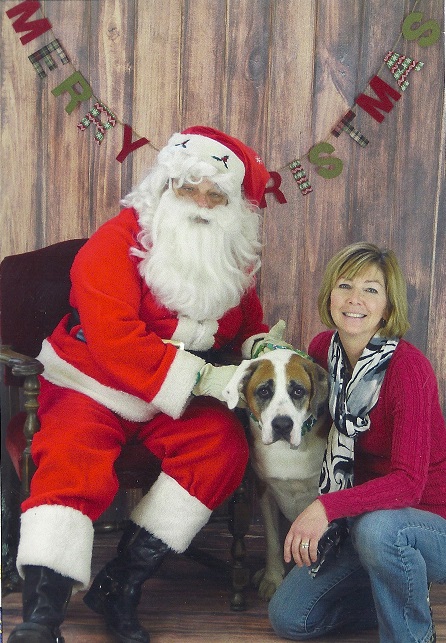
Santa and Moose the Wonder Dog posed for pictures at Pound Partners.

Pets with Santa sponsored a fundraiser for Pound Partners where people could get their pet’s pictures taken with Santa. Moose the Wonder Dog, the Pound Partners’ mascot, received a lot of special attention.

Of course, Santa only takes up a small portion of his life. Activities in the community and with his family fill his schedule these days.

In 2019, Jerry managed the Heritage Tent for the Salt Fork Arts & Crafts Festival. There was a large variety of local talent displayed in that tent from potters and weavers to quilters and fabric designers. Local organizations also took part such as Guernsey County Museum, Cambridge Amateur Radio Association, and The National Road/Zane Grey Museum. In 2021, Jerry managed both the Heritage Tent and the Marketplace.

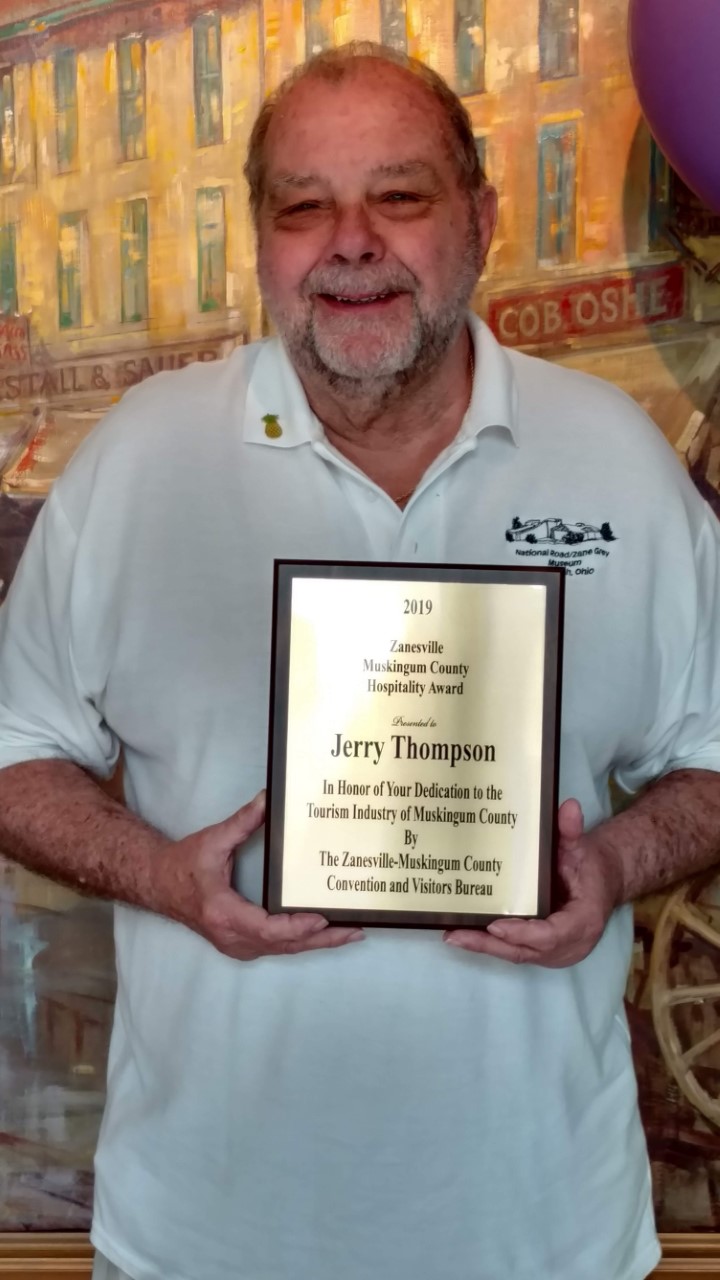
Jerry won the 2019 Muskingum County Hospitality Award.

The Muskingum County Hospitality Award was awarded to Jerry in 2019 for his dedication as a staff member at the Old National Road/Zane Grey Museum. His friendly manner as tour guide and host makes guests feel welcome as soon as they enter the door.

Acting has been something that Jerry has done for years as part of the local Cambridge Performing Arts Center. He played a variety of roles there for around 40 years. Some of his favorites were William Jennings Bryant and Dr. Einstein in Arsenic and Old Lace.

In 2020, Jerry took part in Macbeth at Zanesville Community Theater. Its themes of greed, corruption, violence, and fear seem to have reappeared in 2020. He shook his head when he admitted that learning the lines is harder these days.

Motorcyclists gathered at Colony Square Mall for a Toy Ride.

During the past few years, Jerry has participated in the Dickens Marathon Reading held during the Dickens Victorian Village season. This year Jerry will be in charge of that event and is moving it downtown so more people can enjoy the readings. He always seems to find a way to help the community.

Jerry has led an interesting life locally from radio announcer to dyslexia instructor at Muskingum University. However, one of his favorite activities has been portraying Santa Claus and especially the Civil War Santa in memory of his great-great-grandfather, Alfred Weedon.

Clary Gardens Celebrates 20th Anniversary

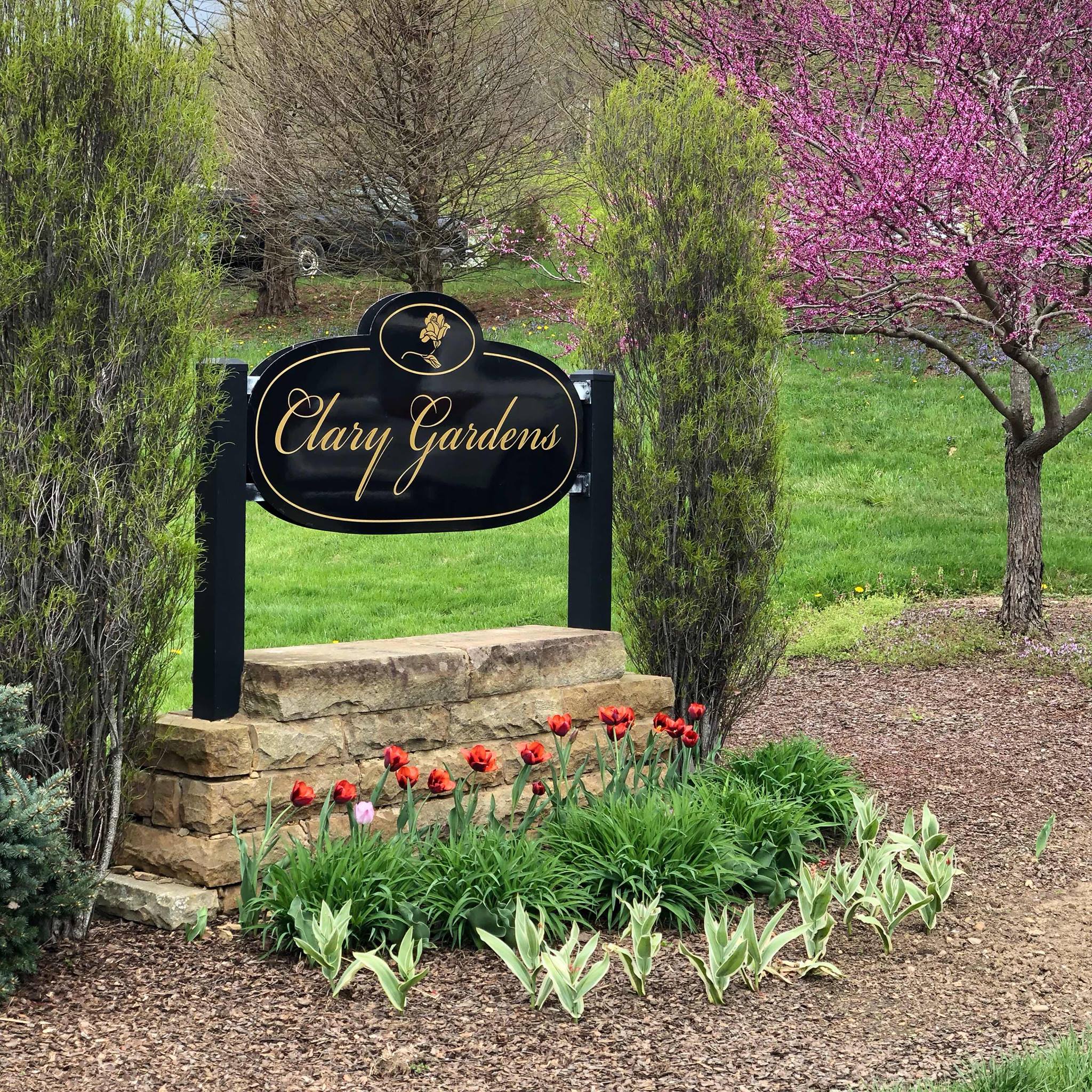
Welcome to Clary Gardens in Coshocton, Ohio.

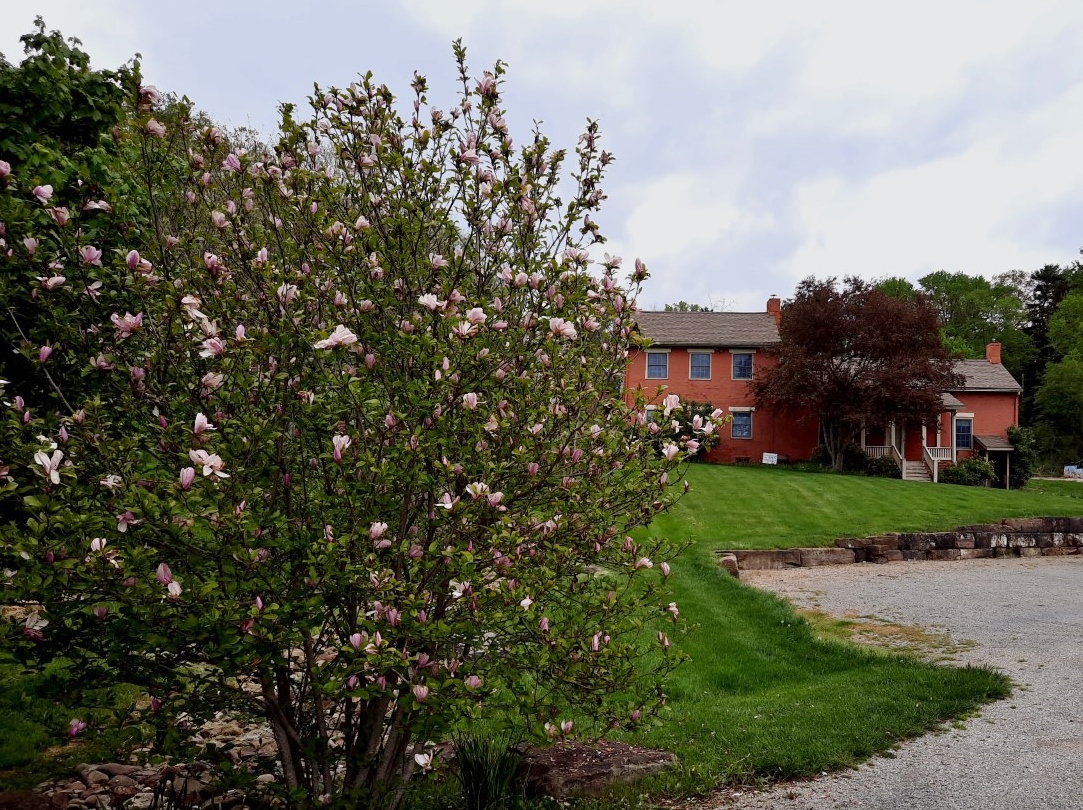
Visit Coshocton as Clary Garden Foundation celebrates its 20th year on their beautiful hillside landscape. The foundation began to encourage the community to develop a botanical garden that would be a place to learn more about horticulture, local history, and the arts.

A local florist, Elizabeth Clary, purchased the 20 acres to memorialize her late husband, Lawrence, in what was to become Clary Gardens. The Clary family had operated a greenhouse in Coshocton for over 100 years and were famous for sending their red roses by rail all over the United States. Over the years, Elizabeth added weeping redbuds, yellow magnolia trees, geraniums, tulips, and 30 varieties of roses to the developing garden.

Ohio Rose & Star quilt pattern can be found here as part of a Coshocton County Quilt Barn Tour.

In honor of the family’s rose business, the Clary Garden barn has become part of the Coshocton County Heritage Quilt Barn Tour. An Ohio Rose & Star quilt pattern has graced the side of their barn since 2003.

You know the place is special the minute you drive through the gate. The setting is beautiful and well maintained. There is no charge for visiting from 8 am to 7 pm daily. The garden is supported by the generosity of the Clary Garden Foundation members.

Spring blossoms add extra beauty early in the year.

“Under the Big Top” has been the theme for 2021 to celebrate their growth over the last 20 years. Floral displays were red, white, and gold – circus colors. There was even a Ringmaster and animals on-site to attract old and young alike.

In the summer months, they have a Nature Program for Children which includes a science adventure and outdoor activity. Grow your own garden! Learn about the plants in the woods.

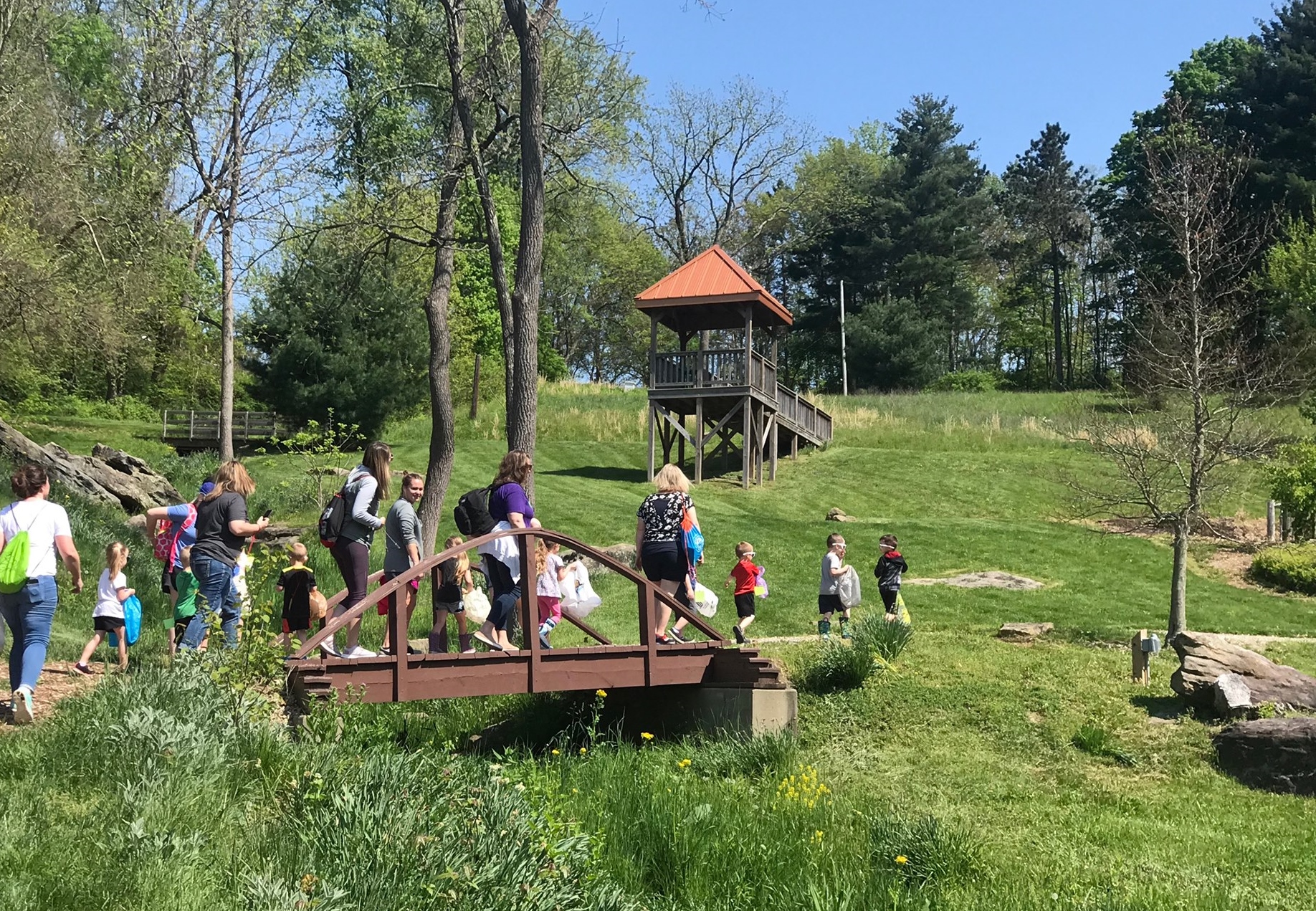
Field trips teach children to explore and enjoy nature.

An assortment of trails makes it possible for people of all ages to find that special place for a walk in nature. Their half-mile Woodland Loop includes some fascinating geological features and is a local favorite. Your dog is welcome as long as you pick up after your furry friend.

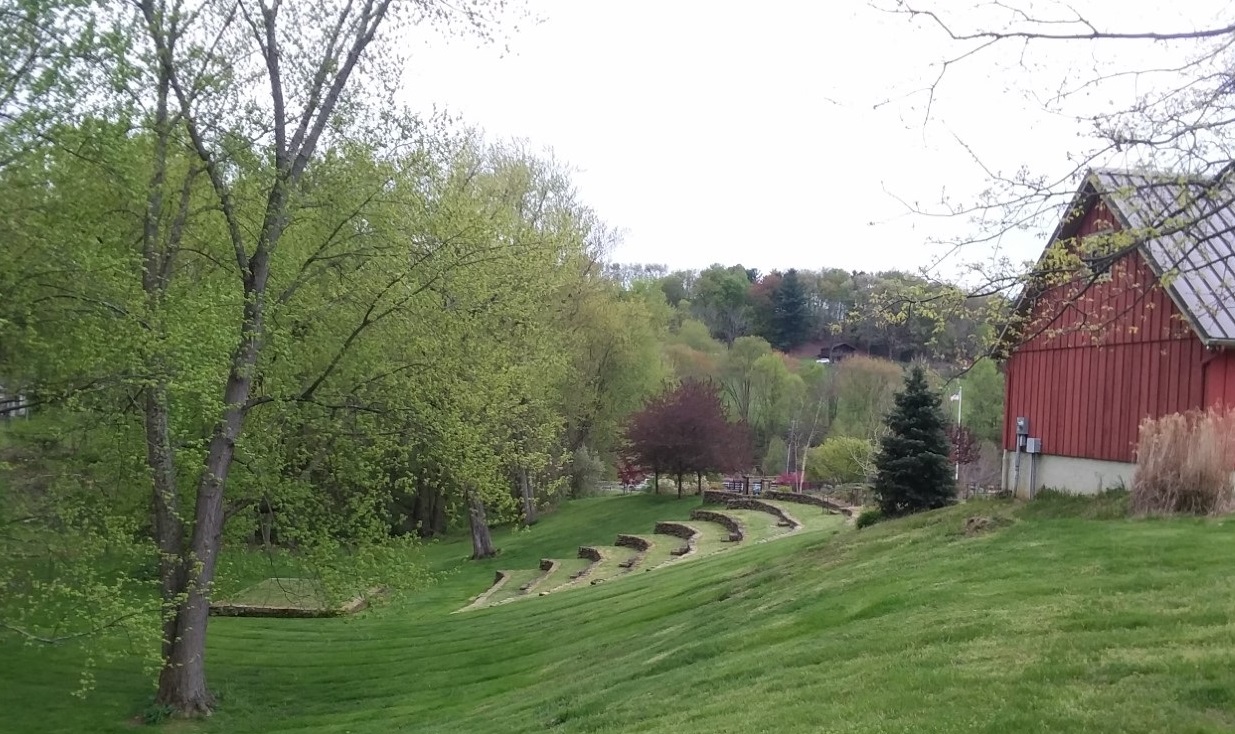
These gates open to a scenic path that leads down to a beautiful amphitheater.

For a very reasonable price, you can have a guided tour of the facility from March through October 31. There are several possibilities on their 20-acre grounds depending on the amount of time and energy you have to spend. These include interesting topics like Time Travel Tour, Woodlands Rock, Stop and Smell the Roses, and the list goes on.

Follow the path through the Rose Garden or relax in the gazebo.

Follow the path through the rose garden or take a rest in the rose garden gazebo. Just below the rose garden, you enter that special amphitheater that has been voted the number one outdoor wedding venue in Ohio.

Theatre in the Ravine provides the perfect place for weddings and concerts.

The Theatre in the Ravine is a very popular spot at Clary Gardens. This sandstone amphitheater is built into the hillside, which overlooks a tranquil stream and wooded area. It’s a wonderful place for concerts, weddings, and theater presentations as it seats over 200 people and has electric hook-up on its natural stage. Two plays have already been scheduled for this summer.

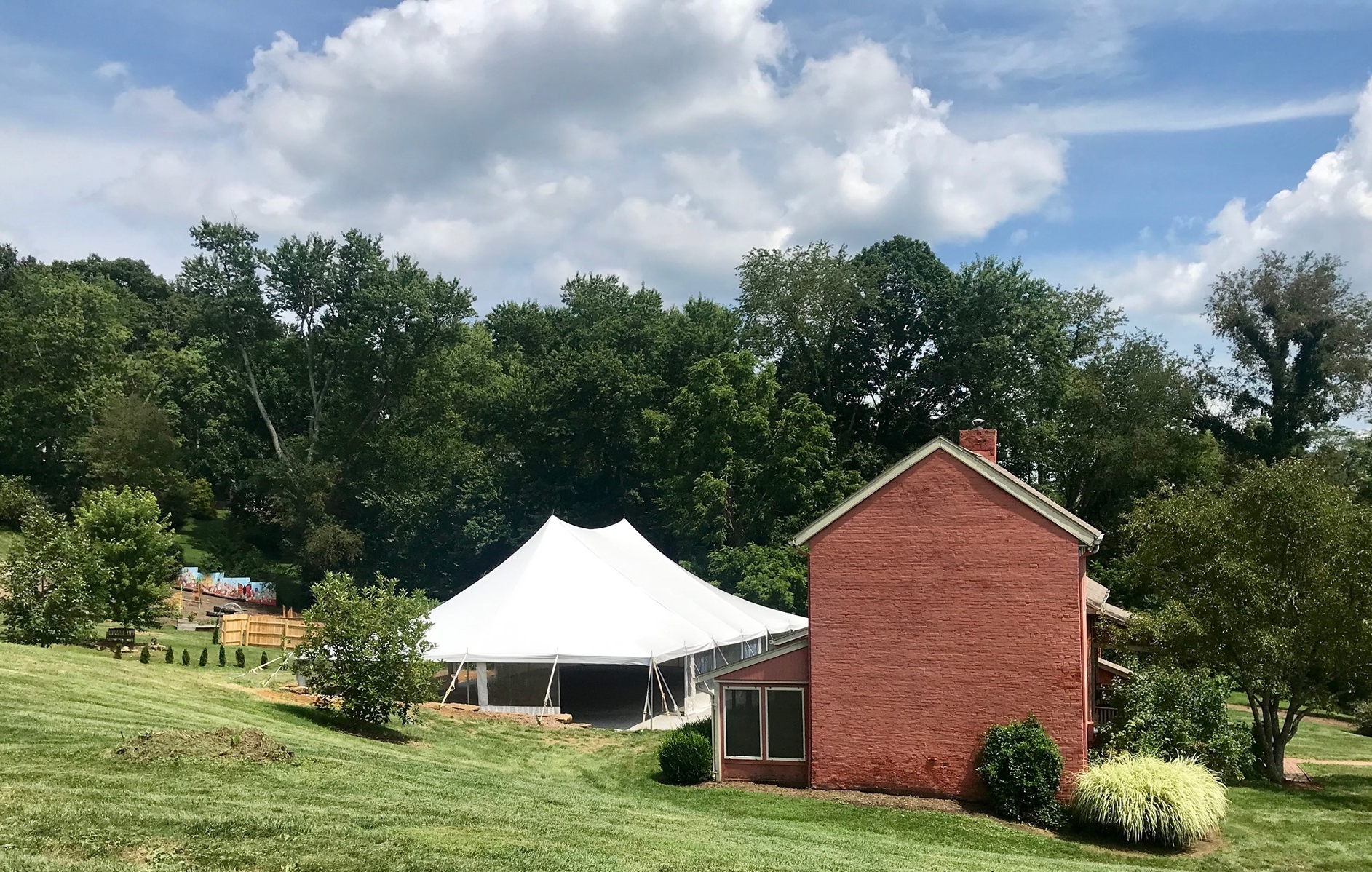
Receptions and public events are held in the tent behind the Compton House.

Receptions and meetings are currently being held in a large tent beside the 1850s red Compton House with beautiful table settings available. This summer they plan to replace the tent by constructing an open-air pavilion on the stamped concrete pad for wedding receptions and other private events.

Choose the Garden House for your next private get-together. Built around 1850, the house has two main rooms separated by a kitchen and is available for rent during the season.

Relax at the Spring House as you listen to the sounds of soothing water as it flows from the historic Spring House. It’s a magical place near the Iris Pond and woodland trails.

The Children’s Garden features wooden balance beams, beanpole tipis, and a crawl-through tunnel that resembles a caterpillar. Children enjoy coming here to learn more about nature. They often take off their shoes and wade in the shallow creek learning to identify salamanders and crawfish.

Enjoy being surrounded by butterflies at the Traveling Butterfly Exhibit.

A special Traveling Butterfly Exhibit comes to the garden nearly every year and gives viewers a chance to walk among the live butterflies as they flutter about. Perhaps you will be lucky enough to have one land on you. Enhance your chances of having a butterfly landing by feeding them some nectar.

The gardens are in their early stages of development and every year sees new additions. Plans for the future include a walkway connecting Clary Gardens and the nearby Caldersburg Cemetery to historic Roscoe Village, which is very close by. This will lead more people to explore both places.

Before visiting the gardens, check out their schedule at www.clarygardens.org as the gardens are sometimes closed for part of the day during weddings and special events.

Clary Gardens holds beauty in nature each season of the year.
Clary Gardens at 588 W. Chestnut Street in Coshocton is a place to enjoy peace and harmony with nature. Every season creates a different view so you might want to return throughout the year.
Clary Gardens are located in Coshocton, Ohio at 588 W. Chestnut Street just around the bend south of Roscoe Village. Watch for the entrance sign on the right-hand side.

The Living Word – Ohio’s Only Outdoor Passion Play

LW Amphitheater

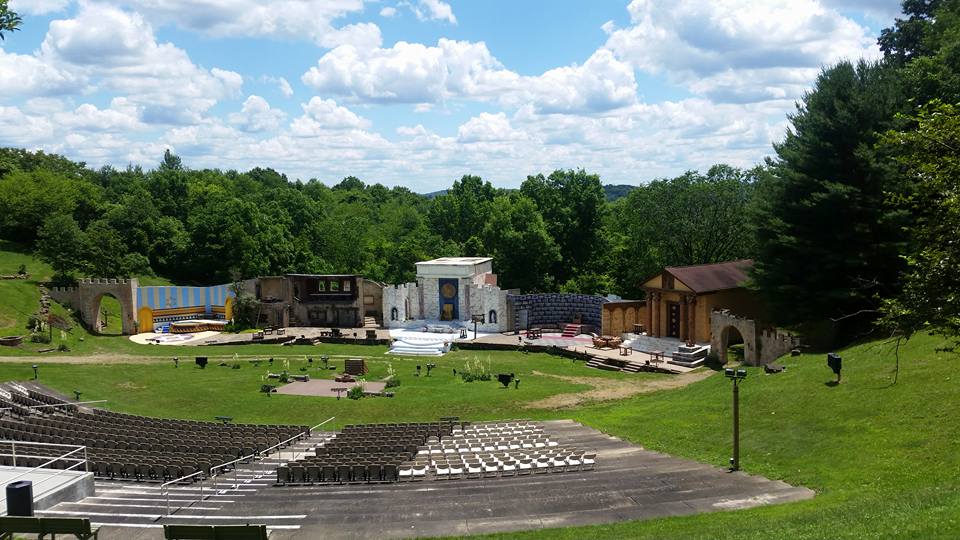
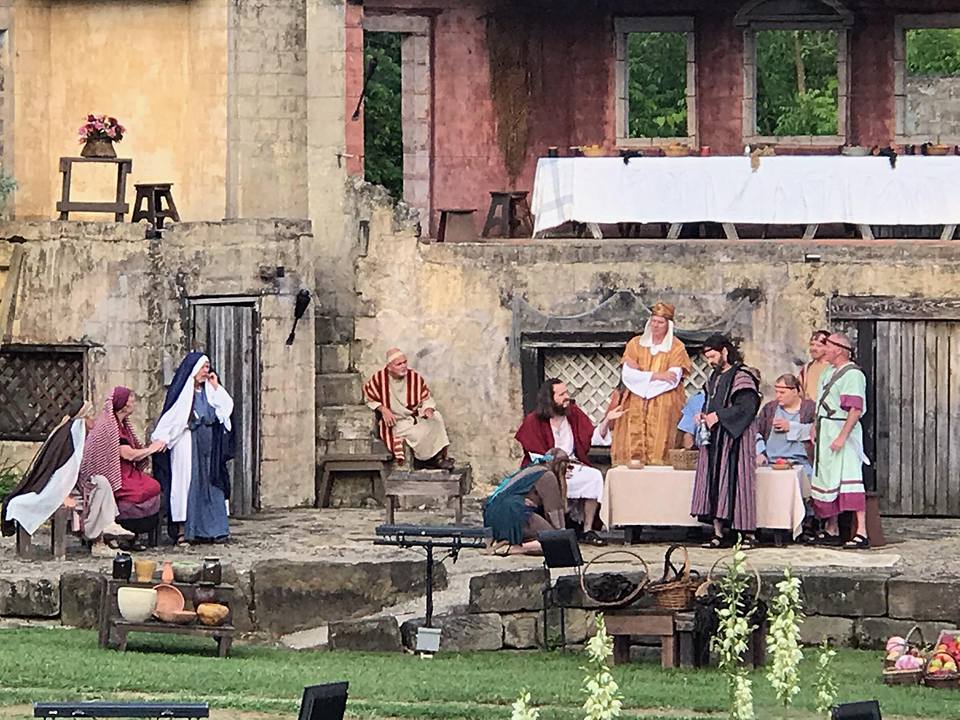
Their hillside amphitheater contains a re-creation of Old Jerusalem.

The only outdoor passion play in Ohio, or in any of the surrounding states, takes place in the hills just outside Cambridge. The Living Word Outdoor Drama tells the story of the last weeks of the life of Jesus. The perfect hillside amphitheater is centered around a 400-foot panoramic set which looks like Old Jerusalem at the time when Jesus lived. The mission of the drama is “To spread the gospel of Jesus Christ.”

LW Cast

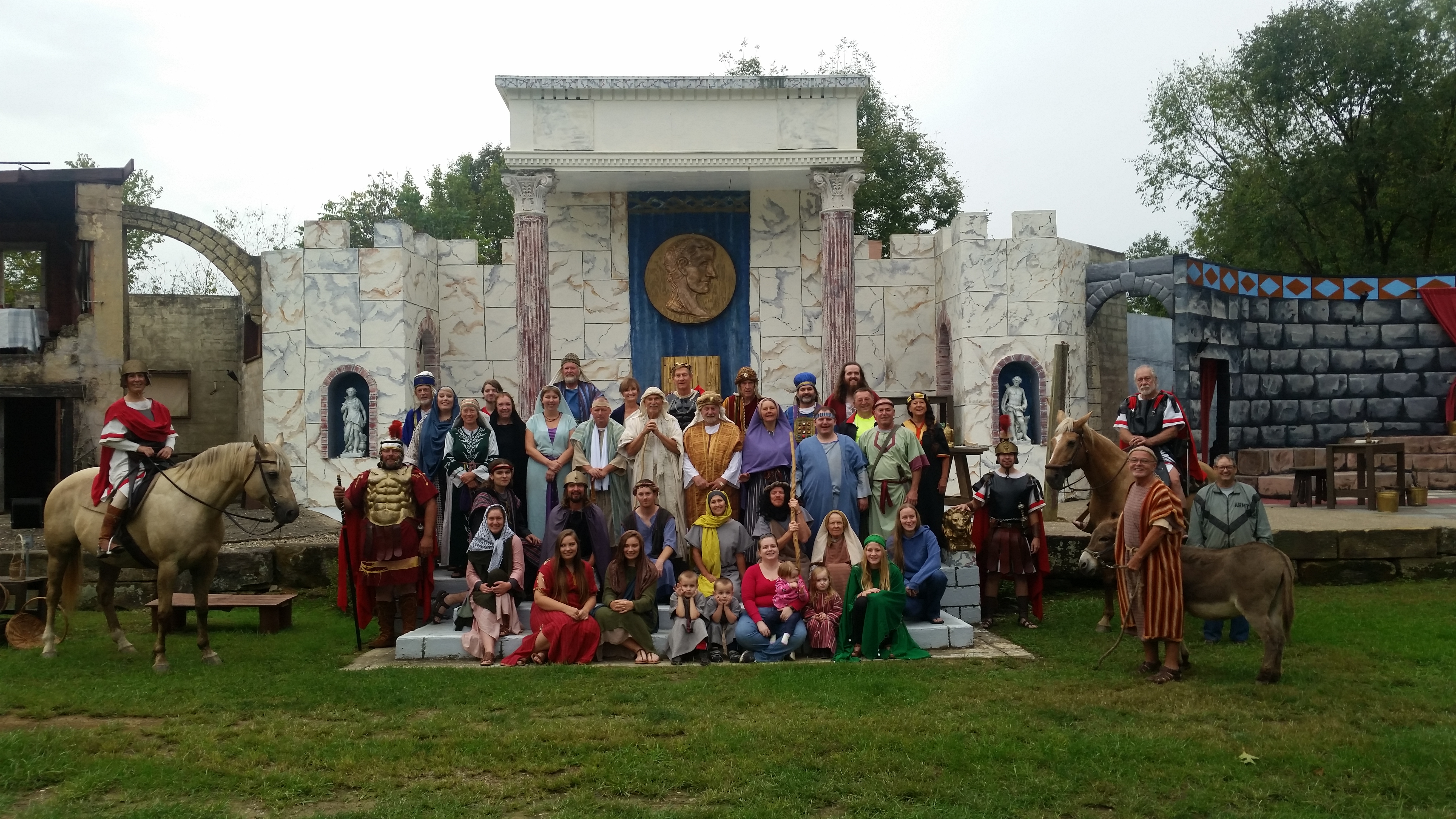
The volunteer cast of the Living Word Drama takes pleasure in each performance.

   Dedicated volunteers from many area churches are at the heart of The Living Word from participating in the drama to working in the ticket booth, gift shop, and concession stand. Lighting and special effects along with authentic costumes make this a spectacular event. A white donkey and an authentic horse-drawn Roman chariot add to the excitement.

Jesus healing a child

This picture of Jesus healing a child is on the front of this year’s Living Word brochure.

   A special feature of “The Greatest Story Ever Told” is the ability of audience members or area residents to participate in the show. Costumes are available for them to wear as they become part of the story. Bring your own sandals (no flip-flops) or use those available with the costumes. It’s a great opportunity to be on stage in a large production without having to learn any lines.

LW Harvey and wife

Living Word was founded by Frank Rougton Harvey with his wife, Hazel.

   The Living Word Drama was founded in 1974 by Biblical dramatist Frank Roughton  Harvey when he moved to Guernsey County from Georgia. Since that time over a half million visitors have witnessed the show, which celebrates its 45th season this year.
LW Jesus healing

Jesus heals a woman while townspeople show amazement at his divine authority to heal.

   Today the Living Word is directed by Heath Dawson, a young man with a passion for the outdoor drama. He has the enthusiasm of youth as well as a love of God that makes a great combination for this position. Heath looked out over the performance and remarked, “I love this place. I don’t ever see myself wanting to leave.”

LW scene

The disciples gather at the home of Mary and Martha.

   It’s amazing to find something as magnificent as The Living Word Outdoor Drama located in the hills of Guernsey County. It’s a spectacular setting over 400′ long with a temple, courtrooms, homes, and gateways. The cast puts their heart and soul into making the scriptures come alive as they tell the story of those last days of Jesus’ life.

LV Last Supper lighted

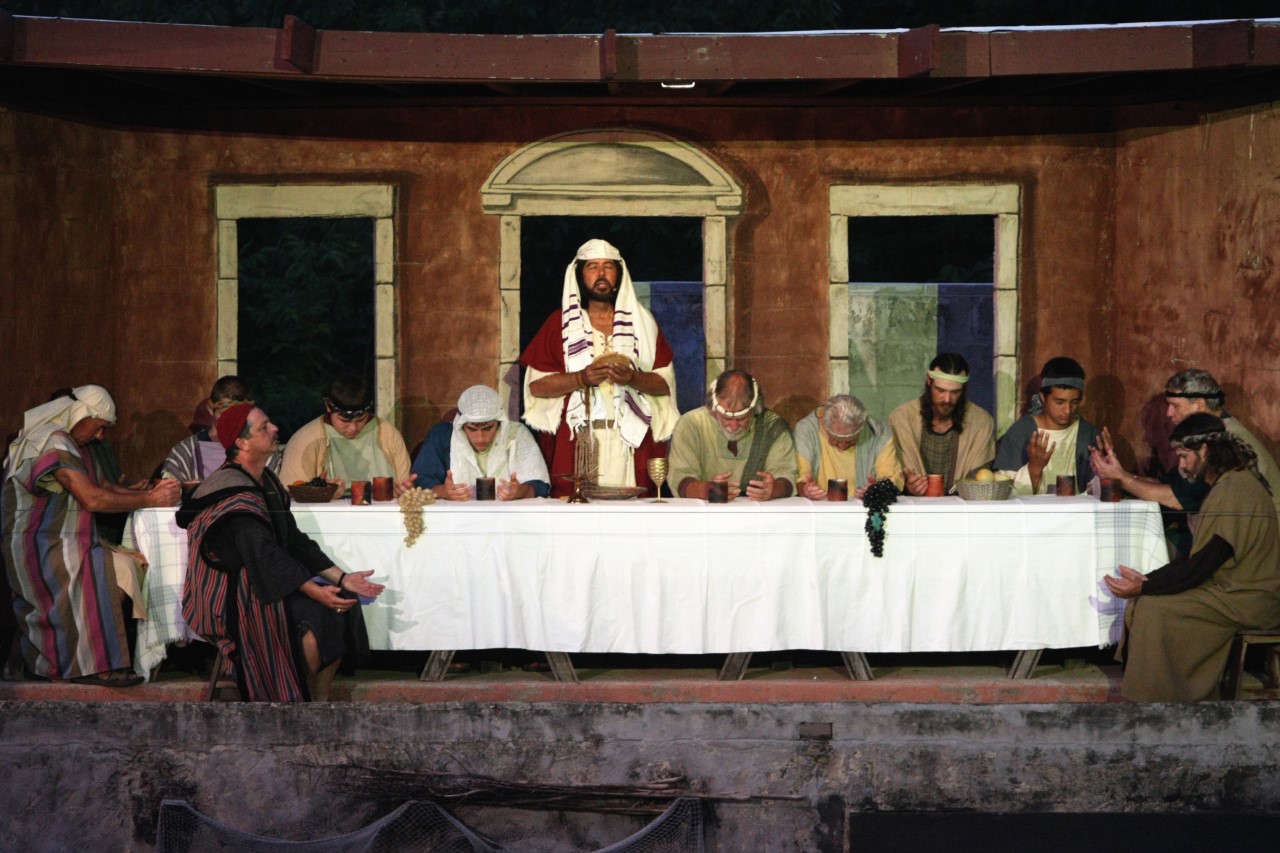
The disciplines gather with Jesus for the Last Supper in the Upper Room.

   Witness scripture come to life through the Sermon on the Mount, the Palm Sunday Entrance, The Last Supper, Crucifixion, Resurrection, and Ascension in this beautiful outdoor setting. The excellent sound system makes it easy to clearly hear the performance from any seat in the amphitheater during this two and a half-hour drama.

   The traumatic ending grabs at the heart of young and old alike. A hush comes over the crowd and many hide their eyes when the crucifixion happens as they can’t bear to watch the agony involved. But resurrection follows giving hope to all. It’s a dynamic drama.

LW Jesus on Palm Sunday

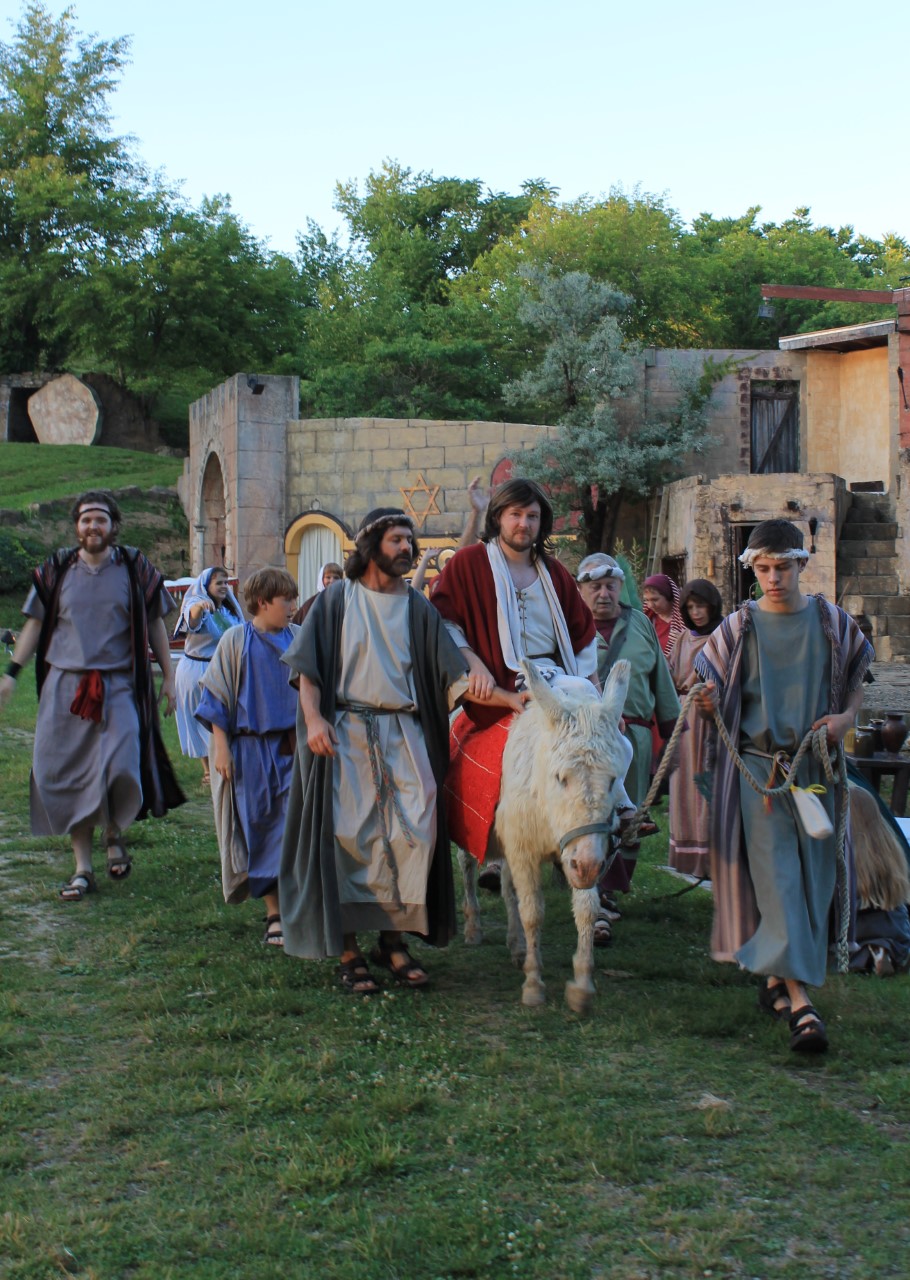
Palm Sunday brings Jesus riding into Jerusalem on a donkey.

   Many improvements have recently been made. New this year are a graveled parking lot, fresh paint in the concession area and restrooms, and wonderful landscaping at the Cross of Mercy circle in front of the box office. Currently, they are working on better lighting for the parking lot.

   During August, the drama hosts “Crucifixed”, a day of musical entertainment geared toward young people. It will feature Christian music bands from across the nation, including As We Ascend, Random Hero, The Protest, Zahna, and our own local praise/worship team The Love Brothers.

LW Art

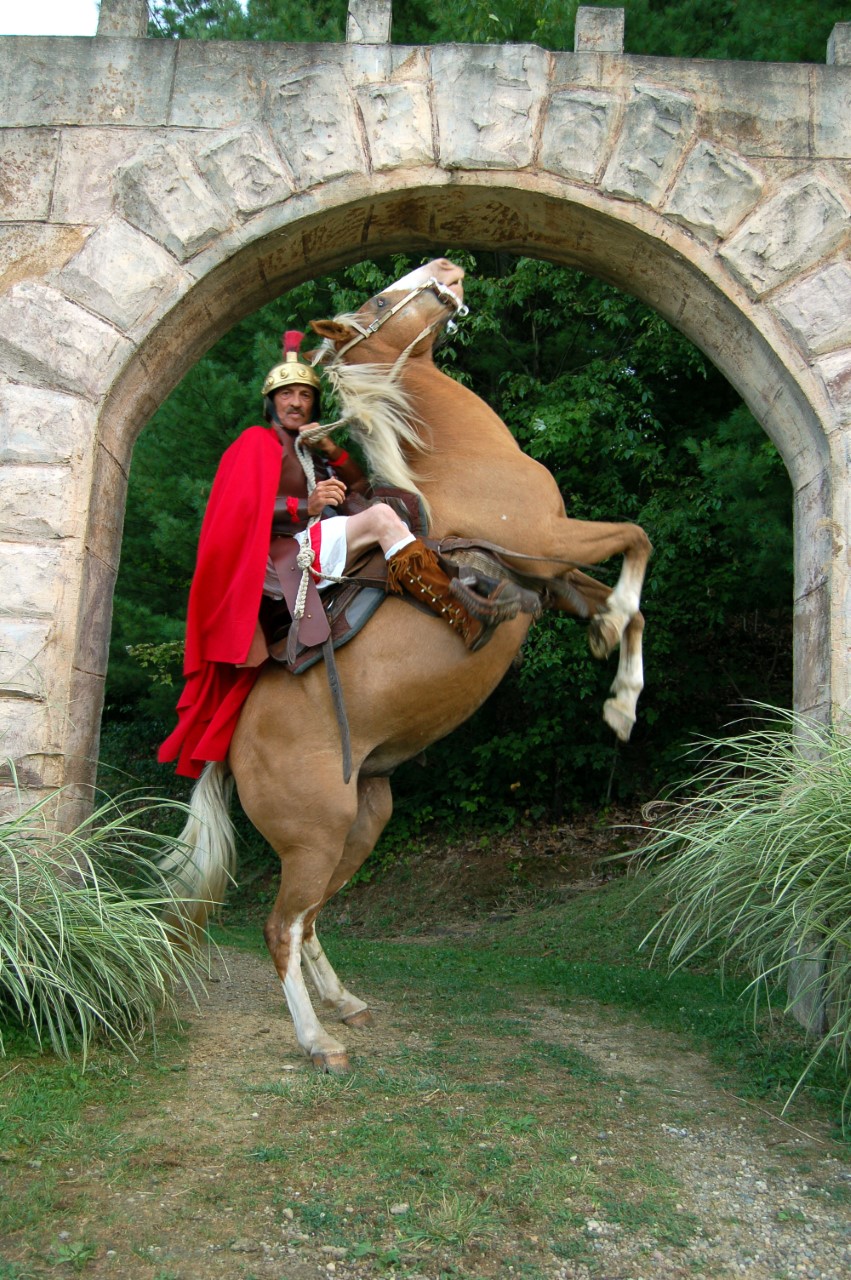
Roman equestrians add excitement to the drama.

   A family-centered day will be held in September. The “Jerusalem Experience” will feature Biblical experiences of making costumes, games, and fun for the entire family. Tickets are $10 for adults and $8 for students but include Free Admission to the evening performance!

   Their director is certain to greet you as you leave with a smile and “God bless you.” His faith means everything in his life as he has discovered, “It’s amazing what God can do to, for, through, and with a person when you let Him.”

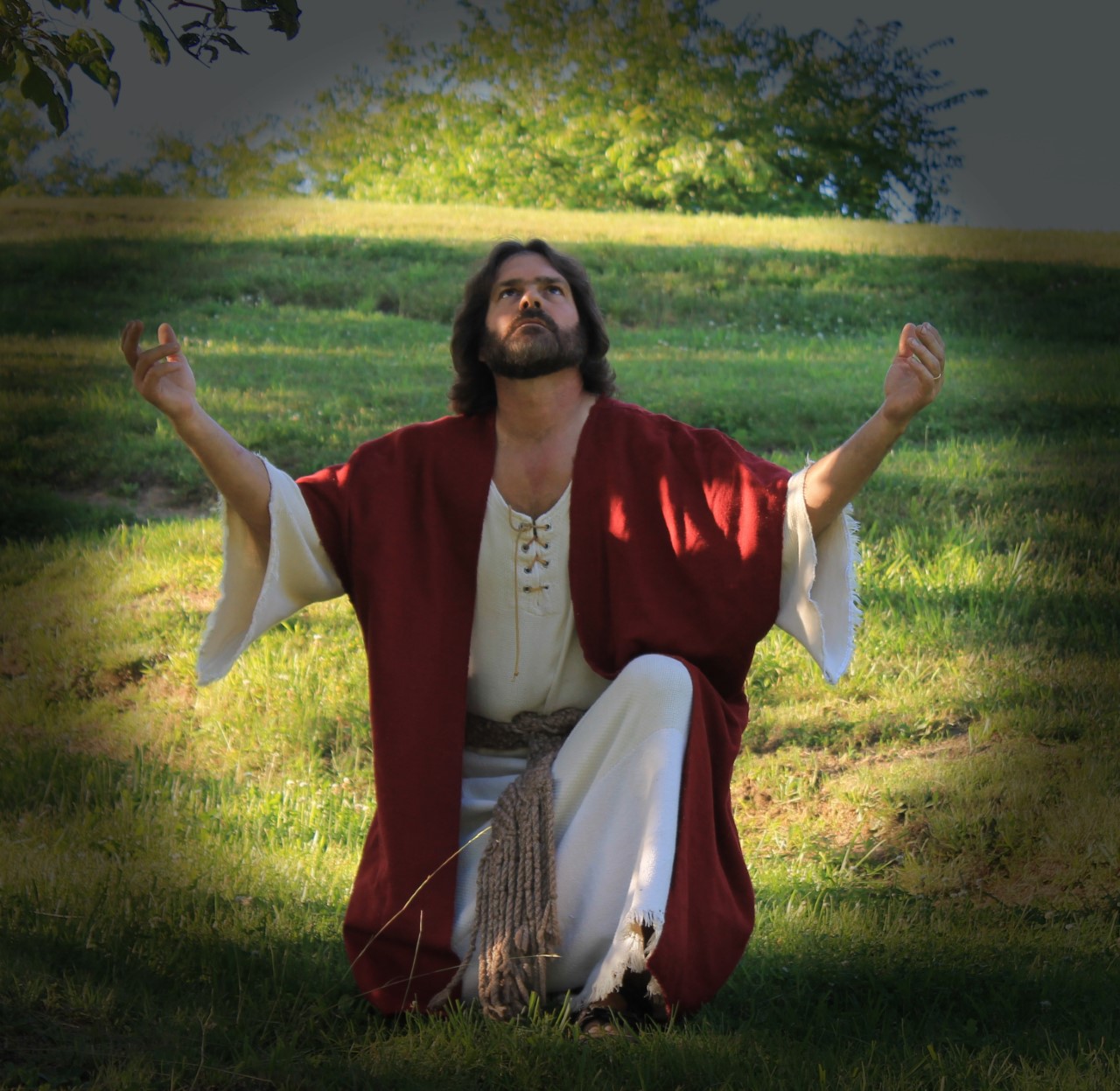
LW Jesus praying   The present attendance record stands from 2016 when nearly 700 people witnessed the Living Word Outdoor Drama. This year “Set the Attendance Record Night” will occur on September 25, 2021, the season finale. They are hopeful that this time there will be nearly 1,000 people in attendance. On this final night of the season, admission is by donation only. Come early to get a good seat.

   Shows for this powerful drama are 7:30 on Friday and Saturday evenings June through Sept.

LW Entrance   Admission is $18 for adults, $6 children (4-12) and $16 for seniors (60 and over). It’s located a couple of miles outside Cambridge at 6010 College Hill Road. It’s a great place for families and even tour buses to spend an evening.

   Listen to the story that never grows old for people of all ages at The Living Word Outdoor Drama sometime soon. Because He lives!

For more information visit their website at www.livingworddrama.org.

Tour Historic Fort Steuben

Fort Steuben captures the spirit of America and represents the opening of the West after the Revolutionary War when settlers could finally afford to purchase land. The first seven ranges of the Northwest Territory along the Ohio River needed to be surveyed into sections before being sold to those settlers.

This original Fort Steuben cornerstone, erected in 1786, has been preserved.

In 1787, Fort Steuben was constructed to protect the surveyors from the Indians as well as prevent squatters from coming across the Ohio River from Virginia. The Federal Government wanted to sell this land so made it illegal for those early pioneers to cross the river and settle without purchase.

Here’s an overview of some of the buildings inside the fort.

Major John Hamtramck was responsible for getting the fort built. It was named for Friedrich Wilhelm von Steuben, a drillmaster who served under General George Washington in the Revolutionary War. It’s easy to see how Steubenville, Ohio received its name. It was the perfect place for a defense with the Ohio River to the east, a bank of hills on the west, and a nice plateau on which to build. Its location was mid-way between Pittsburgh and Wheeling.

One hundred fifty soldiers guarded this fort. There was a lookout station where they could easily watch the Ohio River. However, after one year, the fort was abandoned and never used again.
The University of Steubenville holds an annual archaeological dig here.

Some say that in 1790, the fort burned but archaeological digs have shown no evidence of ashes or burnt objects. Others think that perhaps settlers dismantled the buildings and moved them to a place where they were going to live.

Some items found in the dig are displayed inside the Welcome Center.

Every year since 1978, the University of Steubenville has conducted a summer session on the grounds of the former fort. Their archaeological dig has discovered many discarded items from that time and some are on display at the Fort Steuben Visitors Center while others can be found at the University of Steubenville.
The hospital included a surgeon and a shelf filled with medical supplies.

Several times over the years, people had been interested in reconstructing the fort, but it wasn’t until 1986 that two ladies became enthusiastic about the project after attending a lecture by the archaeologists. Their enthusiasm led to the community becoming involved in the project. It began in 1989 but it wasn’t until 2009 that the fort was completed.

Nutcracker Village happens each year during November and December.

Fort Steuben Park has become a central part of community activities as this is where they hold the Dean Martin Celebration, Nutcracker Village, Farmers’ Market, 4th of July Fireworks, and weekly concerts in Berkman Amphitheater during the summer months. The fort is a private effort funded by local supporters and is staffed with a director and many helpful volunteers.

The table in the Officers’ Quarters was used for dining and as a place to spread out maps of the surveyors.

Taking a self-guided tour or touring the fort with a trained interpreter in this reconstructed village gives you a glimpse of what life was like over 230 years ago. There are seven buildings in the complex where you will find posted stories of the trials and tribulations suffered without today’s modern conveniences. Step inside the Officer’s Quarters, Hospital, Commissary, or Guard House to learn their stories.

The original Federal Land Office, where plots of land were sold, was moved close to the fort.

A special feature is the Federal Land Office, the first one built in the United States in 1800. The original building has been moved near the fort. There seemed to be a natural connection as this Land Office was where people came to buy the land after it had been surveyed. The agent and his family lived in the Land Office cabin.

The agent and his family lived inside the Land Office.

The land was measured off in plots of one square mile, which would be 640 acres. A settler could purchase a square mile for $1 an acre but had to buy 640 acres. Later, those plots were divided and settlers could purchase 320 acres for $2 an acre. Some consider this Ohio’s Ellis Island as it was at the Land Office that people started new lives.

Berkman Amphitheater has weekly concerts during the summer months.

The outstanding Visitors’ Center is open all year long while Fort Steuben is open from May through October. Hours for both are from 10 am – 4 pm. Admission to the fort is $10 for adults and $7 for students 6-12. Those under six are admitted free.

If you enjoy history, you’re sure to enjoy visiting the Welcome Center and Fort Steuben.