Places to go and things to see by Gypsy Bev

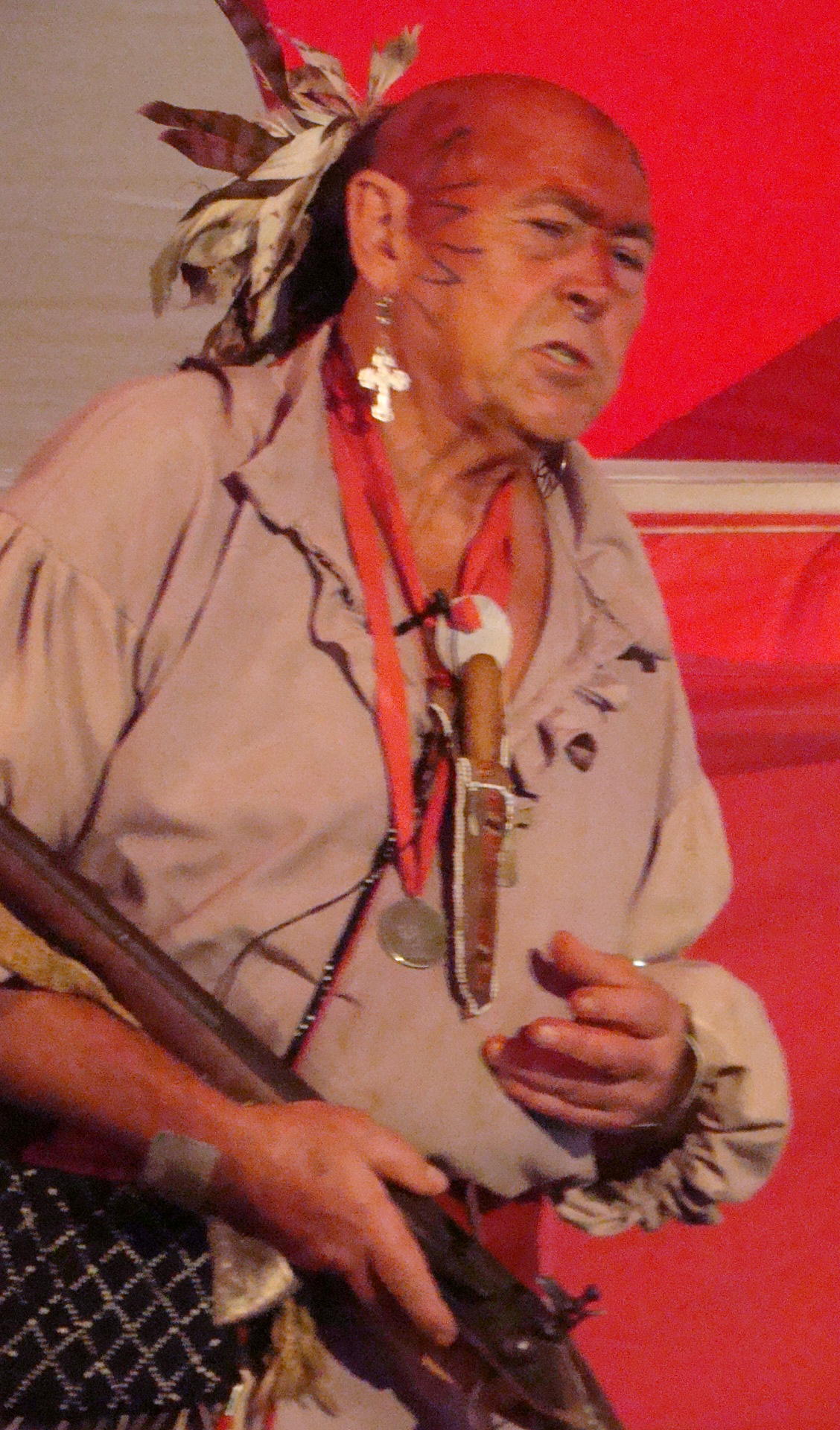
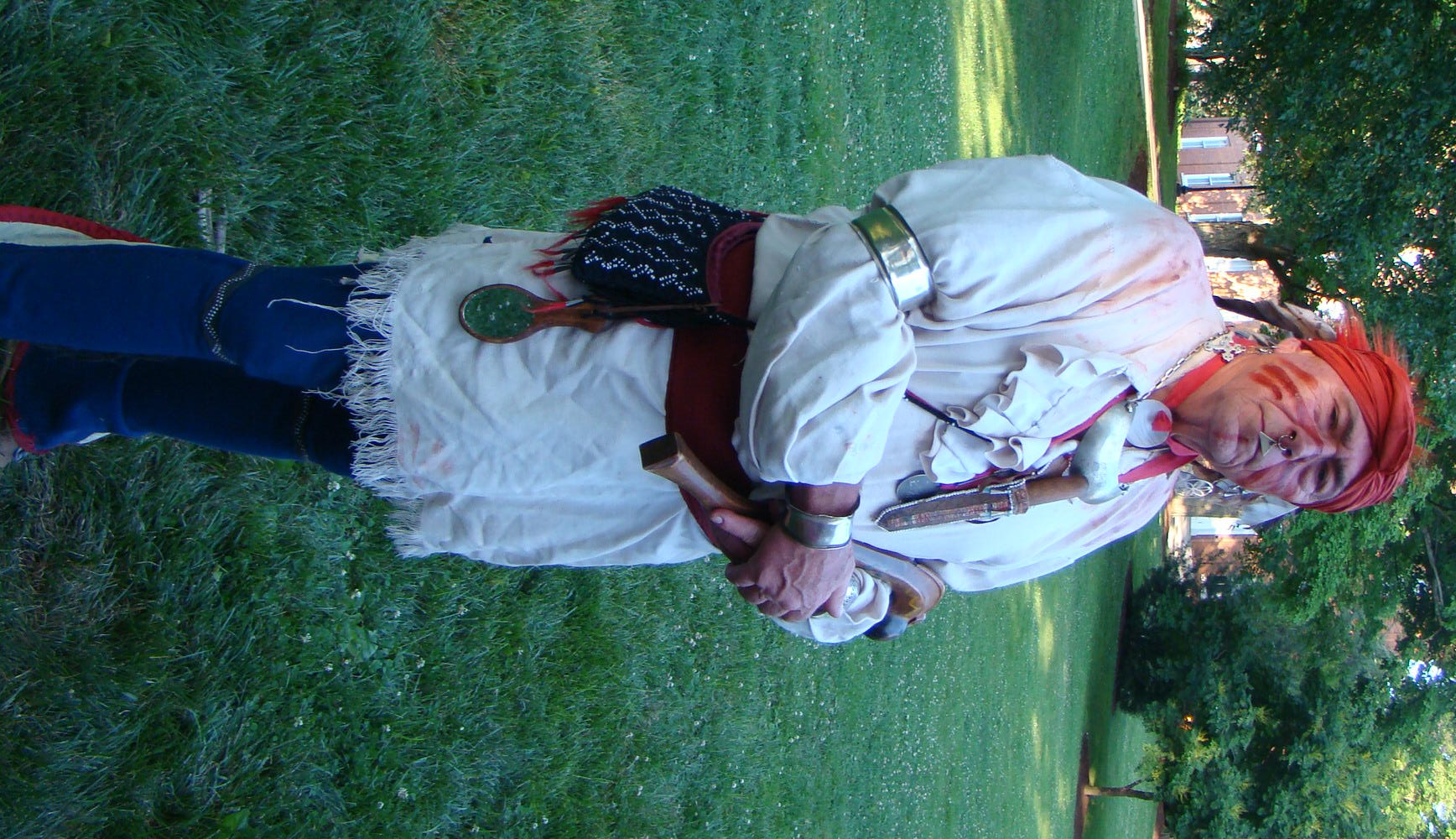
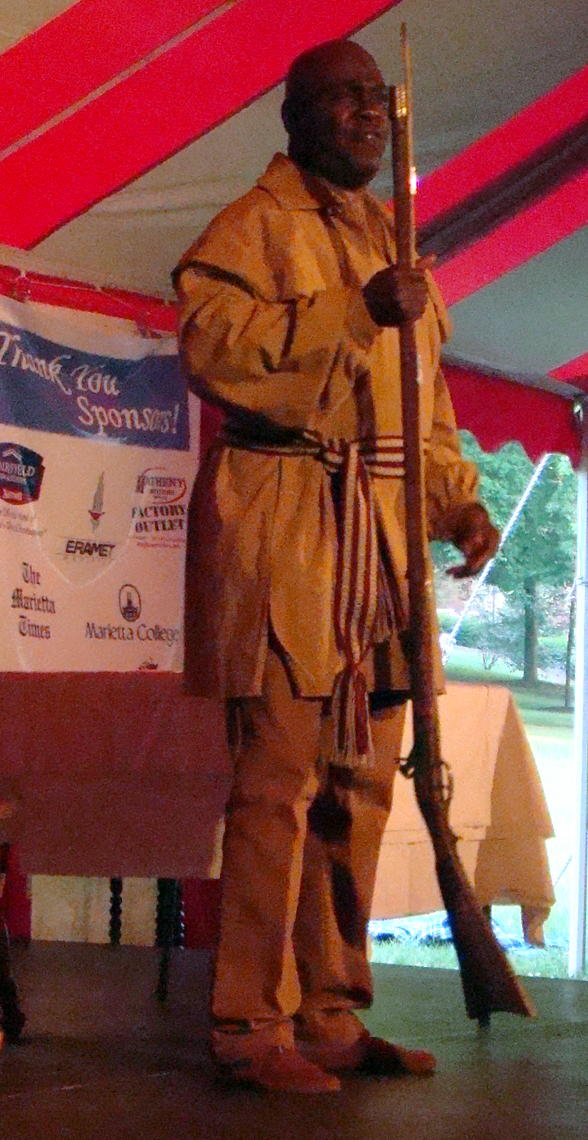
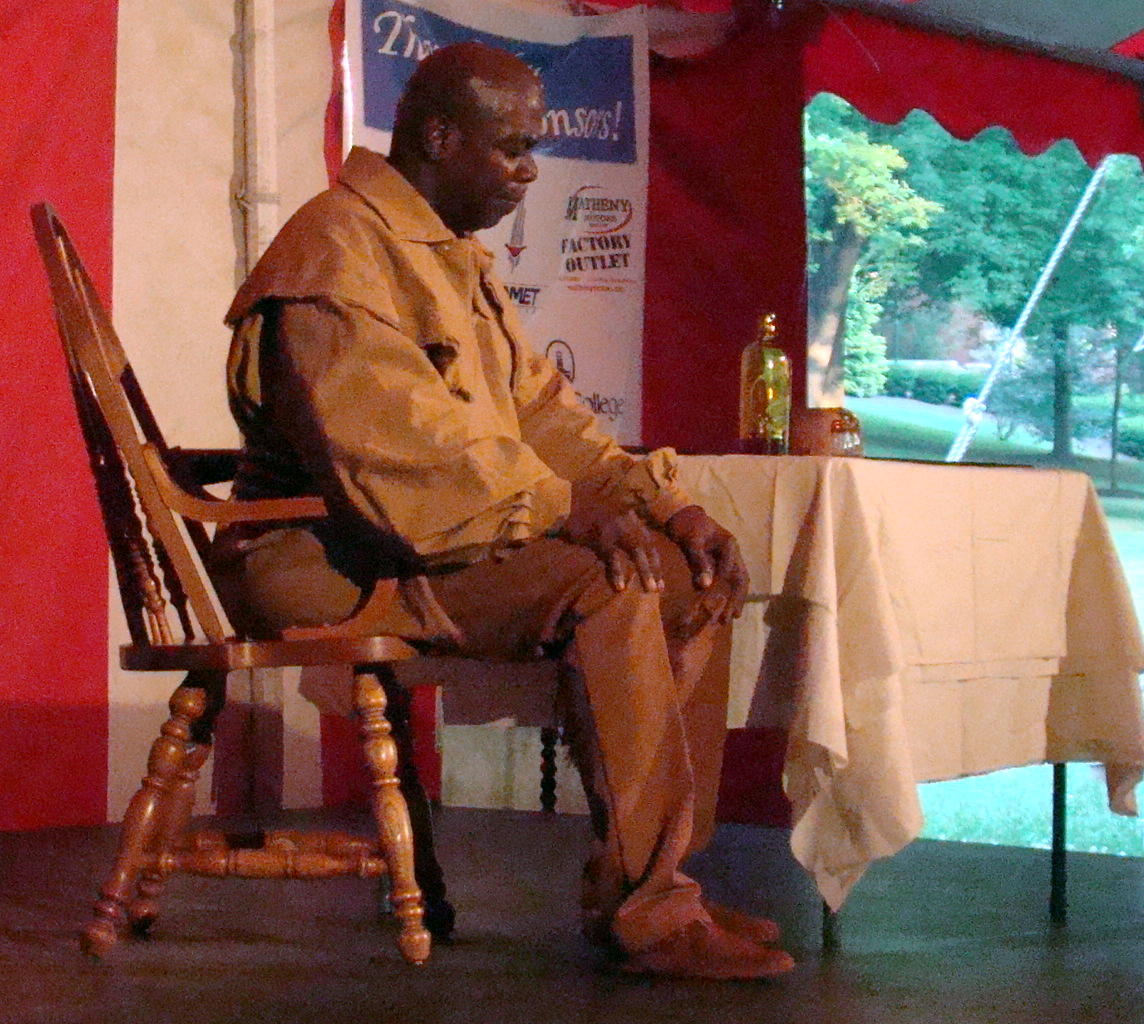
Dressed in buckskin clothes, the appearance of Chief Logan transported the audience back to frontier times. Silver armbands, bracelets, a nose ring and earrings – one a cross- glittered in the sunlight as he took the stage at the Ohio Chautauqua during the 225th Anniversary of Marietta – The Crown Jewel of the Appalachians.   Tattoos also adorned his body with a tobacco leaf tattoo on his ear symbolizing “truthful hearing” while a red hawk on his head denoted his tribal connection.

John Logan began his life on the Susquehanna River and followed his father’s Jesuit teachings where John’s “sins were washed away”. Friendly with the white settlers, John was always a peacemaker for the Iroquois, who were usually called Mingos when settling in the Ohio Country, and John Logan is most often referred to as Chief of the Mingos. Perhaps his role as peacemaker gave him reason to learn eight different Indian dialects as well as English, French, Dutch and even Latin. However, Chief Logan could neither read nor write.

The Ohio Land Company kept expanding their boundaries to include more and more of the Indian lands. The Mingos ignored the marks of surveyors saying, “You can’t sell the wind in the sky or the water in the river.”

Along the Ohio River, settlers frequently met at the tavern for stories, nourishment and ale.  One evening, Logan’s camp along Yellow Creek, near present day Wellsville, Ohio, was invited by a nasty frontiersman, Jacob Greathouse, to a tavern across the Ohio River.  During the course of the evening, some of Logan’s family was shot and killed in an ugly massacre.  This changed Logan’s peaceful ways in a hurry.  In the words of Logan, “It made me want to raise my hatchet that had long been buried and color it with the blood of the English.” Sometime during this period, he walked away from the Christian teachings.

While he told the settlers of his anger, he also said the Indians were not all angry…just Logan, as they had killed his people.  Known as Logan’s Revenge, he vowed to take ten white man’s scalps for every Indian that had been murdered on the Ohio River that evening. Every time he took a scalp, he made a mark on his hatchet. According to Native American custom, he had a right to this retaliation.

Chief Logan refused to attend peace talks in 1774 at Camp Charlotte on the Scioto River, but issued his now famous speech, Logan’s Lament, under an elm tree. While the beautiful old elm no longer exists, the words of his speech can be found today engraved on his memorial at Logan Elm State Memorial near Circleville, Ohio. His speech concluded:

“Logan feels not fear. He would not turn on his heel to save his life for who is there left to mourn Logan? Not one.”

The remainder of his life was spent as a kind man who sold deer skins for a dollar each, so he could bury his sorrows in the taverns he visited.  In 1781, he was killed by his nephew, because John Logan was no longer considered an asset to his people. Today there is not a drop of Logan’s blood in any living creature.

Dan Cutler portrayed Chief Logan with ease as he has spent about a dozen years in that role in West Virginia as well as the Ohio Valley.  Frequently he also slips into the roles of The Cornstalk Warrior, Tecumseh and Simon Girty. Dan is currently active in a new outdoor drama, “Drums Along the Mohawk”, which will premier late this summer in New York.

2012 Ohio Chautauqua continues throughout the summer with week long performances and workshops in Gallipolis (July 17-21) and Warren (July 24-28). Hope you find time to join them and learn a little more about “When Ohio Was the Western Frontier”.

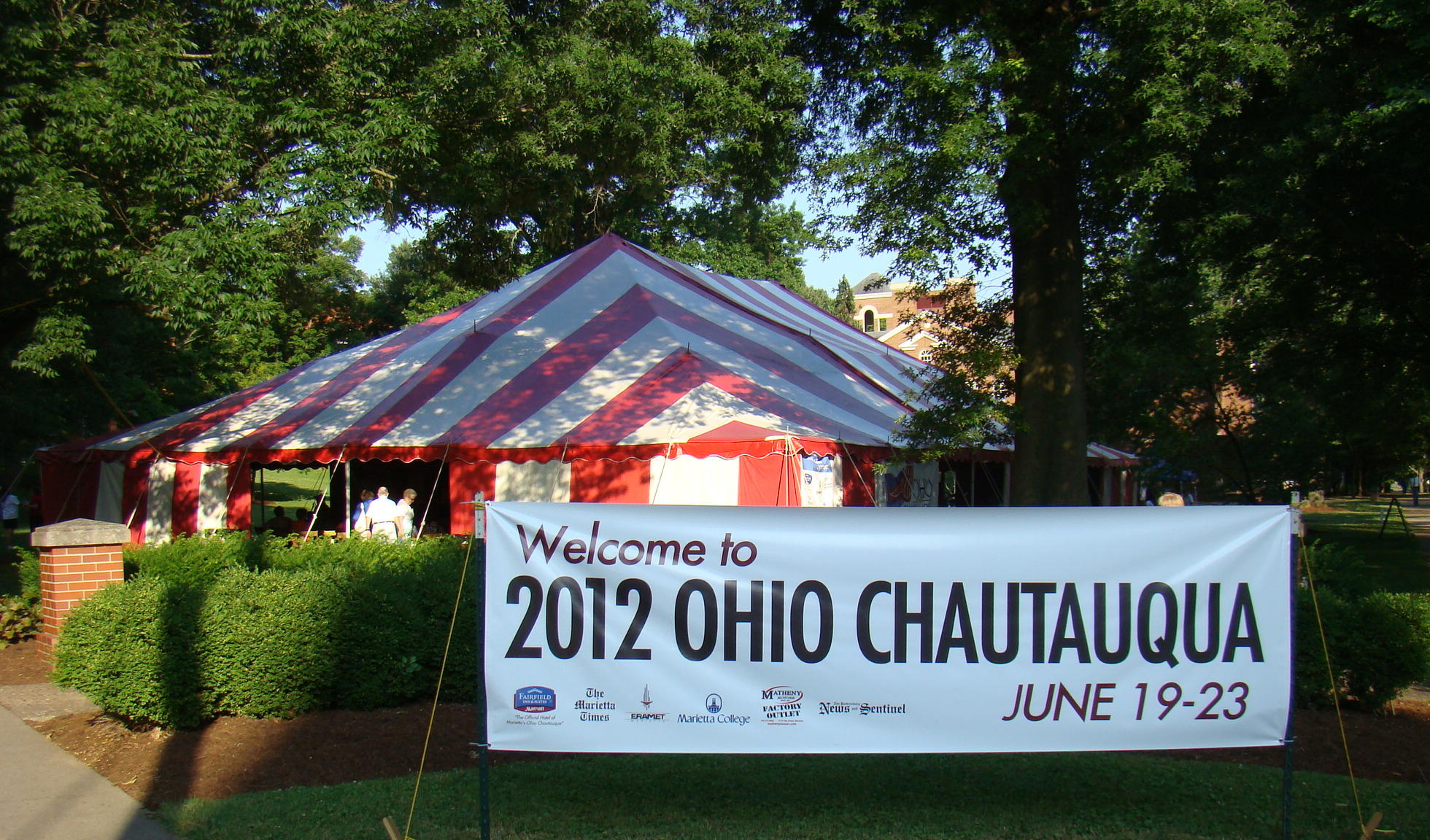
Tracker… Negotiator…Ambassador…Doctor.  All these words were used at one time or another to describe York, Captain William Clark’s black manservant, who was part of the Lewis and Clark expedition to the Pacific Ocean and back to the East. York’s story was told under the red and white striped tent at the 2012 Chautauqua celebration in Marietta, Ohio on the campus of Marietta College. This year’s theme, “When Ohio Was the Western Frontier”, introduced characters that played a role in Ohio’s early history. York, being from Virginia, spent much time on and along the Ohio River.

As the first recorded black explorer, York created much excitement as he traveled across the Western frontier.  Due to his large size and black skin, his presence amazed and intrigued the Indians along the way. Thinking perhaps that he was painted black, at many stops the Indians would spit on their fingers and try to rub the black color from his skin. Indian tribes considered him a friend and referred to him as Big Medicine, since he frequently gave them liniments and herbs to heal their ailments. Some even called him Giant Medicine due to his size, and felt that his skin had sacred power.  This was a time in York’s life when he said, “How great it felt to be admired.  I felt ten feet tall.”

Because he enjoyed storytelling and drinking, York was very popular in taverns wherever he went. His speech was much like “the white man’s” since he had grown up in his master’s household. Never having been taught to read or write, he relied on his tall tales, some higher than the mountains, to entertain the explorers and those he met along the way. The Indian squaws favored him with special treatment, and he entertained the children with stories of being wild. His contribution as a peace maker with the Indians helped make the expedition more successful.

Life was not easy on the journey as they were often cold and hungry. They drank bear fat and even ate candles to survive. At times when food was scare, York was entrusted with a musket, something that never would have been permitted this slave while in Virginia. There were times when they were fortunate to encounter a herd of elk.  Then they ate elk, elk, and more elk all day long. If no other meat was available, they even ate their dogs and found them quite tasty. The children in the tent at Marietta that evening were quite concerned about the expedition eating dogs, and were assured it was only done during an emergency when no other food was available.

When they returned to the East, York reverted to his position as a manservant. He only wanted freedom to be with his wife but this was not to be. Instead he was flogged, even jailed and then hired out to a severe master where he was given spoiled food and further mistreated.

Even though York was married, he seldom saw his wife as she too was a slave. They lost contact completely when she was sent to Mississippi to work on a plantation. So even though he knew she was expecting their child, he never got to see the child or even know of its whereabouts. When he asked Captain Clark if he could be sold as a slave with his wife, Clark said it was out of the question. York said the most painful time he encountered in his life was saying goodbye to his wife.

What really happened to York? Some accounts say that he was eventually freed, but given the fact that he had no knowledge of business was not able to make his way in the world.  Other accounts say he was spotted later with the Crow Indians in the Rocky Mountains. Hope it was the later!

As York sat at the tavern on the Chautauqua stage, he said he was thankful for the Expedition as for a short time he knew what freedom felt like. There his color was not a curse but a blessing. His dream was to eventually go back to the Indians.  His presentation concluded with a toast to the Great Expedition, the beauty and majesty of our great nation, Captain Clark, the Indians, and Big Medicine.

Marvin Jefferson did a very believable portrayal of York. His background as an educator and historical scholar has given him incite into Civil Rights issues and he frequently portrays Martin Luther King, Jr and Paul Robeson in his stage performances.

2012 Ohio Chautauqua continues throughout the summer with week long performances and workshops in Urbana (June 26-30), Gallipolis (July 17-21) and Warren (July 24-28).  Hope you find time to join them and learn a little more about “When Ohio Was the Western Frontier”.

More is better! That was the feeling of Harman and Margaret Blennerhassett as they came to the United States from England in 1797. Their marriage was frowned upon by friends and family in England since Harman was Margaret’s uncle; therefore, their best chance at a happy life together would have to be in a far away country.  Having sold his castle in England, the Blennerhassetts arrived in the United States with lots and lots of money…$140,000! While this fortune seemed limitless at that time, the Blennerhassetts spent their fortune recklessly and unwisely, always wanting more.

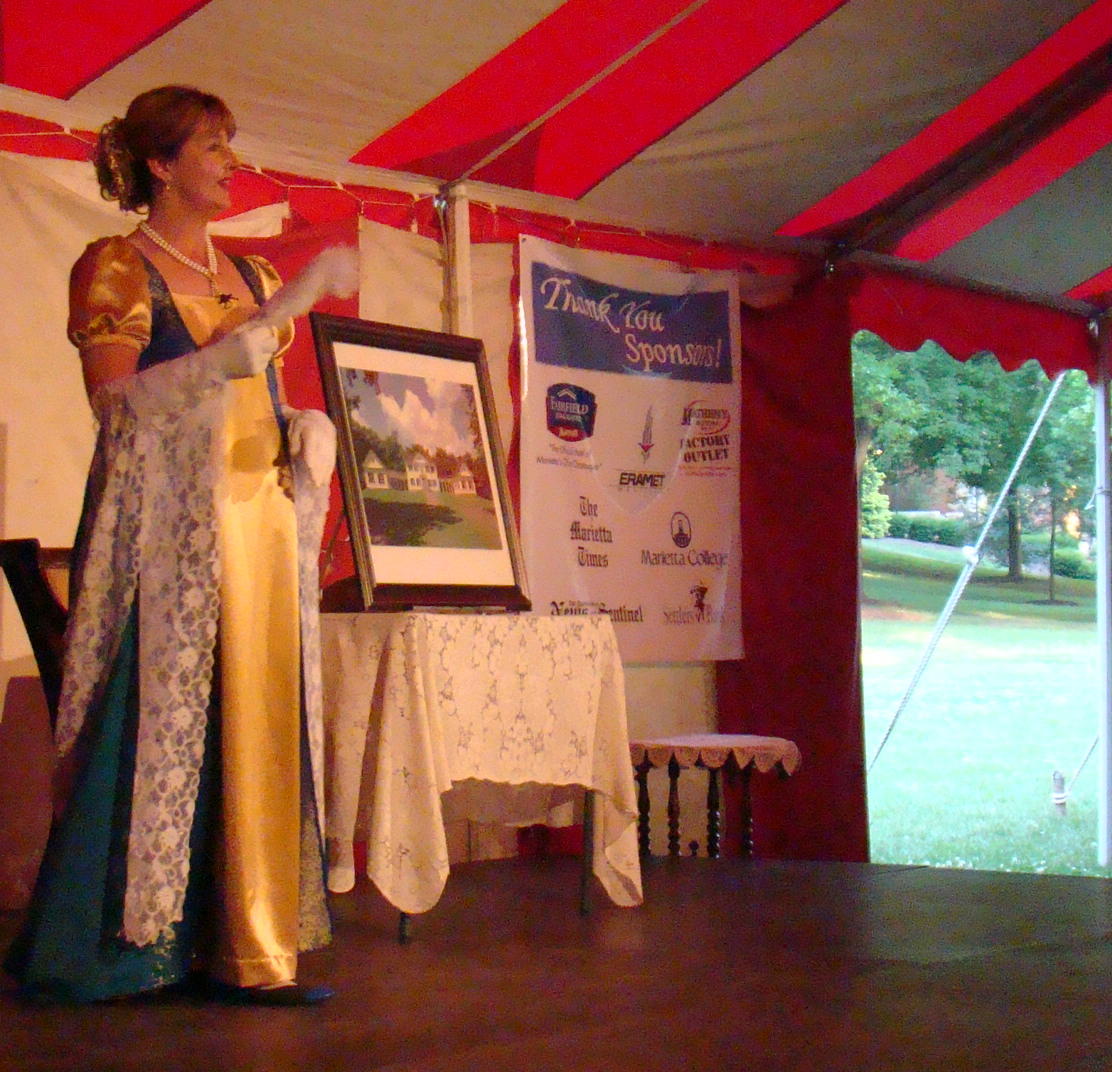
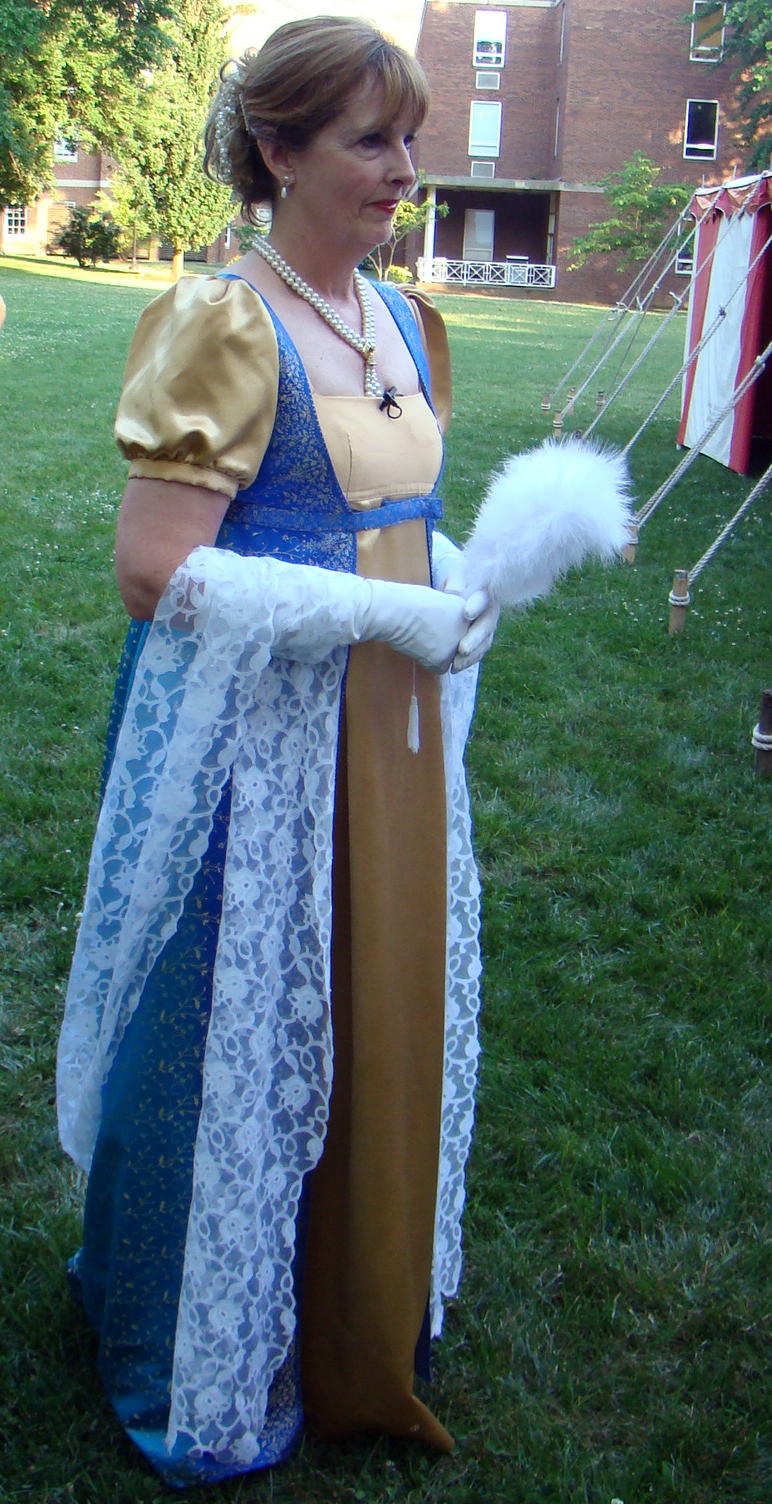
The aristocratic Margaret Blennerhassett was the first historic character for  “When Ohio Was the Western Frontier”, the theme for  2012 Ohio Chautauqua in Marietta, Ohio on the campus of Marietta College.  She received a warm welcome as temperatures soared to near 100 in the red and white striped tent.

Margaret’s story continued with their search for a place to built their new home, and ultimate discovery of  a beautiful tree covered island in the middle of the Ohio River. Margaret thought this would be the perfect place for the elegant home she had in mind so they bought half of the island, approximately 180 acres, for $4500.

One corner of the island was cleared of the huge trees so the mansion would appear as a pearl against green velvet as the boats passed by on the Ohio River. Here they built a luxurious twelve room mansion that had thirty-six glass windows, something not common at that time of log cabins with tar paper windows. Two covered porticos flanked the main house leading to its two appendages: Harman’s office and the summer kitchen.

Not only was the house a beautiful spot but there were acres of gardens and a greenhouse where citrus fruits grew all winter long. There was even special shrubbery trimmed in the shape of the original thirteen colonies.  Margaret especially enjoyed riding her white horse, Robin, over the island appearing as an exotic bird in her scarlet riding cape and feathered hat. Yes, more was definitely better.

But their happy life was short-lived here on the spot they called Blennerhassett Island. Some compared it to the beautiful Garden of Eden, but both seemed to have a snake that spoiled their pleasure. This time it was a snake in the form of Aaron Burr that wanted something forbidden.

Margaret said that Aaron Burr was a genius who applied to college at the age of eleven and graduated from Princeton at an early age. Burr was a very handsome man who loved fine things especially when procured through other people’s money. After a tie in a presidential election between Thomas Jefferson and Aaron Burr, the recount made Jefferson the President, and the loser, Aaron Burr, the vice-president. Things did not start out on a good foot here, and Burr was more than a little dissatisfied.

In 1805, Burr visited Blennerhassett Island for dinner as he was curious about the eccentric foreigner … or perhaps he had heard of the money Blennerhassett had available to “invest” in his plans. Burr led them to believe that this was an easy way for them to increase their fortune.  These events took place at a time when the Blennerhassett funds were running low.

Margaret felt that Thomas Jefferson was the real serpent that crawled into their Garden of Eden in order to destroy them. There was a lot of animosity between Jefferson and Burr.  Margaret said that Jefferson was not the wonderful president that many thought he was.  She felt the Louisiana Purchase was illegal, and while considered an inventor said he only had invented two things: a wheel cypher secret decoder and a plow. Thomas Jefferson was said to even cut parts out of the Bible that he didn’t like or wish to follow in his life. It was quite obvious that Margaret did not have fond feelings for President Jefferson.

Jefferson tried to destroy Aaron Burr and by association, Harman Blennerhassett. He attempted to use his power to have Burr found guilty of treason.  However, Chief Justice John Marshall stood up to Jefferson, and the jury found Aaron Burr not guilty. Burr and Blennerhassett were both released from prison.

By this time, their house on the island had been looted with most of the fine things being carried off. The remainder of the items were sold at auction to pay off debts accumulated by the Blennerhassetts. In 1811, their beautiful mansion was burned to the ground. At this point, the Blennerhassett family fell into hardships and eventual poverty for the remainder of their lives.  Their hopes and dreams were shattered.

Debra Conner’s portrayal of Margaret Blennerhassett was outstanding. Debra actually spent much of her youth in the Marietta community and graduated from Marietta High School.  Often during the year, she presents similar programs to the area schools on both sides of the Ohio River as part of their Ohio or West Virginia history curriculum.

2012 Ohio Chautauqua continues throughout the summer with week long performances and workshops in Urbana (June 26-30), Gallipolis (July 17-21) and Warren (July 24-28).  Hope you find time to join them and learn a little more about “When Ohio Was the Western Frontier”.

“The only rock you will find out there will be your own tombstone,” was the advice given to Ed Schieffelin when he headed to the mountains of Arizona to hunt for ore samples.  When Schieffelin filed his first claim after discovering silver, he suitably named his first mine Tombstone, and organized the Tombstone Mining and Milling Company.

If you want an informative trip through Tombstone, Arizona, hop on the guided horse-drawn stagecoach tour. Here you will hear the basic history of the town with lots of humorous stories thrown in. Don’t be surprised if you see a gunfight or stagecoach robbery along the way. Then you can walk or ride to your favorite places throughout the town for a closer look.

The stagecoach is pictured in front of the Crystal Palace Saloon, which was originally built in 1882 but restored in 1963.  Prominent citizens of Tombstone liked to congregate here as the saloon was know for its “Good Whiskey, Tolerable Water, and Best Food in Town” as well as an honest gambling room. Add to that the fact that upstairs were located offices that furnished all the latest news, and you can see why it was such a popular spot. The second floor contained offices of Marshall Virgil Earp – in the front, Dr George Goodfellow, leading surgeon, and Atty George Berry.

Since plants are one of my pleasures, couldn’t help noticing this huge century plant located in a resident’s yard. This plant’s name is derived from the fact that they only bloom once in a long, long time, but not quite a century. Usually they grow for around twenty five years before the plant puts forth its tall wooden seed stalk filled with blooms.  This blooming spike grows so fast that it takes all the nutrients out of the plant causing it to die.  But the seed lives on!  These plants are used for their medicinal properties, fiber, food, and even needles.

As you can imagine this was rough territory with tough, lawless characters calling it home. Being only twenty miles from the Mexican border, a group of bandits called The Cowboys, led by Billy Clanton and the McLaury brothers, began rustling cattle from Sonora, Mexico to the fields near Tombstone. That brought lawmen onto the scene in the form of the Earp brothers. The Cowboys were welcome in town since they spent a lot of money there, but shootings often occured. Here you will also find The Hanging Tree, which was used for executions when the gun just wasn’t enough punishment.
Early in 1881 however, one story reports that The Cowboys attempted to rob a stagecoach of $26,000 worth of  silver, and killed two passengers. The events that ensued culminated in the now famous Gunfight at the O K Corral where US Federal Marshall Virgil Earp, his brothers, Wyatt and Morgan, and Doc Holliday shot and killed three of The Cowboys.  They are buried today on Boothill, one of the city’s most popular tourist attractions.

Boothill reportedly received its name because so many died violent deaths in that area and were buried with their boots on. Wording on the tombstones tells a lot about the life of those times. Some simply say: MURDERED or HANGED. The tombstone of Lester Moore is one of the most often viewed and remembered on Boothill as it has the epitaph:

HERE LIES LESTER MOORE, 4 SLUGS FROM A 44, NO LES NO MORE

The world’s largest rosebush is also in Tombstone so growing conditions must be exceptional. Planted in 1885, this Lady Banksia Rose covers the roof of an inn as well as this terrace. The trunk of the rose bush is twelve feet wide, which you may be able to spot in the shadows. That rose bush must also have been Too Tough To Die.

Since 1880 until the present day, the local publication, The Tombstone Epitaph…The Old West’s most famous newspaper, has kept locals and visitors informed regarding what’s happening in Tombstone. There are now actually two editions: a monthly historical national and a bi-monthly local.  Check out some of their historical issues at The Tombstone Epitaph online.

Even though this two-fisted, trigger-happy boomtown has settled down quite a bit, Tombstone is proud of its Wild West history.  This is a real town with real inhabitants today and in the past.  That is why they are pleased to call it: The Town Too Tough To Die.

Tombstone is located in the southeastern corner of Arizona, just 70 miles from Tucson. Follow I-10 to exit  303 and head southeast on route 80 for about 23 miles. If time permits, head on down to relaxing Bisbee and tour their Queens Copper Mine, one of the richest copper mines in history.

“Up, up and away, my beautiful, my beautiful balloon” could be the theme song for any hot air balloon festival.  Even though there wasn’t a chance to hit the skies personally, it still was a pleasure to watch the colorful balloons take to the air at the 31st annual Coshocton Hot Air Balloon Festival. The scene in the middle of the Coshocton Fairgrounds doesn’t appear very exciting at first glance…just filled with trucks and trailers. But this would all change before the evening was over.  This scene could occur at two times of the day since just before sunset or near sunrise are the best two times for flying.

Seems that man has always wanted to fly! The first hot air balloon ascended way back in 1783 in France.  The Montgolfier brothers, paper manufacturers, created a special balloon using a combination of linen and paper. Capturing the magical smoke from the fire, they were able to  lift a basket, for about fifteen minutes, carrying animals: a sheep, duck and rooster. At Coshocton Fair Grounds, the Montgolfier name lives on through a business called Montgolfier Balloon Gift Shoppe, where you can find everything imaginable for the balloon enthusiast.

The father of modern day ballooning, Ed Yost, made the sport more practical by building the balloon from nylon, later taffeta, and heating the air inside with a propane burner. The Balloon Works developed a parachute valve so the amount of air inside could be controlled to vary altitude and even land. Rattan wicker baskets carry pilot, passengers, propane tanks, and equipment needed to control the balloon. A variometer shows vertical speed, a digital temperature gauge reflects balloon and air temperatures, and an altimeter tells how high the balloon is above sea level.

In the center of the track is a flag pole with a red flag hanging, which indicates the launch isn’t ready to proceed. Sometimes shows must be cancelled if weather analysis determines there is either not enough wind to fly or if the wind direction is constantly changing. But tonight the wind blows favorably and the crowd cheers as the flag is changed to green. It’s  time for the men to start blowing up the balloons with their handy propane tanks. Anticipation is the name of the game as each balloon is stretched out on the ground, slowly filled with gas, and finally launched into the sky.

Out in the countryside, two targets have been placed to make the evening a little more challenging. Whoever comes the closest to these targets will receive the highest score. Just being part of this spectacular balloon launch would be reward enough. Approximately twenty balloons headed for the hills to see where they would land, which basically depends on where the wind takes them. The only real control the pilot has is to either make the balloon ascend or descend by controlling the heat in the balloon.

At dusk,  a special Night Glow lit up the evening sky while the balloons were anchored instead of being launched. This spectacular sight is created as the  hot air balloon burners illuminate the colorful fabrics of the balloons against the twilight sky. Only six groups participated in the finale here, but displayed some beautiful synchronized lighting patterns.

The only way this day could have been more spectacular is to have been riding in one of the baskets below the hot air balloons. Perhaps someday you can experience the thrill of soaring through the air as there are places in Ohio. such as Hot Air Balloon Rides, that have some pretty exciting trip packages. Look for a hot air balloon launching wherever you happen to live or visit.

The Irish, in typical tradition, added this toast to hot air ballooning, which describes the journey very accurately:

The winds have welcomed us with softness.                                                                           The sun has blessed us with it’s warm hands.                                                                         We have flown so high and so well                                                                                             that God has set us gently back                                                                                                           into the loving arms of mother earth.        

Come fly with me!. As you soar into the air like a bird on the wing and feel the touch of the air on your skin, relax and enjoy the serenity of this beautiful adventure.

Every June, The Coshocton Hot Air Balloon Festival is held at the Fairgrounds in Coshocton, Ohio. Coming into Coshocton on Route 36 , exit at Roscoe Village then proceed over the bridge on Chestnut Street past the courthouse. Make a left turn on 7th Street and after several blocks you will arrive at the Coshocton Fair Grounds on the left side of the street. 

A very great vision is needed, and the man who has it must follow it as the eagle seeks the deepest blue of the sky. ~ Crazy Horse

In the Black Hills of South Dakota at Crazy Horse Memorial, the beginning of the largest mountain carving in the world sets in the glowing sunlight high on a mountain top, or perhaps it is the shining spirit of Crazy Horse that lights up the sky. This memorial to honor the culture, tradition and living heritage of North American Indians was started back in 1948 inside an army surplus tent.

Rattling Blanket Woman gave birth to a son, Cha-O-Ha, later called Crazy Horse, in this Black Hills region. Crazy Horse was a legendary Lakota Sioux hero, who was a true leader of his people for his  time on earth of approximately thirty-five years. His short life  was devoted to serving his people through caring for the children, the elderly and the sick. In the late 1800s, Crazy Horse attempted to defend the Indian lands from encroachment by the US Federal Government. He is best remembered for being one of the leaders in a war party, inspired by visions of Sitting Bull, which  led to the defeat of General Custer at The Battle of Little Bighorn, or as the Indians called it, The Battle of the Greasy Grass.  “All we wanted was peace and to be left alone,” were among the last words of Crazy Horse.

Sculptor Korczak Ziolkowski began work in 1940 designing Crazy Horse to be carved in the granite of Thunderhead Mountain. Korczak originally worked with Gutzon Borglum in the carving of Mount Rushmore, but left the area for a while to serve in World War II where he took part in the Normandy Invasion. Upon his return, he was approached by Chief Henry Standing Bear to design the statue of Crazy Horse because “Indian chiefs would like white man to know the red man has great heroes too. ”

The statue of Crazy Horse astride his horse, Vice Ganda, will stand 563 feet tall when completed. The horse’s head itself is 22 stories high, while Crazy Horse’s head is nine stories tall.  All four heads on Mount Rushmore would fit in the head of Crazy Horse. No wonder it has taken so long to complete!

Seems that Korczak loved sculpting as this was just one of his many projects.  The list is quite impressive and includes: Ignacy Jan Paderewski, Noah Webster, Wild Bill Hickok, and Chief Henry Standing Bear just to name a few of his major works. Another creation is a plaster model of the Crazy Horse mountain carving which is 1/34 scale and located on the main grounds. With some help from his sons, Korczak even carved a tomb for his final resting place at the base of the Crazy Horse sculpture where he remains today after his death in 1982. The epitaph reads: KORCZAK Storyteller in Stone.

This project has many dreams as seen in this illustration from the Master Plans of Crazy Horse Memorial. A poem written by Korczak will be carved in the side of the mountain in letters three feet high. To encourage education, American Indian Training and Medical University Center will be along the Avenue of the Chiefs.

This is a grand work in progress and they rely on fees for entry to the site and donations to continue and complete. The Crazy Horse Foundation decided  this was a project for the public and has never received government funds. While visiting there be sure to explore the Native American Educational and Cultural Center, the home of sculptor Korczak, gift shops and restaurant.

A plaster model made to a 1/1200 scale sets on my mantel as a reminder of the courage and caring nature of Crazy Horse. Sculptor Korczak left us these words of wisdom:

“When the legends die, the dreams end;  When the dreams end, there is no more greatness. Don’t forget your dreams.”                                                                          

Today his wife, Ruth, and their ten children continue developing his dream. The spirit of Crazy Horse still challenges young men to be the warriors of their generation by getting an education.

Crazy Horse Memorial is located five miles north of Custer, South Dakota on US 16 -385. Admission at this time is $10 per adult or you can take a carload for $27. Free admission is given to: children under age six, Native Americans, active military personnel, scouts in uniform, and Custer County, South Dakota residents. While in the area visit Mount Rushmore and Custer State Park nearby.


Elegance of a bygone era is evident at The National Museum of Cambridge Glass, which is near downtown Cambridge, Ohio. Here you will find over 6000 pieces of handcrafted quality glassware – some of the finest in the world.

Cambridge Glass Company was founded back in 1902 with Arthur James Bennett, a glassmaker from Boston, as its president.  Cambridge was chosen as the site of this new venture because of its easy access to natural gas wells and coal mines, as well as railroads to bring in supplies and deliver the finished products. To get those furnaces blasting hot, they even had their own coal mine at Near Cut. Due to the intense heat of those furnaces, it was quite common to work early in the morning during the summer months so temperatures were a little cooler.

How many people do you think handled an elegant piece of glass from start to finish? That number could run as high as seventy five individuals! All of them were extremely proud to be part of this high quality product.

Back in 1973, a group was formed to establish this museum to display, study, and preserve the history of Cambridge Glass Co. At that time they created a revised logo based on the original one used by Cambridge Glass, but added the beginning and ending dates of operation.

Upon entering the museum, the beautiful colors and designs sparkle in rows and rows of showcases. Guides are on hand to explain the history of the glass making process at Cambridge Glass Company from 1902-1958. Back in 1902, the first dazzling piece produced was a crystal water pitcher, the Big X, which is on display at the museum.

One great place to begin your tour is in the Auditorium where they have a short video showing the glass making process. Here you will view actual films of work at Cambridge Glass back in the 1940s. These color enhanced films show workers of that time gathering, shaping, etching and engraving their beautiful glass pieces. There are also on display several original pieces of equipment, which were used at Cambridge Glass Company.

Etched glass attracts the eye of almost everyone who appreciates the beauty of fine hand workmanship. Some of the etched patterns have real gold fused on the glass for trim. as well as gold in the intricate pattern of the etchings. Rose Point is the most popular etching with elaborate wild roses midst vines and leaves. Rose Point is the most collected pattern and while it is usually in crystal, it can be found rarely in other colors.  The guides will often let you experience the method of etching using templates from Cambridge Glass.

The interpretive area sheds light on the history through an interesting display of tools and molds used during their productive years. Here you see an office worker overlooking the time sheets, an engraving table with a high tech bucket cooling system, and the popular glass blower. The addition of color to the glass made Cambridge Glass even more sought after as a collector’s item. As early as 1903, colors of Opal, Turquoise, Blue, Green and Amber were being produced, but not very extensively. Gradually more colors were added and in the early 30s a glass chemist created some of the most popular colors for collectors today.  Everyone has their favorite, but one of the most popular colors  is Crown Tuscan, a flesh colored pink milkglass, while other favorites are Carmen, Royal Blue or Amethyst.

Department stores in that era used Cambridge Glass in their displays for various reasons. These stores used glass holders to display their perfumes and millinery, as well as sparkling glassware displays. Some of the items that are in the museum today were actually purchased from Chicago and New York department stores.

The gift shop has actual pieces of Cambridge Glass for sale as well as books. A recent addition has been jewelry and Christmas ornaments made from broken pieces of Cambridge Glass that have been refinished, making each piece unique.   One of my favorites is a necklace purchased there a couple years ago made from the milkglass wing of a Cambridge Glass swan.  Special memories are included since my father worked at Cambridge Glass from the age of twelve as a carrying-in boy, and later as a presser, finisher and glassblower until the plant closed.

Add some sparkle to your life and stop by The National Cambridge Glass Museum to view fascinating local history. Join visitors from all over the world while you learn more about the rich heritage of glassmaking in the Cambridge area.

The National Museum of Cambridge Glass is located in Cambridge, Ohio on 136 South  Ninth Street, just half a block off Wheeling Avenue. Head to downtown Cambridge off any Cambridge exit near the crossroads of I-77 and I-70. The easily recognizable Cambridge Glass logo is on the front of the museum. The museum is open from April 1st through October 31st, Wednesday through Saturday 9 a.m. – 4 p.m. and Sunday Noon – 4 p.m.  Admission is very reasonable at $5 per adult and $4 for senior.  Children under twelve are free when accompanied by an adult.  If you have any questions regarding the museum, call 740-432-4245. Visit their website at www.cambridgeglass.org .

Nearly 100 years in bloom ! Fifty acres of beautifully landscaped floral beds capture your attention as you wander along the meandering paths through Butchart Gardens near Victoria, British Columbia.  The Canadians certainly created a masterpiece here on Vancouver Island.

Robert and Jennie Butchart, pioneers in the manufacture of Portland Cement, came to Vancouver Island in 1904 because of rich limestone deposits needed for cement production. A few years later, the limestone quarry was exhausted so Mrs. Butchart pictured it replaced with a beautiful garden.  Being transported by horse and cart, tons of top soil were placed on the floor of the quarry.  Little by little the floor blossomed into the spectacular Sunken Garden, which is one of the exquisite spots at Butchart Gardens.

While Mrs. Butchard enjoyed planning her garden, Mr. Butchard collected ornamental birds from all over the world. A parrot lived in their house, peacocks strutted across the front lawn, and birdhouses were placed strategically throughout the garden.

Totem poles carved by artists of the Tsartlip and Tsawout First Nations are a recent addition to the gardens. Totems are very symbolic and designed to tell a story, quite often starting at the bottom. This particular totem tells a story about Butchart Gardens. The bottom figure represents all the people who come to the gardens. In the center is carved a whale, symbolizing the fact that people traveled from afar to arrive here. On top is the mystical, yet powerful, thunderbird, which watches over the gardens and protects it with his outstretched wings.

In 1939, the Butcharts gave the gardens to their grandson, Ian Ross  for quite the spectacular 21st birthday present. Ross Fountain was installed on the 60th Anniversary of the gardens. The Ross Pond with fountain looks great at any season, or any time of the day or night. Today the gardens are still family owned with great-granddaughter, Robin-Lee Clarke, being the present owner/manager.

Through a floral covered archway, visitors find themselves in the relaxing Italian Garden, which includes a dining area where you can sit outside or enjoy the view of the beautifully landscaped pond from inside. Afternoon tea outside under the beautiful hanging baskets, and plants cascading from window boxes, is a scrumptious experience.

Butchart Gardens is delightful every season of the year, which seems quite surprising for Canada. But the gardens are located on the coast so their weather is a little milder than what we might imagine Canada to experience. Beautiful Night Illumination occurs each evening, when the garden looks magical with the flickering lights. Saturday Fireworks draws such large crowds, people sometimes wait in line for hours to get inside the gates.

Every year millions visit these gardens at all seasons of the year in one of the loveliest corners of the world.  Maybe you will get a chance sometime soon to visit there too. During my last visit in the summer when glorious blossoms were at their peak, they even offered me a job in their greenhouse or gift shop.  See you there?

Butchart Gardens can easily be reached from every direction on Vancouver Island. Start out on Route 17, then turn west on Keating X Road, which becomes Benvenuto Avenue and leads directly to the gardens. Cruise ships frequently stop at Vancouver Island and offer transportation to the gardens as well.

“Absence of evidence is not evidence of absence.” This quote from distinguished astronomer, Dr Carl Sagan, is popular with Bigfoot investigators. They are still searching for more clues that will prove their Bigfoot theory.

Guernsey County, Ohio is one of those “hot spots” for Bigfoot investigators.  Annually, the Ohio Bigfoot Conference gathers informative speakers to share their adventures with the gathering crowd.  The 2012 conference was held at Pritchard Laughlin Civic Center near Cambridge, Ohio after previously being held at Newcomerstown and then Salt Fork Lodge. The move was partially made to accommodate the growing attendance as last year at Salt Fork they overflowed the conference room and many were  forced to watch the program on big screen TVs in the lobby.  The Bigfoot enthusiasts have increased from less than a hundred in 1989 to over seven hundred at present.

The goal of the Ohio Bigfoot Organization is to find, recognize, and protect what many believe to be an unclassified primate, commonly known as Bigfoot, and residing in North America.

A highlight of the meeting this year was the appearance of legendary Bigfoot seeker, Peter Byrne, who fascinated visitors in the lobby with his Bigfoot stories. Peter, the star of the show, has led professional expeditions in search of Yeti and Bigfoot.  His book, The Search for Bigfoot, tells of his fascinating life exploring since 1946 in the Himalayas for Yeti, the Himalayan version of Bigfoot.  Even though he is 86 years old, Peter still has a curious mind and continues his search for Bigfoot on the Oregon Coast.

Before the scheduled speakers, curious visitors checked out tables in the lobby with lots of unusual items. Of course, there were videos of possible sightings as well as plaster casts of large footprints left behind by something or someone. Lengths of these footprints average about 16″ long, but some range up to 22″, and are much wider than a human footprint.

Soaps and lotions carried the name Sasquatch, the Canadian Bigfoot rendition. One popular soap made in Canada bore the title Sasquatch Sweat Soap – Guaranteed not to grow hair. Sasquatch Sweat Cream was also available. Not certain if their purpose was to repel or attract Bigfoot.   There were even cookies for sale shaped like…yes, you guessed it, Bigfoot.

The first speaker of the day was past president, Don Keating, who led this conference for 23 years. He first heard of Bigfoot in 1984 from a story in the Newcomerstown News that told of strange sightings of a large, hairy creature in and around the Newcomerstown area. Later Don began investigating some of the unusual sightings he heard from neighboring Guernsey County as well – glowing red eyes, large footprints, and very tall creatures.

Salt Fork Lake area became one of those places where frequent strange events seemed to occur. Often something eerie seemed to be happening at Hosak’s Cave in the late evening hours, especially when there was a full moon.  For their safety, people were even strongly advised to leave the area by park rangers.

When Don Keating said he was leaving his president’s position to devote more time to his weather research, someone in the audience asked an interesting question: “Do you find predicting the weather a lot like investigating Bigfoot?” To which Don answered, “With both, you put your neck on the line.”

Grabbed a Bigfoot cookie to munch while listening to additional speakers which included: Dr John Bindernagel, wildlife biologist; Bill Draginis, surveillance and security expert; and Mike Esordi, crypto zoologist with artistic abilities. All are active in Bigfoot research and frequently share their knowledge through lectures around the world.

Whether you believe in the existence of Bigfoot or not, you could hear some interesting adventures at the conference. Maybe some evening you will want to spend the night at Salt Fork State Park. If you listen carefully, you might hear strange calls, branches breaking in the woods, or rocks being thrown into the lake. Could these sounds be made by Bigfoot?  Keep your eyes and ears open!

Salt Fork State Park is located just five miles north of Cambridge, Ohio just off Route 22. I-70 and I-77 intersect close by so you will have easy access to the area.  While in town, stop at Mr. Lee’s or Theo’s Restaurant as both have delicious home cooked meals at reasonable prices.

Superstitious Mom

Decided to take a different kind of trip for Mother’s Day…one down memory lane. My mom was a very wonderful person full of words of wisdom and lots of superstitions. Things she said are often still  talked about today by family and friends although mom is no longer here. So this little story is based on my “Memories of Mom”.

Superstitious Mom

Mmm, roast beef! The tantalizing smell seeped through the door out into the yard. Even the neighbors could probably smell what Mom cooked for dinner.

Since it was raining cats and dogs, an umbrella covered Cecilia and her two children, Tommy and Rosy, as they headed from the car to the kitchen door. The children each carried some purple petunias for Cecilia’s Mom, better know to them as Gran. Opening the door, Cecilia called out, “Hi, Mom.  Happy Mother’s Day!”

“Oh, my! Thanks for these beautiful petunias.  You know purple is my favorite color. But you better close that umbrella before you come in,” scolded a busy Gran.  “An open umbrella in the house will bring bad luck.”

“OK, Mom,” sighed Cecilia rolling her eyes. She had heard her mother’s superstitions since childhood.  Mothers never changed.

As they sat down at the dinner table to sample the roast beef with trimmings, Tommy knocked a spoon off the table. “Now we need to set another place,” exclaimed Gran, hurrying around the kitchen.  “When a spoon falls on the floor, it means a woman is coming to visit.” If a fork dropped, you could expect a man, and if a knife dropped then an unwelcomed guest would soon arrive. Gran even knew the direction they were coming, depending on the way the handle pointed.

“Remember that time when we started to town and a black cat crossed in front of our car?” questioned Cecilia.  “You made us all come back home, take off our coats and sit down in the front room.  We sat there for at least half an hour, so we could get rid of the bad luck from that black cat.”

“Now, Cecilia,” scolded Gran shaking her finger. “You know we didn’t have any problems after we came back home and rested. You have to believe in magic.”

Laughing at her grandmother, little Rosy accidentally knocked over her glass of water. “Oh my, looks like we’re in for another rain storm,” exclaimed Gran. “Any time someone spills water on the table you can be sure you’re going to have lots of rain.”

“Oh, Gran,” pouted little Rosy with her quivering lip about to touch her chin, “I don’t want more rain today.”

Gran went over to Tommy and tapped on his head jokingly, “Knock on wood, I certainly hope it doesn’t either. Always knock on wood to keep bad luck away. If you don’t have anything wooden around, I always knock on a wooden head like Tommy’s.”  Everyone laughed.

After dinner, the children went out in the yard to play since the sun had peeked through the clouds. Tommy and Rosy searched for four-leaf clovers because Gran always said they were good luck. Today Cecilia even helped them and when she found one remarked, “I’m really lucky to have a wonderful Mom like Gran. She may be superstitious, but she’s certainly brought a lot of luck and happiness into our lives.”

When they left that evening, Cecilia checked her guardian angel hanging from the rear view mirror before heading home. Rolling his eyes, Tommy whispered to his sister, “Mom is starting to act just like Gran.” Superstitions carry on.

Does your family have any superstitions? It would be interesting to hear some of them, if you don’t mind sharing.  If possible, put the name of your state or country with the comment to  better understand superstitions around the world.