Places to go and things to see by Gypsy Bev

Catch the Spirit of Christmas! Step back in time and visit the Dickens Victorian Village in downtown Cambridge, Ohio from November thru January 8, 2012. As you walk the streets, you will be greeted by volunteers in Victorian dress, sometimes entertained by strolling musicians, and on the weekends can see the lighted carriages giving visitors a relaxing ride.  It is a friendly town where you feel welcome and hear ” Merry Christmas” quite often.

Nearly two hundred life sized mannequins can be found either on the main street, Wheeling Avenue, or in close by businesses and towns. Let’s meet a few of the mannequins, so you can hear their stories of how they came to be part of the Dickens experience.

“Father Christmas” was one of the first characters assembled back in 2005 when local businessman, Bob Ley and his wife Sue were inspired on a trip to Oglebay Park to bring visitors to their town for a winter vacation.  Bob and Sue discussed several ideas but the decision was finally made when Sue suggested an English Christmas theme would be a good choice. Since they lived in Cambridge with Victorian architecture, street lamps, and even benches along the street, English roots ran deep. Thus blossomed the idea of using a theme developed from Charles Dickens’ Christmas Carol. Today Father Christmas stands on the courthouse square greeting cars and buses from three directions. In his bright green cloak of Victorian times, Father Christmas typifies the spirit of good cheer at Christmastime… and you will definitely find lots of good cheer at Dickens Victorian Village.

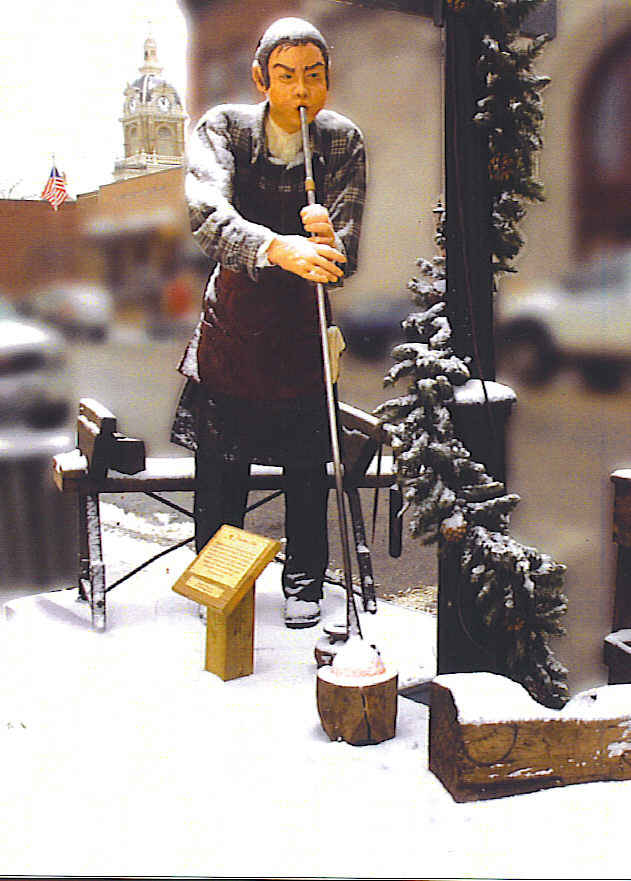
“Glass Blower at Work” symbolizes the rich heritage in the Cambridge area of artisans who produced quality hand made glass and is a special favorite since my father was a glass blower at Cambridge Glass Co. This was a major employer in the area from 1902-1958 and their glassware is a collector’s item today. A frequent bus stop during tours of the city includes the National Museum of Cambridge Glass where you can still see samples of the beautiful etchings and unique designs, which made these glass creations very fashionable to use for a special occasion. Today descendants of former Cambridge Glass workers still have a few small shops in the area. Boyd Crystal Art Glass, Mosser Glass, and Variety Glass all continue to produce handmade pieces today.

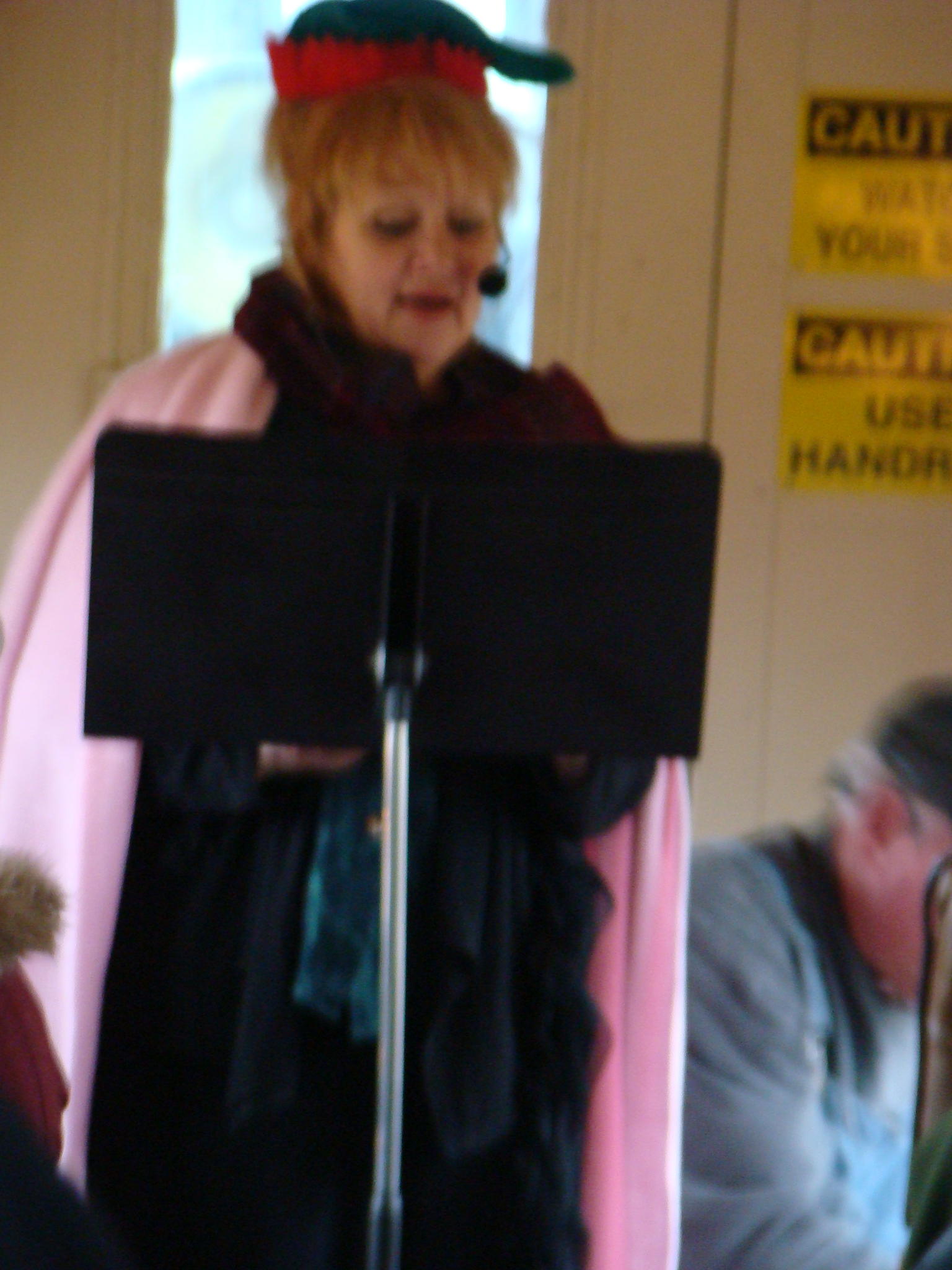
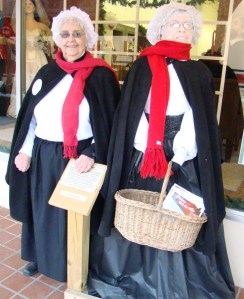
The ShopkeeperYe Olde Curiosity Shoppe is headquarters of Dickens Welcome Center and here you are greeted by “The Shopkeeper,” and quite often beside her you will find the lady who it was created to resemble after she won the first Picture Your Face Raffle. Visitors sometimes say, “Is she real, or is she a mannequin?” Raffle tickets are sold each year and the winners become mannequins in the future.   The Welcome Center’s Imagination Station provides an opportunity for visitors to try on Victorian wear. Then they can have their pictures taken with the beautiful Christmas tree, Charles Dickens, or the new addition this year of the Duke and Duchess of Cambridge mannequins, which resemble Prince William and Kate. This is fun for young and old alike. Here you will also find many unusual Christmas gifts and ideas.

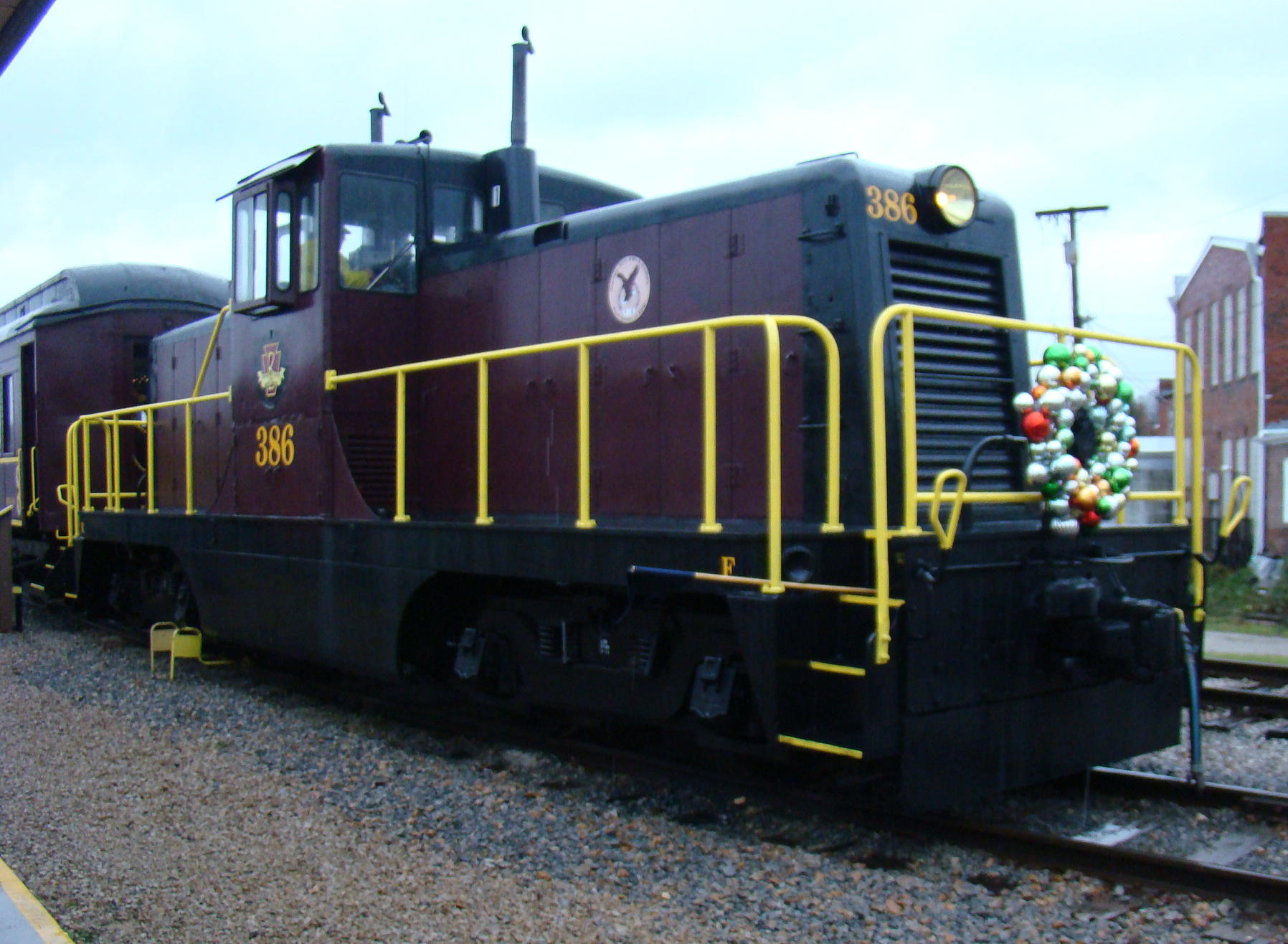
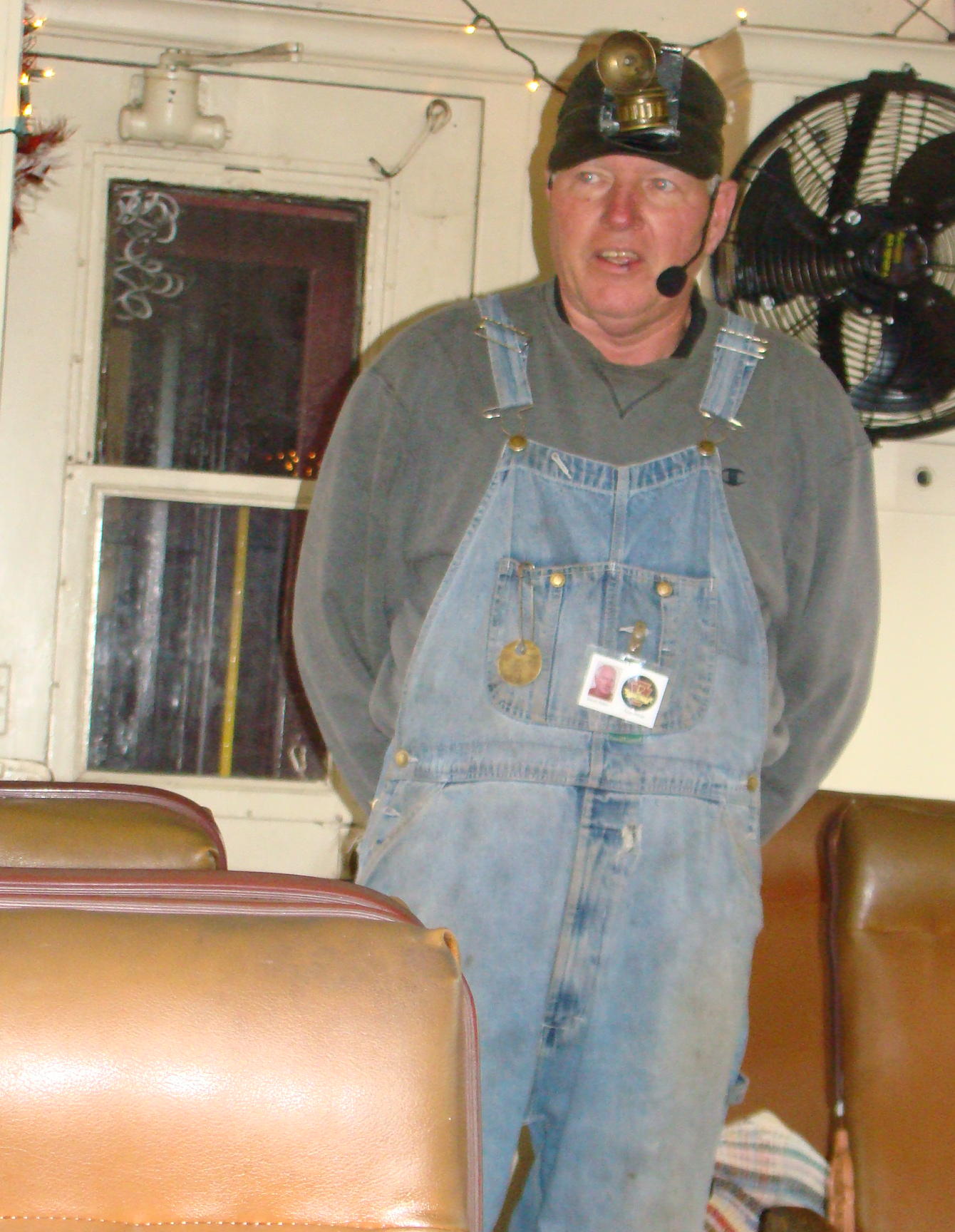
Not all of the mannequins are downtown. In neighboring Byesville, the “Coal Miners” can be found under the station roof of the Byesville Scenic Railway. This is another popular destination with its “Spirit of Christmas” train, which follows a trail over abandoned mines. While on board, men dressed as miners tell stories of days when coal mining was king in this area.  To remember all those who worked in the mines, a statue, “Coal Miners Memorial”, is in the planning stages and will be the only statue to honor coal miners in the state of Ohio. The mines are out of sight, the tipples gone, but the miners are still in the minds and hearts of families and friends.

When evening falls, everyone heads to the Cambridge Courthouse for a spectacular light show. Christmas music and the movement of the lights on the courthouse are synchronized perfectly and enjoyed by all. The display is computer controlled with 60,000 lights and 364 electrical circuits. Four different light shows entertain the packed courthouse square with traditional Christmas songs as well as children’s and contemporary. Add a little snow and it’s a perfect evening!

Introductions have been made to a few mannequins just to get your curiosity aroused, but you need to tour the area to see which one might be your favorite. Dickens Victorian Village welcomes individuals and tour buses to experience the special feeling of Christmas that lives in downtown Cambridge, Ohio.

As one recent visitor remarked, “If you don’t have the Spirit of Christmas when you come here, you certainly should have it when you leave.”

Dickens Victorian Village is located in downtown Cambridge, Ohio, which is just northwest of the intersection of I-70 and I-77. Come spend the day or stay the night, and catch the Spirit of Christmas.

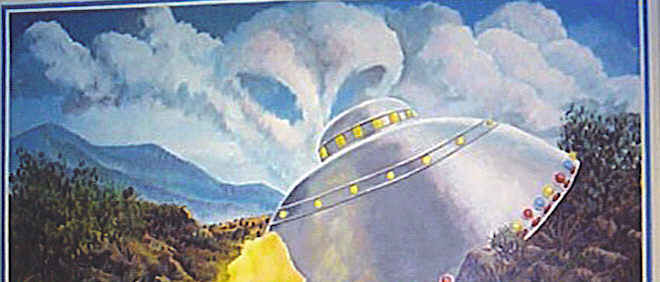
UFO or Weather Balloon? When people hear Roswell, they immediately think of the 1947 UFO alien invasion,  a subject which still interests many people. But there is definitely much more to this town of Roswell, New Mexico than aliens!

As soon as you enter the town, the presence of the New Mexico Military Institute is obvious from the beautiful campus to the polite, young cadets walking the streets. Started in 1891, this four year high school and two year junior college has been the starting point for many officers in the US military, as it is the only state supported military institute in the western United States. Among its most notable graduates are Conrad Hilton, Roger Staubach, Sam Donaldson and Major General Edwin Walker. In 1921, the school adopted the honor code of : “A cadet will not lie, cheat, or steal, nor tolerate those who do.” That code is still enforced today.

During WWII, a prisoner of war camp was located in nearby Orchard Park. These German prisoners assisted with many construction projects in Roswell.   Along the banks of the North Spring River, the sides were paved with stones. In one section the stones were strategically placed to form the outline of an Iron Cross, symbol of the German Army. Nearby was a piece of the Berlin Wall, which was sent by the German Air Force for their nice treatment as POW’s there. Today at the POW/MIA Park, there is a relaxing walkway along the river where you can appreciate the hard work involved and the beauty that they created.

The Roswell Museum and Art Center has many beautiful and unusual paintings by well known artists such as Peter Hurd, Henriette Wyeth, and Georgia O’Keeffe. Of special interest here is the Goddard Wing, which contains a reproduction of the workshop of liquid-fueled rocket pioneer, Robert Goddard. He tested prototypes of this fuel in Roswell from 1930-1941.  While there, noticed this Native American sun design at the gift shop, and now it often hangs in my car to bring a feeling of warmth and peace. Still makes me smile to realize that this beautiful sun is made from the bottom of a Coca Cola can!

Of course, no visit there would be complete without visiting the International UFO Museum and Research Center, and taking a trip to the site where the mysterious crash occurred. Here at the Museum you can find information about the Roswell incident, crop circles, UFO sightings, ancient astronauts, and Area 51. Living up to their motto, “The truth is here,” their library of books and films is a great place for the curious and the serious to explore the unexplainable.

One interesting film told the story of a young boy, who had seen inside a space ship in 1947 and told his parents he saw fine wires with colors flashing.  In the 1990’s, this now adult man worked in maintenance and was called into a phone room for repair work.  He exclaimed, “That looks just like the spaceship I was in!”  Fiber-optics!

Responsible citizens who witnessed the crash were very quiet about it until their retirement. Once they told their story, tourists began to visit to learn more about the possibilities. The event known as the Roswell incident: the crash of an alleged flying saucer, the collection of debris and bodies, and the ensuing military coverup, still leaves lots of questions unanswered. The debate continues to this day.

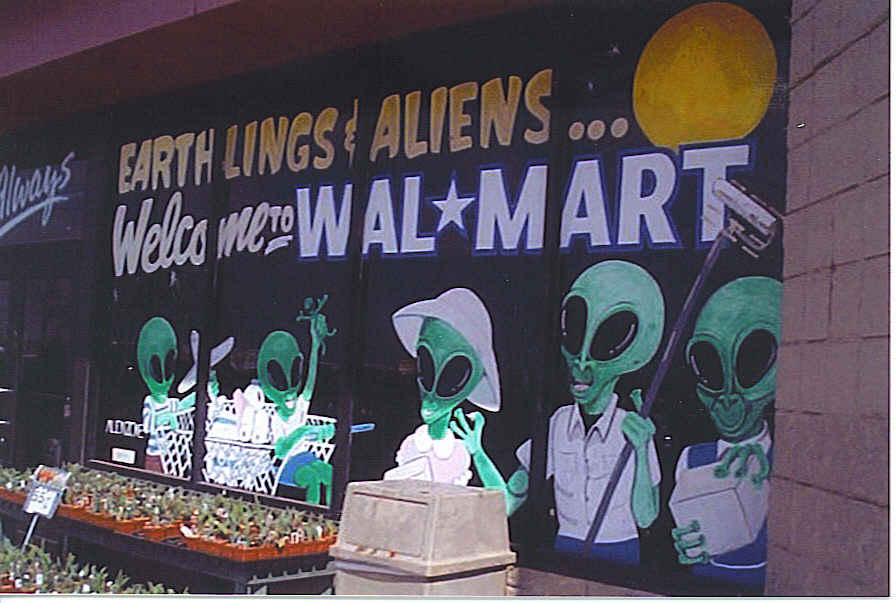
Many local businesses have joined in with the UFO theme as Roswell has suffered a tough economic time, especially after the closing of Walker Air Force Base there. Local gas stations have aliens pumping gas, Wal-Mart has an Aliens’ Welcome sign, and now McDonald’s has built a theme park restaurant there. Yes, you guessed it, McDonald’s is shaped like a UFO with aliens in the play area.

Roswell even has its own small zoo, which is a great place to take a daily walk with the animals. Spring River Park and Zoo is a free zoo run by volunteers and local donations, and has a wide variety of animals from prairie dogs to buffalo and even a black bear. For only a quarter, children, or the young at heart, can ride the miniature train ride or the antique wooden carousel. This is one of about a hundred wooden carousels left in the country and features hand-carved horses.

All ages are sure to find something to enjoy while visiting Roswell… but watch out for those little green men peeking around the corner.

Roswell is located South of I-40 on US 385 or East of I-25 on US Highway 380 in the southeastern  corner of New Mexico. US 380 is also Main Street  and there is a handy information center near the Roswell Museum and Art Center.

Navajo Blessing
We walk in our moccasins upon the Earth
and beneath the sky
As we travel on life’s path of beauty
We will live a good life and reach old age.

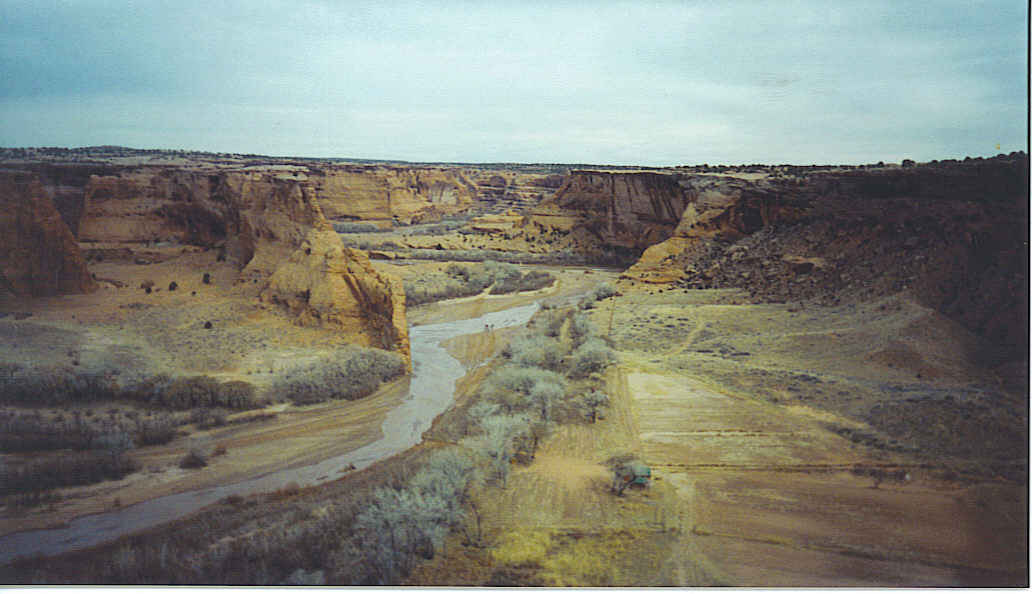
Many American Indians still enjoy life in the Southwest,  and some call Canyon de Chelly (pronounced day Shay) home. Chelly is a slightly modified Navajo word Tseyi, meaning canyon or literally, under the rock.

Located in northeastern Arizona, Canyon de Chelly is completely located within the Navajo nation’s boundaries. Navajo Indians live and work here today among the red rock cliffs with ancient dwellings along their faces and lush valleys below.

Right at the edge of the South Rim parking lot, several wild horses that frequent the area, grazed on the sparse grass. This beautiful scenic drive takes about three hours so be certain that you have plenty of drinking water. There are trails to the bottom but you must be escorted by a guide from the Navajo tribe on all trails except the one leading to the White House Ruins.

One of the spectacular points along the rim trail is Spider Rock, twin sandstone spires with the tallest being 800 feet high. Traditional Navajo believe the taller of the two spires is home to Spider Grandmother. Spider Rock is considered sacred to the Navajo and is associated with Spider Woman, who taught the Navajo how to weave on a loom which Spider Man told them how to make.  Spider Woman also is the enforcer of obedience in children. Part of a Navajo chant heard there still remains in my mind today: With beauty in Nature, I walk.

Another highlight in the area is White House Ruins, which are remains in a sandstone cave of adobe dwellings from a previous culture.  They are believed to have been constructed by Anasazi people “the Ancient Ones”.  There was a time when you could roam up into the cave and walk where the Anasazi walked. But today it is fenced off due to tourists taking bits for souvenirs and thus destroying the historic value of the spot.

At the information center, the Navajo Indians have a beautiful gift shop with handmade Indian crafts. While visiting there talked with Gary Henry and his brother Teddy, Navajo jewelry craftsmen, and their sister Winnie, who leads many of the tours and weaves beautiful blankets.

The beautiful but tough sister, Winnie,  says that weaving is “to weave together the pieces of your own life.” Weaving is her special art given by Spider Woman’s spiritual touch.  Her mother told her, “If you know who you are, where you come from, and where you are going, you will never get lost in this world.” Winnie will tell you that her culture and religion live within her and will never come out.

Gary designed this beautiful two-sided necklace of native stones in a bear claw design – my treasure for this adventure. He grew up in Canyon de Chelly, running up and down the trails as a child. They lived in a hogan, a traditional Navajo dwelling, and their family raised sheep. At that time there was no water or electricity in the canyon, so meals were cooked over a fire, and the evening was spent listening to stories and playing their music.

Canyon de Chelly is a spiritual place where the soul responds to the beauty of nature, which abounds. When we leave, they say Hagona, which means “see you again”. To walk in beauty and die naturally of old age is the Navajo notion of the good life. Hozona h’astleen! May everything go well!

Canyon de Chelly is located in northeastern Arizona.  Take Route 191 to Chinle, Arizona and the Canyon is directly east of town. From the Visitors Center you have a choice of the North Rim Drive or South Rim Drive.  Each drive takes about three hours to complete.

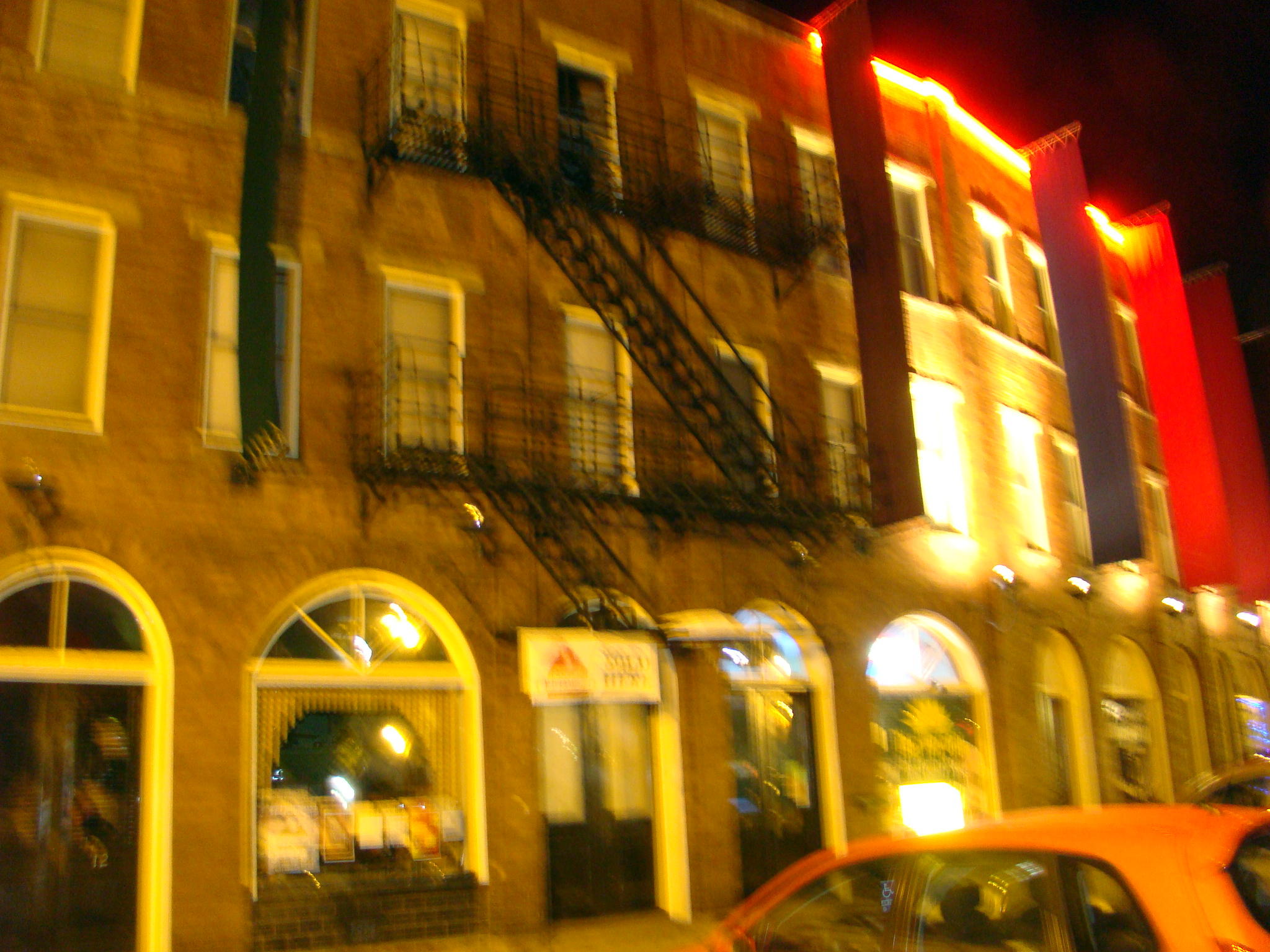
0oOOOoo! ooOOOoo! As the Ghost Lady leads a large group through downtown Marietta, Ohio, stories of ghosts are told on nearly every street. This is an old town with many restless spirits left over from the past.

Ghost Trek is a two hour walking tour of historic and haunted Marietta and begins along the Ohio River on aptly named Ohio Street.  Back in the early 1800s, this was the stopping off point for many riverboats.  So naturally a bar was one of the first establishments to serve the travelers.  The first bar to open ran out of whiskey in two hours and needless to say there were inebriated men walking the street 24/7, along with pick pockets and yes, ladies of the night.

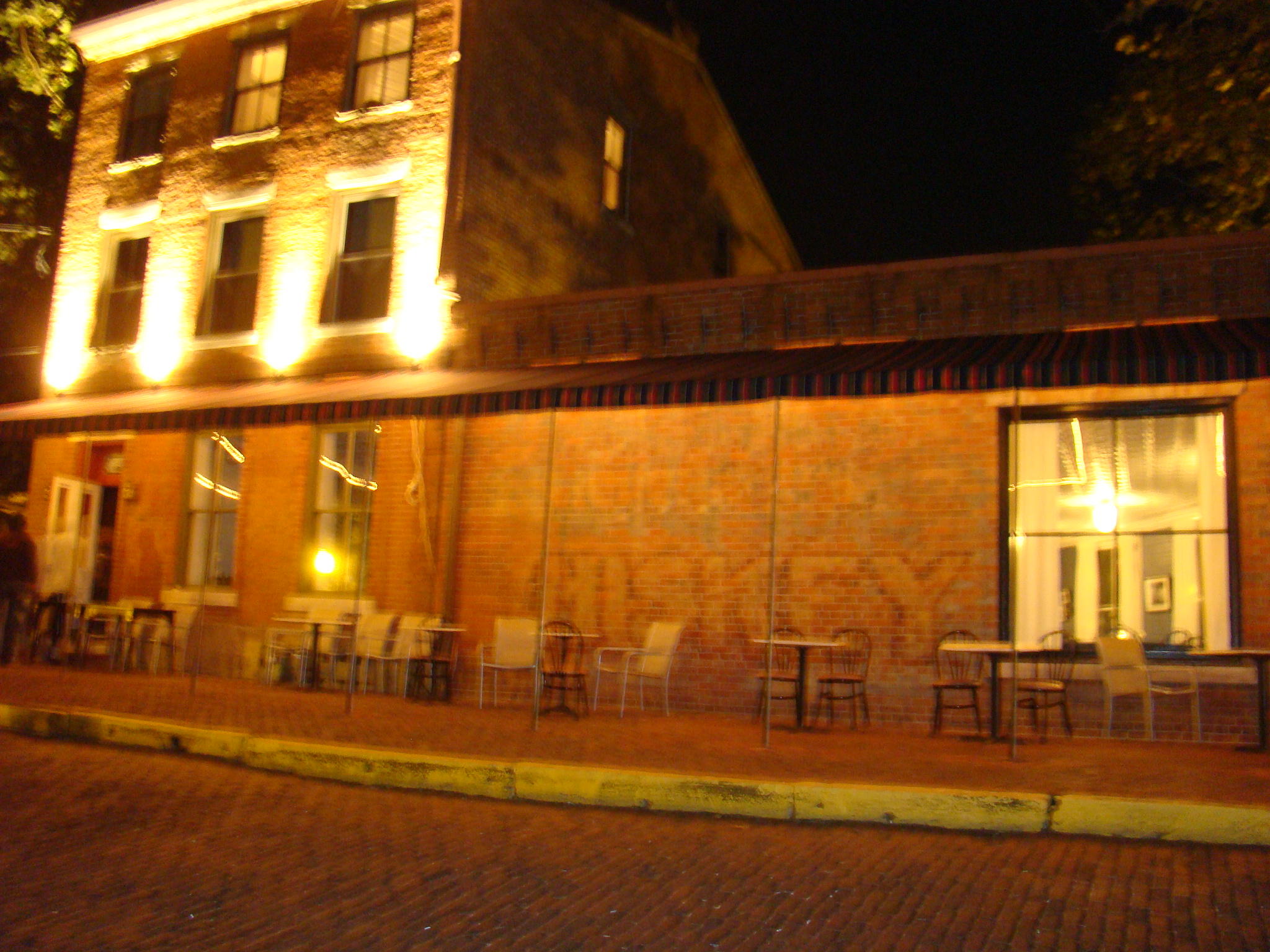
The LaBelle Hotel was a popular House of Prostitution and the building is still in existence today, called the Levee House Cafe.  A story was told of a prominent businessman, who visited one of the young ladies frequently on the second floor. He attempted to keep this  a secret, but one evening his son followed him to the hotel with an axe.

The son watched as his father ascended the steps to the second floor and then waited until the light went out in one of the rooms.  Hastily, the son walked up to the second floor, opened the door, cut off his father’s head with the axe, and ran back down the steps to the street.  Guilty?  Not by the standards of those days! He was arrested but acquitted on the basis that he was defending his family honor.

Today the people who live in this building still hear the sounds of footsteps climbing up the stairs, a time of quiet, then footsteps running down the stairs again.  This is called residual haunting as the energy released in the environment during a traumatic event may  reappear as an echo of its original form.

On to the Lafayette Hotel where the third floor seems to have lots of unsettling paranormal activity. Built in 1918, every death that has occurred in this hotel has happened on the third floor.  Guests frequently complain of personal belongings being moved around.  One man commented, ” I am a science teacher. I don’t believe in any of this stuff”… until his belongings in his room got rearranged and some came up missing.

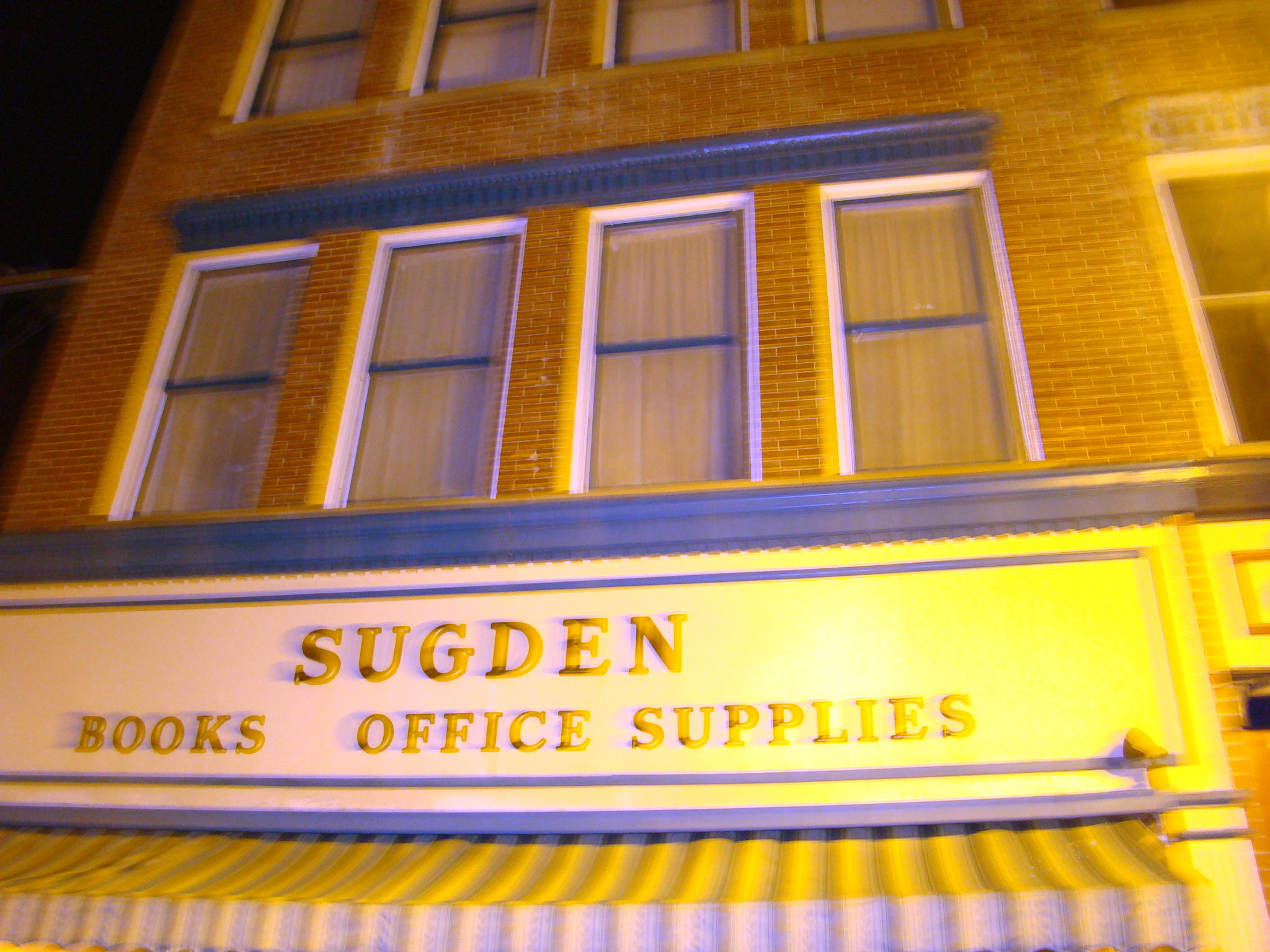
Fifty paintings of  artist James Weber (1888-1958) were brought to Sugden Book Store for an art show on the second floor. Melancholy Weber loved his art work, but was forced to run the family grocery store.  So he said that when he died he wanted all of his paintings burned.  But someone found fifty that were left behind!

After careful setup for the art show, the owners were very pleased with their findings. Next morning when they arrived to open the show, they found the table had been knocked over as well as the pictures.  On the desk was a real estate report – a deed from 1932 for James Weber’s art studio, right there on the second floor!

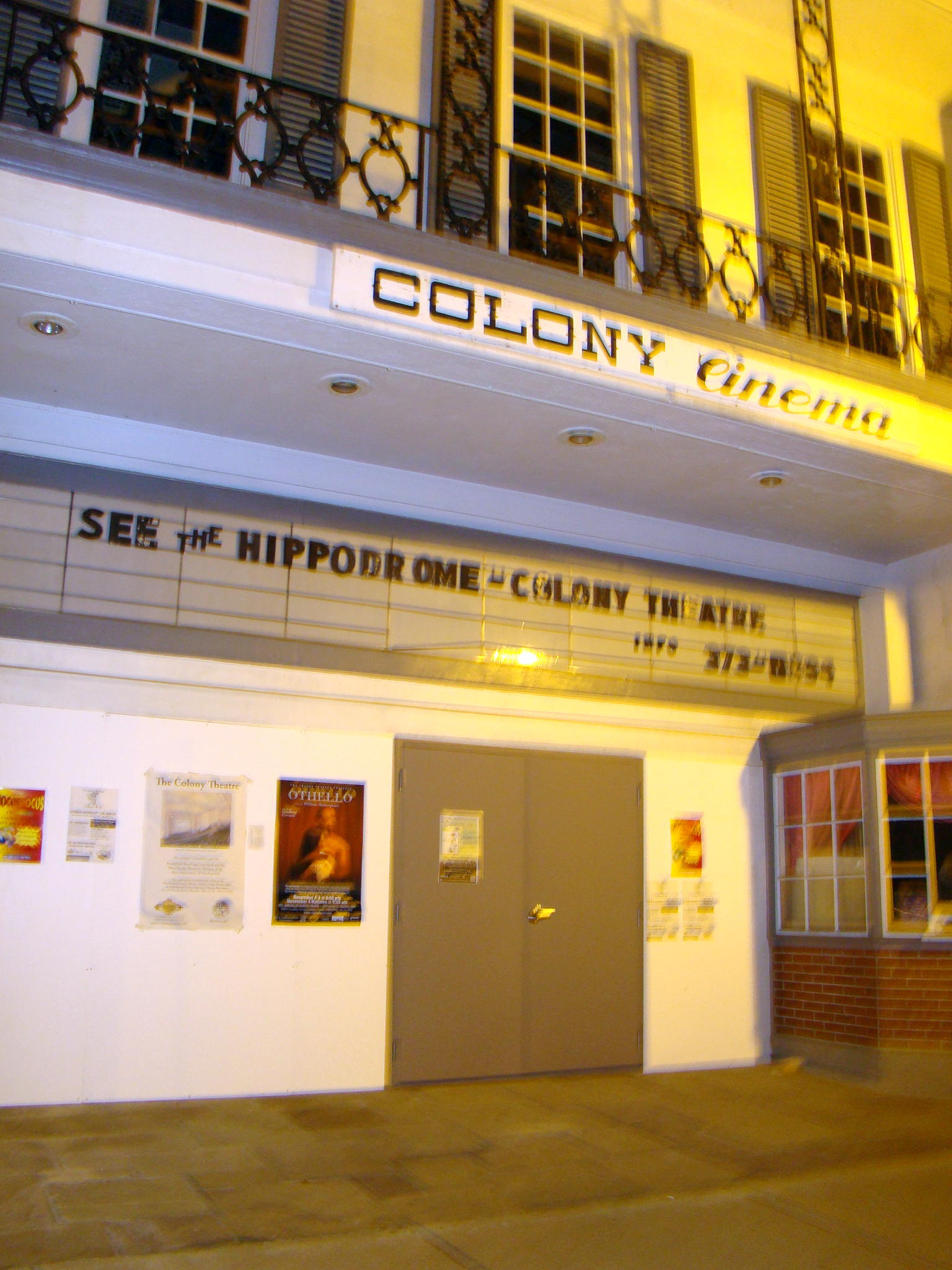
Restoration of the old Colony Cinema was seen firsthand as the group had special permission to enter the theater. Here, it is said, the ghost of the former owner, Mr. Shay,  travels via an underground passageway between the Colony Cinema and Mid Ohio Valley Players Theater across the street. Colony Cinema has been an important part of the Marietta community since 1919 when it was The Hippodrome Theater, the premiere showcase of Marietta and the surrounding area. Some of Hollywood’s biggest names, including Frank Sinatra, Judy Garland, and Boris Karloff, appeared on its stage.  Its gorgeous original asbestos fire curtain has been rediscovered and is being restored to be featured predominately in the restored Colony Cinema.

The last stop on the tour was at Tiber Way Grille, where people hear sobbing, crying, and have an edgy feeling.  They definitely feel it is haunted. Closer look at old lettering on the building perhaps gives a reason for this feeling.  It says: Chronic Diseases The Sanitorium. This twenty six room hospital was used for tuberculosis patients in the early 1900s as well as for those with extreme mental problems. Fittingly, next door was Doudna’s Funeral Services!

Nothing beats a haunted, moonlit night with ghosts of the past.

To arrive in Marietta, Ohio take Exit 1 off I 77 and head west on Route 7, Greene Street. Where the Muskingum River meets the Ohio River, you will find the old Lafayette Hotel, the starting point for the Ghost Trek. This walking tour is under the expert guidance of Lynne Sturtevant, founder of Hidden Marietta and author of several books of Marietta history.

“We like it here and we ain’t goin’ back.”  Residents of Slab City in Southern California enjoy their life of freedom where the air is clean and rent is free.

Sandwiched between the Salton Sea and the Chocolate Mountains, Slab City is home to many campers.  Here they don’t care what you look like or where you came from. Everyone is welcome! Campers come on dirt bikes, in RVs and even greyhound buses to park on this hidden desert city.

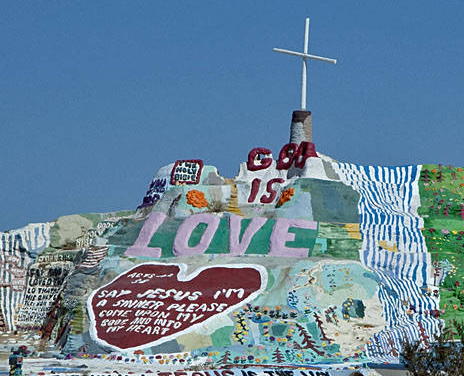
At the entrance to Slab City, you will find Salvation Mountain where the sides are painted with religious pictures and verses to inspire the freedom that is advocated here. Leonard Knight has been painting and repainting this mountain since 1985.  If you like his work and want to donate to the cause, a bucket of paint is his favorite contribution…acrylic is preferred.

As you travel back into Slab City,  you find campers set up on the concrete slabs left behind from the WWII training grounds. The Chocolate Mountains and a few creosote bushes add some beauty to this RV oasis in the middle of the desert. This is indeed rough living, even though free, as there is no electricity, running water, or bathroom facilities.  And the temperature is hot!  Those who stay either use a generator or solar panels to produce enough power to cook, or run a fan for their swamp cooler. Some even use that power to watch TV for a little while each day and have their satellite dishes located on top of their campers. Definitely not a place for those who like all the modern conveniences.

Entertainment seems to come in an easy manner to these free thinking people. Flea markets or swap meets are held most weekends. One camper even set up a library, as there is definitely lots of time to read a good book. In the evenings, those who have an instrument with them provide music with songs like: We Like It Here, Slab City USA, and Free Bird.

Marine Corps Chocolate Mountain Gunnery Range is located close by. This Gunnery range has been a training ground for Marine Corps and Navy pilots since WWII.   If you happen to stay at Slab City, you will hear the sounds of artillery practice throughout the night quite often.  Where Patton once ran his tanks, today folks race their four wheelers and dune buggies.

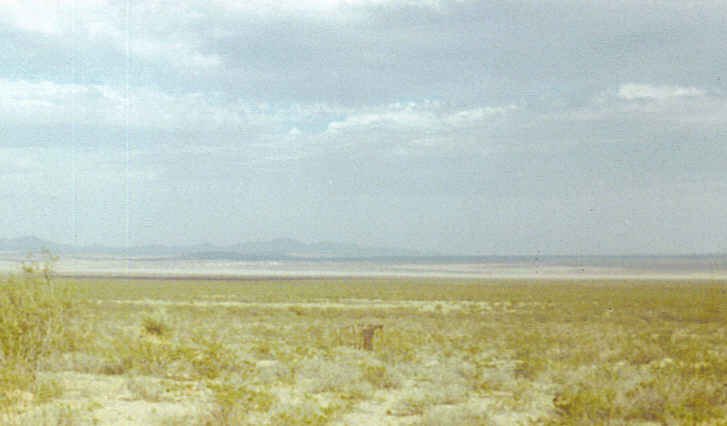
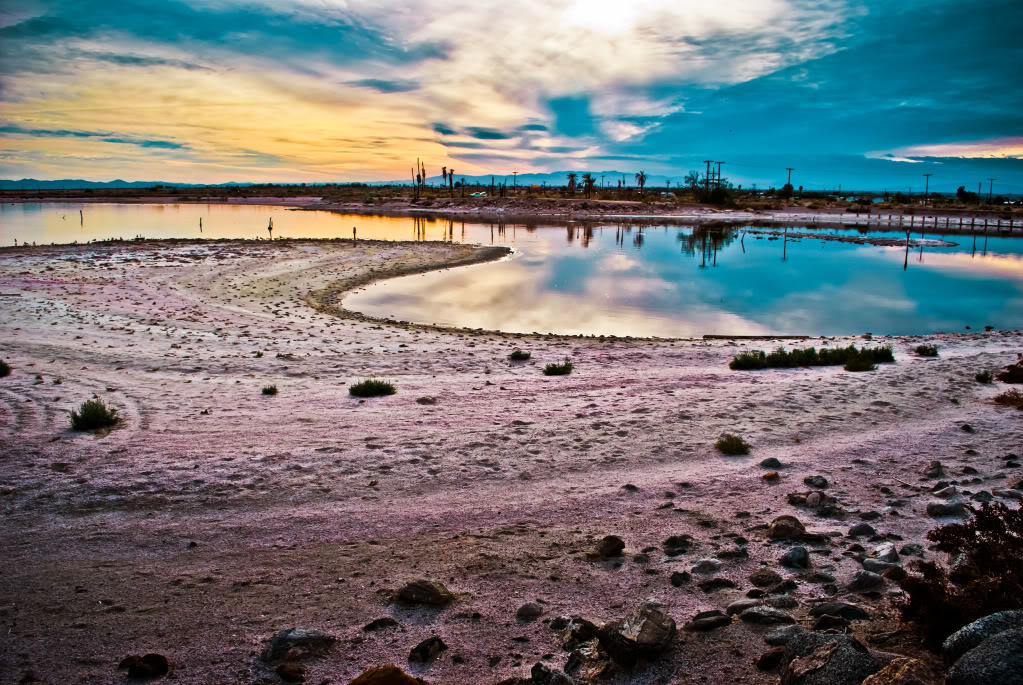
Nearby Salton Sea is one of the world’s largest  inland seas with its surface being 226 feet below sea level. Originally formed from an overflow during a heavy flood of the Colorado River into the Salton basin, this re-created lake in the Imperial Valley of California is located on the San Andreas Fault. This type of flood should not occur again due to the construction of Hoover Dam on the Colorado River in the Black Canyon. Since this inland sea has no fresh water supply except for the inch or two of rain each year, today this polluted sea seems thick enough to walk on!

There is a possibility that this area may soon be developed into a solar and geothermal energy site for much needed power for the California area.  This could power many homes and businesses! But environmentalists are concerned about the dwindling population of the Mojave Desert tortoise, the flat-tailed horned lizard, and the burrowing owl in that area.

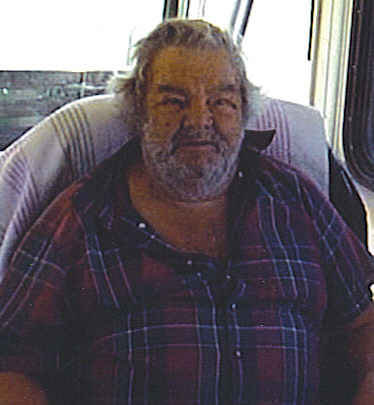
If you happen to stop in a local tavern, you might hear this discussion regarding the protected environment. One slightly disheveled man of the desert will laugh and say, “The most amazing creature in the desert is the stick lizard.  Carries a stick in his mouth whenever the temperature rises above a hundred ‘n fifteen degrees.  Still he searches for food at high noon.  How does he do it?”

“Wow, how can he be out there at high noon?” ask the environmentalists.

“Well,” the desert man thinks deeply, “when the sand starts to burn his feet, he puts the stick in the ground so he can climb it. He just hangs there a few minutes ’til his feet cool off.  Ain’t many stick lizards left.  Definitely endangered.”

If you are tired of the city or your troubles are so many that you can’t list them, flee to Slab City where you are sure to be welcome!

If you are driving or hitchhiking to Slab City, it is located in the desert of Southern California just four miles east of Nilan off Route 111.  There is fairly easy access as it lies just north of I 8 and south of I 10.

Think there is only one Grand Canyon?  Think again!  Ones that come to mind other than the Grand Canyon National Park in Arizona include: Grand Canyon of Pennsylvania at Pine Creek Gorge, Grand Canyon of the East at Letchworth State Park in New York, Grand Canyon of Pacific at Waimea Canyon in Hawaii, and one of my favorites Grand Canyon of Yellowstone in the northwest corner of Wyoming.

Twenty four miles long on the Yellowstone River,  Grand Canyon of Yellowstone is downstream from Yellowstone Falls, whose scenic beauty flows over rapids in its course through the beautiful canyon. During the Washburn expedition in 1870, Lt. Gustavus Doane described the canyon as follows:

“There are perhaps other canyons longer and deeper than this one, but surely none combining grandeur and immensity with peculiarity of formation and profusion of volcanic or chemical phenomena.”

Indeed this is a beautiful canyon and one many miss while taking a peek at the Grand Canyon itself. Upper Yellowstone Falls flows into a deep canyon below, then the stream takes a wild ride over rapids throughout its course. About 10,000 years old,  today the forces of erosion continue to sculpt the canyon through rain, wind and earthquakes. Lookout Point was one of the early popular spots for viewing the canyon, so back in 1880 the park superintendent decided to put the first railing around this area for safety measures.

Since this is an area of bubbling volcanic activity, it is not surprising that earthquakes happen here frequently. Tremors are felt here all the time. Actually the lookout for Inspiration Point has been shortened several hundred feet due to the quakes in this area. Today on this overhang, there is a nice platform with rails, which provides fantastic views of the canyon both directions.

A zigzag path, Uncle Tom’s Trail, down to near the bottom of the falls at Inspiration Point, created quite an afternoon diversion. The trail was named for Bozeman resident, H F Richardson (known as Uncle Tom), who operated a ferry in 1890 across the Yellowstone River in the canyon. Today that trail has been considerably improved; yet, with a drop of over 500 feet, at least 300 steps and lots of paved inclines, it still requires some perseverance. Slowly strolling down the steep blacktopped path, you could hear the roar of the falls and the peace of the canyon all at the same time. The climb back up was a bit more tiring and a lot slower.  Rested at the top and took a picture of the route taken as seen in the picture above.

At the Lower Yellowstone Falls, beautiful Artist Point has a picture post card view of the canyon and falls. This spot is off the beaten path, holding its beauty for the fortunate to discover. The combination of metallic lusters on the face of the canyon walls creates breathtaking color combinations that are one of a kind. This Lower Falls is 309 feet high, nearly twice the height of Niagara Falls but does not have nearly the same volume of water flowing over it as Niagara does. A member of the 1870 Washburn party, N. P. Langford, gave this brief but poetic description of the Lower Falls: “A grander scene than the lower cataract of the Yellowstone was never witnessed by mortal eyes.”

To end the day, made a relaxing stop at Green Dragon Spring where steam often fills the caverns of the hot spring.  Visitors must wait patiently for a glimpse of this sulfur lined cave with boiling green water. This is a land unlike any other in the United States and Theodore Roosevelt described it well when he stated:  “The beauty and charm of the wilderness are yours for the asking, for the edges of the wilderness lie close beside the beaten roads of the present travel.”

It is difficult to comprehend the beauty, majesty and power of the beautiful Yellowstone area without exploring it firsthand.

The Grand Canyon of Yellowstone is located very close to Canyon City, Wyoming in the northwest corner of the state. Yellowstone’s Grand Loop Road arrives there from all directions. This road is usually accessible from May through October. During the winter months, roads are often snow covered and access to the park is either by snowmobile or commercial snow coaches.

“No ghosts – not even rumors of ghosts here,” explained the guide as she began an interesting tour of the Worthington Mansion at Adena State Memorial near Chillicothe, Ohio.  Built in 1806-07, this beautiful mansion home was designed by what many consider the first American architect, Benjamin Henry Latrobe. Usually Latrobe was busy with larger projects, such as designing the United States Capitol, but as a friend of Thomas Worthington he agreed to design a beautiful home on the 2000 acre estate.

The Worthington home, Adena, was the most magnificent mansion in the area at that time, and fascinated crowds of visitors. Large panes of window glass and papered walls were novelties which especially attracted attention. The sandstone blocks for the house were all dug from a quarry on the property.

This drawing by Henry Howe in 1846 shows the beautiful garden vista at Adena that inspired the Great Seal of Ohio. Looking across the front lawn, the Scioto River flowed between the cultivated fields and Mount Logan.  On the Great Seal of Ohio, the sun displays thirteen rays of light symbolizing the thirteen colonies. In the field is a shock of wheat representing the prominent field of agriculture in the state. Nearby, resembling a shock of wheat but showing Ohio’s Indian heritage, is a sheaf of seventeen arrows proclaiming Ohio as the seventeenth state.

Today the house has been restored to appear much like it did during the time the Worthingtons lived there.  Much of their original furniture can still be seen. Worthingtons’ actual skeleton key was used to unlock the door to begin the tour, and felt lucky to have it in my possession for a short while. Upon entering the mansion, a beautiful large clock made by George McCormick and costing $35 at that time stands beside a beautiful staircase, which appears to be marble but was actually painted with a feather to achieve that effect. Throughout the house a shade of pink paint was used. Paint was very expensive at that time and the pink tint was achieved by crushing a special insect into the paint.

Ten children were raised in the nursery, which strangely enough had no heat. Guess they had to be strong to survive, but none of those children died.  The parents’ room was next to them and had a nice fireplace so hopefully they kept the door open. Worthington’s wife, Eleanor, taught the children in the parlor while running the household from there at the same time. On the wall was a list of Family Maxims to live by, for example: “Keep everything in its proper place, do everything in its proper time, and delay not till tomorrow what should be done today.”

The rooms on the second floor were all bedrooms, except one which was perhaps a servant’s room, and a large dark closet where, it was told, they placed children when they misbehaved. Many famous guests stayed here including Henry Clay, General William Henry Harrison, and President James Monroe.  Of special interest was the screen on the left side, which hid from view their bathing area.

Among the  four bedrooms upstairs, there was one for the boys and another for the girls. Although there were ten children, there were seldom more than three in a room at one time. On the dresser in the girls’ room was a set of cards for learning the alphabet with a flexible Mr Hodge Podge to bend to the shape of the letters.  Guess the girls had homework even way back then. Education was very important to the Worthington family and they even thought it important to educate the girls, which was not a common occurrence in the 1800s. Imagine they took a break now and then and looked out the window at the beautiful gardens surrounding their home.

After reading a book on ancient history, on Sept. 18, 1811, Thomas Worthington wrote in his diary: “Adena” a name given to  “places remarkable for the delightfulness of their situations.”  It becomes apparent that visitors experience this same type of feeling by the smiles on their faces as they explore this beautiful mansion from years gone by.

The Adena Mansion is located Northwest of Chillicothe, Ohio just off State Route 35. Directions are well posted to the Adena State Memorial, which includes the Mansion and Gardens.  It is a short walk through the Gardens to arrive at the Mansion. Admission is reasonable but you need to check their schedule for hours opened.

Memories of a One Room School

Long ago in 1906, Hopewell School was built in Indian Camp, Ohio.  Education there continued for nearly fifty years with the last class graduating eighth grade in 1955. One teacher taught eight grades for most of those years and needed lots of patience and planning, as they had to make do with whatever was available.

Most of the one room schools of that time were set on large, hand-hewn, rectangular sandstone blocks with the building being constructed of weather boarding painted white. There were windows on each side, but none in the front or back, and one door in the front.  Behind the school there was a coal house, which kept the supply of coal needed to heat the pot-bellied stove. Of course, there were never any modern conveniences at Hopewell School.  Out back of the school were two outdoor privies, and both two holers.  Could be a very cold trip and seat in the middle of winter.

If they lived within a mile of the school, students walked with their lunch boxes tightly gripped, and that was part of the fun. Older students usually watched out for the safety of the younger ones, and often even helped scare a barking dog away. If the teacher lived in the area, they might pick up a few students on a rainy day.

Every day of school opened with the pledge to the flag and a morning devotion. All subjects were taught to all grades by one teacher.  How busy they must have been! The teacher was very excited when she obtained this special copy machine, a hectograph. After placing the master copy in a pan of gelatin-like substance, several copies could be made quite easily by picking up the ink the master copy left behind.  Now she could make twenty copies of something in five minutes from one original writing.  They would be so amazed at the technology available today! This was a time of learning to help your fellow students also, as students helping students was a big part of the day. Double desks made it easy for one student to sit with another, who might need a little help. With all eight grades in one room, it was also a great opportunity to learn from older students while listening to them recite their schoolwork.

Getting water was a great excuse to get to leave the school ground, and students were seldom in a hurry as they enjoyed talking to neighbors along the way. There was always someone who was kind enough to let children get water from their wells and carry a bucket of it to school.  There it would be placed in a large container at the back of the room that had a spout at the bottom.  Everyone drank from the same dipper, unless they were lucky enough to have their own folding metal cup.

Keeping warm was sometimes a problem as the pot bellied stove seemed to be extra warm on one side and rather cool on the other.  One of the students would go back to the coal house and fill up the bucket to set beside the stove. The boys usually did this and didn’t really mind, as sometimes they would sneak a smoke while they were back there.

Recess was spent playing baseball, hopscotch, Annie Annie Over, Red Rover, and climbing the trees to sit and talk with a friend or watch the games being played. Teachers were usually outside keeping an eye on everyone. The only time recess was inside was during a heavy rain.  In the winter sledding was a popular recess activity on the nearby hills. Once in a while, the teacher would permit some students to go to the General Store in Indian Camp for a little candy or soda treat.

Special programs were a big part of the school and community life.  The Farmers Institute was one special time when students sang and performed skits for the entire community.  Every holiday was an occasion for a school activity. Halloween might involve a costume contest, and Christmas guaranteed a packed house for the program.

After spending eight years at the one room school, the transition to high school was often difficult. The ride on a school bus to Cambridge High School was an adventure in itself.  The early bus was a small one compared to today’s standards, and only held a dozen students. Days were long for many, who would get on the bus at 7:00 after chores were finished, and get home at 5:00 in the evening, just in time to help with evening farm chores.

Memories of the Hopewell One Room School are still fresh in the minds of the students who attended there over the years.  The school still stands today and is now used for Grange, 4-H, homemakers, and church services.  Students still meet once a year to relive old memories and get reacquainted with each other. Ties to classmates remain strong over the years as experiences there helped shape their lives. When the day is over, former students depart with the thought: “God be with you till we meet again.”

 
The old Hopewell School is located in Guernsey County near Cambridge, Ohio right near the outskirts of Indian Camp.  Take Route 209 West out of Cambridge, then turn right on 658 North.  After about five miles, you should come to the town of Indian Camp.  At the far side of the town, you will find a church and the old one-room school.

Exquisite! A feeling of wealth poured from the Oglebay Mansion Museum in Wheeling, West Virginia. In 1900, Earl Oglebay, Cleveland industrialist and Wheeling financier, purchased Waddington Farm to use it for experimental ideas such as crop rotation and soil improvement. He worked hard to develop quality of life for rural farmers and supported development of 4-H clubs.  His methods were considered outlandish at the time, but soon opened the eyes of many in the world of agriculture. After his death, he left Waddington Farm to the people of Wheeling and today it is Oglebay Park.

Everywhere you looked, you saw high quality, beautiful antiques in their home. When you visit, there are recordings to tell you about the furnishings, paintings, and life of the family in each room. But the Museum has more in store for you than just beautiful furnishings and paintings, as they have gone to great lengths to provide a history of the area as well.

The Pioneering Spirit Exhibition features the history of Wheeling, plus stores and rooms of the early 1900s. Wymer General Store and Sinclair Pharmacy are two of the highlights. Especially enjoyed the General Store as my grandfather had a very similar one. It was a step back in time to see the old candy case, roll of meat wrapping paper, scales, and all the things that created a  one stop place to shop many years ago.

Earl Oglebay’s only grandson, Courtney Burton, was much in evidence in several large oil paintings scattered throughout the house. Courtney always enjoyed horses, even as a child.  The story was told that he even brought one to the bedroom in the mansion, after riding around what is today Oglebay Park.  As he grew up, his love for horses made him a champion polo player and a master of foxhounds.

Here you find the history of Wheeling from pioneer to Victorian time depicted in pictures, stories, and displays. The name Wheeling was actually a piece of Native American vocabulary, Weelunk, which means place of scalp or skull. Indians decapitated early settlers there and placed their skulls on poles in the Ohio River, creating a unique “No Trespassing” sign. But when Ebenezer Zane’s family settled there in 1769, they said Wheeling was “a vision of paradise.”

Downstairs there is a changing exhibit, which at this time was In Their Wake: Wheeling and the Steamboat Revolution. 2011 is the bicentennial anniversary of the first successful steamboat, New Orleans, that traveled  down the Ohio and Mississippi Rivers to New Orleans with passage costing $30.  The exhibit displayed the many changes that occurred in Wheeling manufacturing and the influx of travelers and new residents into the city.  Wheeling is listed as the birthplace in 1816 of the  American steamboat, The George Washington, which set the pattern for future steamboats.  Also on display were pictures of the original Wheeling Suspension Bridge built in 1847. At that time it was 1,010′ from tower to tower and the longest suspension bridge in the world.

What a beautiful mansion in the rolling mountains of West Virginia!  Imagine spending a quiet evening in the favorite room of the Oglebays surrounded by the treasures of yesteryear. Musical activities were a popular relaxation and many of the rooms contained a piano, organ, or record player. What an elegant place to spend the evening. What a wonderful life!

Oglebay Mansion Museum is part of the Oglebay Institute in Wheeling, West Virginia.  Located just off I-70 at Exit 2A, follow posted signs to Oglebay Park. Continue on Lodge Drive up the mountain side to the Mansion, which is open most days from 9-5. 

“Father of Ohio Statehood” describes Thomas Worthington, original owner of Adena Mansion near Chillicothe, Ohio.  Before visiting the Mansion, an interesting tour of the Education Center there provides background information.

A short film, “Debate for Statehood” at the Adena Mansion and Gardens Education Center, describes the battle for Ohio becoming a state starting back in 1801. Many of the discussions for and against statehood were held at Gregg’s Tavern, which has been reproduced here.  The tavern provided food, drinks, entertainment and a place to sleep. This is where people heard all the news from travelers and locals, and even read the newspaper.

Protests were held at Gregg’s Tavern to oppose Northwest Territory Governor Arthur St Clair’s proposition to divide the land, which we presently know as Ohio, by an entirely different plan than originally proposed by the Northwest Ordinance. Opposition, led by Thomas Worthington, was so strong in the Chillicothe area that St Clair was burned in effigy outside Gregg’s Tavern on Christmas Eve. Eventually St Clair’s plan was not accepted and  in 1803, Ohio became the 17th state with its capital located in Chillicothe.

A tomahawk ceremonial pipe belonging to Tecumseh, Shawnee Indian Chief, is featured in The Tomahawk Room.  When Tecumseh visited Thomas Worthington at Adena in 1807, he found that Worthington was a man of peace and said he would never raise his tomahawk toward him. He presented the ceremonial pipe to Worthington for his efforts to bring peace between whites and Indians. Blue Jacket, warchief for the Shawnees, and Tecumseh were frequent guests at the Worthington home.  Mrs. Worthington was actually afraid of the Indians and often stayed in a different area of the house when they arrived. Even though the Indians were friendly, they always slept outside.

Another area of the Education Center replicated the Dry Goods Store of that era.  Merchandise here was usually paid for either by trading another item or put on credit.  There was a ledger on the counter to track the credit purchases. At this time people were lucky if they received fifty cents a day in pay, so prices of goods were considerably lower also. For example, a chicken cost about six cents, while you could get a barrel of flour for four dollars.  The Dry Goods Store was also the post office where you paid twelve and a half cents to pick up a letter.

Before leaving the center to tour the Adena Mansion, had to stop and play a video game…which definitely wasn’t around then.  An interesting game, River Trader, let you load your boat with products of your choice and transport them to a final destination.  There were problems and choices along the way as you might get stuck on a sandbar or have your produce spoil.  But at the end of the journey, you were given a profit for your trip.  Made $6,381 profit on my first trip and became a Great Trader.  The caption said: You should run for County Commissioner.  What fun!

Stop by to learn more about early Ohio history as well as the influence of Thomas Worthington, one of the founding fathers and first United States Senator from Ohio. See how early pioneer families lived, worked, and played.

Adena Mansion and Gardens Education Center is located Northwest of Chillicothe, Ohio just off State Route 35.  Directions are well posted to the Adena State Memorial, which includes the Mansion and Gardens.  Admission is reasonable but you need to check their schedule for hours opened.