Places to go and things to see by Gypsy Bev

Archive for the ‘Uncategorized’ Category

American History Shall March Along That Skyline

Six Grandfathers Mountain, now known as Mount Rushmore, was spiritual home to the Lakota Sioux Indians. Many of the Sioux were insulted by the building of the Memorial on their sacred land. Add to that the fact that the monument celebrates the Europeans, who killed so many of their tribesmen as well as appropriating their land, and it is no wonder there is still controversy between the Sioux and the US government today.

As far back at 1923, the people of the Black Hills region of South Dakota were searching for an idea to bring tourists to their part of the country. After seeing samples of carvings done by Gutzon Borglum, he was invited by historian Doane Robinson, The Father of Mount Rushmore, to the Black Hills so they could find an acceptable place for a large carving.  After dismissing the idea of using the Needles range, they settled on the granite faced Mount Rushmore near Keystone, South Dakota. The granite was relatively free of fractures, and it also faced southeast for more sun exposure. When the selection was made, sixty year old Borglum remarked, “American history shall march along that skyline.”

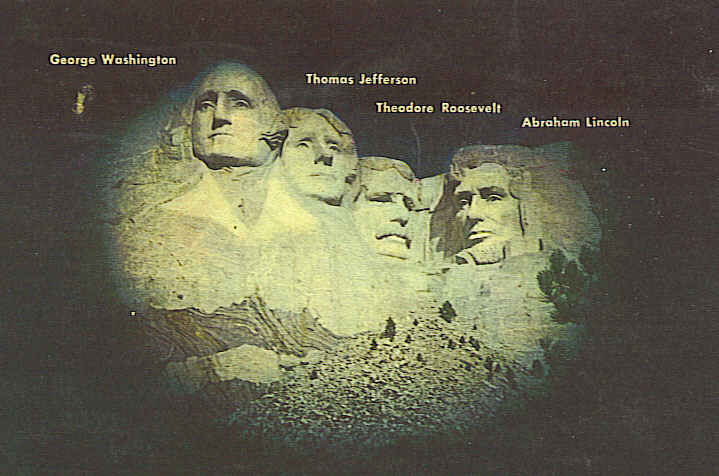
For one hour each evening, Mount Rushmore, The Presidents’ Mountain, is illuminated with steadily increasing lights that make this carving glow in brilliant splendor. The four presidential faces shown on this 1989 postcard are from left to right: George Washington, the father of our country; Thomas Jefferson, principal author of the Constitution, and instrumental in the Louisiana Purchase; Theodore Roosevelt, champion of conservation; and Abraham Lincoln, leader during the Civil War.

Today we can see the results of Gutzon Borglum’s  guidance of approximately four hundred workers, including his son,  from 1927-1941.  The four sixty foot likenesses of the faces rest on 1,278 acres. Original plans were to sculpt them down to the waists, but that idea was cancelled due to insufficient funds. Upon his death, Gutzon’s son, Lincoln Borglum, was in charge of completing the project, but he basically left it as the monument appeared upon his father’s death.

Today you can visit the Lincoln Borglum Museum where a film provides an introduction to the memorial site plus historic exhibits.  Take a lunch break at Carvers’  Cafe where you might find on the menu tasty dishes such as Jeffersonian Gourmet Salad or Teddy’s Bison Chili. If you are lucky, you can sit at a table by the large wall of windows, which provides a great view of Mount Rushmore. The Sculptor’s Studio displays the unique plaster models used prior to sculpting on the mountain side, as well as the tools used while carving. A recent addition is the Native American Heritage Village devoted to Indian culture and the Indians’ place in local history.

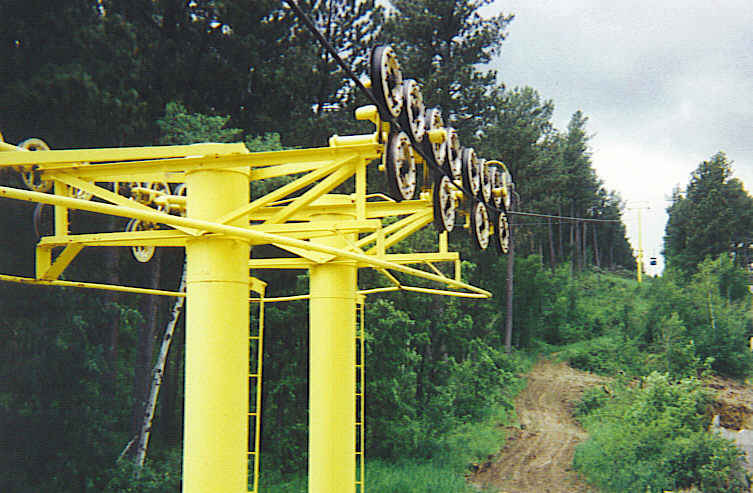
For another close-up view of the mountain, take the scenic chairlift ride through the Ponderosa pines. Views are spectacular and there is a park at the summit as well as a small outdoor grille.  You must be careful getting on and off as the chairlift stops for no one.  You do get a unique view of the presidential faces as well as enjoying the feeling of flying up the mountainside on the chairlift. Coming down you can either return on the chairlift or descend on the Alpine Slide.  This new slide is 2000 feet long and you are able to control the speed downhill on a wheeled sled with brakes. So it is up to you!  Either take a slow and leisurely ride down, or get a rush of excitement.

On the side of the mountain behind the faces is an interesting tunnel called the Hall of Records. In 1998, they began construction of a vault there that would hold sixteen porcelain enamel panels.  On these panels are: text of The Declaration of Independence, Constitution, biographies of the four presidents, and a short history of the United States.  All this is being done to preserve our present history for future generations. At this time, the Hall of Records is not accessible to the public.

Here at Mount Rushmore, you and your family can have a great educational experience by learning about the Indian heritage as well as the significance of the four faces carved there. Leaving the park, there was an interesting view from the back road where it appeared that George Washington was keeping watch on everything with eyes eleven feet across. The pupils of each eye are made of granite so they appear to twinkle when the sun hits them.  Maybe that is the reason the eyes seem to follow you!  Join the nearly three million people who visit here each year to see the faces march along the skyline.

Mount Rushmore Memorial in western South Dakota can easily be reached off I-90 off Exit 57 to Highway 16, which goes to Keystone. At Keystone take Highway 244 to the Mount Rushmore entrance. 

White Waves of Desert Sand

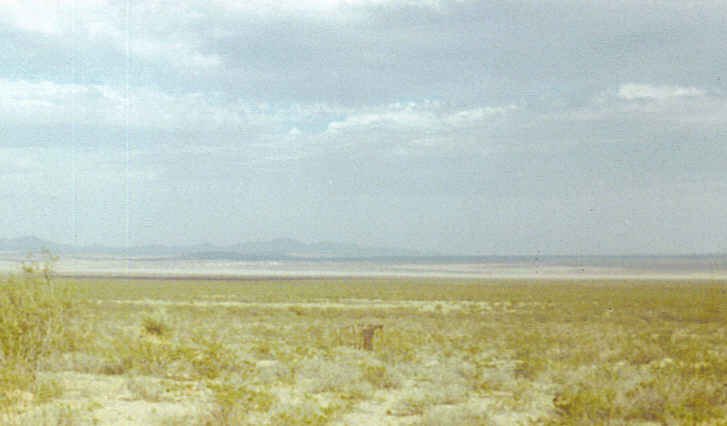
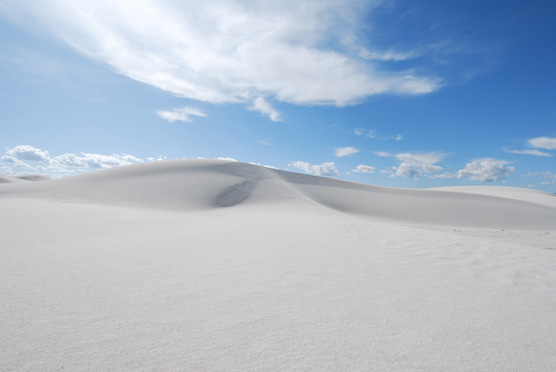
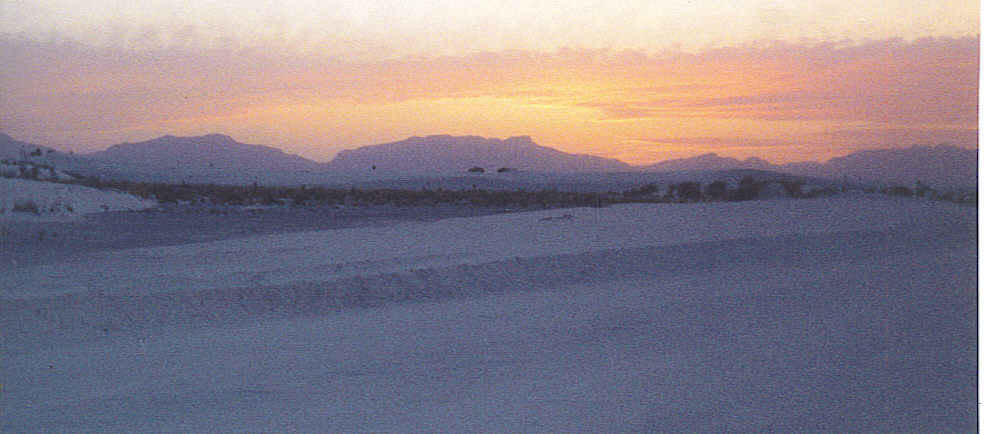
White Sand as far as the eye can see!  Beautiful waves and dunes of sand cover 275 square miles of land near Alamogordo, New Mexico. Approaching from Cloudcroft, a mountain village with an altitude of about 10,000 feet, the view of White Sands in the distance with a mountain background was spectacular.

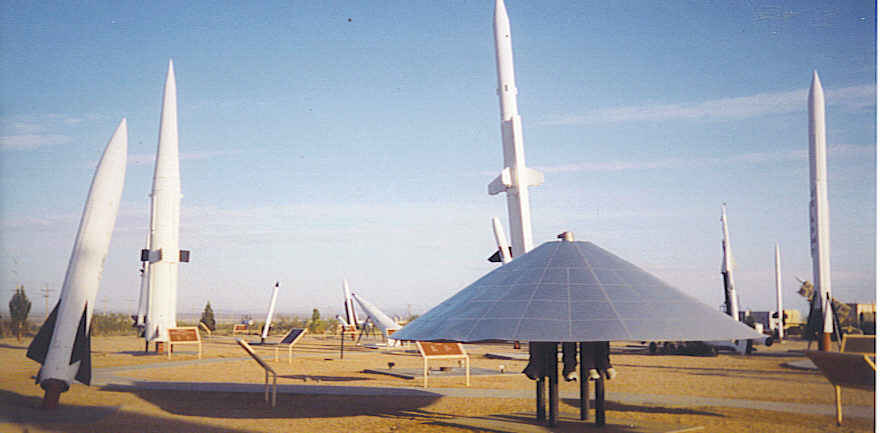
Surrounded by military installations, White Sands National Monument, the largest gypsum sand dune field in the world, was an unusual environment to explore. White Sands Missile Range surrounds the place and was where the first atomic bomb was detonated. Holloman Air Force Base was just east of here and a few miles farther on you will find a landing site for space shuttles.A couple times a week, traffic will be stopped for a few hours as test missiles are being shot overhead. This is truly an interesting place for those interested in space travel, as in nearby Alamogordo you can find the International Space Hall of Fame.

Reaching White Sands National Monument, first stop is the Visitors Center, which was a 1938 WPA project constructed of adobe in Spanish pueblo style. Adobe bricks are usually sixteen inches long, ten inches wide, and four inches thick so this is a solid building which has stood the test of time. Two men would work all day to form about a hundred bricks. Set in a landscape of native plants, this is truly a Welcome Center to the area.

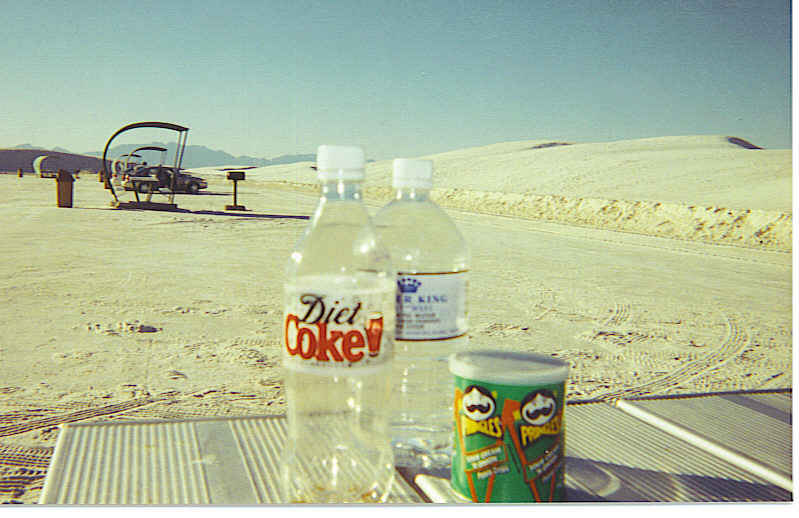
Outside it is time to explore. Don’t forget your water bottle because if the sun shines, this can be a very hot desert scene.  This is an especially unusual scene as gypsum is seldom found in the form of sand. But located here in a basin, the white gypsum  is captured, because there is no outlet to the sea. The dunes are constantly changing shapes as tiny grains of sand are blown into ripples across the vast white desert. This area, with shelters inspired by Frank Lloyd Wright, makes a great place for a rest, or to watch the antics of others on the dunes.

You will probably want to take a leisurely drive through the White Sands area, just to get the feel of things. There was a paved road for a couple of miles, and then you were on your own, to decide if you wanted to venture off driving on the gypsum highway through the hills of sand.

There were also a couple of walking trails – one mile-long path through the sand and another an actual boardwalk. Climbing to the top of one of these large dunes is a challenge and fun.  But this is one place where coming down is the hard part! Children have the right idea here as they use saucers or cardboard and slide down the dunes, resembling what a youngster would do with a sled in the snow.

Animals lived in this ocean of white sand in an evolved state as they became part of their environment and were thus camouflaged against the white desert scene. Salamanders, spiders and the Bleached Earless Lizard were white…just like the sand.

Drive, hike, walk the boardwalk, or go sledding!  So many options! But definitely an unusual place to enjoy the beauty that nature provides, including beautiful sunsets.

White Sands National Monument is in southern New Mexico along U.S. Highway 70, which can be reached off I-25 from Las Cruces or off U.S. Highway 54 from Alamogordo. Personally think the approach over the Sacramento Mountains on U.S. Highway 82 gives a great overview. Remember the roads may be closed at times for missile testing with a possible wait of several hours.

Way Down South – Key West

“Cayo Hueso” – Spanish for “Bone Island” – was the original name for Key West because of all the skeletons found on the beaches during the days of pirates and sunken treasures. This is the southernmost city in the continental United States with Cuba just 90 miles away! With the Atlantic Ocean connecting with the Gulf of Mexico on its shores, the sunsets here are spectacular and always accompanied by a gentle breeze.
Just getting here is an adventure as you travel across forty two bridges through the Keys on US Highway 1, the Overseas Highway. The route is only 113 miles from the southern mainland of Florida to Key West with the longest bridge being seven miles long.  All the way you are surrounded by tropical beauty and aquamarine waters. You see the coves where pirates landed long ago, and where drug smugglers currently hide their stash.

The highway here is actually built on the original route of the Overseas Railroad, which was constructed by Henry Flagler back in 1912. When the railroad and its bridges were destroyed in a hurricane in 1935, it was rebuilt and reopened as a highway in 1940.

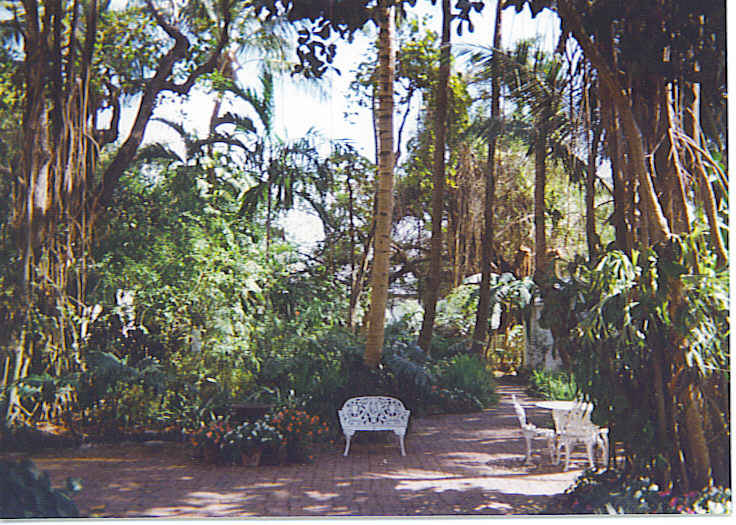
Ernest Hemingway, John James Audubon and Harry S Truman all were frequent visitors here. The Hemingway house is one of the favorite stops and has a relaxing garden, which is a photographer’s dream. Nobel Prize Winner  Ernest Hemingway called the island home for ten years and found solace here along the turquoise waters. Be sure to look for the 40-50 six-toed cats that are descendants of Hemingway’s favorite tomcat, Snowball. Did seem fitting to take home one of his books, so selected his final work published during his lifetime, which not surprisingly had an ocean theme, Old Man and the Sea.

Conch Tour Train gives a guided tour of the island and even makes a stop at Sloppy Joe’s, the most famous bar in Key West. Opened in 1933, the day after Prohibition was repealed, owner Joe Russell had previously operated an illegal speakeasy. Hemingway and his “Mob” of literary cohorts were regular customers, who philosophized and drank the days away.  Today the bar is filled with historic memorabilia dating back to the days when Hemingway – known as Papa – stopped in for a drink with one of his best friends, Joe Russell – known as Sloppy Joe.

Heritage House Museum, the historic Porter family home, gives visitors a taste of the pirate folklore and island life. Built in 1834, this is one of the oldest houses on the island where Jessie Porter established a creativity haven for many famous artists and writers.  The Robert Frost winter cottage in the garden has a beautiful orchid collection. Each year the Robert Frost Poetry Festival is held at this site to promote Key West as a literary destination.

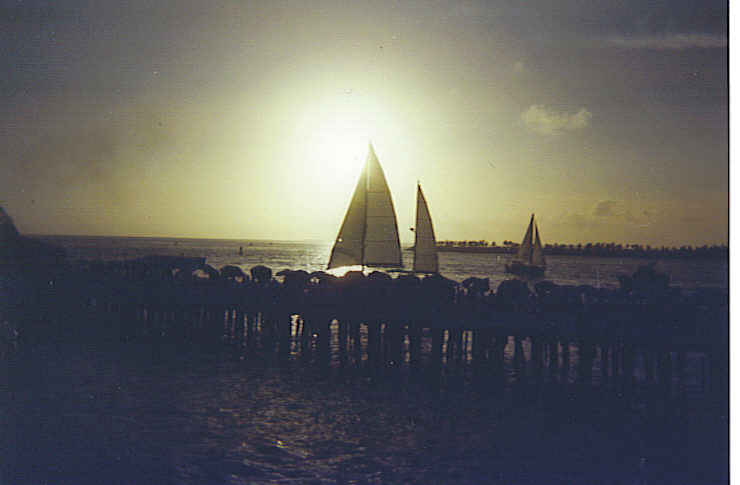
Sunset Pier on the Gulf Coast of Florida is the best seat in the house for the fantastic sunsets of Key West. Here at the Sunset Celebration you watch the sun sink into the Gulf of Mexico while the streets are filled with arts and crafts exhibits, entertainers, psychics, and of course, food!
As poet Wallace Stevens once wrote: Key West is the real thing – the sweetest doing nothing contrived.

Key West, Florida can be reached by crossing all the bridges through The Keys down US Highway 1 to its very end. It is the only highway going that direction so there is no possibility of getting lost.  Enjoy the journey!

Don’t Worry Be Happy in Jamaica

Hey Mon, No Problem! That seemed to be the phrase heard most often on the island of Jamaica in the Caribbean Sea.  Relaxation appeared to be the key there, as no one was in a hurry.

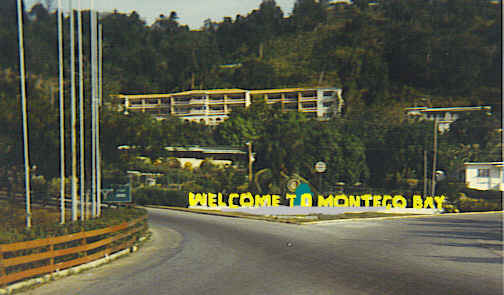
Landing in Montego Bay, the largest and busiest airport on the island, the country travelers learned that it was necessary to have an actual destination, in other words a reserved place to stay, before being cleared through customs. Sleeping on the beach was not acceptable!  Seemed rather convenient, that someone working at the airport, just happened to have a cousin with a Guest House available.  While we waited to be wisked away to our island retreat, the welcome center greeted passengers with rum, one of the island’s tasty drinks.  Perhaps that was the reason they are so relaxed!  No Problem!

Traveling to the Guest House, a young Jamaican boy raced alongside the car trying to sell sticks of sugar cane. Another one shouted, “Ganja, No Problems,” as they attempted to sell marijuana, which is said to be used by sixty to seventy percent of their rural population. This Jamaican grass can either be smoked, or boiled to produce ganja tea. These young people seem to have no problem keeping up with traffic as they run beside the cars. Maybe this early training is a reason for the fastest man in the world being from Jamaica.  Usain Bolt, from nearby Trelawny, can run about 28 mph!

Staying with the people of the island gives one a different perspective of life on Jamaica vs staying at a resort there. The house had no traditional doors or windows, just screens, and no air conditioning, just fans since here it is summer year round.  For a snack, you could go into the yard and pick fresh fruit from the trees, while breakfast was a delectable combination of fresh fish and fruit.

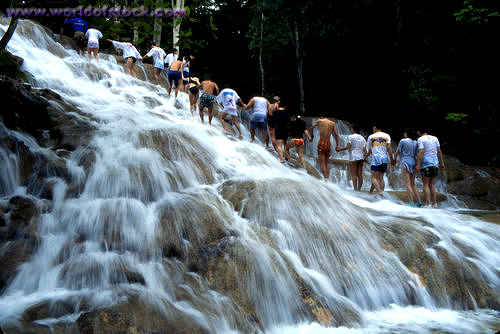
After renting a car the next day to travel this island, which is approximately 145 miles long and 50 miles wide, headed to a beautiful beach in Ocho Rios, where they believe Christopher Columbus  first set foot on land in the New World.  Close by was the famous Dunn’s River Falls, a 600 foot cliff to the sea, which is the most popular tourist attraction in Ocho Rios. Here you could carefully climb up this cascading challenge one steppingstone at a time.  Since it was quite slippery from the pulsating flow, most people took a fall or two but that was expected, and the reason for wearing a swim suit.

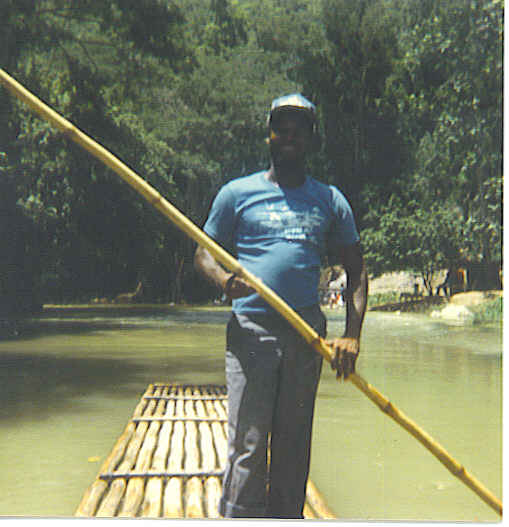
Another great adventure was a ride down nearby Martha Brae River guided by a local storyteller, Tony, from Martha Brae Rafter’s Village. Passengers drifted on a thirty foot bamboo raft down the same route taken by Martha Brae, an Indian maiden legend, who supposedly knew the secret location of a gold mine on the island. When asked to share that secret with the Spanish, she took them down this river and disappeared while going through a cave. Then using her magic, she created a change in the weather, which upset their raft causing the Spanish explorers to drown.

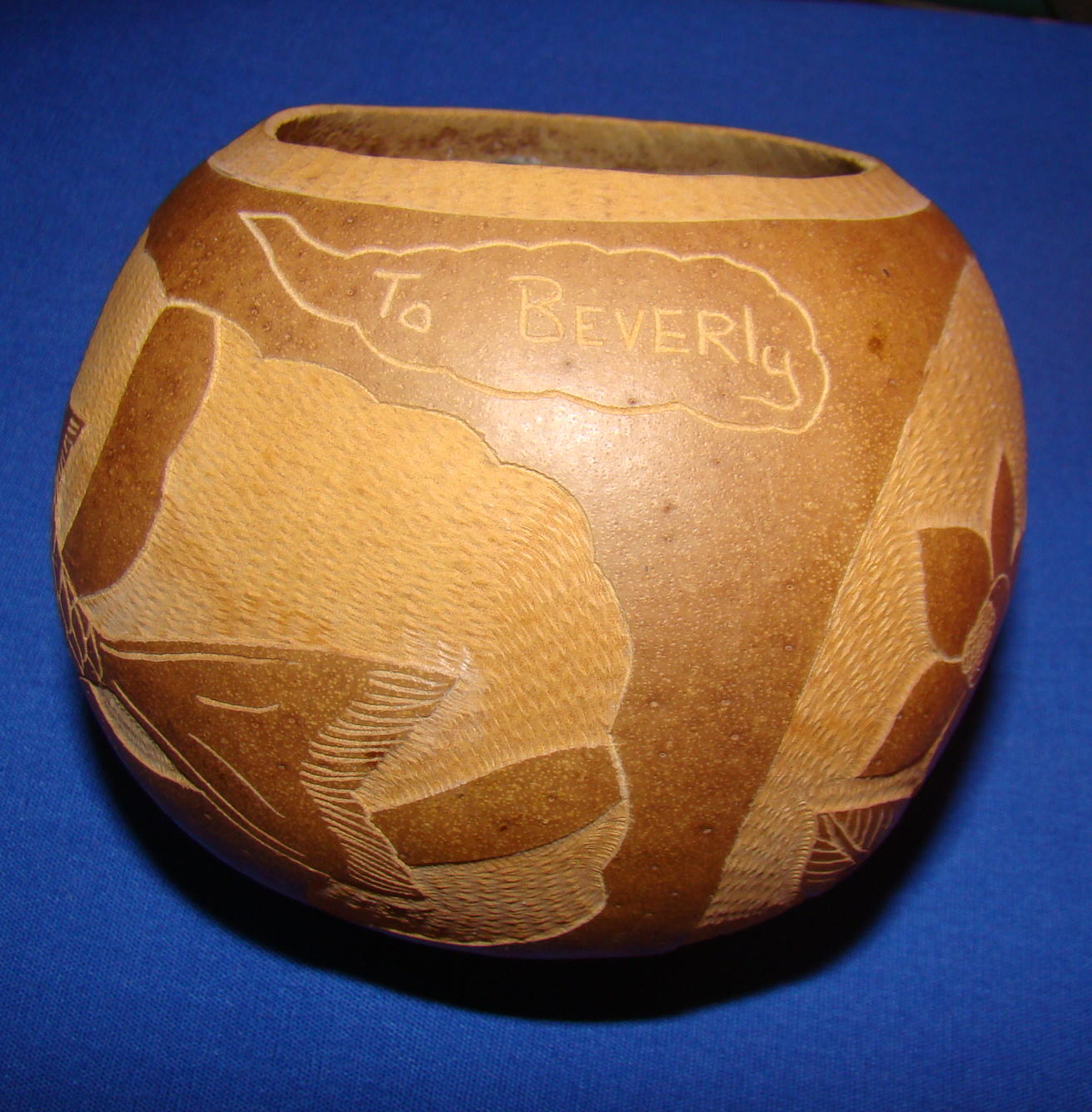
Also interesting were Tony’s tales of the trees and plants that grew along the river.  All seemed to have a medicinal purpose from curing poison ivy to a cold. While he was talking, the guide used a long thin knife and carved a dried calabash shell with designs of fish and flowers… and even put my name on it. Of course, carving names in objects was one of their methods of better insuring that passengers would purchase the item. Upon disembarking, guests could stroll through Miss Martha’s Herb Garden and Gift Shop and purchase many of the herbs mentioned on the rafting experience.

One early morning rode a minibus to the other side of the island to Kingston, the capital and largest city of this independent Commonwealth where Queen Elizabeth II is still called Queen by tradition. The ride was a real cultural experience as the bus, designed to hold about thirty, crowded in nearly fifty. Since there was no air conditioning on the ride, tourists, especially, experienced more than a little local flavor.  People were actually hanging out the windows as the driver drove faster than necessary through the Blue Mountains. These mountains were called Gold Mountains by the locals as here they grew supplies of marijuana, which was their biggest crop.

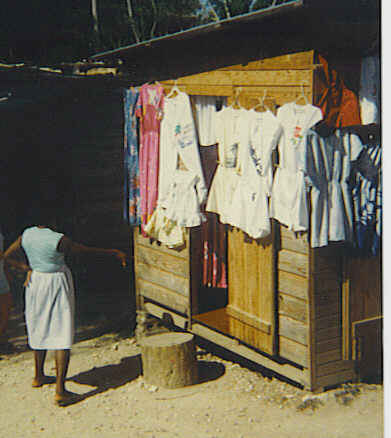
Shopping in Ocho Rios was a treat as there were little craft shops along the streets with polite sellers, who were very persistent and always willing to bargain. These rough looking establishments held some nice quality handmade clothing and jewelry. Actually purchased a dress from the shop pictured here that was worn for several years.

Anytime you want a relaxing getaway, Jamaica might be the place to explore. Want to enjoy the good vibrations of reggae music? No Problem!

Jamaica is an island in the Caribbean Sea located south of the tip of Florida and approximately 90 miles south of Cuba.  You can reach the island by plane or cruise ship. Most planes fly into Montego Bay, while cruise ships dock at either Ocho Rios, Montego Bay, and just recently a port was opened at Trelawny.

Dickens Victorian Village Generates Christmas Spirit

Catch the Spirit of Christmas! Step back in time and visit the Dickens Victorian Village in downtown Cambridge, Ohio from November thru January 8, 2012. As you walk the streets, you will be greeted by volunteers in Victorian dress, sometimes entertained by strolling musicians, and on the weekends can see the lighted carriages giving visitors a relaxing ride.  It is a friendly town where you feel welcome and hear ” Merry Christmas” quite often.

Nearly two hundred life sized mannequins can be found either on the main street, Wheeling Avenue, or in close by businesses and towns. Let’s meet a few of the mannequins, so you can hear their stories of how they came to be part of the Dickens experience.

“Father Christmas” was one of the first characters assembled back in 2005 when local businessman, Bob Ley and his wife Sue were inspired on a trip to Oglebay Park to bring visitors to their town for a winter vacation.  Bob and Sue discussed several ideas but the decision was finally made when Sue suggested an English Christmas theme would be a good choice. Since they lived in Cambridge with Victorian architecture, street lamps, and even benches along the street, English roots ran deep. Thus blossomed the idea of using a theme developed from Charles Dickens’ Christmas Carol. Today Father Christmas stands on the courthouse square greeting cars and buses from three directions. In his bright green cloak of Victorian times, Father Christmas typifies the spirit of good cheer at Christmastime… and you will definitely find lots of good cheer at Dickens Victorian Village.

“Glass Blower at Work” symbolizes the rich heritage in the Cambridge area of artisans who produced quality hand made glass and is a special favorite since my father was a glass blower at Cambridge Glass Co. This was a major employer in the area from 1902-1958 and their glassware is a collector’s item today. A frequent bus stop during tours of the city includes the National Museum of Cambridge Glass where you can still see samples of the beautiful etchings and unique designs, which made these glass creations very fashionable to use for a special occasion. Today descendants of former Cambridge Glass workers still have a few small shops in the area. Boyd Crystal Art Glass, Mosser Glass, and Variety Glass all continue to produce handmade pieces today.

The ShopkeeperYe Olde Curiosity Shoppe is headquarters of Dickens Welcome Center and here you are greeted by “The Shopkeeper,” and quite often beside her you will find the lady who it was created to resemble after she won the first Picture Your Face Raffle. Visitors sometimes say, “Is she real, or is she a mannequin?” Raffle tickets are sold each year and the winners become mannequins in the future.   The Welcome Center’s Imagination Station provides an opportunity for visitors to try on Victorian wear. Then they can have their pictures taken with the beautiful Christmas tree, Charles Dickens, or the new addition this year of the Duke and Duchess of Cambridge mannequins, which resemble Prince William and Kate. This is fun for young and old alike. Here you will also find many unusual Christmas gifts and ideas.

Not all of the mannequins are downtown. In neighboring Byesville, the “Coal Miners” can be found under the station roof of the Byesville Scenic Railway. This is another popular destination with its “Spirit of Christmas” train, which follows a trail over abandoned mines. While on board, men dressed as miners tell stories of days when coal mining was king in this area.  To remember all those who worked in the mines, a statue, “Coal Miners Memorial”, is in the planning stages and will be the only statue to honor coal miners in the state of Ohio. The mines are out of sight, the tipples gone, but the miners are still in the minds and hearts of families and friends.

When evening falls, everyone heads to the Cambridge Courthouse for a spectacular light show. Christmas music and the movement of the lights on the courthouse are synchronized perfectly and enjoyed by all. The display is computer controlled with 60,000 lights and 364 electrical circuits. Four different light shows entertain the packed courthouse square with traditional Christmas songs as well as children’s and contemporary. Add a little snow and it’s a perfect evening!

Introductions have been made to a few mannequins just to get your curiosity aroused, but you need to tour the area to see which one might be your favorite. Dickens Victorian Village welcomes individuals and tour buses to experience the special feeling of Christmas that lives in downtown Cambridge, Ohio.

As one recent visitor remarked, “If you don’t have the Spirit of Christmas when you come here, you certainly should have it when you leave.”

Dickens Victorian Village is located in downtown Cambridge, Ohio, which is just northwest of the intersection of I-70 and I-77. Come spend the day or stay the night, and catch the Spirit of Christmas.

Canyon de Chelly – Home to Navajo Indians

Navajo Blessing
We walk in our moccasins upon the Earth
and beneath the sky
As we travel on life’s path of beauty
We will live a good life and reach old age.

Many American Indians still enjoy life in the Southwest,  and some call Canyon de Chelly (pronounced day Shay) home. Chelly is a slightly modified Navajo word Tseyi, meaning canyon or literally, under the rock.

Located in northeastern Arizona, Canyon de Chelly is completely located within the Navajo nation’s boundaries. Navajo Indians live and work here today among the red rock cliffs with ancient dwellings along their faces and lush valleys below.

Right at the edge of the South Rim parking lot, several wild horses that frequent the area, grazed on the sparse grass. This beautiful scenic drive takes about three hours so be certain that you have plenty of drinking water. There are trails to the bottom but you must be escorted by a guide from the Navajo tribe on all trails except the one leading to the White House Ruins.

One of the spectacular points along the rim trail is Spider Rock, twin sandstone spires with the tallest being 800 feet high. Traditional Navajo believe the taller of the two spires is home to Spider Grandmother. Spider Rock is considered sacred to the Navajo and is associated with Spider Woman, who taught the Navajo how to weave on a loom which Spider Man told them how to make.  Spider Woman also is the enforcer of obedience in children. Part of a Navajo chant heard there still remains in my mind today: With beauty in Nature, I walk.

Another highlight in the area is White House Ruins, which are remains in a sandstone cave of adobe dwellings from a previous culture.  They are believed to have been constructed by Anasazi people “the Ancient Ones”.  There was a time when you could roam up into the cave and walk where the Anasazi walked. But today it is fenced off due to tourists taking bits for souvenirs and thus destroying the historic value of the spot.

At the information center, the Navajo Indians have a beautiful gift shop with handmade Indian crafts. While visiting there talked with Gary Henry and his brother Teddy, Navajo jewelry craftsmen, and their sister Winnie, who leads many of the tours and weaves beautiful blankets.

The beautiful but tough sister, Winnie,  says that weaving is “to weave together the pieces of your own life.” Weaving is her special art given by Spider Woman’s spiritual touch.  Her mother told her, “If you know who you are, where you come from, and where you are going, you will never get lost in this world.” Winnie will tell you that her culture and religion live within her and will never come out.

Gary designed this beautiful two-sided necklace of native stones in a bear claw design – my treasure for this adventure. He grew up in Canyon de Chelly, running up and down the trails as a child. They lived in a hogan, a traditional Navajo dwelling, and their family raised sheep. At that time there was no water or electricity in the canyon, so meals were cooked over a fire, and the evening was spent listening to stories and playing their music.

Canyon de Chelly is a spiritual place where the soul responds to the beauty of nature, which abounds. When we leave, they say Hagona, which means “see you again”. To walk in beauty and die naturally of old age is the Navajo notion of the good life. Hozona h’astleen! May everything go well!

Canyon de Chelly is located in northeastern Arizona.  Take Route 191 to Chinle, Arizona and the Canyon is directly east of town. From the Visitors Center you have a choice of the North Rim Drive or South Rim Drive.  Each drive takes about three hours to complete.

Ghost Trek Stories in Hidden Marietta, Ohio

0oOOOoo! ooOOOoo! As the Ghost Lady leads a large group through downtown Marietta, Ohio, stories of ghosts are told on nearly every street. This is an old town with many restless spirits left over from the past.

Ghost Trek is a two hour walking tour of historic and haunted Marietta and begins along the Ohio River on aptly named Ohio Street.  Back in the early 1800s, this was the stopping off point for many riverboats.  So naturally a bar was one of the first establishments to serve the travelers.  The first bar to open ran out of whiskey in two hours and needless to say there were inebriated men walking the street 24/7, along with pick pockets and yes, ladies of the night.

The LaBelle Hotel was a popular House of Prostitution and the building is still in existence today, called the Levee House Cafe.  A story was told of a prominent businessman, who visited one of the young ladies frequently on the second floor. He attempted to keep this  a secret, but one evening his son followed him to the hotel with an axe.

The son watched as his father ascended the steps to the second floor and then waited until the light went out in one of the rooms.  Hastily, the son walked up to the second floor, opened the door, cut off his father’s head with the axe, and ran back down the steps to the street.  Guilty?  Not by the standards of those days! He was arrested but acquitted on the basis that he was defending his family honor.

Today the people who live in this building still hear the sounds of footsteps climbing up the stairs, a time of quiet, then footsteps running down the stairs again.  This is called residual haunting as the energy released in the environment during a traumatic event may  reappear as an echo of its original form.

On to the Lafayette Hotel where the third floor seems to have lots of unsettling paranormal activity. Built in 1918, every death that has occurred in this hotel has happened on the third floor.  Guests frequently complain of personal belongings being moved around.  One man commented, ” I am a science teacher. I don’t believe in any of this stuff”… until his belongings in his room got rearranged and some came up missing.

Fifty paintings of  artist James Weber (1888-1958) were brought to Sugden Book Store for an art show on the second floor. Melancholy Weber loved his art work, but was forced to run the family grocery store.  So he said that when he died he wanted all of his paintings burned.  But someone found fifty that were left behind!

After careful setup for the art show, the owners were very pleased with their findings. Next morning when they arrived to open the show, they found the table had been knocked over as well as the pictures.  On the desk was a real estate report – a deed from 1932 for James Weber’s art studio, right there on the second floor!

Restoration of the old Colony Cinema was seen firsthand as the group had special permission to enter the theater. Here, it is said, the ghost of the former owner, Mr. Shay,  travels via an underground passageway between the Colony Cinema and Mid Ohio Valley Players Theater across the street. Colony Cinema has been an important part of the Marietta community since 1919 when it was The Hippodrome Theater, the premiere showcase of Marietta and the surrounding area. Some of Hollywood’s biggest names, including Frank Sinatra, Judy Garland, and Boris Karloff, appeared on its stage.  Its gorgeous original asbestos fire curtain has been rediscovered and is being restored to be featured predominately in the restored Colony Cinema.

The last stop on the tour was at Tiber Way Grille, where people hear sobbing, crying, and have an edgy feeling.  They definitely feel it is haunted. Closer look at old lettering on the building perhaps gives a reason for this feeling.  It says: Chronic Diseases The Sanitorium. This twenty six room hospital was used for tuberculosis patients in the early 1900s as well as for those with extreme mental problems. Fittingly, next door was Doudna’s Funeral Services!

Nothing beats a haunted, moonlit night with ghosts of the past.

To arrive in Marietta, Ohio take Exit 1 off I 77 and head west on Route 7, Greene Street. Where the Muskingum River meets the Ohio River, you will find the old Lafayette Hotel, the starting point for the Ghost Trek. This walking tour is under the expert guidance of Lynne Sturtevant, founder of Hidden Marietta and author of several books of Marietta history.

Slab City in the Chocolate Mountains

“We like it here and we ain’t goin’ back.”  Residents of Slab City in Southern California enjoy their life of freedom where the air is clean and rent is free.

Sandwiched between the Salton Sea and the Chocolate Mountains, Slab City is home to many campers.  Here they don’t care what you look like or where you came from. Everyone is welcome! Campers come on dirt bikes, in RVs and even greyhound buses to park on this hidden desert city.

At the entrance to Slab City, you will find Salvation Mountain where the sides are painted with religious pictures and verses to inspire the freedom that is advocated here. Leonard Knight has been painting and repainting this mountain since 1985.  If you like his work and want to donate to the cause, a bucket of paint is his favorite contribution…acrylic is preferred.

As you travel back into Slab City,  you find campers set up on the concrete slabs left behind from the WWII training grounds. The Chocolate Mountains and a few creosote bushes add some beauty to this RV oasis in the middle of the desert. This is indeed rough living, even though free, as there is no electricity, running water, or bathroom facilities.  And the temperature is hot!  Those who stay either use a generator or solar panels to produce enough power to cook, or run a fan for their swamp cooler. Some even use that power to watch TV for a little while each day and have their satellite dishes located on top of their campers. Definitely not a place for those who like all the modern conveniences.

Entertainment seems to come in an easy manner to these free thinking people. Flea markets or swap meets are held most weekends. One camper even set up a library, as there is definitely lots of time to read a good book. In the evenings, those who have an instrument with them provide music with songs like: We Like It Here, Slab City USA, and Free Bird.

Marine Corps Chocolate Mountain Gunnery Range is located close by. This Gunnery range has been a training ground for Marine Corps and Navy pilots since WWII.   If you happen to stay at Slab City, you will hear the sounds of artillery practice throughout the night quite often.  Where Patton once ran his tanks, today folks race their four wheelers and dune buggies.

Nearby Salton Sea is one of the world’s largest  inland seas with its surface being 226 feet below sea level. Originally formed from an overflow during a heavy flood of the Colorado River into the Salton basin, this re-created lake in the Imperial Valley of California is located on the San Andreas Fault. This type of flood should not occur again due to the construction of Hoover Dam on the Colorado River in the Black Canyon. Since this inland sea has no fresh water supply except for the inch or two of rain each year, today this polluted sea seems thick enough to walk on!

There is a possibility that this area may soon be developed into a solar and geothermal energy site for much needed power for the California area.  This could power many homes and businesses! But environmentalists are concerned about the dwindling population of the Mojave Desert tortoise, the flat-tailed horned lizard, and the burrowing owl in that area.

If you happen to stop in a local tavern, you might hear this discussion regarding the protected environment. One slightly disheveled man of the desert will laugh and say, “The most amazing creature in the desert is the stick lizard.  Carries a stick in his mouth whenever the temperature rises above a hundred ‘n fifteen degrees.  Still he searches for food at high noon.  How does he do it?”

“Wow, how can he be out there at high noon?” ask the environmentalists.

“Well,” the desert man thinks deeply, “when the sand starts to burn his feet, he puts the stick in the ground so he can climb it. He just hangs there a few minutes ’til his feet cool off.  Ain’t many stick lizards left.  Definitely endangered.”

If you are tired of the city or your troubles are so many that you can’t list them, flee to Slab City where you are sure to be welcome!

If you are driving or hitchhiking to Slab City, it is located in the desert of Southern California just four miles east of Nilan off Route 111.  There is fairly easy access as it lies just north of I 8 and south of I 10.

Powerful Beauty at Grand Canyon of Yellowstone

Think there is only one Grand Canyon?  Think again!  Ones that come to mind other than the Grand Canyon National Park in Arizona include: Grand Canyon of Pennsylvania at Pine Creek Gorge, Grand Canyon of the East at Letchworth State Park in New York, Grand Canyon of Pacific at Waimea Canyon in Hawaii, and one of my favorites Grand Canyon of Yellowstone in the northwest corner of Wyoming.

Twenty four miles long on the Yellowstone River,  Grand Canyon of Yellowstone is downstream from Yellowstone Falls, whose scenic beauty flows over rapids in its course through the beautiful canyon. During the Washburn expedition in 1870, Lt. Gustavus Doane described the canyon as follows:

“There are perhaps other canyons longer and deeper than this one, but surely none combining grandeur and immensity with peculiarity of formation and profusion of volcanic or chemical phenomena.”

Indeed this is a beautiful canyon and one many miss while taking a peek at the Grand Canyon itself. Upper Yellowstone Falls flows into a deep canyon below, then the stream takes a wild ride over rapids throughout its course. About 10,000 years old,  today the forces of erosion continue to sculpt the canyon through rain, wind and earthquakes. Lookout Point was one of the early popular spots for viewing the canyon, so back in 1880 the park superintendent decided to put the first railing around this area for safety measures.

Since this is an area of bubbling volcanic activity, it is not surprising that earthquakes happen here frequently. Tremors are felt here all the time. Actually the lookout for Inspiration Point has been shortened several hundred feet due to the quakes in this area. Today on this overhang, there is a nice platform with rails, which provides fantastic views of the canyon both directions.

A zigzag path, Uncle Tom’s Trail, down to near the bottom of the falls at Inspiration Point, created quite an afternoon diversion. The trail was named for Bozeman resident, H F Richardson (known as Uncle Tom), who operated a ferry in 1890 across the Yellowstone River in the canyon. Today that trail has been considerably improved; yet, with a drop of over 500 feet, at least 300 steps and lots of paved inclines, it still requires some perseverance. Slowly strolling down the steep blacktopped path, you could hear the roar of the falls and the peace of the canyon all at the same time. The climb back up was a bit more tiring and a lot slower.  Rested at the top and took a picture of the route taken as seen in the picture above.

At the Lower Yellowstone Falls, beautiful Artist Point has a picture post card view of the canyon and falls. This spot is off the beaten path, holding its beauty for the fortunate to discover. The combination of metallic lusters on the face of the canyon walls creates breathtaking color combinations that are one of a kind. This Lower Falls is 309 feet high, nearly twice the height of Niagara Falls but does not have nearly the same volume of water flowing over it as Niagara does. A member of the 1870 Washburn party, N. P. Langford, gave this brief but poetic description of the Lower Falls: “A grander scene than the lower cataract of the Yellowstone was never witnessed by mortal eyes.”

To end the day, made a relaxing stop at Green Dragon Spring where steam often fills the caverns of the hot spring.  Visitors must wait patiently for a glimpse of this sulfur lined cave with boiling green water. This is a land unlike any other in the United States and Theodore Roosevelt described it well when he stated:  “The beauty and charm of the wilderness are yours for the asking, for the edges of the wilderness lie close beside the beaten roads of the present travel.”

It is difficult to comprehend the beauty, majesty and power of the beautiful Yellowstone area without exploring it firsthand.

The Grand Canyon of Yellowstone is located very close to Canyon City, Wyoming in the northwest corner of the state. Yellowstone’s Grand Loop Road arrives there from all directions. This road is usually accessible from May through October. During the winter months, roads are often snow covered and access to the park is either by snowmobile or commercial snow coaches.

Adena Mansion Pictures Life in Early Ohio

“No ghosts – not even rumors of ghosts here,” explained the guide as she began an interesting tour of the Worthington Mansion at Adena State Memorial near Chillicothe, Ohio.  Built in 1806-07, this beautiful mansion home was designed by what many consider the first American architect, Benjamin Henry Latrobe. Usually Latrobe was busy with larger projects, such as designing the United States Capitol, but as a friend of Thomas Worthington he agreed to design a beautiful home on the 2000 acre estate.

The Worthington home, Adena, was the most magnificent mansion in the area at that time, and fascinated crowds of visitors. Large panes of window glass and papered walls were novelties which especially attracted attention. The sandstone blocks for the house were all dug from a quarry on the property.

This drawing by Henry Howe in 1846 shows the beautiful garden vista at Adena that inspired the Great Seal of Ohio. Looking across the front lawn, the Scioto River flowed between the cultivated fields and Mount Logan.  On the Great Seal of Ohio, the sun displays thirteen rays of light symbolizing the thirteen colonies. In the field is a shock of wheat representing the prominent field of agriculture in the state. Nearby, resembling a shock of wheat but showing Ohio’s Indian heritage, is a sheaf of seventeen arrows proclaiming Ohio as the seventeenth state.

Today the house has been restored to appear much like it did during the time the Worthingtons lived there.  Much of their original furniture can still be seen. Worthingtons’ actual skeleton key was used to unlock the door to begin the tour, and felt lucky to have it in my possession for a short while. Upon entering the mansion, a beautiful large clock made by George McCormick and costing $35 at that time stands beside a beautiful staircase, which appears to be marble but was actually painted with a feather to achieve that effect. Throughout the house a shade of pink paint was used. Paint was very expensive at that time and the pink tint was achieved by crushing a special insect into the paint.

Ten children were raised in the nursery, which strangely enough had no heat. Guess they had to be strong to survive, but none of those children died.  The parents’ room was next to them and had a nice fireplace so hopefully they kept the door open. Worthington’s wife, Eleanor, taught the children in the parlor while running the household from there at the same time. On the wall was a list of Family Maxims to live by, for example: “Keep everything in its proper place, do everything in its proper time, and delay not till tomorrow what should be done today.”

The rooms on the second floor were all bedrooms, except one which was perhaps a servant’s room, and a large dark closet where, it was told, they placed children when they misbehaved. Many famous guests stayed here including Henry Clay, General William Henry Harrison, and President James Monroe.  Of special interest was the screen on the left side, which hid from view their bathing area.

Among the  four bedrooms upstairs, there was one for the boys and another for the girls. Although there were ten children, there were seldom more than three in a room at one time. On the dresser in the girls’ room was a set of cards for learning the alphabet with a flexible Mr Hodge Podge to bend to the shape of the letters.  Guess the girls had homework even way back then. Education was very important to the Worthington family and they even thought it important to educate the girls, which was not a common occurrence in the 1800s. Imagine they took a break now and then and looked out the window at the beautiful gardens surrounding their home.

After reading a book on ancient history, on Sept. 18, 1811, Thomas Worthington wrote in his diary: “Adena” a name given to  “places remarkable for the delightfulness of their situations.”  It becomes apparent that visitors experience this same type of feeling by the smiles on their faces as they explore this beautiful mansion from years gone by.

The Adena Mansion is located Northwest of Chillicothe, Ohio just off State Route 35. Directions are well posted to the Adena State Memorial, which includes the Mansion and Gardens.  It is a short walk through the Gardens to arrive at the Mansion. Admission is reasonable but you need to check their schedule for hours opened.