Places to go and things to see by Gypsy Bev

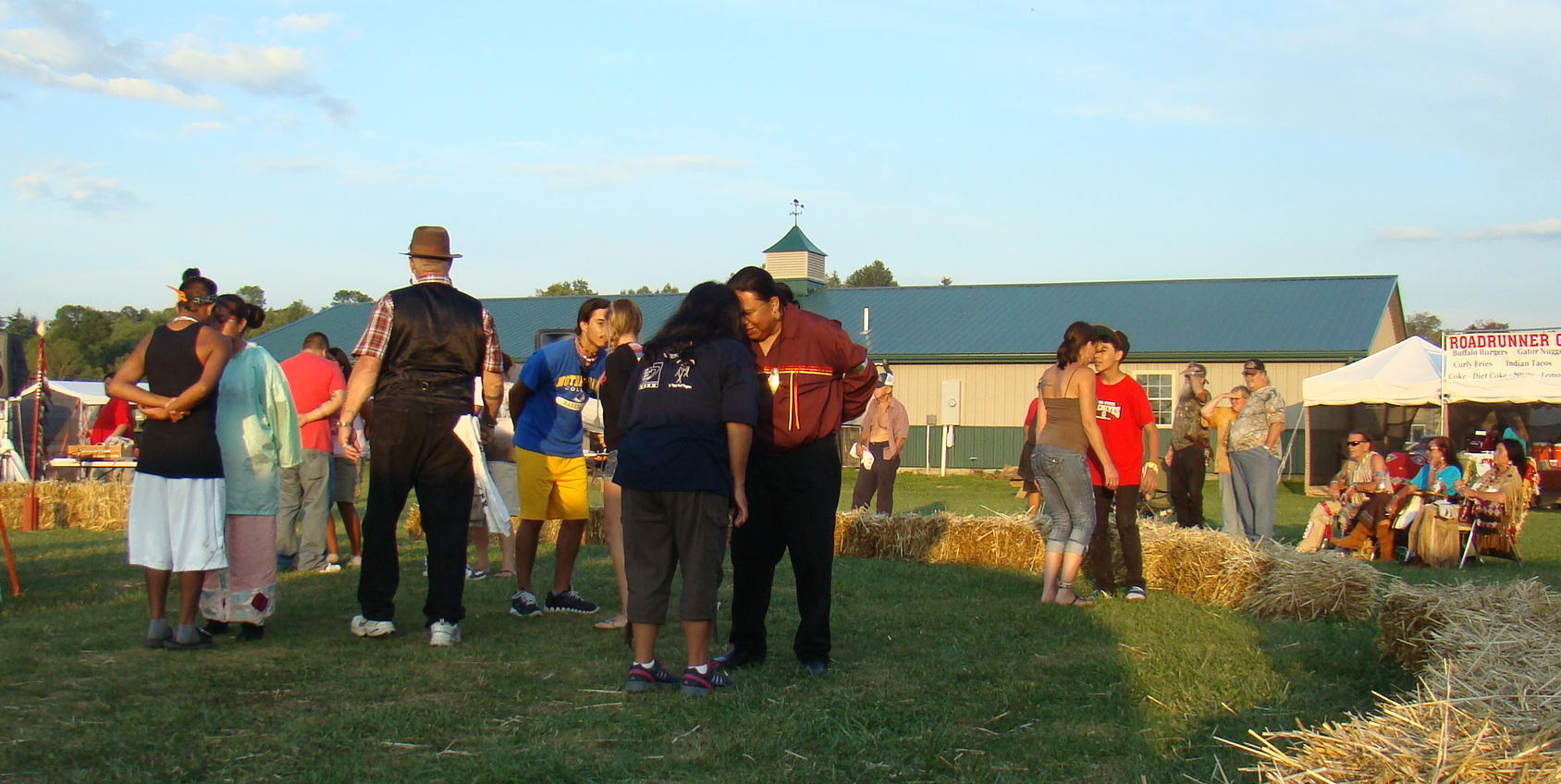
Native Americans are proud of their heritage as was witnessed at the gathering of tribes near Senecaville, Ohio at Buffalo Hills Resort.  Indian Pow Wows join together tribe members  for dancing, singing, socializing, and most of all, honoring their Indian culture. This seemed like the “real thing” as Native Americans congregated for their own enjoyment, not just entertainment. Any lessons learned by White Man were considered a bonus.

Did you ever taste Frybread? Native Americans will often remark, “Frybread is the story of our survival.”  Over a hundred years ago when the US forced Indians to take “The Long Walk” from Arizona to New Mexico, they nearly starved in their new landscape. To keep them from starving, the US government gave them flour, sugar, and lard – the makings of frybread, which later led to various health problems. At the Pow Wow, authentic Indian food was served by concessions and Frybread was delicious either served as the base for an Indian Taco, or covered with sugar and cinnamon. Also on the menu were Buffalo Burgers and Gator Nuggets on a Stick, with Snowballs for dessert.

Native costumes caught the eye of visitors as Indian maidens seemed to float over the ground with their smooth movements.  Delicate woodland flowers and vines added beauty to the deerskin dresses, as did the unusual jewelry made with the help of Mother Nature. Necklaces and bracelets were designed from acorns, spices, dried corn and seeds. This beautiful maiden was called Gentle Dove and said to be a Messenger for Love and Peace.

A circle of baled hay made a comfortable place to observe the Indians’ presentations. In the afternoon an entertaining storyteller told traditional Indian legends, most of which centered around animals.  All their stories have special meaning, and hopefully an effect on the listeners. The story of a Snake taught children to beware of wild animals, while the adventures of Bear and Rabbit with Buzzard described why Buzzard has a deep mark on his face to this day.

John Red Deer filled the spot of medicine man for the day with his extensive knowledge of herbs for healing. While there were many interesting items in his display, the popular 7 Grandfathers All Purpose Salve topped the list. As you can see from the sign, it can be used for many different ailments as well as a detox. John Red Deer feels inspired to make this in cream, liquid for detox, and even in stick form to carry with you for cuts and bites.

Peppermint and Spearmint form the base of this magical salve plus seven other herbs, which he feels he will reveal soon so others can carry on his work. Plants are harvested as he is guided by the voice of Spirit, and later the herb combination is brewed during the Summer Solstice.  This time of solar and lunar infusion gives the perfect blending of the herbs. A severe storm this year, while he was making the salve, produced two hours of intense energy, which John Red Deer felt increased the strength and effectiveness of that salve. His plans are to make a medicinal soap in the near future.

With the drums and flutes of Southern Pine in the center of the circle, the evening dance was a pleasure to watch.  Leading the procession of dancers were Native Americans carrying the USA flag, an MIA flag, as well as their traditional eagle staff with an eagle head on the top. The opening prayer was given first in Choctaw language, followed by English.

Songs were sung to relatives who had passed on to another world and veterans were honored with the blowing of the eagle whistle. Beautiful dresses filled the center and individual dances were performed.  The Jingle Dress glistened in the sunlight and jingled to the beat of the drums.

To close the evening, couples did a Potato Dance with a potato held between their foreheads as they constantly moved to the music. The last couple to keep the potato from dropping to the ground was the winner of a small monetary prize.
Find an Indian Pow Wow in your area to attend so you, too, can learn of the American Indian traditions. While sometimes stories are heard about the Indian attacks long ago, they basically wanted to be peaceful people and enjoy their style of life in the quiet of their homes.  Imagine sitting in the woods with the drums beating, chants filling the air, and the Spirit surrounding you. That’s the way life is meant to be!

Buffalo Hills Resort encompasses over 300 acres in southeastern Ohio making it one of Ohio’s largest campgrounds. Campers have their choice of primitive camping, parking for their RV, as well as cabin or perhaps teepee rental.  While it isn’t far from the interstate, it is definitely peaceful country and near Seneca Lake. Leaving I-77, take exit 37 to the East  (State Route 313) until you come to the four-way stop at Senecaville.  Make a right hand turn on State Route 285  then shortly a left at the fork on State Route 566, also called Opossum Run Road. After a couple miles, campers will find Buffalo Hills Resort on the left hand side.  
Give them quality. That’s the best kind of advertising in the world.”                             ~Milton Hershey

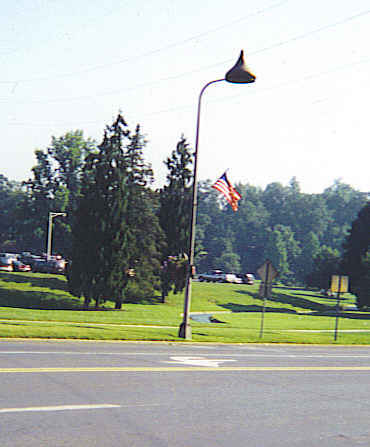
The smell of chocolate drifting through the breeze is one of the fond memories of Hershey, Pennsylvania. There’s no doubt about being in the popular chocolate town, because the shapes of Hershey kisses serve as street lights down Chocolate Avenue. Naming the town Hershey was one of the best advertising schemes a candy company could devise.

Upon arrival at Hershey Chocolate World, take the Great American Chocolate Tour Ride.  Seated in moving cars, the tour follows the trail of the cocoa beans from their original home in the tropical rain forest. Then upon their arrival at Hershey, they are transformed into that delectable chocolate that we have enjoyed throughout our lives. All five senses are treated as visitors see the displays, hear the stories, and smell the chocolate as they travel to the Sweetest Place on Earth. Finally tourists get a taste of Hershey’s, as they give everyone a free piece of candy at the end of the tour. Of course, chocolate always makes you feel good.
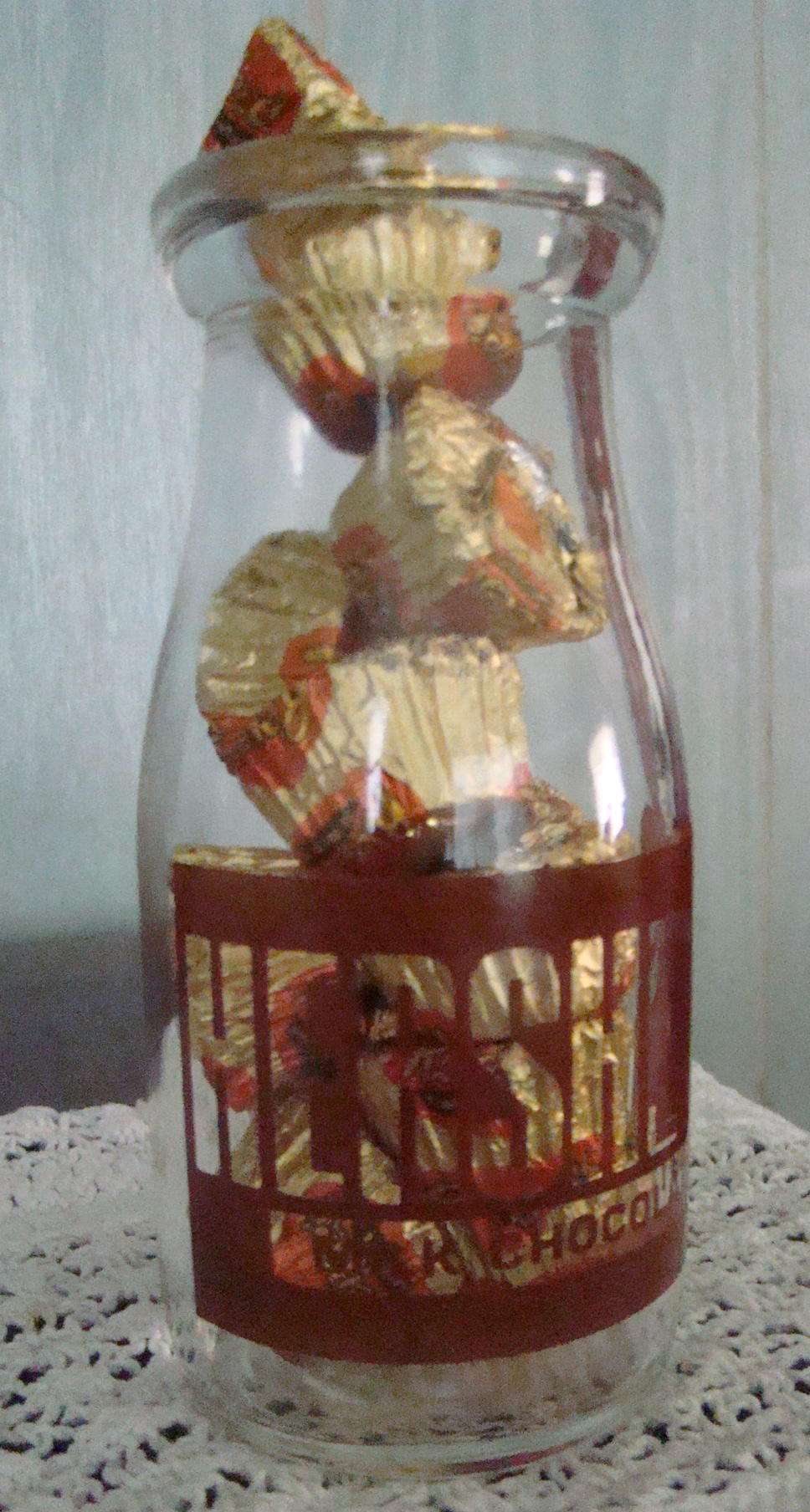
Their gift shop is filled with chocolate in every form and combination. The walls are covered with everything from apparel to household items with popular candy bar logos. Nearby shelves hold all the chocolate products including the Hershey Kisses and Hershey Bars, which have been around for over a hundred years.  My Christmas tree now has a Hershey Kiss ornament, while a Hershey milk bottle holds candy treats on my coffee table.  Sweet memories!

It’s just a short walk to the Hershey Story, a museum telling the history of the Hershey family.  Milton S Hershey, the man who revolutionized the way to make milk chocolate back in 1894, left his fortune to the Milton Hershey School’s orphan boys. Since Milton and his wife had no children of their own, they developed a real concern for less fortunate children and founded the school in 1909.  His legacy is an inspiration to many, as his life was a rags to riches story.

Here visitors also learn of Hershey’s inspiration for creating the town of Hershey. Seems it was patterned after another chocolate maker, Cadbury in England, who also built their factory in what was considered a workers’ paradise. Wanting his employees to be as content as the cows who gave the milk for the chocolate, Milton included an amusement park, community center for family activities, and low cost housing for his employees.  Today some of these same items are enjoyed by tourists.

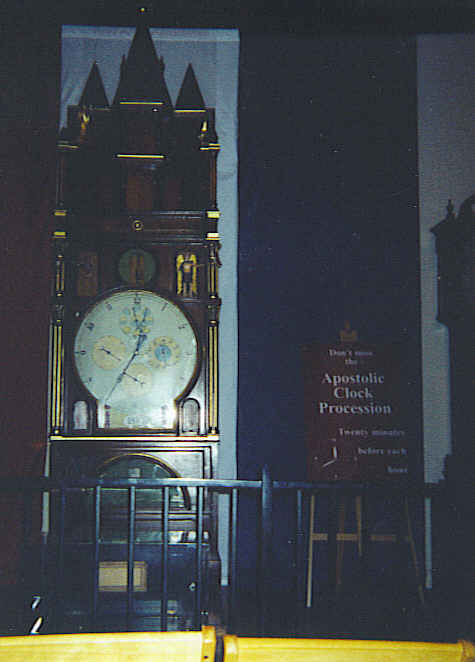
A popular spot in the museum was the Apostolic Clock, which tells more than the time, as it tells phases of the moon, zodiac signs, months, dates and days of the week. Its main attraction, however, is telling the story of the betrayal of Christ.  The Twelve Apostles and Christ appear at a quarter to each hour and begin telling the story of the betrayal. Every fifteen minutes Father Time strikes a bell and the center figure changes.  It is quite an amazing performance to watch.

Built by John Fenner in 1878, the clock was taken on a tour of Pennsylvania where ten cents was charged to view its story. This  clock was purchased by Milton Hershey back in 1936 when he placed it in the museum for the enjoyment of the local community. During past visits, the clock performed on an hourly basis, but today it is limited to a special calendar, so you need to check ahead to see when performances are scheduled. Having been built in the 1880’s, it is understandable that the clock would now be in delicate condition.

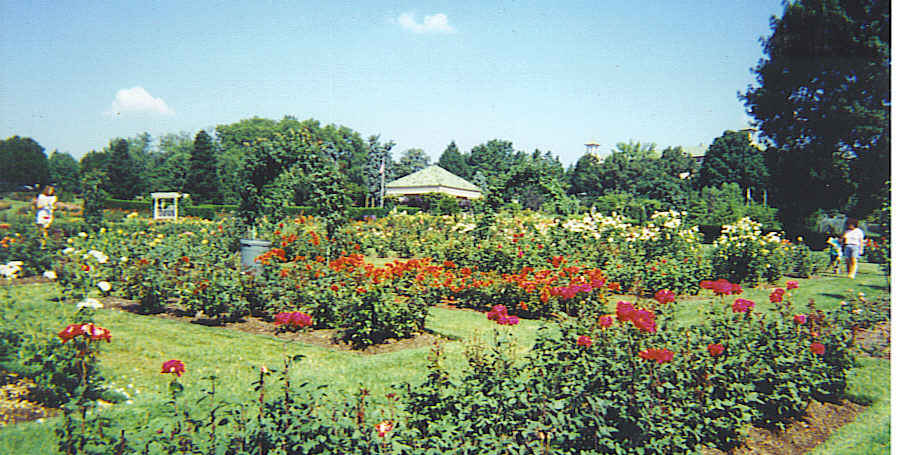
What started out as a Rose Garden has expanded over the years to a twenty-three acre botanical bonanza. Every day is a beautiful day for a walk in the gardens and their Butterfly House is a favorite of youngsters especially. Lucky there are benches along the way, as most people want to sit for a while and take in the quiet and majesty that surrounds the gardens.

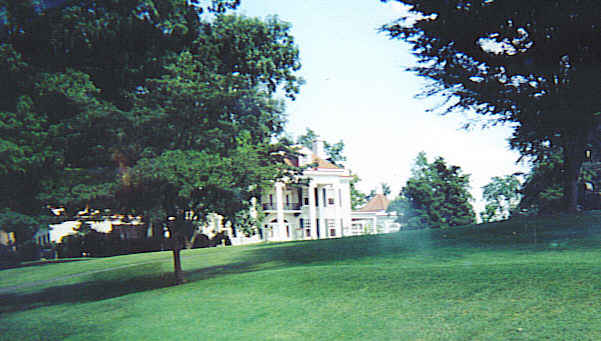
High Point, Hershey family’s home, was given in 1930 to Hershey Country Club as their clubhouse, with Milton retaining room for his private office. In 1977 it was renovated again to be used as Hershey Company headquarters through the efforts of WIlliam Dearden.  Being a student of the Milton Hershey School, William became CEO of Hershey Foods and had a passion for the beautiful old home, and wanted to save it from destruction.

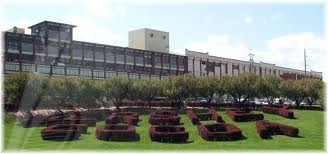
No visit would be complete without checking out the source of the tantalizing chocolate smell that permeates this town. The smokestacks of the old Hershey Chocolate Company, a chocolate brown brick building, can be easily spotted as its lawn has hedges cut into the words HERSHEY COCOA. There’s no doubt that you’re in the right place!

But times change and the Hershey Company has moved its plant this last year to the outskirts of town.  Haven’t been back to see the new plant, but the modern equipment couldn’t be accommodated into the old plant with its low ceiling and columns throughout.  Some say Milton would be upset with the changes, while others feel he was a businessman who understood that things must change.

Even though times change, chocolate bars are still a favorite for many. Imagine reading this Hershey Chocolate quote the next time you bite into your favorite bar:

Put a smile on your face, make the world a better place

Leaving town down Chocolate Avenue with its Hershey kisses, memories of this chocolate world will hang around for years to come, much like the cocoa goodness has covered Hershey, Pennsylvania for over a hundred years.

Hershey, Pennsylvania is just off I-70 / I-76, part of which is a toll road. Take exit 247 to PA 283 at Elizabethtown.  Hershey is directly North of Elizabethtown as you follow Hershey Road.  The town is well marked for signs to the various attractions. Enjoy a chocolate experience!

“Something bad is going to happen. Don’t go back.” “Be careful girl, I’ll get you.” These were just a couple of the messages received by residents of Point Pleasant, West Virginia after the appearance of what locals call “The Mothman”.

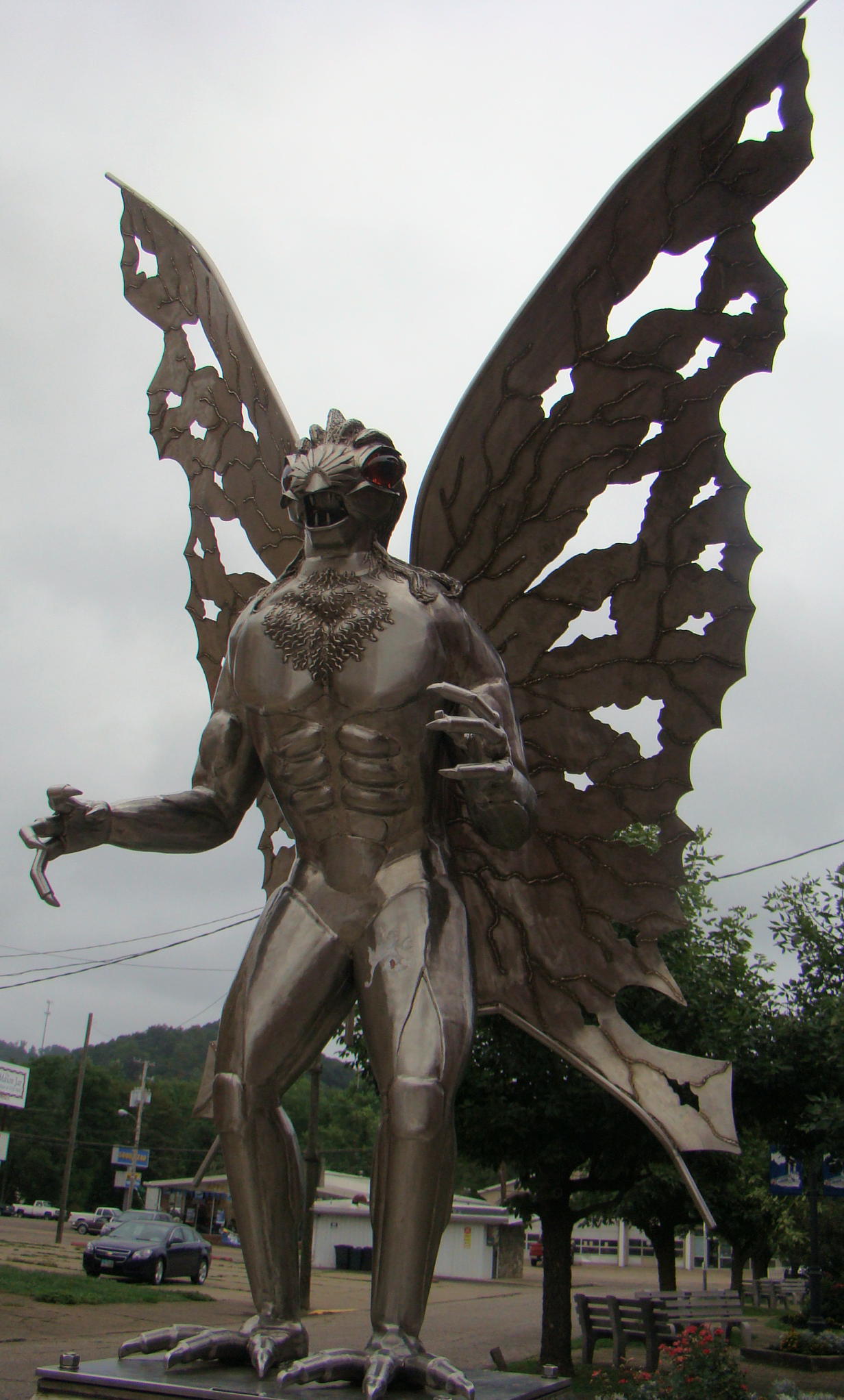
First stop on your Mothman adventure in downtown Point Pleasant will probably be the statue of Mothman at the corner of Main and Fourth Streets. This stainless steel sculpture by artist Robert Roach was unveiled in 2003 in what is now called Mothman Park. Red eyes are one of the outstanding features of this life size creature and are set to glow at night.

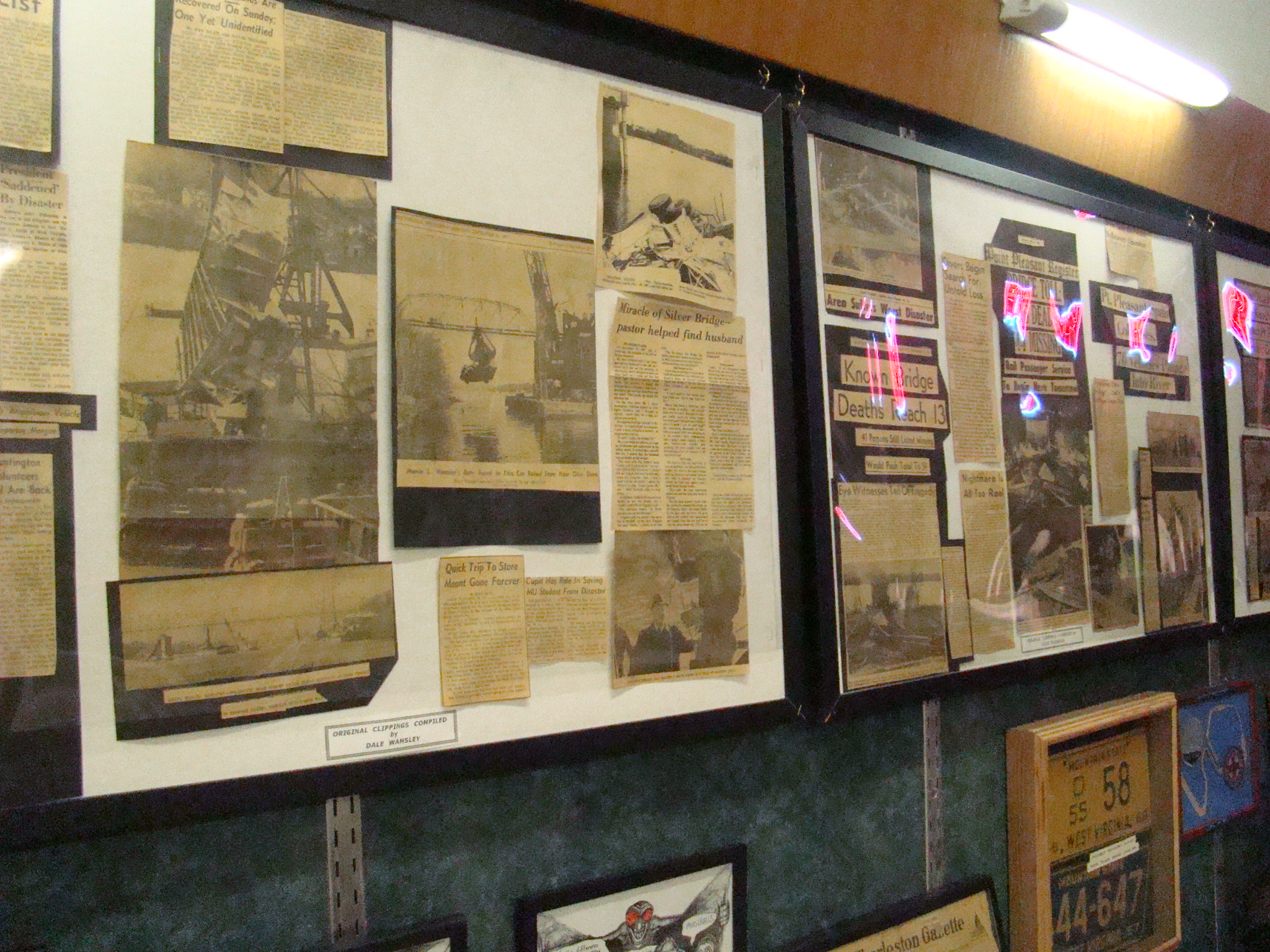
Today a visit to Mothman Museum will review the story of this unexplained mystery through videos, recordings, newspaper clippings of Mothman sitings, photos of the Silver Bridge collapse, and props from the Mothman Prophecies movie.

In 1966-67, over a hundred appearances by Mothman in the surrounding area frightened residents to the point that they were afraid to go out at night.  A seven foot tall figure would first be seen appearing to have wings with feathers, which had a ten foot wingspan. As it got closer the glow of its fiery red eyes seemed to be one of its most frightening features. Those who saw it would have terrible headaches, dreams, and visions.

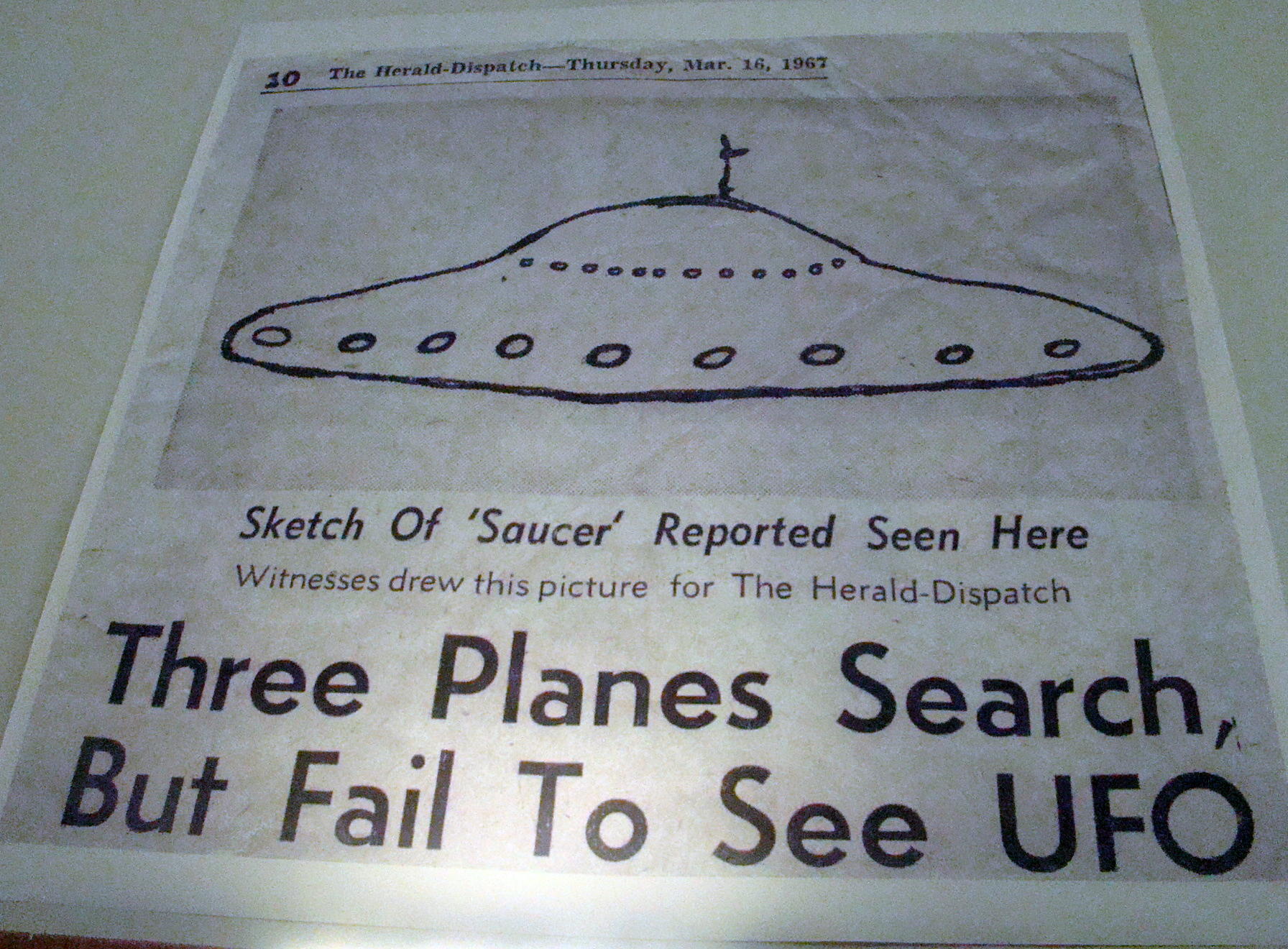
At nearly the same time, UFO’s were also seen in town. Law enforcement as well as local residents were searching for Mothman and the UFO’s at night with search lights, as though they were searching for Frankenstein. The UFO’s were said to be disc shaped objects in the night sky with red lights encircling them.

Another mystery was the arrival in town of Men in Black. Really!  These men dressed in black suits would threaten those who had seen Mothman to silence…or else.  One newspaper reporter said the Men in Black visited her or phoned her and told her not to publish any more stories about the Mothman or UFO’s. One curious thing about them was that they never blinked their eyes. The government denied any involvement. These same Men in Black were seen crawling around the bridge before its collapse. This same reporter had visions of many Christmas packages floating in the Ohio River, which actually happened at the time of the collapse of the Silver Bridge on December 15, 1967.

When the Silver Bridge collapsed, witnesses reported it came down like dominoes. A loud cracking sound was heard and in less than a minute, the entire bridge collapsed into the icy waters of the Ohio River. Forty-six people died when the bridge completely disappeared under the water.  Mothman had appeared 13 months prior to the collapse, which occurred at Pier 13. Several possible reasons were given for the disastrous bridge collapse: 1) structural failure, 2) a sonic boom, or 3) the Curse of Chief Cornstalk.

While structural failure seems the most likely, could a sonic like boom have been caused by the sinister Men in Black crawling over the bridge shortly before it collapsed, or by Mothman’s wings?  Or was Chief Cornstalks’s curse responsible? Chief Cornstalk worked hard to keep his people neutral and was a member at treaty councils. When Chief Cornstalk surrendered in 1774 at the Battle of Point Pleasant, he signed a peace treaty with the Virginia militia, but a couple years later Cornstalk and his son were executed by the British. At this time, Cornstalk is said to have placed a curse of death and destruction on the town of Point Pleasant, as recorded in part here:

“I came to the fort as your friend and you murdered me. You have murdered by my side, my young son…. For this, may the curse of the Great Spirit rest upon this land. May it be blighted by nature. May it even be blighted in its hopes. May the strength of its peoples be paralyzed by the stain of our blood.”

However, after careful review, it was found that a weak eyebar was the most probable cause of the collapse, perhaps stressed by the additional weight of all the rush hour holiday traffic.

Many feel that the Mothman was a Prophet of Doom, warning the people that a tragedy was going to happen, as there are no stories of him attempting to harm anyone.  Fascinating Mothman appearances don’t seem to be limited to this one spot as there have been sightings around the world from Cincinnati to Afghanistan before major tragedies, for example: the earthquake in Mexico City, and the Chernobyl nuclear power plant in Ukraine.

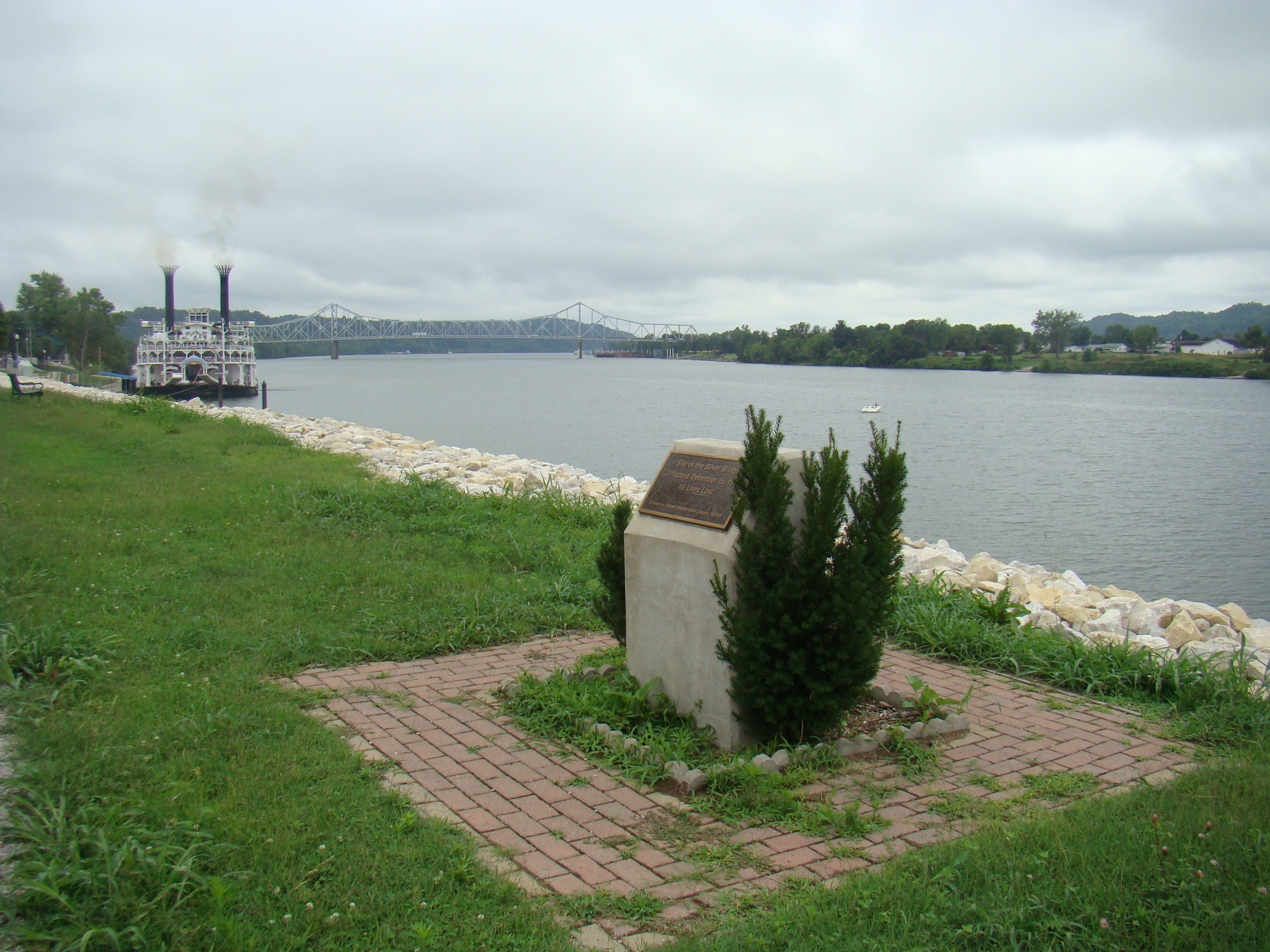
Before leaving town  If you walk up the street a half block to the Ohio River you can also see along the Riverwalk a stone set at the place of the original Silver Bridge, which is just up the river from today’s bridge crossing the Ohio River to the Gallipolis area. During this visit, the American Queen can be seen docked between the two points.

After the Silver Bridge collapsed, there were no further sightings of Mothman, the UFO’s or the Men in Black.  Just mere chance? You decide. Best to keep an open mind as someday it could happen to you.  What will you do if YOU see Mothman?
Mothman Museum, one of the sidewalk shops of the famous Lowe Hotel, is along the Ohio River in Point Pleasant, West Virginia.  Across the street from the Mothman Statue on Main Street, the museum is open every afternoon.

Will the Yanks run the Rebels out of town? Reenactors lined the streets of McConnelsville, Ohio for their 25th Annual Civil War Encampment Days, Ohio’s longest consecutive running reenactment.  What a great place to observe the living history of the Civil War.

Everyone dressed in period costume in the soldier camps seemed eager to discuss their life style, and patiently answered all questions.  Their canvas tents provided great cover from rain storms.  However, they reminded those in attendance that it was important not to touch the canvas with your fingers during a rain.  Seems the oil on your fingers would make the canvas leak. Rains were important for their War Gardens, which provided food for the army as well as land owners.

Since death was frequently a visitor during this time, ladies told about the cemeteries where they often held picnics. Union stones were flat so you might sit on them, but the Confederate stones had a pointed top so “Yankees” couldn’t sit on their tombstones. The ladies also mentioned that black wreaths were hung on doors when someone died as a notice of death, since it was the only method of letting the neighbors know.

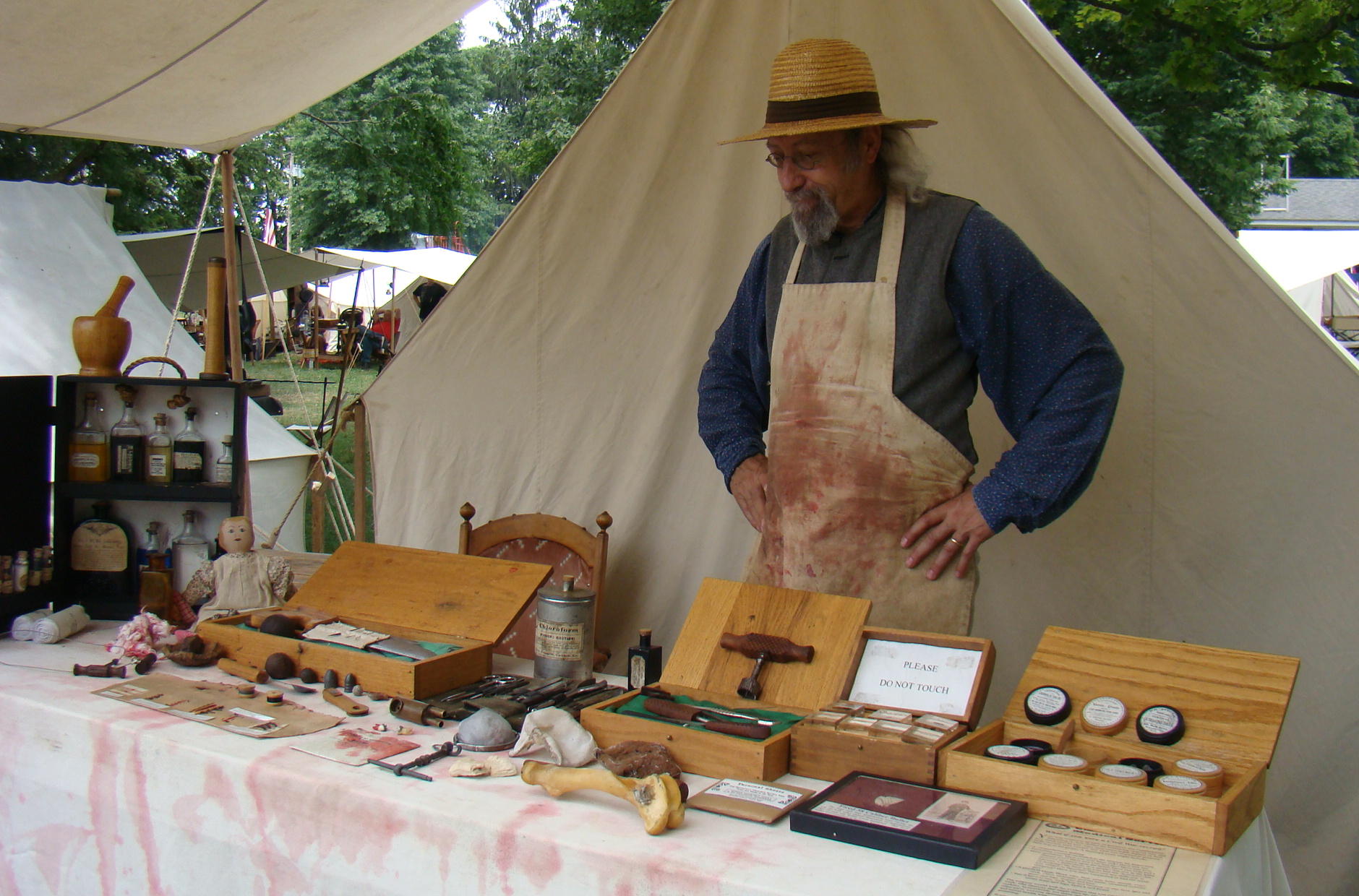
Many medical treatments were explained by the blood stained Head Surgeon of the Confederate regiment. When asked what might be used to help a headache, the major informed visitors that opium would be used if it was severe, while a relaxing morphine or sassafras would be used  for minor headaches. If the headache was too bad, they would just bore a hole in the head to release the evil spirits. Upset stomachs were treated with licorice or ketchup, and beef extract provided a soothing soup for many ailments. They even had a hollow doll that was used to smuggle medicine through the opposing lines.  Later in the afternoon at the field hospital, the surgeon cured a case of gangrene and subsequent blood poisoning by sawing off the leg of the victim.

Walked down to the Courthouse for “Squirmish on the Square”, where a staged battle occurred between soldiers from the North and South. Much ceremony was involved in the presentation of the battle both before and afterwards. There was even a bit of humor thrown in as they robbed a Wells Fargo box and then blew it up. The closing ceremony showed soldiers from both sides presenting arms, taps were played and a wreath was placed on the Civil War Private monument standing in the center of Main Street.  The base of this monument is made of stone from Gettysburg and the Gettysburg Address is engraved on one side of the monument.

After a hot afternoon on the square, it was time for a drink. As Yosemite Sam would have said, “Sasparilly, and make it snappy!” Sarsaparillo was a popular drink of the Civil War era and a cold bottle hit the spot.  Made from sarsaparilla roots, this drink is  called “The Granddaddy of All Root Beers”.  Originally the bitter root brew was used for medicinal purposes treating digestive problems, but later sugar water was added to make it more palatable. ..and a soft drink was born.
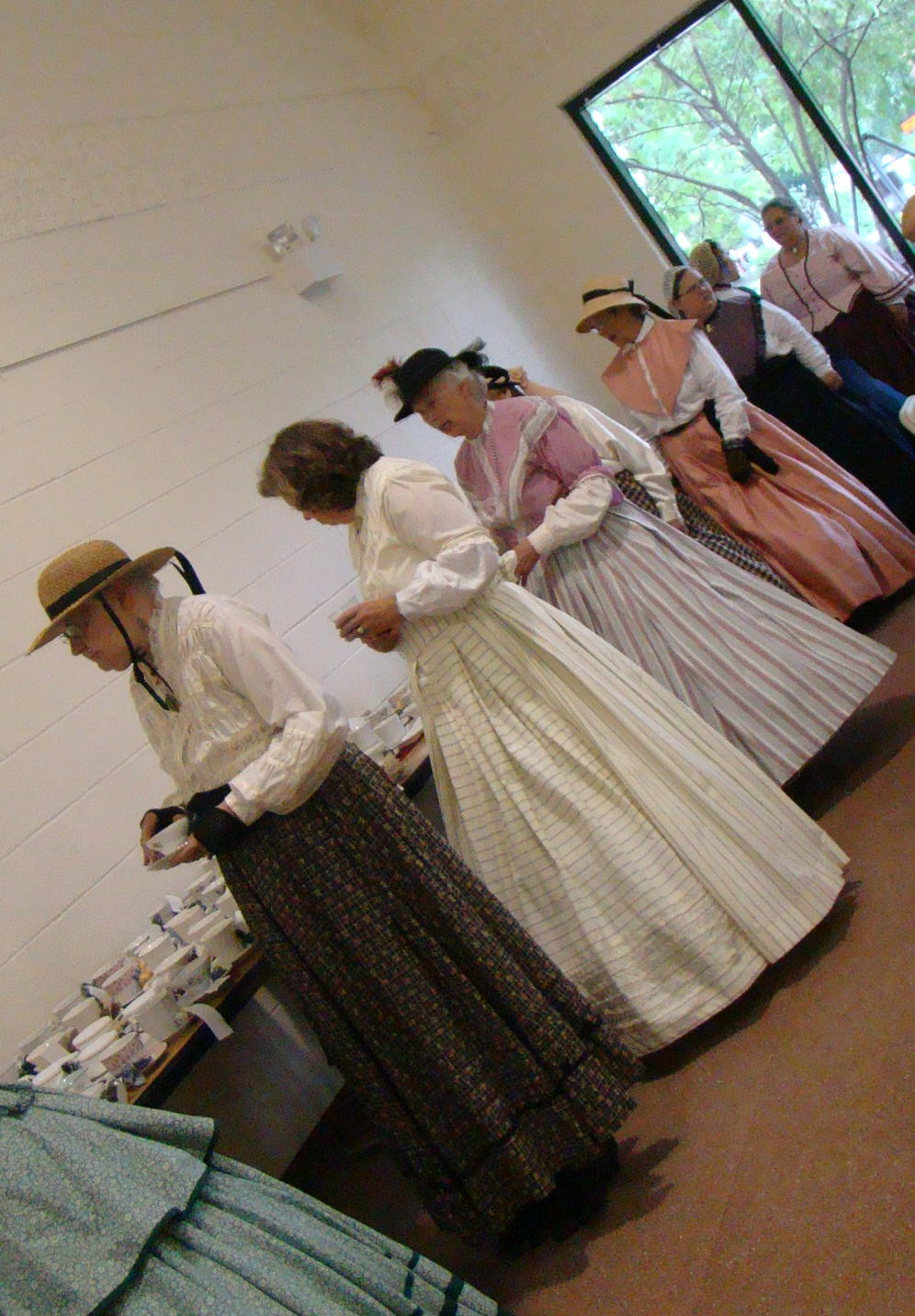
Ladies’ Tea was served amid beautiful hooped gowns and lovely flowered hats. Cucumber sandwiches, fresh fruit, and small cakes were part of the traditional menu. After tea, Verna Owens of St Mary’s, West Virginia told tea drinkers about Women During the War…from the Confederate viewpoint. Her leader was President Jefferson Davis, who had his Confederate White House at Richmond.

She described the proper dress and manners for a Southern lady, who always carried a parasol and wore a hat.  Her cooling fan accomplished an additional task as a means of expressing her thoughts without saying a word.  For example a fan closed in a snap meant she was angry with what was being said, while fanning quickly might mean she couldn’t believe what was happening, or as we might say, “Oh, my!” Many toys of the time were explained and on display. Quiet dolls for church were made out of handkerchiefs, and there was a cow’s jaw for musical entertainment. When soldiers were leaving for battle they gave their sweethearts a tear bottle to collect their tears while they were gone.  Upon their return, they hoped to find it at least half full. Verna closed by saying one truth learned from the war was that we definitely should learn to get along.

In the evening, a Civil War Ball captured the beauty that sometimes appears in the midst of turmoil. Ladies were dressed in their finest, but few hats were worn to the ball…just ribbons or flowers in their hair. Some men wore their uniforms while others were dressed in their best tailcoat. Dancers swirled around the floor doing The Promenade, Waltz, Virginia Reel, and Patty Cake Polka with music provided by Back Porch Swing Band.  What a great ending to a Civil War Day.

This particular Civil War Encampment occurred in McConnelsville, Ohio which is just South of Zanesville, Ohio on Route 669 following the beautiful Muskingum River.  Located riverside just north of town is The Boondocks, one of Ohio’s best small-town eateries being featured in many magazines across the state. Their specialties are their award winning BBQ as well as their great and friendly service.  Could be worth a Sunday drive for a nice meal even if there isn’t an encampment happening!

Opened on July 14, 1932 the International Peace Garden on the border of Canada and the USA near Dunseith, North Dakota is the world’s largest unfortified border, “Like No Other Place On Earth”. It encompasses 2,300 acres of botanical gardens and on a stone caim on the border are inscribed these words:

TO GOD IN HIS GLORY,
we two nations
dedicate this garden
and pledge ourselves
that as long as men
shall live, we will
not take up arms
against one another.

What a great thought all those years ago as a symbol of friendship between the two nations.

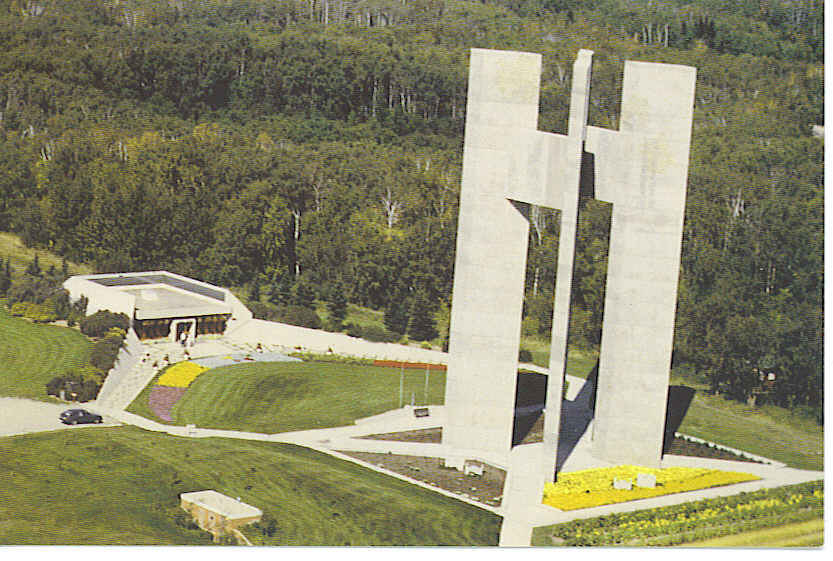
The sounds of bell chimes faintly echo every fifteen minutes from the Veterans Memorial Bell Tower.  The nearby 120′ concrete Peace Tower has four columns symbolizing the four corners of the world from which thousands of immigrants arrived in Canada and the United States to make better lives for themselves. Two of the columns are in Manitoba, Canada while the other two columns are in North Dakota.  The foundation symbolizes one solid base of democratic beliefs between the two countries.

The Peace Chapel provides the perfect place to sit down and relax, meditate, or read the positive thoughts written on the walls. The Peace Chapel has been a long time project of area members of the Order of the Eastern Star and is the only building which straddles the United States and Canadian border. While the chapel is a simple building, the addition of amber glass windows from France gives it a soft, golden, peaceful glow.

The three encircling walls into which quotations have been engraved were one of the special features that grabbed my attention. All quotations were either spoken or written by great men of peace throughout history. Some of the limestone walls still have embedded fossils of strange marine life, which had been molded into the bed of a tropical sea in the Manitoba region millions of years ago.

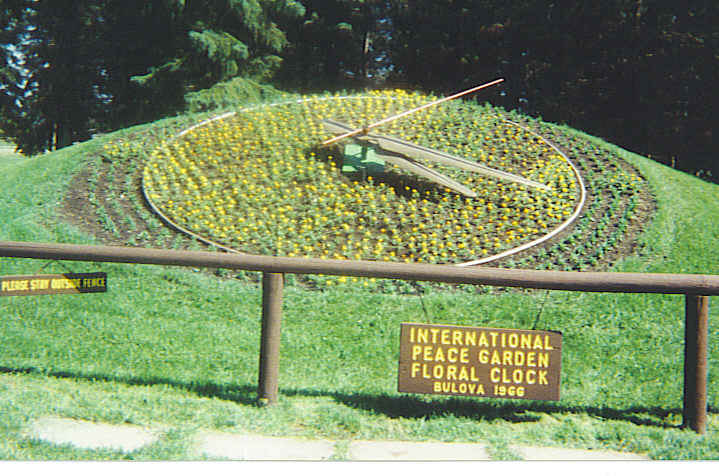
Flower beds are around every corner here, but two displays that have been constant from the beginning are beds forming the United States and Canadian flags.  A beautiful International Peace Garden Floral Clock actually works and was originally donated by Bulova in 1966. This original was designed as a replica of the famous Bulova Floral Clock in Berne, Switzerland, but inner workings were replaced in recent years by a clock from St Louis, Missouri.  The clock contains over 2,000 flowers with the design changing yearly, and reminds visitors to take time for the peaceful feeling surrounding the gardens.

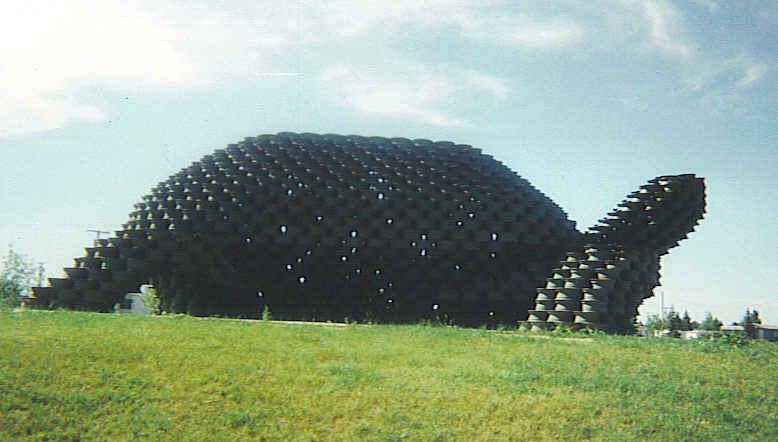
Just down the road in the Turtle Mountains near Dunseith, North Dakota is the largest man-made turtle in the world. Constructed of nearly 2,000 wheel rims, this “W’eel Turtle made from Wheels” has a head that actually bobs up and down. While the turtle is nearly forty feet long, its head alone weighs almost a ton! Stop and visit this tire rim sculpture at Dale’s Thrifty Barn – a gas-station, cafe, and motel in Dunseith, North Dakota. Little extras like this always bring a smile.

Turtle Mountains seem to be a perfect location for the International Garden of Peace as the slow movement of the turtle gives a relaxed and peaceful feeling just like the gardens. May peace prevail in your world as well. We should all attempt to be more like the turtle… at ease in our own shell.

The International Peace Garden in North Dakota can be reached by taking I-29 North in North Dakota to Exit 203.  Take Route 81/281 West to Dunseith where 281 bends North to the Canadian border.  This is a beautiful back-road drive away from the crowds.

An apple a day keeps the doctor away is a saying we have heard most of our lives. But John Chapman, better known as Johnny Appleseed, has a slightly different version:  Eat an apple before you go to bed, and make the doctor beg his bread.

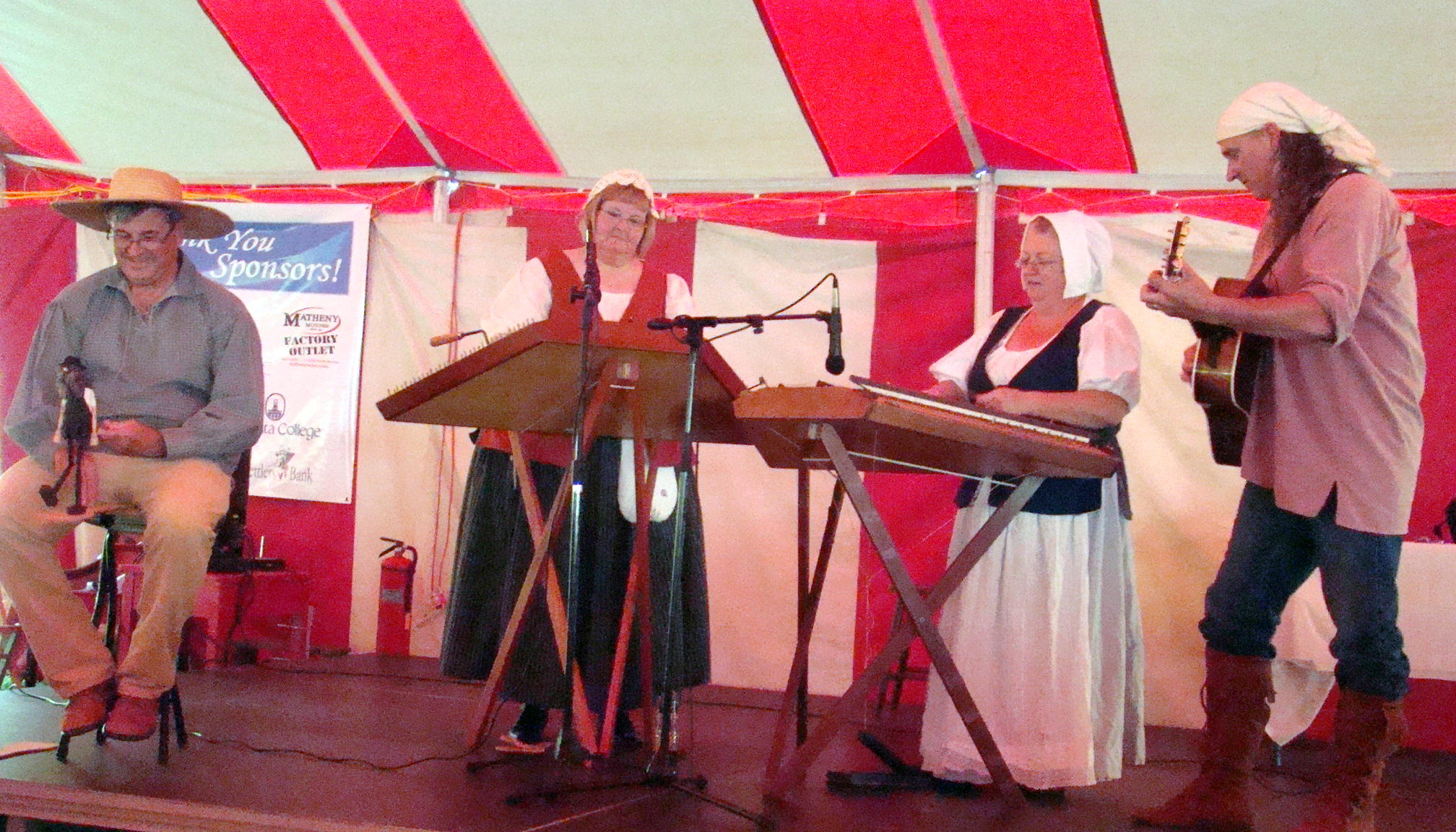
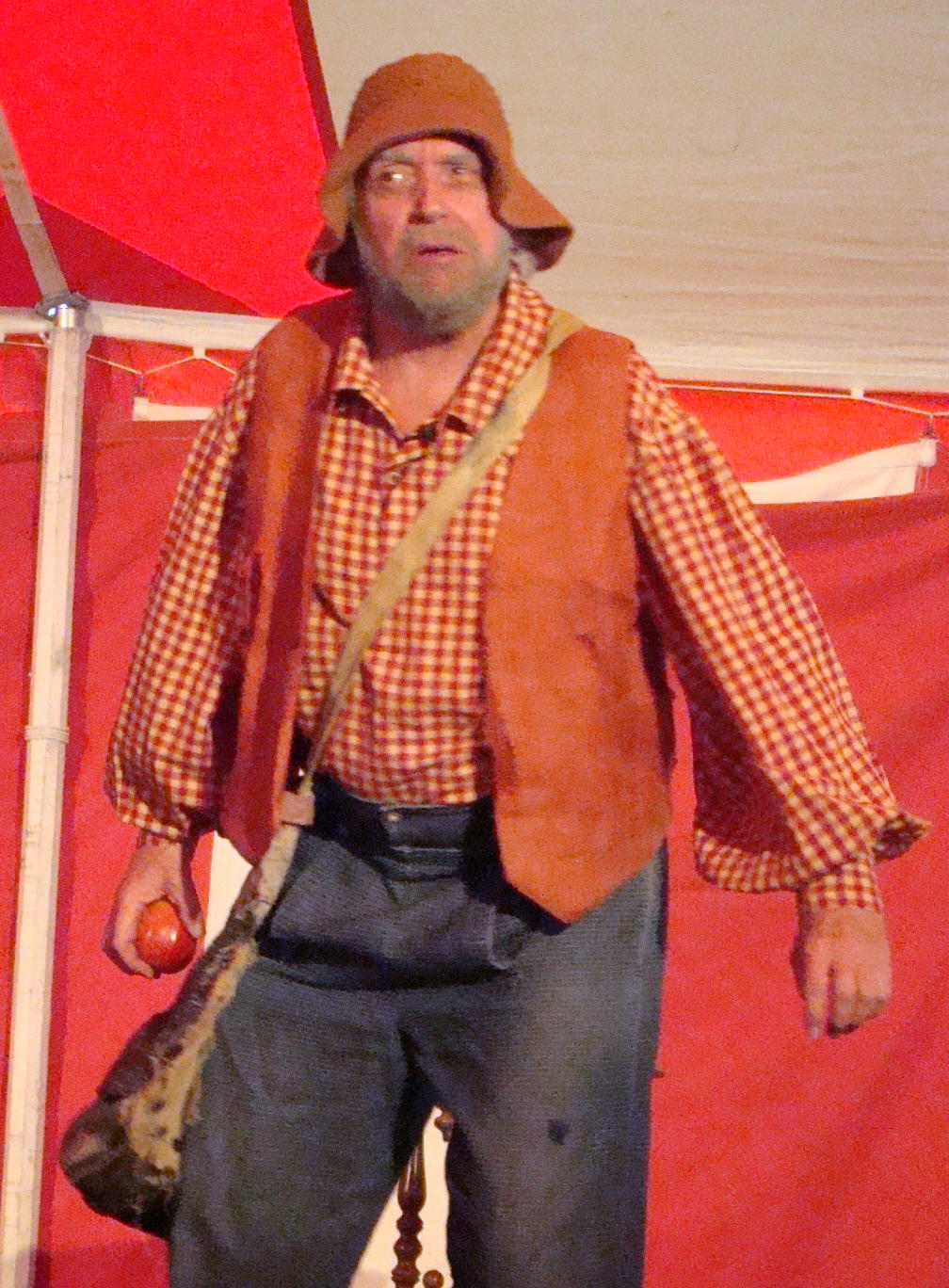
Each evening before the appearance of historical scholars, local musical groups entertained with songs from frontier times.  This particular evening a group called Unwound presented lively music on two hammer dulcimers accompanied by guitar and tapping Limberjacks.  They got the crowd in the Chautauqua tent at Marietta Ohio ready for the appearance of Johnny Appleseed, an excellent yarn spinner.

John Chapman wanted to do something useful with his life that would also support his ministry. Apples seemed to be the perfect tool as they were the only fruit that could stay fresh for an extended time. There was a litany of uses given by John regarding his favorite fruit: apple chips, apple butter, apple brandy, and even payment for taxes…to name a few. Would you believe his favorite color is apple red?

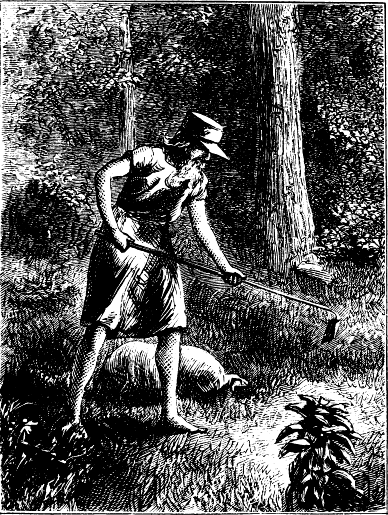
Starting a nursery for Johnny was a simple affair: poke a hole, plant a seed, cover it up. He tried to anticipate where people would be settling in two or three years and would start a nursery in that vicinity. Johnny said that in order to claim the land, the homestead law required settlers to plant fifty apple trees during the first year. Sometimes you might see him going down the Ohio River with two canoes:  Johnny in the first one, 50 apple seedlings or apple seeds in the second.

In 1812 when troubles in America erupted with the British and the Indians, Johnny said the fear grew deeper than the snow. These war years were painful for Johnny, as he had always been friends with both Indians and whites.  Trying to make peace was like trying to put out a fire – while you were stomping on one, you were fanning the rest. At this time, he felt the Indians were like a tornado – you never knew where they were going to strike.  But you couldn’t always trust the British either as they burned whole villages – another white man’s promise up in smoke!

With his constant good humor, he admonished listeners not to believe everything they heard about him, “Gossip is like the measles, sooner or later it will turn your face red.”  For example, barefoot Johnny Appleseed did not walk over the entire country.  His travels and consequent apple tree plantings only occurred in New York, Pennsylvania, Virginia, Ohio, Michigan, Indiana, Illinois and often in a State of Confusion.

Johnny was deeply religious and felt his religion gave him a peaceful path to tread. His was the perfect life in his eyes because sometimes he was with people… but sometimes by himself.  He often enjoyed being alone and said he was not “the marrying kind”.

He spent his life doing good deeds for others and planted more than just apple trees. He also planted spiritual seeds that nourished the soul.

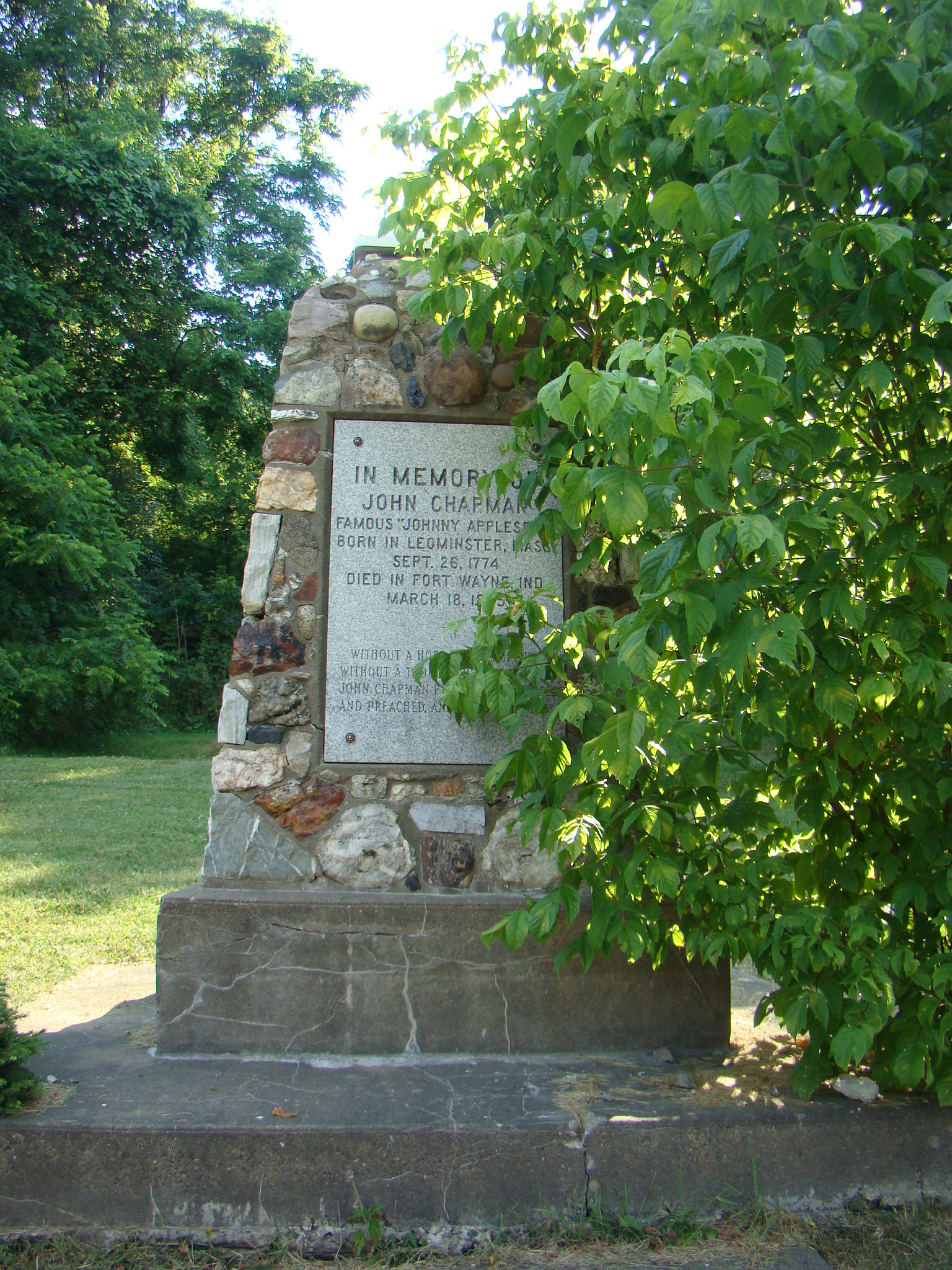
Along the way to Marietta, stopped just south of Dexter City on SR 821 to see a monument dedicated to Johnny Appleseed.  It is made of small rocks contributed by people in areas where Johnny planted apple tree.  The grave sites of his family are located nearby.  The tree to the right behind it is, of course, an apple tree.

Hank Fincken displayed a great sense of humor in his portrayal of Johnny Appleseed /John Chapman.  Johnny was the first historic figure that Hank ever developed. He feels it opened doors for him much the way Johnny’s seedlings opened doors for early settlers.

2012 Ohio Chautauqua continues throughout the summer with week long performances and workshops in Gallipolis (July 17-21) and Warren (July 24-28). Hope you find time to join them and learn a little more about “When Ohio Was the Western Frontier”.

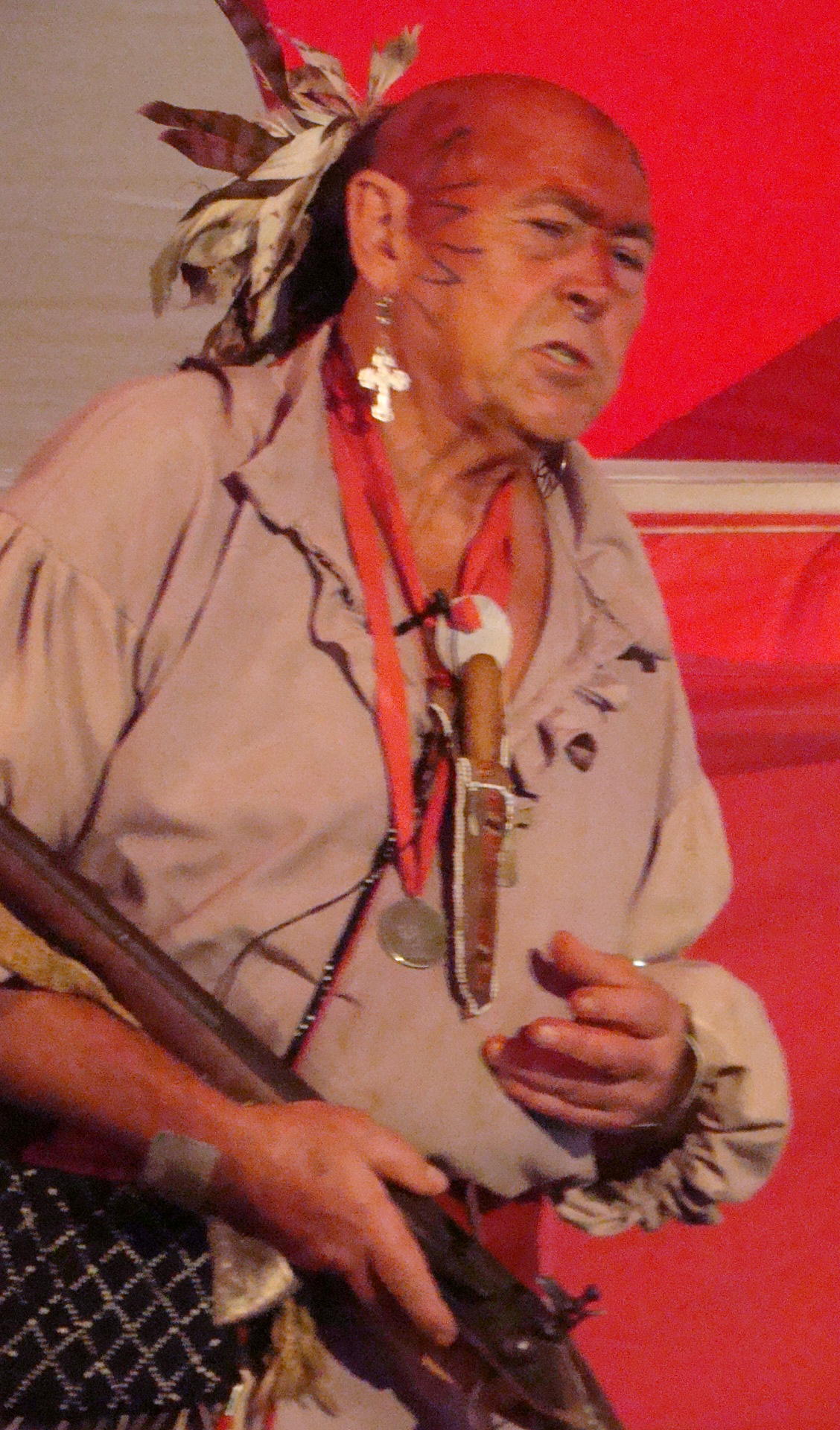
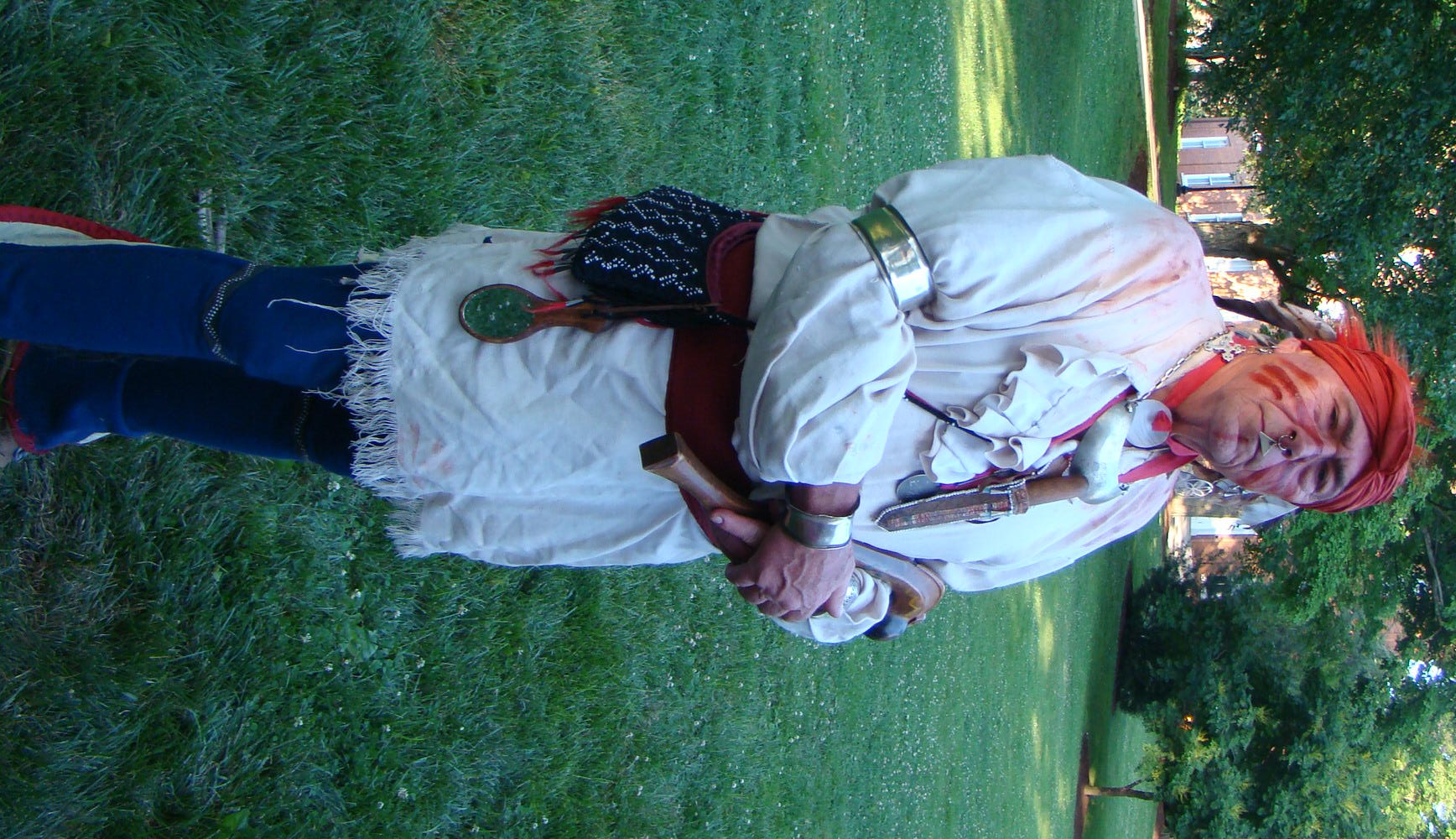
Dressed in buckskin clothes, the appearance of Chief Logan transported the audience back to frontier times. Silver armbands, bracelets, a nose ring and earrings – one a cross- glittered in the sunlight as he took the stage at the Ohio Chautauqua during the 225th Anniversary of Marietta – The Crown Jewel of the Appalachians.   Tattoos also adorned his body with a tobacco leaf tattoo on his ear symbolizing “truthful hearing” while a red hawk on his head denoted his tribal connection.

John Logan began his life on the Susquehanna River and followed his father’s Jesuit teachings where John’s “sins were washed away”. Friendly with the white settlers, John was always a peacemaker for the Iroquois, who were usually called Mingos when settling in the Ohio Country, and John Logan is most often referred to as Chief of the Mingos. Perhaps his role as peacemaker gave him reason to learn eight different Indian dialects as well as English, French, Dutch and even Latin. However, Chief Logan could neither read nor write.

The Ohio Land Company kept expanding their boundaries to include more and more of the Indian lands. The Mingos ignored the marks of surveyors saying, “You can’t sell the wind in the sky or the water in the river.”

Along the Ohio River, settlers frequently met at the tavern for stories, nourishment and ale.  One evening, Logan’s camp along Yellow Creek, near present day Wellsville, Ohio, was invited by a nasty frontiersman, Jacob Greathouse, to a tavern across the Ohio River.  During the course of the evening, some of Logan’s family was shot and killed in an ugly massacre.  This changed Logan’s peaceful ways in a hurry.  In the words of Logan, “It made me want to raise my hatchet that had long been buried and color it with the blood of the English.” Sometime during this period, he walked away from the Christian teachings.

While he told the settlers of his anger, he also said the Indians were not all angry…just Logan, as they had killed his people.  Known as Logan’s Revenge, he vowed to take ten white man’s scalps for every Indian that had been murdered on the Ohio River that evening. Every time he took a scalp, he made a mark on his hatchet. According to Native American custom, he had a right to this retaliation.

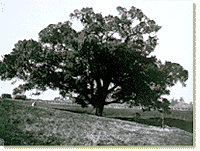
Chief Logan refused to attend peace talks in 1774 at Camp Charlotte on the Scioto River, but issued his now famous speech, Logan’s Lament, under an elm tree. While the beautiful old elm no longer exists, the words of his speech can be found today engraved on his memorial at Logan Elm State Memorial near Circleville, Ohio. His speech concluded:

“Logan feels not fear. He would not turn on his heel to save his life for who is there left to mourn Logan? Not one.”

The remainder of his life was spent as a kind man who sold deer skins for a dollar each, so he could bury his sorrows in the taverns he visited.  In 1781, he was killed by his nephew, because John Logan was no longer considered an asset to his people. Today there is not a drop of Logan’s blood in any living creature.

Dan Cutler portrayed Chief Logan with ease as he has spent about a dozen years in that role in West Virginia as well as the Ohio Valley.  Frequently he also slips into the roles of The Cornstalk Warrior, Tecumseh and Simon Girty. Dan is currently active in a new outdoor drama, “Drums Along the Mohawk”, which will premier late this summer in New York.

2012 Ohio Chautauqua continues throughout the summer with week long performances and workshops in Gallipolis (July 17-21) and Warren (July 24-28). Hope you find time to join them and learn a little more about “When Ohio Was the Western Frontier”.

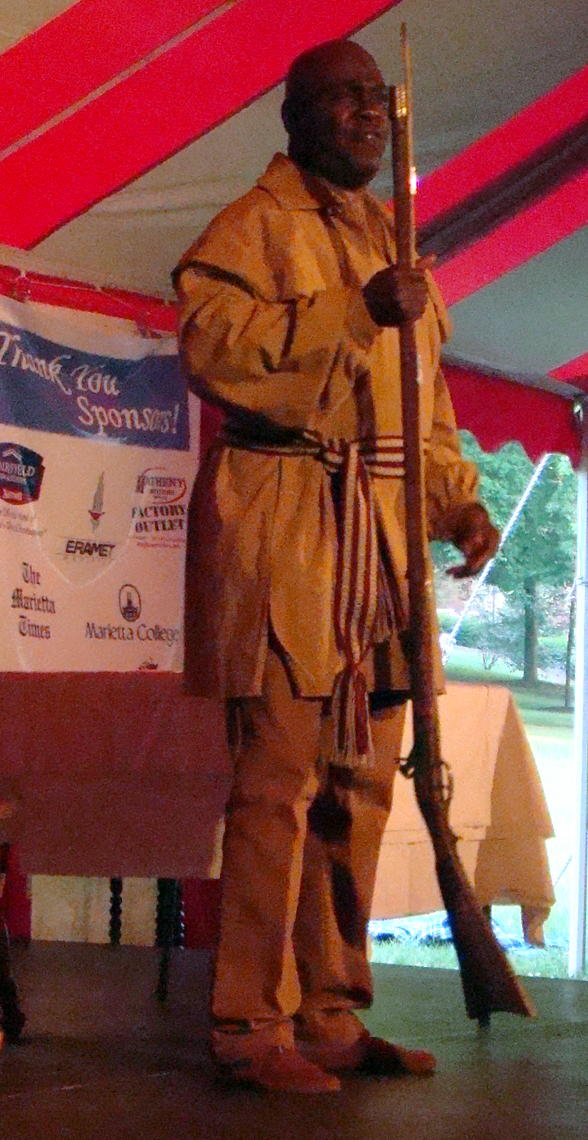
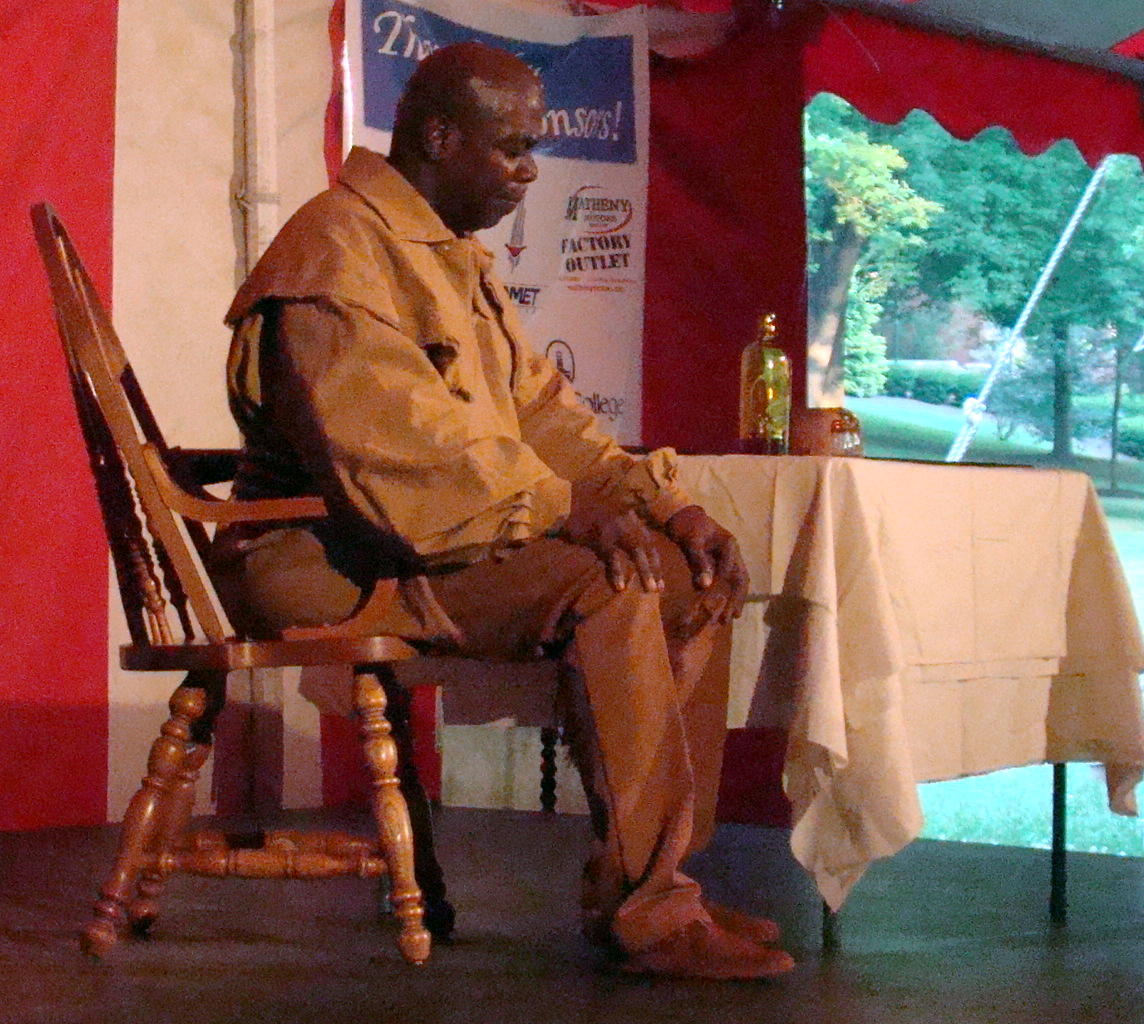
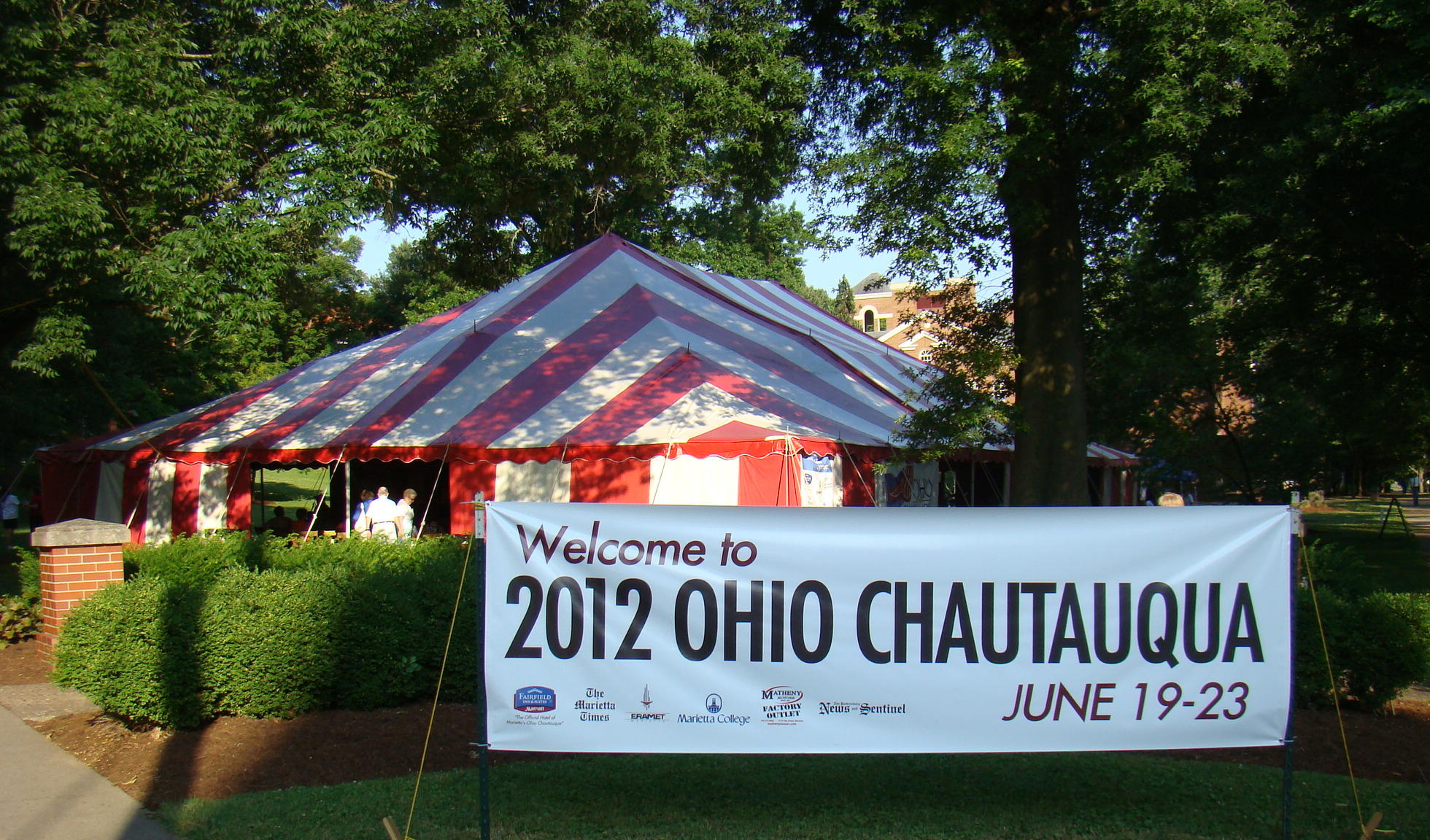
Tracker… Negotiator…Ambassador…Doctor.  All these words were used at one time or another to describe York, Captain William Clark’s black manservant, who was part of the Lewis and Clark expedition to the Pacific Ocean and back to the East. York’s story was told under the red and white striped tent at the 2012 Chautauqua celebration in Marietta, Ohio on the campus of Marietta College. This year’s theme, “When Ohio Was the Western Frontier”, introduced characters that played a role in Ohio’s early history. York, being from Virginia, spent much time on and along the Ohio River.

As the first recorded black explorer, York created much excitement as he traveled across the Western frontier.  Due to his large size and black skin, his presence amazed and intrigued the Indians along the way. Thinking perhaps that he was painted black, at many stops the Indians would spit on their fingers and try to rub the black color from his skin. Indian tribes considered him a friend and referred to him as Big Medicine, since he frequently gave them liniments and herbs to heal their ailments. Some even called him Giant Medicine due to his size, and felt that his skin had sacred power.  This was a time in York’s life when he said, “How great it felt to be admired.  I felt ten feet tall.”

Because he enjoyed storytelling and drinking, York was very popular in taverns wherever he went. His speech was much like “the white man’s” since he had grown up in his master’s household. Never having been taught to read or write, he relied on his tall tales, some higher than the mountains, to entertain the explorers and those he met along the way. The Indian squaws favored him with special treatment, and he entertained the children with stories of being wild. His contribution as a peace maker with the Indians helped make the expedition more successful.

Life was not easy on the journey as they were often cold and hungry. They drank bear fat and even ate candles to survive. At times when food was scare, York was entrusted with a musket, something that never would have been permitted this slave while in Virginia. There were times when they were fortunate to encounter a herd of elk.  Then they ate elk, elk, and more elk all day long. If no other meat was available, they even ate their dogs and found them quite tasty. The children in the tent at Marietta that evening were quite concerned about the expedition eating dogs, and were assured it was only done during an emergency when no other food was available.

When they returned to the East, York reverted to his position as a manservant. He only wanted freedom to be with his wife but this was not to be. Instead he was flogged, even jailed and then hired out to a severe master where he was given spoiled food and further mistreated.

Even though York was married, he seldom saw his wife as she too was a slave. They lost contact completely when she was sent to Mississippi to work on a plantation. So even though he knew she was expecting their child, he never got to see the child or even know of its whereabouts. When he asked Captain Clark if he could be sold as a slave with his wife, Clark said it was out of the question. York said the most painful time he encountered in his life was saying goodbye to his wife.

What really happened to York? Some accounts say that he was eventually freed, but given the fact that he had no knowledge of business was not able to make his way in the world.  Other accounts say he was spotted later with the Crow Indians in the Rocky Mountains. Hope it was the later!

As York sat at the tavern on the Chautauqua stage, he said he was thankful for the Expedition as for a short time he knew what freedom felt like. There his color was not a curse but a blessing. His dream was to eventually go back to the Indians.  His presentation concluded with a toast to the Great Expedition, the beauty and majesty of our great nation, Captain Clark, the Indians, and Big Medicine.

Marvin Jefferson did a very believable portrayal of York. His background as an educator and historical scholar has given him incite into Civil Rights issues and he frequently portrays Martin Luther King, Jr and Paul Robeson in his stage performances.

2012 Ohio Chautauqua continues throughout the summer with week long performances and workshops in Urbana (June 26-30), Gallipolis (July 17-21) and Warren (July 24-28).  Hope you find time to join them and learn a little more about “When Ohio Was the Western Frontier”.

More is better! That was the feeling of Harman and Margaret Blennerhassett as they came to the United States from England in 1797. Their marriage was frowned upon by friends and family in England since Harman was Margaret’s uncle; therefore, their best chance at a happy life together would have to be in a far away country.  Having sold his castle in England, the Blennerhassetts arrived in the United States with lots and lots of money…$140,000! While this fortune seemed limitless at that time, the Blennerhassetts spent their fortune recklessly and unwisely, always wanting more.

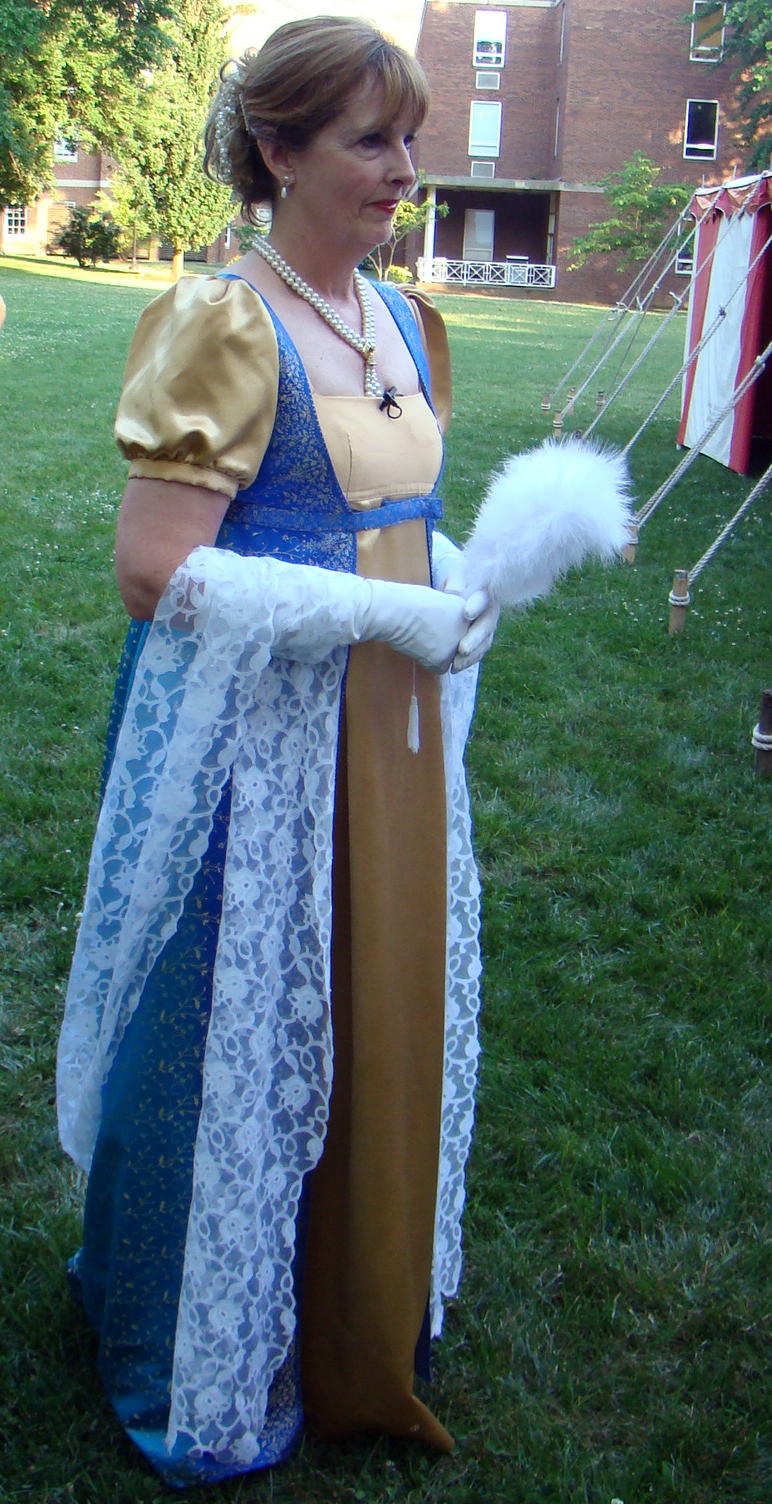
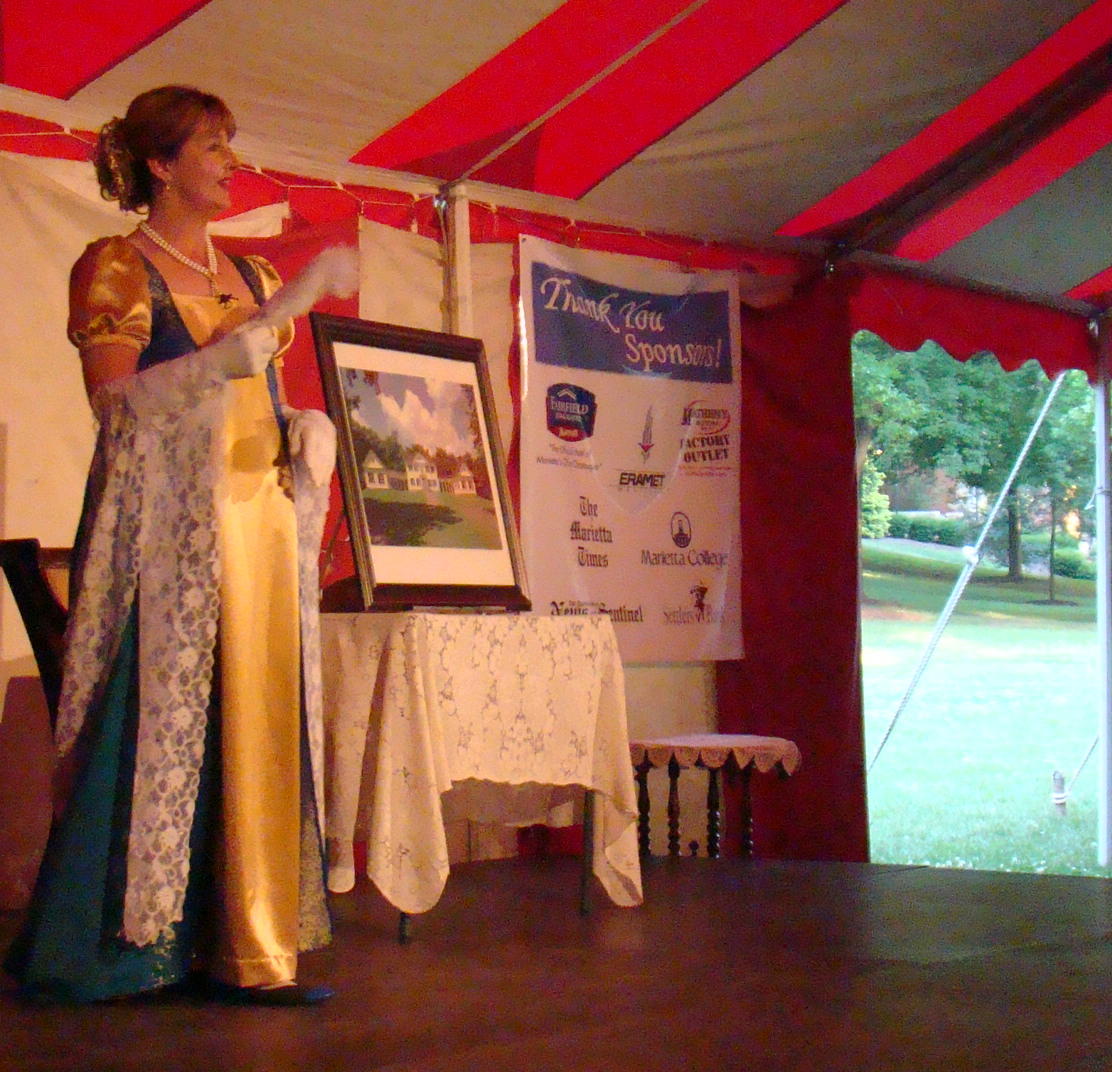
The aristocratic Margaret Blennerhassett was the first historic character for  “When Ohio Was the Western Frontier”, the theme for  2012 Ohio Chautauqua in Marietta, Ohio on the campus of Marietta College.  She received a warm welcome as temperatures soared to near 100 in the red and white striped tent.

Margaret’s story continued with their search for a place to built their new home, and ultimate discovery of  a beautiful tree covered island in the middle of the Ohio River. Margaret thought this would be the perfect place for the elegant home she had in mind so they bought half of the island, approximately 180 acres, for $4500.

One corner of the island was cleared of the huge trees so the mansion would appear as a pearl against green velvet as the boats passed by on the Ohio River. Here they built a luxurious twelve room mansion that had thirty-six glass windows, something not common at that time of log cabins with tar paper windows. Two covered porticos flanked the main house leading to its two appendages: Harman’s office and the summer kitchen.

Not only was the house a beautiful spot but there were acres of gardens and a greenhouse where citrus fruits grew all winter long. There was even special shrubbery trimmed in the shape of the original thirteen colonies.  Margaret especially enjoyed riding her white horse, Robin, over the island appearing as an exotic bird in her scarlet riding cape and feathered hat. Yes, more was definitely better.

But their happy life was short-lived here on the spot they called Blennerhassett Island. Some compared it to the beautiful Garden of Eden, but both seemed to have a snake that spoiled their pleasure. This time it was a snake in the form of Aaron Burr that wanted something forbidden.

Margaret said that Aaron Burr was a genius who applied to college at the age of eleven and graduated from Princeton at an early age. Burr was a very handsome man who loved fine things especially when procured through other people’s money. After a tie in a presidential election between Thomas Jefferson and Aaron Burr, the recount made Jefferson the President, and the loser, Aaron Burr, the vice-president. Things did not start out on a good foot here, and Burr was more than a little dissatisfied.

In 1805, Burr visited Blennerhassett Island for dinner as he was curious about the eccentric foreigner … or perhaps he had heard of the money Blennerhassett had available to “invest” in his plans. Burr led them to believe that this was an easy way for them to increase their fortune.  These events took place at a time when the Blennerhassett funds were running low.

Margaret felt that Thomas Jefferson was the real serpent that crawled into their Garden of Eden in order to destroy them. There was a lot of animosity between Jefferson and Burr.  Margaret said that Jefferson was not the wonderful president that many thought he was.  She felt the Louisiana Purchase was illegal, and while considered an inventor said he only had invented two things: a wheel cypher secret decoder and a plow. Thomas Jefferson was said to even cut parts out of the Bible that he didn’t like or wish to follow in his life. It was quite obvious that Margaret did not have fond feelings for President Jefferson.

Jefferson tried to destroy Aaron Burr and by association, Harman Blennerhassett. He attempted to use his power to have Burr found guilty of treason.  However, Chief Justice John Marshall stood up to Jefferson, and the jury found Aaron Burr not guilty. Burr and Blennerhassett were both released from prison.

By this time, their house on the island had been looted with most of the fine things being carried off. The remainder of the items were sold at auction to pay off debts accumulated by the Blennerhassetts. In 1811, their beautiful mansion was burned to the ground. At this point, the Blennerhassett family fell into hardships and eventual poverty for the remainder of their lives.  Their hopes and dreams were shattered.

Debra Conner’s portrayal of Margaret Blennerhassett was outstanding. Debra actually spent much of her youth in the Marietta community and graduated from Marietta High School.  Often during the year, she presents similar programs to the area schools on both sides of the Ohio River as part of their Ohio or West Virginia history curriculum.

2012 Ohio Chautauqua continues throughout the summer with week long performances and workshops in Urbana (June 26-30), Gallipolis (July 17-21) and Warren (July 24-28).  Hope you find time to join them and learn a little more about “When Ohio Was the Western Frontier”.

“The only rock you will find out there will be your own tombstone,” was the advice given to Ed Schieffelin when he headed to the mountains of Arizona to hunt for ore samples.  When Schieffelin filed his first claim after discovering silver, he suitably named his first mine Tombstone, and organized the Tombstone Mining and Milling Company.

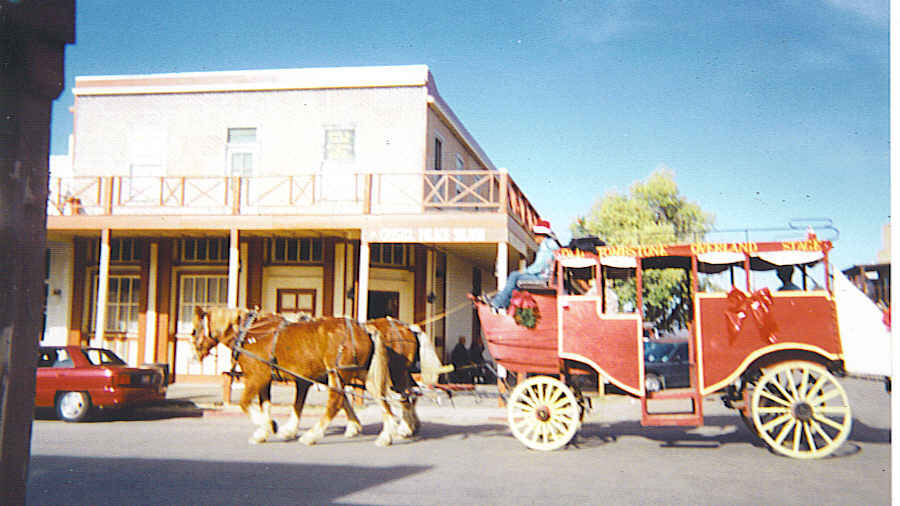
If you want an informative trip through Tombstone, Arizona, hop on the guided horse-drawn stagecoach tour. Here you will hear the basic history of the town with lots of humorous stories thrown in. Don’t be surprised if you see a gunfight or stagecoach robbery along the way. Then you can walk or ride to your favorite places throughout the town for a closer look.

The stagecoach is pictured in front of the Crystal Palace Saloon, which was originally built in 1882 but restored in 1963.  Prominent citizens of Tombstone liked to congregate here as the saloon was know for its “Good Whiskey, Tolerable Water, and Best Food in Town” as well as an honest gambling room. Add to that the fact that upstairs were located offices that furnished all the latest news, and you can see why it was such a popular spot. The second floor contained offices of Marshall Virgil Earp – in the front, Dr George Goodfellow, leading surgeon, and Atty George Berry.

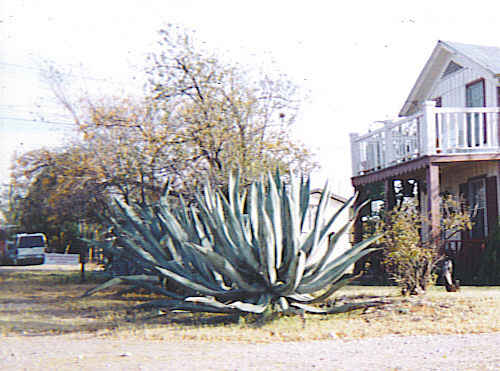
Since plants are one of my pleasures, couldn’t help noticing this huge century plant located in a resident’s yard. This plant’s name is derived from the fact that they only bloom once in a long, long time, but not quite a century. Usually they grow for around twenty five years before the plant puts forth its tall wooden seed stalk filled with blooms.  This blooming spike grows so fast that it takes all the nutrients out of the plant causing it to die.  But the seed lives on!  These plants are used for their medicinal properties, fiber, food, and even needles.

As you can imagine this was rough territory with tough, lawless characters calling it home. Being only twenty miles from the Mexican border, a group of bandits called The Cowboys, led by Billy Clanton and the McLaury brothers, began rustling cattle from Sonora, Mexico to the fields near Tombstone. That brought lawmen onto the scene in the form of the Earp brothers. The Cowboys were welcome in town since they spent a lot of money there, but shootings often occured. Here you will also find The Hanging Tree, which was used for executions when the gun just wasn’t enough punishment.

Early in 1881 however, one story reports that The Cowboys attempted to rob a stagecoach of $26,000 worth of  silver, and killed two passengers. The events that ensued culminated in the now famous Gunfight at the O K Corral where US Federal Marshall Virgil Earp, his brothers, Wyatt and Morgan, and Doc Holliday shot and killed three of The Cowboys.  They are buried today on Boothill, one of the city’s most popular tourist attractions.

Boothill reportedly received its name because so many died violent deaths in that area and were buried with their boots on. Wording on the tombstones tells a lot about the life of those times. Some simply say: MURDERED or HANGED. The tombstone of Lester Moore is one of the most often viewed and remembered on Boothill as it has the epitaph:

HERE LIES LESTER MOORE, 4 SLUGS FROM A 44, NO LES NO MORE

The world’s largest rosebush is also in Tombstone so growing conditions must be exceptional. Planted in 1885, this Lady Banksia Rose covers the roof of an inn as well as this terrace. The trunk of the rose bush is twelve feet wide, which you may be able to spot in the shadows. That rose bush must also have been Too Tough To Die.

Since 1880 until the present day, the local publication, The Tombstone Epitaph…The Old West’s most famous newspaper, has kept locals and visitors informed regarding what’s happening in Tombstone. There are now actually two editions: a monthly historical national and a bi-monthly local.  Check out some of their historical issues at The Tombstone Epitaph online.

Even though this two-fisted, trigger-happy boomtown has settled down quite a bit, Tombstone is proud of its Wild West history.  This is a real town with real inhabitants today and in the past.  That is why they are pleased to call it: The Town Too Tough To Die.

Tombstone is located in the southeastern corner of Arizona, just 70 miles from Tucson. Follow I-10 to exit  303 and head southeast on route 80 for about 23 miles. If time permits, head on down to relaxing Bisbee and tour their Queens Copper Mine, one of the richest copper mines in history.