Places to go and things to see by Gypsy Bev

Yabba Dabba Doo!

Flintstones… Meet the Flintstones,
They’re a modern stoneage family.
From the town of Bedrock,
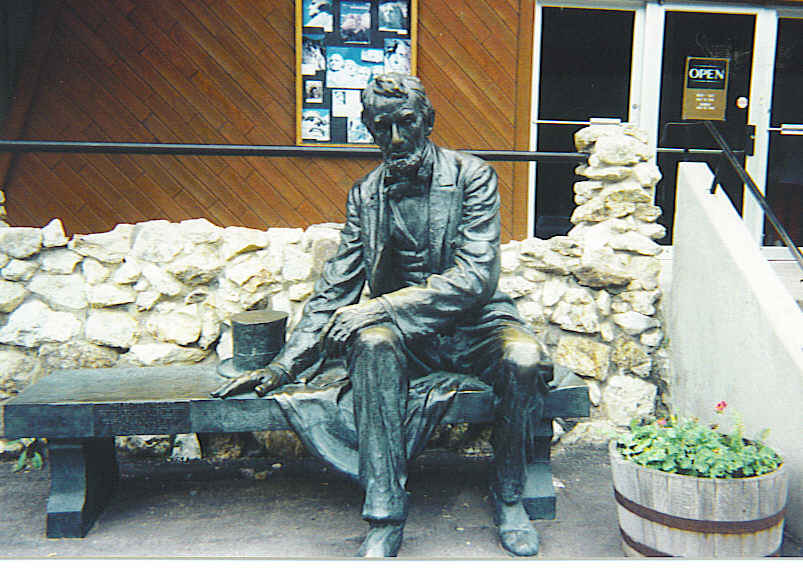
They’re a page right out of history.

Let’s ride with the family down the street.
Through the courtesy of Fred’s two feet.

When you’re with the Flintstones,
have a yabba dabba doo time,
a dabba doo time,
we’ll have a gay old time

Couldn’t resist stopping for a visit with Fred and Barney at Flintstones’ Bedrock City Theme Park near Custer, South Dakota. The Flintstones was the first animated comedy show on primetime TV, starting in  1960.  For those of you not familiar with the show, Fred and Wilma Flintstone and their neighbors, Barney and Betty Rubble, lived in the prehistoric town of Bedrock.  Here they faced all those age old problems with work, family and leisure that we still experience today.

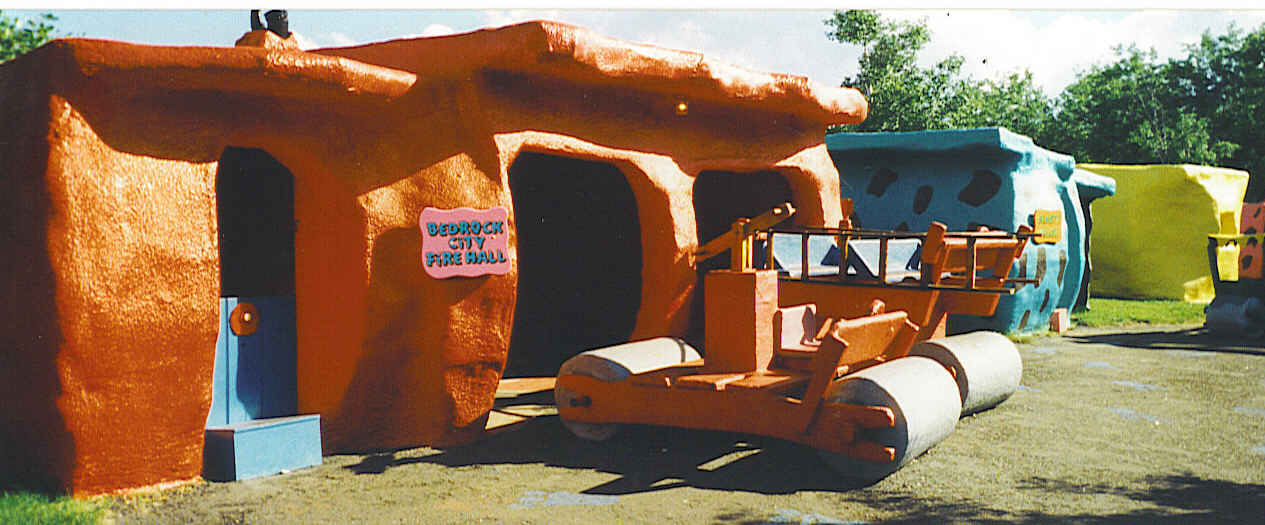
At Bedrock, you have a chance to actually drive and propel one of those famous Flintmobiles.  This pre-historic car was owned by Fred Flintstone when he worked at the stone quarry. It was made of a tree trunk and rolled along on rock wheels…no engine, just foot power!  They have several of these at Bedrock today so many can get a chance for a ride, or at least sit in one of the cars and get the feel of Stone Age living.

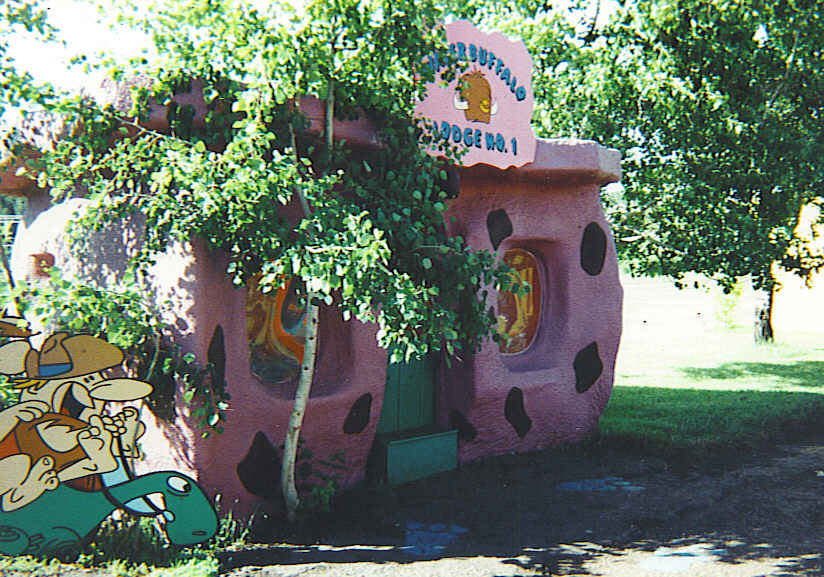
Stroll through the streets and reminisce as you walk past Fred and Barney’s houses just across the field from each other. Peek inside the Stone Age setting of Bedrock City Fire Hall,  Rocko Gas Station and Water Buffalo Lodge, where Fred and Barney liked to have a guys night out. All the buildings are painted with bright cartoon colors, and there are statues everywhere.
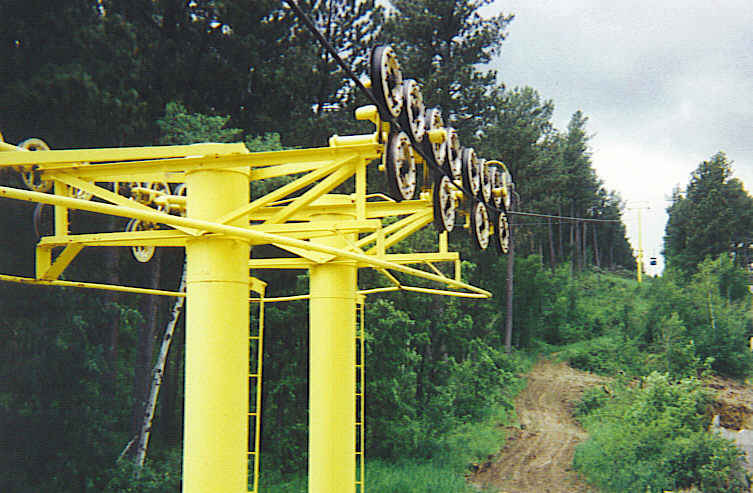
Since Bedrock is only thirty minutes from Mount Rushmore, it isn’t really surprising that they have their own mountain sculpture, Mount Rockmore. There are four faces here too: Fred Flintstone, friend Barney Rubble, the Flintstone’s pet Dino, and the founder of Bedrock, Mr Granitebilt.

Remember those days when Barney and Fred would stop at the Drive In on the way home from work?  When they put the loaded down tray of ribs on the side of the Flintmobile, it fell over on its side.  Now that’s a heavy meal! Stop by the Drive In Restaurant yourself  for a tasty treat of Brontoburgers, Dino Dogs, Chickasaurus sandwiches, or Rockbusters.

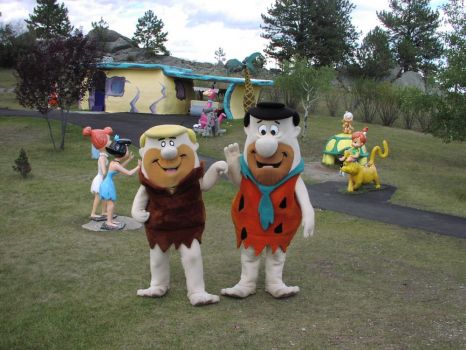
During the summer months, you will find a live Fred and Barney walking around Bedrock ready to shake your hand or have their picture taken with you.  Being part of a cartoon setting is great fun.

Bedrock City is a priceless piece of America along the route to the Grand Canyon. This is a great place for a family vacation as there are many places to explore in the area. Close by are the 1880 Train, Bear Country USA, and Rushmore Waterslide Park. You can stay at the Flintstone Campground in a cabin, tent, or your RV. For forty five years, Bedrock City has been giving enjoyment to old and young alike.

Spend your vacation in a cartoon and enjoy the wonderful world of Bedrock. Yabba Dabba Doo!

Bedrock City, South Dakota is located just off US Highway 16 west of Custer on Mt. Rushmore Road. Just watch for the Flintstones sign.

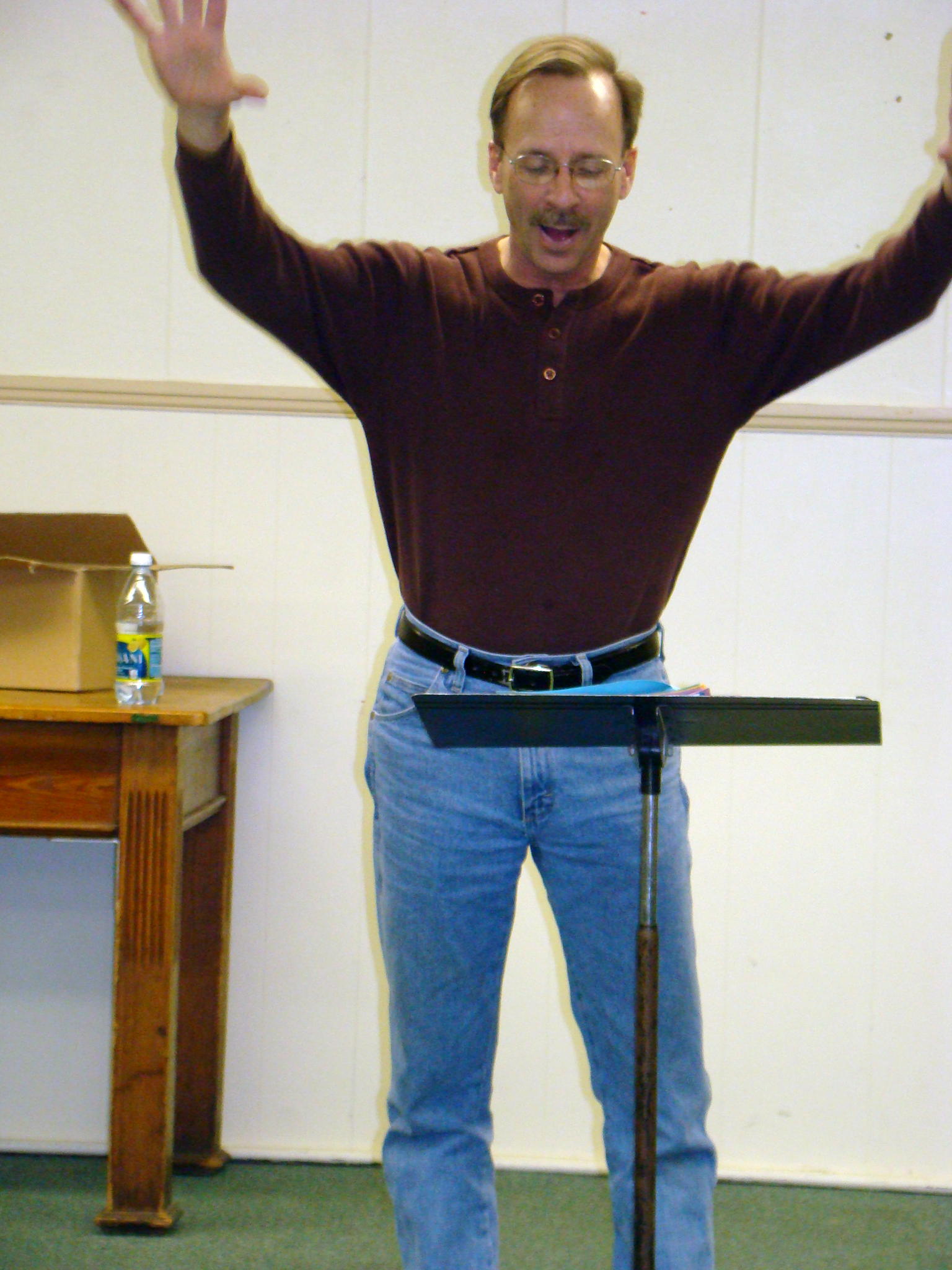
Everyone has their dreams, and the only thing that can keep you from fulfilling your dreams is you. David Turrill, faculty member at Muskingum University, found one special dream fulfilled on a recent trip abroad.

Quite often you don’t have to go as far from home as David did to find interesting and unusual activities. At the Muskingum University Library, each month they present Author Talks with campus and local authors describing their writing experiences. David’s talk centered around musical research in the archives of Bologna, Italy.

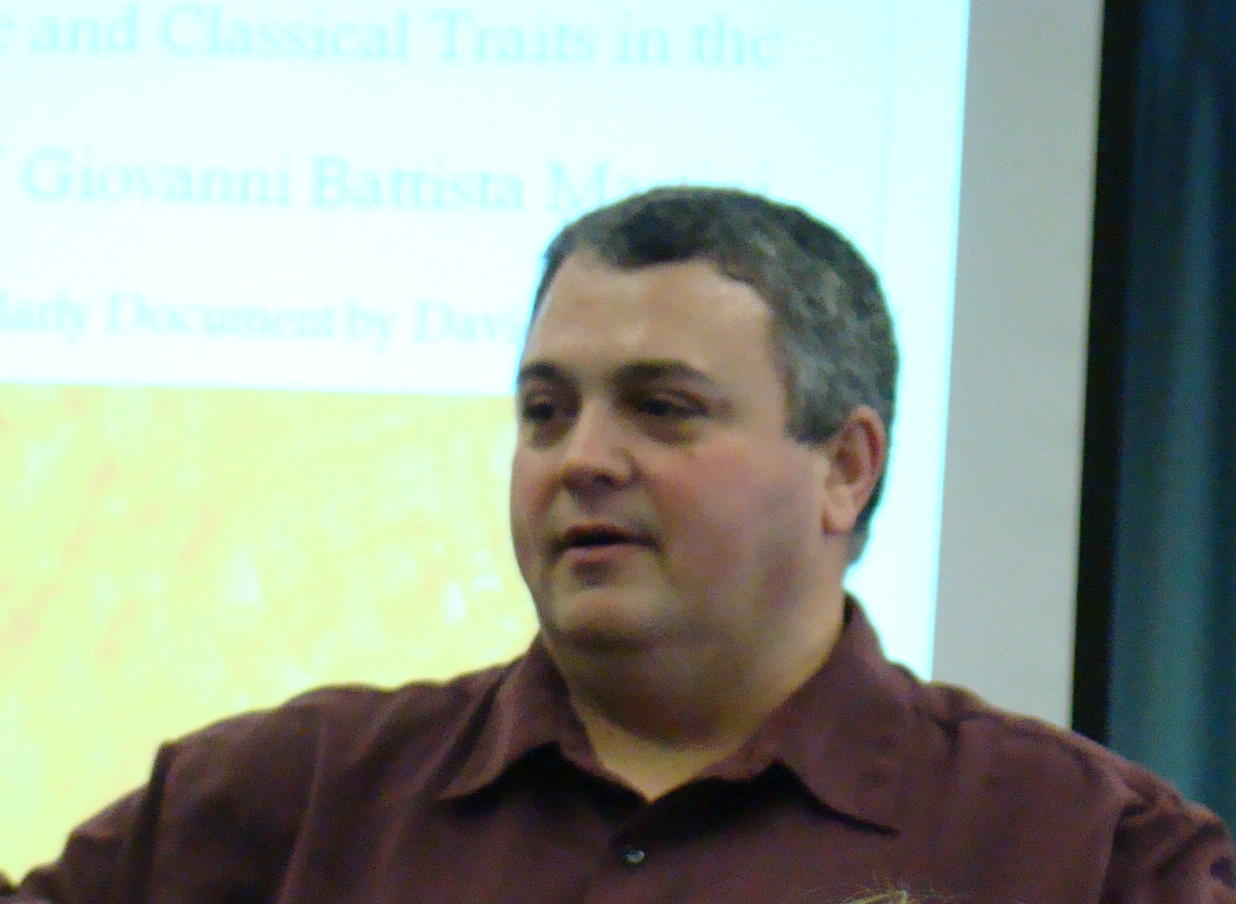
As conductor of the Muskingum University Wind Ensemble, Muskingum University Band, and Muskingum Valley Symphonic Winds plus teacher of trumpet and music education, David Turrill breathes music most of his waking hours.  His special interest exists in the Baroque period from 1600-1750.  So when it came time to select a topic for his doctoral presentation, David decided to study Giovanni Battista Martini and his passion for the Baroque trumpet.

Starting at the Natural Trumpet Making Workshop in Indiana, David and other participants assembled, pounded, and polished their original Baroque Trumpet, synonymous with Natural Trumpet. David said this was not an easy task for him as he wasn’t really very good at working with his hands. By using a slide presentation at the library, he was able to explain the day to day process. When completed, those trumpets each had a slightly different sound depending on how they were pounded out, and also on who was playing them.

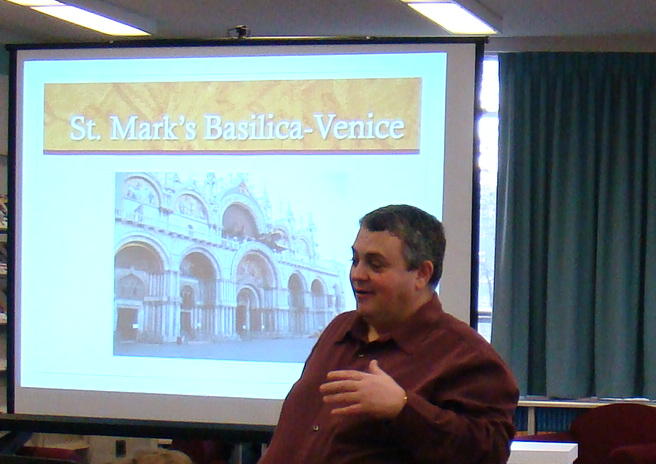
His relaxed manner had the audience laughing at his musical jokes and asking questions throughout.  He did play a selection on the Baroque Trumpet, which is very specialized and can only play in certain compositions. One of his students played a traditional trumpet to display differences. Since there are no valves on the Baroque trumpet, the mouthpiece is very special and there are bits to change keys.  David smilingly said, “Wrong notes are easier to come by!”

Many of the participants spent hours creating a glossy shine on their instruments, but David said he wanted his to look like it was played in the 1700’s so he didn’t spend time shining. Or maybe he wanted to explore other things?

Next stop, Germany, where he visited the Baroque Trumpet Shop featuring Egger trumpets, which David said were the Rolls-Royce of Trumpets.  This was just a short stop on his way to Bologna, Italy where he did his research on Martini, who was a composer of over 1500 works as well as a teacher and historian. The Martini Library at the Conservatory of Bologna was where David spent two to three hours a day looking at 280 year old manuscripts, and trying to figure out that age old question – What was the intent of the composer?

All through his research he was hoping to strike gold and find an undiscovered composition or interesting life story. But this was not to be.  However, David did feel that he struck gold when he arrived in Venice, which had been a dream spot to visit for several years. St Mark’s Basilica seemed to be one of his favorite stops. Sometimes when we dream of something, it never quite lives up to the dream. This time however, David said Venice was “beyond my wildest dreams.”

He does hope to write dissertations and journal articles in the future regarding his travel experience, as well as sharing his knowledge of the Baroque music period. This accomplished musician needs to keep on dreaming.

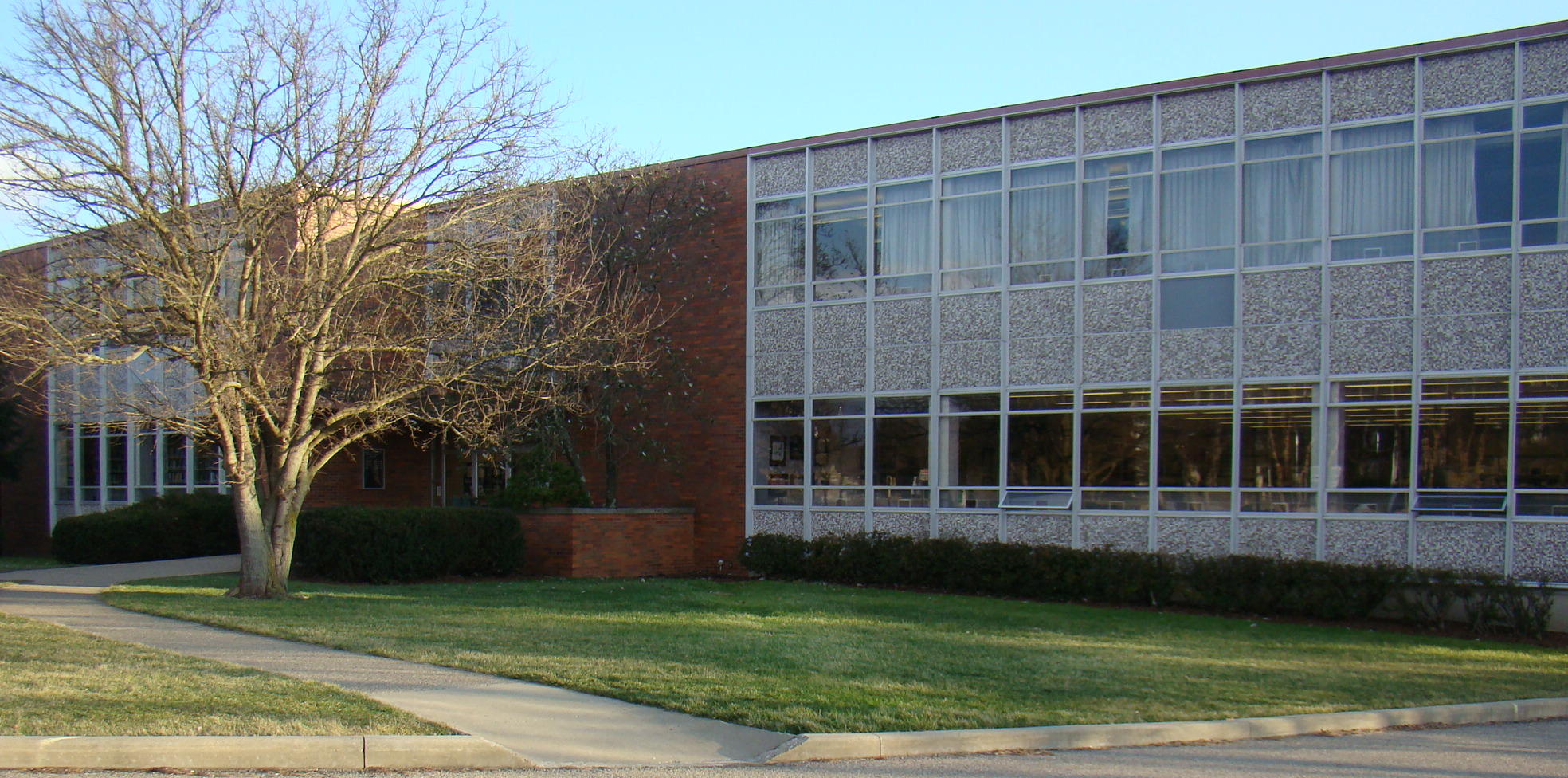
Muskingum Library is quite easy to access on the Muskingum University campus. From I-70 take Exit 169 OH 83 towards New Concord. At the traffic light turn right onto Main Street/ US 40. Turn left at the entrance gates to Muskingum University and follow the road to the top of the hill.  Turn left again and at the left end of the short street, you will find the library.  Parking is available for visitors either before you reach the library or at the side.

Six Grandfathers Mountain, now known as Mount Rushmore, was spiritual home to the Lakota Sioux Indians. Many of the Sioux were insulted by the building of the Memorial on their sacred land. Add to that the fact that the monument celebrates the Europeans, who killed so many of their tribesmen as well as appropriating their land, and it is no wonder there is still controversy between the Sioux and the US government today.

As far back at 1923, the people of the Black Hills region of South Dakota were searching for an idea to bring tourists to their part of the country. After seeing samples of carvings done by Gutzon Borglum, he was invited by historian Doane Robinson, The Father of Mount Rushmore, to the Black Hills so they could find an acceptable place for a large carving.  After dismissing the idea of using the Needles range, they settled on the granite faced Mount Rushmore near Keystone, South Dakota. The granite was relatively free of fractures, and it also faced southeast for more sun exposure. When the selection was made, sixty year old Borglum remarked, “American history shall march along that skyline.”

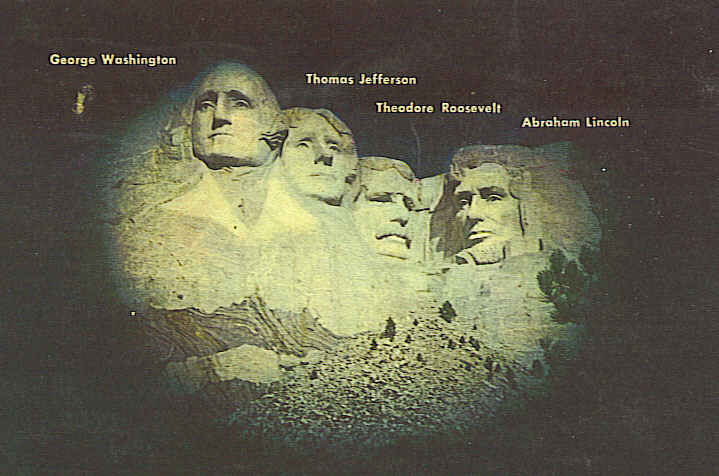
For one hour each evening, Mount Rushmore, The Presidents’ Mountain, is illuminated with steadily increasing lights that make this carving glow in brilliant splendor. The four presidential faces shown on this 1989 postcard are from left to right: George Washington, the father of our country; Thomas Jefferson, principal author of the Constitution, and instrumental in the Louisiana Purchase; Theodore Roosevelt, champion of conservation; and Abraham Lincoln, leader during the Civil War.

Today we can see the results of Gutzon Borglum’s  guidance of approximately four hundred workers, including his son,  from 1927-1941.  The four sixty foot likenesses of the faces rest on 1,278 acres. Original plans were to sculpt them down to the waists, but that idea was cancelled due to insufficient funds. Upon his death, Gutzon’s son, Lincoln Borglum, was in charge of completing the project, but he basically left it as the monument appeared upon his father’s death.

Today you can visit the Lincoln Borglum Museum where a film provides an introduction to the memorial site plus historic exhibits.  Take a lunch break at Carvers’  Cafe where you might find on the menu tasty dishes such as Jeffersonian Gourmet Salad or Teddy’s Bison Chili. If you are lucky, you can sit at a table by the large wall of windows, which provides a great view of Mount Rushmore. The Sculptor’s Studio displays the unique plaster models used prior to sculpting on the mountain side, as well as the tools used while carving. A recent addition is the Native American Heritage Village devoted to Indian culture and the Indians’ place in local history.

For another close-up view of the mountain, take the scenic chairlift ride through the Ponderosa pines. Views are spectacular and there is a park at the summit as well as a small outdoor grille.  You must be careful getting on and off as the chairlift stops for no one.  You do get a unique view of the presidential faces as well as enjoying the feeling of flying up the mountainside on the chairlift. Coming down you can either return on the chairlift or descend on the Alpine Slide.  This new slide is 2000 feet long and you are able to control the speed downhill on a wheeled sled with brakes. So it is up to you!  Either take a slow and leisurely ride down, or get a rush of excitement.

On the side of the mountain behind the faces is an interesting tunnel called the Hall of Records. In 1998, they began construction of a vault there that would hold sixteen porcelain enamel panels.  On these panels are: text of The Declaration of Independence, Constitution, biographies of the four presidents, and a short history of the United States.  All this is being done to preserve our present history for future generations. At this time, the Hall of Records is not accessible to the public.

Here at Mount Rushmore, you and your family can have a great educational experience by learning about the Indian heritage as well as the significance of the four faces carved there. Leaving the park, there was an interesting view from the back road where it appeared that George Washington was keeping watch on everything with eyes eleven feet across. The pupils of each eye are made of granite so they appear to twinkle when the sun hits them.  Maybe that is the reason the eyes seem to follow you!  Join the nearly three million people who visit here each year to see the faces march along the skyline.

Mount Rushmore Memorial in western South Dakota can easily be reached off I-90 off Exit 57 to Highway 16, which goes to Keystone. At Keystone take Highway 244 to the Mount Rushmore entrance. 

White Waves of Desert Sand

White Sand as far as the eye can see!  Beautiful waves and dunes of sand cover 275 square miles of land near Alamogordo, New Mexico. Approaching from Cloudcroft, a mountain village with an altitude of about 10,000 feet, the view of White Sands in the distance with a mountain background was spectacular.

Surrounded by military installations, White Sands National Monument, the largest gypsum sand dune field in the world, was an unusual environment to explore. White Sands Missile Range surrounds the place and was where the first atomic bomb was detonated. Holloman Air Force Base was just east of here and a few miles farther on you will find a landing site for space shuttles.A couple times a week, traffic will be stopped for a few hours as test missiles are being shot overhead. This is truly an interesting place for those interested in space travel, as in nearby Alamogordo you can find the International Space Hall of Fame.

Reaching White Sands National Monument, first stop is the Visitors Center, which was a 1938 WPA project constructed of adobe in Spanish pueblo style. Adobe bricks are usually sixteen inches long, ten inches wide, and four inches thick so this is a solid building which has stood the test of time. Two men would work all day to form about a hundred bricks. Set in a landscape of native plants, this is truly a Welcome Center to the area.

Outside it is time to explore. Don’t forget your water bottle because if the sun shines, this can be a very hot desert scene.  This is an especially unusual scene as gypsum is seldom found in the form of sand. But located here in a basin, the white gypsum  is captured, because there is no outlet to the sea. The dunes are constantly changing shapes as tiny grains of sand are blown into ripples across the vast white desert. This area, with shelters inspired by Frank Lloyd Wright, makes a great place for a rest, or to watch the antics of others on the dunes.

You will probably want to take a leisurely drive through the White Sands area, just to get the feel of things. There was a paved road for a couple of miles, and then you were on your own, to decide if you wanted to venture off driving on the gypsum highway through the hills of sand.

There were also a couple of walking trails – one mile-long path through the sand and another an actual boardwalk. Climbing to the top of one of these large dunes is a challenge and fun.  But this is one place where coming down is the hard part! Children have the right idea here as they use saucers or cardboard and slide down the dunes, resembling what a youngster would do with a sled in the snow.

Animals lived in this ocean of white sand in an evolved state as they became part of their environment and were thus camouflaged against the white desert scene. Salamanders, spiders and the Bleached Earless Lizard were white…just like the sand.

Drive, hike, walk the boardwalk, or go sledding!  So many options! But definitely an unusual place to enjoy the beauty that nature provides, including beautiful sunsets.

White Sands National Monument is in southern New Mexico along U.S. Highway 70, which can be reached off I-25 from Las Cruces or off U.S. Highway 54 from Alamogordo. Personally think the approach over the Sacramento Mountains on U.S. Highway 82 gives a great overview. Remember the roads may be closed at times for missile testing with a possible wait of several hours.

Way Down South – Key West

“Cayo Hueso” – Spanish for “Bone Island” – was the original name for Key West because of all the skeletons found on the beaches during the days of pirates and sunken treasures. This is the southernmost city in the continental United States with Cuba just 90 miles away! With the Atlantic Ocean connecting with the Gulf of Mexico on its shores, the sunsets here are spectacular and always accompanied by a gentle breeze.

Just getting here is an adventure as you travel across forty two bridges through the Keys on US Highway 1, the Overseas Highway. The route is only 113 miles from the southern mainland of Florida to Key West with the longest bridge being seven miles long.  All the way you are surrounded by tropical beauty and aquamarine waters. You see the coves where pirates landed long ago, and where drug smugglers currently hide their stash.

The highway here is actually built on the original route of the Overseas Railroad, which was constructed by Henry Flagler back in 1912. When the railroad and its bridges were destroyed in a hurricane in 1935, it was rebuilt and reopened as a highway in 1940.

Ernest Hemingway, John James Audubon and Harry S Truman all were frequent visitors here. The Hemingway house is one of the favorite stops and has a relaxing garden, which is a photographer’s dream. Nobel Prize Winner  Ernest Hemingway called the island home for ten years and found solace here along the turquoise waters. Be sure to look for the 40-50 six-toed cats that are descendants of Hemingway’s favorite tomcat, Snowball. Did seem fitting to take home one of his books, so selected his final work published during his lifetime, which not surprisingly had an ocean theme, Old Man and the Sea.

Conch Tour Train gives a guided tour of the island and even makes a stop at Sloppy Joe’s, the most famous bar in Key West. Opened in 1933, the day after Prohibition was repealed, owner Joe Russell had previously operated an illegal speakeasy. Hemingway and his “Mob” of literary cohorts were regular customers, who philosophized and drank the days away.  Today the bar is filled with historic memorabilia dating back to the days when Hemingway – known as Papa – stopped in for a drink with one of his best friends, Joe Russell – known as Sloppy Joe.

Heritage House Museum, the historic Porter family home, gives visitors a taste of the pirate folklore and island life. Built in 1834, this is one of the oldest houses on the island where Jessie Porter established a creativity haven for many famous artists and writers.  The Robert Frost winter cottage in the garden has a beautiful orchid collection. Each year the Robert Frost Poetry Festival is held at this site to promote Key West as a literary destination.

Sunset Pier on the Gulf Coast of Florida is the best seat in the house for the fantastic sunsets of Key West. Here at the Sunset Celebration you watch the sun sink into the Gulf of Mexico while the streets are filled with arts and crafts exhibits, entertainers, psychics, and of course, food!

As poet Wallace Stevens once wrote: Key West is the real thing – the sweetest doing nothing contrived.

Key West, Florida can be reached by crossing all the bridges through The Keys down US Highway 1 to its very end. It is the only highway going that direction so there is no possibility of getting lost.  Enjoy the journey!

Spirit of Christmas seems to be a fitting name for a ride on the Byesville Scenic Railway, because after you hear the stories of the miners from long ago, you will definitely appreciate the Christmas of today.

Accompanied on this trip by Miner Dave and Miner Steve, the hour train ride passed by twelve abandoned mines where about five hundred men worked underground.  However, in the area there were seventy seven deep coal mines with approximately five thousand men working.

The train track here was busy back in the early 1900’s with perhaps one hundred fifty trains going down the tracks on a busy day.  Their regular routes went from Marietta to Cleveland, but they went North as far as Canada.

Since it was the Christmas season, Miner Dave asked if there were any teachers on board. Then he selected a lady to read “The Night Before Christmas” as the train went down the track.  Miner Dave did appropriate sound effects as well as scene effects behind her back, which made for an amusing reading.

Young people are remembered in the mines as children often started working at the age of eight, with their parents’ consent, especially if the father had been injured. Someone had to work to pay their $12 a month rent as otherwise their family would have no place to live.

They did indeed, as Tennessee Ernie sang, “Owe my soul to the company’s store.”   They were paid in tokens that could only be spent at the company store.  So if the family needed an item, they would charge it there, then the man of the family would pay for it on payday.

Miner Dave explained that only men worked in the mines as it was thought that women would bring bad luck. They worked about 175 days out of the year. There was no welfare in those days, so they had to use credit…at the company store. For this most dangerous job in the world, there was no insurance and no vacation. There were definitely no atheists working in the mines.  They all believed that someone was watching over them.

How did you know if you were to work each day? At 7:15 each evening, everyone would listen for the whistle at the mine. If it blew once, there would be work tomorrow; twice, maybe and listen again at 4:15 in the morning; three times, no work the next day.

All nationalities headed out to work swinging their dinner pail. The pails could not be set down on the mine floor or the rats would open them and eat their dinner.  So miners always hung their dinner pails high on the mine wall. A sandwich made of West Virginia Ham was quite a treat – that ham, by the way,  was bologna. They always left a little something in their pail, just in case there was a cave in and they might be below ground all night. If they made if safely through the day, the miners would let the children have their pails on the way home and enjoy a little snack.

On Christmas Eve a hundred years ago, the mines would close early for the day at 4:30. Since there was no money for gifts, a stop at the company store might allow them to get an orange or some walnuts for the children. Often they would break a limb off a tree and either stick it in a can or in holes in the handle of a broom. This they would decorate with rags, bittersweet, popcorn, ribbon or berries.

Everyone would go to sleep early that night and be up to go to church on Christmas Day in their cleanest bib overalls. When they arrived back home, there would be one or two gifts under the tree. Gifts were often wrapped in newspaper, and then tied with rags and decorated with sprigs of berries.  Most were gifts made with love, and all Made in America.

Byesville is the coal mining capital of Ohio and their plans are to erect a monument to the coal miner at their station in downtown Byesville. When you give a donation, you are given a badge that explains the mining story.

The colors on the badge are symbolic of life down in the coal mines.

Yellow stands for a beam of sunshine that sheds light on the darkness of the dungeon of a  dark and gray mine.

Gray is for the rock/slate layers that are found above and below the seams of coal.

Black needs little explanation as it is the color of coal, also know as black diamonds, buried sunshine, or rocks that burn.

Red is for the color of blood that was spilled onto the ground from those who either lost their lives or were injured while working about the mines.

Someday soon the Coal Miners’ Memorial Statue Fund will reach its goal and the efforts of all the workers and their families will be recognized.  Coal miners helped make our country what it is today and will never be forgotten.

Now you better understand why the Spirit of Christmas should be alive in your heart today and all through the year. Charles Dickens expressed this in A Christmas Carol when  Scrooge said:

I will honor Christmas in my heart

and try to keep it all the year

May the Spirit of Christmas roll on!

Byesville Scenic Railway is located in Byesville, Ohio just off I-77 (Exit 41) South of Cambridge. Turn toward Main Street of Byesville, then left at the traffic light.  The train depot is one block on the right. Free parking is available along Second Street and Seneca Avenue. The train operates most weekends during the summer months as well as for special holidays throughout the year.

Hey Mon, No Problem! That seemed to be the phrase heard most often on the island of Jamaica in the Caribbean Sea.  Relaxation appeared to be the key there, as no one was in a hurry.

Landing in Montego Bay, the largest and busiest airport on the island, the country travelers learned that it was necessary to have an actual destination, in other words a reserved place to stay, before being cleared through customs. Sleeping on the beach was not acceptable!  Seemed rather convenient, that someone working at the airport, just happened to have a cousin with a Guest House available.  While we waited to be wisked away to our island retreat, the welcome center greeted passengers with rum, one of the island’s tasty drinks.  Perhaps that was the reason they are so relaxed!  No Problem!

Traveling to the Guest House, a young Jamaican boy raced alongside the car trying to sell sticks of sugar cane. Another one shouted, “Ganja, No Problems,” as they attempted to sell marijuana, which is said to be used by sixty to seventy percent of their rural population. This Jamaican grass can either be smoked, or boiled to produce ganja tea. These young people seem to have no problem keeping up with traffic as they run beside the cars. Maybe this early training is a reason for the fastest man in the world being from Jamaica.  Usain Bolt, from nearby Trelawny, can run about 28 mph!

Staying with the people of the island gives one a different perspective of life on Jamaica vs staying at a resort there. The house had no traditional doors or windows, just screens, and no air conditioning, just fans since here it is summer year round.  For a snack, you could go into the yard and pick fresh fruit from the trees, while breakfast was a delectable combination of fresh fish and fruit.

After renting a car the next day to travel this island, which is approximately 145 miles long and 50 miles wide, headed to a beautiful beach in Ocho Rios, where they believe Christopher Columbus  first set foot on land in the New World.  Close by was the famous Dunn’s River Falls, a 600 foot cliff to the sea, which is the most popular tourist attraction in Ocho Rios. Here you could carefully climb up this cascading challenge one steppingstone at a time.  Since it was quite slippery from the pulsating flow, most people took a fall or two but that was expected, and the reason for wearing a swim suit.

Another great adventure was a ride down nearby Martha Brae River guided by a local storyteller, Tony, from Martha Brae Rafter’s Village. Passengers drifted on a thirty foot bamboo raft down the same route taken by Martha Brae, an Indian maiden legend, who supposedly knew the secret location of a gold mine on the island. When asked to share that secret with the Spanish, she took them down this river and disappeared while going through a cave. Then using her magic, she created a change in the weather, which upset their raft causing the Spanish explorers to drown.

Also interesting were Tony’s tales of the trees and plants that grew along the river.  All seemed to have a medicinal purpose from curing poison ivy to a cold. While he was talking, the guide used a long thin knife and carved a dried calabash shell with designs of fish and flowers… and even put my name on it. Of course, carving names in objects was one of their methods of better insuring that passengers would purchase the item. Upon disembarking, guests could stroll through Miss Martha’s Herb Garden and Gift Shop and purchase many of the herbs mentioned on the rafting experience.

One early morning rode a minibus to the other side of the island to Kingston, the capital and largest city of this independent Commonwealth where Queen Elizabeth II is still called Queen by tradition. The ride was a real cultural experience as the bus, designed to hold about thirty, crowded in nearly fifty. Since there was no air conditioning on the ride, tourists, especially, experienced more than a little local flavor.  People were actually hanging out the windows as the driver drove faster than necessary through the Blue Mountains. These mountains were called Gold Mountains by the locals as here they grew supplies of marijuana, which was their biggest crop.

Shopping in Ocho Rios was a treat as there were little craft shops along the streets with polite sellers, who were very persistent and always willing to bargain. These rough looking establishments held some nice quality handmade clothing and jewelry. Actually purchased a dress from the shop pictured here that was worn for several years.

Anytime you want a relaxing getaway, Jamaica might be the place to explore. Want to enjoy the good vibrations of reggae music? No Problem!

Jamaica is an island in the Caribbean Sea located south of the tip of Florida and approximately 90 miles south of Cuba.  You can reach the island by plane or cruise ship. Most planes fly into Montego Bay, while cruise ships dock at either Ocho Rios, Montego Bay, and just recently a port was opened at Trelawny.

Catch the Spirit of Christmas! Step back in time and visit the Dickens Victorian Village in downtown Cambridge, Ohio from November thru January 8, 2012. As you walk the streets, you will be greeted by volunteers in Victorian dress, sometimes entertained by strolling musicians, and on the weekends can see the lighted carriages giving visitors a relaxing ride.  It is a friendly town where you feel welcome and hear ” Merry Christmas” quite often.

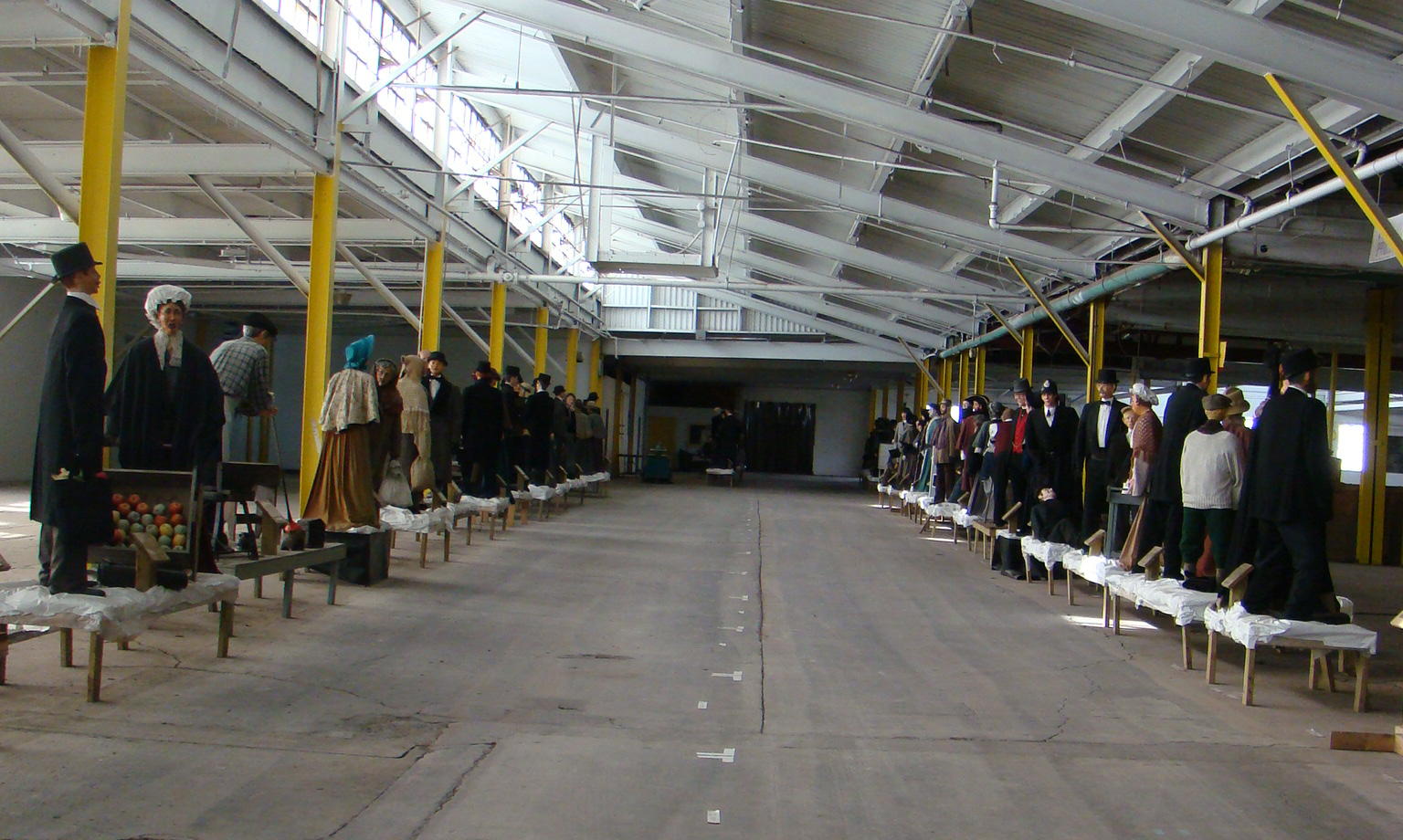
Nearly two hundred life sized mannequins can be found either on the main street, Wheeling Avenue, or in close by businesses and towns. Let’s meet a few of the mannequins, so you can hear their stories of how they came to be part of the Dickens experience.

“Father Christmas” was one of the first characters assembled back in 2005 when local businessman, Bob Ley and his wife Sue were inspired on a trip to Oglebay Park to bring visitors to their town for a winter vacation.  Bob and Sue discussed several ideas but the decision was finally made when Sue suggested an English Christmas theme would be a good choice. Since they lived in Cambridge with Victorian architecture, street lamps, and even benches along the street, English roots ran deep. Thus blossomed the idea of using a theme developed from Charles Dickens’ Christmas Carol. Today Father Christmas stands on the courthouse square greeting cars and buses from three directions. In his bright green cloak of Victorian times, Father Christmas typifies the spirit of good cheer at Christmastime… and you will definitely find lots of good cheer at Dickens Victorian Village.

“Glass Blower at Work” symbolizes the rich heritage in the Cambridge area of artisans who produced quality hand made glass and is a special favorite since my father was a glass blower at Cambridge Glass Co. This was a major employer in the area from 1902-1958 and their glassware is a collector’s item today. A frequent bus stop during tours of the city includes the National Museum of Cambridge Glass where you can still see samples of the beautiful etchings and unique designs, which made these glass creations very fashionable to use for a special occasion. Today descendants of former Cambridge Glass workers still have a few small shops in the area. Boyd Crystal Art Glass, Mosser Glass, and Variety Glass all continue to produce handmade pieces today.

The ShopkeeperYe Olde Curiosity Shoppe is headquarters of Dickens Welcome Center and here you are greeted by “The Shopkeeper,” and quite often beside her you will find the lady who it was created to resemble after she won the first Picture Your Face Raffle. Visitors sometimes say, “Is she real, or is she a mannequin?” Raffle tickets are sold each year and the winners become mannequins in the future.   The Welcome Center’s Imagination Station provides an opportunity for visitors to try on Victorian wear. Then they can have their pictures taken with the beautiful Christmas tree, Charles Dickens, or the new addition this year of the Duke and Duchess of Cambridge mannequins, which resemble Prince William and Kate. This is fun for young and old alike. Here you will also find many unusual Christmas gifts and ideas.

Not all of the mannequins are downtown. In neighboring Byesville, the “Coal Miners” can be found under the station roof of the Byesville Scenic Railway. This is another popular destination with its “Spirit of Christmas” train, which follows a trail over abandoned mines. While on board, men dressed as miners tell stories of days when coal mining was king in this area.  To remember all those who worked in the mines, a statue, “Coal Miners Memorial”, is in the planning stages and will be the only statue to honor coal miners in the state of Ohio. The mines are out of sight, the tipples gone, but the miners are still in the minds and hearts of families and friends.

When evening falls, everyone heads to the Cambridge Courthouse for a spectacular light show. Christmas music and the movement of the lights on the courthouse are synchronized perfectly and enjoyed by all. The display is computer controlled with 60,000 lights and 364 electrical circuits. Four different light shows entertain the packed courthouse square with traditional Christmas songs as well as children’s and contemporary. Add a little snow and it’s a perfect evening!

Introductions have been made to a few mannequins just to get your curiosity aroused, but you need to tour the area to see which one might be your favorite. Dickens Victorian Village welcomes individuals and tour buses to experience the special feeling of Christmas that lives in downtown Cambridge, Ohio.

As one recent visitor remarked, “If you don’t have the Spirit of Christmas when you come here, you certainly should have it when you leave.”

Dickens Victorian Village is located in downtown Cambridge, Ohio, which is just northwest of the intersection of I-70 and I-77. Come spend the day or stay the night, and catch the Spirit of Christmas.

UFO or Weather Balloon? When people hear Roswell, they immediately think of the 1947 UFO alien invasion,  a subject which still interests many people. But there is definitely much more to this town of Roswell, New Mexico than aliens!

As soon as you enter the town, the presence of the New Mexico Military Institute is obvious from the beautiful campus to the polite, young cadets walking the streets. Started in 1891, this four year high school and two year junior college has been the starting point for many officers in the US military, as it is the only state supported military institute in the western United States. Among its most notable graduates are Conrad Hilton, Roger Staubach, Sam Donaldson and Major General Edwin Walker. In 1921, the school adopted the honor code of : “A cadet will not lie, cheat, or steal, nor tolerate those who do.” That code is still enforced today.

During WWII, a prisoner of war camp was located in nearby Orchard Park. These German prisoners assisted with many construction projects in Roswell.   Along the banks of the North Spring River, the sides were paved with stones. In one section the stones were strategically placed to form the outline of an Iron Cross, symbol of the German Army. Nearby was a piece of the Berlin Wall, which was sent by the German Air Force for their nice treatment as POW’s there. Today at the POW/MIA Park, there is a relaxing walkway along the river where you can appreciate the hard work involved and the beauty that they created.

The Roswell Museum and Art Center has many beautiful and unusual paintings by well known artists such as Peter Hurd, Henriette Wyeth, and Georgia O’Keeffe. Of special interest here is the Goddard Wing, which contains a reproduction of the workshop of liquid-fueled rocket pioneer, Robert Goddard. He tested prototypes of this fuel in Roswell from 1930-1941.  While there, noticed this Native American sun design at the gift shop, and now it often hangs in my car to bring a feeling of warmth and peace. Still makes me smile to realize that this beautiful sun is made from the bottom of a Coca Cola can!

Of course, no visit there would be complete without visiting the International UFO Museum and Research Center, and taking a trip to the site where the mysterious crash occurred. Here at the Museum you can find information about the Roswell incident, crop circles, UFO sightings, ancient astronauts, and Area 51. Living up to their motto, “The truth is here,” their library of books and films is a great place for the curious and the serious to explore the unexplainable.

One interesting film told the story of a young boy, who had seen inside a space ship in 1947 and told his parents he saw fine wires with colors flashing.  In the 1990’s, this now adult man worked in maintenance and was called into a phone room for repair work.  He exclaimed, “That looks just like the spaceship I was in!”  Fiber-optics!

Responsible citizens who witnessed the crash were very quiet about it until their retirement. Once they told their story, tourists began to visit to learn more about the possibilities. The event known as the Roswell incident: the crash of an alleged flying saucer, the collection of debris and bodies, and the ensuing military coverup, still leaves lots of questions unanswered. The debate continues to this day.

Many local businesses have joined in with the UFO theme as Roswell has suffered a tough economic time, especially after the closing of Walker Air Force Base there. Local gas stations have aliens pumping gas, Wal-Mart has an Aliens’ Welcome sign, and now McDonald’s has built a theme park restaurant there. Yes, you guessed it, McDonald’s is shaped like a UFO with aliens in the play area.

Roswell even has its own small zoo, which is a great place to take a daily walk with the animals. Spring River Park and Zoo is a free zoo run by volunteers and local donations, and has a wide variety of animals from prairie dogs to buffalo and even a black bear. For only a quarter, children, or the young at heart, can ride the miniature train ride or the antique wooden carousel. This is one of about a hundred wooden carousels left in the country and features hand-carved horses.

All ages are sure to find something to enjoy while visiting Roswell… but watch out for those little green men peeking around the corner.

Roswell is located South of I-40 on US 385 or East of I-25 on US Highway 380 in the southeastern  corner of New Mexico. US 380 is also Main Street  and there is a handy information center near the Roswell Museum and Art Center.

Navajo Blessing
We walk in our moccasins upon the Earth
and beneath the sky
As we travel on life’s path of beauty
We will live a good life and reach old age.

Many American Indians still enjoy life in the Southwest,  and some call Canyon de Chelly (pronounced day Shay) home. Chelly is a slightly modified Navajo word Tseyi, meaning canyon or literally, under the rock.

Located in northeastern Arizona, Canyon de Chelly is completely located within the Navajo nation’s boundaries. Navajo Indians live and work here today among the red rock cliffs with ancient dwellings along their faces and lush valleys below.

Right at the edge of the South Rim parking lot, several wild horses that frequent the area, grazed on the sparse grass. This beautiful scenic drive takes about three hours so be certain that you have plenty of drinking water. There are trails to the bottom but you must be escorted by a guide from the Navajo tribe on all trails except the one leading to the White House Ruins.

One of the spectacular points along the rim trail is Spider Rock, twin sandstone spires with the tallest being 800 feet high. Traditional Navajo believe the taller of the two spires is home to Spider Grandmother. Spider Rock is considered sacred to the Navajo and is associated with Spider Woman, who taught the Navajo how to weave on a loom which Spider Man told them how to make.  Spider Woman also is the enforcer of obedience in children. Part of a Navajo chant heard there still remains in my mind today: With beauty in Nature, I walk.

Another highlight in the area is White House Ruins, which are remains in a sandstone cave of adobe dwellings from a previous culture.  They are believed to have been constructed by Anasazi people “the Ancient Ones”.  There was a time when you could roam up into the cave and walk where the Anasazi walked. But today it is fenced off due to tourists taking bits for souvenirs and thus destroying the historic value of the spot.

At the information center, the Navajo Indians have a beautiful gift shop with handmade Indian crafts. While visiting there talked with Gary Henry and his brother Teddy, Navajo jewelry craftsmen, and their sister Winnie, who leads many of the tours and weaves beautiful blankets.

The beautiful but tough sister, Winnie,  says that weaving is “to weave together the pieces of your own life.” Weaving is her special art given by Spider Woman’s spiritual touch.  Her mother told her, “If you know who you are, where you come from, and where you are going, you will never get lost in this world.” Winnie will tell you that her culture and religion live within her and will never come out.

Gary designed this beautiful two-sided necklace of native stones in a bear claw design – my treasure for this adventure. He grew up in Canyon de Chelly, running up and down the trails as a child. They lived in a hogan, a traditional Navajo dwelling, and their family raised sheep. At that time there was no water or electricity in the canyon, so meals were cooked over a fire, and the evening was spent listening to stories and playing their music.

Canyon de Chelly is a spiritual place where the soul responds to the beauty of nature, which abounds. When we leave, they say Hagona, which means “see you again”. To walk in beauty and die naturally of old age is the Navajo notion of the good life. Hozona h’astleen! May everything go well!

Canyon de Chelly is located in northeastern Arizona.  Take Route 191 to Chinle, Arizona and the Canyon is directly east of town. From the Visitors Center you have a choice of the North Rim Drive or South Rim Drive.  Each drive takes about three hours to complete.