Places to go and things to see by Gypsy Bev

Posts tagged ‘Ohio River’

Down the Ohio River with Charles Dickens

messenger

The steamboat Messenger carried the Dickens party down the Ohio River from Pittsburgh to Cincinnati.

A fine broad river always, but in some parts much wider than in others, and then there is usually a green island, covered with trees, dividing it into two streams.”

In 1842 at the age of 30, Charles Dickens made his first visit to America with his wife Kate, her maid Anne Brown, and Charles’ traveling secretary George Putnam. As part of their tour, the group boarded the steamboat Messenger in Pittsburgh to flow down the Ohio River to Cincinnati – a three day tour.

The Messenger held some forty passengers on board, exclusive of the poorer persons on the lower deck. Dickens wondered that its construction would make any journey safe with the great body of fire that rages and roars beneath the frail pile of painted wood.

As expected, he wrote in his journal daily while traveling, giving us a picture now, of what he saw on that trip long ago. Most of the time he wrote on his knee in their small cabin at the back of the boat. He felt lucky to have a cabin in the stern, because it was known that ‘steamboats generally blew up forward’.

ohio-river-diorama

This diorama from the National Road/Zane Grey Museum shows a scene at Wheeling that DIckens described of goods being loaded and unloaded.

Coming from the crowded city of London, this wilderness must have appeared strange with trees everywhere and cabins sparsely populating the banks along the river. For miles and miles the banks were unbroken by any sign of human life or trace of human footsteps.

Meal time was not pleasing for him as lively conversation was lacking. Each ‘creature’ would empty his trough as quickly as possible, then slink away. A jest would have been a crime and a smile would have faded into a grinning horror.

I never in my life did see such listless, heavy dullness as brooded over these meals. And was as glad to escape again as if it had been a penance or a punishment.
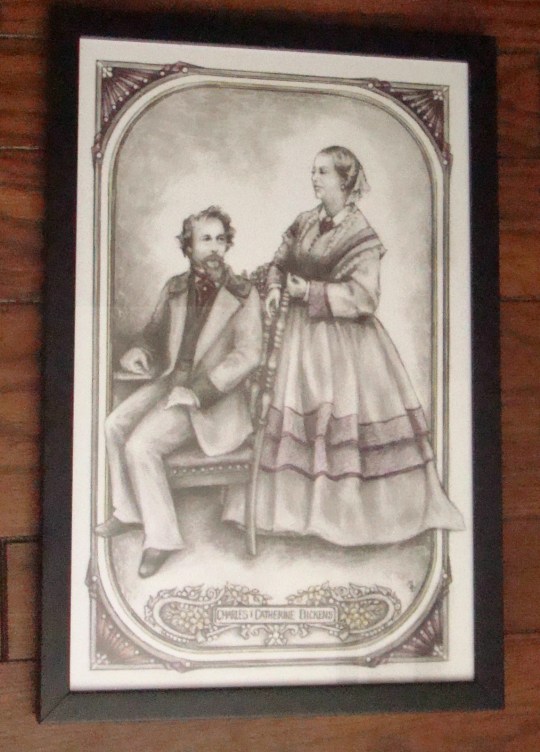
charles-and-kate

Charles and Kate Dickens came to America in 1842. This is a pencil sketch by a very dear friend, the late Mary Ruth Duff.

After the meals, men would stand around the stove without saying a word, but spitting, which was a bad manner Dickens deplored. Therefore, Charles and Kate spent much of the time sitting on the gallery outside their cabin. His description of the only disturbance outside was in true Dickens style:

Nor is anything seen to move about them but the blue jay, whose colour is so bright, and yet so delicate, that it looks like a flying flower.
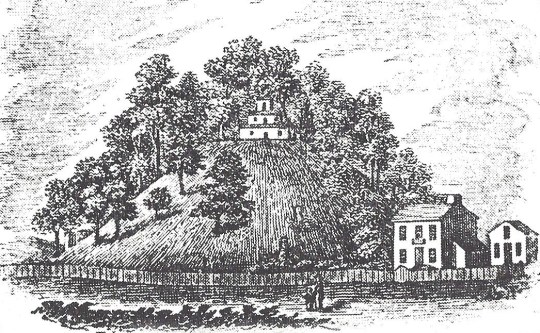
mound-by-henry-howe-001

This sketch by Henry Howe in 1843 shows the mound Dickens described in his journal.

He noted that the steamboat whistle was loud enough to awaken the Indians, who lie buried in a great mound, so old that oaks and other forest trees had stuck their roots into its earth. The Ohio River sparkled as it passed the place these extinct tribes lived hundreds of years ago.

Evening steals slowly upon the landscape, when we stop to set some emigrants ashore, five men, as many women, and a little girl. All their worldly goods are a bag, a large chest and an old chair.

Those emigrants were landed at the foot of a large bank, where several log cabins could be seen on the summit, which could be reached by a long winding path. Charles Dickens watched them until they became specks, lingering on the bank with the old woman sitting in the chair and all the rest about her.

dickens-children

They carried this picture of their children – Katey, Walter, Charlie, and Mamie – when they came to America in 1842. As time passed, they had ten children.

When he reached Cincinnati, a booming frontier river town, Dickens viewed it as a beautiful city: cheerful, thriving and animated. He was quite charmed with the appearance of the town and its free schools, as education of children was always a priority for Charles Dickens. Here he could actually find people to engage in conversation.

While his first trip was a disappointment in many ways,in the 1850s, he was encouraged to make another trip to America to extend his popular England reading tour to audiences there. He was told  would be lots of money to be made in the United States.

But the outbreak of the Civil War, caused him to put those plans on hold. When the war was over, he again received encouragement to visit this New World. Despite his ill health and caution from his closest friends, Charles Dickens wrote a seven point “Case in a Nutshell” describing why he should visit America.

Once decided, he arrived in Boston on November 19, 1867. Even though his health was failing, Dickens never canceled a performance.

No man has a right to break an engagement with the public if he were able to be out of bed.

He stayed for five months and gave 76 performances for which he earned an incredible $228,000, helping to give him a much better view of the United States on his second trip. The country had much improved during those twenty-five years in his estimation.

How astounded I have been by the amazing changes I have seen all around me on every side – changes moral, changes physical, changes in the amount of land subdued and peopled.
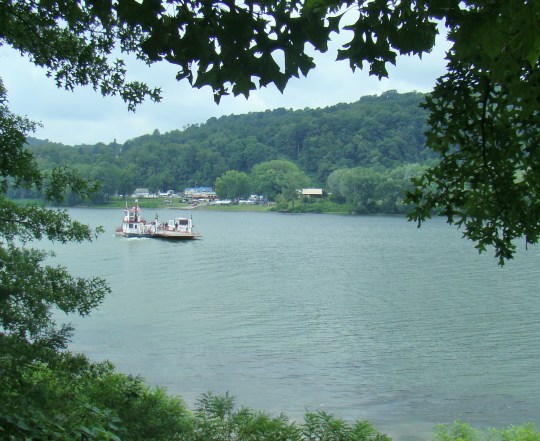
fly-ferry

The Ohio River is a peaceful place to let your imagination flow.

The next time you visit the banks of the Ohio River, find a secluded spot and imagine what it must have been like when Charles Dickens viewed it in 1842.

Words in italics are Charles Dickens words from his journal “American Notes”, 1842 with the exception of the last one, which was of course written after his second trip.
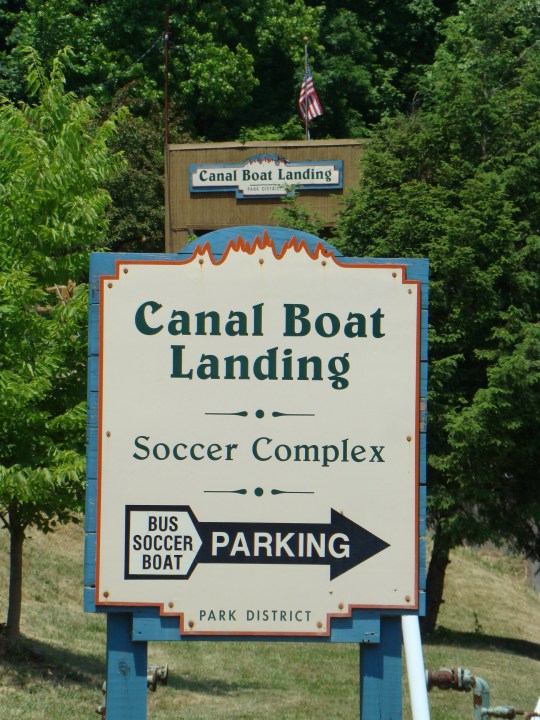


Drift Along on the Monticello III Canal Boat at Roscoe Village


Monticello sign

Look for this sign off Route 83 near Coshocton to find the Canal Boat Landing.

The smoothest ride you’ve ever had!

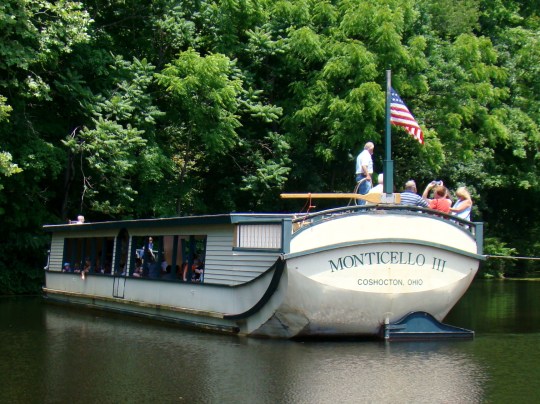
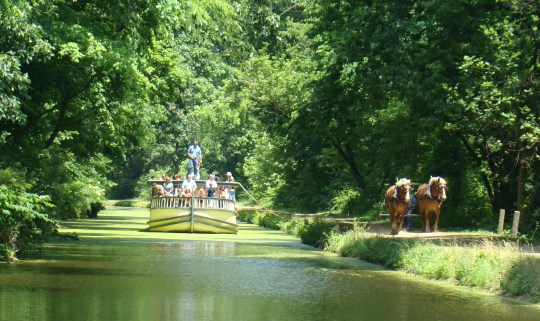
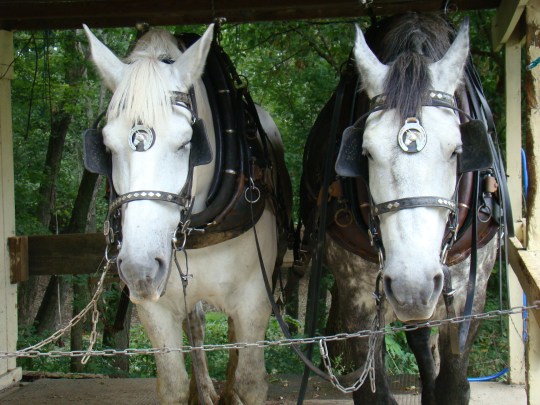
That describes the trip along the restored Ohio-Erie Canal near Roscoe Village. Two horses, Rock and Bill, slowly walk the original tow path as they gently pull a replica of the canal boats that traveled this same route in the early 1800s. Sit back and relax on this forty minute ride while you listen to the captain tell the story of life on the canal.

Monticello horses

Bill and Rock, two huge draft horses, wait patiently in their stable.

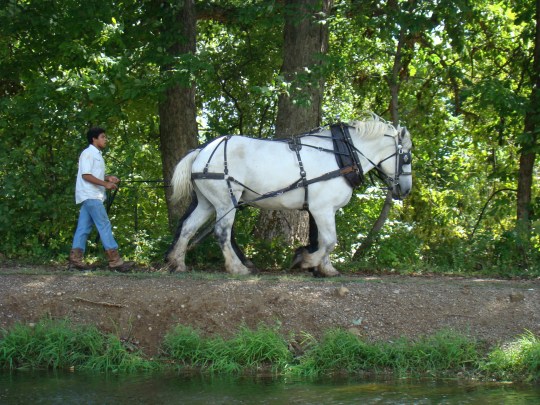
Two Percheron horses pull the Monticello III canal boat quite easily. The hoggee, or horseman, leads them along the tow path. He uses 150′ of rope to guide them as they pull with great ease this flat bottomed boat weighing twenty-five tons.

In 1803, the need for a canal was evident. They would place a boat carrying goods on the Muskingum River, and it would drift downstream to the spot in Marietta where it met the Ohio River. They had no way to get the boat back upstream, so they had to dismantle the boat and carry it piece by piece to be reassembled. The canal eliminated that problem.

Monticello hogie walks horses

The hoggee walks along the original canal towpath as he guides the horses.

Ground breaking for the canal began in 1825.The canal was built by Irish immigrants, who worked for 30 cents a day and four jiggers of whiskey. The need for whiskey came into play to avoid the condition known as canal fever.

First, the canal was dug by hand to a depth of four feet, then lined with clay to make a sturdy bottom. How did they pack the clay? With a sheep-foot roller – a herd of sheep ran over it to smooth it.

Completion occurred in 1832, seven years later. Transportation at that time gave few choices – either a stagecoach or a passenger boat. Rates for the boats were fifty cents a day, which included room and board, while stagecoach fares were typically five cents a mile.

Monticello turning

Monticello III gives a smooth ride that is certain to relax you.

Often three hundred boats traveled on the canal at one time. Passing became the real challenge as their tow ropes could easily get tangled. This intricate job fell to the hoggees, the boys who guided not only the horses, but also the tow ropes. Quite often they were teenage orphans with no other way to find food and shelter.

Former president, James Garfield, worked as a hoggee in 1847 when he was a teenager. The story was told that Garfield fell into the canal so often, he became ill. After that experience, that young man decided that college would be a better choice.

Monticello on the canal

Everyone enjoys their trip down the restored Ohio-Erie Canal.

Captains often lived in the cabin on the boats with their family. The females of the family would be the cooks and do household tasks as they traveled on the canal. All garbage and waste was thrown to the towpath side. So if the cooks needed extra water for cooking they would dip it from the side opposite the towpath.Turtle soup was a favorite treat.

Monticello mileage sign

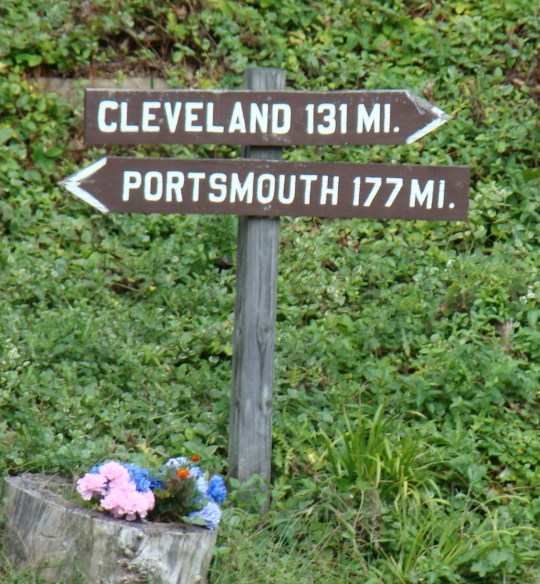
This sign at the edge of the landing tells distances from the Roscoe Port to Cleveland and Portsmouth.

As humorous as it may sound, there was a speed limit for boats on the canal to keep the banks from eroding. Four miles an hour was the limit and they were fined for speeding. Speed was determined by how long it took to get from one lock to the next.

Monticello map

This map of Ohio shows the route on the eastern side of the Ohio-Erie Canal from Cleveland to Marietta and Portsmouth.

In 1913, a major flood throughout Ohio wiped out the Erie Canal. Parts of it still exist today from Cleveland to Portsmouth. View a bit of history and take the smoothest ride imaginable at Roscoe Village sometime this summer. It’s relaxing!

The canal boat ride at Roscoe Village is seasonal from Memorial Day to Labor Day on Tuesday – Saturday at 1:00, 2:00, and 3:00 and Sunday at 1:00 and 2:00.

Earth Healing Ceremony

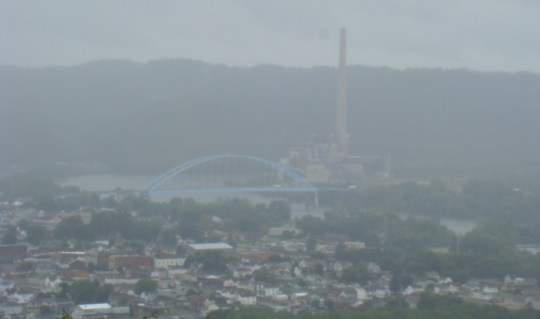
Fog over Ohio RiverOn a rainy day at Grand Vue Park near Moundsville, WV, fog hung in the air making the valley below seem mystical. Through the mist you could see the bridge over the Ohio River. A celebration of our connection to the sacredness of earth was the focus of this Earth Healing and Water Blessing Day, but it seemed the rain had already performed the Water Blessing part.
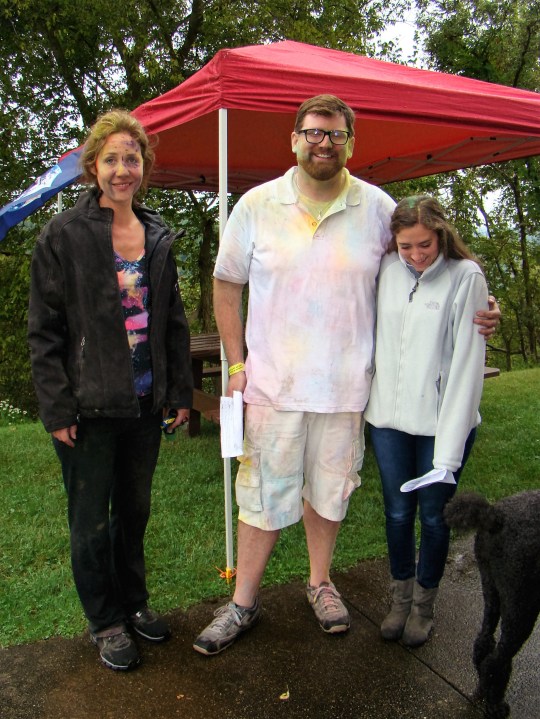
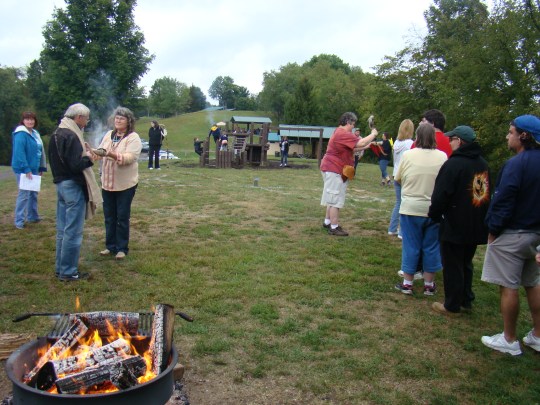
Amanda DeShong and Mick Burk conducted the ceremony in a shelter at the park with help from many of their friends. This was a day of coming together for the healing of the earth and water, by participating in traditions of cultures from around the world.

Andy story teller

Andy Frankel, a multicultural storyteller, captured the group’s attention as everyone gathered around to hear this master narrator tell tales of other cultures and traditions. He told the story of Chief Seattle, who predicted that man’s appetite would devour this land. By request, he told a second story of a Jewish man looking for justice.

Paint Day

Some had just returned from the Festival of Colors at The Temple of Gold located nearby. The Festival of Colors is a family gathering of friendship, re-enacting a pastime of Lord Krishna with his devotees over five thousand years ago.  Bright colored powders are thrown on other participants until they appear to be in technicolor.

Water Purification

A water anointing was performed on the way to the Prayer Circle. Its intention was to generate energy to heal Mother Earth during this time of extreme turmoil and pollution. One young lady brought a bottle of water from Wheeling Creek to be blessed at the ceremony, thus beginning the purification process. She reported that when she poured the water into the creek that evening, the water in that area became clear enough to see the bottom of the stream.

The group then formed a circle around the Medicine Wheel to honor the Seven Directions Prayer. Everyone joined in the directional prayers, which were led by various people in attendance.

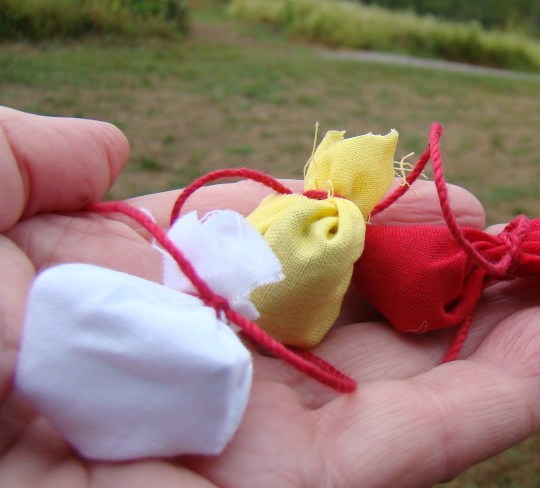
Prayer BundlesPrayer bundles were then made for a Despacho Fire Ceremony. A prayer request was written on a small piece of paper and placed inside a small piece of cloth with some special herbs. After praying over the prayer bundle, it was then tossed into the fire so prayers could ascend to the heavens.

Sunshine JonesSunshine Jones led the group in a session of drumming to connect with Spirit. Everyone had the opportunity to use some kind of instrument for participation in the event.
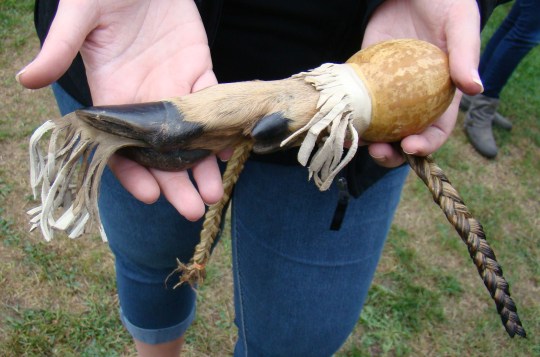
Deer Foot ShakerOne unusual instrument was the foot of a deer topped with a shaker ball, which made a delightful sound…and the foot was easy to grip.

DrummingMuch dancing and singing took place around the fire as people got caught up in the spirit of the afternoon of earth healing. That healing must begin within ourselves, so we can then spread our energy to influence everything we touch.
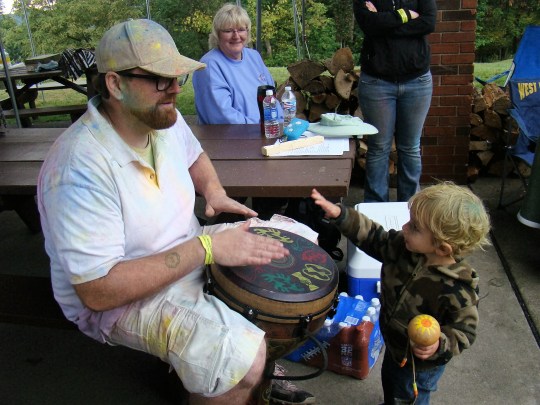
Druming

This was a great day for meditation and connection with like-minded friends. There was a feeling of peace on the hilltop that is not often found in our busy lives today. Everyone left looking for things to appreciate in the world around them.


A Stroll Through History Portsmouth Flood Wall Murals

Floodwall 7

Early life in Portsmouth can be seen in the Stagecoach Mural, Hanging Rock Iron Furnaces, and the Ohio and Erie Canal at its southernmost point.

2000 seems to be the magic number in Portsmouth. 2000 years of Scioto County History on 2000 feet of Portsmouth Flood Wall Murals.

Floodwall Flood

The disastrous Ohio River Flood of 1937 led to the construction of this floodwall.

In 1937, a disastrous flood caused the U.S. Army Corps of Engineers to construct a flood wall along the Ohio River to prevent the same thing from happening in the future.

While the flood wall served its purpose, it wasn’t very pleasing to the eye. Dr. Louis Chaboudy  and his wife, Ava, had visited Steubenville, Ohio in 1992 and were pleased with the murals they saw there. They decided to begin the search for a person who might not only paint pictures of the history of Scioto County, but bring it to life so it would attract visitors to their city.

Floodwall Mounds

The Portsmouth Earthworks is a large mound complex constructed by the Ohio Hopewell Culture from 100 BCE to 500 CE.

Robert Dafford, an internationally known muralist, seemed the perfect person for that role and painting began on the largest mural, 20′ x 160′ in 1993. One artist created all 2000′ of the Flood Wall Murals by October of 2002. The remainder of the murals are 20′ x 40′. Whether you are an artist or have little appreciation for fine art, these murals will grab your attention and tell you the story of the changes that have taken place in Portsmouth over the years.

Floodwall 9

The Greyhound Bus Station was a popular place during WWII gas rationing. Or you could have joined local legend, Roy Rogers, riding Trigger.

The murals tell the story of the history of the area, and depict all the former factories, the great flood of 1937, sports history and much, much more. See detailed paintings of historical Portsmouth, which include local legends, such as Roy Rogers, Branch Rickey, and the Portsmouth Spartans NFL football team. The Spartans could not survive in the small town of Portsmouth during the depression, and in 1934 were sold to Detroit, where they became the Detroit Lions.

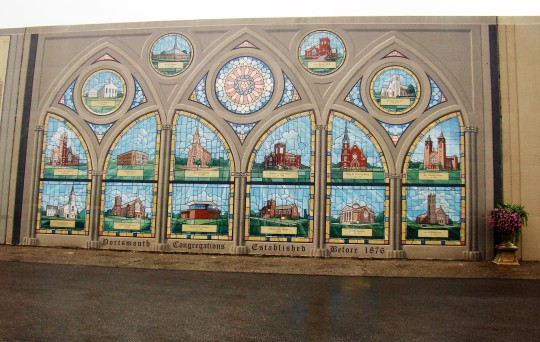
Floodwall 8

Sixteen churches established in the 1800s are featured in this stained glass motif. 

Some surprises appear along the way whether you are walking for the best view, or driving along in your vehicle. Discover that the shoe industry had six factories here in the early 1800s employing over 6,000 people. Look carefully at the mural of the Portsmouth Motorcycle Club and see if you can spot the reflection of the muralist, Robert Dafford, in one of the hubcaps.

After the initial 2000′ were painted, there have been four murals added. One of them depicts famous baseball players from the area, while another shows a bicycle tour from Columbus to Portsmouth.

Floodwall Ohio River

The Ohio River flows just outside the flood wall where the U.S. Grant Bridge crosses over to Kentucky. 

The great thing is…it’s FREE!  Take a leisurely stroll along the murals or view from them the sidewalk across the street for a different perspective. An amazing feature is that there are paintings on both sides of the wall so don’t forget to view the wall from the Ohio River side as well.

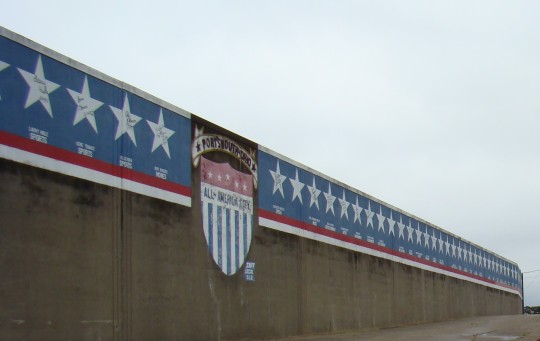
Portsmouth Outer Wall

The Ohio River side of the flood wall was begun before the mural side. You can drive along most of the outside of the wall along the Ohio River.

Here the flood wall has been designated at the Portsmouth Wall of Fame, where accomplishments of area natives are recognized. Their name is placed beneath a star with an autograph of the person being honored in many cases – Don Gullett, Al Oliver, Roy Rogers, Dan Quayle, Larry Hisle and Gene Tenace being a few of those recognized.

Floodwall Town Mural

Downtown Portsmouth in the 1900s is the cover of the Scioto County Visitors’ Guide. The Steel Industry played a major role in the town’s growth.

The Portsmouth Flood Wall serves as a great example of how something that serves a needed purpose doesn’t have to be dull or boring. With a little bit of talent, it can brighten up the world.

Portsmouth is located in the southern part of Ohio along back country roads. Your best bet for directions is using your GPS. 

Marietta Vice Walking Tour Filled with Thieves, Bars and Murders

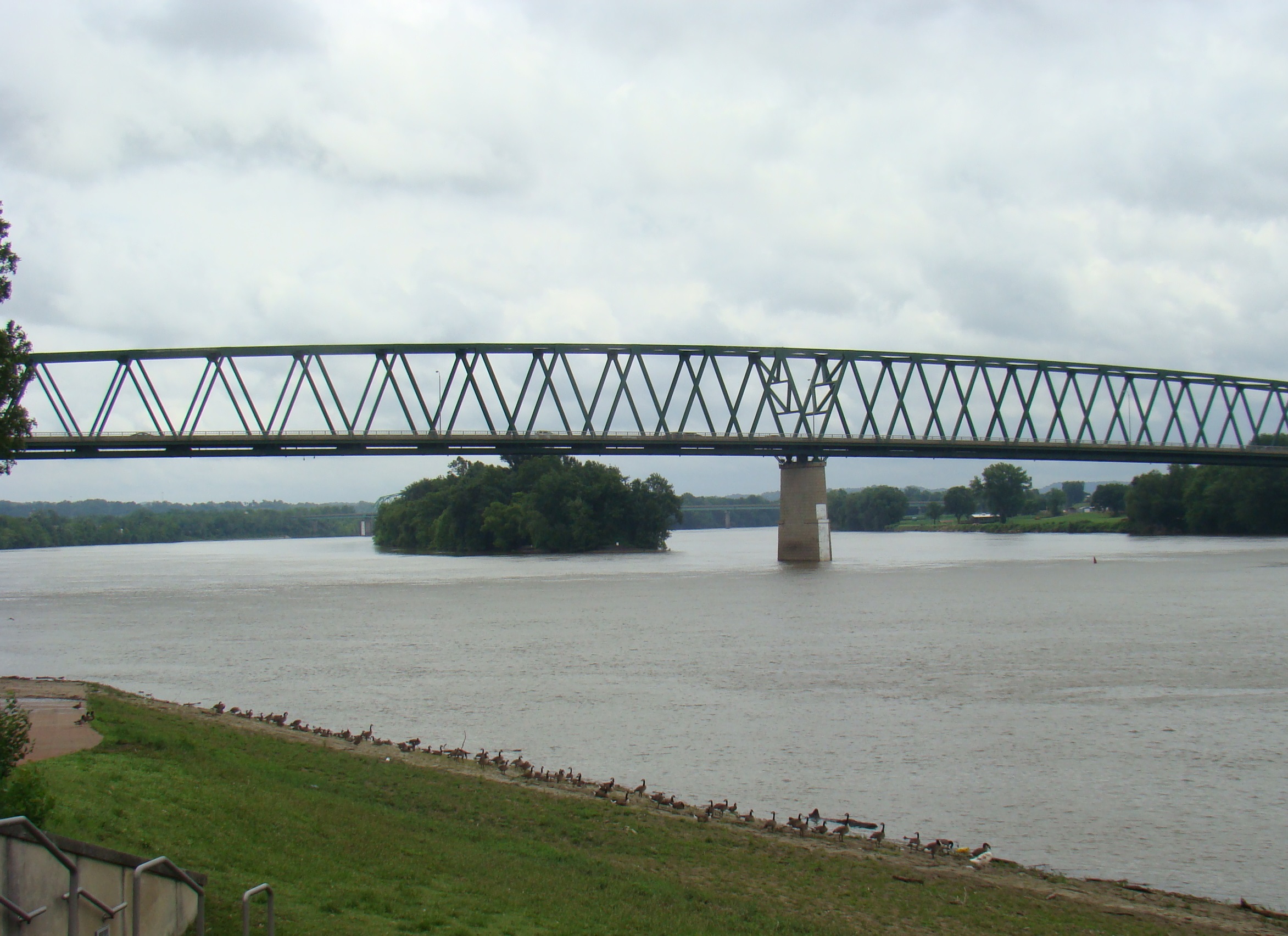
This island contained an Amusement Park in 1900.

In 1900, Buckley Island contained an Amusement Park during the day, then became a Lawless Wonderland at night.

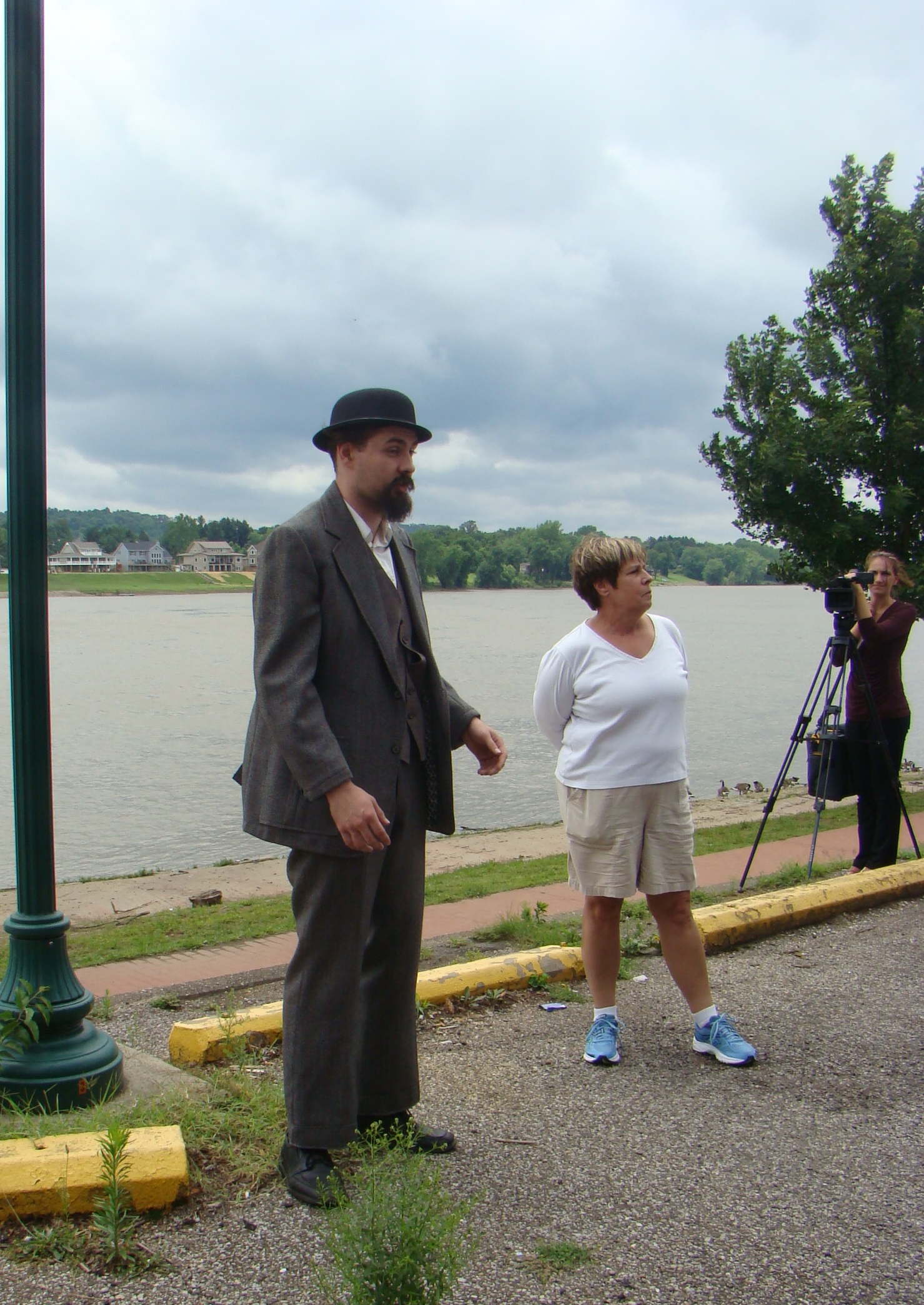
You had to be bold and brave if you dared walk on the seedy side of town in Marietta, Ohio back in the early 1900s. But Lynne Sturtevant recently led a crowd of fifty on an adventure back to early days as the old sections of Marietta were revisited. Along the way, characters in costume greeted the tour and told of dangerous adventures at that time.

Riverfront man and Lynne, our guide

Riverfront man and Lynne, our guide

Crime was a severe problem all along the Ohio and Muskingum Rivers in Marietta, with bars, bars, and more bars. The Ohio River flowed around a small island, that served as an amusement park during the day, but a whole new crowd arrived in the evening. They enjoyed all the vices of the time – drinking, gambling, prostitution, and murder. Going to the island in the evening had an added enticement of cheap beer. Along the shore beer was twenty-five cents a glass, but on the island, only five cents. The Island, now known as Buckley Island, was a lawless wonderland. If you wanted to do anything illegal, the island was the place!

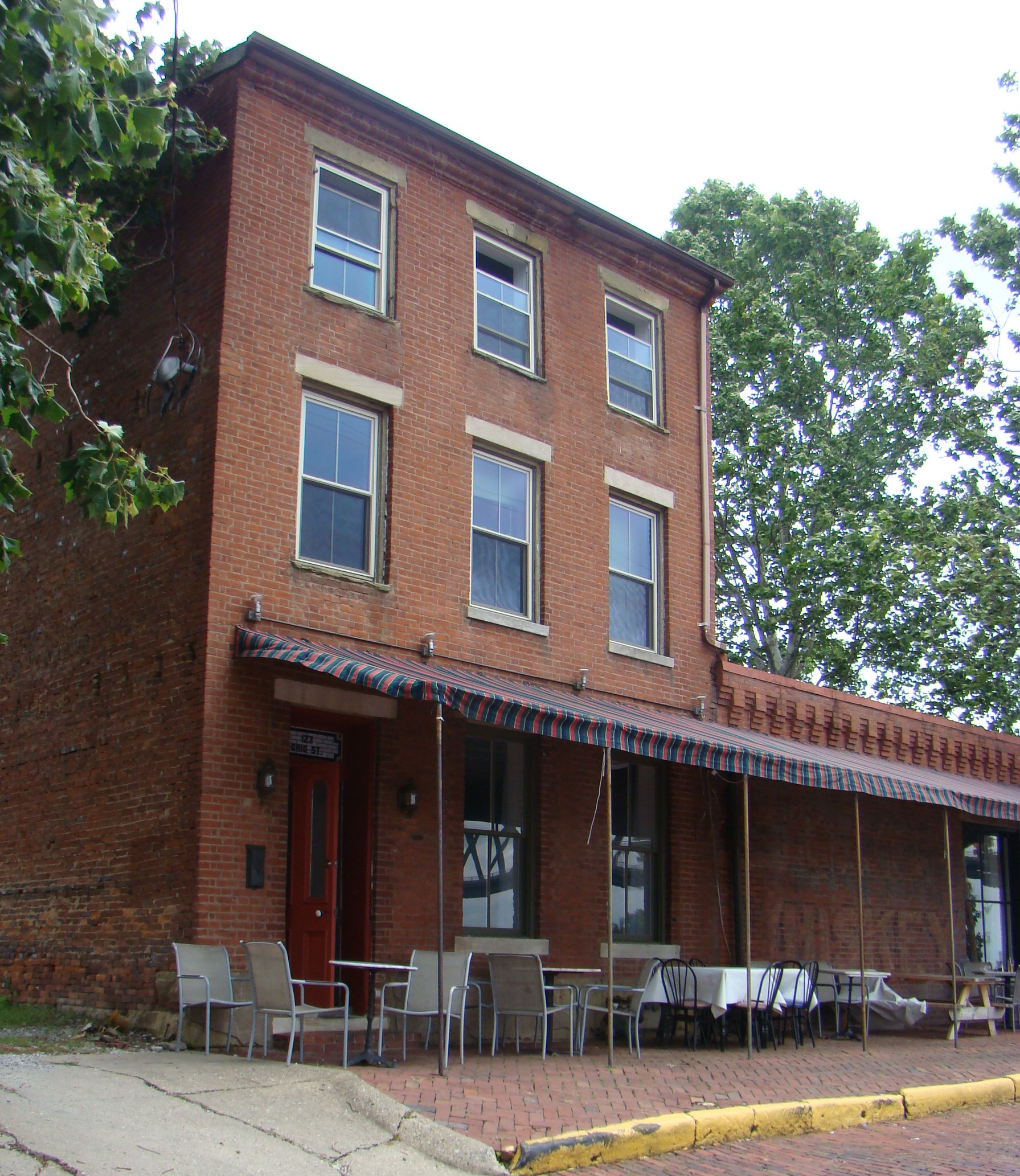
Old hotel and bar

Notice the popular shadow advertisement of WHISKEY at The Levee House – just above the table tops.

Despicable characters roamed the streets, drinking and arguing over everything imaginable. One man and his wife were each found with bullets in their head after an argument over a wristwatch. The stories told were all true reports of the Marietta newspaper from that time.

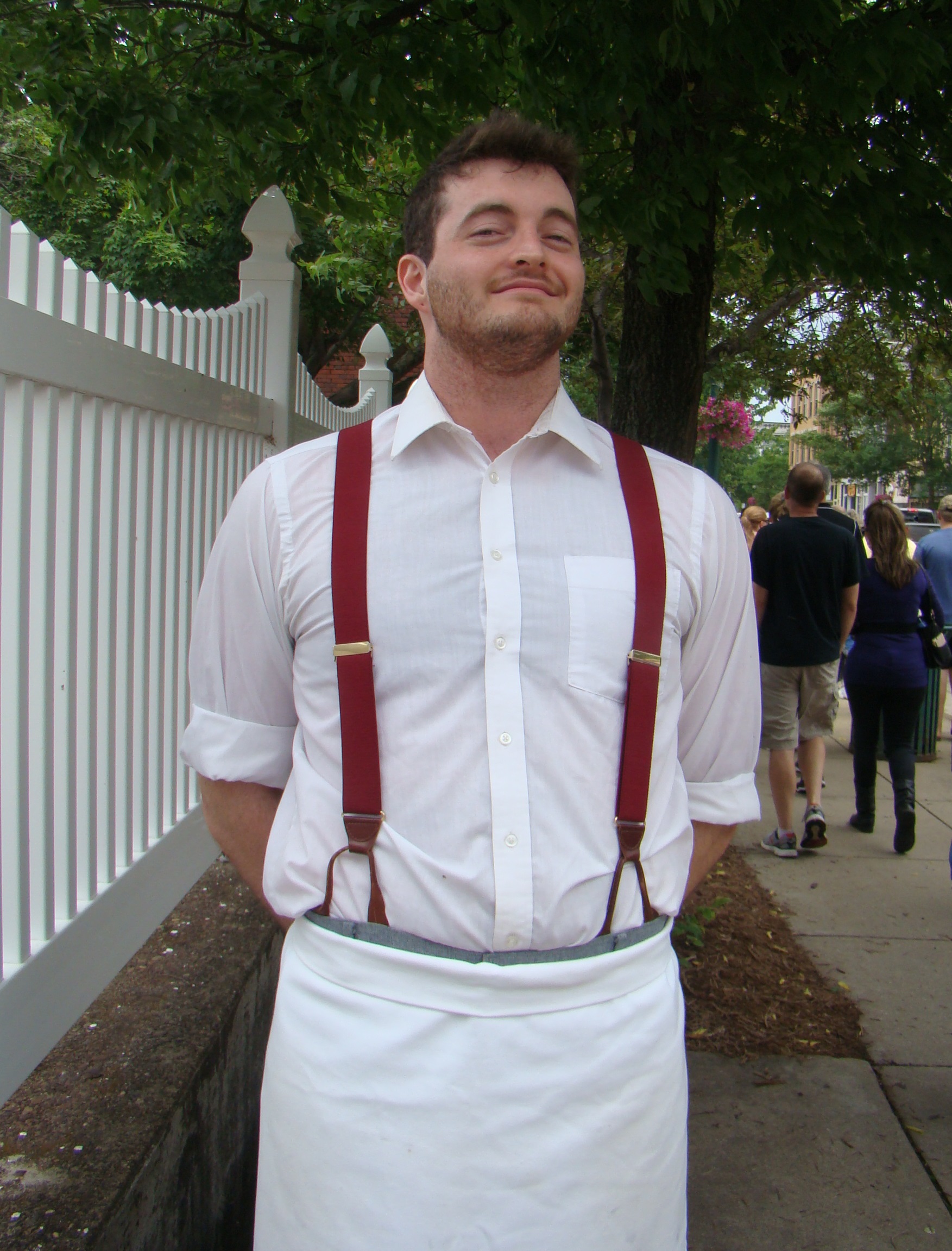
Proud bartender

Proud bartender

Dance halls and saloons were the main businesses in town. Shadow advertising can still be seen on many buildings with words like WHISKEY worked right into the brick works.

Along the way, the group met a delightful bartender who told of some of the fights he had witnessed at the bars. The job he hated the most was cleaning the spittoons.

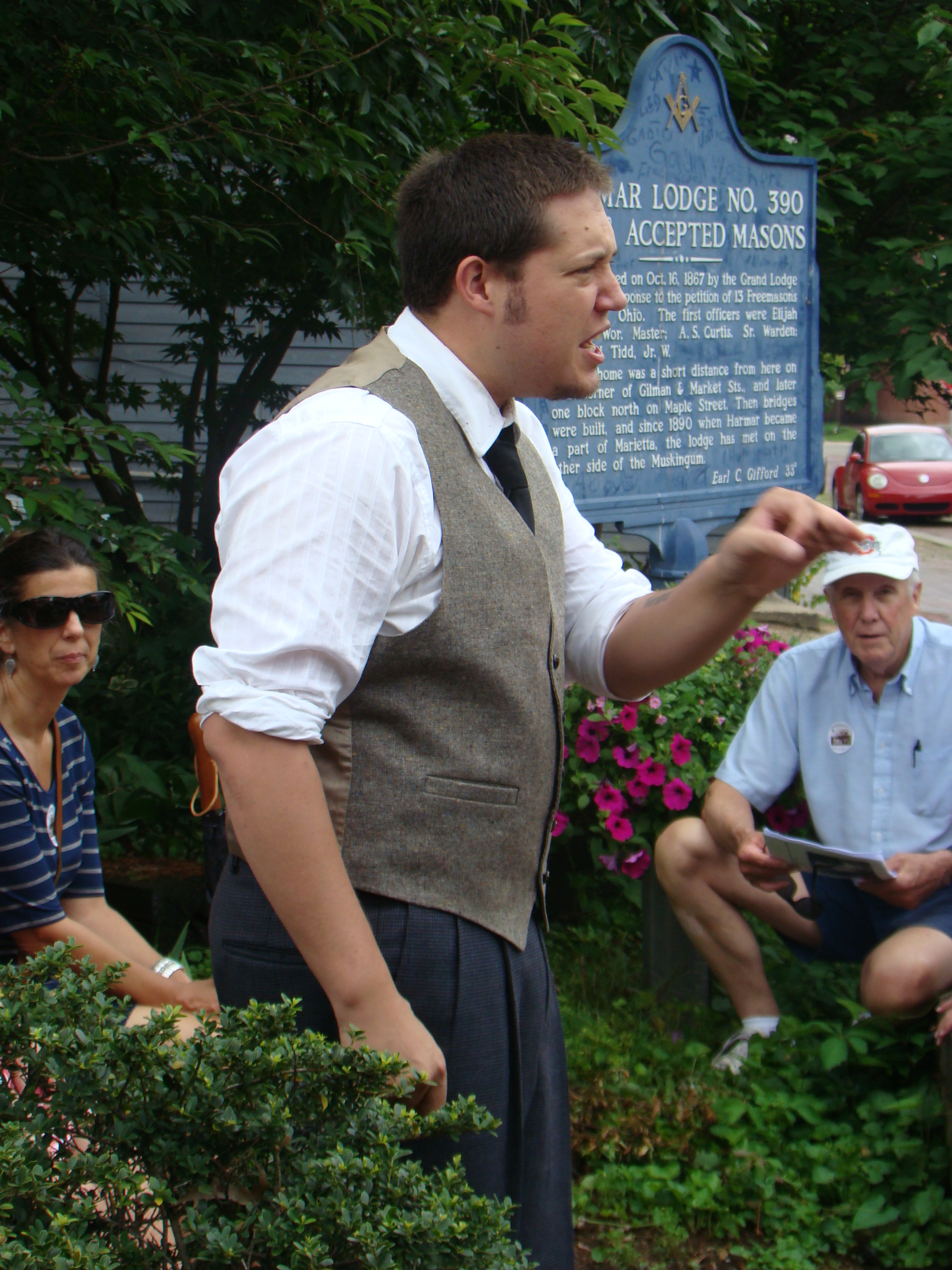
A character portraying Oliver Hyde, mayor of Marietta in 1904, spoke to the group in front of the police station. The building also served as the electric company and the mayor had his office on the top floor. He gave the latest police report describing real events in Marietta in 1904.

Historic Harmar Bridge

Historic Harmar Railroad Bridge

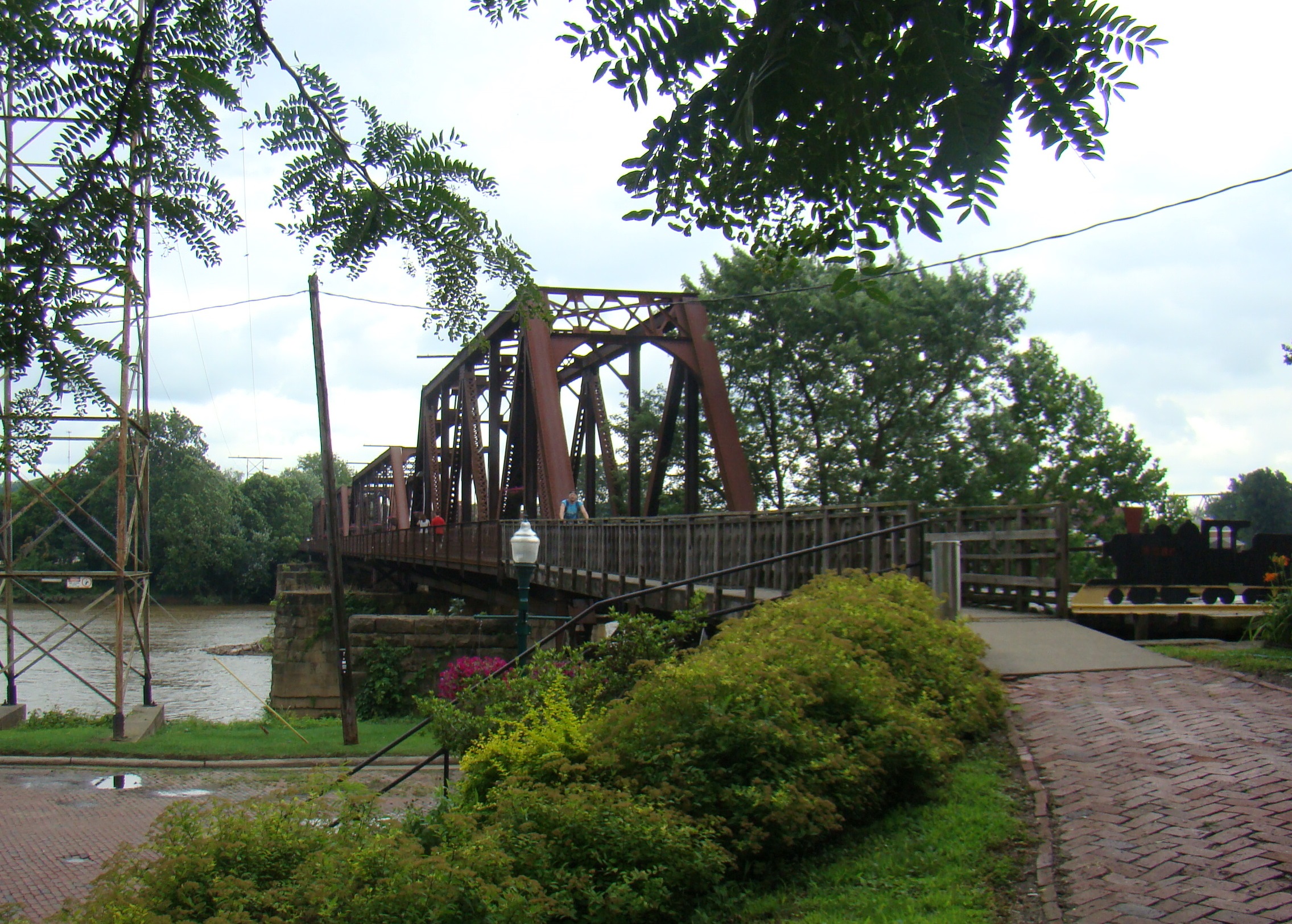
The historic Harmar Railroad Bridge provided a scenic walkway over the Muskingum River. This is the country’s oldest operating railroad swinging bridge, still using a hand crank to swing it open for passing boats. Where the Harmar Historical Village stands today, Fort Harmar existed in 1785 for the protection of the Indians.

Walking over the bridge, one of the roughest sections of town was on Maple Street. A young man, who lived there, told about his neighborhood. He spoke of Mr. and Mrs. Hayes, who were well known local folks. Mrs. Hayes served as a madam, while her husband usually caused problems. Mr. Hayes was very jealous of his wife and accused her of seeing the local bartender. She begged him, “Don’t kill me!”

He did.

Guy from the rough side of town

Guy from the rough side of town

The young man said the Marietta Police had never caught the husband and asked the mayor why he wasn’t working on it. The mayor, in typical mayor fashion said, “It’s under investigation.” The young man told the group to get back over the bridge as quickly as possible as the area was not a safe one.

While visiting a housewife in Sin City, she told of a murder that happened next door to her house. She was hanging out the laundry when she heard a husband and wife fighting next door. The husband yelled, “I’ll break your face right in if you do that again.”

Later she smelled a fire burning in their back yard and hurried to get her clothes off the line. About 5:00 the next morning, there was a knock at her door. At the door stood the next door neighbor. “Good morning, the missus has gotten drunk and fell into the fire and burned right up. She’s always getting drunk.”

When the police arrived at the scene, over half of the woman’s body was severely burned, but they could see severe bruises on her neck. Perhaps she didn’t just fall into the fire, but was pushed. You’ll have to visit to find out…the rest of the story.

A rainy ending to an educational and interesting day

A rainy ending to an educational and interesting day

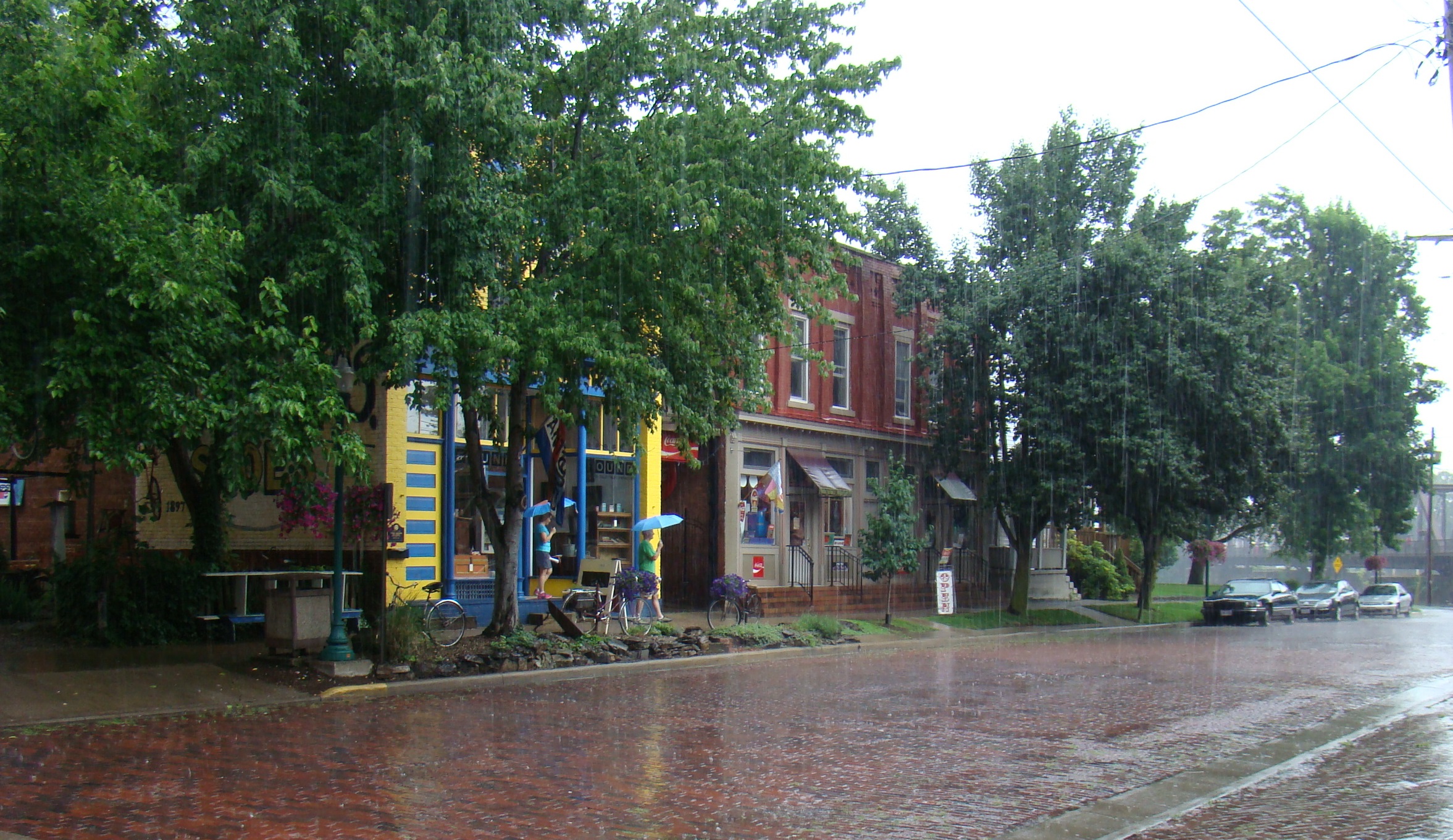
Rain held off until the very end of the tour, when it came down from the sky in buckets. The wind, rain and lightning made it seem that this place was perhaps still dangerous.

Marietta, Ohio is located at the confluence of the Muskingum and Ohio Rivers in southern Ohio. Take Exit 1 off I -77 in Ohio to experience this delightful town. Characters along the way were provided by Paskawych Entertainment, LLC of Marietta.

Ghost Tales Flourish in Historic Marietta

Welcome to Hidden Marietta, where some stories – and some people – simply refuse to die.

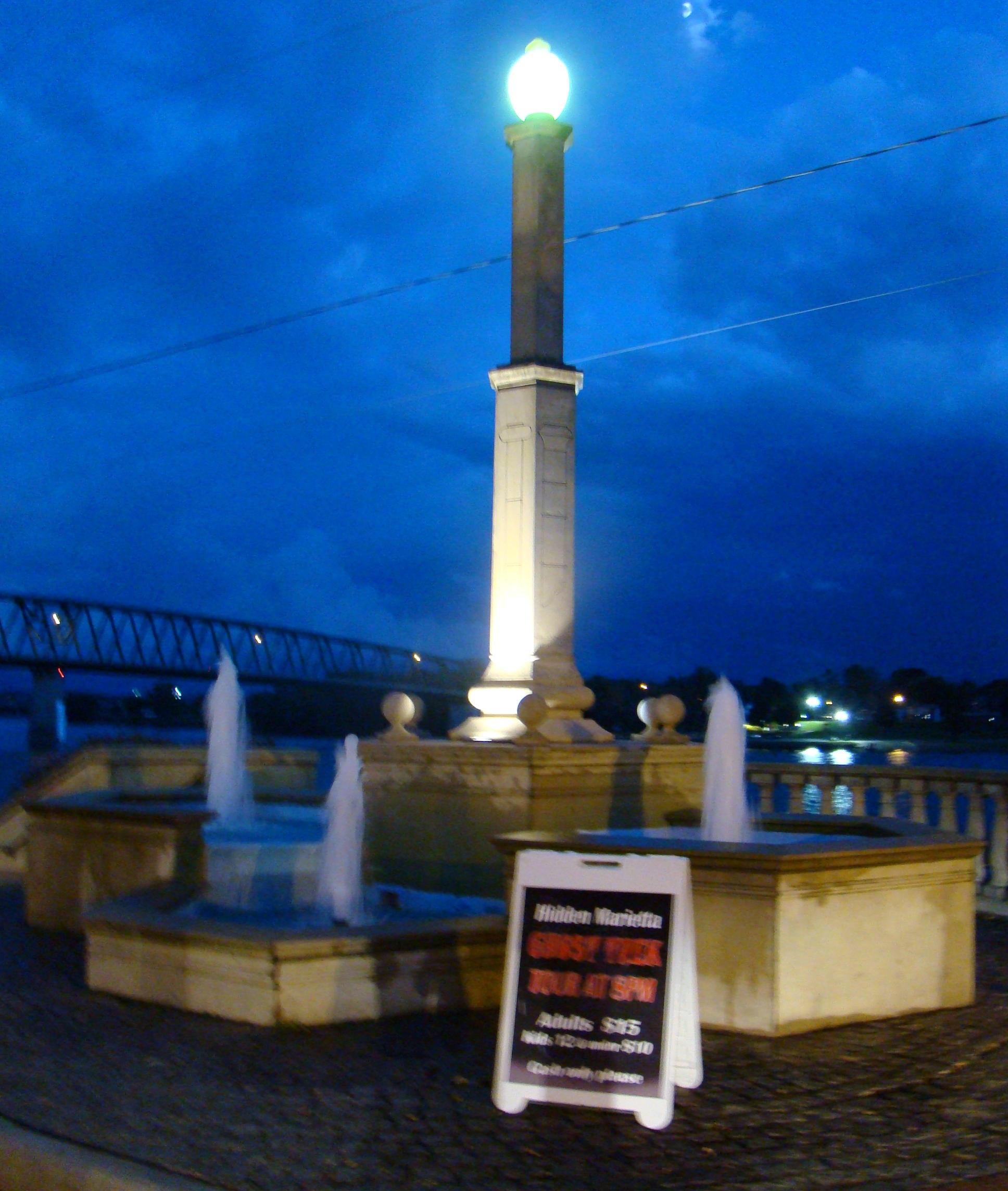
The fountain marks the starting place for the Ghost Trek.

The fountain marks the starting place for the Ghost Trek.

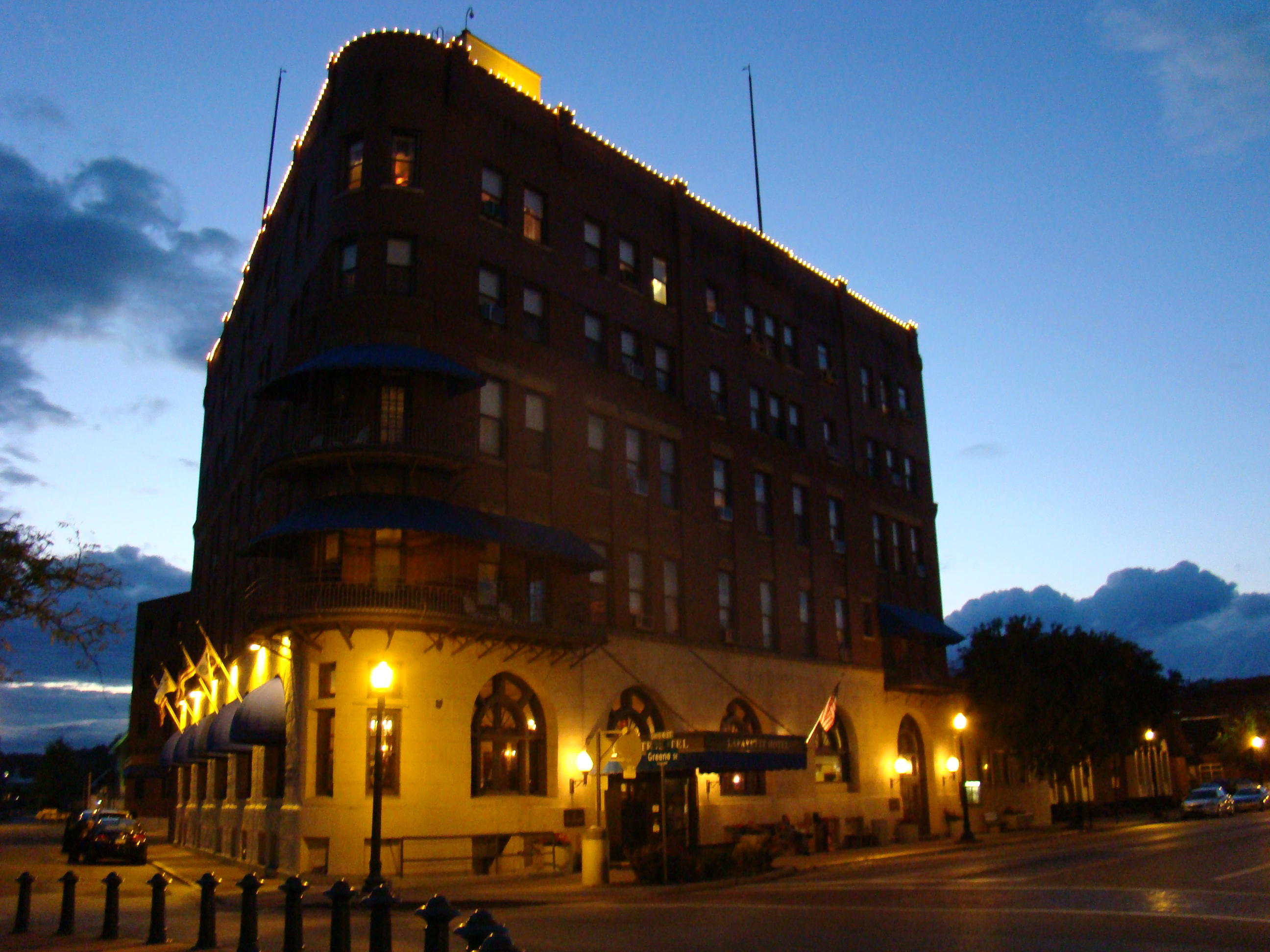
The most haunted town in Ohio seems a natural place for a Ghost Trek – the streets of Marietta. Meeting near the Lafayette Hotel along the Ohio River, excellent guides tell some of the scariest stories about restless spirits left over from the past in this paranormal hot spot. Even rain won’t dampen your spirits.

While ghost stories are told at each stop, the tour also tells the history of early Marietta. As you hear stories of murder and paranormal activities, the heart races just a little faster as you glance around to see if there’s anything unusual happening.

The tour takes about two hours with perhaps a dozen stops, so many interesting ghost and historic tales are told along the way. Buckley Island in the middle of the Ohio River has experienced everything from Native American Indian attacks to an amusement park. At one point it also contained “Pest House”, where all sick people were quarantined to prevent illness from spreading on land. Once there, you stayed permanently. Today, hikers still feel sick and weak on the island…perhaps leftover energy?

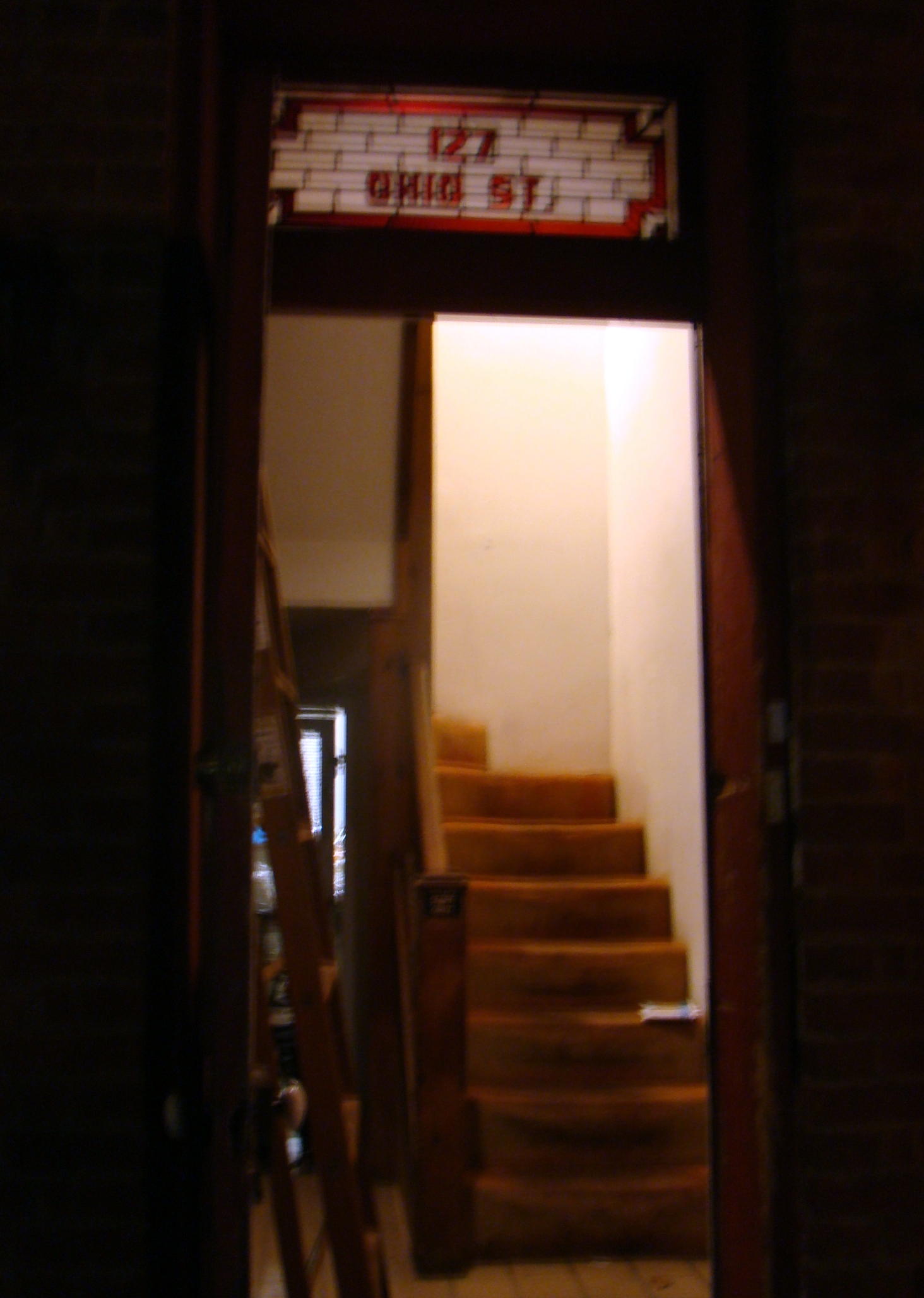
Staircase the Ax Murderer used in 1890's.

Staircase the Ax Murderer used in 1890’s.

Walking down the brick streets, with Victorian style buildings, gives you the feeling of stepping back in time. Listen to the tales of footsteps, knocks, and voices in the night. When you visit the old La Belle Hotel, the eerie glow of the night beckons for a close look at the staircase where the ax murderer walked slowly up, then ran down. Those footsteps are still heard frequently today and reflect a residual haunting – energy left over from 130 years ago.

Today, guests at the Lafayette Hotel often comment about unusual happenings in their rooms. Glasses may be moved, lights turned on or off, and people are frequently seen roaming the halls. One of those nighttime visitors appears to be Mr. Hoag, former owner, in his brown derby hat.

Haunted Lafayette Hotel

Haunted Lafayette Hotel

Employees of long ago recognized Mr. Hoag as the best possible manager. Employees today say that sometimes during the night, the elevator will suddenly light up for 6th floor, which is where maintenance equipment is stored, and the manager frequently visited. After a short time, the elevator comes back down to the ground floor. Just Mr. Hoag, still checking on his hotel.

Former home of Marietta Sanitorium

Former home of Marietta Sanitarium

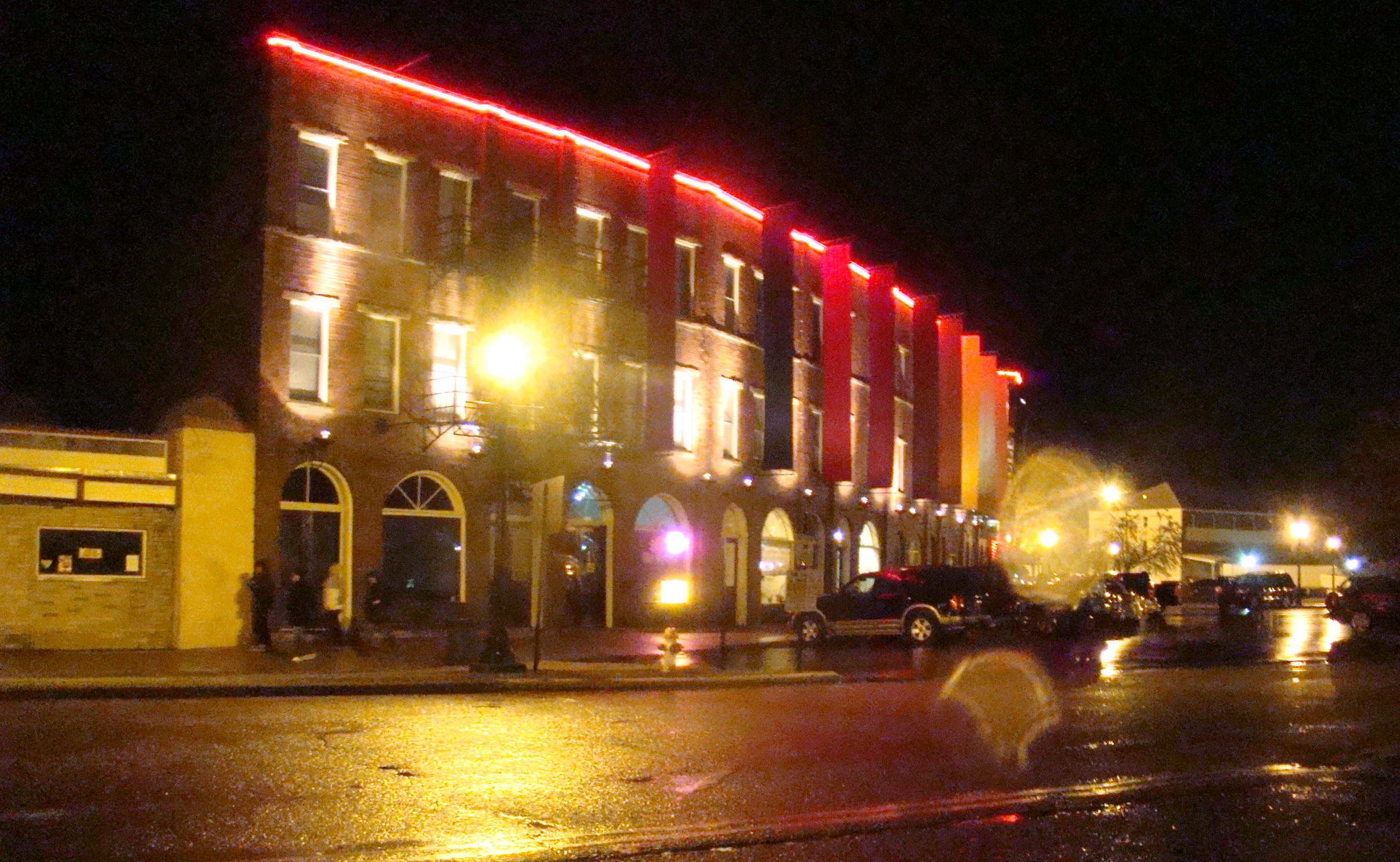
Another eerie stop was the Tiber Way Grille, where people hear moaning and sobbing. Close inspection of the old ghost advertisement on the side of the building, brings out the letters saying: Chronic Disease- Marietta Sanitarium. After the hospital moved, a funeral parlor occupied this building. Now you see the reason for the crying sounds. Soon this will become a Victorian style hotel – complete with ghosts.

Now that you have heard a few of the ghost stories, perhaps you’ll enjoy a visit to Marietta sometime soon yourself. While Halloween seems the perfect time for a Ghost Trek, this event is held every Friday and Saturday evening from June to November at 8:00. Meet at the corner of Front and Greene Streets, at the fountain by the famous haunted and historic Lafayette Hotel.

Watch out for those ghosts!

To arrive in Marietta, Ohio take Exit 1 off I off I-77 and head west on Route 7, Greene Street. Where the Muskingum River meets the Ohio River, you will find the old Lafayette Hotel, the starting point for the Ghost Trek. This walking tour is under the expert guidance of Lynne Sturtevant, founder of Hidden Marietta and author of several books of Marietta history.


Cruisin’ down the Ohio River with Mark Twain on the Valley Gem

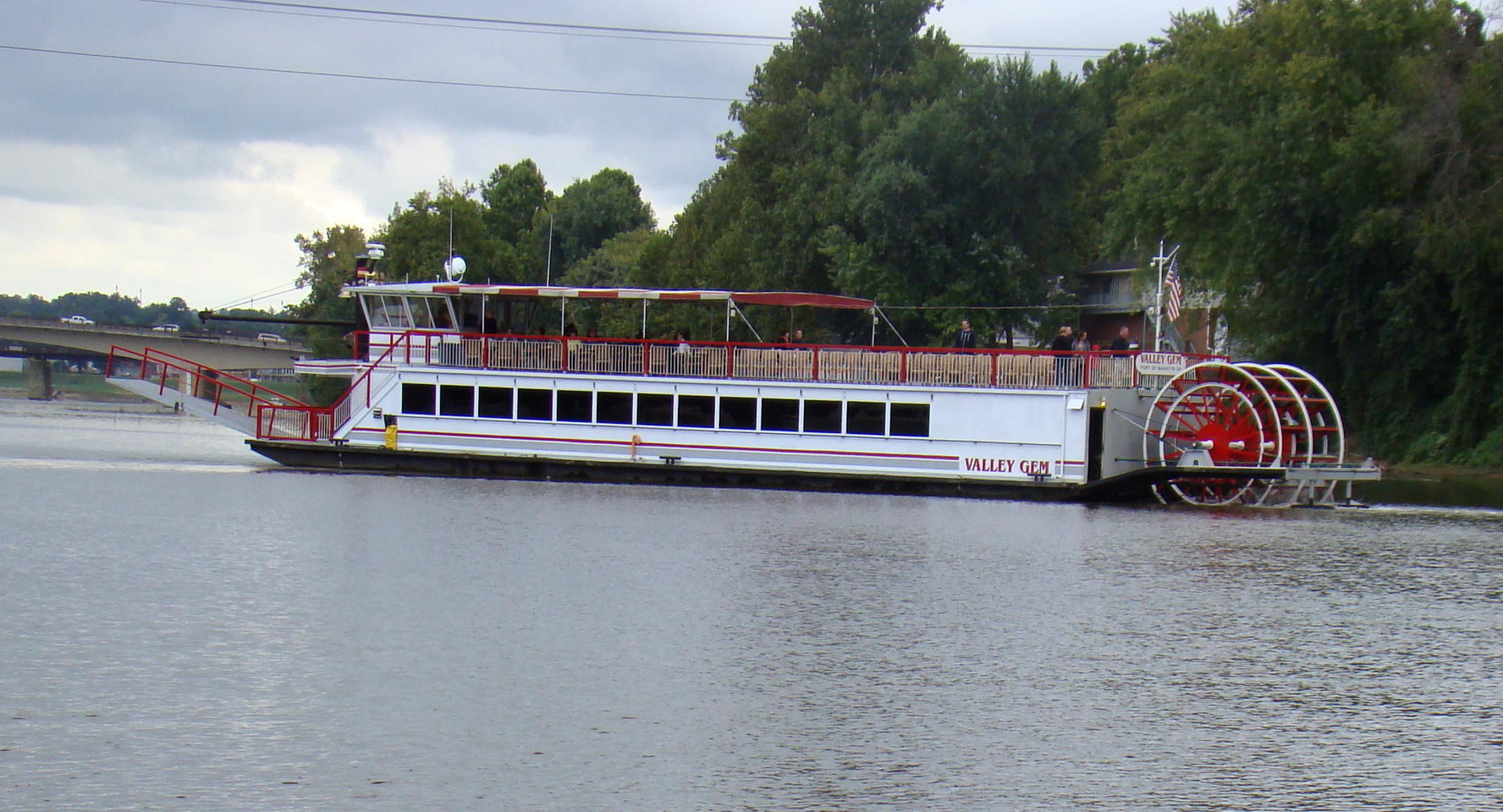
Valley Gem heads down the Muskingum River to its confluence the Ohio River.

Valley Gem heads down the Muskingum River to its confluence with the Ohio River.

Riverboat’s a comin’!

Nothing excited Samuel Clemens more than his time on the riverboats.  The sound of the paddlewheel hitting the water thrilled him, while the changing landscape gave him opportunity to see deer and even Injuns, while sitting in the pilot house.

Some say Clemens received his pen name, Mark Twain, from this passion for the river, since Mark Twain means “mark number two”. The second mark on the water measuring stick signified  twelve feet of water – a safe depth for boats to pass easily.

Breakfast Cruise on Valley Gem

Breakfast Cruise on Valley Gem

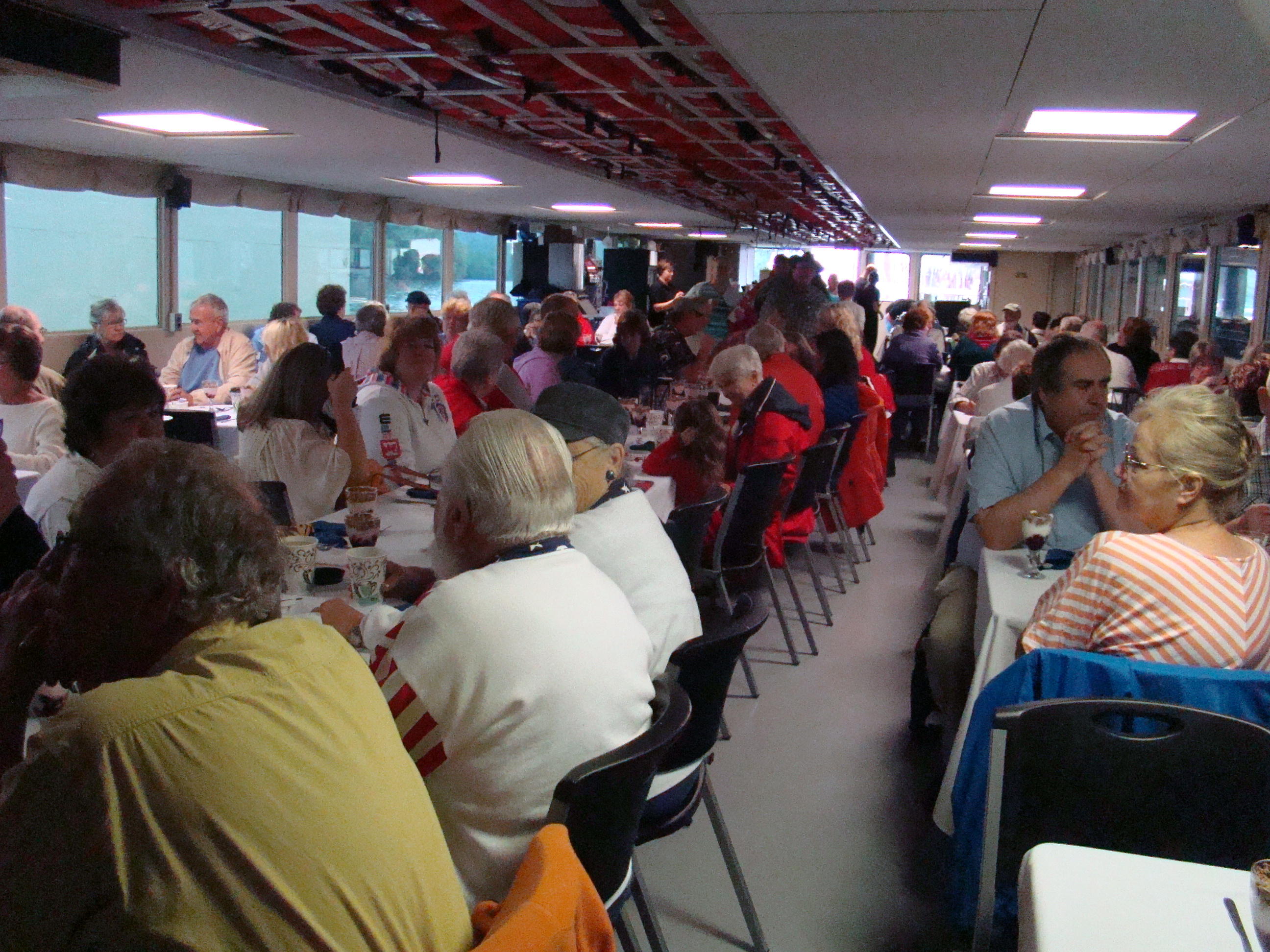
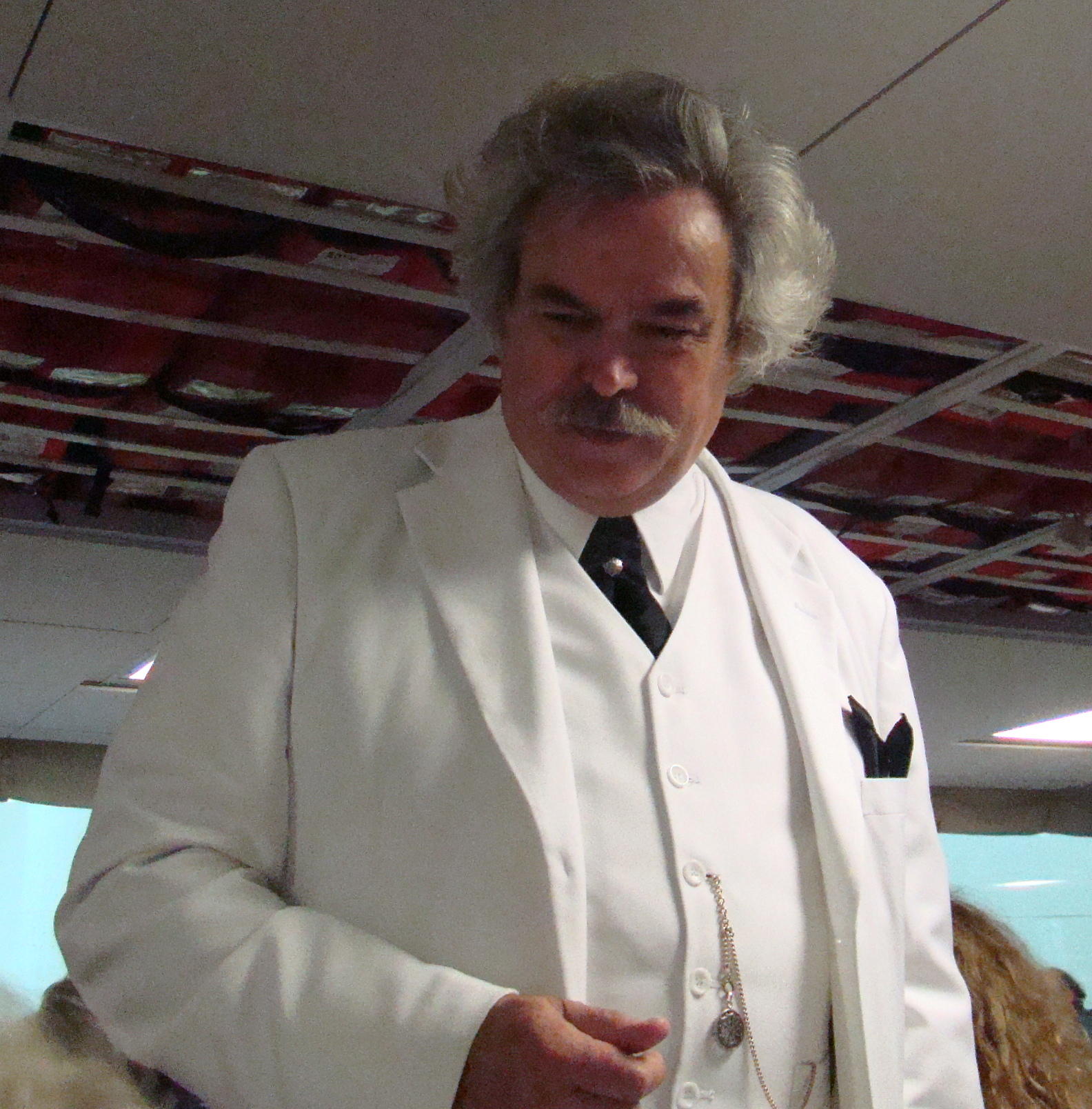
Spending time on the Valley Gem, with the charming impersonator of Mark Twain, delighted all passengers. They also enjoyed a tasty breakfast buffet as they cruised the Muskingum and Ohio Rivers. Mark Twain, portrayed by Stephen Hollen, greeted everyone with a hearty welcome as they stepped aboard the Valley Gem at Marietta, Ohio.

Immediately his sense of humor became apparent as he strolled from table to table encouaging everyone to try the marinated road possum and grits. His enjoyment in that role quickly ignited the crowd into a happy mood.

View behind the paddle wheel

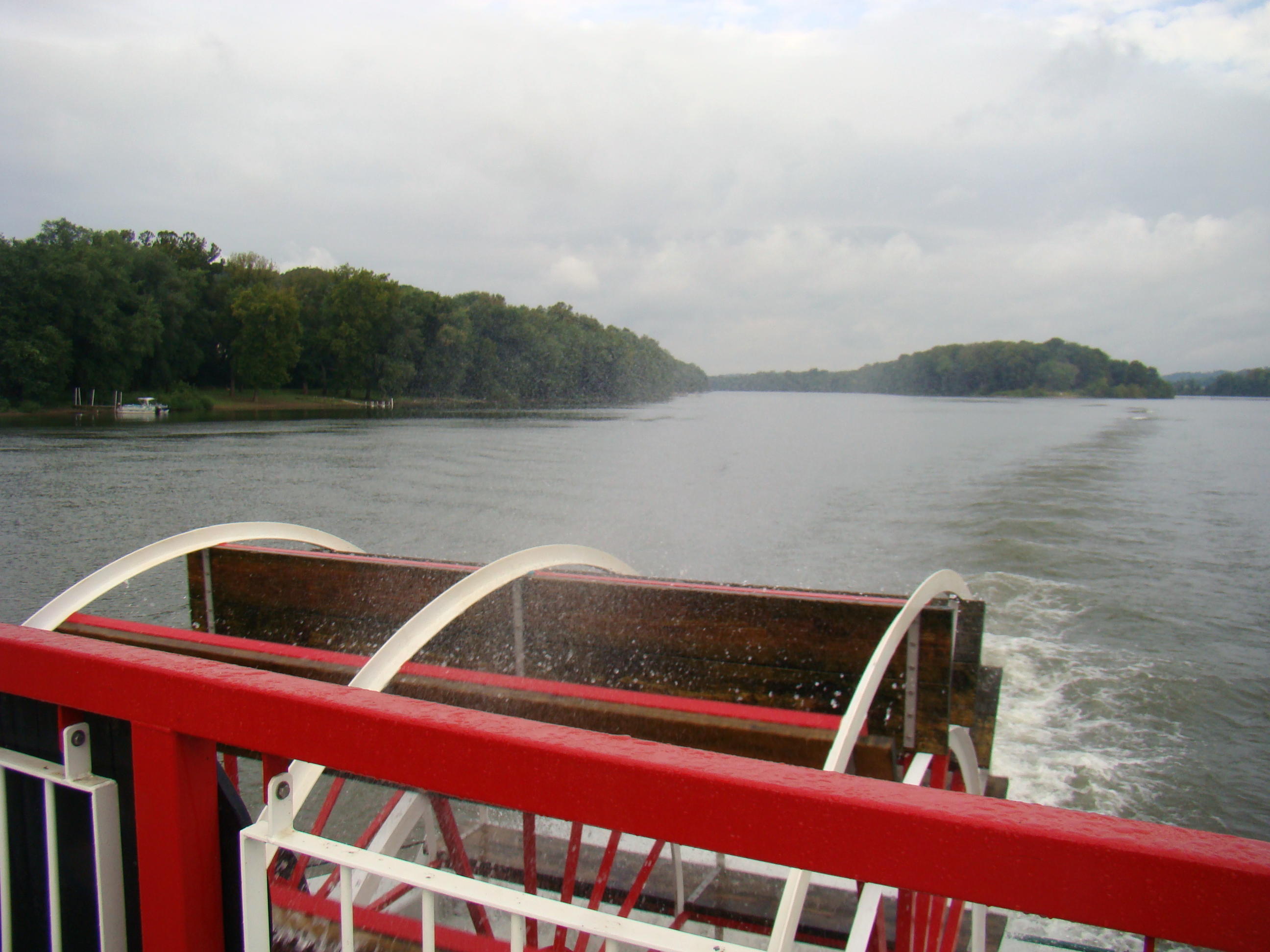
View behind the paddle wheel

The cruise was a smooth two hour ride up and down the river. Many enjoyed going to the top deck to get a better view and feel the breeze. The paddle wheel created quite a spray so those standing near it received a generous sprinkling. After some fresh air, passengers returned to the main cabin to listen to Mark Twain spin his yarns.

Twain then told of his being born in 1835 at Florida, Missouri – population 99. Growing up,  he was given a big spoon of cod liver oil every day. He remarked that his tongue and body were so slippery, he could have eaten broken glass and it would have passed.

Twain visited everyone.

Twain visited everyone.

At 13, Samuel Clemens became a printer’s apprentice and soon joined his brother Orion’s newspaper, where he discovered he enjoyed writing stories.

A few years later he headed to St. Louis, Missouri for another newspaper job but got sidetracked by falling in love …with the river.

For two years he served as an apprentice receiving $500 at the end of that period. Training was not as easy as it might sound. In order to get a license, pilots had to know the 2,000 miles of the Mississippi like the back of their hand. Even at nighttime, pilots were required to remember the placement of every sandbar and the name of every twist and turn, like Eagles Fork or Johnsons Landing. But Mark Twain said during those years, “I had the time of my life.”

After becoming a full-fledged riverboat pilot, he was paid $250 a month. The only other people in the United States at that time that made $250 a month, besides river pilots, were the vice-president of the United States and Chief Justice of the Supreme Court. Riverboat pilot was much more profitable than writing fiction!
When riverboat travel became impossible in 1861 due to the Civil War, Mark Twain returned to the world of the newspaper. His adventures led him across the United States from coast to coast as well as to Europe and the Middle East.

After his travels, he settled in Hartford, Conneticut with his wife and family in 1873. That is where he wrote stories based on his memories of growing up in Hannibal, and enjoying the Mississippi River. Tom Sawyer and Huckleberry Finn came to life through his pen.

Mark Twain says thanks to each passenger as they leave.

Mark Twain says thanks to each passenger as they leave.

The journey was closed with Mark Twain telling his favorite story, “Golden Arm”. It was the story of a rich family from Hannibal, who always came to the landing to see the riverboats arrive and hear the calliope. Mark Twain even sang a Riverboat Song and had the audience join in on the chorus:

Down the river, Down the river, Oh down the O-hi-o.

I’ll not tell the story though, perhaps the next time he visits Marietta you will get a chance to hear more of his delightful tales.

Later in life Mark Twain uttered this comment: “I came in with Halley’s Comet in 1835. It is coming again next year, and I expect to go out with it. It will be the greatest disappointment of my life if I don’t go out with Halley’s Comet. The Almighty has said, no doubt: ‘Now here are these two unaccountable freaks; they came in together, they must go out together.’ ”  And Mark Twain was not disappointed.

The Valley Gem is located next door to the Ohio River Museum at 601 Front Street, Marietta, Ohio, one block from Ohio State Route 7, and minutes from I-77.

Powhatan Point on the Ohio River

The Point on the Ohio River

The Point where the Captina Creek and the Ohio River meet

Chief Powhatan is memorialized here at the Point where the Captina Creek meets the Ohio River. The town laid out here in 1847 was named Powhatan Point in his honor. Captina Creek was the site of many Mingo, Powhatan, and Shawnee Indian camps in the late 1700’s, with exploration by famous white leaders such as Lewis Wetzel, George Washington and Ebenezer Zane.

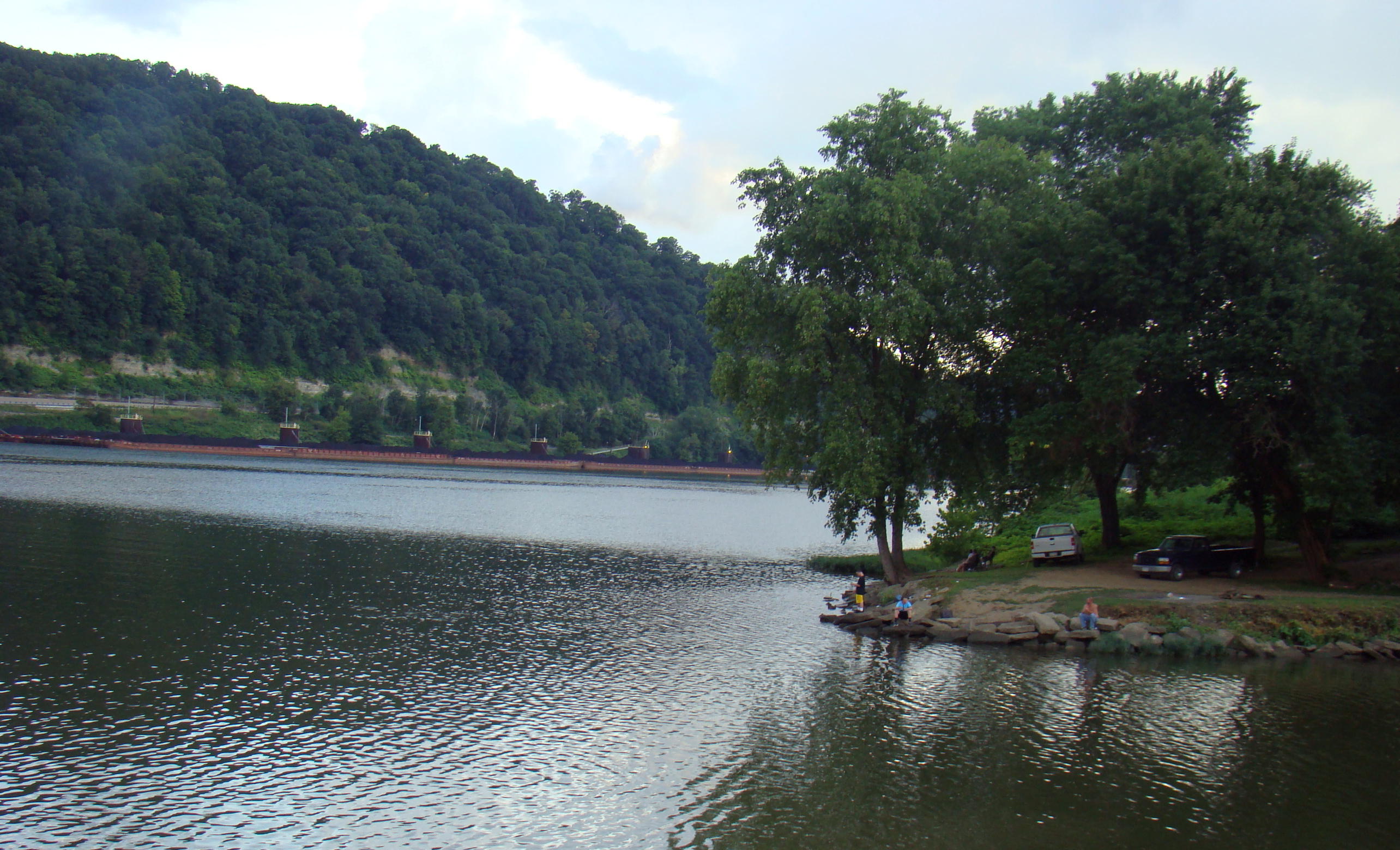
Today the banks of the beautiful Ohio River provide a peaceful place to watch the barges float by, or relax with a fishing pole in hand in the cool of the evening.

Historical sign

Historical sign

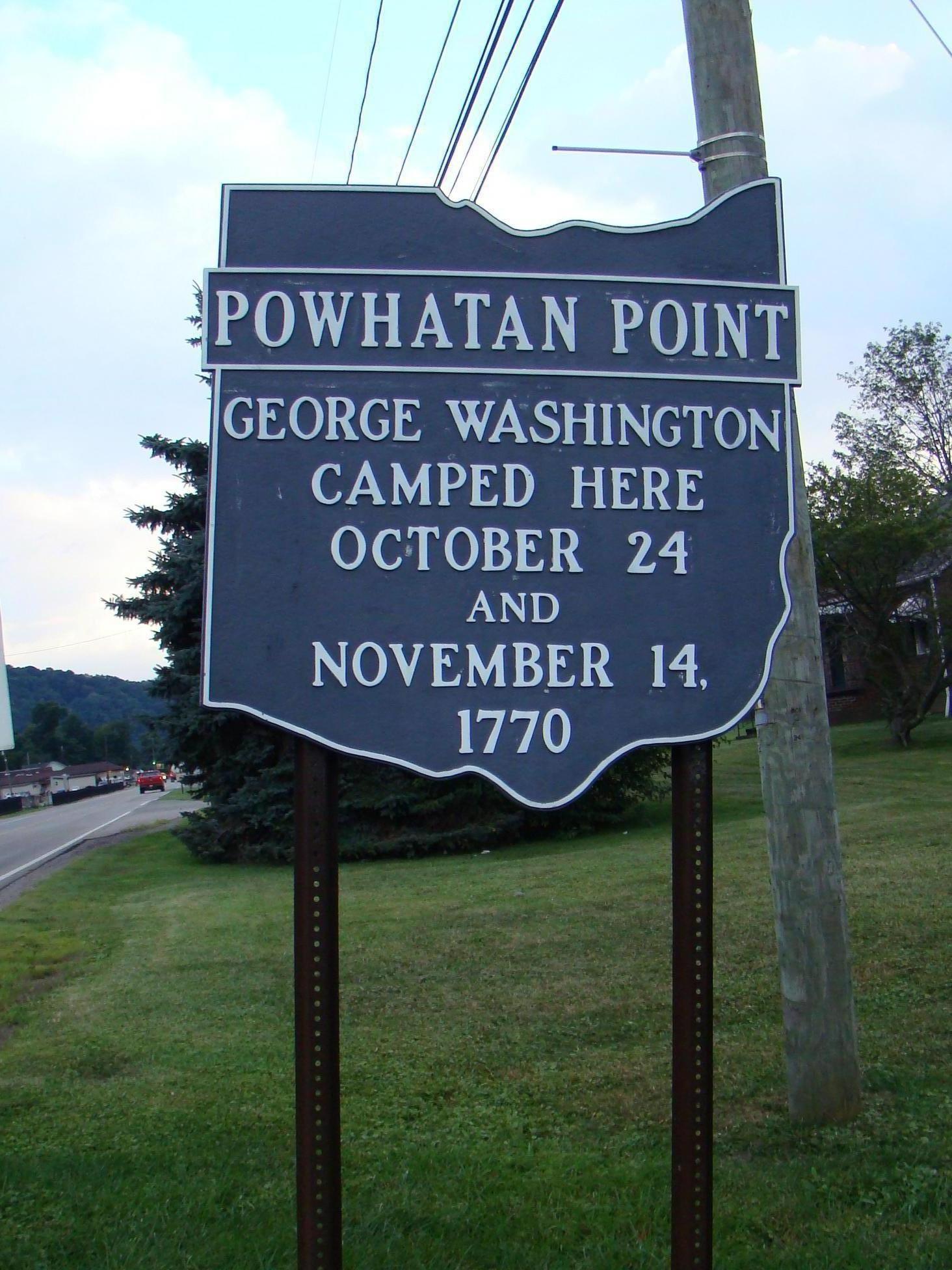
When you enter town, an Ohio historical sign greets you. It states that George Washington camped at what is now known as Powhatan Point on October 24 and November 14, 1770. Some say that is the most important thing that ever happened in this small town, but there was more happening during the last visit.

Chief Powhatan was famous for his dealing with the Whites, but even before the Europeans came to this section of America, he had conquered 30 different Indian tribes. Later Chief Powhatan, with the chiefs from those 30 tribes, tried to recover their lands, which they felt had been stolen by the English and European immigrants.

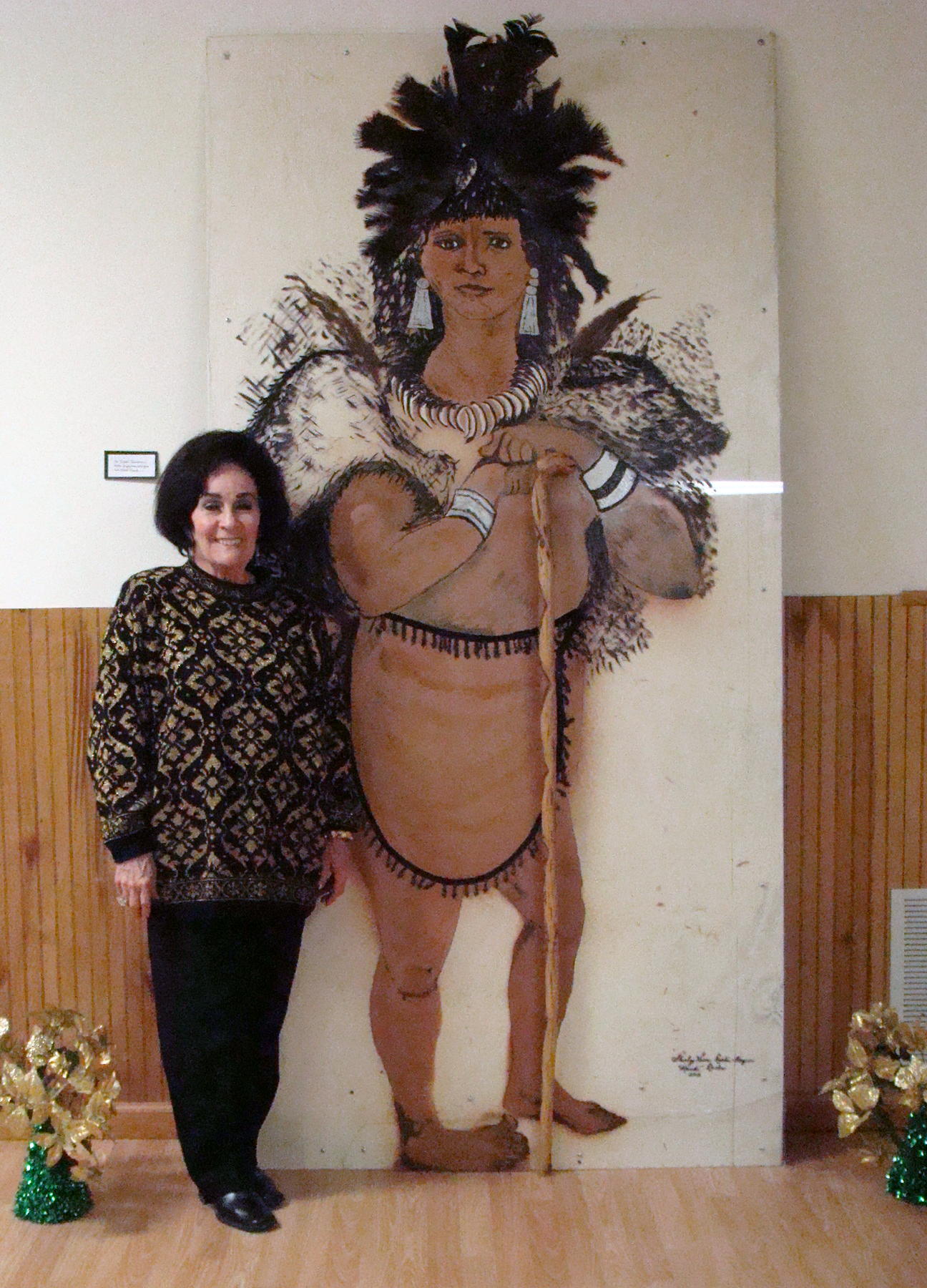
Kandi's Chief Powhatan

Kandi’s Chief Powhatan

Since the town was named for Chief Powhatan, it seemed fitting for one West Virginia artist, Kandi Roche, to compose a modern day sculpture of the Chief for The Art Gallery at Powhatan Point Village.  The art gallery is situated at what they call “The Gateway to the Appalachias”. Kandi made an unusual Chief Powhatan statue, which was painted on plexi-glass, and left for the community to enjoy. This chief was the father of the famous Indian maiden, Pocahontas (1595-1617), who was a peacemaker to the first white settlers.

A beautiful fence covered with Native American tribal patterns greets you when you arrive at The Gallery here. Inside are paintings, pottery, glass and photography. Art classes have been available from time to time. Since this is a relaxed atmosphere, little is scheduled, but friends enjoy getting together along the river banks.

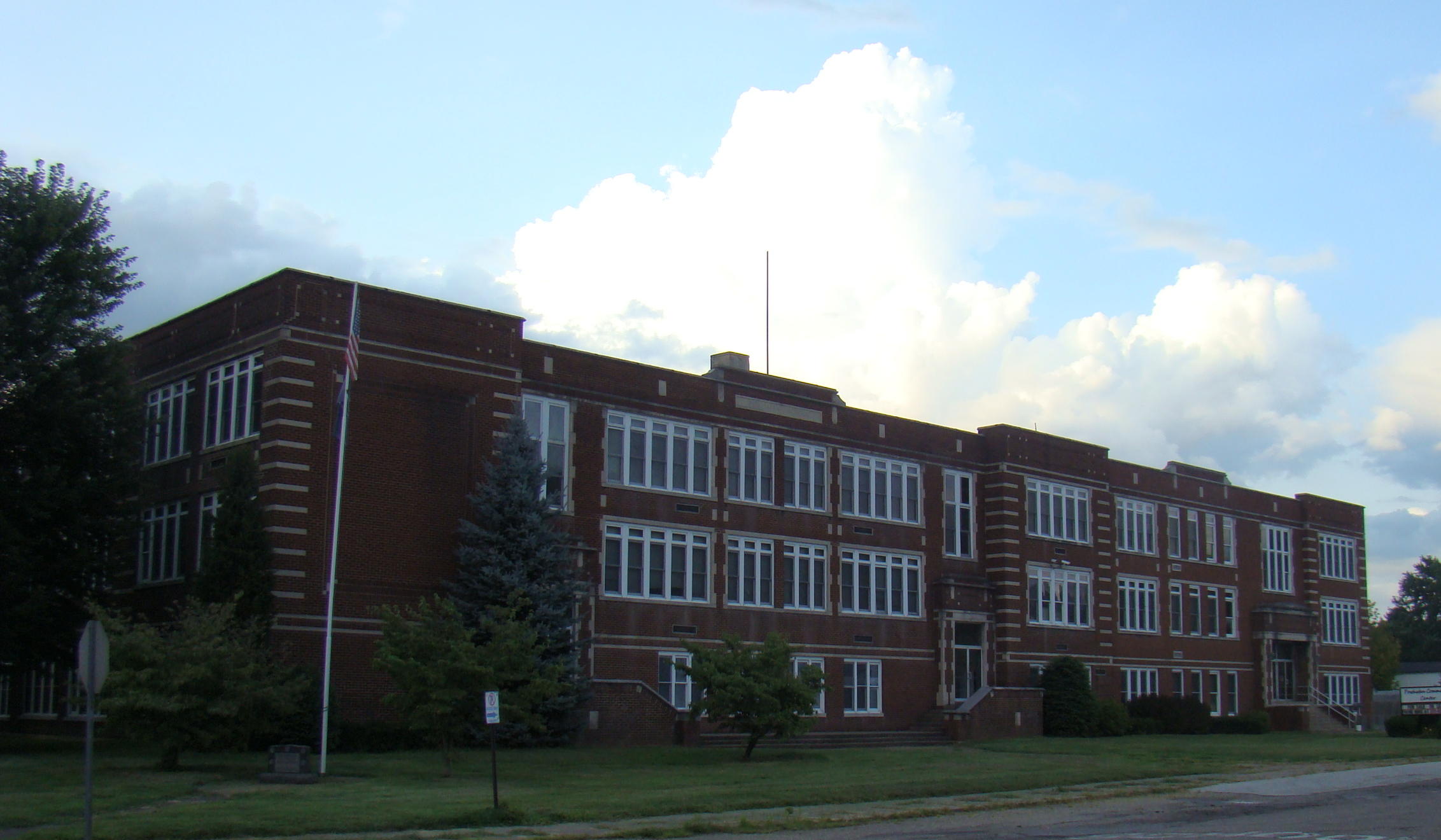
Community Center

Community Center and home to Christmas in the Village

Just down the street from the gallery is the abandoned Powhatan Point High School, which today has been turned into a community center. During the month of December, Christmas in the Village is held here. The 9th Annual celebration will be held in 2014 with crafts, food vendors, entertainment and of course, Santa. But if funds aren’t made available soon, this facility may be lost to the community.

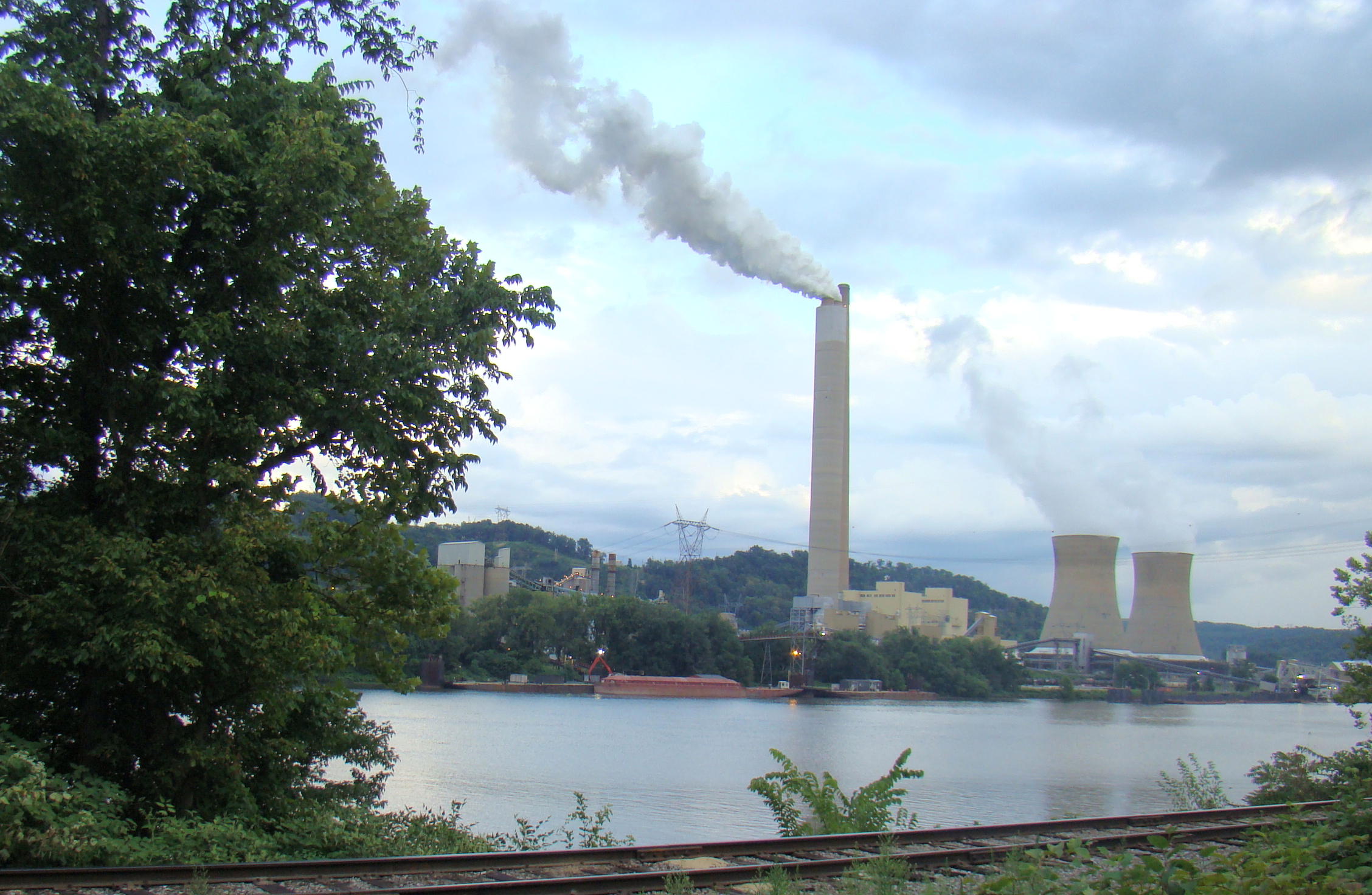
Kammer-Mitchell Power Plang across the river from Powhatan Point.

Kammer-Mitchell Power Plant across the river from Powhatan Point.

Just south of Powhatan Point is the Kammer-Mitchell Power Plant providing electricity and employment for parts of Ohio and West Virginia. Today this American Electric Power (AEP) plant is partially shut down due to failure to meet EPA standards. They must convert their wet coal ash to a dry coal ash bed to return to full operation. This coal-fired plant has the sixth highest power plant chimney in the world.

Drive through our beautiful land and watch for pieces of history wherever you happen to visit. Every small town has its place in history, and Powhatan Point is no exception.

Drive along the beautiful Ohio River on Ohio Route 7 and you will come to the town of Powhatan Point, about fifteen miles south of  Bridgeport, Ohio.


Steamboat History Flourishes at Ohio River Museum

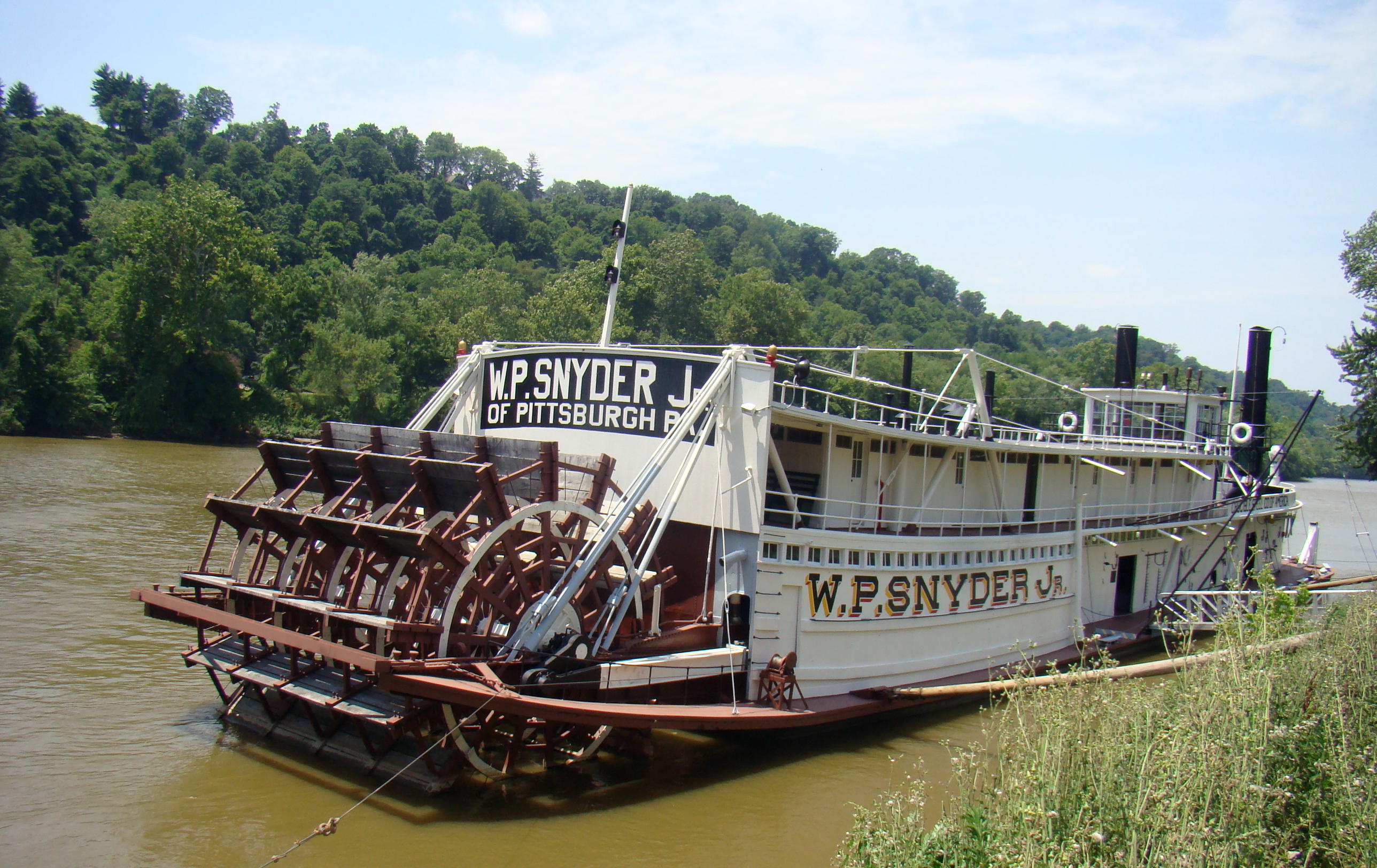
W.P. Snyder, Jr on the Muskingum River in Marietta, Ohio

W.P. Snyder, Jr on the Muskingum River in Marietta, Ohio

“Say Steam” Those are the special words the guide used when taking pictures of visitors on the steam-powered W.P. Snyder, Jr. at the Marietta River Museum in Marietta, Ohio. You can feel the river beneath your feet as you walk the deck, listening to the guide’s description of life on the river many years ago.

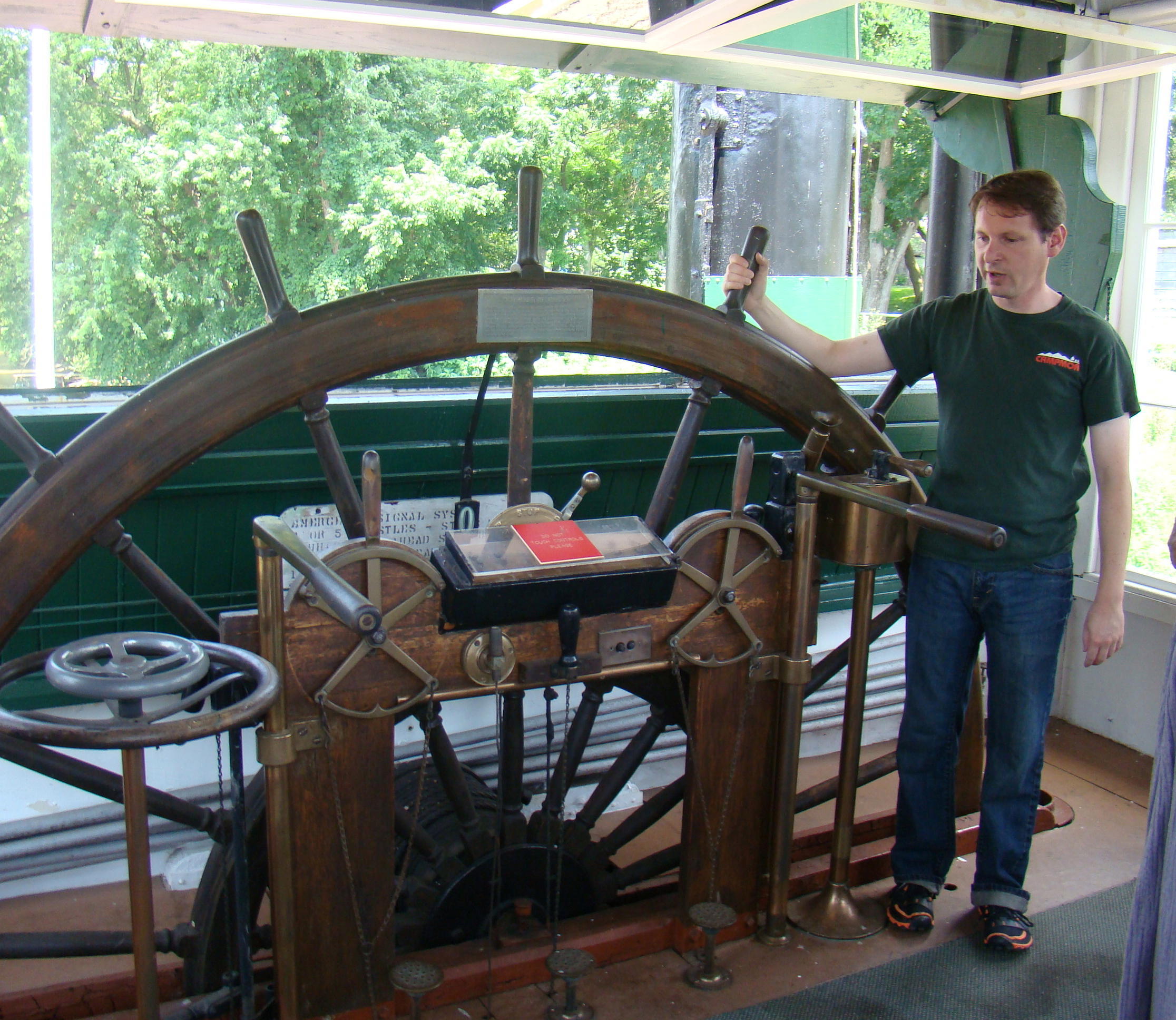
Pilot Wheel of W.P. Snyder, Jr.

Pilot Wheel of W.P. Snyder, Jr.

This early tugboat replaced the mules that walked along the banks of the river towing the barges. Tugboat probably wasn’t the best name for this type of boat, because they didn’t tug anything…they pushed it instead.

W.P. Snyder, Jr. was built in Pittsburgh in 1936 as the result of a terrible winter there. The wooden boats were brutally torn apart by the ice on the Monongahela River, so for the first time, a tugboat was constructed of steel by Carnegie Steel Co, and called W.H. Clingerman.

After years of service, it was retired due to its coal furnaces. In 1955, the Sons and Daughters of Pioneer Rivermen purchased the boat, now re-named the W.P. Snyder, Jr. for $1.00, and moved it to the banks of the Muskingum River in Marietta. This tugboat is the last intact steam-powered, stern-wheeled tugboat in the United States.

But the effects of weathering made it necessary, in October of 2013, for the W.P. Snyder to leave the dock at Marietta for refurbishing, mainly on the exterior. The trip back had a slight delay because the Ohio River was too high in late May, 2014 for the W.P. Snyder to get under the Putnam Avenue Bridge.

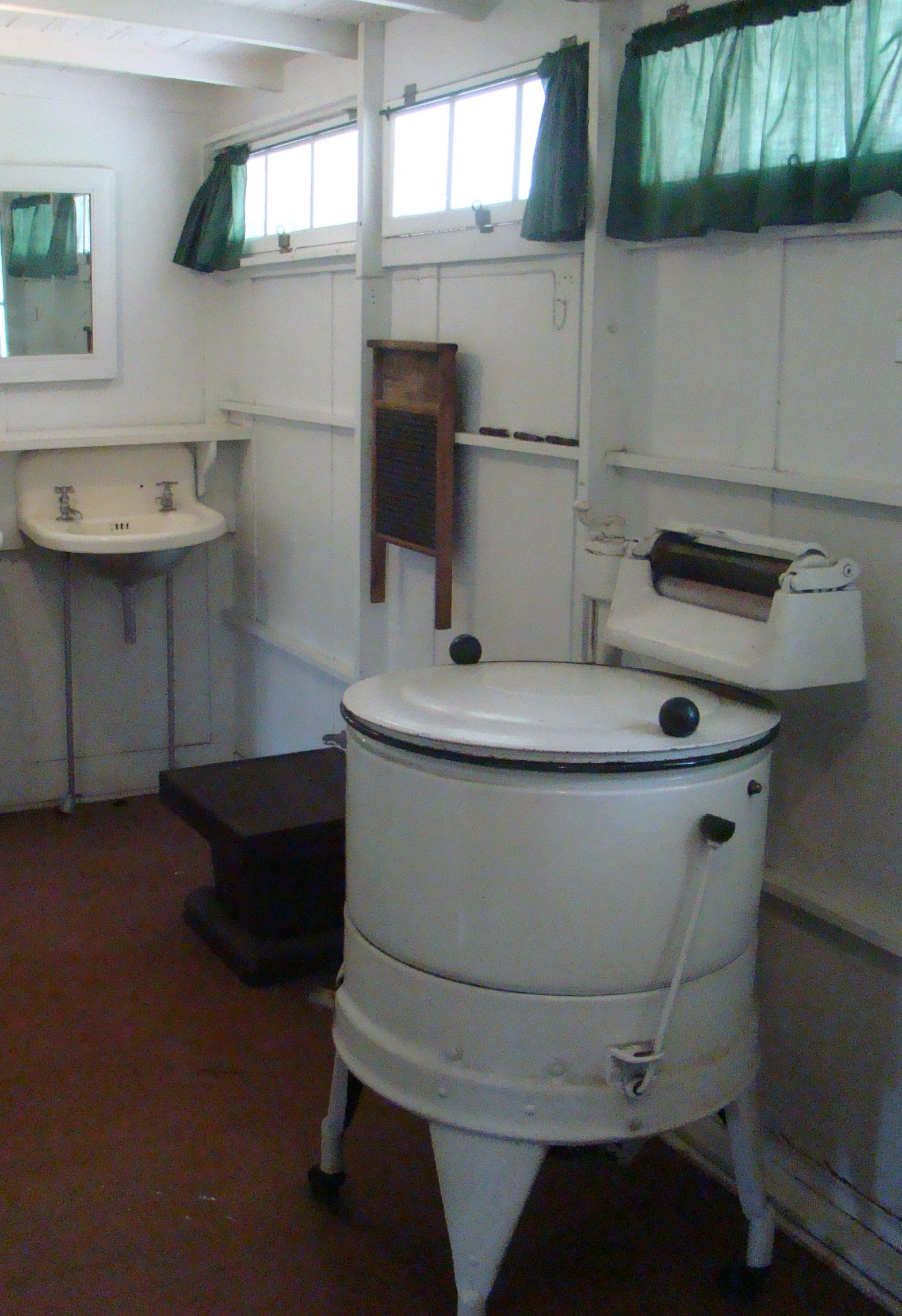
Laundry Room with wringer washer and washboard

Laundry Room with wringer washer and washboard

Pushed back by two antique tugboats, Lady Lois (‘28) and J.S. Lewis (‘31) the W.P. Snyder, Jr is now moored at the confluence of the Muskingum and Ohio Rivers, ready for tour.

On board, you will see the Engine Room, where the engineer controlled passage by using not only steam but also electricity. A system of bells could be pulled to signal conditions or problems. There was even a telegraph handy for outside communication.

Officers and crew were provided completely separate living quarters on the upper deck. If at all possible, officers and crew went out of their way to keep from crossing paths. Two separate bathrooms, a laundry room, and kitchen completed the facilities onboard.

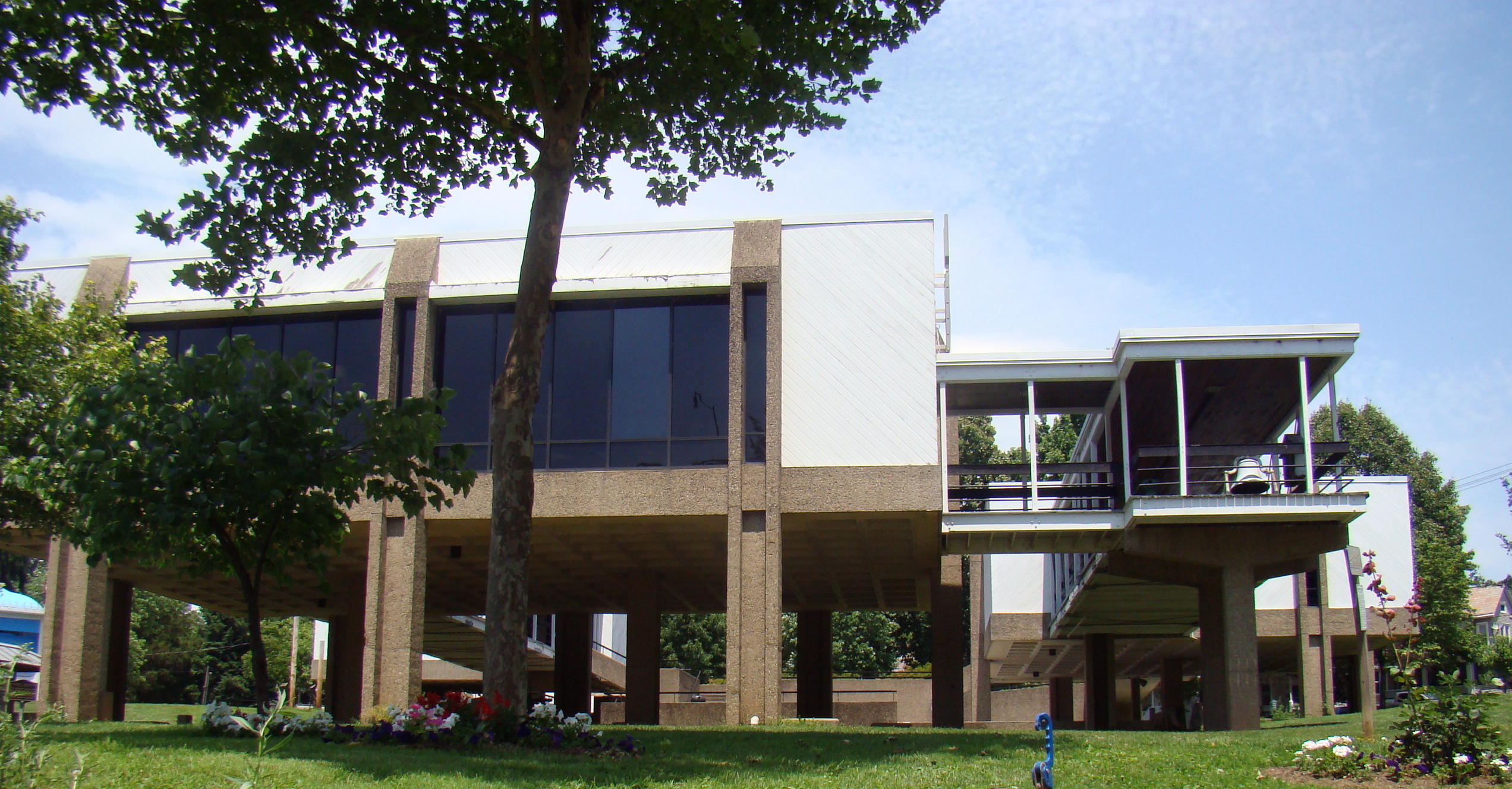
Ohio River Museum

Ohio River Museum

While the tugboat draws many visitors to the museum, there are three separate buildings nearby that contain a history of the Ohio and Muskingum Rivers, and the steamboats that frequented their waters.

An introductory film, History of Steamboats, opens the door to exploration inside the museum. The buildings are filled with models of steamboats, related artifacts, and stories of early life on the river…and much more!

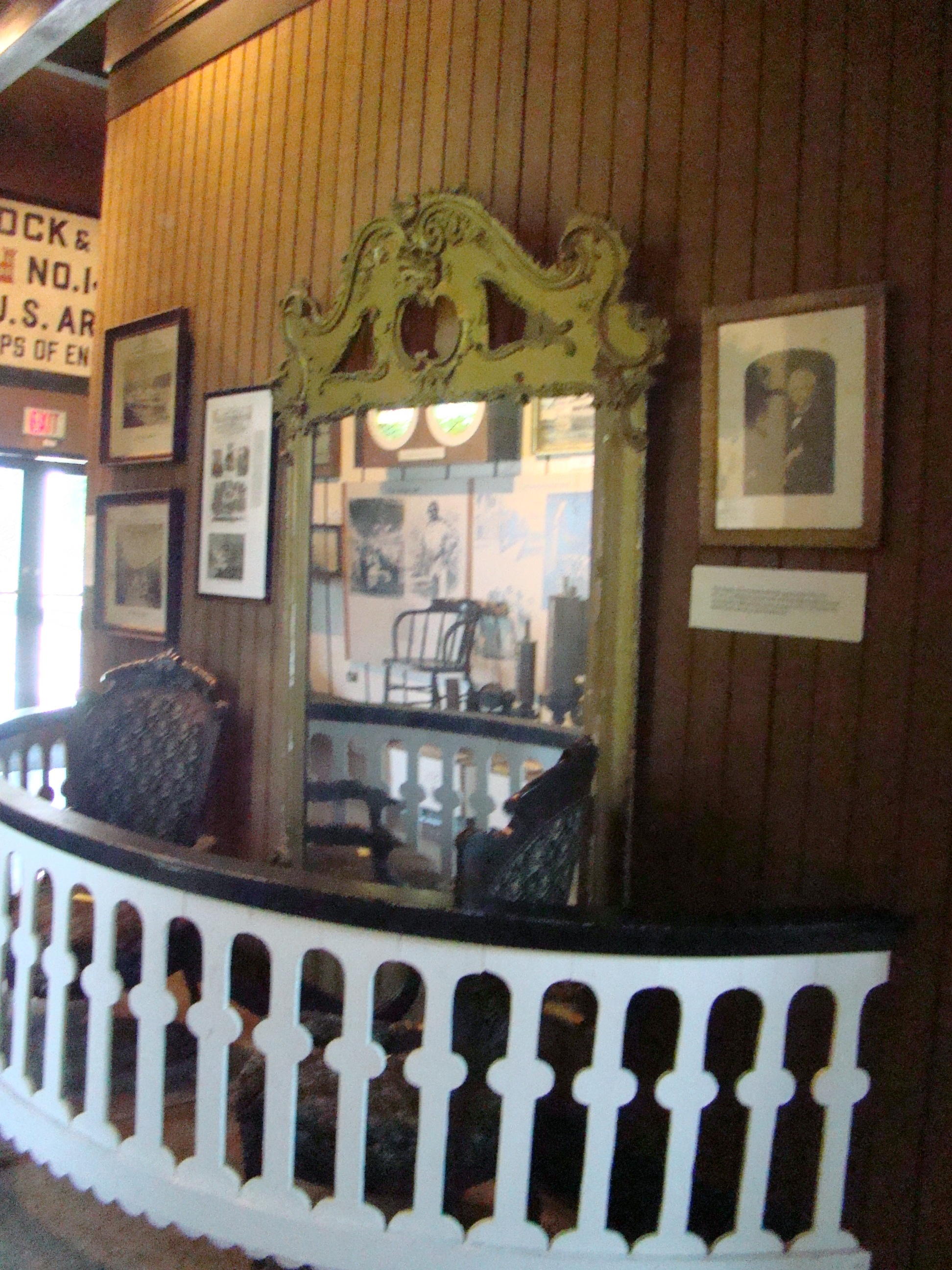
Mirror from Mark Twain's Crystal Palace

Mirror from Mark Twain’s Crystal Palace

Among the historic pieces, the exhibit contains a dug-out canoe that was used as a ferry between Fort Harmer and Marietta. There is even a reminder of Mark Twain through a display of an ornate mirror that hung in the Crystal Palace steamboat, where Mark Twain served as pilot.

Near the river’s edge, a flatboat that was used during Ohio’s early settlement is on display. Close by stands the oldest existing Western Rivers’  steamboat pilothouse from the steamboat, Tell City, which sank in 1917. An interesting section of poles shows the heights of some of the worst floods in Marietta history, three of the worst being : 54.5′ in 1884, 55′ in 1937 and 60.3′ in 1913.

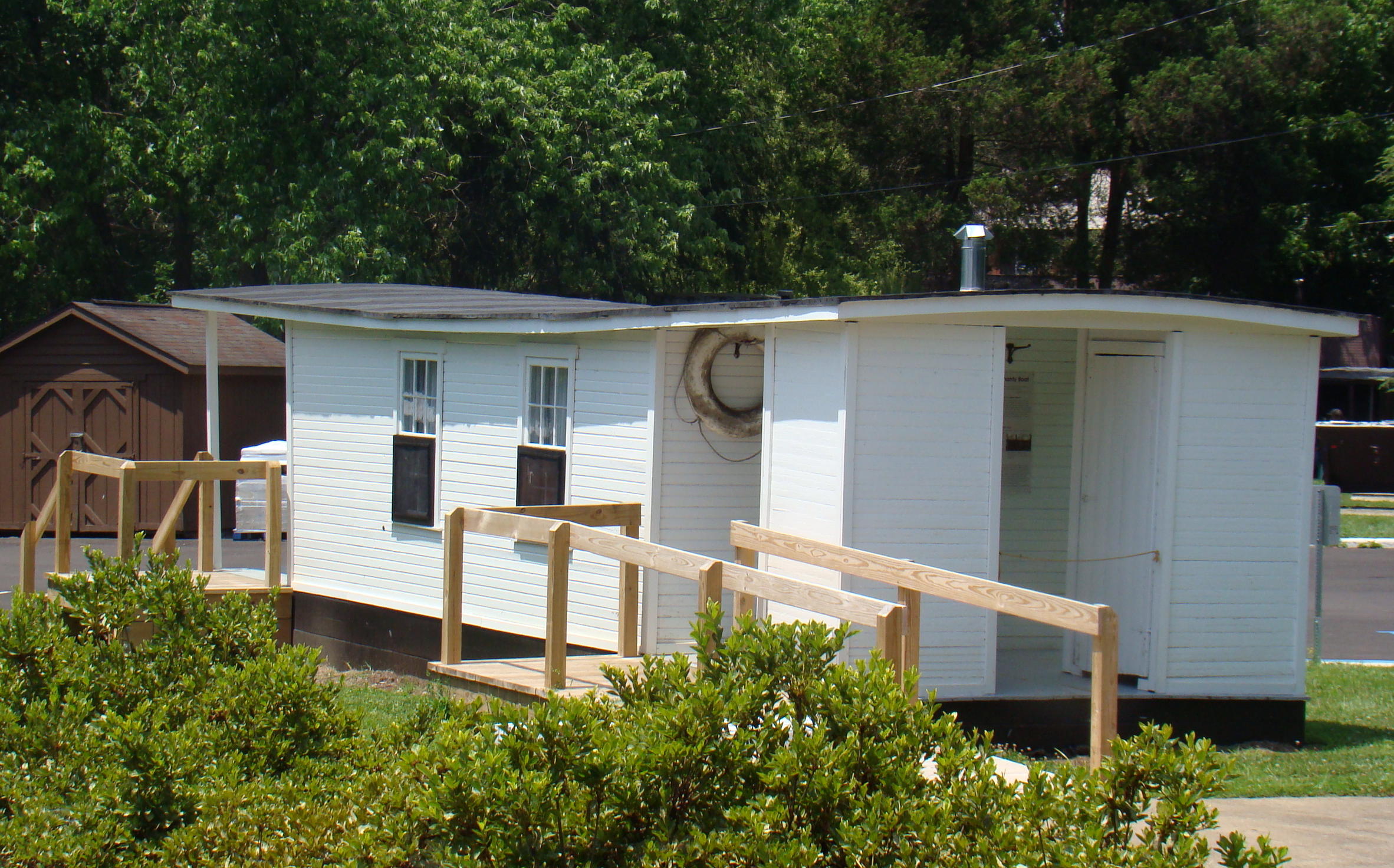
Shanty Boat where folks flew under the radar

Shanty Boat where folks flew under the radar

Don’t miss the old shanty boat, probably from the 1920’s to 1930’s. It possibly could be the oldest surviving shanty boat on the inland river system. People actually lived on these boats or had businesses there. Many of those who lived on the boats were trying to hide from something. Here they could avoid taxes as they were always on the move, and needless to say, the shanty boat provided the perfect place for thieves and lawbreakers, of many sorts, to hide from the law.

These floating shanty boats were banned in 1930 from the Ohio and Muskingum Rivers. However, a friend said when he was a kid in Parkersburg along the Ohio River, there were still shanty boats in the 50’s . Evidentally, more law breakers! The gypsy in me still likes the idea of being able to fly under the radar during those early years with no address, but much freedom.

End your day by cruisin’ down the river on the Valley Gem docked right next door to the Ohio River Museum.

The Ohio River Museum is located at 601 Front Street, Marietta, Ohio, one block from Ohio State Route 7, and minutes from I-77. Plenty of free parking is available and cost of admission is very reasonable.

Visit Henderson Hall Plantation 19th Century Hoarders

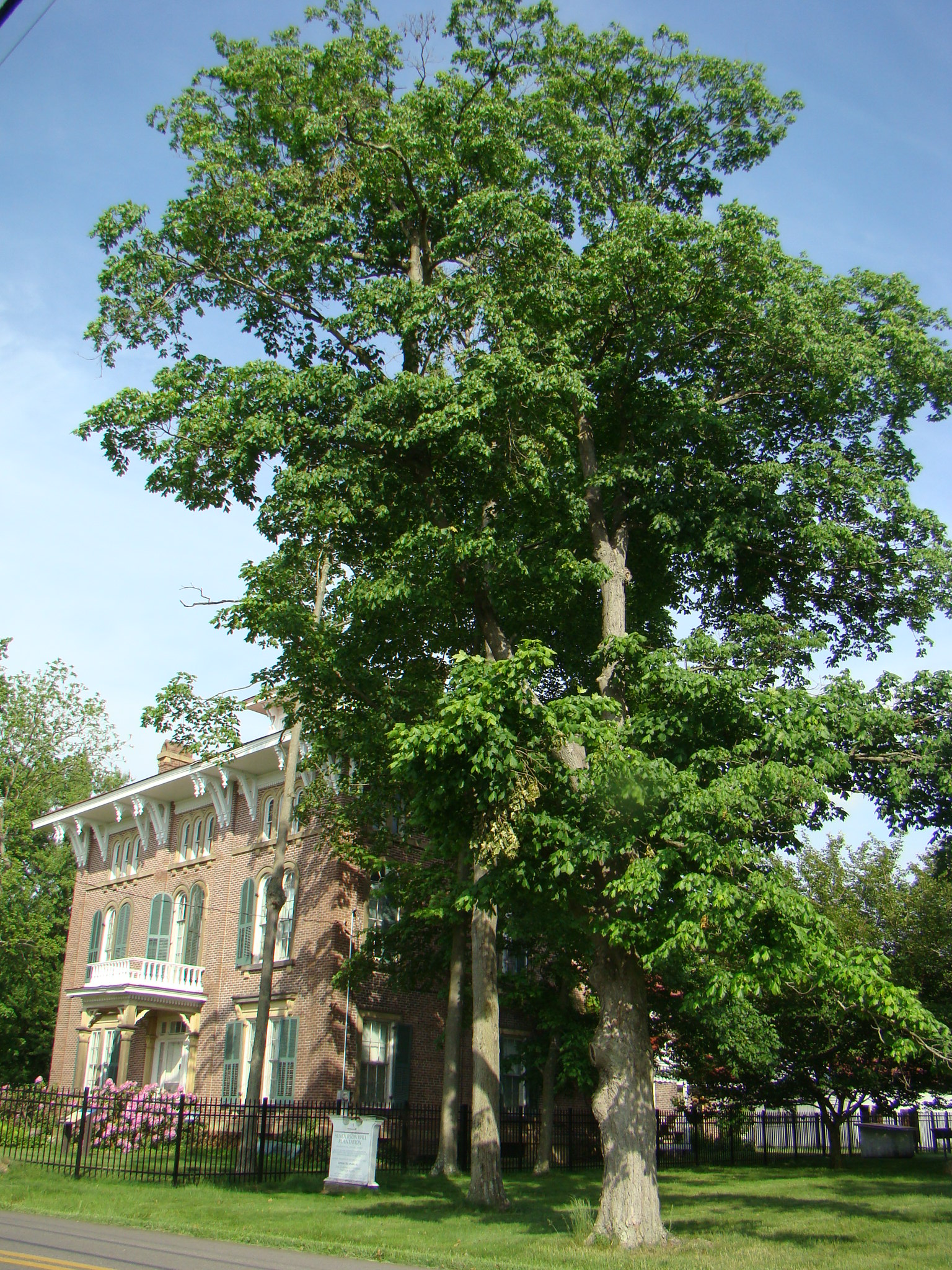
Henderson Hall

Henderson Hall

Look for a hidden treasure across the river from Marietta, Ohio along the banks of the Ohio River. Here a Victorian plantation mansion from nearly two hundred years ago seems to watch over the river between Williamstown and Parkersburg, WV.

Even before Henderson Hall came into being, the Henderson family played a vital role in the Ohio River Valley. Vice-President Aaron Burr and Harman Blennerhassett thought that perhaps the Henderson brothers would help in their attempt to set up a separate nation west of the Alleghenies. Hendersons would not be coerced, called their father’s friend President Thomas Jefferson, and testified in the Burr-Blennerhassett trail in 1807.

Henderson Hall was built shortly thereafter in 1835 by George Washington Henderson and Elizabeth Ann Tomlinson Henderson, grand-daughter of original claimant of Williamstown. This merger of estates encompassed 2600 acres on the eastern bank of the Ohio River. It seemed that everything they touched turned to gold, from the land they purchased, to breeding fine horses, to owners of an oil field boom.

Henderson Indian Mound

Adena Indian Mound

Walking to the house, one of the three Indian mounds on the property is clearly visible. Dating back 2,000 years, Adena mounds appear in several places in the Ohio Valley. Inside the mounds were found skeletal remains and artifacts.

Even though the Henderson family supported the efforts of the Union during the Civil War, they did themselves keep thirty slaves. Some of those slaves actually left through the Underground Railroad, which the Henderson family supported, in Marietta, Ohio.

This well preserved Victorian plantation propels visitors into the past with twenty-nine rooms to explore. All the rooms overflow with memorabilia from the 18th century to the present. It seems the Hendersons kept everything. 250 years of letters and diaries were found in the home – what treasures! Even more impressive is the trail of famous historic figures, who visited frequently.

Front Parlor

Front Parlor

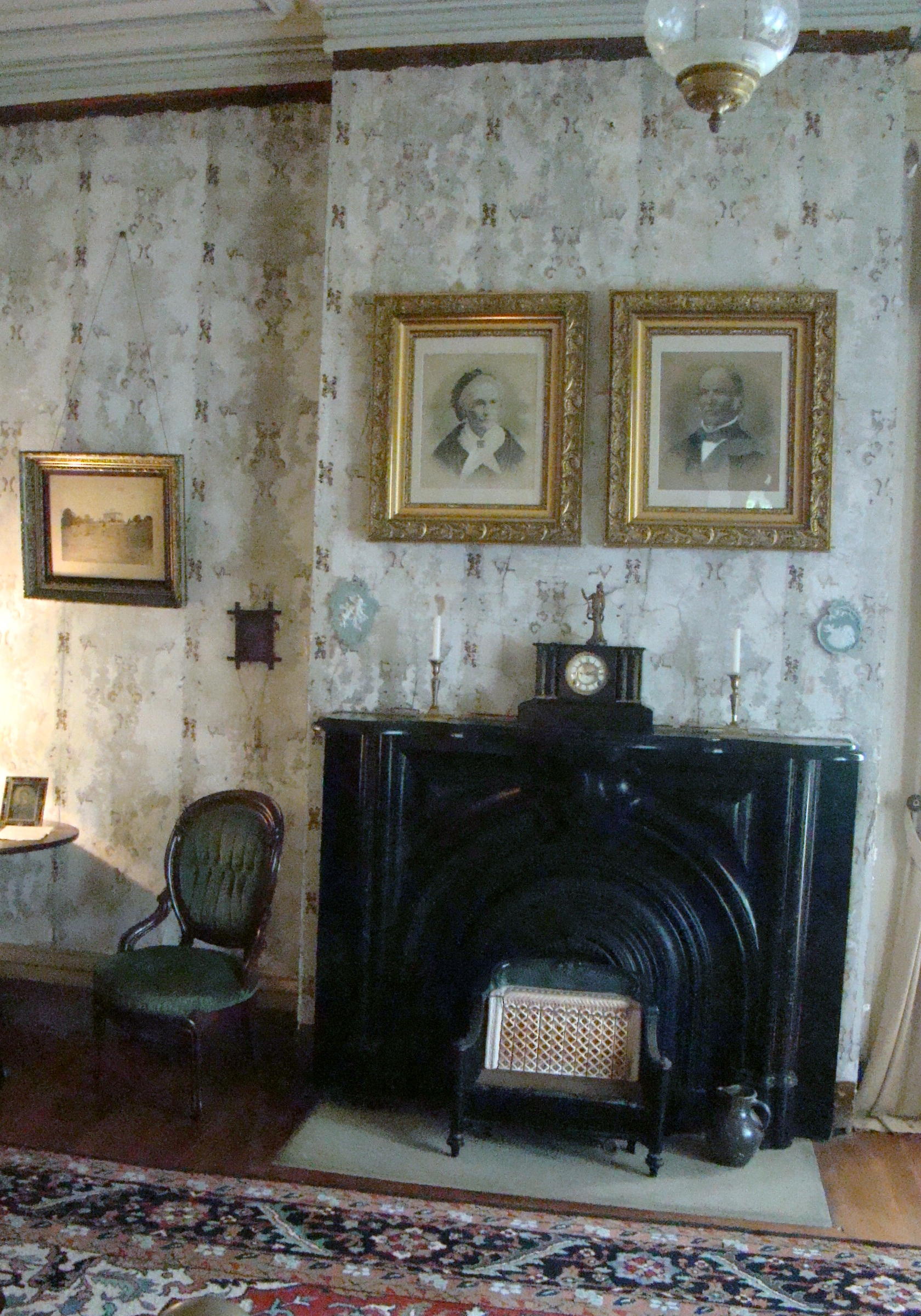
In the front parlor with its gold leaf wallpaper, pictures of Elizabeth and George hang over the mantle of the fireplace. In the picture she wore a hair broach, which was considered mourning jewelry. Having twelve children during their lifetime, six of them died before the age of ten. Elizabeth took a lock of hair from each of those six children to weave into an intricate pattern for her broach, which she always wore. The broach remains on display today in their small museum.

Collections from these 19th century hoarders give visitors a chance to see the changes made in many areas of life. The overwhelming amount of treasures saved, ranges from toys to wedding gowns to beautiful dining room settings. A winding staircase curves up to the third floor ballroom, making the mind wonder how those ladies managed these steep stairs in their flowing gowns.

The original kitchen

The original kitchen

The 1836 kitchen holds household cooking utensils and crockery dating back a couple centuries. This was part of the original smaller house before the 1859 impressive addition. Many of the rusted kitchen utensils can be found stored in the basement today.

When the last family member died in 2007, the historic house was deeded to the Board of West Virginia Oil & Gas Museum. Today they keep the place in repair and have great guides to share the Henderson story.

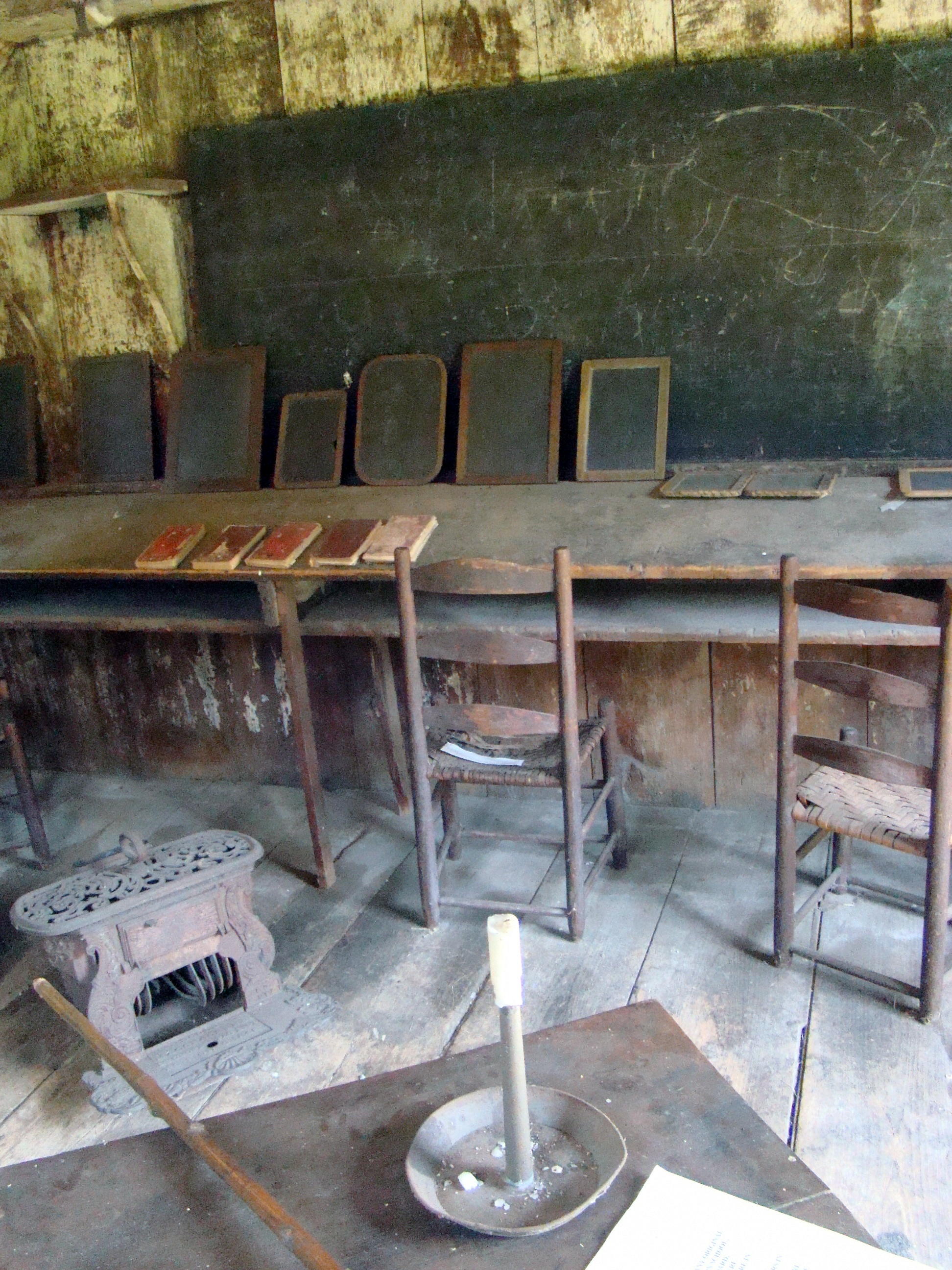
First school houe in West Virginia

First school houe in West Virginia

The earliest school in the area was here behind Henderson Hall in 1836. Note the teacher’s desk with candle and switch – for pointing and for correcting. Several old books from that time period have been placed on the students’ desk along with slates to practice writing and mathematics. Original equipment includes:  slates, blackboards, and seats. What a thrill to gently touch the slates, which were used by youngsters from the 1800’s.

The Carriage House contains different buggies. Among them is the actual buggy used by the original founders, George and Elizabeth, on their honeymoon to Niagara Falls.

Henderson Hall overflows with treasures too numerous to mention. Hopefully you have now received a taste of history that will whet your appetite for more. Johnny Chapman, John James Audubon, and Stephen Foster always enjoyed their visits here.  Shouldn’t you?

Henderson Hall Plantation is just a few miles off I-77 at the Williamstown, WV exit. Follow Route 14 South, then turn right on Old River Road. Summer hours are noon- 5 p.m. daily.