Places to go and things to see by Gypsy Bev

Posts tagged ‘Ohio’

Time for Chestnuts Roasting on an Open Fire

For two months each year, the spirit of Charles Dickens thrives in the city of Cambridge. One of the favorite delicacies of Dickens’ Victorian England was chestnuts. At a party in his famous novel, “A Christmas Carol”, he wrote,”the chestnuts and the jug went round and round.” So perhaps Charles Dickens would have enjoyed visiting a chestnut farm just north of here in Carrollton.

Back in the time of Charles Dickens, cones filled with hot roasted chestnuts were sold on street corners in merry old England. Not only did this provide a tasty treat, but holding the cone kept the hands warm as the aroma of roasted chestnuts filled the street.

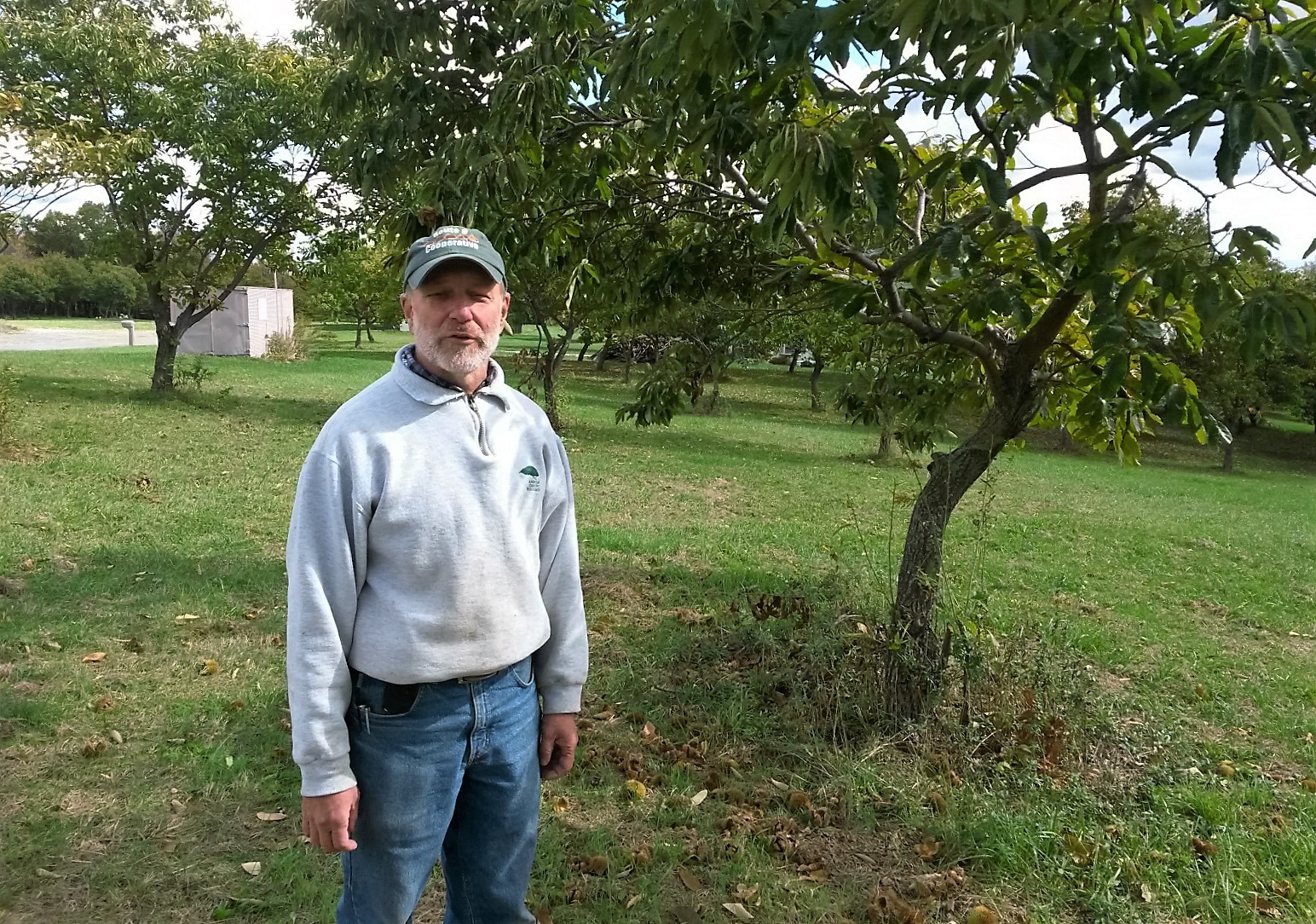
Greg Miller enjoys telling everyone about his chestnut orchard.

Greg Miller enjoys telling everyone about his chestnut orchard.

Here in Ohio, Greg Miller’s father began a hobby of growing chestnuts and various nut trees back in the 70s after a blight destroyed nearly all the American chestnuts back in the early 1900s. When Greg returned home from college, they noticed that the Chinese chestnuts were the most productive. Thus began the Empire Chestnut Co.

On their farm on Empire Road near Carrollton, chestnuts are planted in their nursery to start new trees. Only the very best chestnuts are used for this purpose. These new seedlings are then transplanted to a nearby field until they are mature enough to sell.

Headquarters for Route 9 Cooperative sports five chestnuts, indicating the five families that participate in the cooperative.

Headquarters for Route 9 Cooperative sports five chestnuts, indicating the five families that participate in the cooperative.

They encouraged others to plant them too and in 2010, with four other growers, formed Route 9 Cooperative, headquarters for the only commercially grown chestnuts in Ohio.

This is no small operation. From 90 acres of chestnut trees, over 60,000 pounds of chestnuts are harvested annually. Chestnut trees thrive in sandy loam soil. Greg said, “They grow best on a mountain or hillside where the soil is so poor you can’t raise your voice on it.”

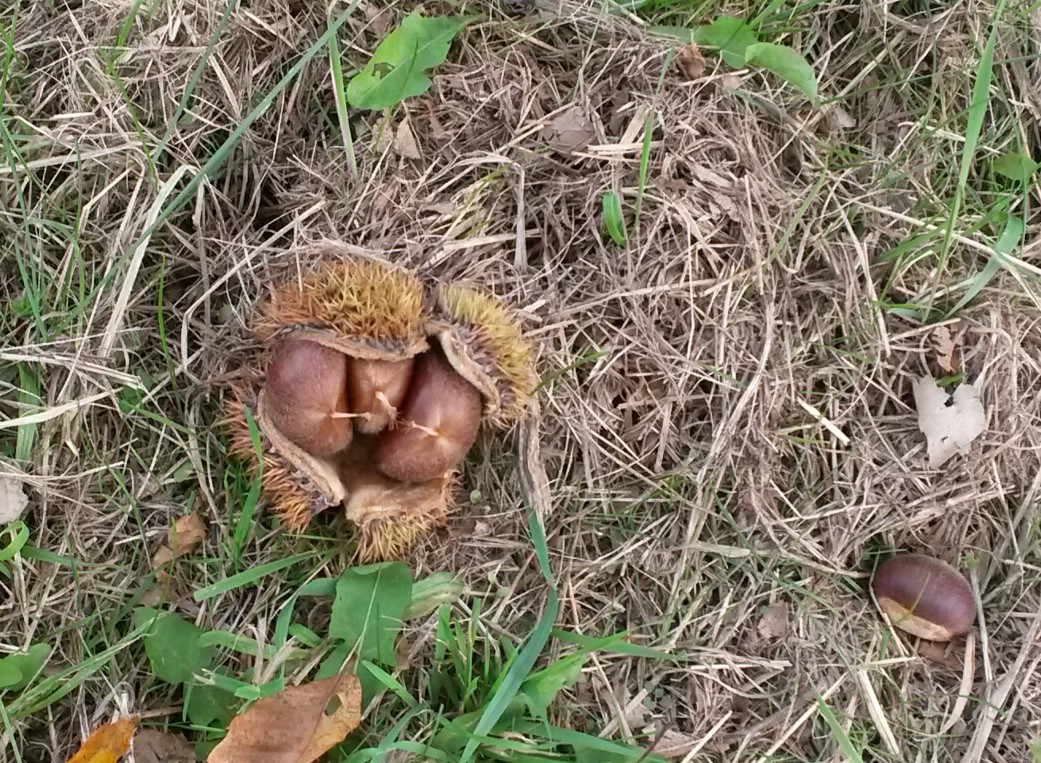
Chestnuts fall to the ground in a prickly hull, which is soft inside.

Chestnuts fall to the ground in a prickly burr, which is soft inside.

For those familiar with chestnuts, harvesting can be difficult and even painful. When the prickly burr falls from the tree, it normally pops open revealing three or four chestnuts inside. However, the inside of the chestnut hull feels as smooth as velvet. thereby cradling the nuts.

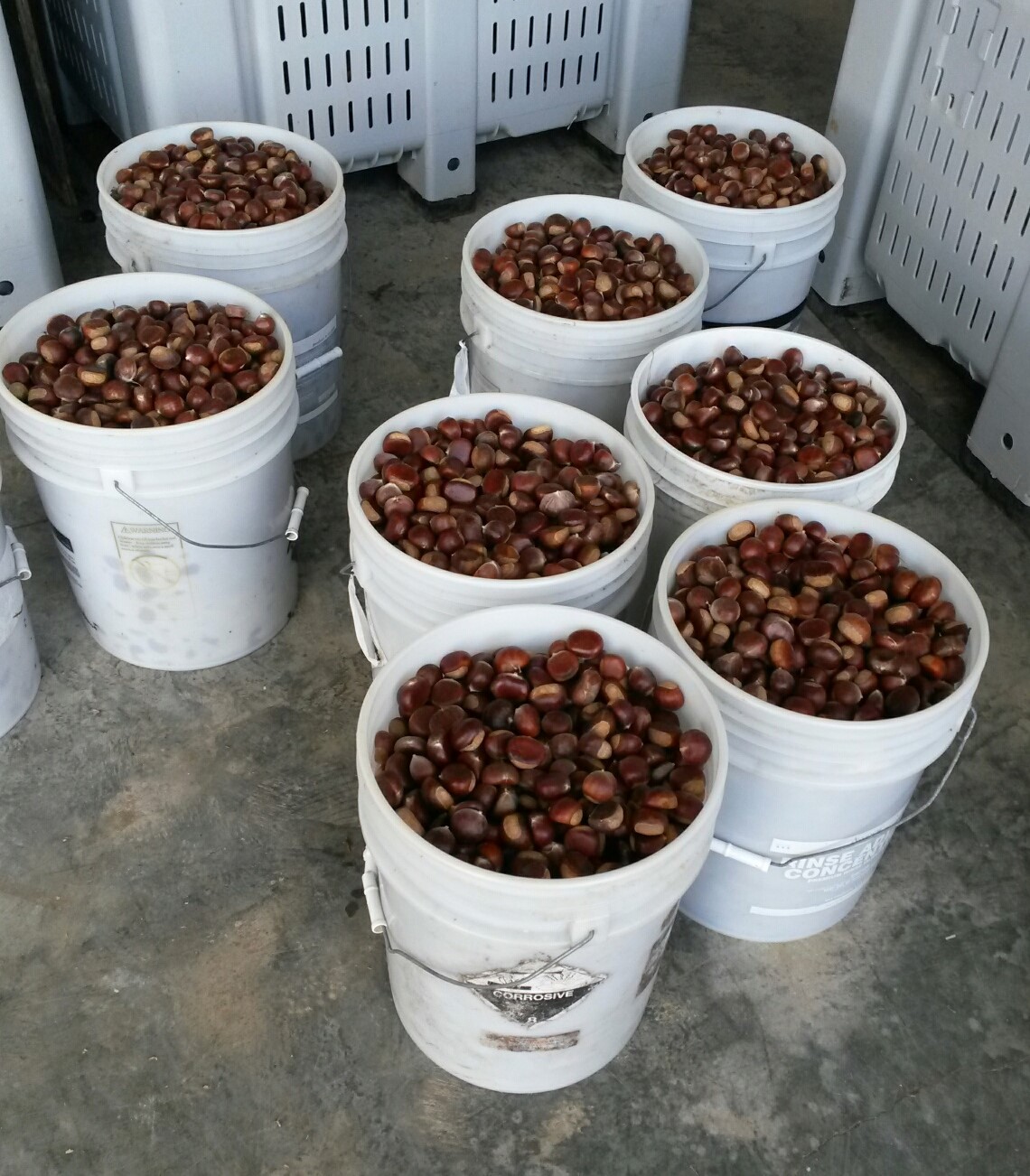
Imagine picking a bucket of about 1,000 chestnuts - one by one from the ground.

Imagine picking a bucket of about 1,000 chestnuts – one by one from the ground.

Even with today’s modern technology, chestnuts are still picked by hand. Greg places an ad in the paper looking for workers and usually has 100-200 people picking each year. They range from individuals to Amish families and community youth groups. His ad carries a bit of humor:

If you don’t mind bending down to pick up a penny,

this job might be for you!

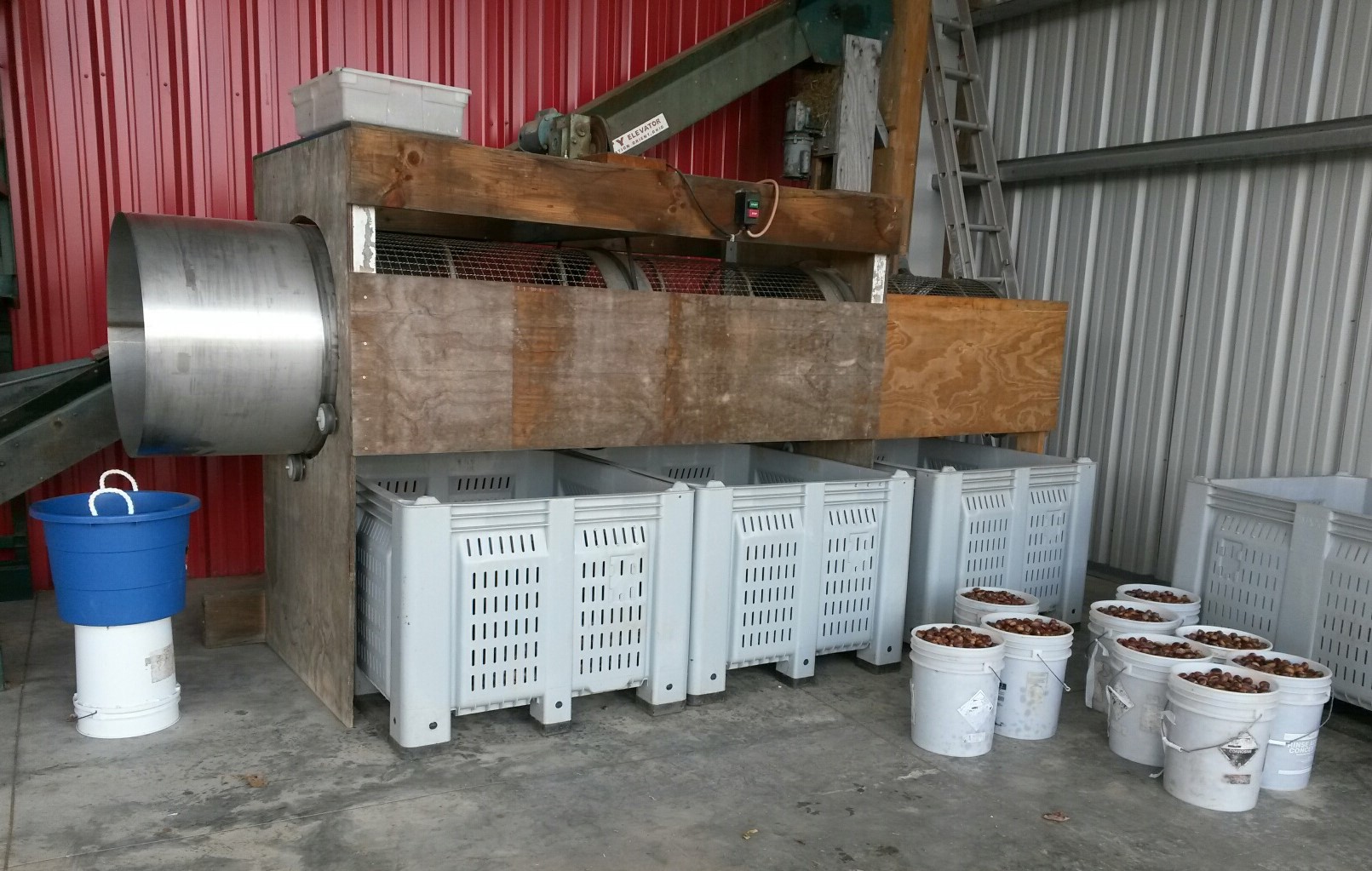
This Drum Sizer cleans and sizes the chestnuts.

This Drum Sizer cleans and sizes the chestnuts.

It takes over 1,000 chestnuts to fill a five gallon bucket so picking requires a lot of patience. Once the buckets are filled, the chestnuts are cleaned and sorted by size before their plastic perforated bin gets placed in the “nut jacuzzi”. As a precaution, to eliminate the possibility of any insects or eggs surviving, they are kept in a temperature of 119 degrees for about four hours.

The plastic bin filled with nuts gets dipped into the "Nut Jacuzzi" to kill any possible insects or eggs.

The plastic bin filled with nuts gets dipped into the “Nut Jacuzzi” to kill any possible insects or eggs.

From here they are hand sorted to eliminate any imperfect chesnuts, then dried in their bin, but kept moist to avoid mold. They are then placed in a refrigerated room before bagging.

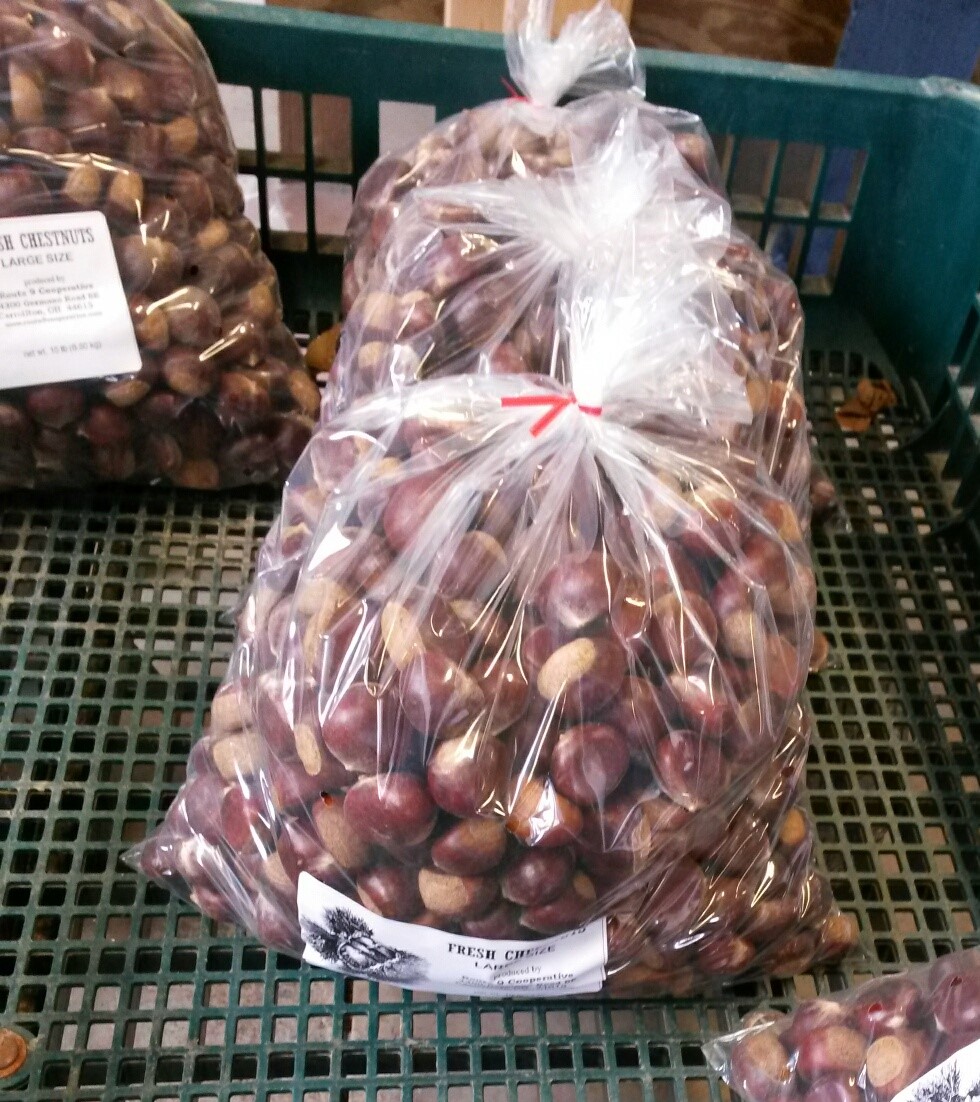
Finally, the chestnuts are bagged for shipping all over the United States.

Finally, the chestnuts are bagged for shipping all over the United States.

Most of their orders come from the internet and are sent all over the United States. Many of these customers being ethnic groups that have always enjoyed chestnuts as part of their culture. Some places even use them in chestnut beer and whiskey.

The Millers favorite way to eat chestnuts is “raw”. They feel they can easily tell the difference in quality by eating them this way. His daughter, Amy, also enjoys them ground into flour for pancakes. A delicious treat! One gourmet goat cheese producer orders chestnut leaves to wrap the cheese for flavor as it ages.

Orders for 50,000 pounds of chestnuts before the season began show the need for more chestnut tree growers. Chestnut trees are a long term investment as it takes about seven years to get your first chestnuts, while their peak will be reached in fifteen to twenty years. But at $3 -5 a pound wholesale, it may be worth the wait.

If Dickens’ Cratchit family lived here, they would be certain to place an order to make stewed chestnuts for Thanksgiving dinner. Perhaps at payment of $11 a bucket, they would even help pick them.

******************

Route 9 Co-operative is located near Carrollton on Route 9 south of town. Visit their website at http://www.empirechestnuts.com for more information

.

It’s Snowing in Cambridge, Ohio

dickens-snow

‘Snowing’ the scene is one of the final touches in the warehouse by Cindy and Shana.

Oh the weather outside’s been frightful…frightfully hot that is. But inside Dickens Universal, it’s snowing! The crew at Dickens Victorian Village is busy replacing the layer of snow on 67  scene platforms.

Some think that the scenes are placed on the street in the fall, returned to storage, and then magically appear again the next year. This is not the case, as much hard labor in many areas is necessary to repair the winter damage.

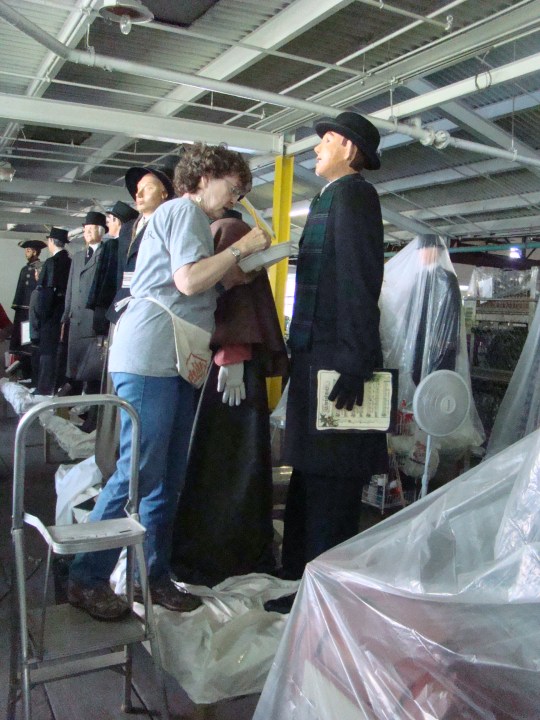
The Creation Team, who make and maintain the mannequins, works all year round so the figures will look excellent when placed on the streets in late October. There’s usually a month off in January to let them dry out from snow and rain. Then the work begins.

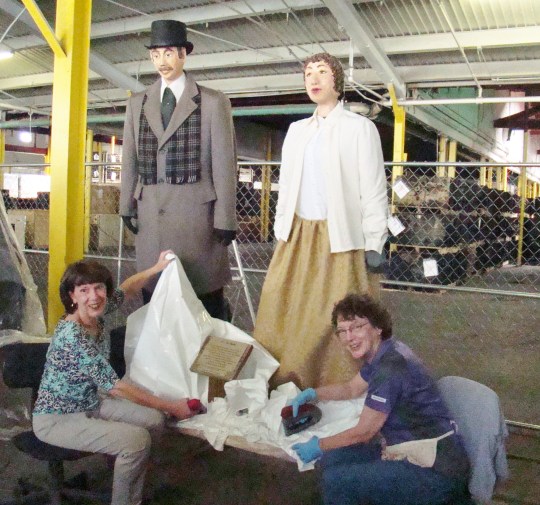
Last winter wasn’t a terrible winter, but still freezing and thawing plus the wind caused great damage to heads and clothing alike. “The Travelers” provide a great example of some of the possible problems to be encountered.

lindy-and-tom-replace-a-shirt

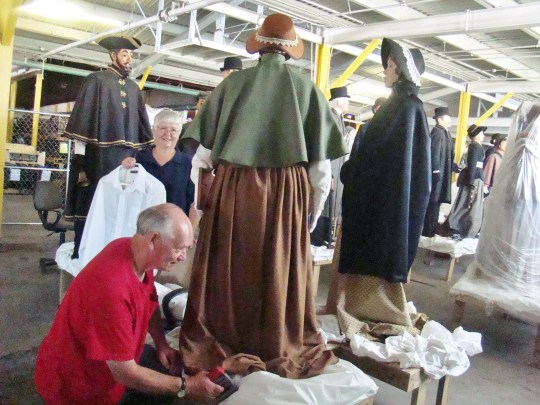
Lindy gets help from Tom putting a new shirt on this mannequin..

The lady needed a new skirt this year and it has been discovered that upholstery material is often one of the best choices. Cotton does not hold up well. Donated clothing and material are appreciated and used as often as possible. Making new clothes requires time at home at a sewing machine as well as time in Dickens Universal, where mannequins are stored.

One very time consuming detail happens when each item has to be tacked down, or they would blow away when on the street. For example, a scarf must be stitched meticulously to the jacket. This could take a couple hours to make it secure enough to hold through the strongest wind.

shana-paints-a-face

Touching up the heads seems a never ending job. Just ask volunteer, Shana.

Their heads need some repair each year. Often it is just a touch-up of paint, but sometimes the weather causes the clay used in making the heads to crack, much like our highways. When water gets in that crack, it expands creating bigger problems.Paint cracks and varnish turns yellow, so repairs are necessary if they are to look presentable on the street for the season.

john-and-annie-glenn

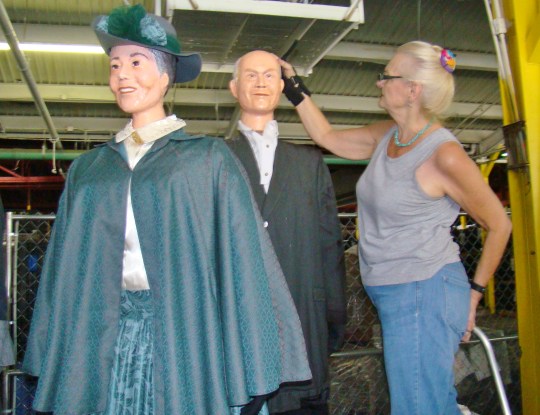
Annie and John Glenn take their place on Wheeling Avenue this year. Sharon had to adjust John’s neck to fit just right.

Once in a while the entire side of a face may peel off, causing either cracks to be filled or a new head to be made. Hats in some ways protect the heads, but in others they cause a problem as mildew forms under the hats that tend to hold dampness.

universal-chuck

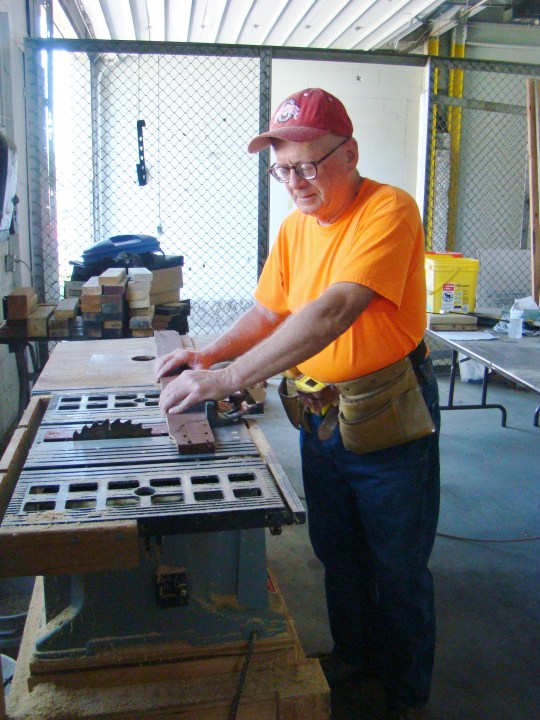
Making and repairing the frames has received great help this season from Chuck.

Inside each figure is a basic frame of 2 x 4s  and they all set on a raised platform to keep them off the ground and make them more easily seen on Wheeling Avenue. This is going to be the 11th year for Dickens Victorian Village, so some of these must also be replaced.

bob-and-lindy

Even founder, Bob, helps with ‘snowing’ as Lindy passes by with a clean shirt for another figure.

Around the base of each platform, a plastic skirt gives it a finished look. All skirts must be removed each year and thoroughly cleaned. Then snow is placed on the top of the platform in the form of white plastic, which is stapled in place.

sitting-mannequins

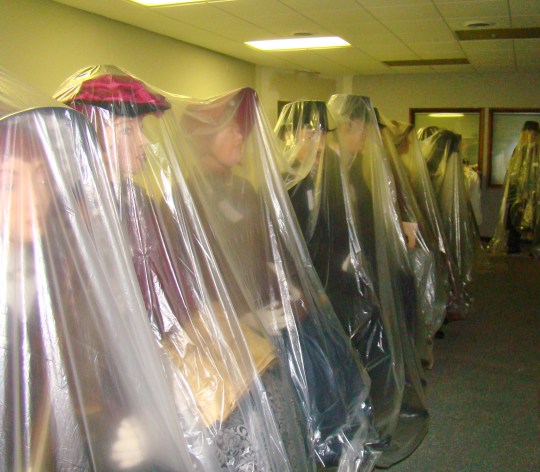
For now, those finished Victorian characters sit waiting for the end of October so they can make their annual trip to downtown Cambridge.

You can see that for “The Travelers” to be ready to make their journey in the fall, much time has to be spent for at least nine months of the year. Right now, even though there is no AC in the warehouse and work is frightfully hot, it’s snow time at Dickens Victorian Village.

Let it snow! Let it snow!  Let it snow!


Enjoy Musical Entertainment at the Salt Fork Festival

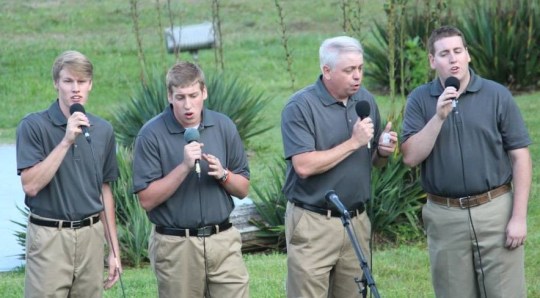
The Loves

The Loves Gospel Quartet

While most people think of artistic creations when headed to the Salt Fork Festival in Cambridge, Ohio, musical entertainment plays a large role in the festivities.

Jazz   Celtic   Bluegrass   Gospel   Bands   Dance   Strings  Drums

A wide variety of musical entertainment will be presented at the Salt Fork Festival from August 12-14, 2016 at the Cambridge City Park. Every day the Performing Arts Tent and Large Pavilion will be filled with music by many different groups.

Yurco Boys

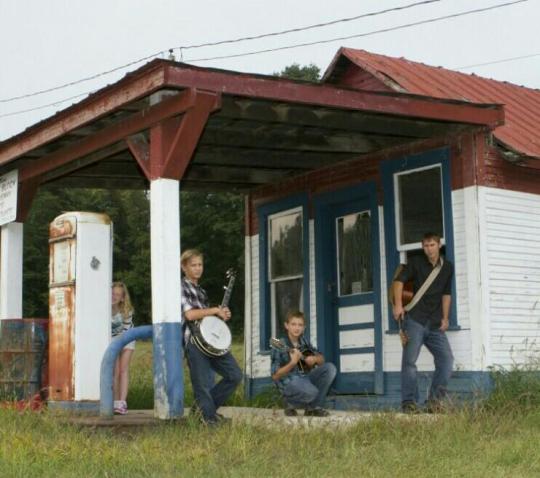
The Yurco Boys

It all begins on Friday afternoon with The Yurco Boys, a talented group of young men who sing bluegrass music while strumming on their guitar, mandolin, and banjo. These young fellows are brothers and have been performing together for seven years. Their lively music is a crowd pleaser and they get better every year. Sometimes their little sister, Waverly, brings her fiddle along and joins in the fun.

Northwest Territory

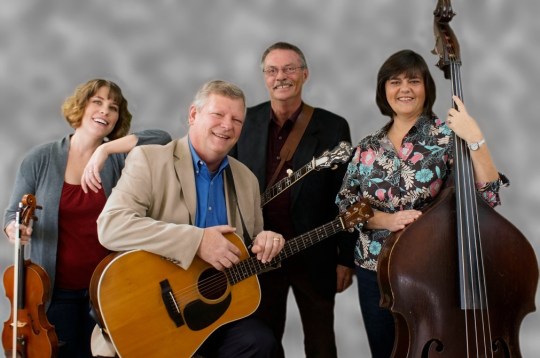
Northwest Territory Bluegrass Band

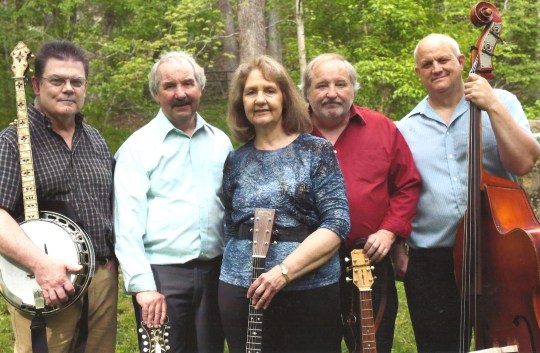
They aren’t the only Bluegrass musicians this year. During the weekend you’ll also want to hear the Northwest Territory Bluegrass Band, a lively fast-moving quartet that also sings country, folk and gospel.

Buck & Company 001

Buck & Company

Buck & Company think Bluegrass people are the best people in the world and their dedication to high quality bluegrass is certain to please.

Chris Hart

Chris Hart

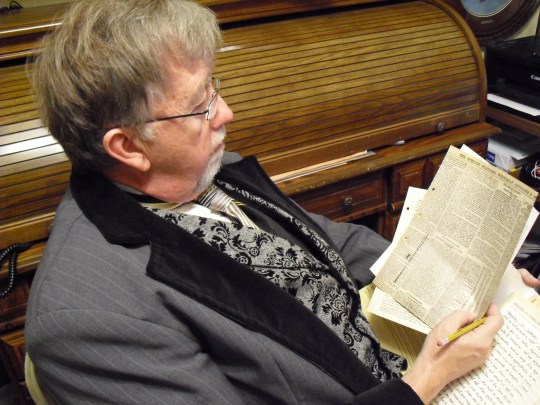
Chris Hart will portray a Civil War veteran in “Paws for the Cause”, a tale of Curly, a mascot during the war. This is a must see for every dog lover or Civil War buff.

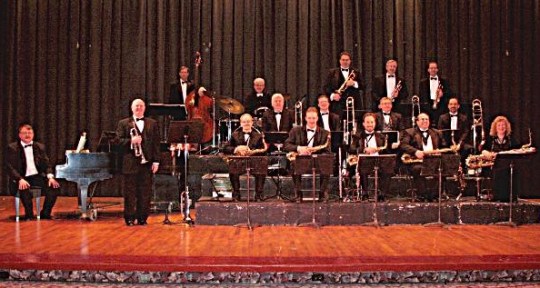
Cambridge Jazz Band

Cambridge High School Alumni Jazz Band

Bands will also provide entertainment during the festival. The Cambridge High School Alumni Jazz Band brings back students who have enjoyed music over the years. Their quality of music brings listeners back again and again.

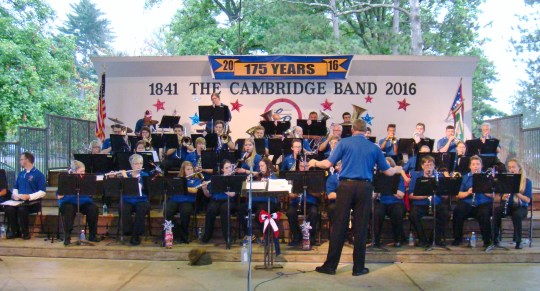
Berk Cambridge Band

Cambridge City Band

The ever popular Cambridge City Band has been active a long time. On this their 175th anniversary, you can expect some great music and even special antics by their conductor, Berk Jones. They are a pleasure all summer long at the Cambridge City Park.

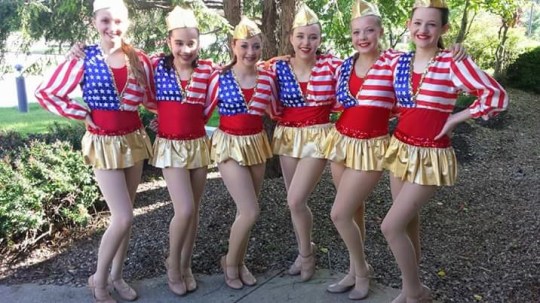
Dance Central

Dance Central

Dance Central presents a vivacious program with students performing a wide variety of dances. Their dancers learn to express themselves through jazz, hip-hop, tap and ballet. This group puts on a vibrant show and often their dancers perform at community activities, such as the Cambridge Singers’ Concert or the Dickens’ Teddy Bear Tea.


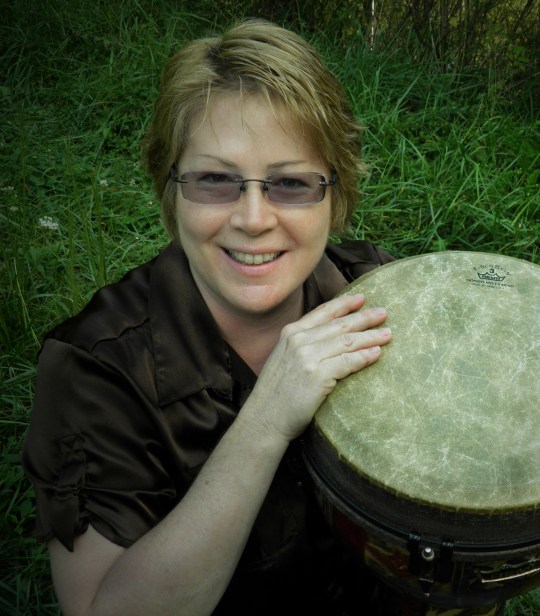
OLYMPUS DIGITAL CAMERA

Toni Kellar “Roots to Rhythm”

A special feature will be Toni Kellar with her “Roots to Rhythm” program. Toni’s popular drum circles help people find their inner rhythm and soon the group is connected through this fantastic drumming technique.

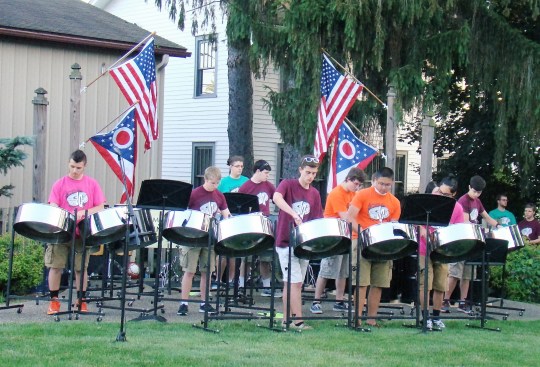
PanJGea 2

PanJGea!

New to the area is a group called PanJGea from John Glenn High School. This steel drum band produces a sound and rhythm that everyone will enjoy. It’s indeed surprising to find the sound of the Caribbean here in Ohio as the band plays traditional calypso and Salo. But these youngsters also enjoy using their pans for rock and roll or doo-wop.


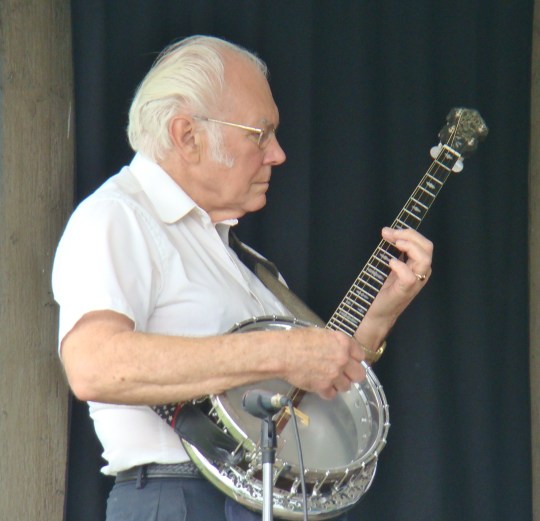
Dick Pavlov

Dick Pavlov entertains with his banjo.

Steve Miller

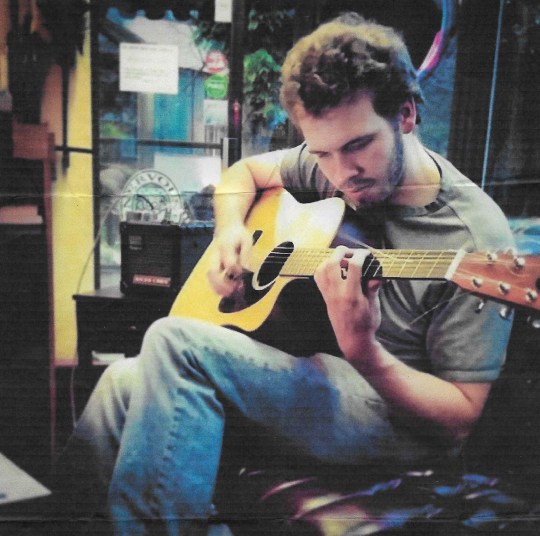
The talented Steve Miller strolls as he plays his guitar.

Strolling musicians throughout the weekend will play their music while walking the grounds of the festival. Dick Pavlov with his banjo and Steve Miller on guitar never seem to tire of playing.

Festival Chorus

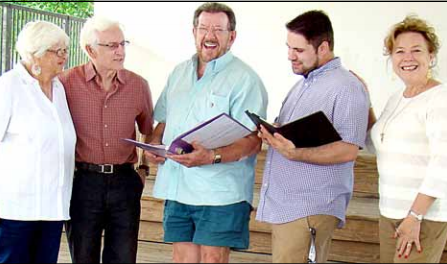
This group has been planning the entertainment portion of the festival and have created a dynamic Festival Chorus, which will be performing on Sunday.The group consists of: Holly Phillips, Leonard Thomas, Bob Jones, Aaron Lashley, and Carol Jones. 

There is something for every musical taste during the Salt Fork Festival, August 12-14 at the Cambridge City Park. Come out and enjoy a weekend of outstanding artistic creations, fine musical entertainment, and refreshments to enjoy on a hot summer day. You may even want to try your hand at a workshop and do a little creating yourself.

Have fun at the Salt Fork Festival!


Cascading Cedar Falls in Hocking Hills State Park

Cedar Falls 1

Welcome sign to Cedar Falls

Should I or shouldn’t I?  That was the question upon approaching the one hundred steps down to Cedar Falls. The naturalist said they were easy steps so with the help of my walking stick, the walk down began.

Cedar Falls steps

Looking back to the top

From the very top, the roar of the falls could be heard distinctly. That brought a smile to my face as several trips to the falls in previous years were made in the summer time when the water was not running with much force.

In Hocking Hills State Park, it was also surprising how many others were looking for that peaceful walk through nature. Step  by step the bottom got closer, but the sound of the falls got farther away. Well-placed benches along the way provided not only a place to rest, but a place to meditate and connect with nature.

Cedar Falls flowers

Tiny white spring blossoms

Since this trip was solo, there was no need to hurry so it was possible to leisurely enjoy the sights and sounds of the forest along the way. Springtime just had its beginnings that day and small flowers were popping up through the ground.

Cedar Falls Ferns

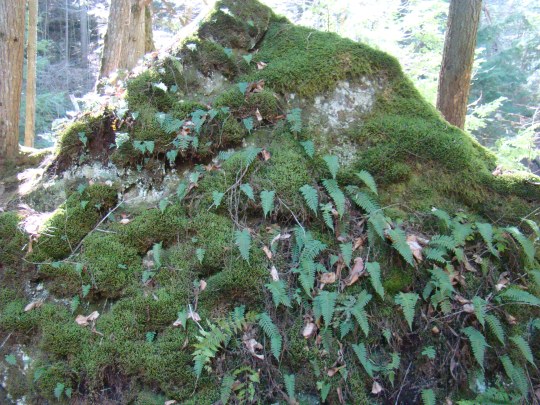
Fern and moss covered rock

Ferns were coming back to life and the trees were budding. A good day to be out for a walk.

Cedar Falls stream

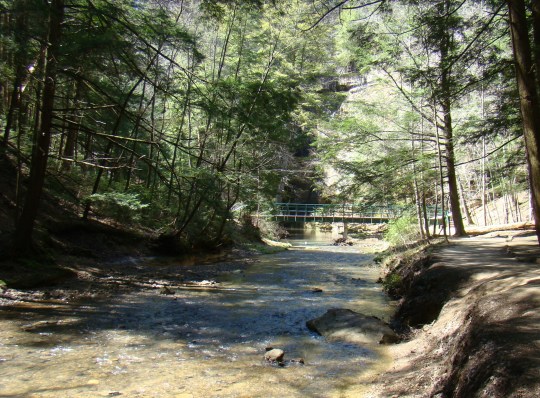
Bridge over the stream

To be in nature is to know peace. At the bottom of the stairs, a path along the stream, called Queer Creek by the early settlers, brought relaxation, because this far from the falls the stream ran quietly. But the nearer the path came to the falls, the stream became a bubbling brook with water rippling over the stones. Seemed like a great place to build a cabin.

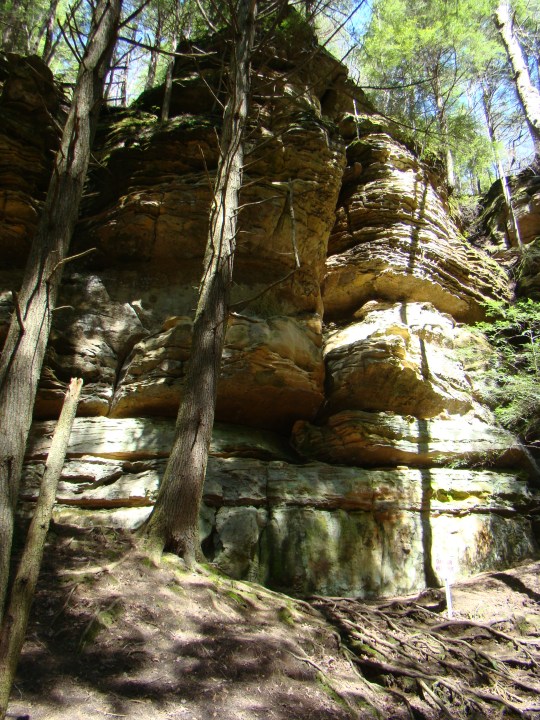
Cedar Falls cliffs

Surprisingly high cliffs

This remote area was bound by steep rock walls and grottos. While it may be a wild and lonely place, its beauty made the trip worthwhile.

Cedar Falls

Powerful Cedar Falls

After crossing the gentle bubbling brook, a path led closer to the waterfalls. Around a bend, it could be heard full force. As the stream tumbled over the face of Blackhand Sandstone, the amazing force of the water was displayed. A large rock platform or another small bridge made perfect places to take pictures of the waterfalls and drink in their beauty and power.

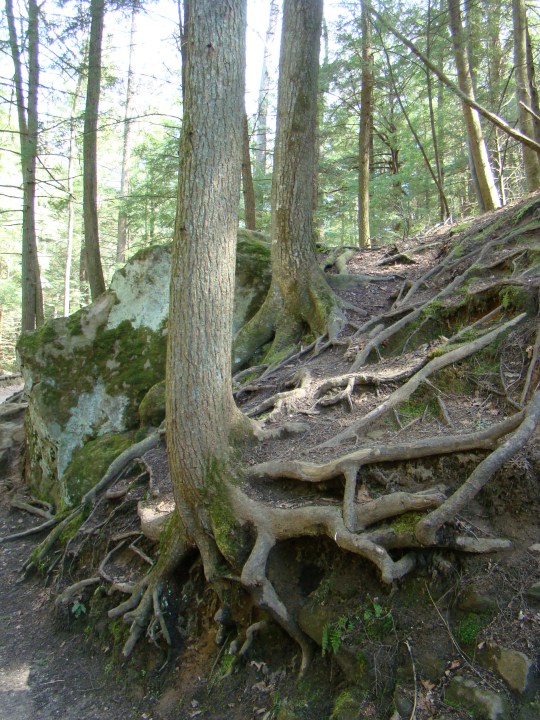
Cedar Falls roots

Roots for support

While standing at the largest waterfall, a hawk spread its wings and flew overhead as if to welcome everyone. It served as a reminder to observe the world from a higher perspective. While the forest is predominantly hemlock trees, the early settlers mistook them for cedar trees – thus the name, Cedar Falls.

Although there were many people all along the path and at the waterfalls, it was unbelievably quiet. Folks talked in soft voices…almost whispers, so as not to disturb the intense feeling of Cedar Falls. It’s one of those places you don’t want to leave.

But now for the walk back along the path and up those steps. Thanks to my walking stick, the climb back up wasn’t as difficult as one might think. Ah! What a beautiful day for a walk in the forest.

Cedar Falls is located in Hocking Hills State Park in the south-central section of Ohio. Find your closest route to Logan, Ohio, then follow OH-664 S until you reach Hocking Hills State Park. Watch for signs to guide you to Cedar Falls and other points of interest. A walk in the park is good for the soul.

Dreams Do Come True

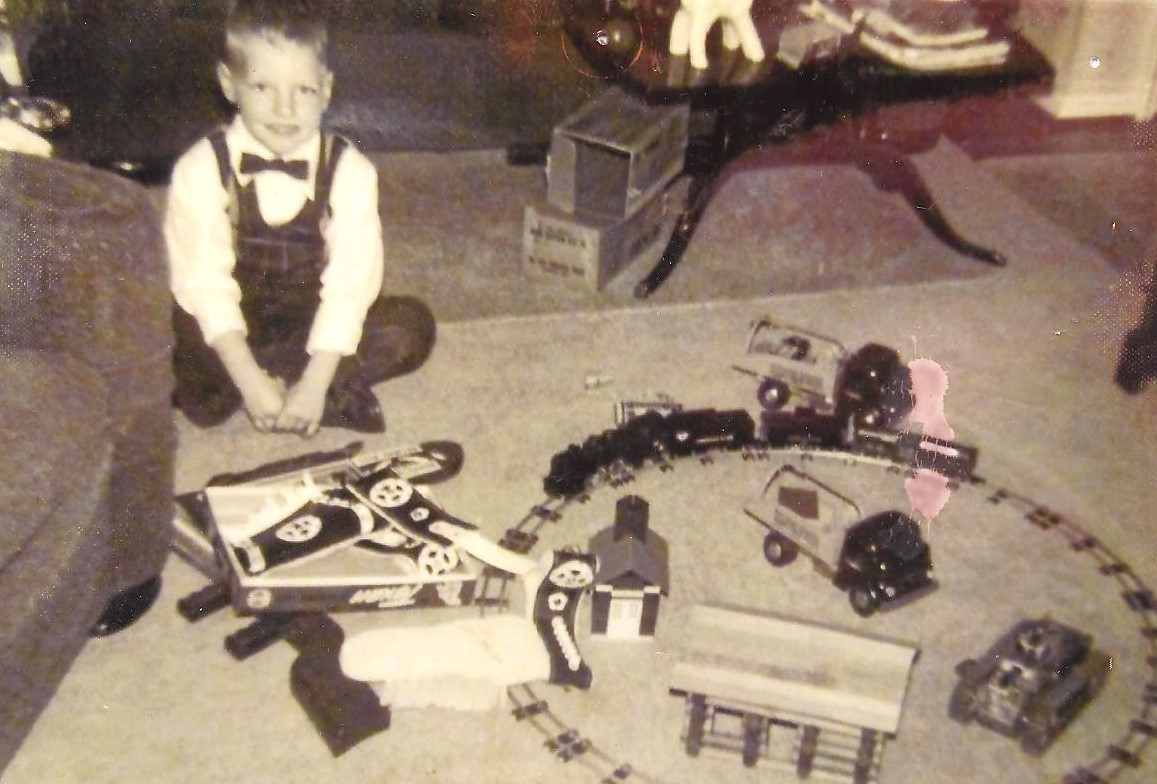
Dave received his first train in 1950.

Dave received his first train in 1950.

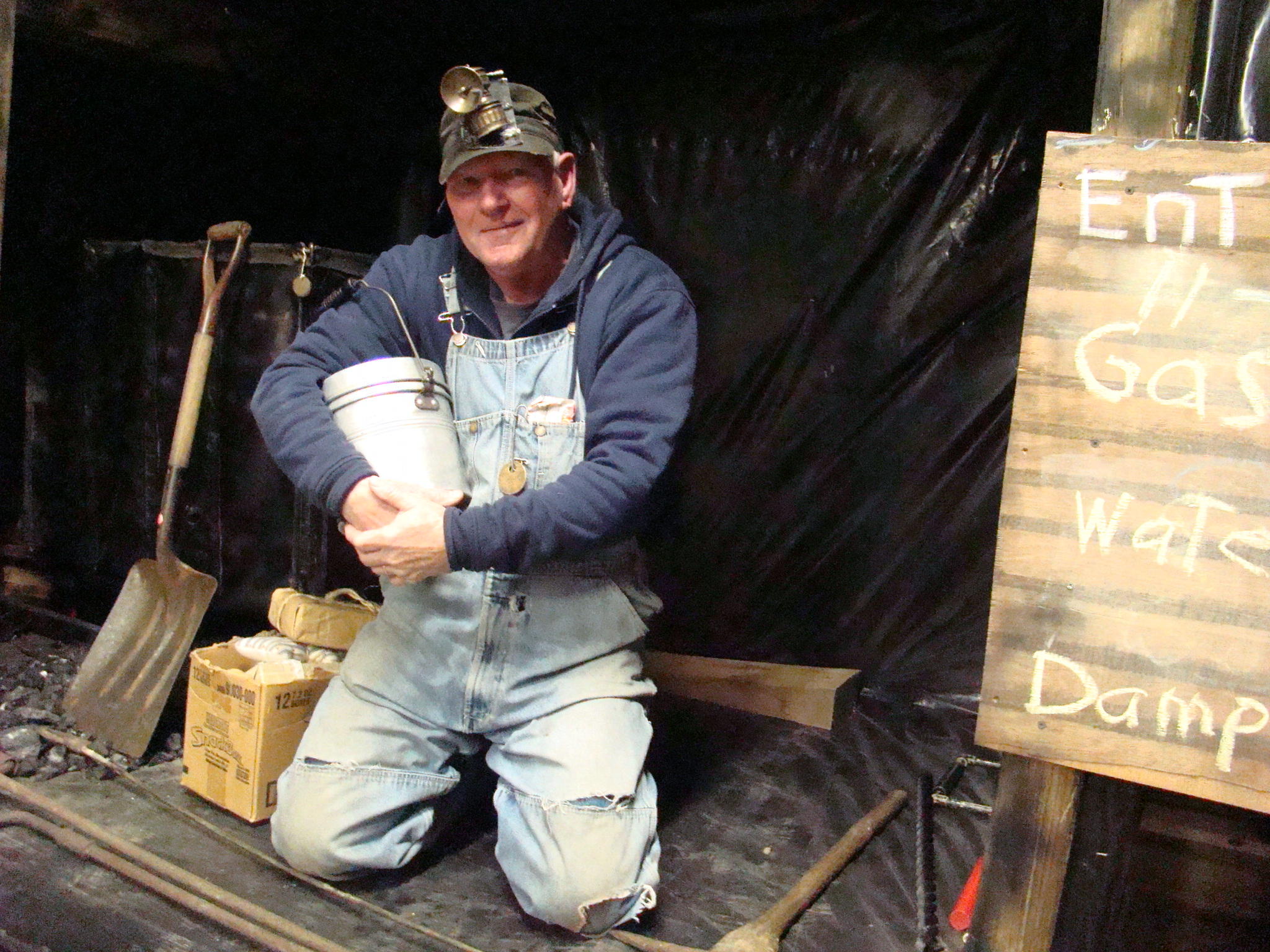
Ever since Dave Adair was a small child, he enjoyed trains. As a youngster, he frequently visited his Slavish grandfather, Dzeda, who lived near the train tracks in East Cambridge. Dzeda also worked in the Klondyke and Black Top coal mines in Guernsey County so he would tell Dave stories about the coal cars as they rolled by. It’s easy to see how Dave became interested in trains and coal mines.

Dave’s secret wish was that someday he would be able to have a caboose of his very own – a real one used on the train tracks.

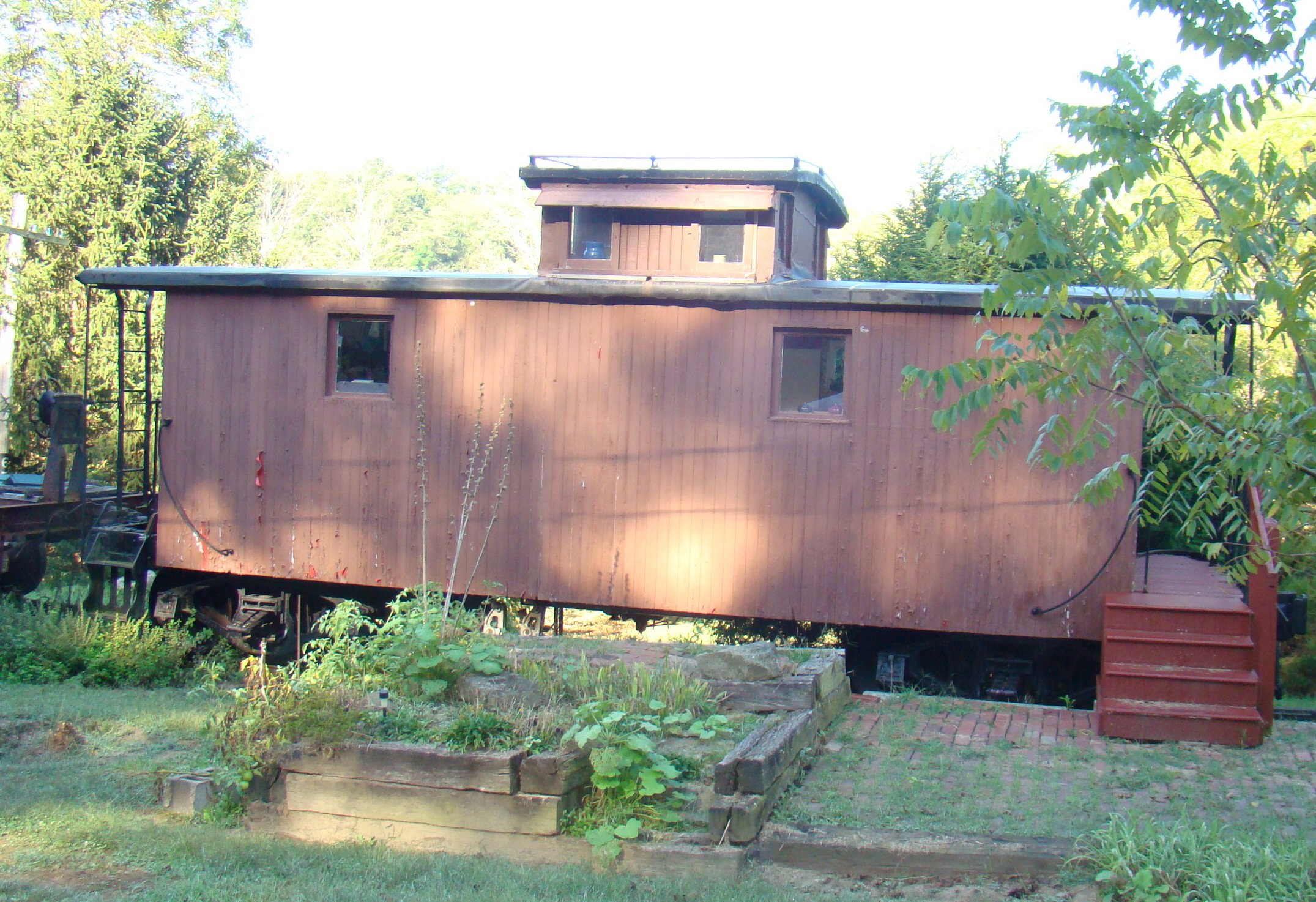
Ellen, Dave's wife, started his collection with this caboose.

Ellen, Dave’s wife, started his collection with this caboose.

When Dave was about forty, his wife, Ellen, took a ride with him a couple weeks before Christmas. They stopped in Senecaville to look at a caboose that belonged to Herb Tipton and had been used on the B&O Railroad. When they arrived and looked over the caboose, Ellen said, “Merry Christmas!”

Dave couldn’t believe it and looking back on that day said, “It was the biggest shock of my life.” Of course, she told him it would be his Christmas and birthday present for years to come. Little did she know at the time that she was only starting a vast train collection that today fills their home’s yard.

This original chair from a B&O office holds two lanterns.

This original chair from a B&O office holds two railroad lanterns.

Over the years, Dave has narrowed his interest to Guernsey County trains and coal mining history. Almost everything in his collection came from Guernsey County. Every item and picture is special to him, but he doesn’t have any favorites. They are all part of history.

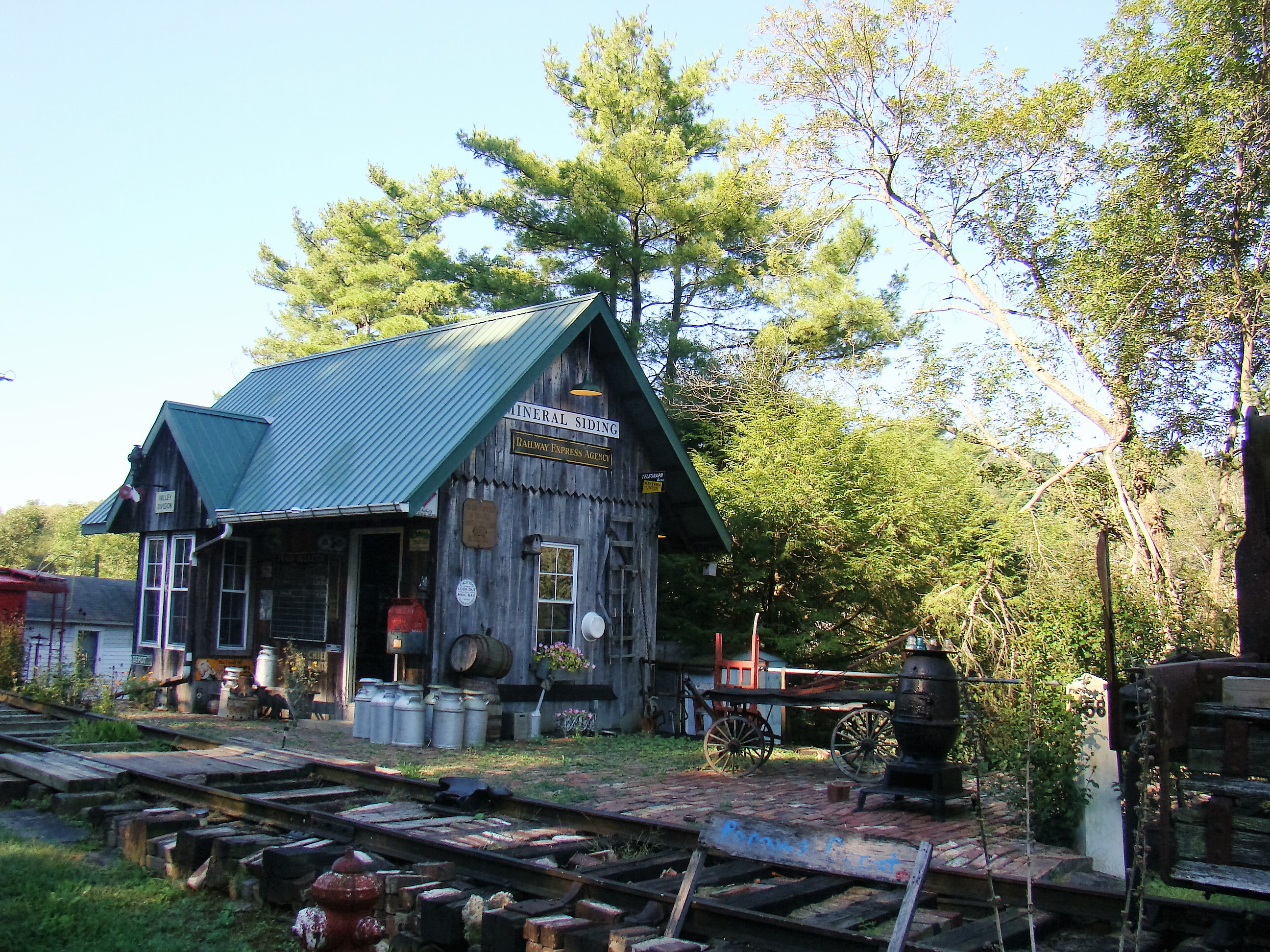
Dave built his own Depot and Museum in his back yard.

Dave built his own Depot and Museum in his back yard.

Since there wasn’t any place nearby that had room for his coal mine and train collection, Dave decided to build his own depot at his home and turned it into a museum. Nothing pleases him more than to sit down in his depot and tell stories about the coal mines and trains that were in Guernsey County long ago. But getting him to talk about himself was not an easy task.

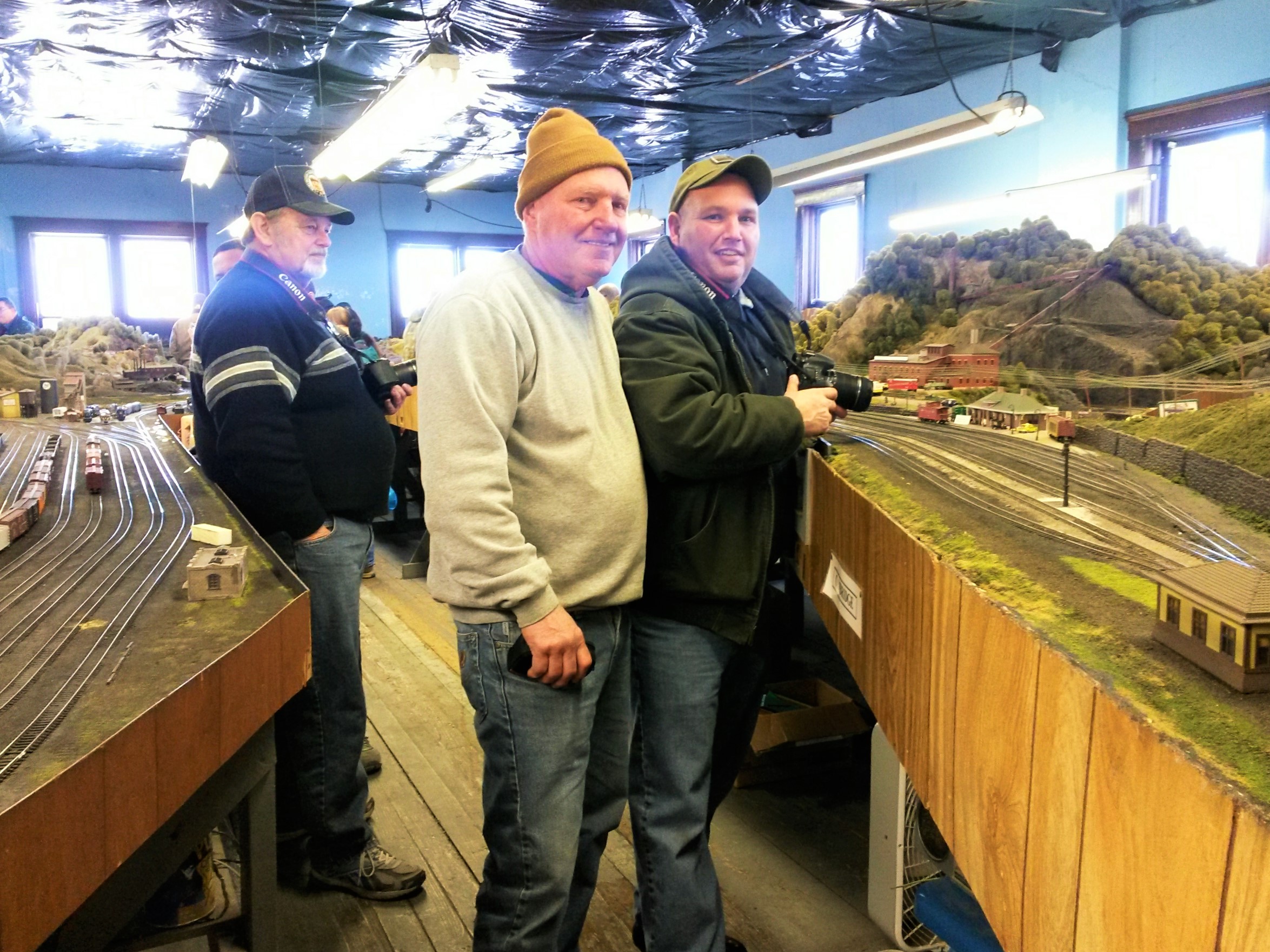
Dave and his son, Alan, look over their large HO display.

Dave and his son, Alan, look over their large HO display.

Now that Dave is retired, most of his time is spent volunteering, while spreading the word about Guernsey County history. His slide shows have been popular attractions for years. He spends time volunteering at the Guernsey County Historical Society, Cambridge Amateur Radio Association, Coal Miners Museum in Byesville, and at various nursing homes, giving people a chance to tell their stories. He says, “It’s better to give than receive.”

Dave Adair tells coal miners' stories.

Dave Adair tells coal miners’ stories.

While he claims to be “an ordinary Joe”, the history he has collected makes him a special person even though to him it’s just a hobby. It’s a good thing to make people happy and that is what Dave does best as he shares his stories and makes people smile. Through it all, his main goal is to preserve the history of Guernsey County trains and coal mines.

Dave and his family, thirty people in all, recently went on a short vacation. Where do you think they went? They headed for the train tracks in West Virginia, where they rode the Tygart Flyer. He’s still living his dream.

Lincoln Funeral Car Travels Original Route 150 Years Later

UNITED STATES, Lincoln's Funeral Car stopped in Dover, Ohio at Warther's Museum in 2015.

Lincoln’s Funeral Car stopped in Dover, Ohio at Warther Museum

Now he belongs to the ages – or maybe to the angels.

At the time of Lincoln’s death,  these words are sometimes credited to Edwin Stanton, Lincoln’s Secretary of War, but whether they are his or not, the words connect Lincoln to his peers and also to those above them.

Warther Museum recently hosted one of the stops for the 2015 Lincoln Funeral Train. It traveled from Washington D.C. to Springfield, IL in honor of the 150th Anniversary of Lincoln’s death. Over 50,000 visitors toured the Lincoln Funeral Car on its journey.

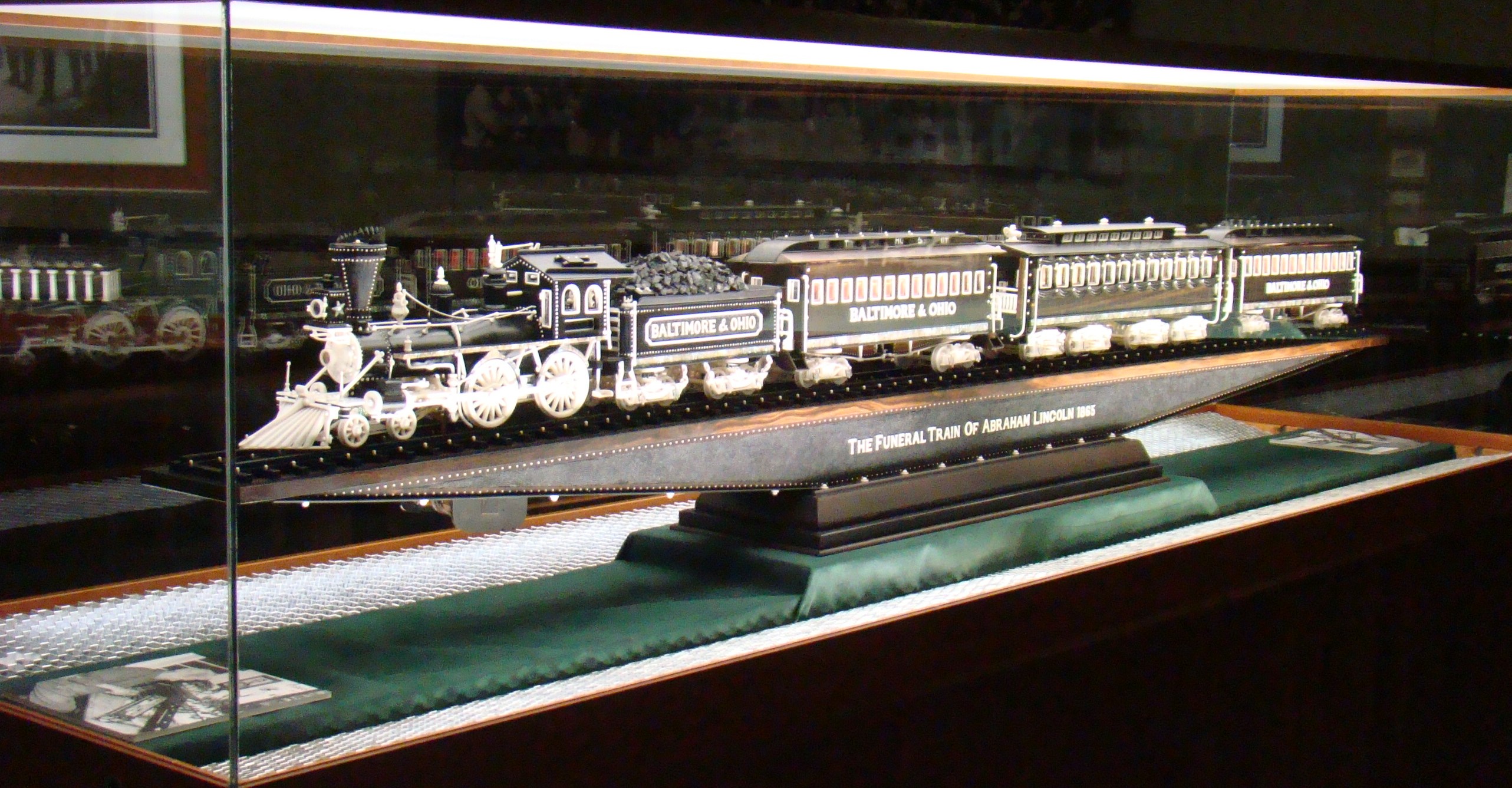
Warther carved this ivory replica train at the age of 80.

Warther carved this ivory replica train when he was 80.

People have always been fascinated with Lincoln’s Funeral since 1865. Ernest Warther carved Lincoln’s funeral train out of ivory to celebrate the 100th Anniversary of his death. Therefore, they thought it would be fitting to have the replica of the original, stop by Warther Museum on its journey across America.

The ivory carving was finished in 1975 when Earnest Warther was 80 years old. A hippo’s ivory eye tooth was used because it is the very best grade of ivory. Warther commented, “Nothing but the best for Lincoln” as Lincoln was his hero.

Warther admired Abraham Lincoln and had a vast collection relating to the president.

Warther admired Abraham Lincoln and had a vast collection relating to the president.

For the 150th Anniversary, outside the museum sat a wooden replica car, which they tried to keep as close as possible to the original.  The train car traveled as the trailer of a semi with highway wheels attached.

Dave Kloke of Kloke Locomotive Works in Elgin, IL and a staff of craftsmen were responsible for most of the work on this replica, which took four years to finish. Along the way he had a great deal of help from researchers in construction and history. One of those was a chemist and model train maker, Wayne Wesolowski of University of Arizona. All Wesolowski could find of the original train car was a pencil sized piece of wood. From this the chemist in him determined the original color and type of wood used. He wanted everything to match the original car.

This armored car was compared to Air Force One in regards to security and its design equaled the opulence of railroad cars used by European Royalty. This “Presidential Car” contained three rooms: parlor, stateroom, and sitting room.

The Lincoln coffin was 6'8

The Lincoln coffin was 6’8″ long with handles made by the same company that made the original ones.

Upon entering the car, a 6’8″ casket appeared before your eyes. This long casket was made especially for Lincoln, a tall man for his time. The handles were made by the same company that made the original ones for Lincoln’s coffin. Chairs were for the soldiers to sit as they guarded the coffin during its entire journey.

Lincoln felt this train too luxurious when the country suffering from the effects of the Civil War.

Lincoln felt this train too luxurious when the country suffered from the Civil War.

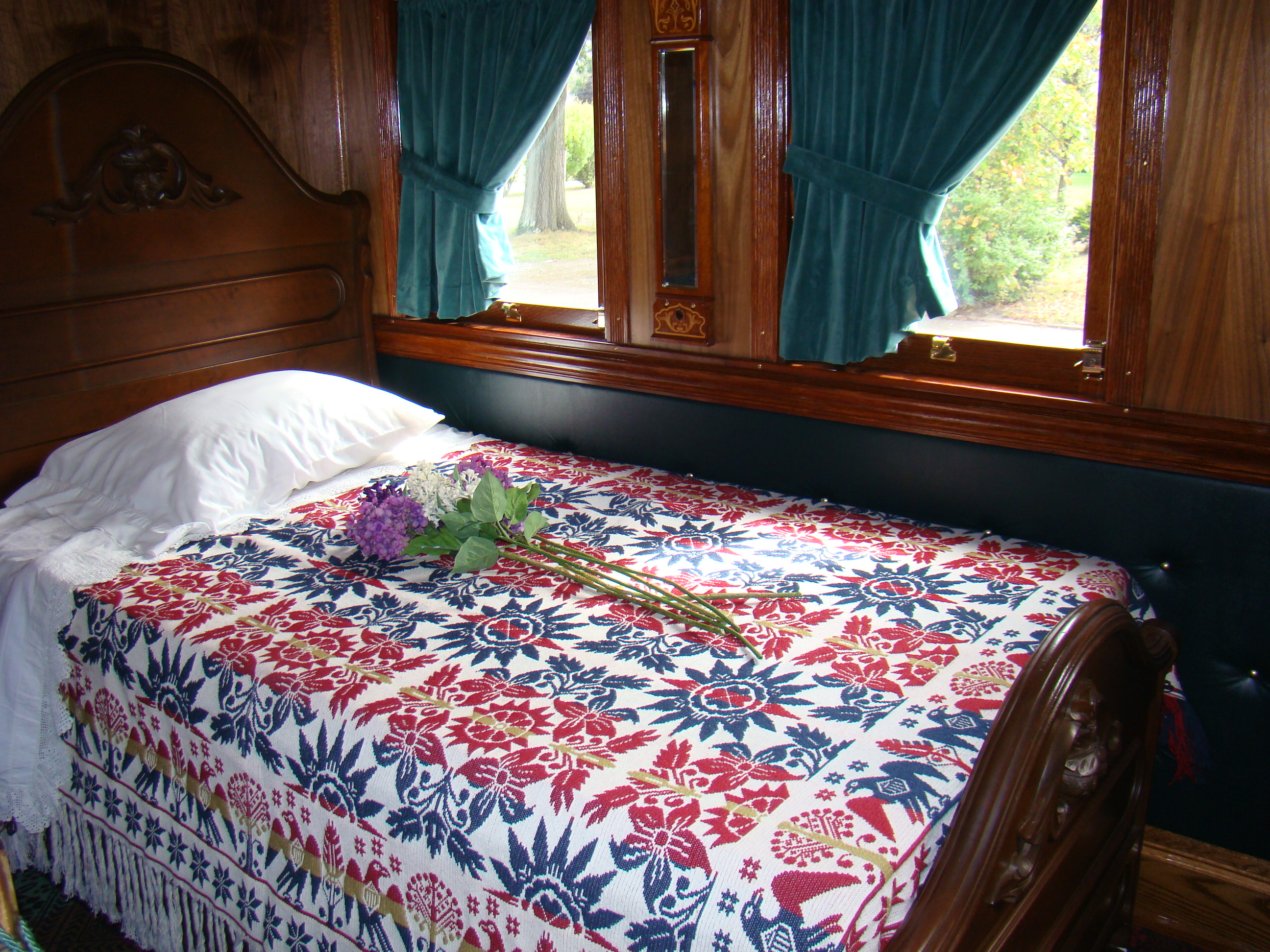
The presidential bedroom had never been used as President Lincoln felt this Presidential Car was too luxurious when many in the country were living in poverty. This funeral car, draped in black crepe, was one of nine cars in the funeral procession and was always the second to last in line.

Young Willie's coffin was carried at the place there is a sofa today.

Young Willie’s coffin was carried at the place a sofa sets today.

Son Willy’s coffin was also on this train even though he had died three years previously. It was in the living room section where it replaced the couch. Lincoln’s wife did not go on this trip as she was too distraught.

Even the wheels of the train were patriotic.

Even the wheels of the train were patriotic.

This car was never used for anything else or by any other presidents. The following year, it sold for $6850 to Union Pacific Railroad, where it became an officers’ car while building the Transcontinental Railroad. After being displayed at the Worlds Fair in 1904, a grass fire destroyed the train car at Minneapolis in 1911.

One of the main purposes of this excursion was to help young people learn about history. Many local schools took advantage of this unique educational stop in Dover, Ohio to give their students a close look at an oft told story in United States history.

Lincoln would have been pleased as he felt education very important. When speaking to a university he remarked, “A capacity and taste for reading gives access to whatever has already been discovered by others. It is the key, or one of the keys, to the already solved problems. And not only so. It gives a relish and facility for successfully pursuing the yet unsolved ones.”

Marietta Vice Walking Tour Filled with Thieves, Bars and Murders

This island contained an Amusement Park in 1900.

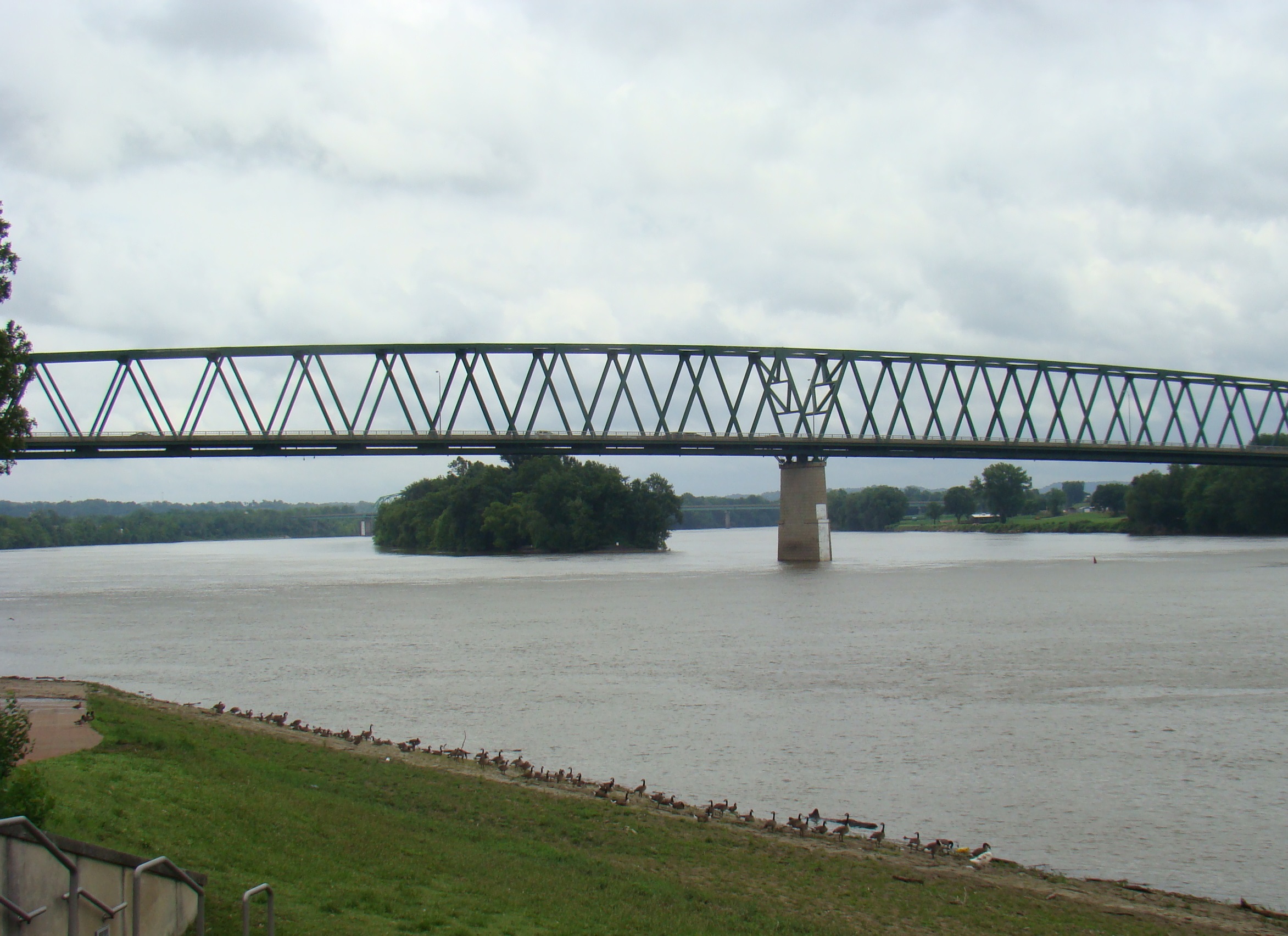
In 1900, Buckley Island contained an Amusement Park during the day, then became a Lawless Wonderland at night.

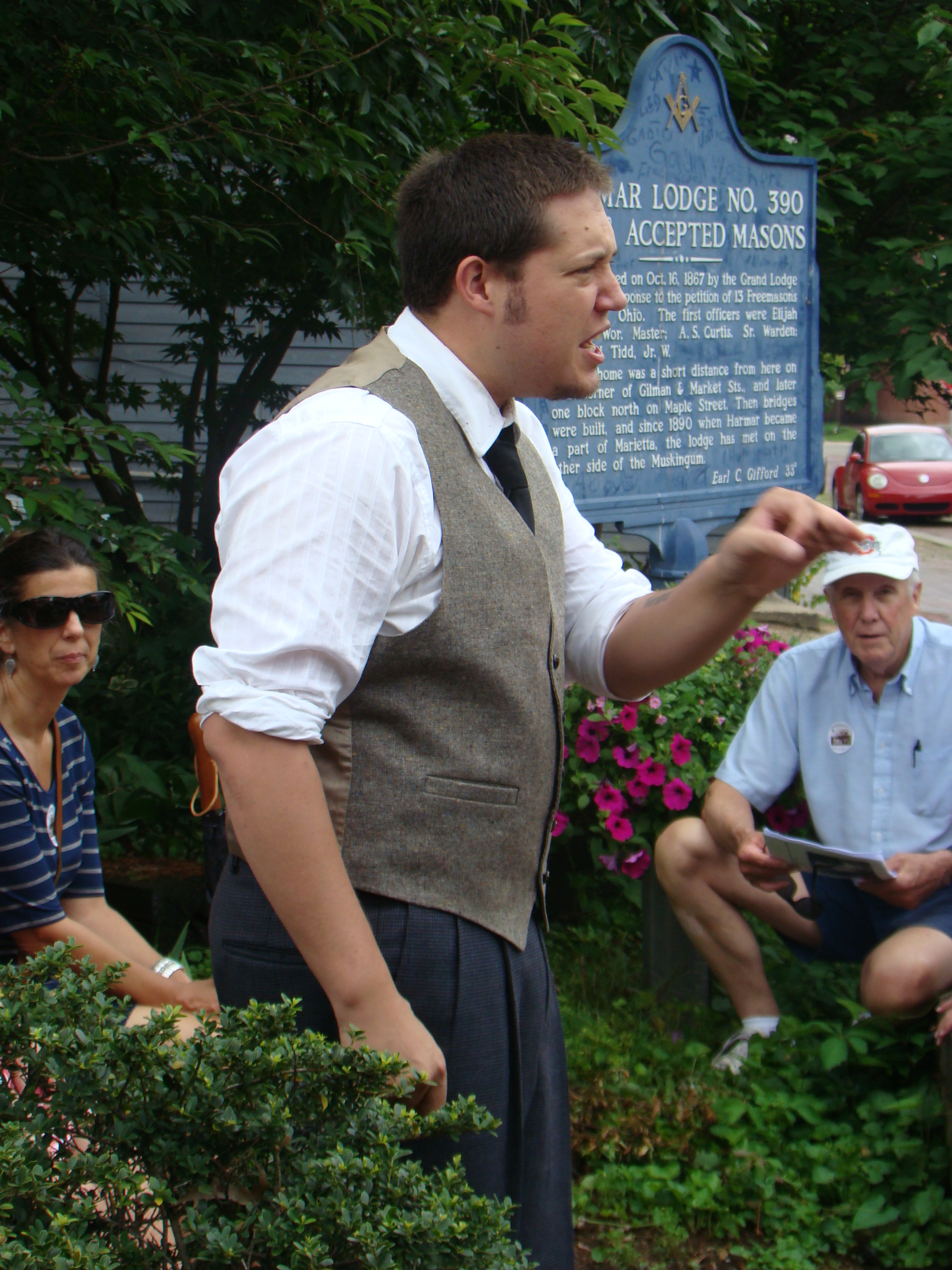
You had to be bold and brave if you dared walk on the seedy side of town in Marietta, Ohio back in the early 1900s. But Lynne Sturtevant recently led a crowd of fifty on an adventure back to early days as the old sections of Marietta were revisited. Along the way, characters in costume greeted the tour and told of dangerous adventures at that time.

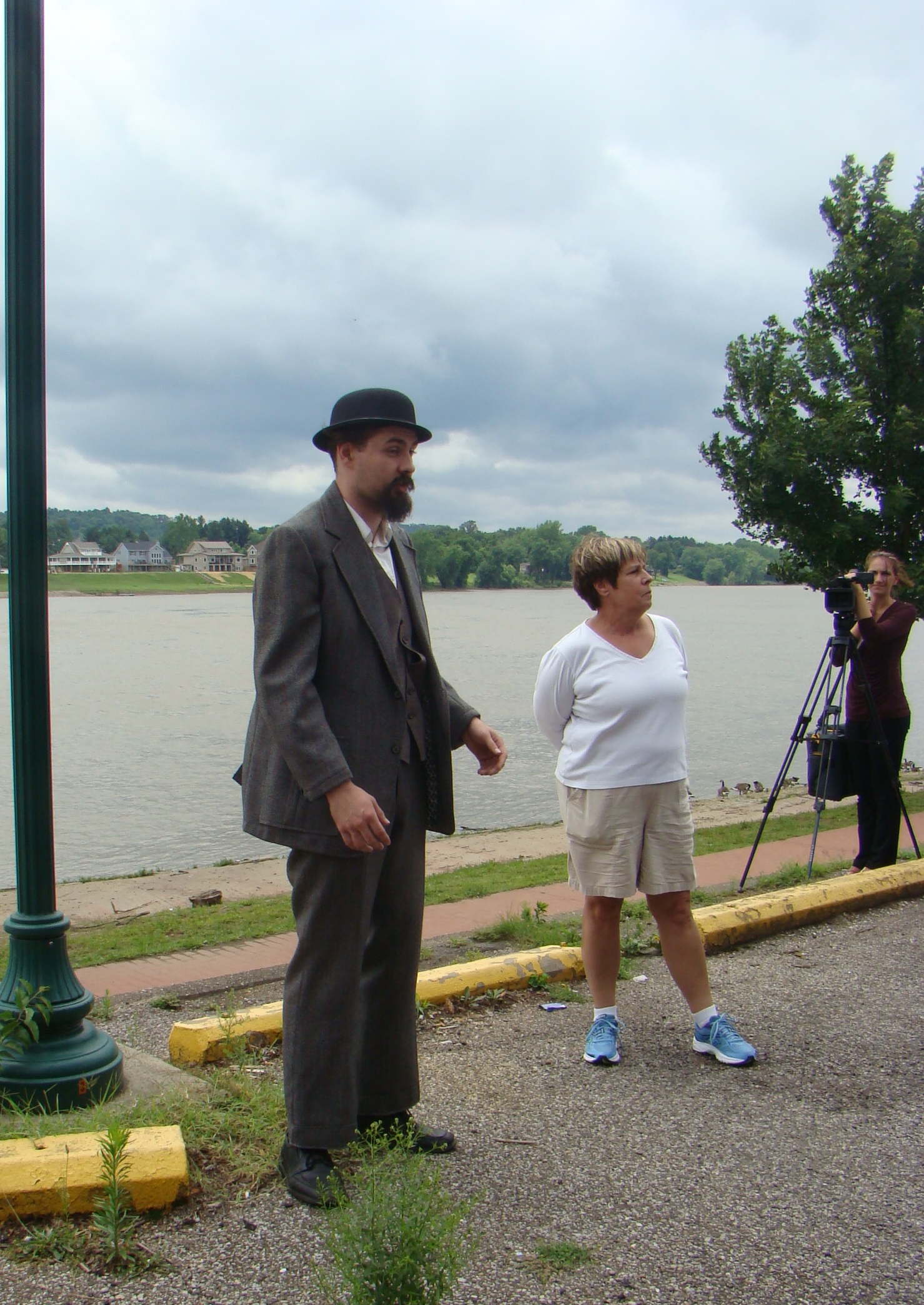
Riverfront man and Lynne, our guide

Riverfront man and Lynne, our guide

Crime was a severe problem all along the Ohio and Muskingum Rivers in Marietta, with bars, bars, and more bars. The Ohio River flowed around a small island, that served as an amusement park during the day, but a whole new crowd arrived in the evening. They enjoyed all the vices of the time – drinking, gambling, prostitution, and murder. Going to the island in the evening had an added enticement of cheap beer. Along the shore beer was twenty-five cents a glass, but on the island, only five cents. The Island, now known as Buckley Island, was a lawless wonderland. If you wanted to do anything illegal, the island was the place!

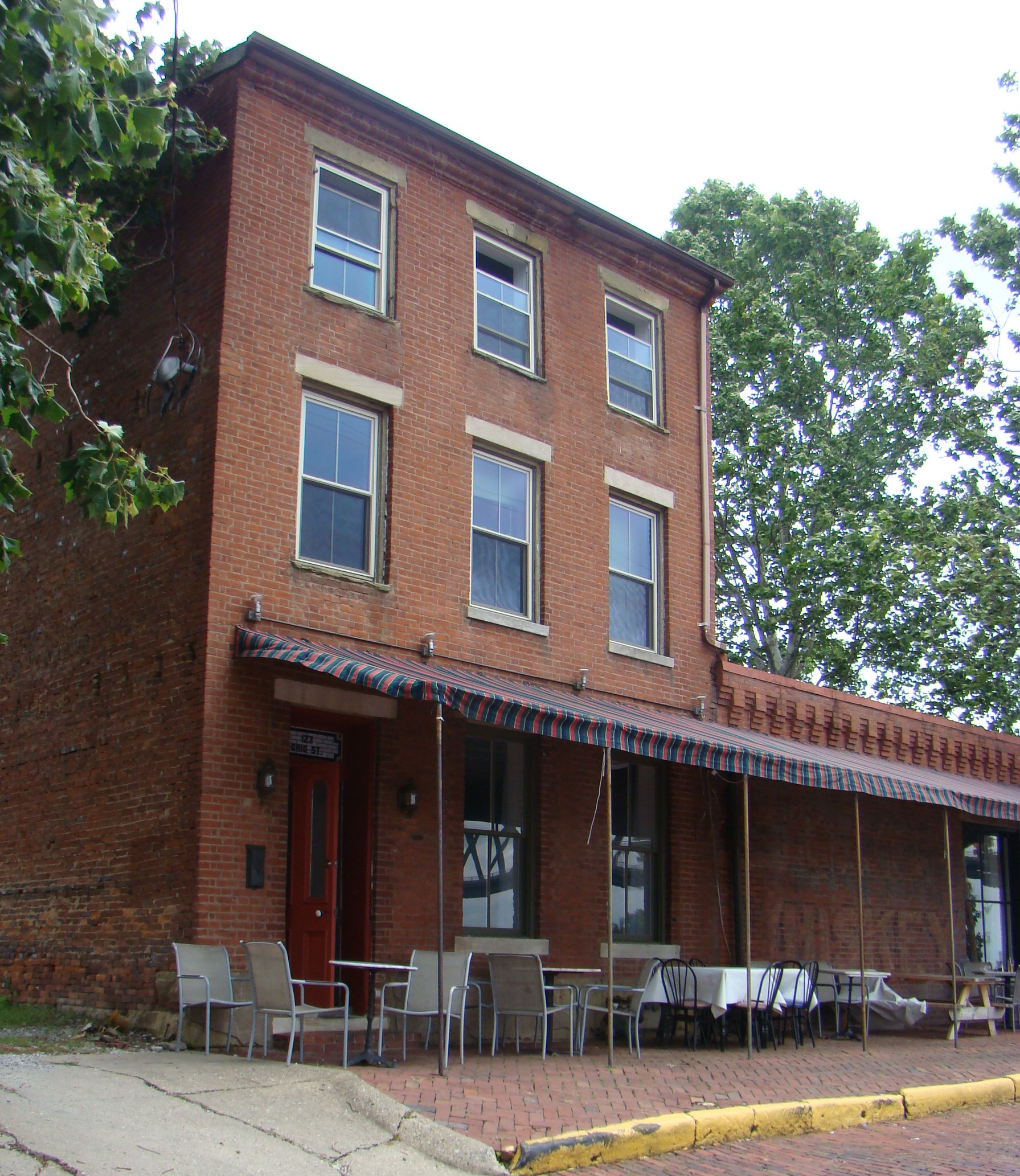
Old hotel and bar

Notice the popular shadow advertisement of WHISKEY at The Levee House – just above the table tops.

Despicable characters roamed the streets, drinking and arguing over everything imaginable. One man and his wife were each found with bullets in their head after an argument over a wristwatch. The stories told were all true reports of the Marietta newspaper from that time.

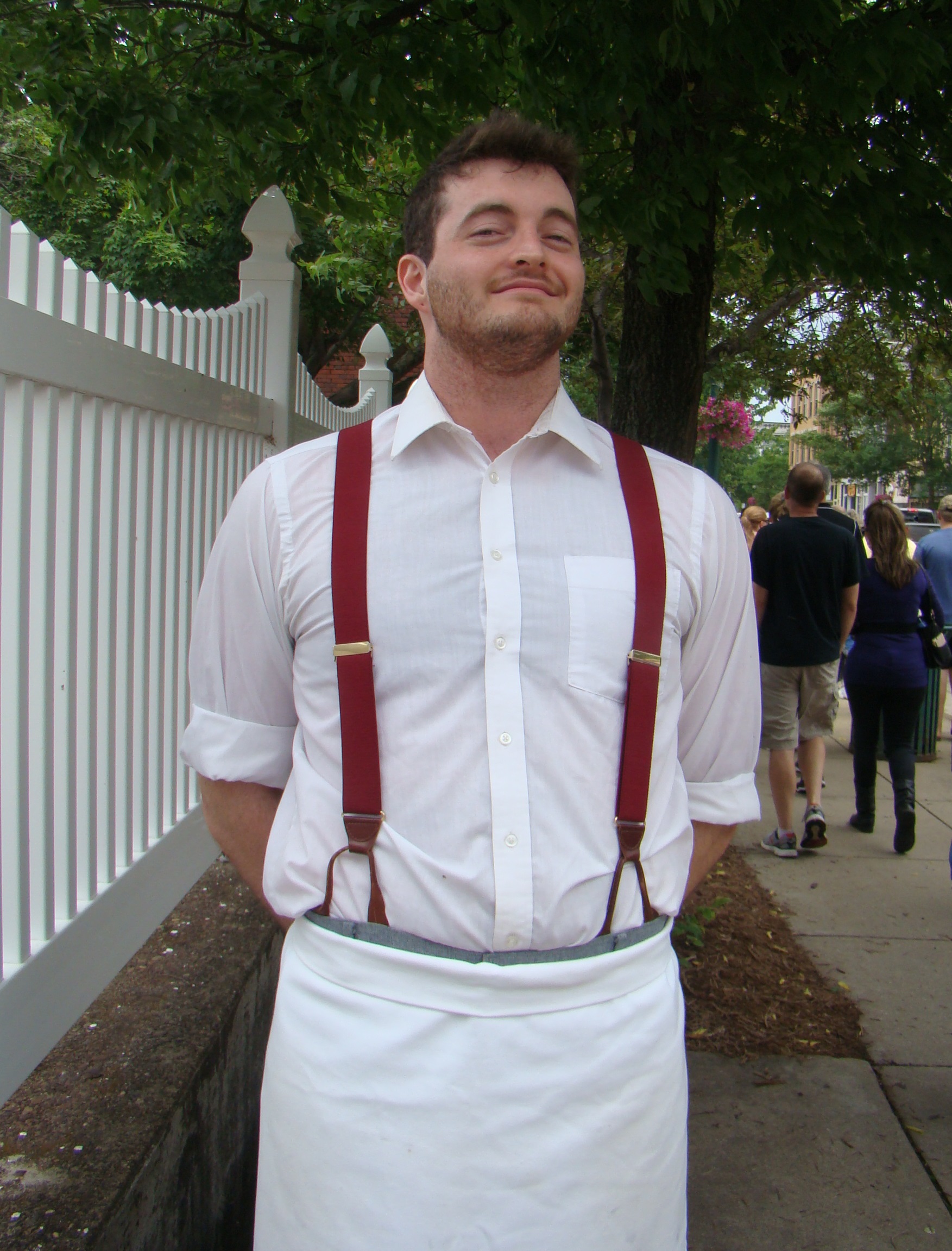
Proud bartender

Proud bartender

Dance halls and saloons were the main businesses in town. Shadow advertising can still be seen on many buildings with words like WHISKEY worked right into the brick works.

Along the way, the group met a delightful bartender who told of some of the fights he had witnessed at the bars. The job he hated the most was cleaning the spittoons.

A character portraying Oliver Hyde, mayor of Marietta in 1904, spoke to the group in front of the police station. The building also served as the electric company and the mayor had his office on the top floor. He gave the latest police report describing real events in Marietta in 1904.

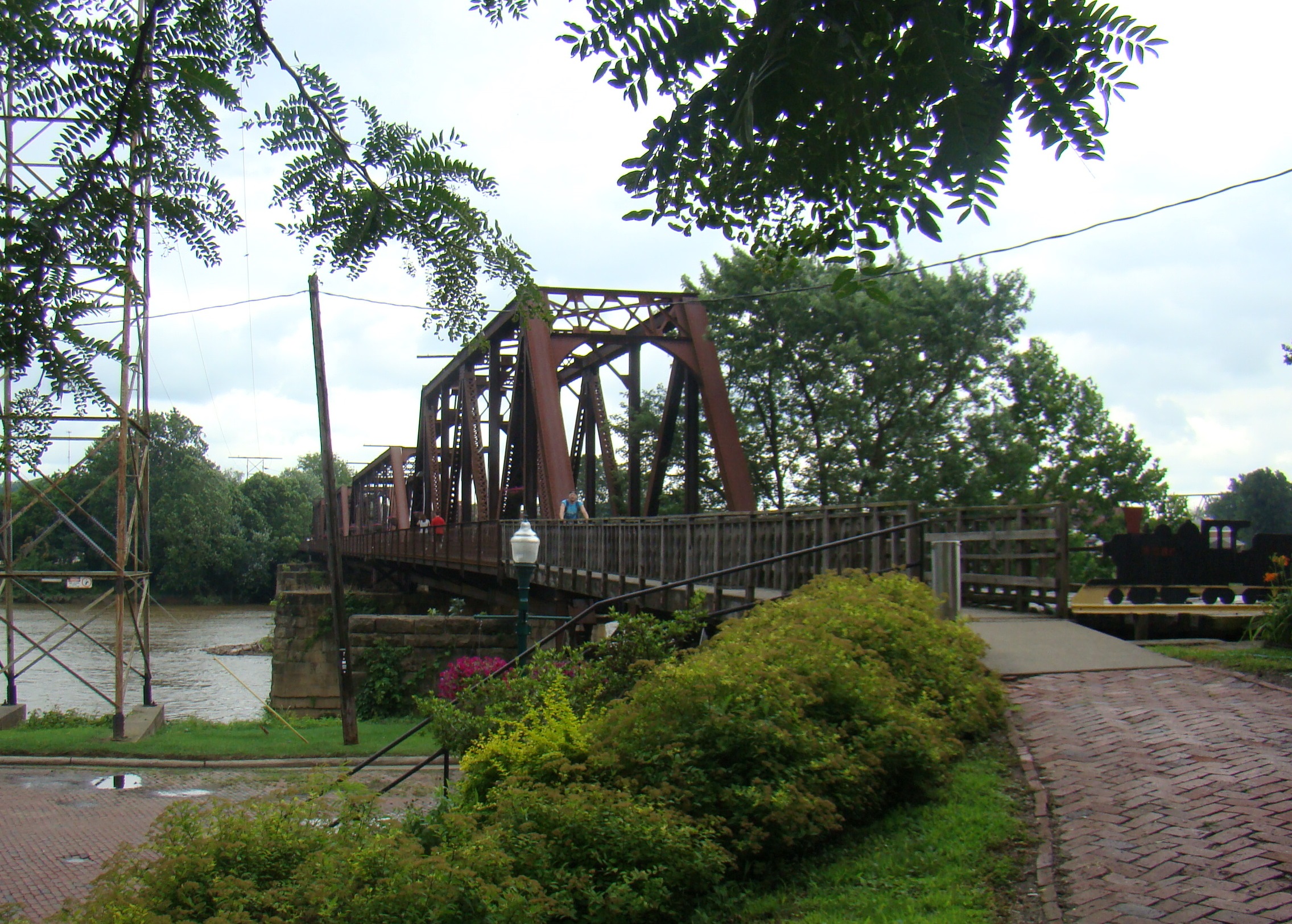
Historic Harmar Bridge

Historic Harmar Railroad Bridge

The historic Harmar Railroad Bridge provided a scenic walkway over the Muskingum River. This is the country’s oldest operating railroad swinging bridge, still using a hand crank to swing it open for passing boats. Where the Harmar Historical Village stands today, Fort Harmar existed in 1785 for the protection of the Indians.

Walking over the bridge, one of the roughest sections of town was on Maple Street. A young man, who lived there, told about his neighborhood. He spoke of Mr. and Mrs. Hayes, who were well known local folks. Mrs. Hayes served as a madam, while her husband usually caused problems. Mr. Hayes was very jealous of his wife and accused her of seeing the local bartender. She begged him, “Don’t kill me!”

He did.

Guy from the rough side of town

Guy from the rough side of town

The young man said the Marietta Police had never caught the husband and asked the mayor why he wasn’t working on it. The mayor, in typical mayor fashion said, “It’s under investigation.” The young man told the group to get back over the bridge as quickly as possible as the area was not a safe one.

While visiting a housewife in Sin City, she told of a murder that happened next door to her house. She was hanging out the laundry when she heard a husband and wife fighting next door. The husband yelled, “I’ll break your face right in if you do that again.”

Later she smelled a fire burning in their back yard and hurried to get her clothes off the line. About 5:00 the next morning, there was a knock at her door. At the door stood the next door neighbor. “Good morning, the missus has gotten drunk and fell into the fire and burned right up. She’s always getting drunk.”

When the police arrived at the scene, over half of the woman’s body was severely burned, but they could see severe bruises on her neck. Perhaps she didn’t just fall into the fire, but was pushed. You’ll have to visit to find out…the rest of the story.

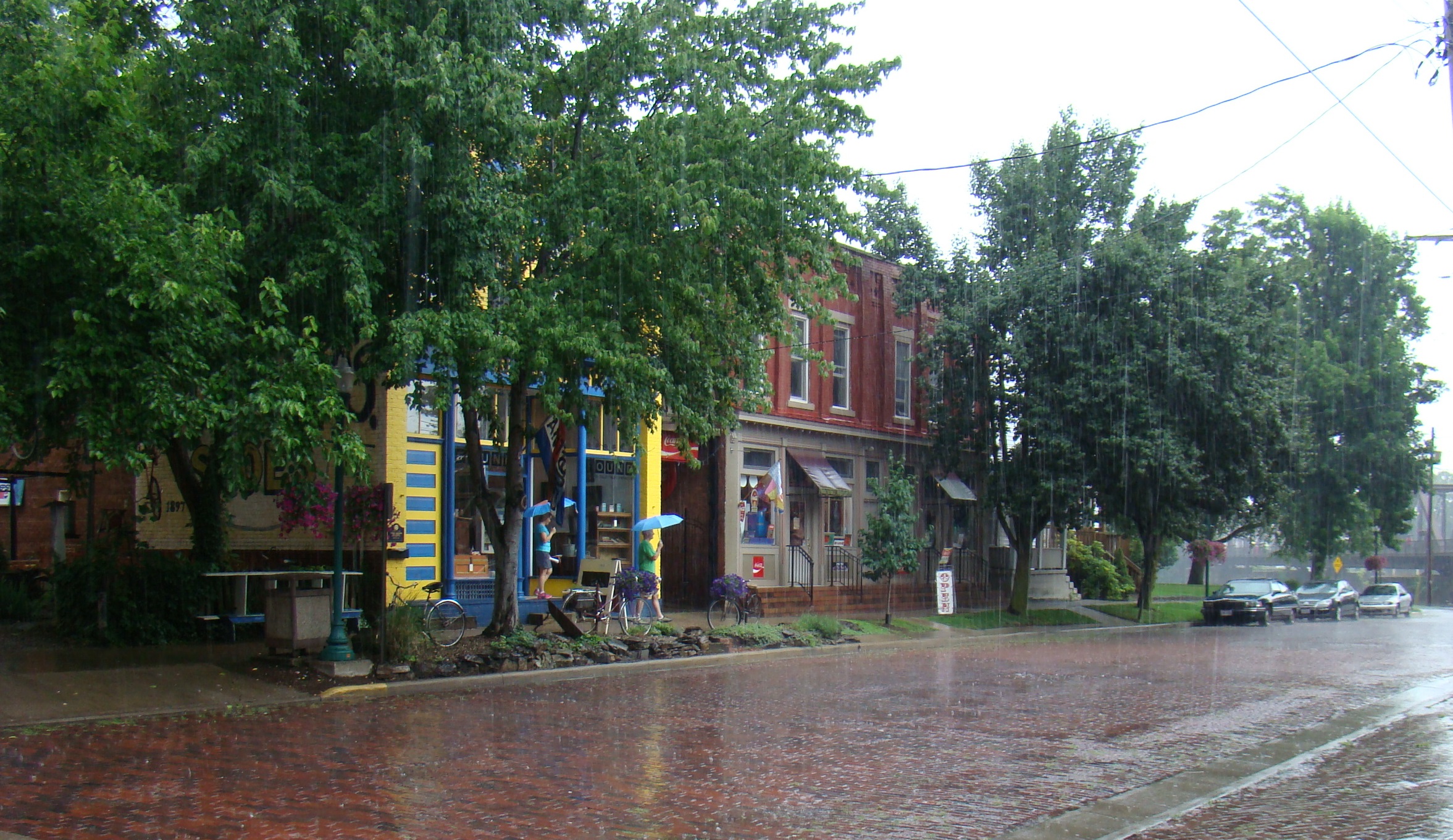
A rainy ending to an educational and interesting day

A rainy ending to an educational and interesting day

Rain held off until the very end of the tour, when it came down from the sky in buckets. The wind, rain and lightning made it seem that this place was perhaps still dangerous.

Marietta, Ohio is located at the confluence of the Muskingum and Ohio Rivers in southern Ohio. Take Exit 1 off I -77 in Ohio to experience this delightful town. Characters along the way were provided by Paskawych Entertainment, LLC of Marietta.

Anderson Hancock Planetarium Explores the Expanding Universe

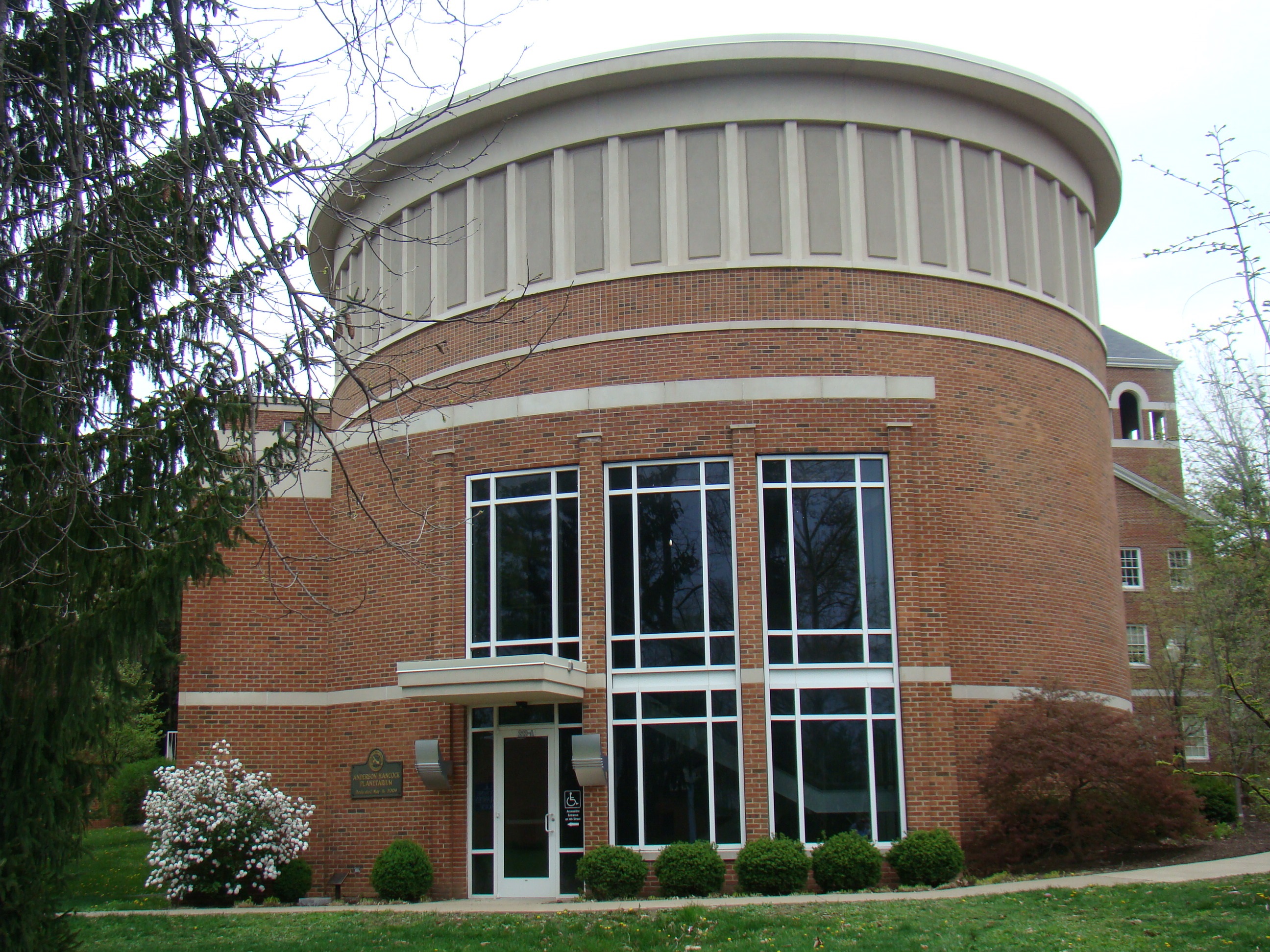
Anderson Hancock Planetarium at Marietta College

Anderson Hancock Planetarium at Marietta College

“Twinkle, twinkle little star, how I wonder what you are!”

Everyone gains a better understanding about those little stars in the sky after watching the night sky from the comfort of a cozy seat at Anderson Hancock Planetarium on the campus of Marietta College in Marietta, Ohio.  As the present night sky appears overhead, the movement and stories of the constellations provide a fascinating time of entertainment and increased knowledge of our expanding Universe.

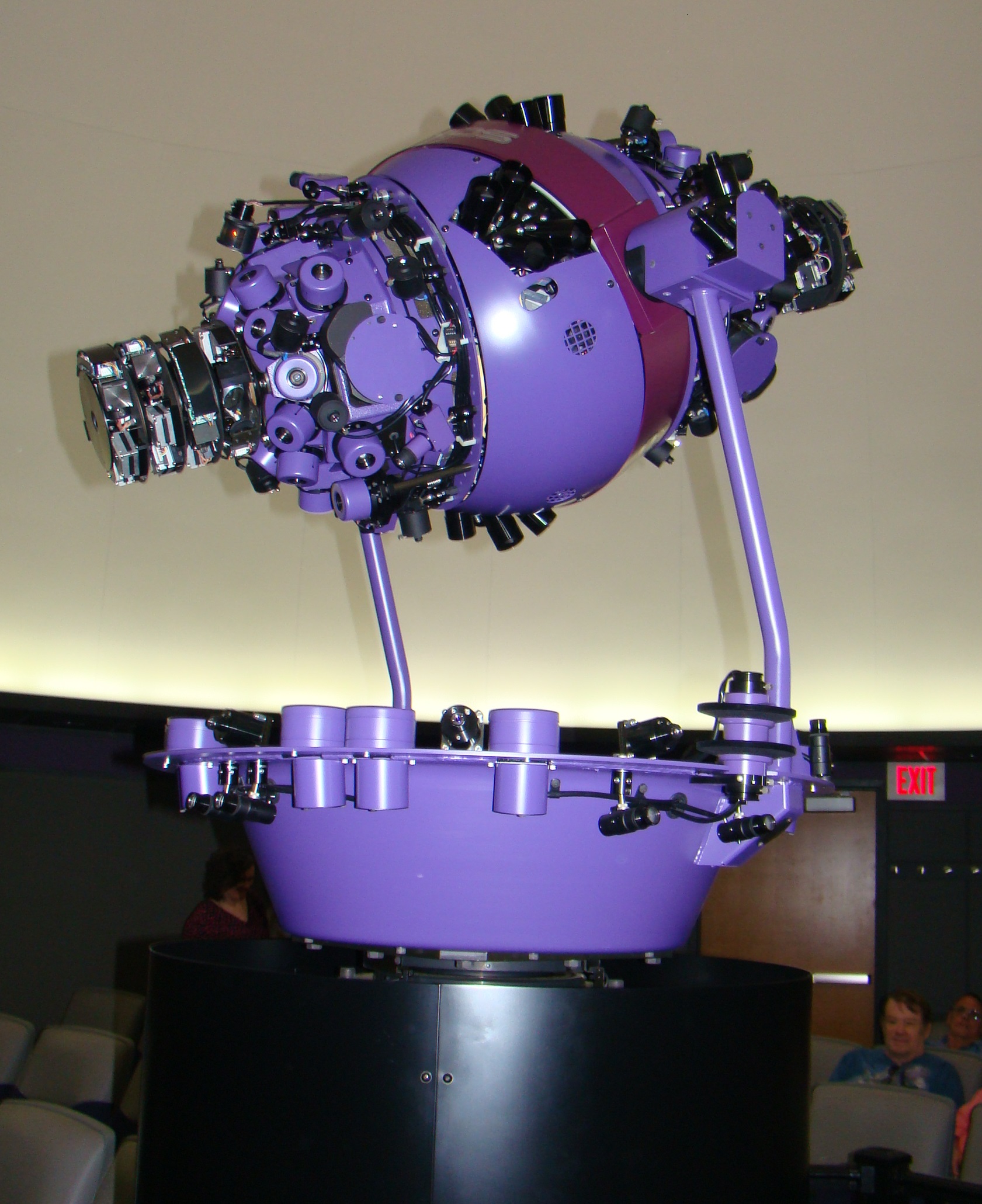
Named after Emeritus Professors Dr. Les Anderson ’55 and Dr. Whit Hancock, the planetarium is equipped with a hybrid projection system that combines an optical mechanical star projector with a powerful full dome digital video projector.

Gog Chronos star projector

Goto Chronos hybrid star projector

Marietta College is currently one of a handful of planetariums in the country to feature the Goto Chronos hybrid system, which can replicate with great accuracy the night sky from thousands of years in the past to thousands of years in the future from countless vantage points in the Universe. This projects the night sky onto the dome, which is about 40′ in diameter.

Every month, the planetarium hosts a special sky program with two showings on a Thursday evening and Sunday afternoon. Recent topics have explored “Cosmic Castaways”, “Chasing Ghost Particles” and most recently the premiere of “Space Aliens: Looking for Life in the Universe”.

During a visit to see “Space Aliens”, experts Hopeful and Skeptical took those in attendance on a journey from the ocean floor to an adventure across the galaxy as they tried to convince each other whether life exists outside of earth. No definite conclusion was reached except that we keep discovering more and more about our vast Universe all the time.

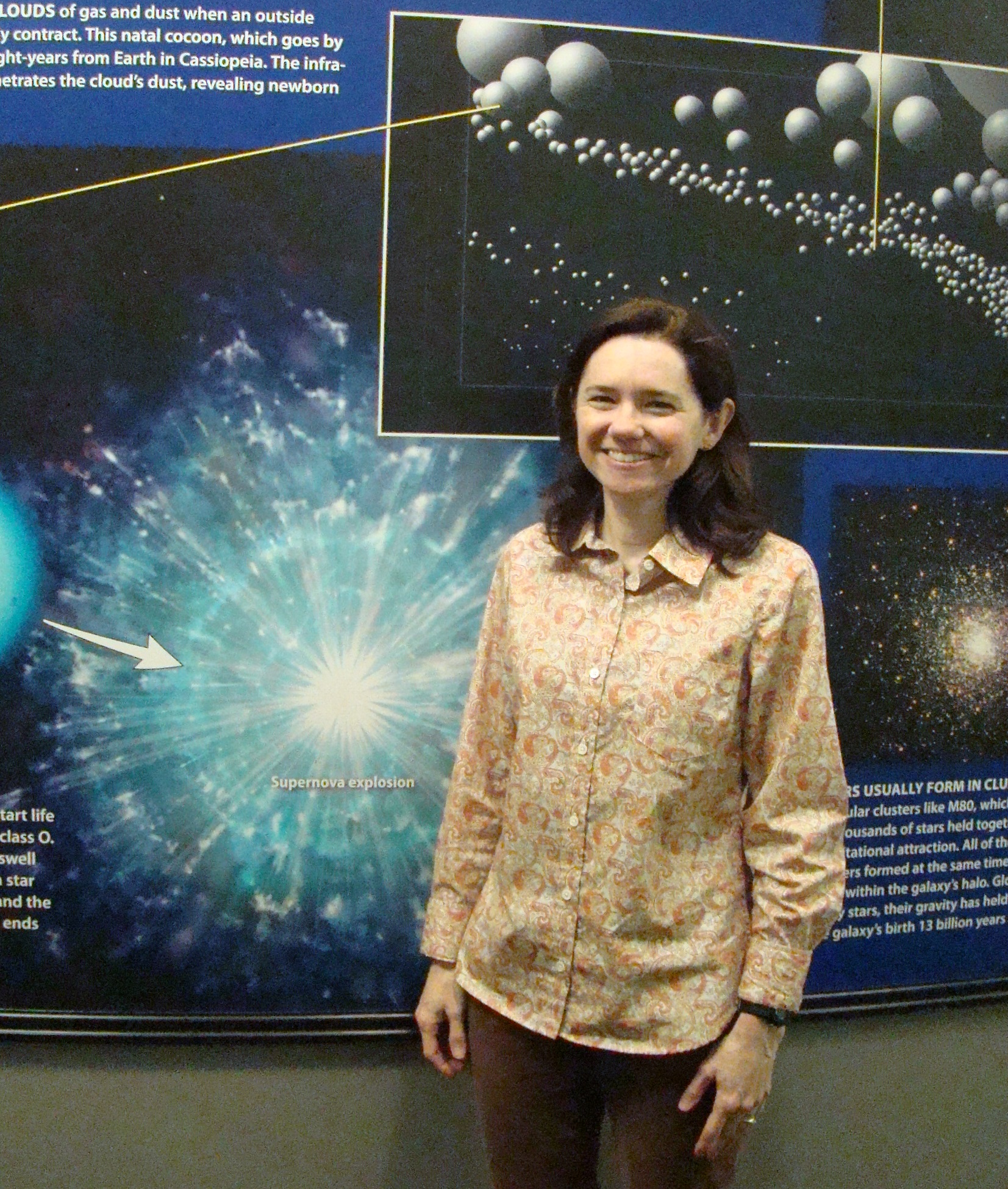
Dr. Ann Bragg, director

Dr. Ann Bragg, planetarium director

The planetarium director, Dr. Ann Bragg, has been with the program since it opened in the spring of 2009. Since her goal is to educate the community as well as the students, she projects a contagious enthusiasm, which hooks the viewers.

Dr. Bragg, also associate professor of physics, enjoys teaching and opening students’ minds to new possibilities. She feels, “The process of discovery is often more interesting than what is actually discovered.”

Star talks about the current evening sky always precede the special program. Here they tell about and display the different constellations that are visible in the sky. This provides a tremendous opportunity for adults and children to learn more about our vast Universe. During the year, nearly 4000 students visit the planetarium with school, scout and camp groups.

The lobby also features quiet study areas and current science programming from NASA’s ViewSpace data/video feed. It’s a great place to catch up on some of the latest NASA developments.

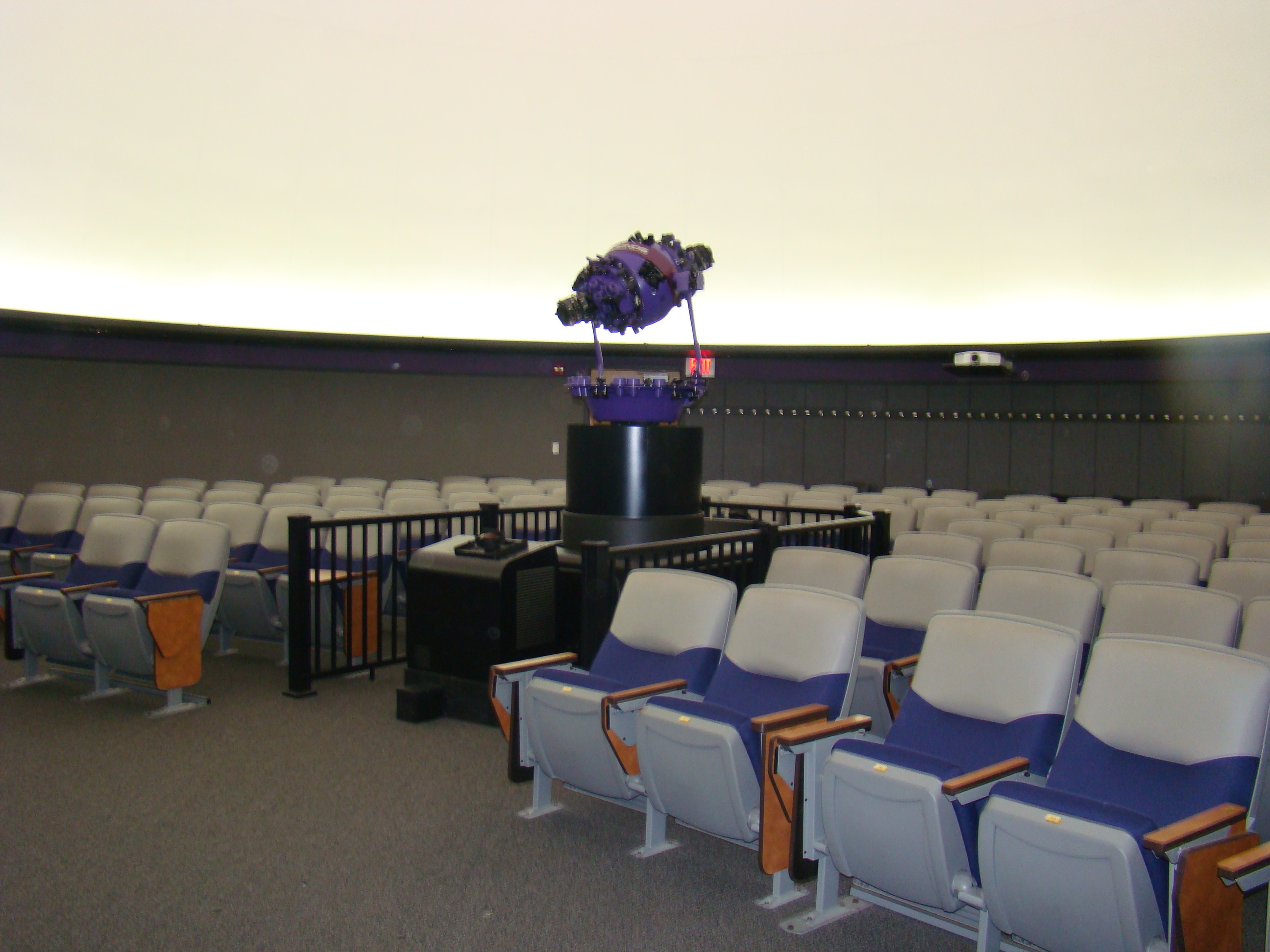
Planetarium Auditorium

Planetarium Auditorium with 40′ dome ceiling

During the summer months at least two of their showings will be geared toward students. While all shows are free, the planetarium requires reservations as seating is limited in their 102 seat auditorium. Perhaps you would like to visit the Anderson Hancock Planetarium at Marietta College and witness several of their outstanding presentations in the future.

Sometimes your road trip needs to leave earth and explore what is beyond.

Be sure to check out their website at http://www.mariette.edu/planetarium for future programs. To visit Anderson Hancock Planetarium, take Interstate 77 toward Marietta to Exit 1. At Exit 1, turn right onto ramp, which will be Ohio 7 (Pike Street). Remain on Pike Street until turning right onto Fourth Street. Take the first right onto Butler Street. Parking will be immediately on your right in the lot adjacent to Hermann Fine Arts Center.

Polar Frontier at Columbus Zoo – A Cool Place to Visit

Polar Frontier Entrance

Polar Frontier Entrance

Perhaps the “coolest” spot at the Columbus Zoo & Aquarium occurs in North America’s Polar Frontier. On a recent visit to the zoo, howling winds and cold temperatures seemed the perfect time to check out the Polar Bears. They certainly weren’t bothered by the cold.

Set in what appears to be an abandoned mine camp in the Arctic Circle, Polar Frontier is home to four Arctic foxes, two brown bears, and two polar bears. Snow, ice and cold help create the atmosphere for their favorite time of the year. A sign near the entrance states:

An Arctic without ice would be like a garden without soil.

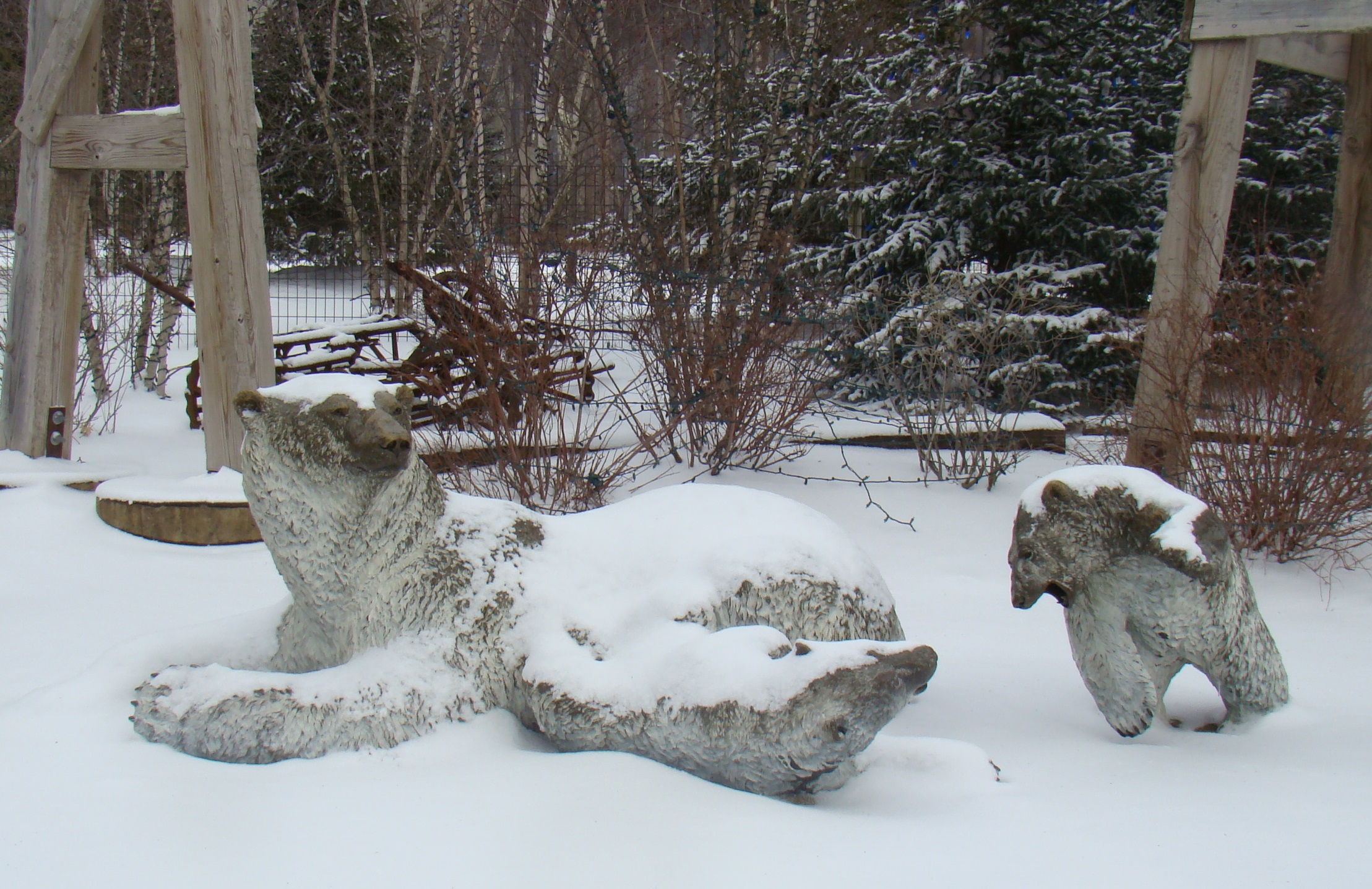
Polar Bear statues

Statues of Mother Polar Bear and two cubs

Polar bear statues of mother and two cubs welcome visitors to the Polar Frontier. Since North High School in Columbus, Ohio had as their mascot a Polar Bear, their alumni organizations funded the statues. Local artist, Mathew Palmer, created these delightful bronze figures covered with a white patina. Statues of animals frequently appear throughout the zoo and are perfect places for a close up picture with the animals.

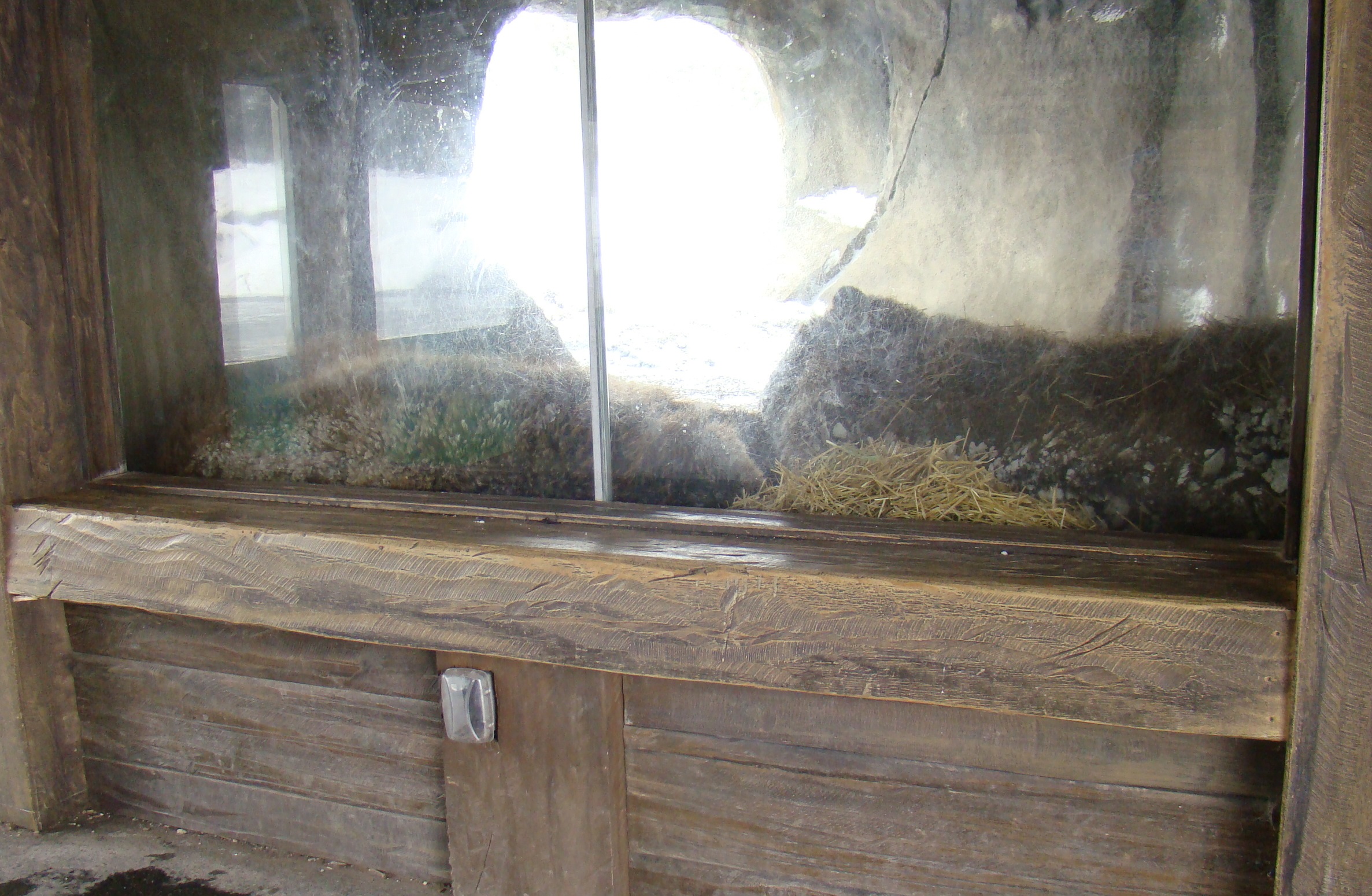
Two brown bears sleep inside their glass cave.

Two brown bears sleep inside their glass cave.

Two Alaskan brown bears, brother Brutus and Buckeye – from Ohio of course, sleep soundly as they huddle against a heavy glass wall. They appear to believe in hibernation even at the zoo. Usually, they can be found swimming in their own small pool or having a bear wrestling match.

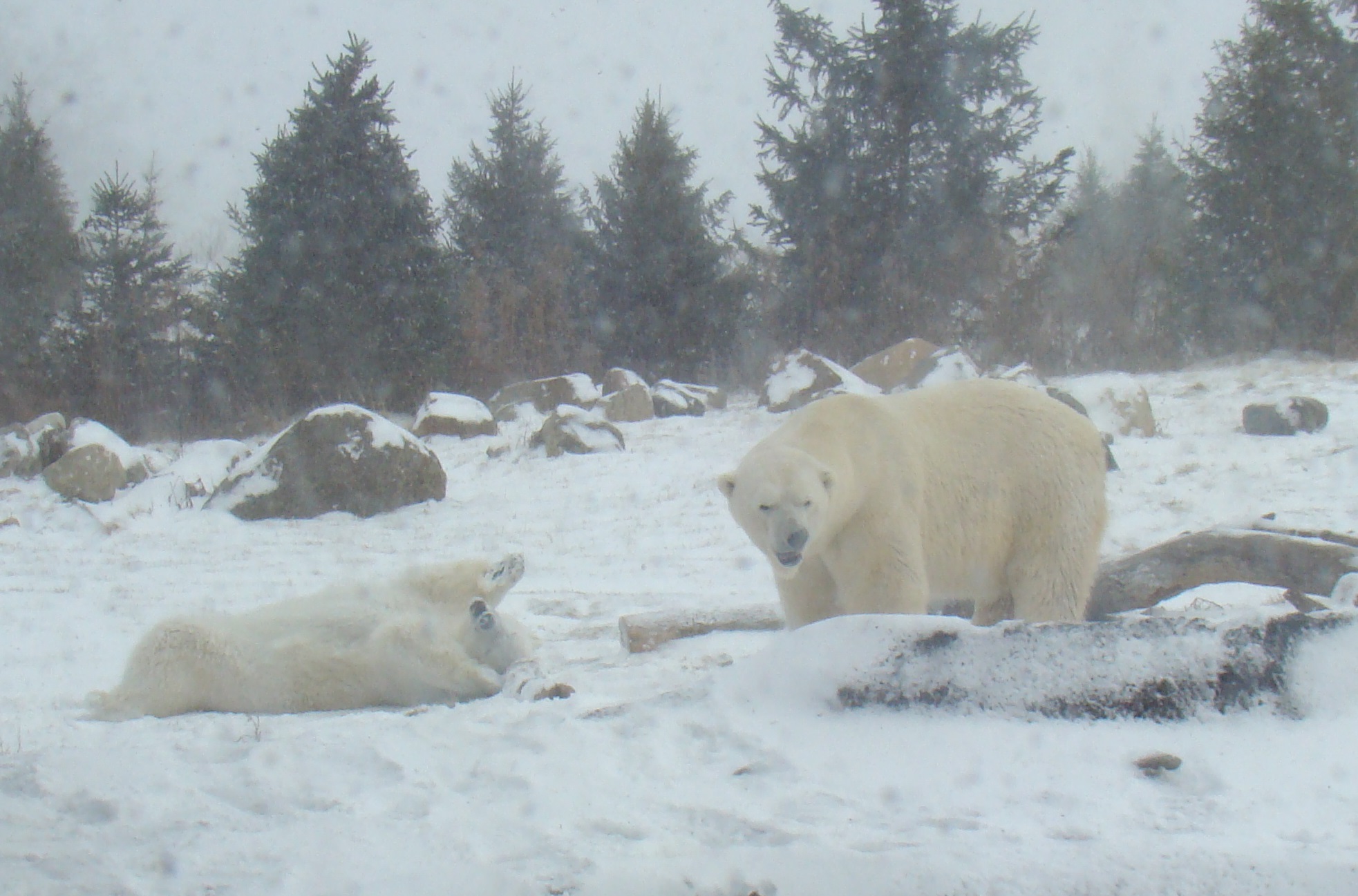
Polar bears play in the snow.

Polar bears play in the snow.

Polar bears, Aurora and Anana, have a playful time in the new fallen snow. Both rolled around on their backs taking a snow bath or perhaps just relaxing . Today they seemed happy to play in the snow and didn’t venture into either of their two pools for a dip

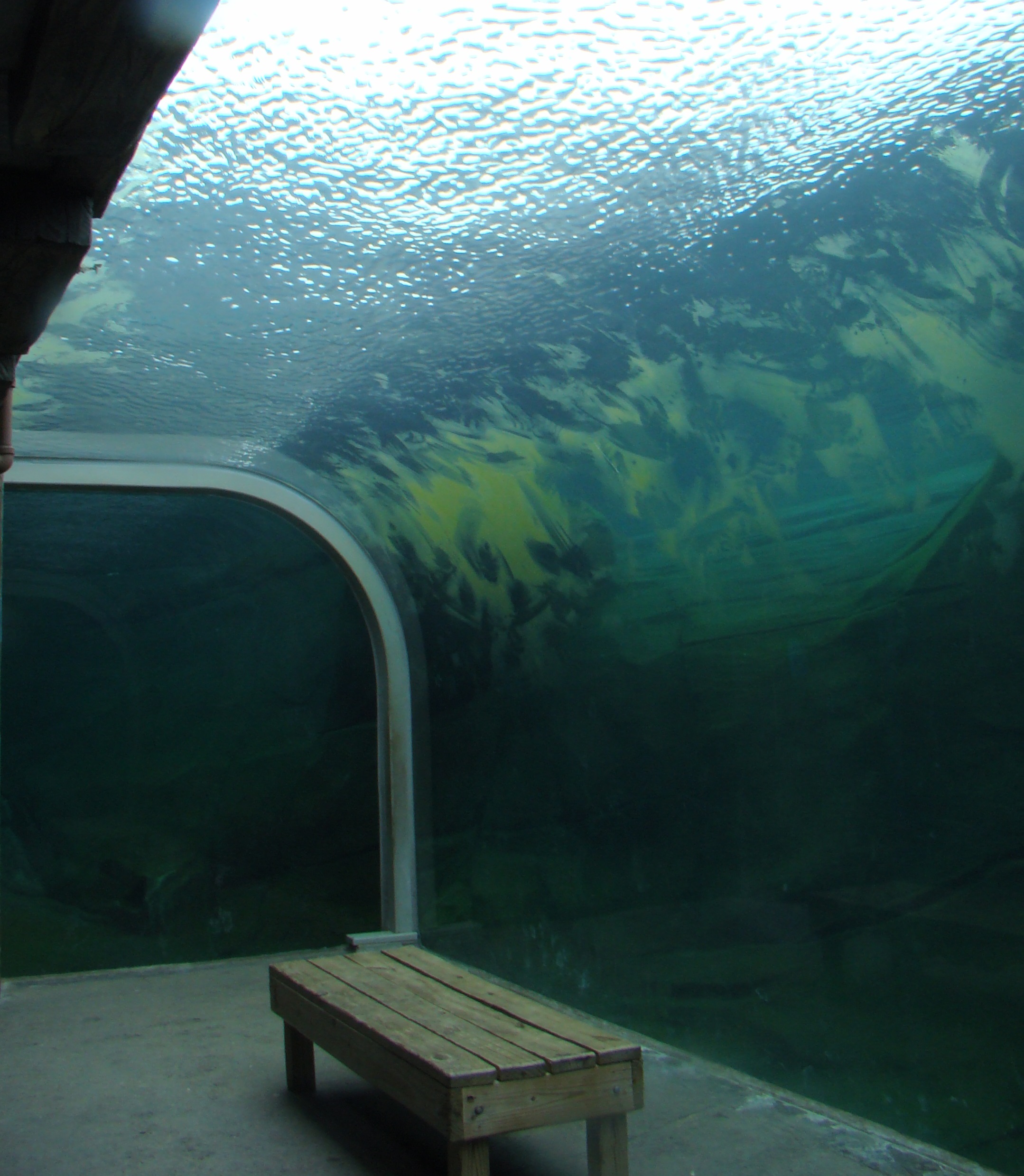
Salt water tunnel where  polar bears often swim overhead.

Salt water tunnel where polar bears often swim overhead.

The polar bears have a 167,000 gallon pool of salt water in which to swim and catch lunch. You can observe the bears diving in for a swim from eye-level, or underneath through a 5″ thick acrylic tunnel. There is an ample supply of fresh trout available when the polar bears decide they might like a snack. Two underground geothermal tanks keep the water in their pools at the perfect temperature for polar bears to enjoy.

Compare the size of various bears.

Compare the size of various bears.

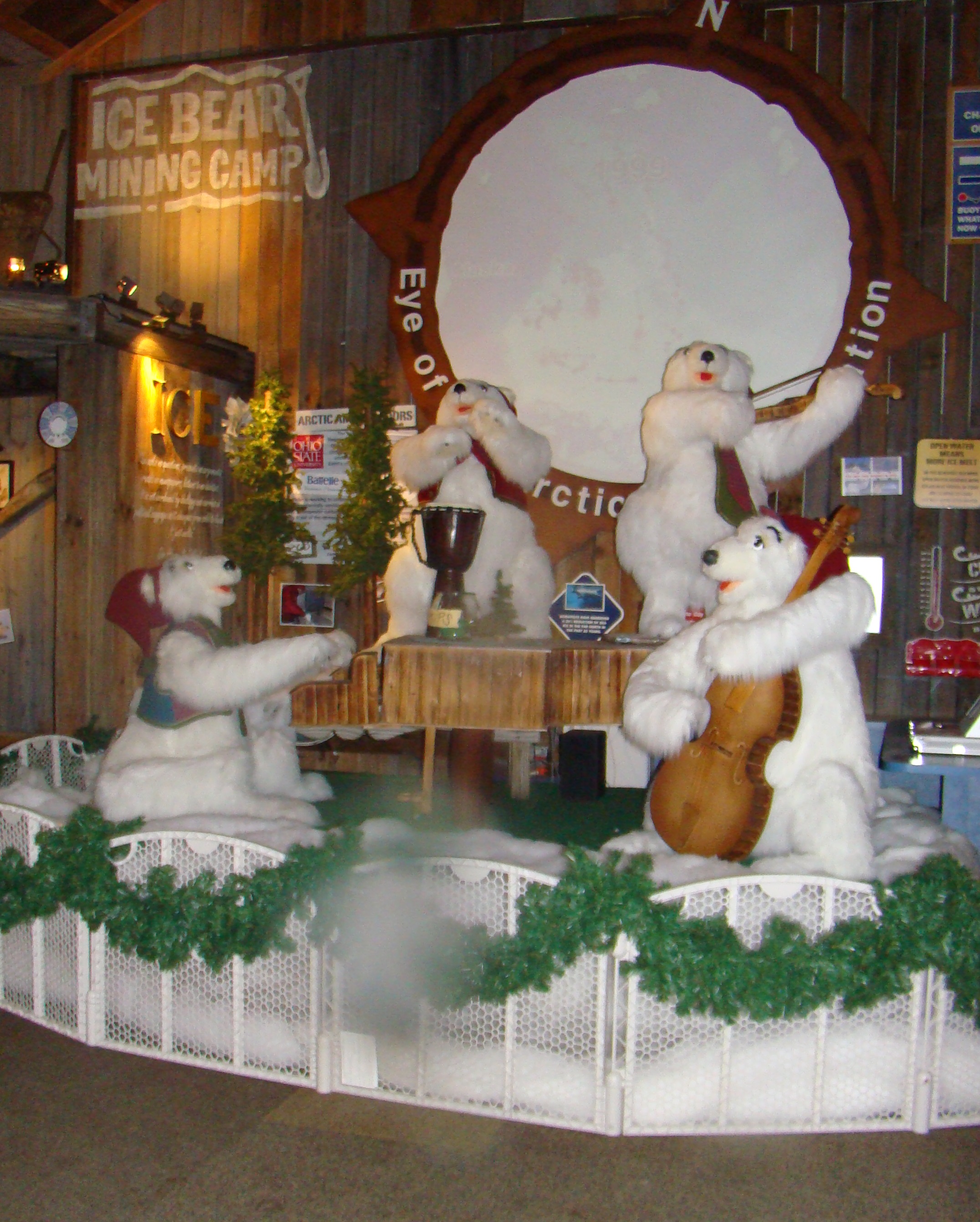
Inside the Battelle Ice Bear Outpost, you can find videos regarding the life of the bears. This interpretive center provides many activities that focus on polar bears and climate changes. It shares ways to practice conservation at home to save the polar bears. They have pictures to compare the sizes of various bears and even an animated Polar Bear Band at Ice Bear Mining Camp.

Bear Band

Bear Band at Ice Bear Mining Camp

A fantastic playground for the youngsters is right outside the Polar Bear Exhibit where children can build an igloo, ride an ice teeter-totter, or slide down a snow bank. Parents can grab a snack at the Polar Grille and chill out while the children have a cool time.

This corner of the zoo is one of the favorite stops for most visitors. A winter visit also has the benefit of being able to see the animals more easily as the zoo isn’t crowded. Make sure you save time for the Polar Frontier…any time of the year!

To visit Columbus Zoo & Aquarium, take I-270 around Columbus, Ohio and use Exit 20. From there you will see signs directing you to the zoo. You’re sure to have a great day!

“Digging the Past” at Campus Martius Museum in Marietta, Ohio

Campus Martius Museum in Marietta, Ohio

Campus Martius Museum in Marietta, Ohio

Dig into the past and discover facts about people who lived hundreds or even thousands of years ago. At Campus Martius Museum in Marietta, Ohio, those interested in archaeology had an exciting day called “Digging the Past”. Special displays by area people, who are interested in what is under the ground, provided valuable information for anyone who wished to listen.

One of the speakers at Archaeology presentation

One of the speakers at Archaeology presentation

Five knowledgeable archaeologists and collectors gave slide show lectures on various archaeological subjects. Some of my favorite dealt with the various groups of mounds around the state of Ohio. Bruce Lambardo, ranger at the Hopewell Culture National Historic Park, explained why we should change the term “mounds” to “earthworks”. These structures are not just piles of dirt built by early Native Americans, but precise, geometrical art works that were not only enormous in size, but also aligned astronomically. He described the Hopewell Culture site near Chillicothe as the most spectacular configuration of Earthworks in the world.

Dr. Jarrod Burks, Director of Archaeological Geophyics at Ohio Valley Archaeology, discussed the earthworks throughout the state including Newark, Chillicothe, and Marietta. While many of the mounds have been destroyed by farming and housing developments, there are still new ones being discovered in the last fifty years.

Mound City Artifacts explained.

Mound City Artifacts explained.

There seemed to be a strong connection between the Newark and Chillicothe Earthworks when they were constructed in 300 B.C. – 400 A.D. These earth architects constructed these ceremonial mounds, where the circles had the exact same diameter, and squares measured the same corner to corner. Even more exacting was the fact that the circle would fit perfectly inside the square. How did these early people perform such mathematically correct shapes and even have them aligned to the winter and summer solstices? How did they construct Great Hopewell Road directly between the two mound centers? Either they were geniuses or perhaps they had some extraterrestrial help. Keep your mind open to all possibilites.

Wes Clark explained his finds at The Castle Museum, where pottery and earthworks artifacts have been discovered. Nathaniel Clark Pottery (1808 -1849) existed on the same site as today’s Castle, so many pieces of pottery have been discovered from red earthenware to stoneware. Earthworks artifacts also frequently appear, including flint arrowheads.

From all the buttons found at the military sites, Archaeologist Greg Shipley remarked, with a smile, that the thread must not have been very strong. A wide variety of buttons appeared in archaeological digs in western Ohio military sites while looking for footprints of an outpost there. The hot spot for buttons seemed to be in the area of the taverns.

Flint Knapper demonstrates skills.

Flint Knapper demonstrates skills.

Flint knappers displayed  the intricate methods they use to shape the pieces of flint found. Their methods are beyond my description as they magically formed arrowheads by chipping and shaping the layers of the flint. Long ago the Indians used either stone or bone to shape their arrows from flint, in much the same manner. After use, the arrowheads would need re-sharpened by removing flakes to reshape, so they would get smaller and sharper as time passed. The flint knapper at Marietta had been creating flint pieces for fifteen years so was quite excellent at his craft.

Archaeology displays filled the lobby of Campus Martius Museum.

Archaeology displays filled the lobby of Campus Martius Museum.

Numerous displays throughout the lobby included historic artifacts from collections around the state. Not only were there Indian artifacts from the Adena and Hopewell people, but also artifacts from military camps of the Revolutionary and Civil Wars as well as historic Marietta.  The Pipe Tomahawk intrigued me with a head that has an ax on one edge with a pipe bowl on the other. It enjoyed multiple uses as a pipe to smoke, a ceremonial instrument, and also a weapon.

Tomahawk Peace Pipe

Tomahawk Peace Pipe had several uses.

Campus Martius Museum in Marietta holds informative speakers throughout the year on a wide variety of subjects. If you are interested in Ohio history, check out their schedule at Campus Martius Museum website.

Marietta is located on the beautiful Ohio River just off I-77. Take Exit 1 to downtown Marietta and follow State Route 7 / 60. Turn left on Washington Street and one block down on the right hand side, you’ll see Campus Martius Museum. There is parking to the right of the building or one block behind at the Ohio River Museum. Visit both museums if time permits.