Places to go and things to see by Gypsy Bev

Archive for the ‘History’ Category

Temperance Tavern Museum Holds Tales of Newcomerstown Area
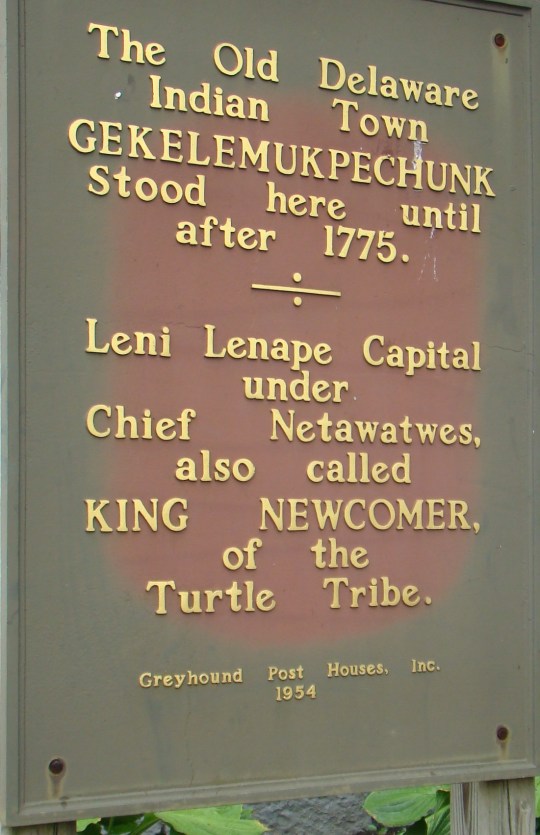
Temperance Tavern Sign

This sign in front of the museum explains the history of the town.

The Delaware Indians settled a village along the Tuscarawas River at what is today Newcomerstown. In 1776, over 700 Delaware Indians lived there with a few English colonists. The Indians called their village Gekelemukpechunk, but the settlers called it Newcomerstown after the Delaware Chief Newcomer of the Turtle Tribe.
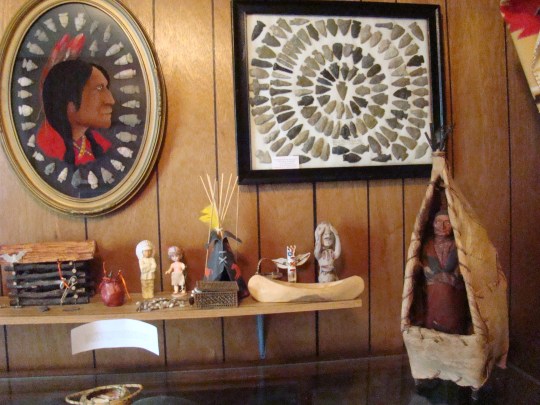
Temperance Tavern Delaware Indians

These Delaware Indians arrowheads and artifacts are an important part of the town’s history.

   During the time of the Ohio & Erie Canal, the tavern and inn in Newcomerstown, Ohio was a popular stop for canal boats. One of the oldest homes in town, built in 1841 by Andrew Creter, Temperance Tavern was made of black walnut and still contains many of the original features.
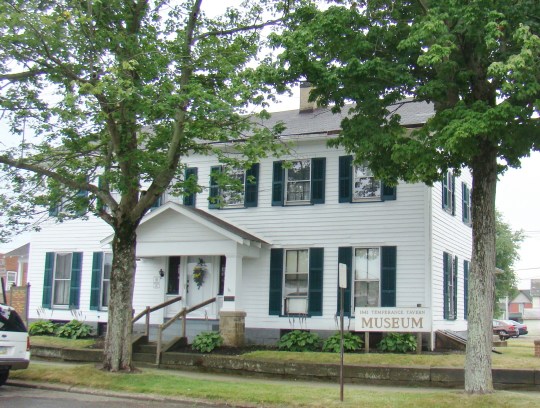
Temperance Tavern

Temperance Tavern Museum, a beautiful old tavern and inn, is one of the oldest homes in Newcomerstown.

   The home and tavern was conveniently built between the canal and the stagecoach trail. One home on Canal Street still has the original canal ditch in their front yard. The ditch was never filled in.

   The Creter family lived on the first floor, while rooms on the second floor housed only women. Single men were literally locked in the attic to keep any embarrassing moments from happening with the lady guests. The basement contained Temperance Tavern. While the names don’t seem to fit together perfectly, no alcohol was served in this tavern.

   Miss Elizabeth, wife of Andrew Creter, still visits the house in spirit. While her form is seldom seen, frequently doors move and cabinets open. She keeps watch over her house.
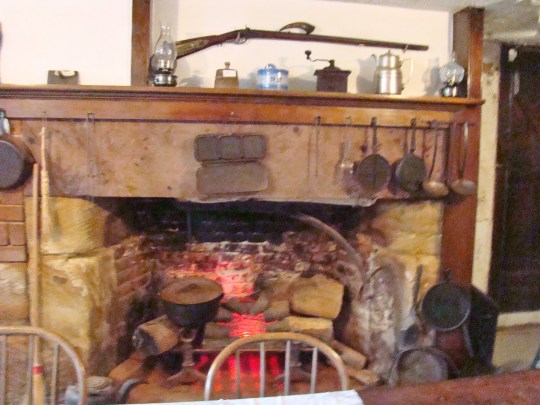
Temperance Tavern Fireplace

This stone fireplace provided a place to cook meals for visitors to the inn.

   The kitchen has a large fireplace where all the tavern meals were cooked. The cast iron utensils hung over the fireplace for easy access in meal preparation. Meals were cooked and served here for people from the canal and stage, but it was also a local gathering place. The table served not only as a place for meals, but operations took place there as well.
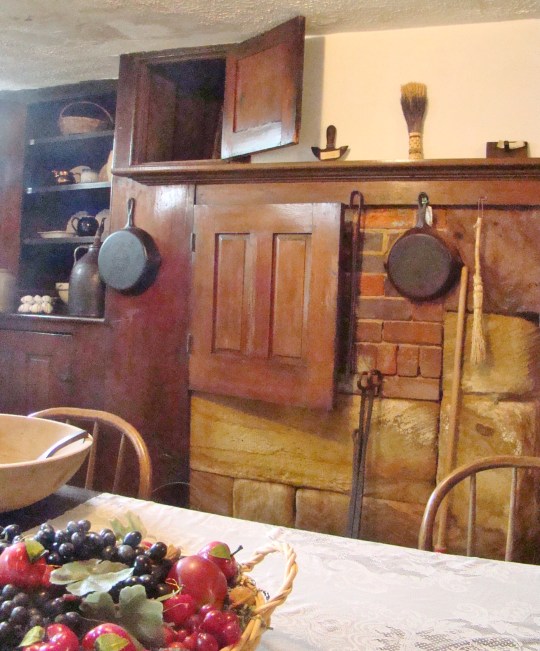
Temperance Tavern Oven

Behind this cabinet was where slaves were hidden on the Underground Railroad.

   This was also a stop for the Underground Railroad. Slaves were hidden in the cellar of this house. You can still see a cabinet that concealed where slaves hid on their Underground Railroad route.
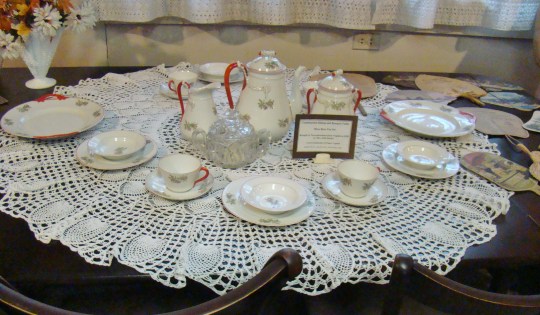
Temperance Tavern Miss Rose Tea Set

This beautiful Moss Rose Tea Set came all the way from Virginia in 1820.

   The dining room table displayed a beautiful Moss Rose Tea Set, which was brought to Newcomerstown from Virginia in 1820 by Mrs. John Snyder. The living room features military artifacts as well as a collection of dresses from the 1800-1900 time frame.

Temperance Tavern Wedding Dress

The wedding dress of Maude Scott highlights this display of clothing from 1800-1900.

   A wedding dress from 1894 belonging to Maude Scott shows the style of the time. It also gives history of one of those early prominent women in the Tuscarawas County area. Maude Scott was the first woman in the county to be elected to public office and formed the first Republican Women’s Club there, a couple examples of her forward thinking.

   Here also, you will find memorabilia honoring two of Newcomerstown’s favorite sons, Cy Young, the most winning pitcher in baseball, and Woody Hayes, Ohio State’s well-known and adored coach.
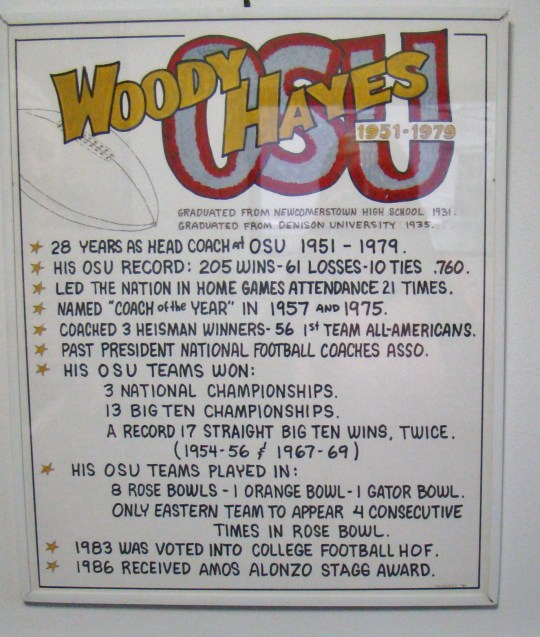
Temperance Tavern Woody

Woody Hayes, Ohio State University football coach, went to school here.

   Woody’s dad was superintendent of schools in Newcomerstown. After graduation from Newcomerstown High School, Woody coached football at Mingo Junction and New Philadelphia before moving on to Ohio State.
Temperance Tavern Cy Young

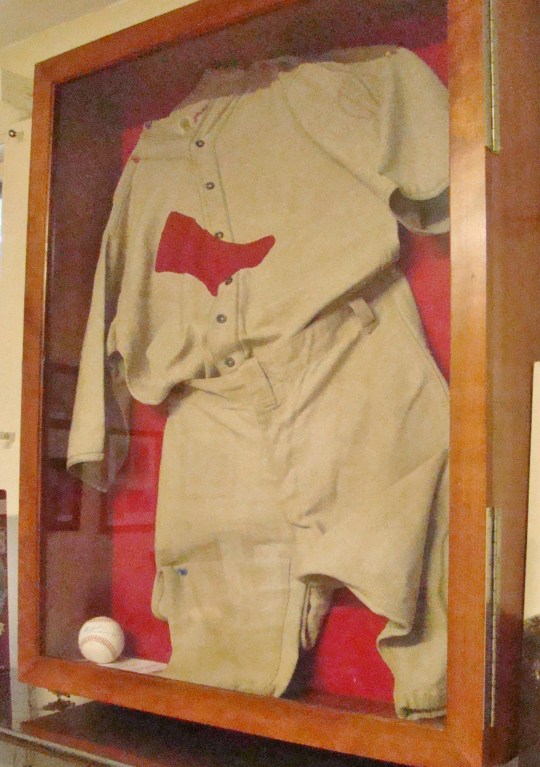
This 1908 Boston Red Sox uniform belonging to Cy Young is on display at the museum.

   One special item in the museum is Cy Young’s complete 1908 Boston Red Sox uniform. The memorabilia span his life from baseball player to retiree, who enjoyed sitting on his front porch in a rocking chair, which is also in the museum today. From 1890-1911, Young won 511 games with an ERA if 2.63. No wonder he is a local hero.
Temperance Tavern Civil War Monument

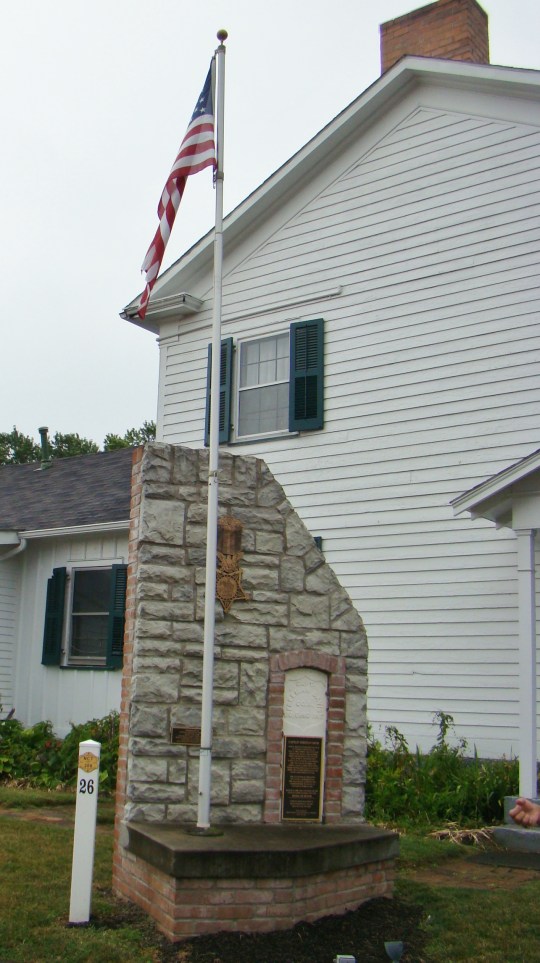
Outside the museum stands a monument to Freeman Davis, a local Civil War hero.

   Outside the Temperance Tavern Museum is a monument honoring Freeman Davis, a local man who earned the Congressional Medal of Honor during the Civil War. Davis served as a sergeant with Company B, 80th Ohio Volunteer Infantry during the war and his commendation came due to his bravery in the Battle of Missionary Ridge in Tennessee.
Main Street BJ

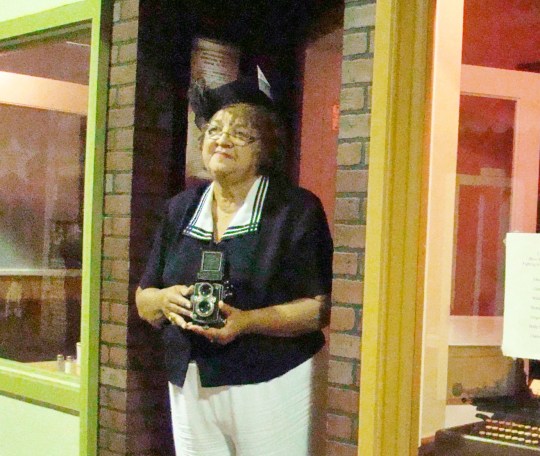
BJ McFadden has served as president of the Newcomerstown Historical Society for several years but recently stepped down from that post.

   Located at 221 Canal Street in Newcomerstown, the Temperance Tavern Museum opens its doors each Memorial Day weekend through the end of October on Tuesday – Sunday. Every small town has interesting history to share. Stop by and explore Temperance Tavern Museum this summer!

The museum is located at 221 West Canal Street in Newcomerstown, Ohio. Off I-77, take Exit 65 for US 36, Turn left on US 36 and then take the second exit, Ohio 258, to Newcomerstown to the left onto Pilling Street. After a short distance, turn right onto East Canal Street and about a mile down the street you’ll find the museum on the left.
Stockport Mill and Inn Gives Scenic View of Muskingum River

A retreat for all reasons – or no reason at all

Stockport Dam

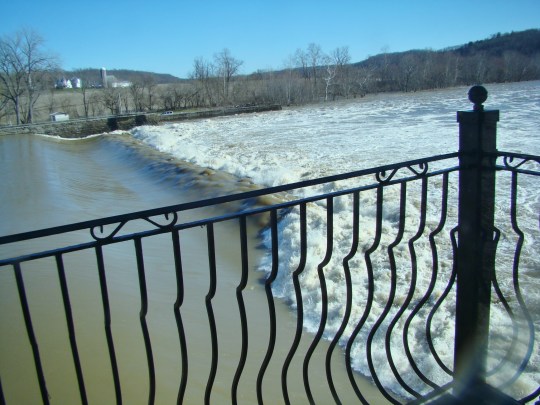
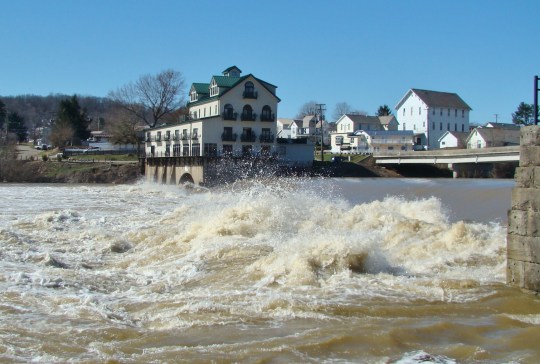
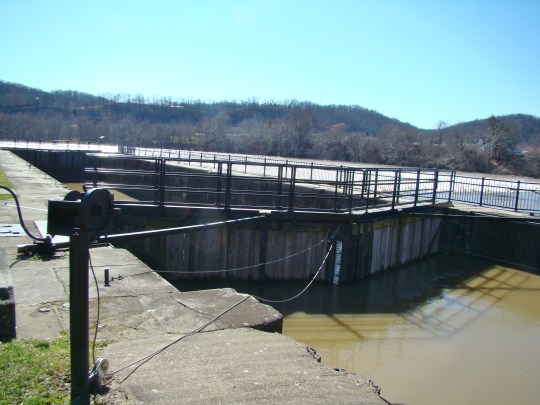
Turbulent waters recently flowed past the Stockport Mill and Inn along the Muskingum River.

Escape crowds and noise. Listen to the sounds of the flowing river. Enjoy a delicious meal. All of these become part of the experience when visiting Stockport Mill and Inn on the Dam at the edge of Stockport, Ohio. Explore the history of the area while you “mill around”.

Stockport Locke

This hand-operated lock sets across the Muskingum River from the inn.

     Stockport Mill, located at the sixth in a series of locks and dams on the Muskingum River, had its beginning in 1842. The building today is the third mill on that site. It was built in 1906 by the Dover Brothers. By using a pair of 10-inch Leffel turbines, it not only provided power to run the mill but generated electricity for the town of  Stockport.

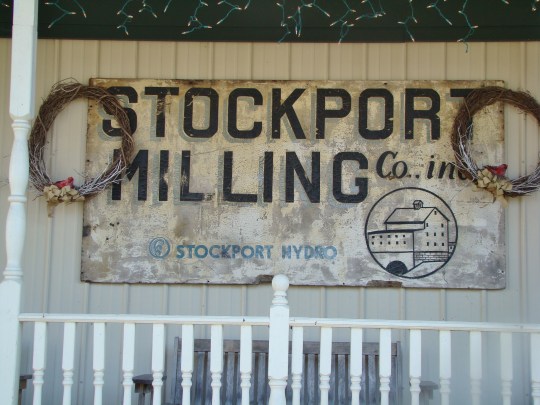
Stockport Mill Sign

This old mill sign hangs on the porch of the Stockport Inn on the Dam.

     Stockport Milling Company was known for making Gold Bond, Seal of Ohio and Pride of the Valley refined flours. Products were shipped on steam packet boats and on the Ohio & Little Kanawha Railroad, because good roads were not available at that time.

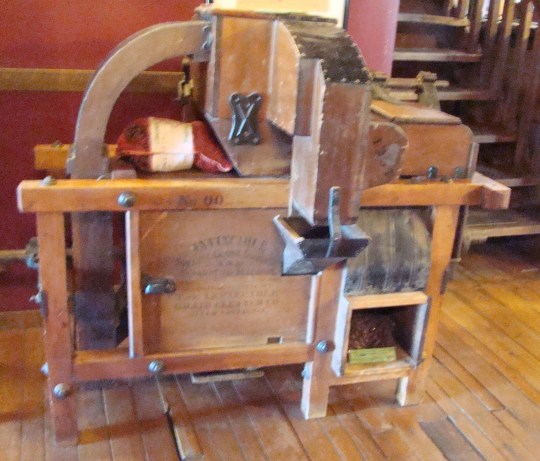
Stockport Corn Grinder

Some antique equipment, like the corn separator, can be found throughout the inn.

     That early mill supplied many different needs. Farmers could get feed and supplies for their animals, including halters and show supplies. Wives used the mill to purchase their garden seeds and plants. Even the children found a place to pick up a 4-H project in the form of baby chicks.

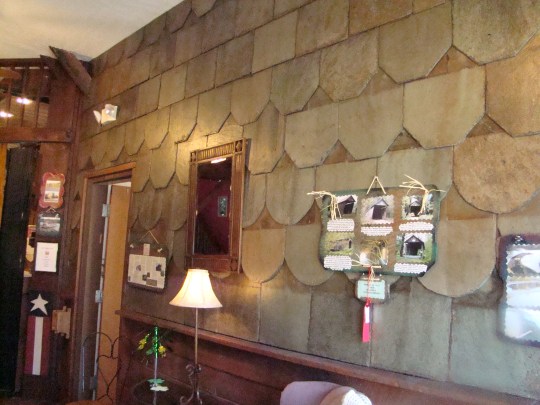
Stockport Slate in Entrance

Slate from the roof has been recycled into wall covering at the inn’s entrance.

     This was also the place where farmers met to share their news, until it ceased operation as a feed mill in 1997.  Three years later this beautiful old mill was restored and now functions as Stockport Mill Inn and Restaurant on the Dam. It is the only mill still remaining of many that dotted the busy river in the past.

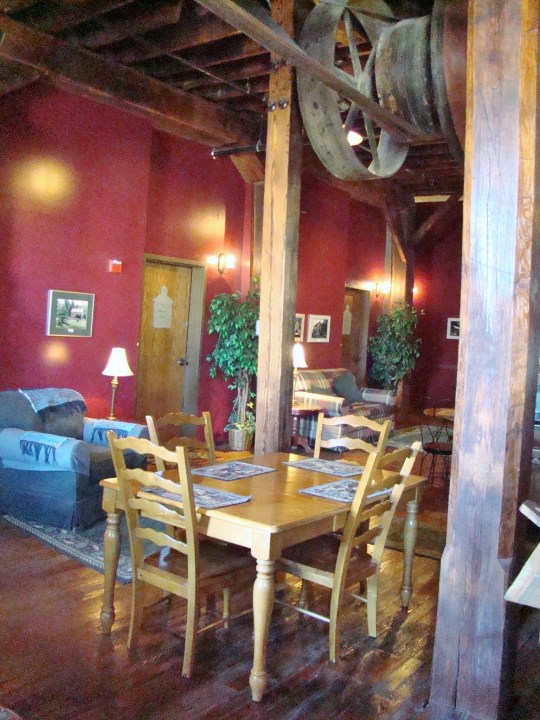
     The owner, Dottie Singer, has attempted to preserve the original architecture and building materials. Inside you’ll find many unusual antiques, information about the history of the area, and great pictures and paintings throughout donated by local Morgan County residents.

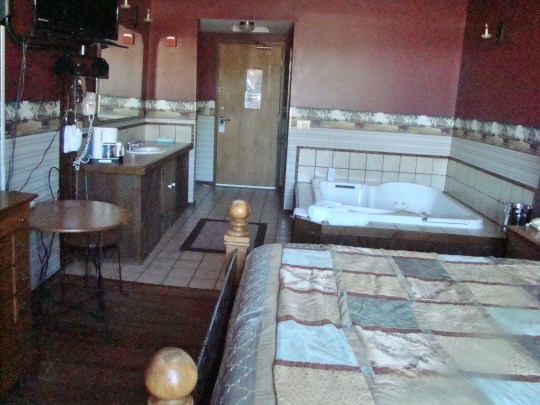
Stockport Suite

Hudson Suite offers a view of the river and a jacuzzi for relaxation.

     There are fourteen guest rooms with private balconies, which all have scenic views of the Muskingum River. You might choose to stay in the Morgan Raider Suite, Valley Gem River View, or Captain Hook Suite.

Stockport Lounge

This meeting room contained workings of the mill as well as a place to visit.

     Suites come with a jacuzzi, while other rooms still have that old fashioned claw bath tub. Each of the four floors has a meeting room for relaxation as well as early morning taste treats. This is a great place for a reunion, wedding, business meeting, or just to get away.

Stockport Dining Room

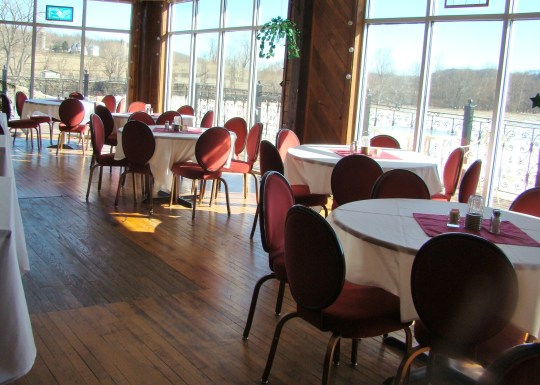
Enjoy weekend meals at Stockport Restaurant on the Dam.

     Their dining area has a wrap around terrace so you can have a delicious meal while watching the river drift by. The restaurant is open weekends throughout most of the year, but closed in January. Friday and Saturday, their hours are 5PM-9 PM, while on Sunday, their delicious buffet, which brings memories of Sunday dinners on the farm, runs from noon-4PM.  Reservations are recommended.

Stockport Turbine

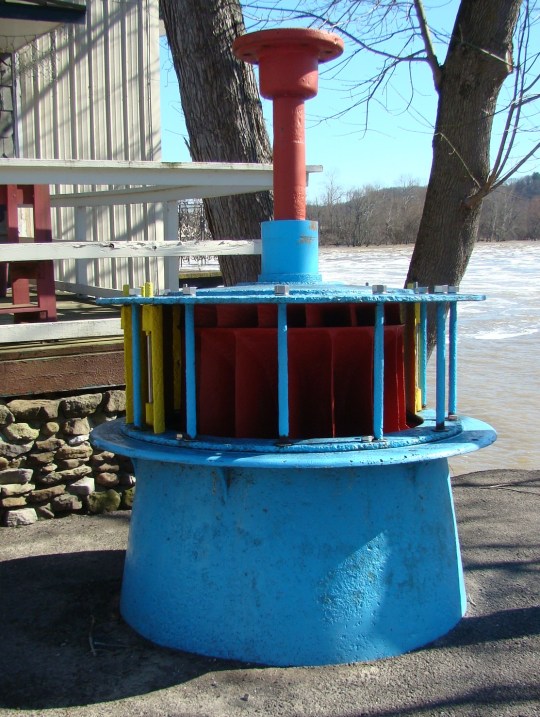
This was one of the original turbines that provided electricity to the mill and town of Stockport.

     While those early turbines that produced electricity for the town became corroded, new turbines have been installed that are similar Samson Leffel turbines. The only difference is these new ones have stainless steel parts instead of the early carbon steel, which rusted.

Stockport Tunnel

This is the exit tunnel for the water after it has run through the turbines.

     Water enters the turbines through a trash-rack, which keeps logs from interfering with turbine action. Then it goes in a tunnel under the mill, where it hits a runner, which turns and makes the power.

Stockport Wall 2

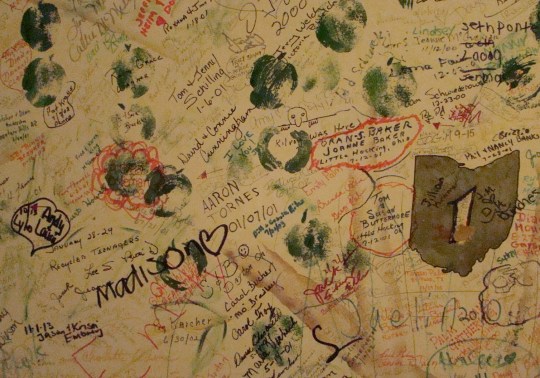
Guests are encouraged to visit the “Signing Wall” along the steps on their way to see the turbines in the basement area.

     The generator sets on top of the Speed Increaser at a level above the 100-year flood level. This Hydro Project produces around 800,000 kilowatt hours per year, using seventeen million gallons of water each day. After all their electric needs are met at the mill, any excess electricity is sold to the electric company. It’s no surprise that today this system is run by a computer!

Stockport Balcony

There’s always an exciting view of the Muskingum River from the balconies.

     For those who like to stay away from it all, Stockport Inn and Mill Restaurant on the Dam would be the perfect place. Guests often come back for the river view from their balcony, great food, and the rustic décor. Many have a favorite suite they use time after time.

Stockport Summer

In the summer, the river here is peaceful near Stockport, Ohio.

     Relax as you hear the sound of the river bubbling right past your balcony at this historic structure. Look for it on your next trip down the Muskingum River.

Stockport Mill and Inn on the Dam is located just off Route 60 along the Muskingum River about halfway between Zanesville and Marietta. Cross over the river at Ohio 266 W and the mill will be on the left hand side. Their address is 1995 Broadway Avenue, Stockport, Ohio.


Make Your Memory a Tradition at Pearl Valley Cheese

PV storefront

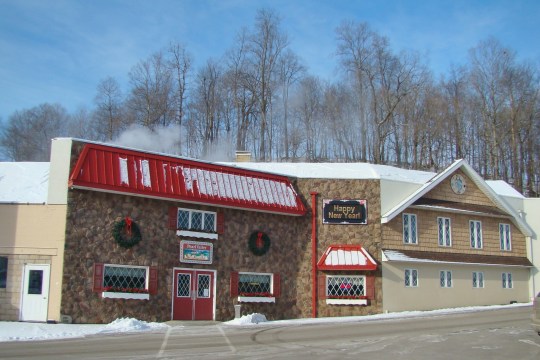
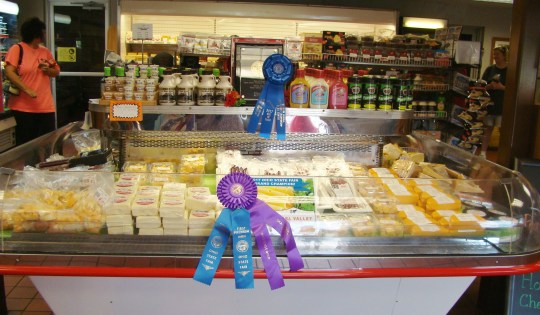
Pearl Valley Cheese is today nestled in the valley along State Route 93 between Fresno and Baltic.

This has been a great year for us!  We won the 2017 Ohio Grand Champion Swiss Cheesemaker at the Ohio Swiss Festival.  What a testimony to our amazing farmers, employees and especially all our customers who continually support us year after year.”                              ~Pearl Valley Cheese

PV Original Factory

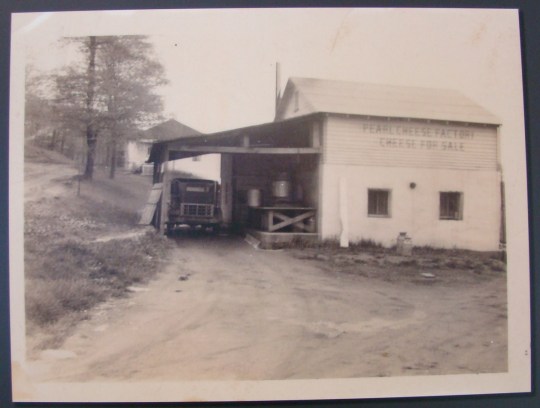
Their original business sat in the parking lot of today’s Pearl Valley Cheese.

Pearl Valley Cheese has been a family owned business since 1928. No wonder they have excelled at making the best cheese around. They credit their success with farmers bringing them high quality milk, employees who all seem like family, and wonderful customers from all over the area. It’s not surprising they have won many state, national and international awards.

PV Founders

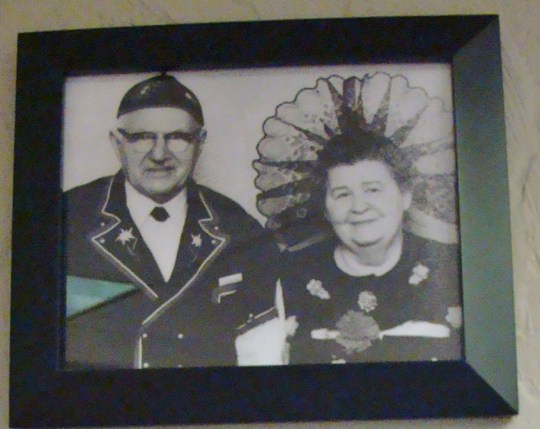
Swiss immigrants, Ernest and Gertrude Stalder, started Pearl Valley Cheese in 1928.

Founded by Swiss immigrants, Ernest and Gertrude Stalder, area farmers brought them their fresh milk in cans by horse and wagon. They purchased the building, which was on today’s property, for $700.

PV Original Copper Kettle

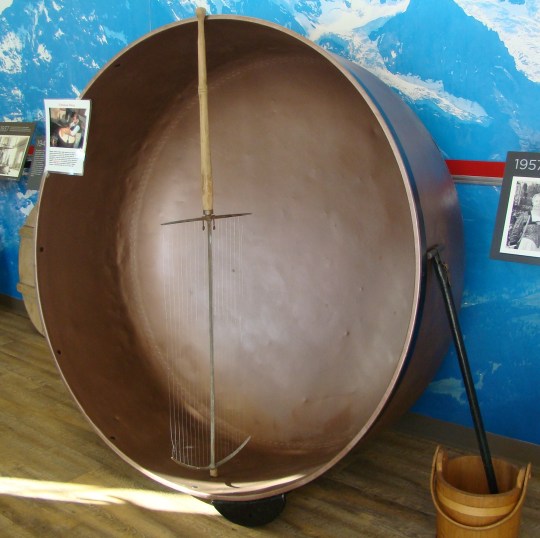
This was the original copper kettle used for making cheese until WWII.

Ernest thought it needed a little improvement so began hauling wheelbarrow loads of bricks from a nearby source until he was satisfied with its appearance. In those early days of 1928, cheese sold for eleven cents a pound.

PV Tanker

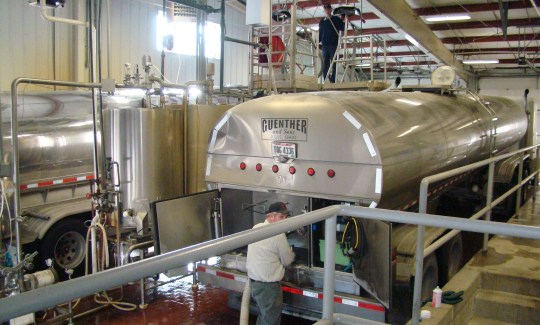
A stainless steel tanker is unloading a morning load of milk after it had been tested.

All the milk they use today is of top quality and as safe as they can possibly buy. The milk comes from about 50 area farmers and two milk marketing co-ops. Dairy producers are very important because high quality milk makes high quality cheese. Each load is tested for antibiotics, and the whole load would be disposed of if any were found. This rarely happens.

PV milk silos

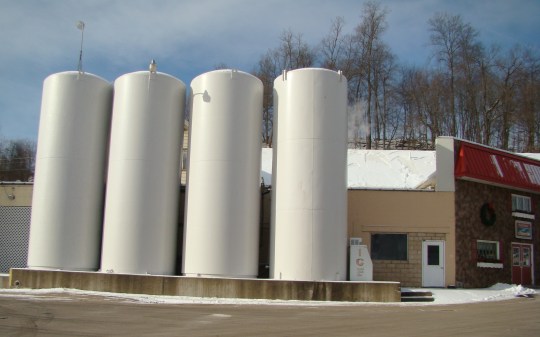
These cold wall silos hold the milk until ready for pasteurization.

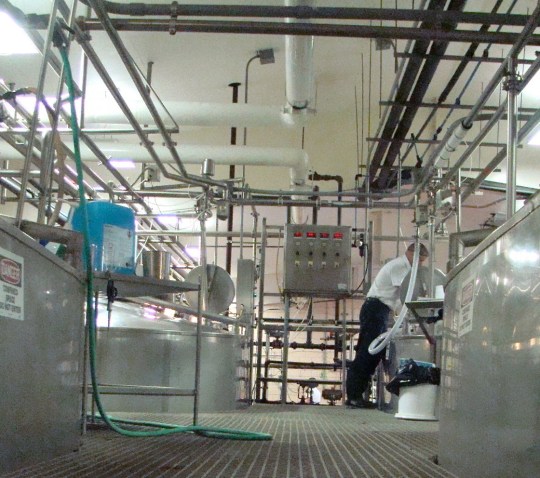
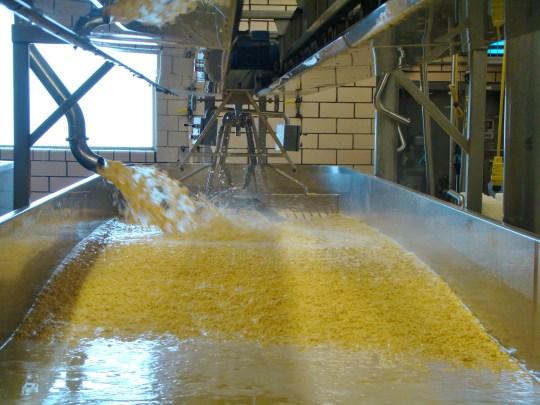
Once the milk is received, they store it in cold wall silos until time for it to be pasteurized to make sure bacteria counts are minimized. Then the milk is cooked in Double Os, which look like ‘large stainless steel crock pots’, holding 4000 gallons each, until the curds are formed. Around 30,000 gallons of milk are used at Pearl Valley Cheese each day, resulting in 25-30,000 pounds of cheese daily.

PV Double Os

Four Double Os, ‘large stainless steel crock pots’, cook the milk until curds are formed.

The separated cream is sold to a butter factory in Wisconsin. Pearl Valley buys back truckloads of butter monthly to sell in their store and to their wholesalers. A pound of that delicious fresh butter came home with this gypsy.

They process the whey and send it to other companies, who dry it and use some of it in nutritional whey protein drinks, animal feeds and other food products. Some of the excess whey is stored at Pearl Valley in a waste water treatment plant, where it is refined into methane gas, then used to create electricity for their business. Pearl Valley has gone green.

PV draining table

The curds and why are separated on this draining table by churning arms.

Through a window to the left of the cheese store, you can watch cheese being made most weekday mornings. See giant vats of milk being turned into curds on their draining tables, and then packed into cheese rolls or wedges.

PV Cheese Tubes

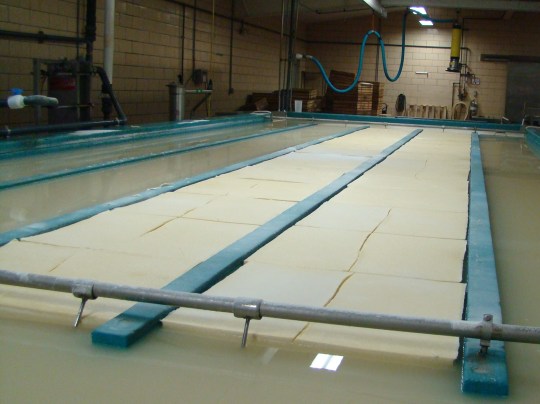
After the curds and whey are separated, the curds are pressed into tubes and wedges.

Only two major cheeses are made here: Swiss and Cheddar, and four different kinds of each. At the end of the day, everything is cleaned and sanitized to maintain their high standards.

PV Swiss

Large blocks of Swiss cheese float in the brine to add a touch of salt to their taste.

Swiss cheese is often more expensive because it takes more time to make. Once blocks of Swiss are formed, they are then soaked in a salt brine to absorb a small amount of salt.

PV Swiss Cheese Crates

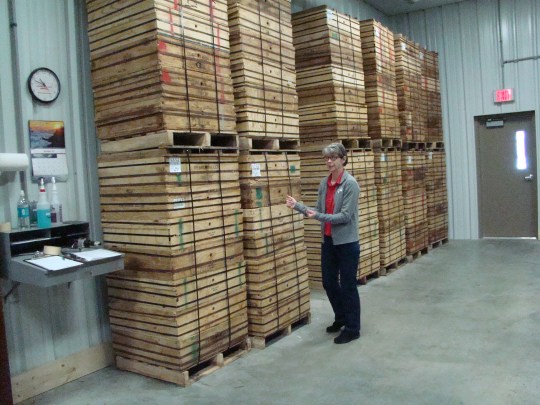
Sally Ellie, my guide on this trip, explained the crates of Swiss cheese in the warming room where they wait for the bubbles to burst.

After this they are placed in a warming room at 76* where the cheese is placed in wooden crates where it “creates the holes”. Those round holes are caused by carbon dioxide bubbles in the cheese, and take weeks to appear.

Ohio is the largest producer of Swiss cheese in the nation. While several local places make Swiss Cheese, the Stalder family feels Pearl Valley makes it better than anyone else. Their Mild Swiss Cheese is an area favorite.

Grace and Sally

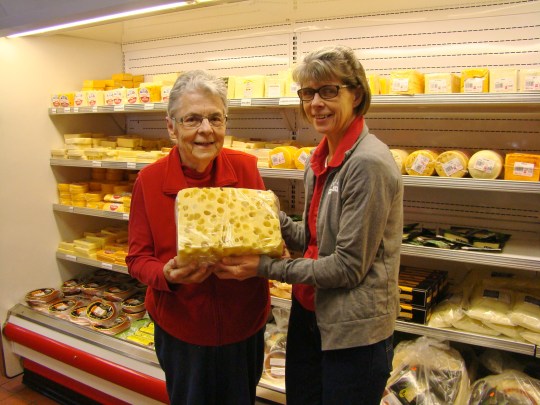
Grace Stalder and her daughter, Sally Ellis, display a large piece of Swiss cheese, a customer favorite.

Four generations of that Swiss family are still working there today headed up by John and Grace Stalder and their extended family. Grace shared her story of joining the Stalder family 60 years ago when she married John, the son of Ernest and Gertrude. The next morning Ernest was at their door telling Grace she needed to total lines of figures that very day. She’s been working there ever since.

PV 2017 Ohio State Fair

Their awards include 2017 Ohio State Fair Grand Champion.

They feel with all their experience, they know how to make cheese the very best way. Even though they have a retail store, they want your experience to be more than a buying adventure. They want to educate you on how the cheese is made from farm to table.

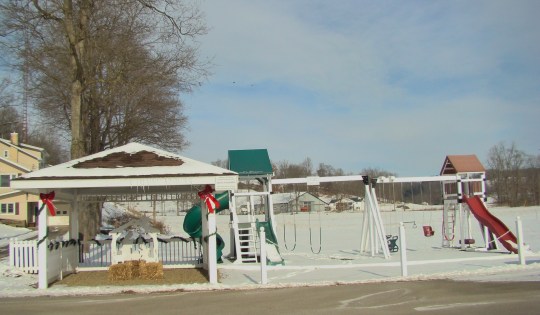
PV Playground

There’s even a close-by playground for children to enjoy.

Customers enjoy their friendly service with plenty of free cheese samples so you can always get a taste before buying. Prices are extremely reasonable so people come back again and again. Everyone has their favorites from Baby Swiss to Extra Sharp Cheddar. Visit soon and try to decide your favorite from so many choices.

Make your visit a special memory that starts a tradition of visiting Pearl Valley Cheese with your family.

Pearl Valley Cheese is located on Ohio State Route 93 between Fresno and Baltic.

Button Designs by Frieda Warther

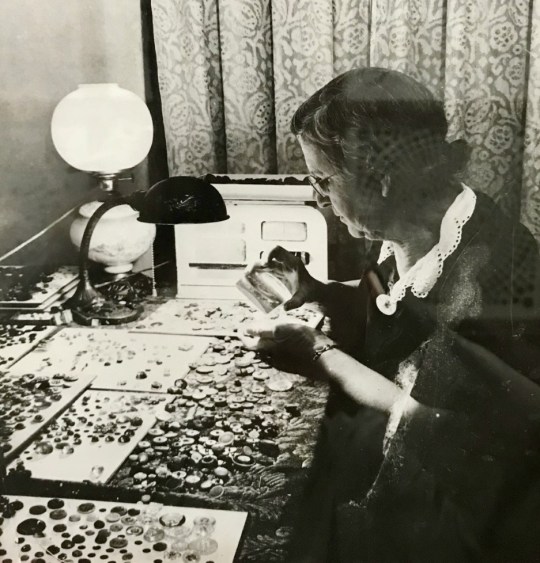
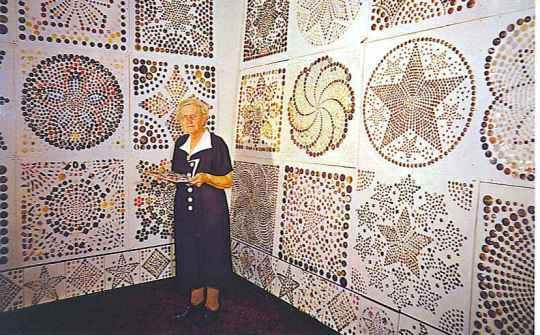
frieda-and-her-buttons.jpg

Frieda surrounded herself with buttons and more buttons.

Almost everyone keeps a container of buttons someplace in their home. At one time, many cut off the buttons on old clothes and kept them in a jar or can. You never knew when you might need an extra button.

Frieda Warther did much the same thing.

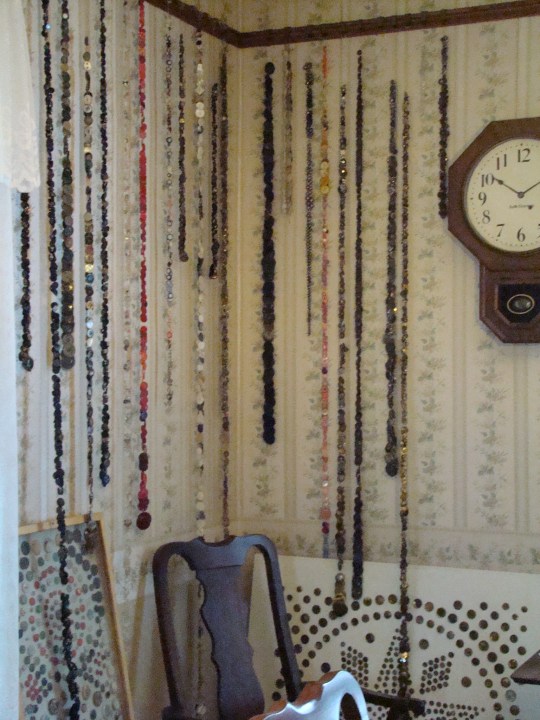
Frieda Button Strings

Buttons hung on strings around the walls of their dining room so she could reach them easily.

Living in Switzerland until the age of four, the family then came to the United States and settled in Dover, Ohio. Frieda was the oldest of thirteen children. It was a Swiss tradition that the oldest child would receive their mother’s box of buttons and sewing tools. Thus began Frieda’s love of buttons.

Frieda Button House

This Button House originally housed the Warther Museum to display Mooney’s trains.

Today those buttons have been used in some of the designs at the Warther Button House, which is just outside Warther’s Museum in Dover.

When Frieda first met Earnest Warther, called Mooney by his friends, their first date consisted of a field trip to hunt arrowheads. After marrying Mooney, Frieda became a wonderful mother to their five children and Mooney’s main support as he developed into a master woodcarver.

Her main relaxation came from tending the gardens outside their home and Mooney’s workshop. She designed them to remind her of her back yard in Switzerland. When the children were young, these gardens contained many vegetables as well. Today, those flower gardens provide a peaceful place to relax with many benches available.

Frieda Bank

During the depression, Mooney hid his money under the coal in this train. But Frieda knew!

Mooney frequently ‘borrowed’ items from his wife to use in his carving creations. When he needed a belt to run one of his model trains, he would borrow it from her sewing machine and replace it when he found one in his journeys. He often liked to use red and green sparkling gems on his trains as well. These he borrowed from Frieda’s brooches.

When visitors came to see all of Mooney’s carvings in those early days, they often spent the afternoon viewing trains brought from storage in the various rooms of their house and even the attic. Frieda decided in 1936, it was time for a museum, so they built the small museum, which is today her Button House.

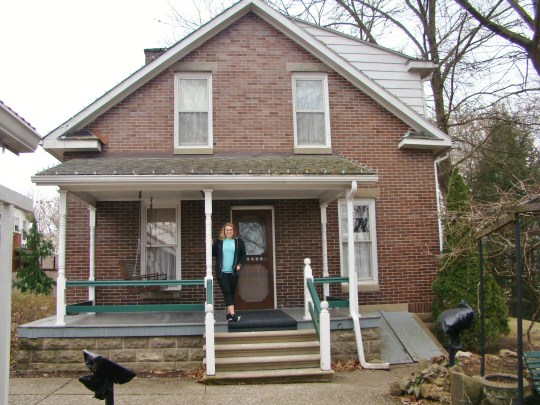
Frieda House

Kristen, great-granddaughter of  Mooney and Frieda, stands on the porch of the Warther’s’ home.

The porch of the Warther Home gave Mooney and Frieda the perfect place to watch trains go by on tracks just across the street. From here they could also watch their children playing in a large playground Mooney had created for them. It’s no surprise that there is a red caboose there also, since Mooney carved so many trains during his lifetime.

Inside the Warther Home, you’ll learn more about Frieda and the family. They lived in their original residence for sixty-three years.

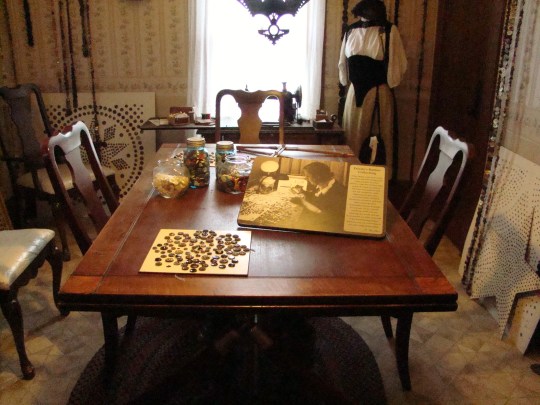
Frieda Table 2

This table served as Frieda’s workplace for most of her button creations.

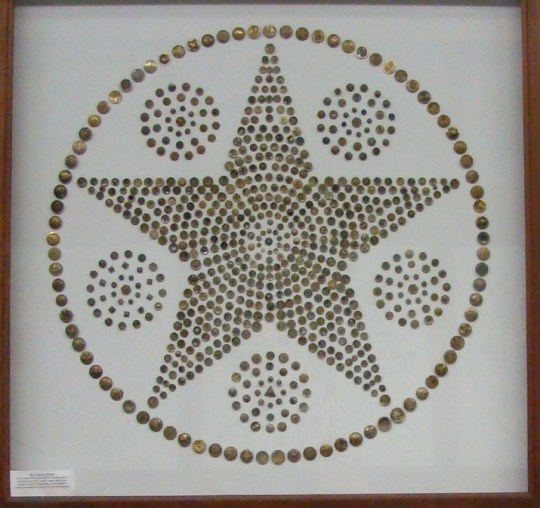
Life was busy for young Frieda, so it wasn’t until she turned sixty that she began working on her button designs at their dining room table. She began experimenting with various combinations and then attached them to a board with either wire or dental floss to make beautiful hanging designs.

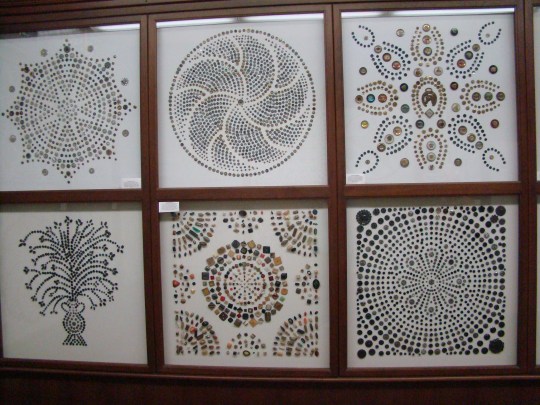
Frieda Button Wall Favorite

Beautiful button designs fill the walls and ceiling of the Button House.

Mooney enjoyed her artistic endeavors by saying, “Sometimes while Frieda was working, she would drill too deep and hit our table. One look at her breathtaking designs and you will realize it was well worth all the holes.” Those holes can still easily be seen.

She also used buttons to make jewelry, a button tree, chess sets and many games. Strings of buttons hung in her kitchen just waiting to be used.

frieda-warther

This picture postcard show Frieda in her Button House.

Today many of those creations containing 73,000 buttons can be found on the walls and ceiling of the Button House. Here you will find buttons of many kinds of materials: hand-painted ceramic, pearl, metal and wooden. Amazing as it may sound, there are no duplicates in the displays.

Frieda Lincoln Button

This button design features a button in the center from Mrs. Lincoln’s inaugural dress.

One of her favorite designs has, as its centerpiece, a button from the Inaugural Dress of Abraham Lincoln’s wife. Lincoln was a favorite of the Warthers, and Mooney followed Lincoln’s philosophy of life.

Because the family loved children, Frieda made one design especially for them. It consists of Cracker Jack prizes, novelties, and what she called Goofy Buttons.

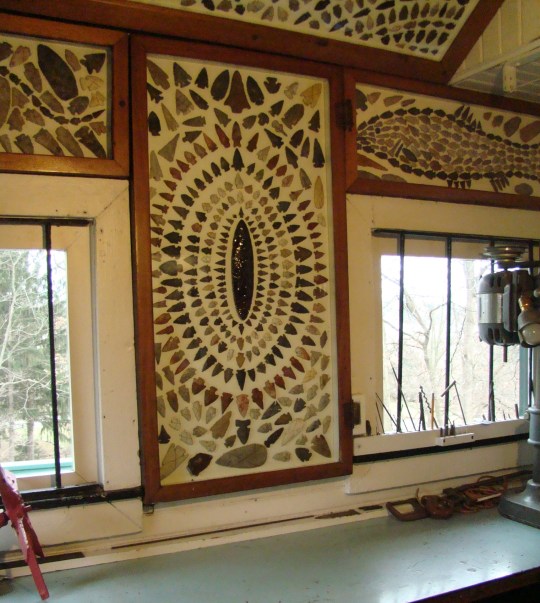
Frieda Arrowheads

Arrowhead displays by Frieda also hung in Mooney’s workshop.

If you look carefully, you can also spot her button designs in another spot – the ladies’ restroom inside the Warther Museum. Had to inquire from a gentleman visitor regarding what was on the wall in the men’s restroom. Here Frieda made a creative display of Mooney’s arrowheads he found on his trips to the country with their family. You never know where creative objects might be found.

Frieda back

The back of a button display was shown by Sheila, our guide and daughter of Mooney’s barber.

There are still unfinished patterns that Frieda had planned. Even when she was in her final days at the age of 98, she was still asking people for one of their buttons if she saw an unusual one.

Soon thousands of springtime tulips will be blooming in Frieda’s Swiss Flower Garden. Many of the spring flowers were originally planted by Freida. Stop by and relax on a bench and imagine what it would have been like to live at “Dumb Street” along the Calico Ditch.

Warthers Museum can be found easily off I-77 in Dover, Ohio. Take Exit 83 to the east and follow the well placed signs to Warthers.

Blessing the Orthodox Easter Basket

Veselenak family at Easter

The Veselenak family continues the Easter tradition followed by their grandparents and great-grandparents at St. Michael’s Orthodox Church in Robins in the early 1900s.

Traditions often bring families closer together. An old Czech tradition being carried on at the Christ the Saviour Orthodox Church in Byesville involves an Easter Basket. This year, the Orthodox Easter falls on April 8.


When the blessing of Easter Baskets likely began back in the 1700s, people faced stark times without meats or fats in their diets for the 40 days of Lent. Being able to return these items to the table was a big part of the Easter celebration.

Most Orthodox celebrate Lent as a time to do without meat and cheese or something that they especially like. They want to make a sacrifice that is meaningful.

Slovak Inside Church

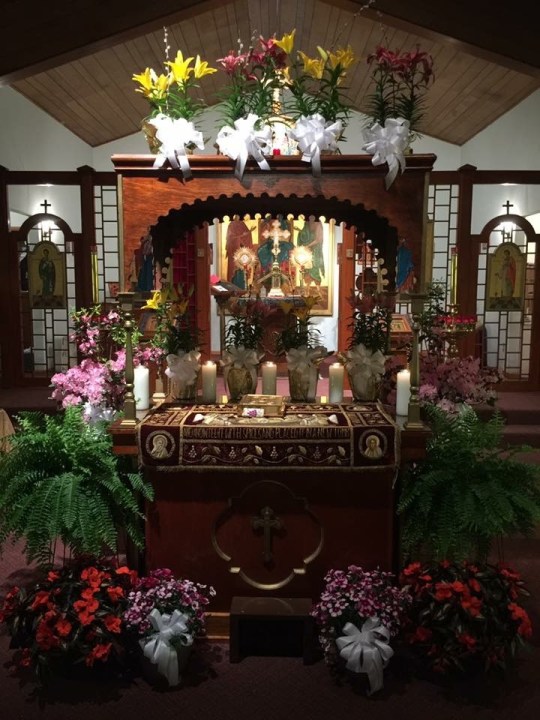
Christ the Saviour Orthodox Church in Byesville is filled with light during the Easter service.

On Holy Saturday evening before Easter Sunday, they gather at the Byesville church to create a service of resurrection. The darkened church becomes filled with light after circling the church three times to indicate the three days Jesus stayed in the tomb.

Slovak priest

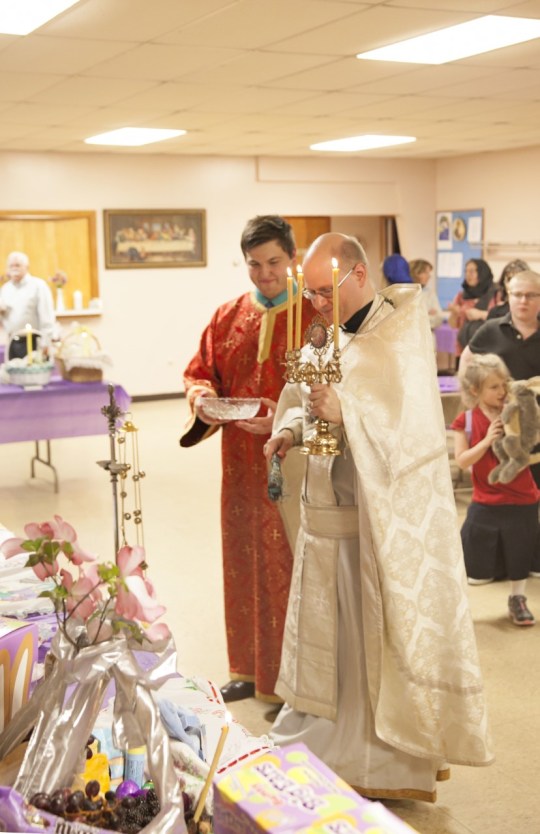
Easter baskets are blessed by Orthodox priest, Father Benjamin Johnson.

After this service, early on Sunday morning, the priest then blesses all the Easter baskets that have been brought to the church hall. Then there is a bountiful feast, as they once again enjoy the taste of meat, cheese, and their favorite food that they haven’t had during the weeks of Lent.

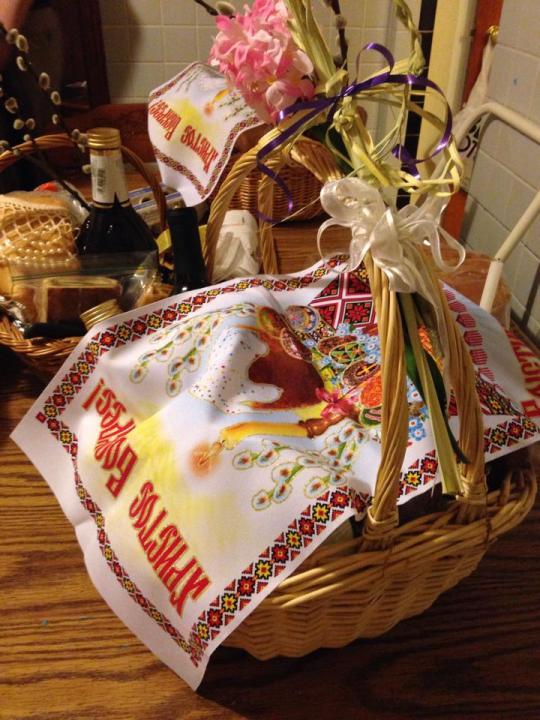
Slovak Basket

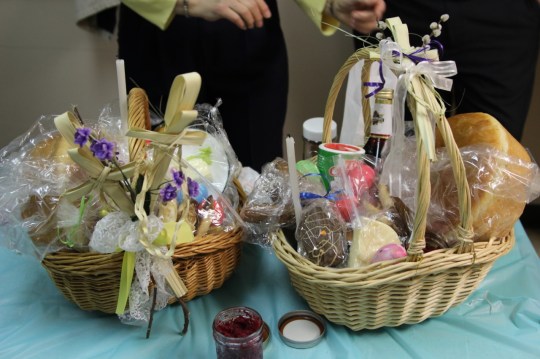
These beautifully filled baskets contain everything expected and even more.

Each item in the large Easter basket holds special meaning:

  • Bread symbolizes Jesus, the Bread of Life.

  • Easter eggs represent our new life in Christ.

  • Salt reminds Christians they are to “season” the Earth.

  • Meat stand for Joy and Abundance.

  • Candles signify Christ as the Light of the World.

  • Ribbons symbolize Joy and Celebration.

Other items they might add are chocolates and desserts.

Slovak Bread

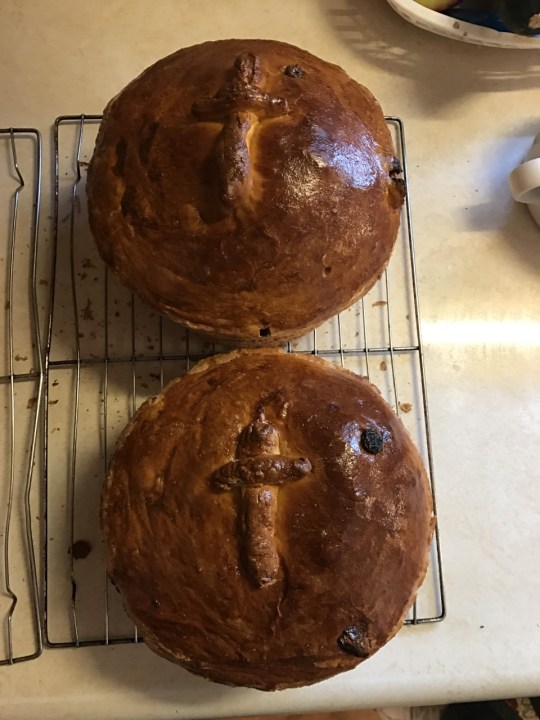
Bread has various designs on the top with this using the symbol of the cross.

The Pascha Easter bread is a sweet, rich bread filled with eggs. milk and butter…the foods that were not eaten during Lent. The bread is often braided to represent Christ’s crown of thorns.

Slovak Easter eggs

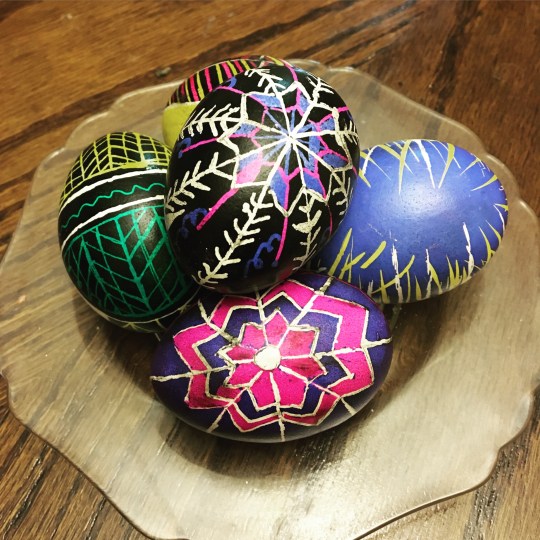
Every basket is certain to contain intricately decorated Easter eggs.

A red egg plays an important role in the Orthodox Easter. Legend says that when Mary Magdalene told the emperor about the empty tomb, she held an egg as a symbol of it. The emperor said the empty tomb was just about as likely as the egg in her hand turning red. The egg did turn red and has ever since been part of the Easter tradition.

Slovak Basket cover

A traditional embroidered cover is placed over the basket.

Some of the men make smoked kielbasa for this special Easter Basket, while the women might prepare cirak, a special Slovak Easter Cheese. This homemade cheese is very mild and often served sliced with baked ham and beet horseradish. A great sandwich treat!

Traditions like this Easter Basket bring families together as they create and share the contents, while celebrating the meaning of this Holy Easter Season. Their church bulletin states: “May God reward your good deeds and preserve the spirit of devotion to Him every day of the year.”

Photos were provided by Nicole Veselenak Caslow. She is the daughter of Rick and Chris Veselenak. I’m proud to say the pictured, dedicated men – Mike, Rick and Gary – are my cousins. Our grandparents, George and Mary Veselenak (Dede and Baba to us) attended the St. Michael’s Orthodox Church in Robins in the early 1900s.

Wheeling Jamboree Celebrates 85th Anniversary – The Country Music Show with Tradition Like No Other


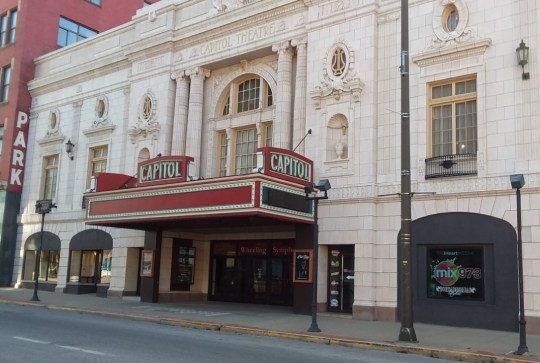
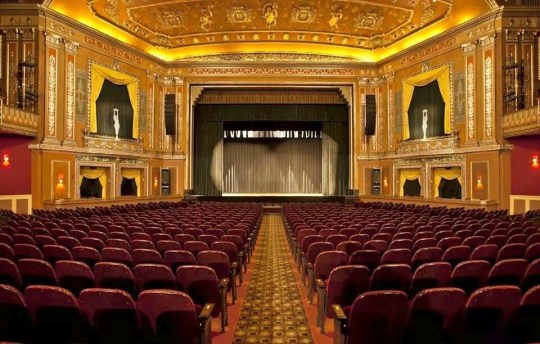
Capitol Theatre

Capitol Theatre in downtown Wheeling, WV will host the 85th Wheeling Jamboree Anniversary.

Wheeling Jamboree lives on! The Historic 85th Anniversary of the Wheeling Jamboree will be held on April 7, 2018 at The Capitol Theatre in downtown Wheeling. Many of the stars will be familiar, and some new, but the country atmosphere will still fill the theater.

The jamboree originated in 1933 on the first Wheeling radio station, a 50,000 watt clear channel station – WWVA. One of its early announcers was Howard Donahoe, who later came to Cambridge to start WILE in 1948.

Mel Tillis

The late Mel Tillis was beloved by country music fans everywhere.

The working people of the Ohio Valley and the Northeast US have their roots in country music so the words in the songs ring true to their lives. That’s why the Jamboree became a popular Saturday evening entertainment.

A unique diversity also appears in Wheeling. The Jamboree and the Wheeling Symphony both take place in Capitol Theatre. So no matter what your musical taste, it can easily be satisfied in Wheeling.

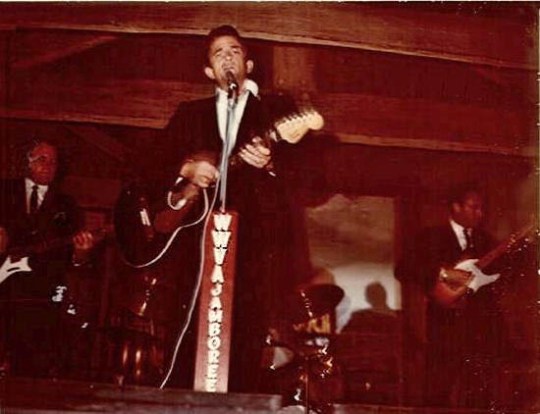
JohnnyCashOnStageatJamboree1968_Enhanced

Johnny Cash made an appearance at the Jamboree early in his career.

William Wallace”Bill” Jones and the Sparkling Four was the first hillbilly act on the radio. They took requests over the telephone. Jones received many requests for yodeling songs and you may have heard him called Silver Yodelin’ Bill Jones.

Due to the popularity of the Jamboree music shows, it was decided to add a live audience to the Jamboree on Saturday nights. The first stage performance of the World’s Original WWVA Jamboree took place at the Capitol Theatre later in 1933 with all local talent, in front of an audience of over 3,000 fans. Then for decades, they broadcast from a different spot each Saturday evening.

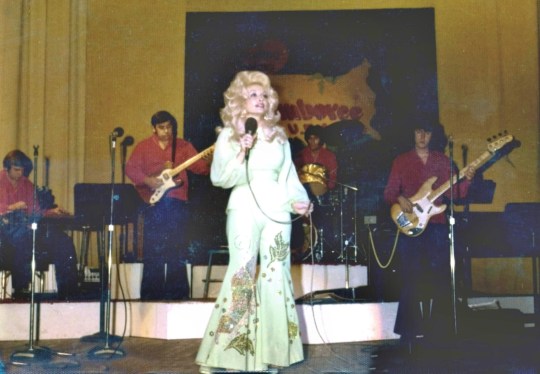
Dolly_Parton_Jamboree_3_1976

Dolly Parton performed at Wheeling Jamboree in 1976.

During WWII, the Jamboree returned to the studio due to the war effort, then began stage performances after the war at Wheeling’s Virginia Theater. One of the most popular Jamboree stars at that time was honky-tonk vocalist, Hawkshaw Hawkins. Add to that the Sunshine Boys and “Yodelin’ Ranger” Hank Snow and people began looking forward to another evening of the Jamboree. If you were a top artist, you did the Jamboree.

Men would bring their cow bells with them as each bell had a unique sound. That way their family back home would know they were in attendance. Today, you’ll still hear the sound of cow bells over the radio on Jamboree nights on WBPS in Cambridge and WWOV in Wheeling.

JamboreeVirginiaTheater1946Color

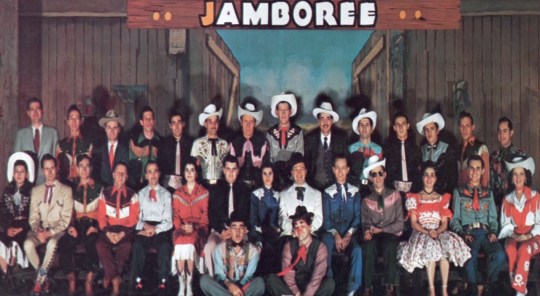
The cast of the 1945 Wheeling Jamboree gathered on stage.

During the late 1940s, my parents took me on perhaps my first gypsy road trip to Virginia Theater to see the Wheeling Jamboree. Two names stick in my mind from that long ago show – Hawkshaw Hawkins with Dog House Boogie, and Grandpa Jones, who later starred in Hee Haw. At the time, this was quite the adventure from the hills of Indian Camp.

When the Virginia Theater was demolished after 16 years of hosting the Jamboree, their new home became the Rex Theater for four years. Then it was moved to Wheeling Island Exhibition Hall in 1966.

Brad young (259x194)

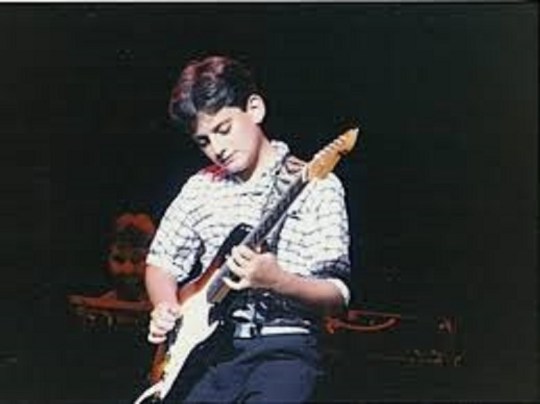
Brad Paisley began playing at the Jamboree when he was ten years old.

Over the years, the Jamboree provided the perfect place for young local talent to get their start. Brad Paisley, from nearby Glen Dale, sang on the Jamboree at the age of 10 and played with their band weekly for eight years before moving on to Nashville.

Ronnie Milsap

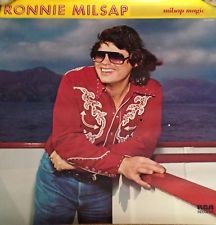
Ronnie Milsap will be one of the performers at the 85th Anniversary.

The 85th Anniversary will be celebrated with well known country stars including Country Music Hall of Fame Members Ronnie Milsap and Charley McCoy. Add to that Wheeling native Tim O’Brien along with Darnell Milller, Rachel Whitcomb and more surprises. Emcee for the evening will be long-time country music personality, Keith Bilbrey.

Craig Wayne Boyd Jamboree

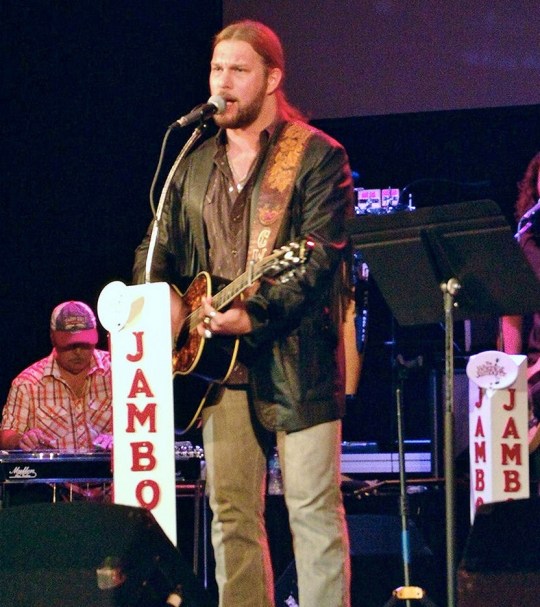
Craig Wayne Boyd was a winner on The Voice, but appeared at the Jamboree long before winning.

Today the Wheeling Jamboree broadcasts on WWOV to the air waves of the greater Wheeling area. Dave Heath, president of Wheeling Jamboree, Inc. and WWOV, has been instrumental in keeping this musical program alive.

Capitol Interior Post Renovation

The interior of the Capitol Theatre has recently had a grand renovation.

Whether you know the Jamboree as the Original WWVA Jamboree, Jamboree USA or The Wheeling Jamboree it remains the 2nd oldest Country Music Radio Broadcast Stage Show in history, behind the Grand Old Opry. Celebrate their 85th Anniversary on April 7 at 7:00 at the Capitol Theatre.

Ticket prices range from $20-$65 and can be purchased online at www.capitoltheatrewheeling.com .You’ve got me thinkin’ that a trip to the Jamboree would be the perfect way to spend an evening.

Capitol Theatre in Wheeling, WV can easily be reached off I-70 at Exit 1A. Take Route 40 straight downtown. The Theatre is on the right hand side at 1015 Main Street.

Malabar Farm, Home of Louis Bromfield

Malabar The Big House

The “Big House” served as home to Louis Bromfield, his wife and three daughters.

Enter Pleasant Valley to find Malabar Farm, the dream of Louis Bromfield. Tour his “Big House”, visit animals in his barn, or follow the self-driven auto tour of Shawshank Redemption film sites. Spend a day or a weekend.

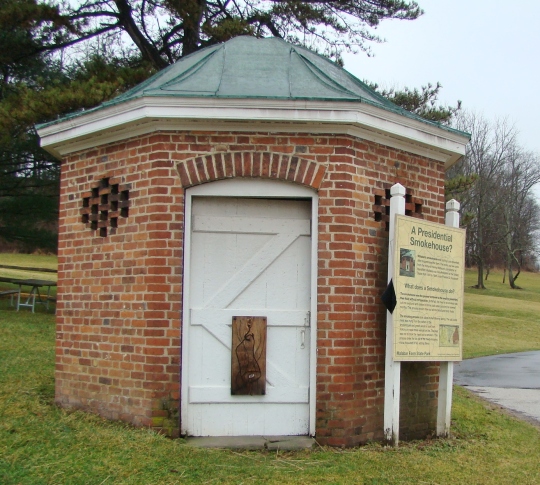
Malabar Smokehouse

Bricks for this smokehouse came from the Mansfield home of Henry Wallace, vice-president of the United States under Franklin Roosevelt.

Louis Bromfield, Pulitzer Prize winning author, was born in Mansfield. After a variety of experiences, he returned to that area for what he considered the perfect place to live. Two things he loved all his live were the farm and words.

Malabar Desk

Often Bromfield wrote at this desk while looking out the window at his farm.

It seemed he had trouble early in life finding that magical work that would please him. He went to agriculture college, studied journalism, served in the Army as an ambulance driver, journeyed through France and eventually came back to the United States to work at writing for several newspapers.

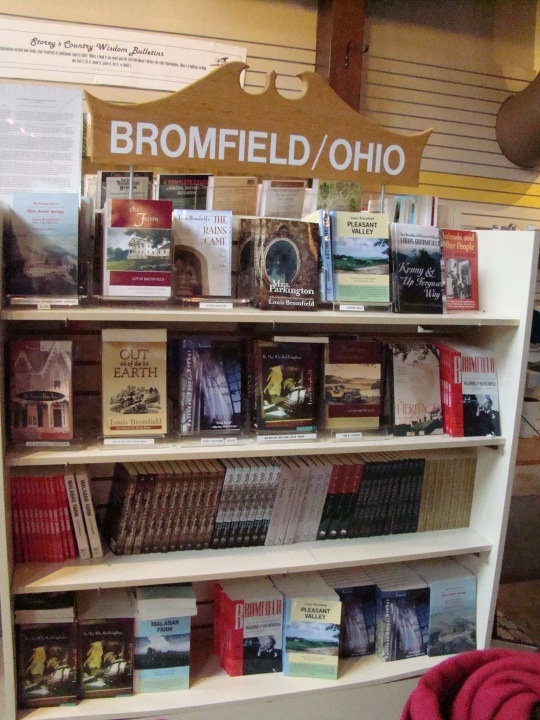
Malabar Gift Shop Books

The gift shop had a fantastic selection of Bromfield’s novels.

Following those experiences, Bromfield began writing novels, which won him high acclaim. His first book, Green Bay Tree, was a big success. His novels were always based on the people and places he knew well. He used a quilt pattern by taking one piece from here and another from there and fitting them all together. He turned his life into stories. All thirty novels were best sellers and several became motion pictures.

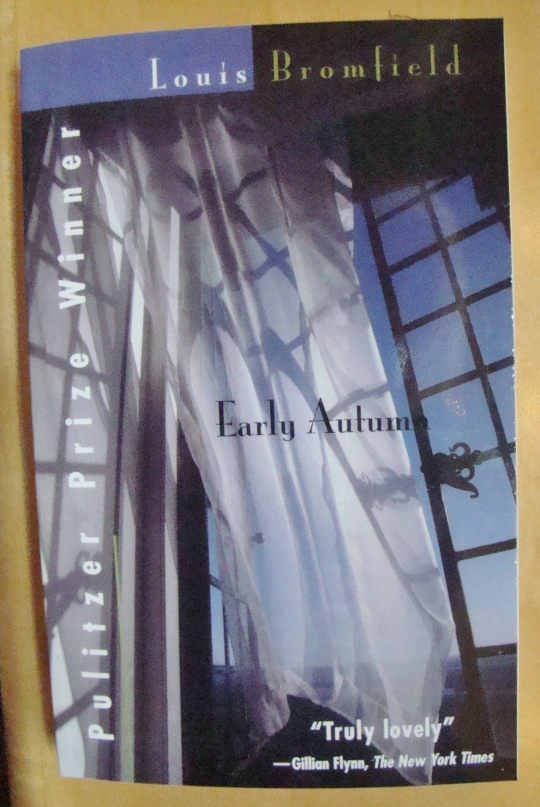
Malabar Pulitzer Book

His novel, Early Autumn, earned Bromfield the 1927 Pulitzer Prize.

His third novel, Early Autumn, won the 1927 Pulitzer Price for Novels. This financial success gave him opportunity to take his wife and three daughters to Paris for a few years and also visited India for a few months. How they all enjoyed life in Paris, but when threat of WWII was in the air, Bromfield brought his family back to the United States.

Malabar Portrait

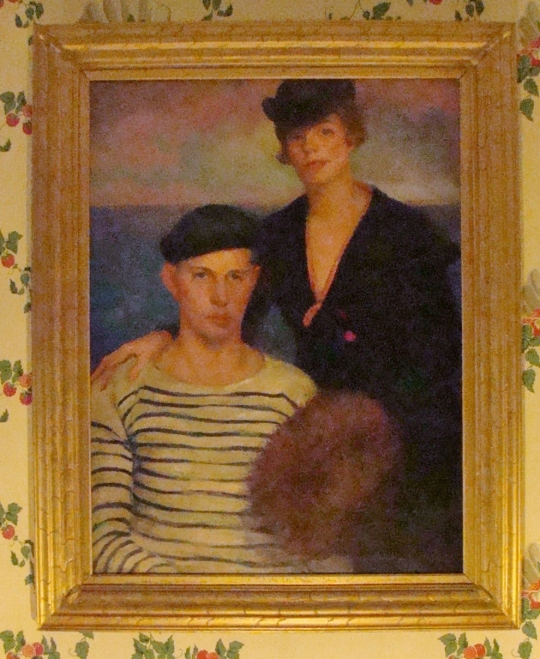
This portrait of Bromfield and his wife, Mary, reminded them of their happy times in France.

In 1939, Bromfield settled back into his old hometown area of Pleasant Valley, where he purchased three farms, totaling one thousand acres. Since he enjoyed the Malabar coast of India, the farm was called Malabar, which means “gently rolling hills and valleys”.

Malabar Grand Piano

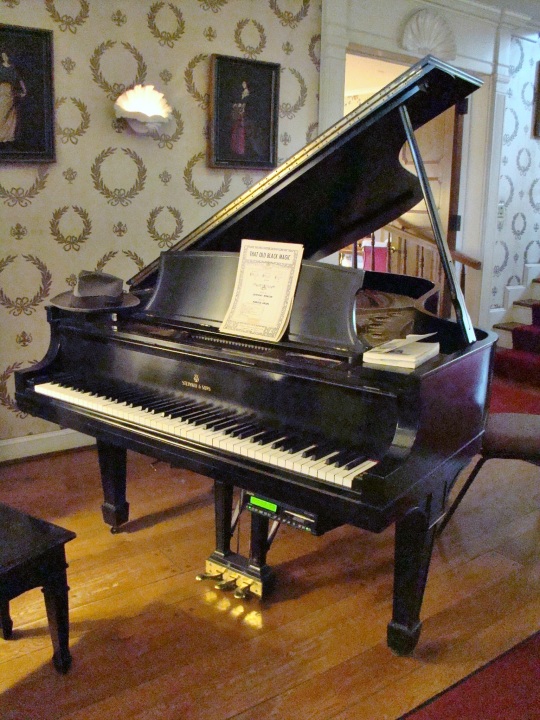
Bromfield’s daughter, Hope, played this piano for the wedding of Humphrey Bogart and Lauren Bacall.

Starting with the original farmhouse, he added several additions for a total of 32 rooms, including nine bedrooms and ten bathrooms. This “Big House” became the perfect place to entertain his guests from Hollywood. If you came to visit, Bromfield insisted you help with farm work. That’s how Shirley Temple learned how to milk cows and Jimmy Cagney to run a vegetable stand.

Malabar Wedding 001

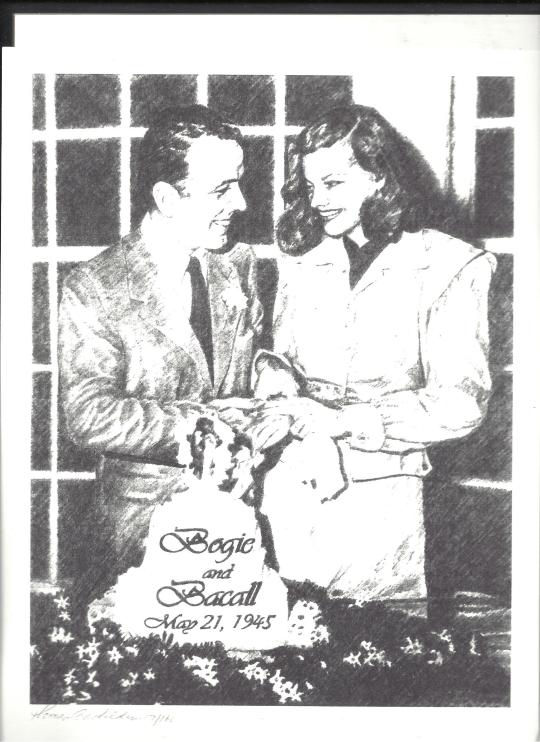
This sketch by Tom Bachelder captured Humphrey Bogart and Lauren Bacall cutting their wedding cake after being married at Malabar Farm in 1945.

A close friend was Humphrey Bogart, who asked Bromfield if he could get married at Malabar. Arrangements were made for Bogart and Lauren Bacall to have their ceremony there with 700 guests attending.

Malabar Bromfield at desk

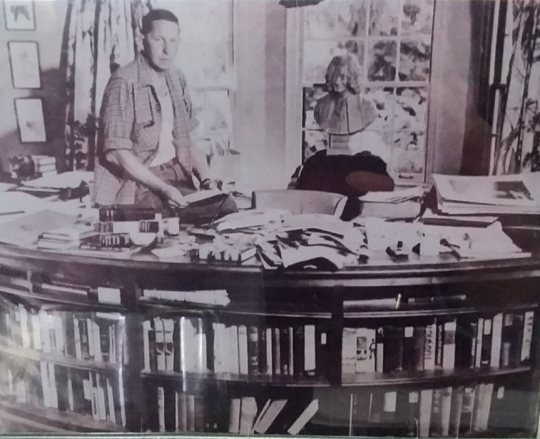
This old photo shows Bromfield at one of his desks, where he did some of his writing.

Every room of their house contains shelves of books, nearly 4,000 total. Bromfield is said to have only slept two or three hours a night so that gave him extra time to read and write novels. His daytime hours were most likely spent pursuing his interest in agriculture.

Malabar Louis and Prince

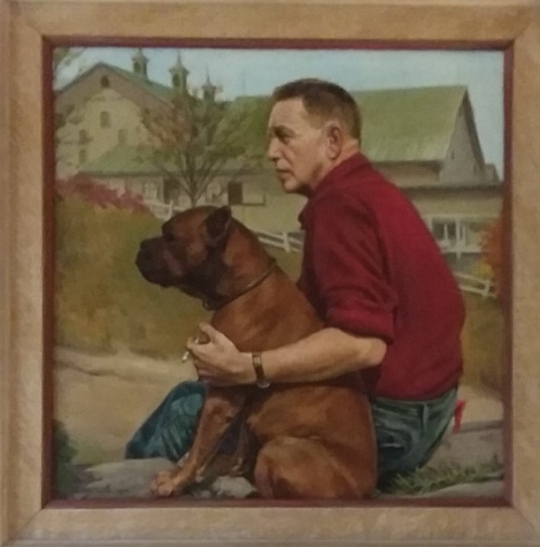
The painting shows Bromfield with his favorite Boxer, Prince.

Over seventy dogs lived at Malabar during Bromfield’s life there and eighty percent of them were boxers. His favorite boxer was Prince. There’s even a picture of a ghost boxer dog still hanging around.

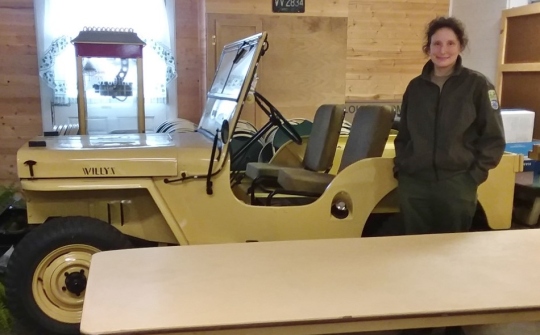
Malabar Guide, Alana and Jeep

Our guide, Alana, tells about the restored Jeep that Bromfield used around the farm.

His ideas as a conservationist changed the face of agriculture in Ohio. He needed to enrich the worn-out soil so planted soybeans and plowed them under to add nitrogen to the soil. Hillsides were planted around in strips to avoid erosion, and he promoted the idea of rotation of crops. His decision to use the spreading multifloral rose as a fence still angers farmers today.

Malabar sign

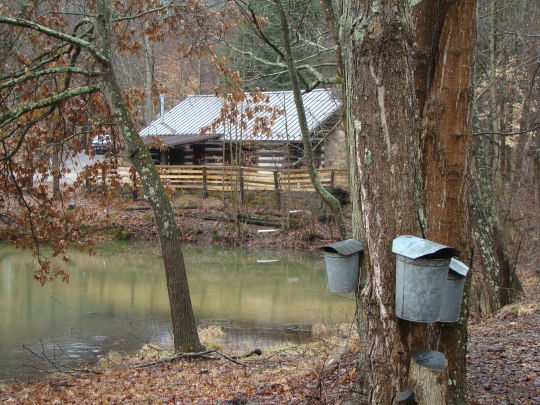
Malabar Maple Syrup Cabin

Over 650 maple trees are being tapped along the road to Maple Syrup Cabin.

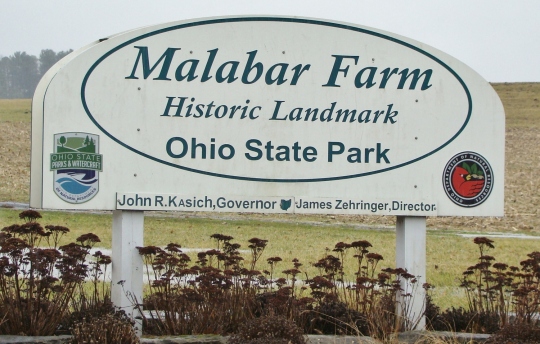
In 1972, the state of Ohio accepted the deed to Malabar Farm and pledged to uphold its beauty and preserve the ecological value of the farm. Everything inside remains as it was when the Bromfields lived there. Then in 1976, Malabar Farm became an Ohio State Park.

Malabar Restaurant

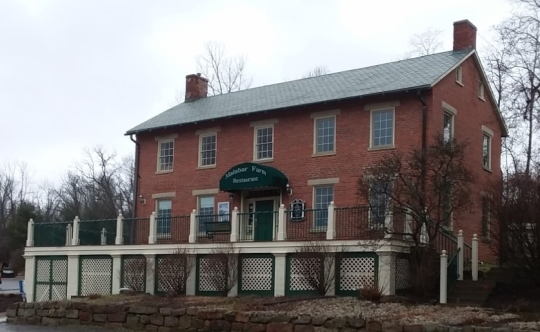
Built in 1820 from bricks made on site, the Schrack Place has become Malabar Restaurant.

There’s no charge to enjoy the trails with rocks and caves, and the tour of “Big House” is only $5. Check out their calendar at www.malabarfarm.org for many exciting activities. Don’t forget the educational Welcome Center.

Malabar Shawshank Trail

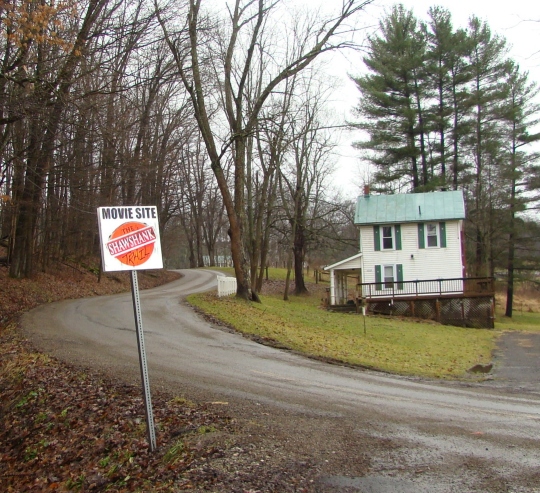
Follow the self-guided auto tour of authentic Hollywood sites from the Shawshank Redemption movie, which was filmed in part on Malabar Farm.

If you enjoy a country drive on scenic back roads, Malabar Farm might be the perfect place for an adventure. Perhaps we’ll come back for a ghost tour in the future.

Malabar Farm is located in Richland County about seven miles southeast of Mansfield. Their address is 4050 Bromfield Road, Lucas, Ohio. Using your GPS would be a great idea as there are many country roads to travel.


Middlebourne – Half Way Between on the Old National Road

Middlebourne Entrance

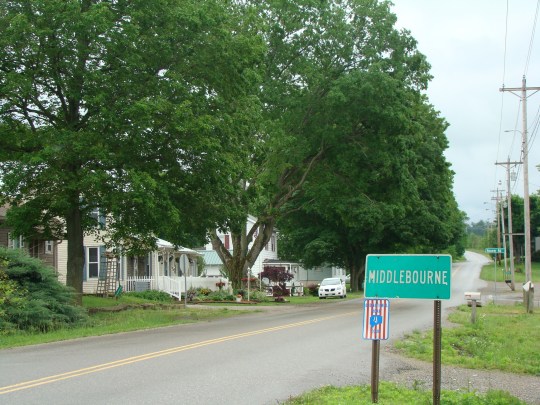
Today Middlebourne is a small, quiet town but still has businesses at the edge of town.

The small town of Middlebourne, originally called Middletown, was relatively centrally located between Zanesville and Wheeling along the Old National Trail, today known as Route 40. When Benjamin Masters discovered that the National Trail was going to run right through his farm, he laid out a town believing that it would be a prosperous place.

That Old National Trail is often considered to be the road that helped build the nation. It was the nation’s first interstate highway crossing six states as it stretched from Maryland to Illinois.

Hays Tavern 001

In 1826, Hays Tavern was one of the best known hostelries on Turnpike Street in Middlebourne.

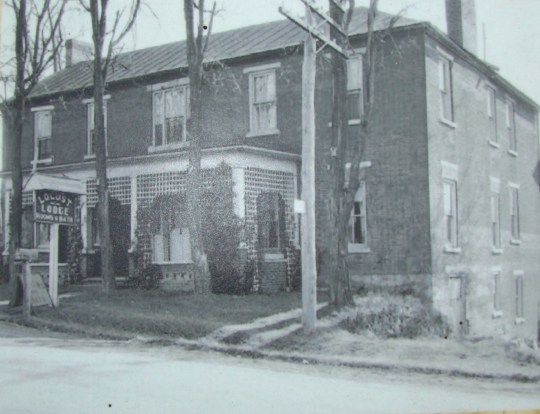
In 1828, William Hays established Hays Tavern, a hotel and barroom in Middlebourne. It was one of the best known hostelries on the National Trail, also called Turnpike Street, because of its bountiful meals, barroom, barns for wagoners, and lots for the drovers’ stock. Even Henry Clay stopped here occasionally on his way from Kentucky to Washington.

Bridgewater Bridge 001

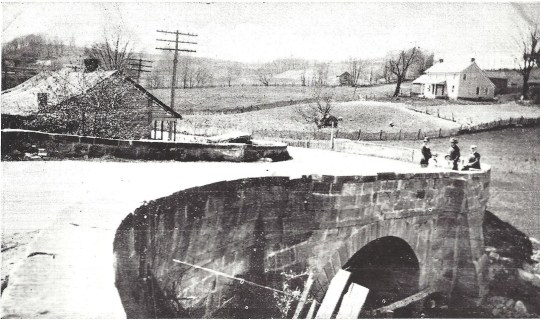
The stone Bridgewater S Bridge, just west of town, was built in 1828.

A popular stop along the way just west of Middlebourne was the Bridgewater S Bridge built in 1828. When a bridge was needed to cross a stream at an angle, they built a stone arch at right angles to the stream. Then added a curve at each end to make the road meet smoothly. Thus, the S Bridge, which saved money and was a stronger structure.

Their first post office was established in 1829 and operated unto 1917. At this point, the name was officially changed from Middletown, which was also the name of a larger town in Ohio, to Middlebourne.

By 1850, their population was 267 and it grew for a while after that. The village had several stores, three or four churches, doctors, a lawyer, and even a brass band. But when the railroad was built six miles south of town, population seemed to wane. Eventually Route 40 and I-70 bypassed Middlebourne.

Middlebourne Methodist Church

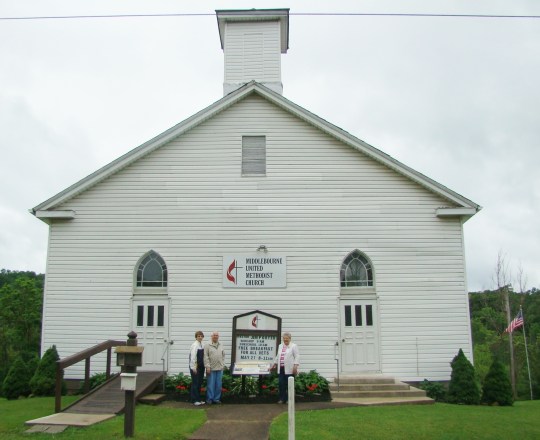
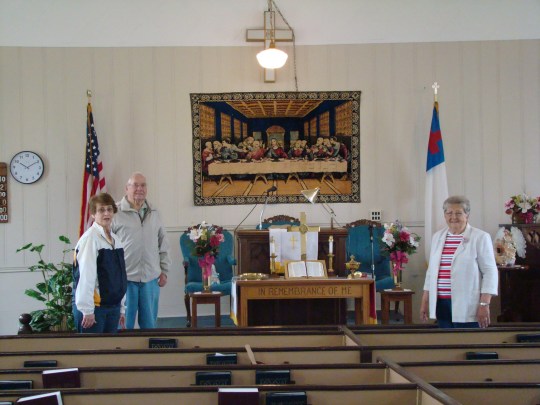
The Middlebourne Methodist Church recently celebrated their 160th Anniversary. Standing in front are Edith Carter, Paul Carter, and Beverly Watson, all faithful members of the church.

The Middlebourne Methodist Church was founded in 1840, but the church was actually built in 1857. A unique feature of the church is its double doors in the front. At that time, women were to enter the church through the door on the right, while men entered through the door at the left. Inside their hand hewed pews had a divider between them to keep the women and men separate inside the sanctuary. The divider has been removed – in some of the pews.

At that time, preachers who delivered sermons in various towns were called circuit riders. Middlebourne services were conducted by circuit riders in the homes of various members until the church became a reality.

Middlebourne Prayer Bears

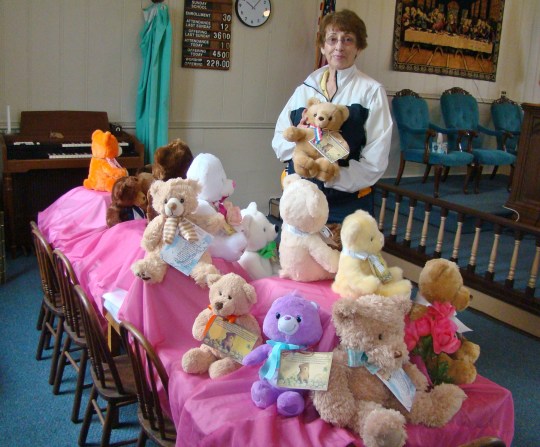
Edith Carter holds a Prayer Bear, a special project of their church today for the sick and injured who need a hug.

Many walked to church back then, while others drove their horse and buggy. The Old National Road, today’s Route 40, ran in front of the church, so often there might be a herd of cattle or sheep passing by along with a wagon train.

Paul Carter, who grew up in Middlebourne, is the oldest member of the Methodist Churh. When he was a youngster, there were about a hundred people in the congregation and six Sunday School classes scattered around the church sanctury. He remembers delivering the Daily Jeffersonian to his customers in Middlebourne for 18 cents a week back in 1947.

Middlebourne Sign 001Residents recall hearing stories about people getting stuck on the muddy National Road when rains poured down. Local farmers would then pull those early cars out of the mud with their horses for a fee. One local jokester would sometimes pour barrels of water on the road to make it muddy, so he could make money pulling cars out.
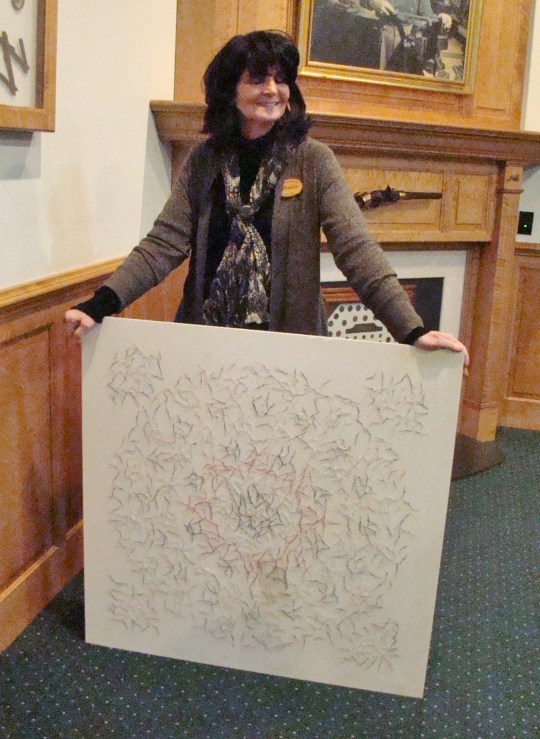
Charles Ellis Moore, a U.S. Representative from Ohio, was born near Middlebourne in 1884. Moore taught school in Oxford Township and graduated from Muskingum College and OSU School of Law. He also served as Prosecuting Attorney for Guernsey County before becoming representative from 1919-1933. Bob Secrest succeeded him.
Locust Lodge

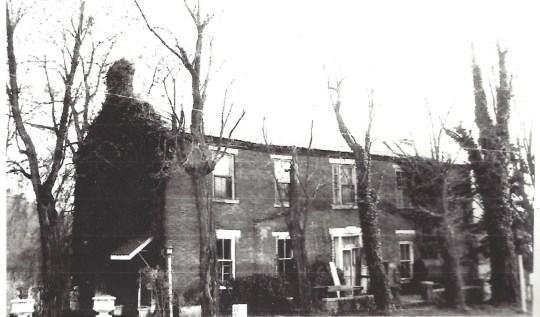
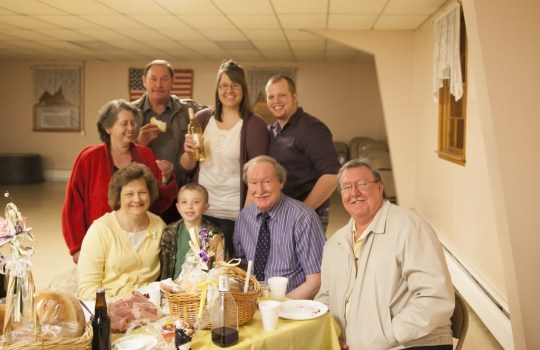
In the 1930s when the automobile became more popular, Hays Tavern became Locus Lodge, a Home for Tourists.

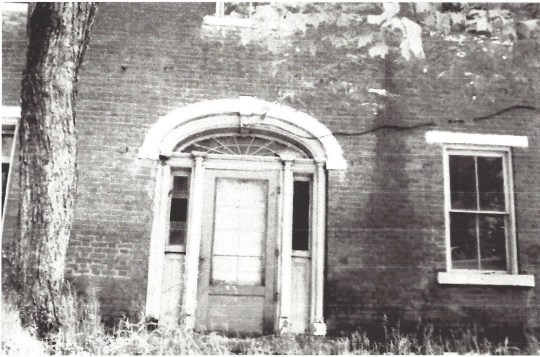
Door of Penn Tavern 001

The doorway of Penn Tavern was said to be one of the most unique doorways on the National Road.

Middlebourne Church inside

The only original building is the Methodist Church.

The only original building left in town is the Middlebourne Methodist Church, which recently celebrated their 160th anniversary. While attendance has dwindled, they still love their little church. Small country churches always hold special memories.

Take a country ride and enjoy the small town atmosphere of Middlebourne. Folks are friendly there!

Middlebourne, Ohio is located just off I-70 at Exit 193 along the North side of the highway.

Ted Lewis’ Grand Refrain – “Is Everybody Happy?”

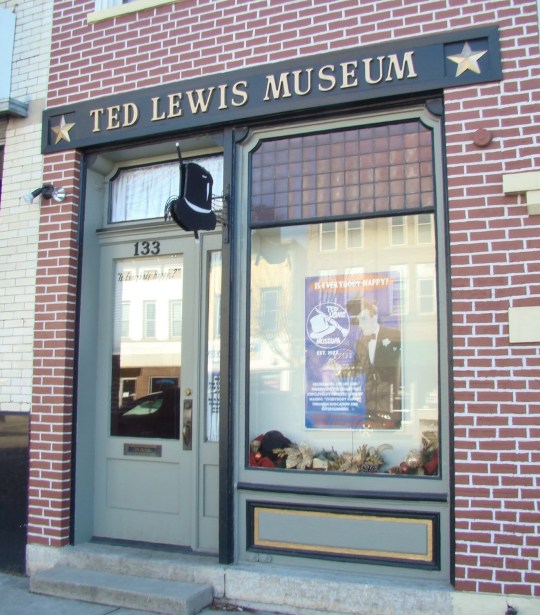
Ted Lewis Museum

The Ted Lewis Museum was renovated last year for its 40th Anniversary.

For those interested in old entertainers and movies, Ted Lewis Museum in Circleville, Ohio will arouse your curiosity. Ted’s first professional singing job happened in 1906 in between movies at the Circleville Electric Nickelodeon. His salary – $4 a week. But that was just the beginning.

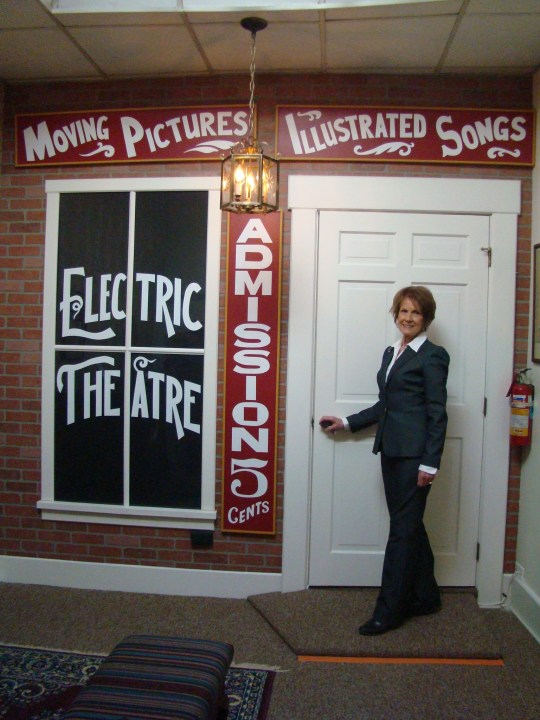
Ted Theater with Joyce

Joyce Keller, president of the museum, stands in front of a replica of the first theater where Ted  performed.

Born Theodore Friedman in Circleville, Ohio, his younger years were spent helping his parents in Friedman’s Bazaar, an emporium which supplied women of Pickaway County with the latest fashions. Ted spent his time sweeping inside and outside the store, as well as making deliveries. It wasn’t something he enjoyed.

His earliest musical instrument experience came at the age of nine when he played piccolo in the Circleville Cadet Band. His fingers weren’t long enough yet to play the clarinet. But Ted mowed lawns during the summer to save money to buy an E-flat clarinet he knew he wanted to play.

However, Ted became fascinated with syncopation and began taking lessons after school with Cricket Smith, a black barber. Jazz ran in Ted’s blood, which had him dismissed from the Cadet Band. The band teacher later apologized when Ted became famous.

Ted Early Days

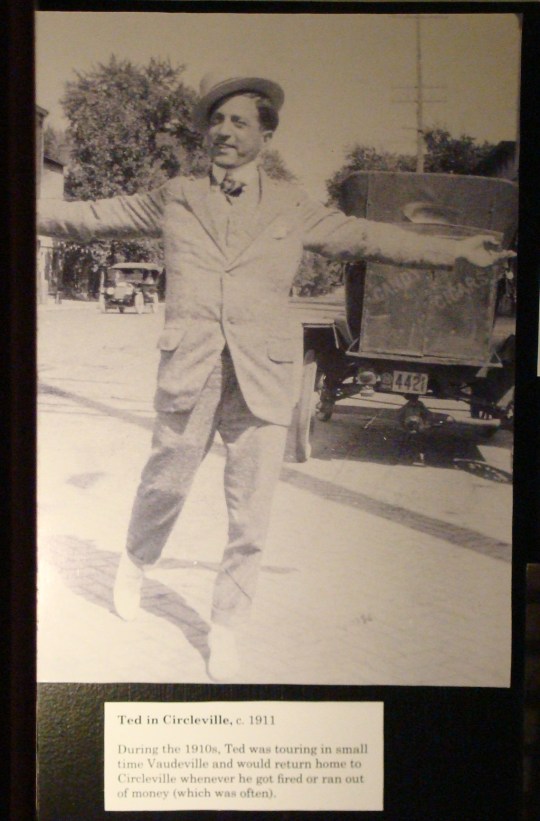
In 1911, Ted would return home from tours when he ran out of money, which was often.

As a teenager, he played his clarinet to help draw a crowd for Dr. Cooper’s Medicine Man Show and sold balloons and cotton candy. He’d carry circus banners in parades and even followed them out of town. This caused his parents much embarrassment and they tried to send him to business college in Columbus, but to no avail.

Ted Apartment 2

The books, bookcase and photos of life long friends, Ted and Sophie Tucker, are from his New York City apartment. Even the gold wallpaper has been replicated.

Ted kept busy following his dream of becoming an entertainer. He paired up with Jack Lewis under the billing Lewis and Friedman. One day in South Carolina, he saw the billing said Lewis & Lewis. The manager said that fit on the marquee better. After that he was always known as Ted Lewis, even though he never legally changed his name.

Ted Top Hat 2

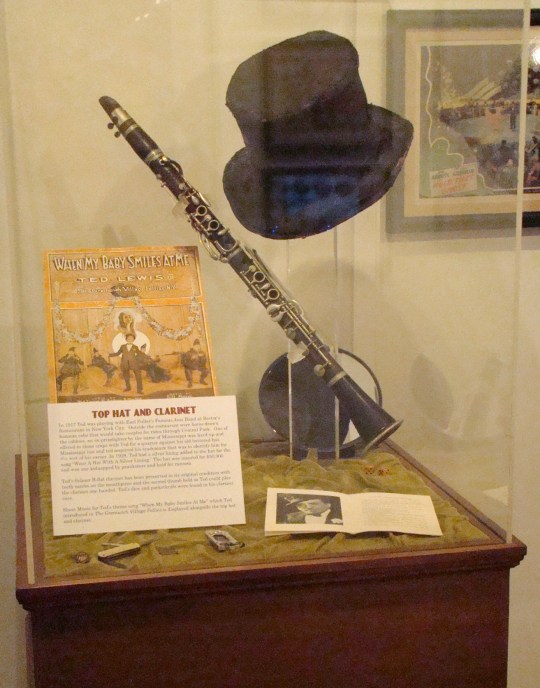
His battered top hat, cane, and clarinet are on prominent display.

In 1916, at the age of 26, Ted formed his first band – Ted Lewis Nut Band. They were very popular in the New York City area and performed at Rector’s Restaurant, a high class venue. While there, he won an old top hat in a dice game from a cab driver called Mississippi. That top hat, his clarinet, cane and the question: “Is everybody happy?” were always part of his act.

Ted Lewis 001

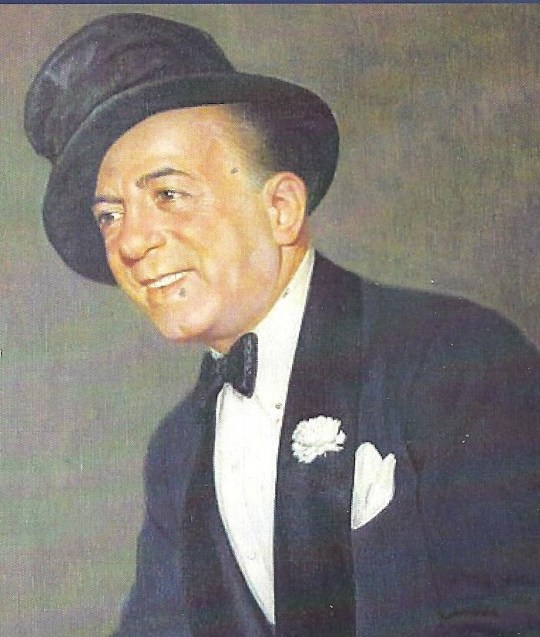
Ted Lewis always wore his old battered hat at every performance.

Ted Phonograph

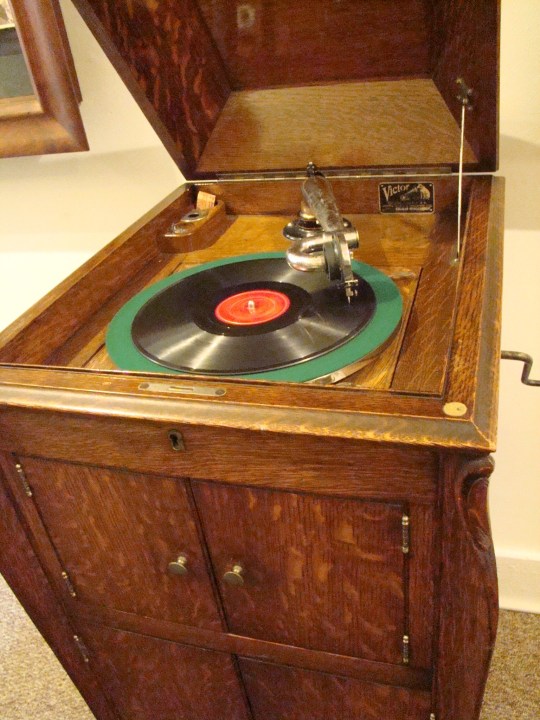
This old hand-crank Victrola played “Blues My Naughty Sweetie Gives to Me”.

His theme song, “When My Baby Smiles at Me” and hits such as “Tiger Rag” and “On the Sunny Side of the Street” earned him the title, “King of Jazz”. In 1926, his Columbia recording of “Tiger Rag” sold more than five million copies. He was their highest paid artist in the 1920s. This popular performer presented his act to nine United States Presidents and even did a command performance for King George V of England.

Ted Me and My Shadow

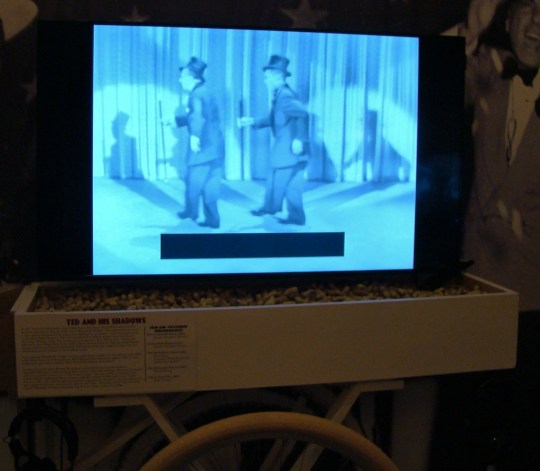
A video in a peanut cart plays “Me and My Shadow”.

During one performance, Ted noticed the doorman, Eddie Chester, mimicking him from the wings and asked him to join him on stage. Thus was born his signature routine, “Me and My Shadow”.

Ted Is Everybody Happy

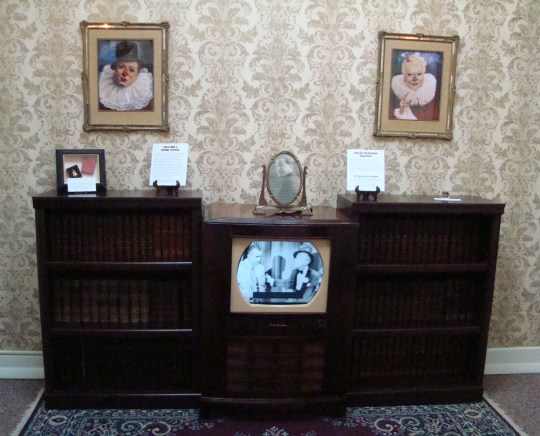
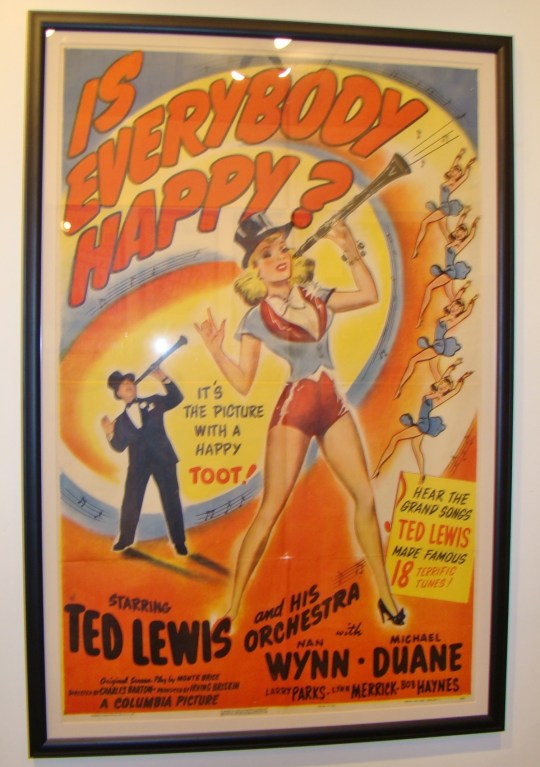
Ted starred in a movie about his life. Beautiful women played a large part in his acts.

Ted Lewis Museum opened in 1977 across the street from where Ted was born. Here you’ll be able to see classic memorabilia and watch videos of Ted Lewis performing. He told his wife that when he died he wanted everything to come back to Circleville, “The Capital of the World”.

Ted 80th 2

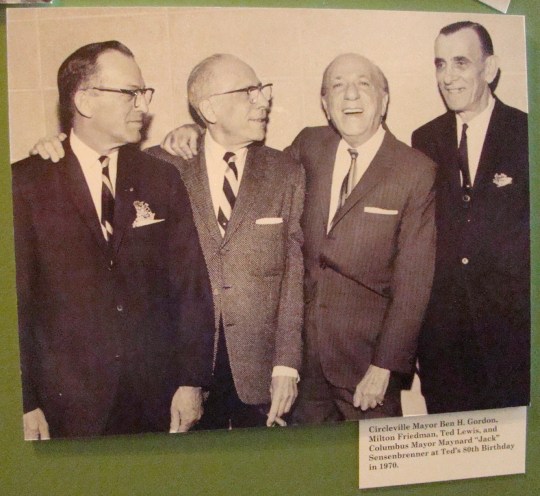
Pictured at Ted’s 80th birthday party are Circleville Mayor Gordon, brother Milton Friedman, Ted, and Columbus Mayor Sensenbrenner.

This showman never forgot his hometown. Ted and his wife, Adah, devoted themselves to making Circleville a better place to live. They supported Berger Hospital, the local schools, and even made possible a 13-acre Ted Lewis Park complete with playground equipment, ball fields, and a swimming pool at that time. Ted entertained the troops during WWII and was a leader in selling war bonds.

Ted and friends

Ted’s friends included Benny Goodman, Sophie Tucker, George Jessel, and Eddie Cantor.

The museum on Main Street only opens on Friday and Saturday from 1-5. After your visit you’ll be ready to put on some tap shoes while grabbing a top hat and cane.

Ted Lewis Museum is located at 133 W Main Street in Circleville, Ohio. Follow US 22 for a scenic ride.


“Civil War Songs and the Stories They Tell” with Steve and Lisa Ball

Stee and Lisa Ball

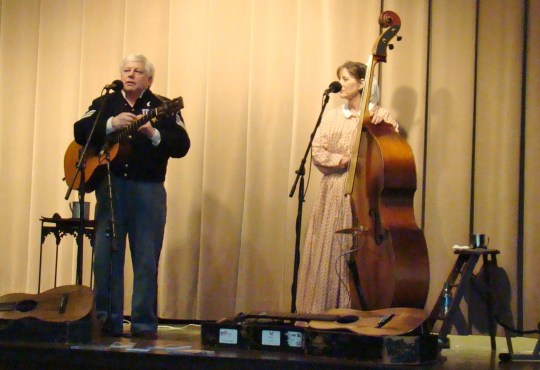
Steve and Lisa Ball  perform Civil War songs at Crossroads Library.

Music plays an important role in the ranks of the military. They have used music to signal their troops for hundreds of years. Often music served as a boost to morale of the soldiers after a hard day of battle.

Be entertained by tales of the Civil War put to music as Steve and Lisa Ball present an entertaining and informative program “Civil War Songs and Stories They Tell”. This musical way of teaching history of the Civil War from 1861-65 is shared around the country about a hundred times each year. The songs come alive with their wonderful vocal and instrumental skills.

Steve Ball guitar

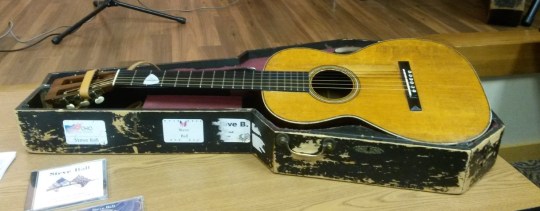
An 1855 Martin is one of Steve’s favorite guitars.

Martin guitars of the Civil War era, from Steve’s private collection, are used in their presentation. All the Martins are in their original coffin cases. Steve’s only the caretaker for these guitars as they will hopefully be passed on from generation to generation. He frequently calls Lisa ‘his band’ as she joins with her upright bass and voice.

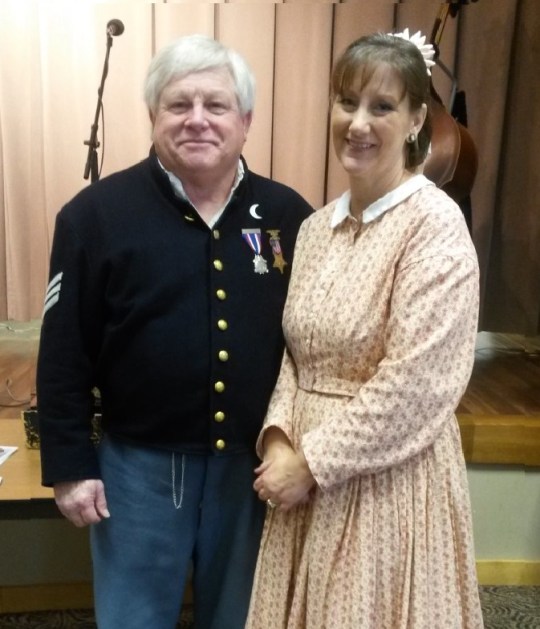
Steve’s interest in the Civil War began as a teen, when he learned his Great-Great-Grandfather, William Tyler Butts, was a Union private from Athens, Ohio. He was part of the 73rd Ohio Volunteer Infantry Regiment out of Chillicothe. Steve is a member of the Sons of Union Veterans of the Civil War and wears his SUV medal on his uniform.

He’s spent the last twenty years studying the music of the Civil War era and the development of the first American folk songs. A long list of accomplishments could follow his name. They also have a Stephen Foster program telling the history of many of those popular folk songs.

During their program, the variety is astounding. There are not only patriotic pieces, but also silly marches and songs of lost love. You’ll be drawn to their music and stories even if you aren’t a Civil War buff.

Lisa's cello

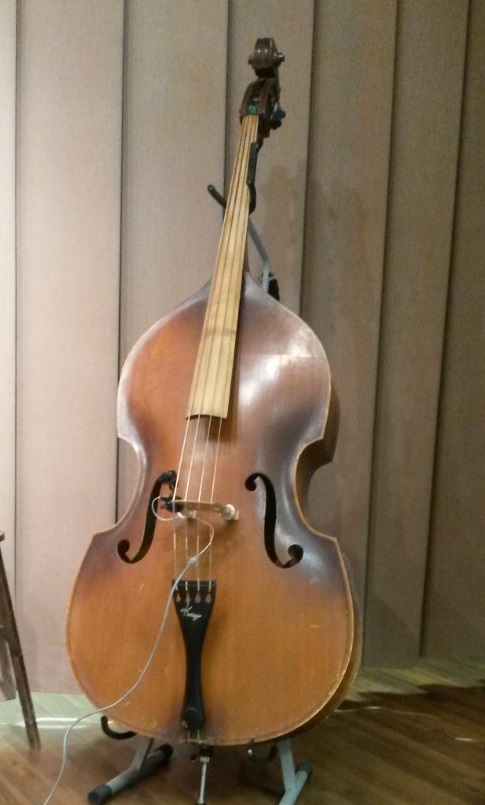
Lisa plays bass and vocalizes with Steve.

Their performances happen at reenactments, indoor presentations, Civil War roundtables, and even the Ohio Statehouse. Being a Civil War buff , he researches everything so it’s authentic. Steve is living his dream.

Learn more about the history of the Civil War and come away with a better understanding of life during that time as Steve and Lisa Ball tell the story through song.

Many of the songs have a unique history, such as “Darling Nellie Gray”, a song written by Benjamin Hanby, who operated an Underground Railroad in Rush, Ohio. It told about his girlfriend, Nellie Gray, who wanted to escape to Canada. You can learn more about this song by visiting the Hanby House in Westerville, Ohio.

Steve and Lisa

Steve and Lisa add much background information on songs to their performances.

Another song “Aura Lea”, was written by Willie Fosdick (lyrics) and George Poulton (music) in Cincinnati, Ohio. Willie’s wife was Aura Lee, the woman with the golden hair. In 1955, Elvis Presley used the tune of “Aura Lee” and added new lyrics to become his theme song, “Love Me Tender”.

A popular Southern song was “Goober Peas”. Burle Ives liked the folk song. The Balls  had everyone singing along.

Peas, peas, peas, peas, eating Goober peas

Goodness how delicious, eating Goober peas..

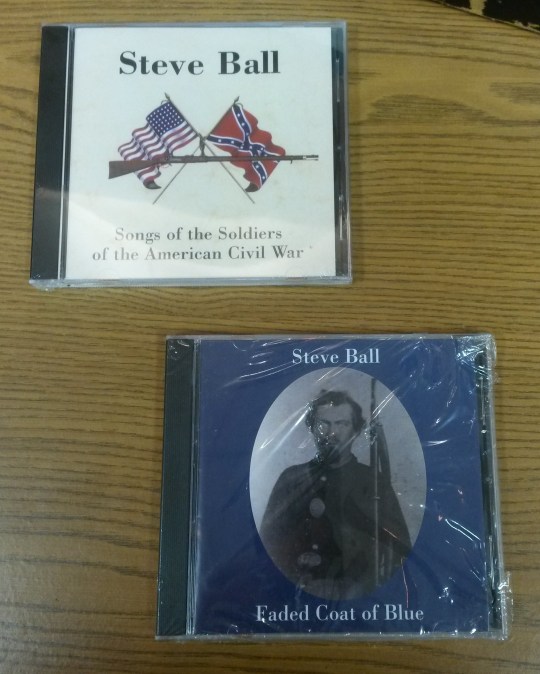
Steve Ball CD

Listen to Civil War songs anytime with their popular CDs.

Next time you hear that Steve and Lisa Ball are performing in your area, be certain to drop by and hear their story of the Civil War in song, or perhaps you’ll hear his story of the music and life of Stephen Foster. Either way, you’re sure to enjoy their stories and music.