Places to go and things to see by Gypsy Bev

Archive for the ‘Museums’ Category

Handmade Wooden Toys for the Young and the Young at Heart
sign

Look for this welcome sign on Dewey Avenue when you pay a visit to the Cambridge Wooden Toy Co.

The best kept secret in Cambridge” describes the Cambridge Wooden Toy Co on Dewey Avenue. Here Brian Gray creates toys and trains with craftsmanship difficult to surpass. He’s been making these extraordinarily detailed carvings since 1976, first in his basement and then in a small shop beside his home.

brian-big-boy

Big Boy from Union Pacific, carved in 2014, was an engine that could pull a hundred cars filled with coal.

Brian grew up in Seattle, where his father worked as a fireman on trains. As a child, Brian used to ride the switch engines around the train yard. He and his brother would play being engineer and fireman. Having a father in the railroad world, gave them many opportunities for train rides.

Therefore, Brian acquired a passion for trains that has never been squelched. His main inspiration for carving engines came from Ernest Warther, world’s master carver of Dover. When Brian told his brother about how he would like to try carving, his brother’s response was “I’m tired of hearing you talk about it. Do it.” And that’s what Brian did.
dinner-menu

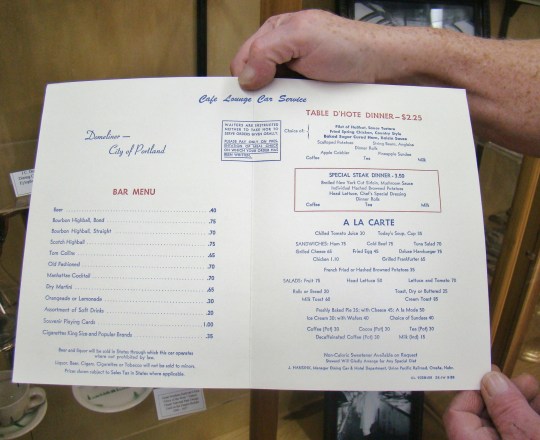
Brian holds a Domeliner Dinner Menu from 1958. This was from the first class section where meals were served using china and silver.

Over the years, Brian studied engineering and when drafted into the Army, studied General Engineering there. Upon the end of his military service, jobs were scarce. A friend told him they were hiring in Cambridge at NCR. With his engineering background, Brian decided to give it a try…and has been here ever since. 
brian-toy-maker

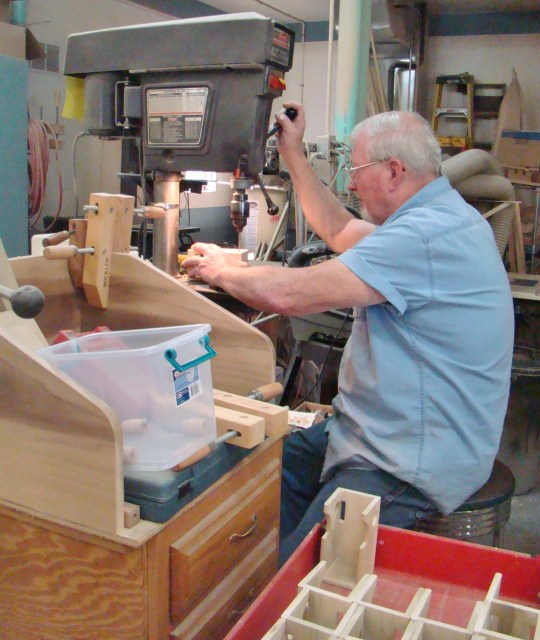
Brian drills the window in the cab of My First Choo-Choo, a new pull toy this year.

Woodworking has been his hobby for years. Sometimes he did carpenter work building decks and gazebos or remodeling houses. But Brian wanted to do something where he had the freedom to choose what he made.

1982 was the first year he made toys. In 1983, he decided to exhibit at the Salt Fork Festival. There he sold almost all the toys he had made, plus he won first prize for an oil field tractor trailer with a bulldozer on the back. That success made him decide to work five hours each day making toys before heading to his regular job. Brian has been participating in the festival ever since.

But making toys and trains isn’t his only pastime. He also does upholstery and repairs wooden furniture. When visiting, Brian was refinishing the arms on chairs for the Barnesville Library.

brian-gray-booth

For 33 years, his toys have been displayed and sold at the Salt Fork Festival. The 2016 festival was particularly hot so Brian donned a sweatband.

His specialty engines are carved intricately from wood. Some of these engines have won first place at shows such as the Ohio State Fair, Salt Fork Festival, and Tri State Woodworking Show.

Each year Brian makes one new wooden engine to add to his increasing collection, which he displays for those who visit his Great Steam Locomotive Engine Museum. All the engines are made on a 1-18 scale out of walnut. Right now there are seven large locomotives in his museum.

brian-557

Alaskan Railroad #557 has won three awards so far. It’s the most detailed engine he’s ever done.

His Alaskan Railroad # 557 won first prize in woodworking at the Ohio State Fair in 2016. This was done in memory of Brian’s father, who worked as a fireman on the rails of Alaska.
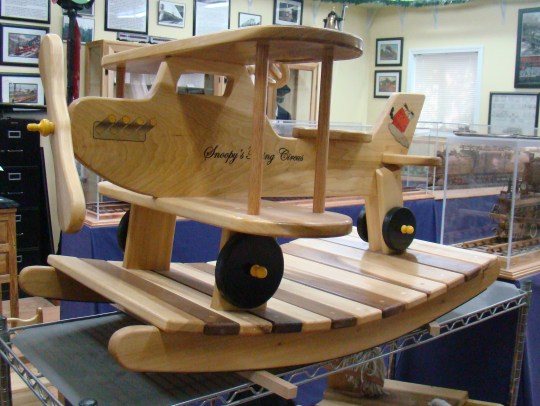
snoopys-flying-circus

A child would enjoy rocking in this bi-plane, Snoopy’s Flying Circus.

Rocking horses, cascading marbles, and many wooden toys make great Christmas gifts. No nails are used, just wooden pins, and he’s careful that edges are rounded and smooth for the child’s protection. His toys are so strong, they last for generations. Brian has been making these toys for over forty years. Presently, he makes 72 different toys in his shop.
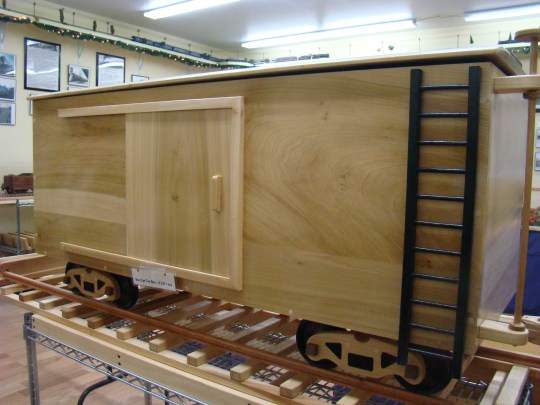
wooden-toy-chest

The Railroad Toy Box is the perfect place to store a child’s toys. It even comes with 6′ of track. The child’s name can be added and the boxcar number is usually the child’s birthdate.

While Brian sells his toys, he’s doesn’t do his wood carving for the money. Many hours are spent to make each toy and sometimes he figures he makes about $1.50 per hour. “I love doing it. I keep my prices low. Haven’t changed prices in five years.”

brian-with-drawing

Brian checks out the blueprint for next year’s engine project.

The blueprint is ready for next year’s engine project. The Golden Spike National Historic Site sent him the blueprints of the original engines on a CD. Then the map department printed it off 1- 18 scale. He’s going to do a scene for the first time. It will be two engines meeting at Promontory Summit, Utah, where the driving of the “Golden Spike” connected east to west.

Brian still has a dream for a place in Cambridge where he could display his trains, and other local train enthusiasts could find a home for theirs as well. His eyes are on the original Train Depot as the perfect place for a museum to attract visitors to our area. Keep dreaming, Brian, you never know what the future may hold.
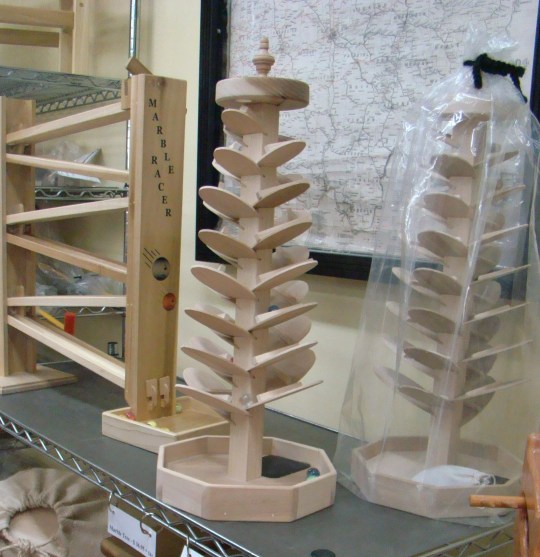
cascading-marbles

Musical Marble Trees entertain children and adults with their cascading musical tones. It’s hard to resist putting one more marble down its branches.

At his small museum, children and young-at-heart adults are free to play with the toys. There is no cost to visit so head up to 515 Dewey Avenue and walk inside. You’ll be amazed at such talent right here in Cambridge.  Then you’ll want to share this “best kept secret” with your friends.

Cambridge Wooden Toy Co can easily be reached off old Route 40 through Cambridge, Ohio. At the west end of town is a viaduct over Wills Creek and the railroad tracks. The Toy Co is straight south of here at 515 Dewey Ave. 

.
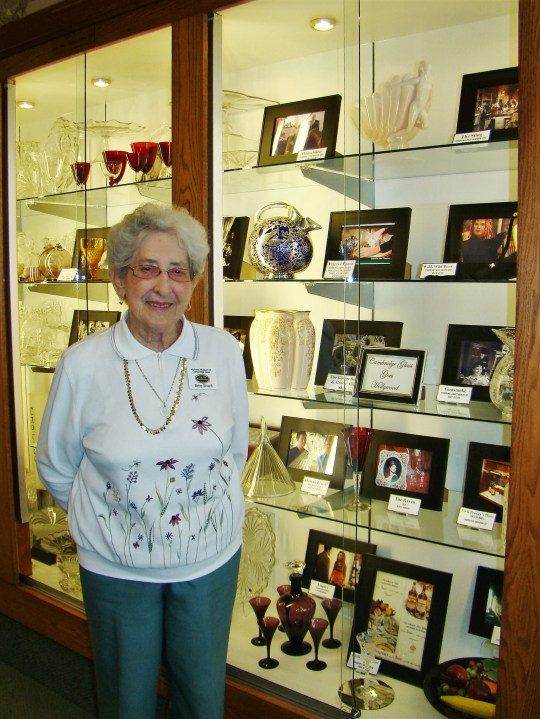
 

Cambridge Glass Goes Hollywood

Hooray for Hollywood and Cambridge Glass!

Betty

Betty Sivard. a long time volunteer, tells visitors about Cambridge Glass used in Hollywood and on television.

It’s not surprising that the famous Cambridge Glass has been used in countless movies over the years as it exudes glamour as well as beauty. Several of these pieces are being featured in two large showcases  at the National Museum of Cambridge Glass  in Cambridge, Ohio, along with photos and cards designating the movies and stars.

Throughout the display of over 6,000 pieces of the collectible Cambridge Glass, other references to Hollywood movies and television shows appear frequently. A few years back a member spotted a piece of Cambridge Glass being used in a movie. After reporting this to the group, all eyes became focused on glassware used in movies. You’ll be surprised  at how often Cambridge Glass appears.

Elvis Presley

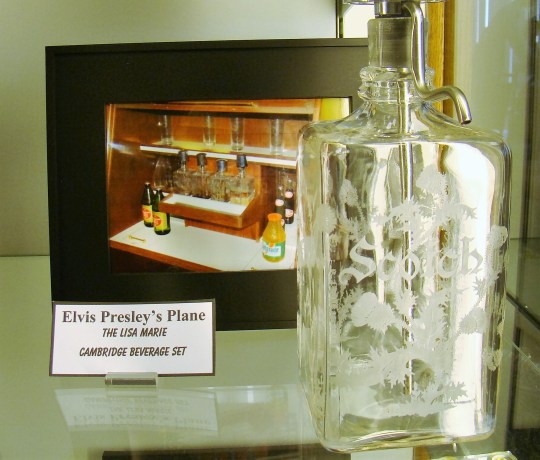
This beverage set was used on Elvis Presley’s plane, The Lisa Marie, which was named after his daughter.

This locally made fine glassware isn’t seen only in older movies. Recently, The Astronaut Wives Club toasted a special moment with Cambridge Rose Point Stemware. In the current series, Empire, stars used an Amethyst Decanter and Sherries.

White Christmas

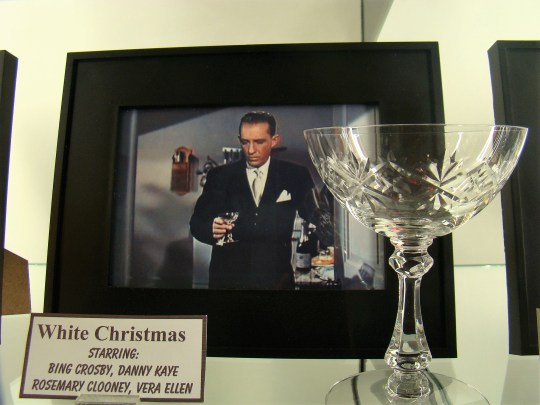
Bing Crosby holds an engraved Bexley champagne glass in White Christmas. It’s a museum favorite!

It’s impressive to think that local men and women had a hand in producing exquisite glass items that are fine enough quality to be used in Hollywood and television. A favorite on display shows  Bing Crosby holding an engraved Bexley champagne glass in the year-after-year favorite of White Christmas.

Cambridge Glass Hollywood Stars

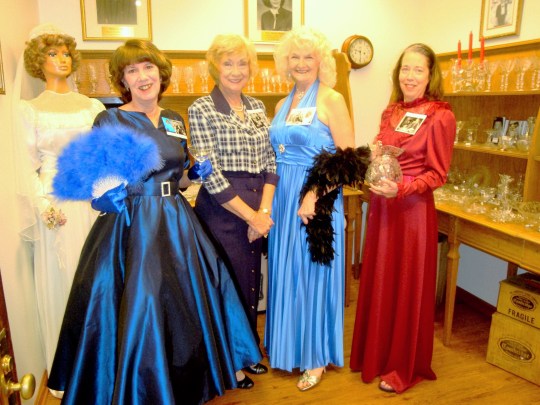
When group tours request a Hollywood program, these volunteers represent White Christmas (Cindy Arent), Astronaut Wives Club (Sandi Rohrbough), Mae West (Sharon Bachna), and Gunsmoke (Sarah Carpenter).

If you are interesting in the Hollywood presence of Cambridge Glass, arrangements can be made by tour groups to have volunteers entertain in costume and even break into song. Groups might hear The Haynes Sisters sing, “Sisters, sisters, there were never such devoted sisters…”  Or meet Mae West as she flings her boa and entertains the crowd.

The museum has created a DVD showing some of the movies as well as the Cambridge Glass used, so you know what to look for throughout the museum. The volunteers will then serve as your guides for your stay at the museum.

The Sting

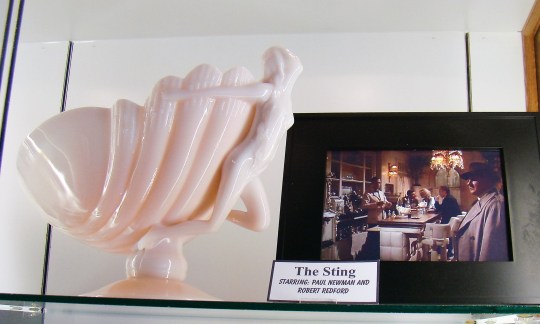
On each end of the bar, The Sting used a Crown Tuscan Flying Lady Bowl filled with peanuts.

These guides not only know their glassware well, but they tell interesting stories along the way. An example would be the story of the Crown Tuscan Flying Lady Bowl used in The Sting.

In the early days of Cambridge Glass Co, a circus came to town. Several of the glassworkers attended the event. One of those had artistic talents and drew a picture of the trapeze artist performing that day. That picture was taken back to a talented mold maker, who developed this artistic Flying Lady Bowl. What talented men!

Even the western television shows used Cambridge Glass for a touch of glamour. In an episode of Gunsmoke, a little girl was casting her eyes on an etched Portia Doulton water pitcher. The Wild Wild West used a Cambridge Glass perfume atomizer as part of its background.

Clark Gable

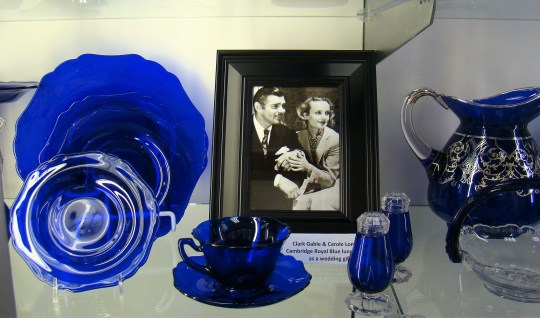
This beautiful Royal Blue Luncheon Set was a wedding gift to Clark Gable and Carole Lombard.

A personal favorite was the Cambridge Royal Blue and Crystal luncheon set that Clark Gable and Carole Lombard received as a wedding present from a friend in Ft. Wayne, Indiana back in 1939. Nice to know the stars actually used this fine glassware in their homes as well as in the movies.

Prizzi's Honor

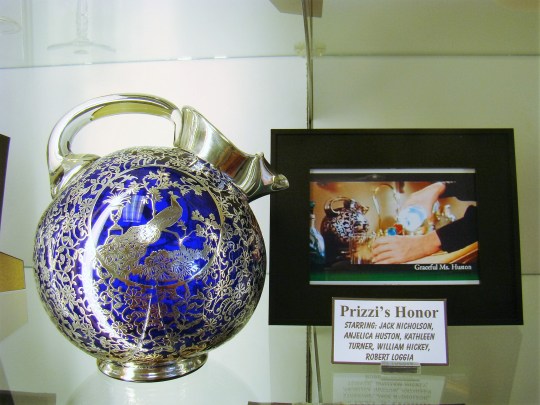
This eye-catching Royal Blue pitcher with silver overlay was used in Prizzi’s Honor.

While there are too many to list in this short article, a few favorites have been mentioned. Perhaps they will give you a desire to search out more Hollywood appearances throughout the museum yourself.

You’ll be impressed.

The National Museum of Cambridge Glass is located at 136 S. 9th Street just a half block off Wheeling Avenue in downtown Cambridge, Ohio.


Remote Sensoring Used at the Moundsville Mound

Bev at Mound 2 (2)

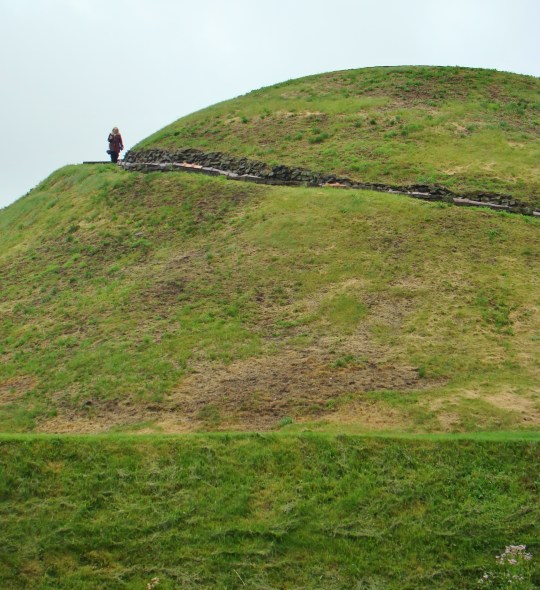
While climbing Grave Creek Mound, this young lady wonders about the past.

What’s inside Grave Creek Mound at Moundsville, WV? That’s a question many people are curious about. Years ago someone actually made a tunnel into the Mound and found some interesting things. An eight foot tall skeleton with copper bracelets and mica breastplate were discovered and actually placed on display for some time in a museum inside the Mound.

Mound Speaker

Alexander is doing a doctoral study on use of varied equipment to receive data on what is inside the Mound.

Now, archaeologists are not able to disturb ancient burial grounds so an alternative method of looking inside is being tried. In the spring of 2016, Alexander Corkum, a doctoral student at the University of Bradford in West Yorkshire, UK, used a non-invasive technique to investigate the Grave Creek Mound.

Modern equipment was used, such as: (ERT) electical resistivity tomography, topographic survey, GPR (Ground Penetrating Radar) survey, and photogrammetry. Most of this equipment had never been seen before in the valley. Actually, Grave Creek Mound is the first place this combination of equipment has been used anywhere in America, according to Corkum. The only previous place for gathering data with this equipment was at England’s Stonehenge, where they discovered a new Super Henge.

Mound Explorer

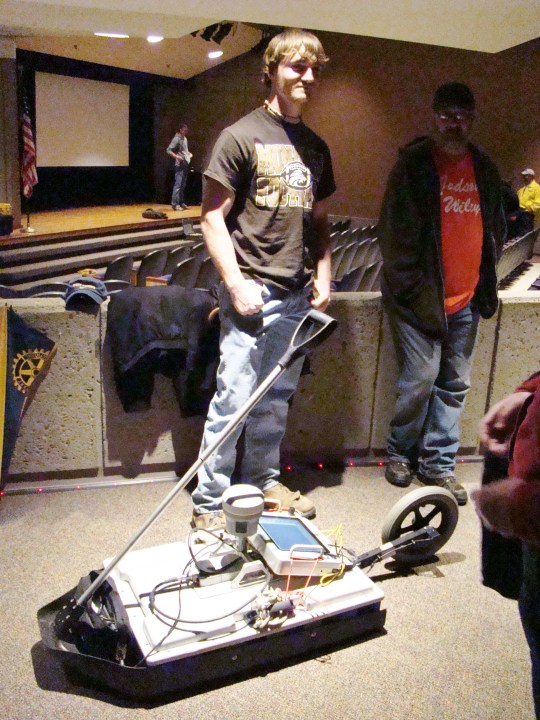
This GPR produces a type of picture of the internal Mound as it gets readings from electronic currents sent into the ground.

In the past, archaeologists have had digs to find pieces of history hidden under the ground. With this new equipment, they are hopeful to find images that will give valuable information about the past without disturbing the ground. Corkum feels that archaeology is destructive.

His team feels that every place does not require excavation. They feel the best way to preserve history is to keep it in the ground, while doing a remote geological survey.

The GPR had been taken up and down the mound in several directions to get as many remote sensory readings as possible. An electronic current is injected into the ground and this produces a radargram. My mind wondered if this was similar to an MRI of the ground.

Mound Drone

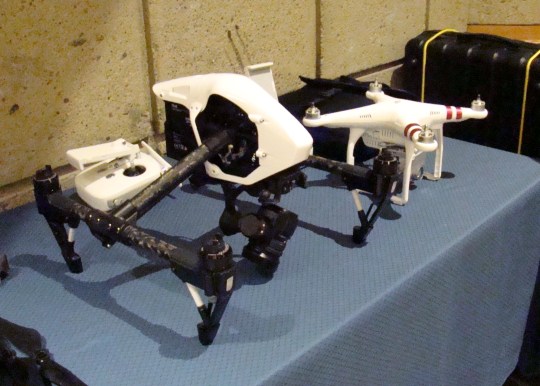
This large drone contains a better camera, which produces clearer pictures.

Drones were also used to take pictures – photogrammetry. They were programmed to take pictures every foot and can then produce a model of the object being photographed, in this case the Grave Creek Mound.

When asked why they came to Grave Creek Mound, they replied, “There’s no other place quite like it.”

For several days, data was collected but little legitimate conclusions have been reached at this point in time. They expect valuable data will be available when the results are carefully analyzed. This could take several months.

One thing the data will not clearly show are fossils and artifacts. Radar will show different disturbances in the ground area such as stones, water and soil density.

Mound student

This high school student was lucky enough to get to assist with the experiments.

Jarrod, a sophomore at John Marshall High School, was fortunate to be able to assist with this project throughout the week. His youth enabled him to climb the mound time after time, pulling the equipment. Some days that included as many as seventy trips. Jarrod was very knowledgeable about the mound and interested in the process. Someday this exceptional young man hopes to become a geoarchaeologist.

Mound Drone Overhead

A drone flies overhead taking pictures during its flight.

After the lecture, everyone went outside to either walk to the top of the mound, or watch as they demonstrated the drones taking pictures.

The final result of all this imagery will be to construct a model of the mound both inside and out. There is always something new to explore in the interesting world in which we live.


Final Days to Tour the Historic Marx Toy Museum

Marx Toy Museum

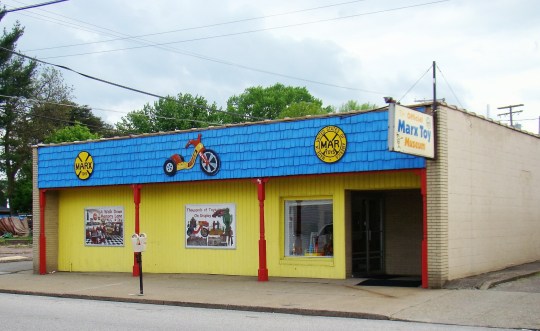
Marx Toy Museum has been in Moundsville, WV for fifteen years.

Closing  June 30, 2016.

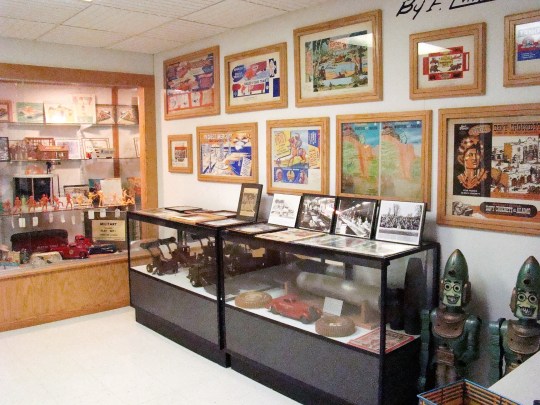
When this day arrives, the Marx Toy Museum will close the doors on a vast collection of Marx toys that have stood the test of time. Located in Moundsville, West Virginia at 915 Second Street, Francis Turner opened Marx Toy Museum in 2001. This former Boner’s Meat Market seemed the perfect place to display his large collection of toys, which he accumulated over thirty years. It’s the largest collection of Marx toys in the world.

Marx Big Loo (1)

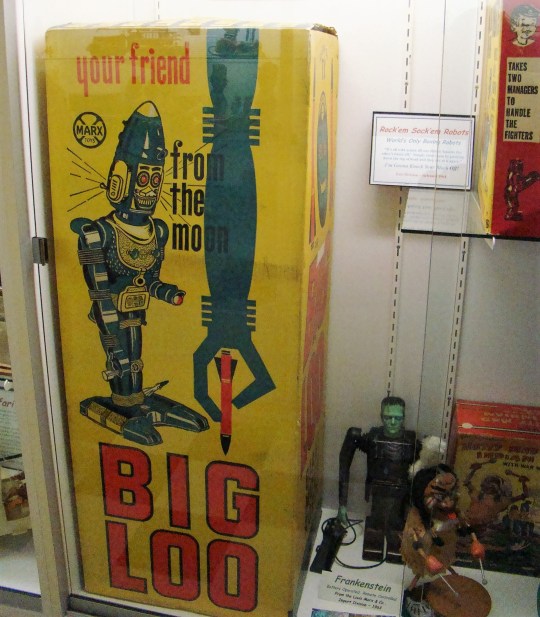
Big Loo, the robot, is the only known one in its original box. This 1963 robot can shoot darts, squirt water and even talk.

Back in 1986, Francis began buying and selling Marx toys. Why Marx? Because many of the toys were made up the river at the Marx factory in Glen Dale, West Virginia from 1934-1980. There were also two plants in Pennsylvania. Over the years, they made everything from dollhouses to ride-on toys.

The plant in Glen Dale was the largest toy factory under one roof in the world for many years. Formerly, this location housed an airplane factory, Fokker Airplanes, who built the trimotor, Josephine Ford, flown by Commander Richard Byrd over the North Pole in 1927.

August 4, 1927 was a big day for the Fokker air strip in Glen Dale. That was the day that Charles Lindbergh, famous American aviator and explorer, landed there in his Ford Tri-Motor airplane. Over 140,000 came out to see this famed aviator.

Marx Doll House 2

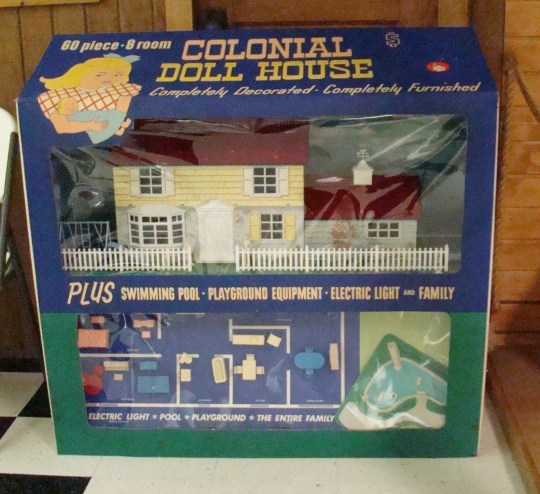
This Colonial Dollhouse in its original box would have been quite the gift.

Francis is passionate about finding choice Marx toys from all over the world. When describing his extensive toy collection, his voice showed pride and enthusiasm. “All the toys in the museum are in their original condition. Nothing has been repaired or repainted.” He has no favorites as likes them all, and enjoys demonstrating them since they still work quite well.

Marx Creation center

The Marx Prototype Room displays original sketches and one-of-a-kind ideas that were never actually produced.

Tour groups always stop at the museum when in the Moundsville area. Francis recalled, “Visitors love the museum. There are a lot of memories here. It’s a piece of history.” People frequently shed a few tears as one of the toys brings back a memory of a gift they received as a child. This museum is packed with room after room of memories.

Marx Francis 2

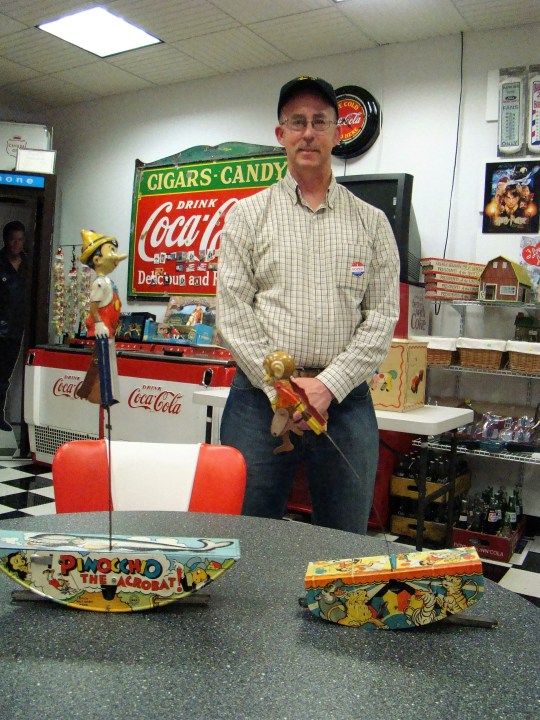
Francis likes to use his Toy Chest to show visitors some of the oldest Marx toys. Pinocchio the Acrobat is 76 years old, while Marvel the Monkey is 80 years old. Francis holds the famous Climbing Monkey.

Louis Marx began working in 1912 at the age of sixteen in the office of toymaker Strauss, before Marx served in WWI.  In 1916, that company went bankrupt and Marx took one of their popular items, Zippo  the Climbing Monkey, and tweaked it just slightly to start his own business and make millions from this one toy.

Marx Louis Figures

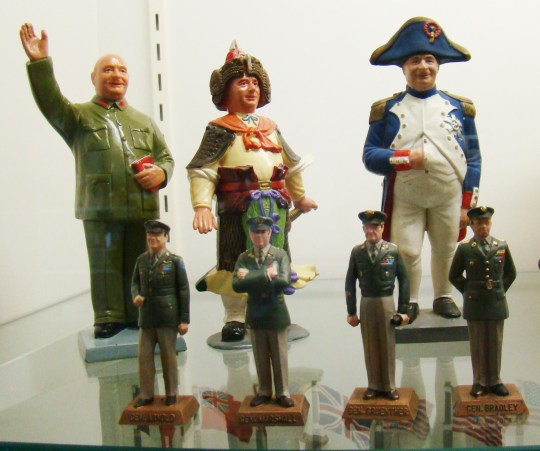
Marx always had a passion for the military so made these famous figures in his own image: Commander Mao, Genghis Khan, and Napoleon.

Marx was the Henry Ford of toy-making as he wanted toys that everyone could afford. All the early toys were made of metal until WWII, when metal was needed for the military. Then it became necessary to find an alternative, and plastic seemed to be the best choice.

Over the years, Louis Marx earned the name, “King of Toy Makers”, throughout the world. His toys were not only creative, but of high quality. In 1955, one of every three toys made in America was made by Louis Marx & Co.

Marx Brad Paisley

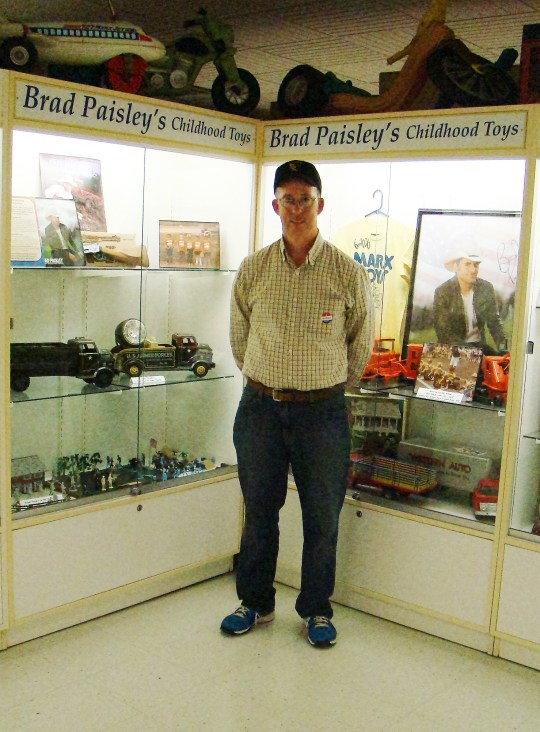
A display of Brad Paisley’s toys shows his Big Wheel on the top. Francis said Brad used the Big Wheel most of the time, but drove the 727 Marx Jet when in a hurry.

The most popular toy ever sold was the Marx Big Wheel back in 1960. Disney even had Mickey Mouse riding Big Wheel. At the peak of its popularity, three assembly lines ran 24 hours a day at the Glen Dale plant, and made 9,000 Big Wheels each day. Brad Paisley’s Big Wheel is on display, since he grew up in Glen Dale and participated in the Big Wheel races there

Marx Diner

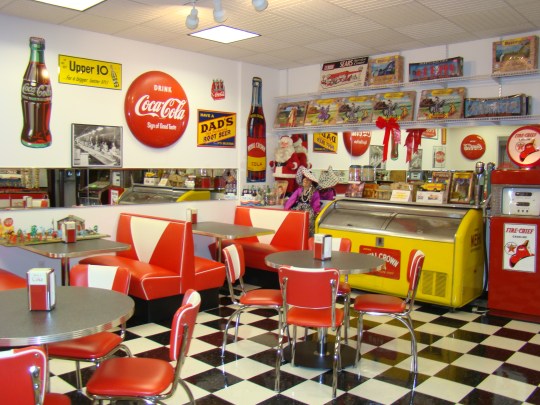
This vintage 1950s dining area provides a great place to relax while having a Coke and some popcorn as you watch old television commercials from that era.

Plans for the future include a virtual website of Marx toys with the intention of preserving the history of Marx around the world. Francis and his son, Jason, also plan to have traveling toy exhibits of the most popular Marx toys. These displays will be available to museums throughout the country, where Francis will be able to share his toys with more people than ever. Their goal is to keep Marx history alive.

Everyone will find something to enjoy at the Marx Toy Museum. It definitely brought back many memories of my childhood and that of my sons. Better hurry down and see this great collection before it closes at the end of June, 2016. Step back into The Toyland of Yesteryear.

Visit Marx Toy Museum at 915 Second Street in Moundsville, WV or at their website: http://www.marxtoymuseum.com for continued information about Marx toys.


American Gas Pump Heaven Museum


Gas Pump HeavenAmerican Gas Pump Heaven Museum overflows with memorabilia from the past.

Remember the good times!

A Sinclair gas delivery wagon from the 1930s greets people as they travel over the bridge in Dover, Ohio. It stands along the bank of the Tuscarawas River with many vintage gas signs on display. Everyone is sure to see the Sinclair Brontosaurus atop American Gas Pump Heaven Museum.

Roger Ramsey, owner of the museum, began collecting gas pumps in the 1970s. This was an expansion of his car restoration hobby, as he thought it would be special to have ‘one’ old gas pump. But as all collectors soon experience, something has to be done with what has accumulated. Roger decided to share his with everyone.

As a teenager, Roger worked at a Bonded gas station in Freeport, Ohio, where he grew up. Men usually pulled up for $1.00 worth of gas and if it went over a few cents, no extra was charged. There he acquired his passion for gas memorabilia, while at his real job at Dover Credit Union he learned about finance.

Gas AmericanaRoger prides himself on his Americana touch to his displays. Everything from American flags to an American eagle and a scaled down model of the Statue of Liberty can be found throughout his museum. There’s so much to see that one trip through will probably not be enough.
Gas Pump Sohio

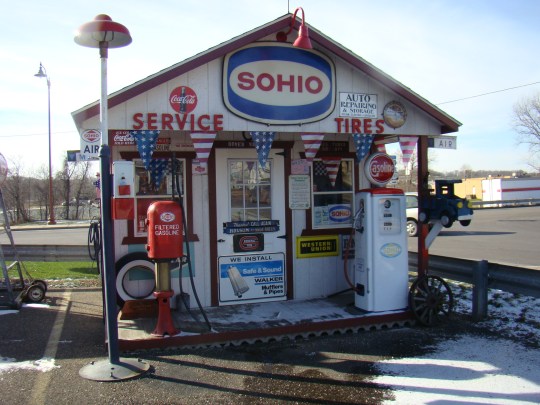
The museum opened in 2010. His original building didn’t have enough room for all his collectibles, so he built another building – this time a replica of a Sohio Service station. His goal is to keep fifty gas pumps at the museum at all times. He frequently sells or trades, so there is always something new to experience.

Gas NickelodeonThis is more than just a collection of gas pumps from 1910 to 1962, it is a collection of memories! Take a walk through gas station history as well as the history of that time. While there stop and play the 1920s Nickelodeon, which works at the drop of a quarter.

Roger enjoys all the memorabilia he has collected. He’s really a kid at heart as he listens to the crooning of Dean Martin or a talking parrot from his desktop. Flashing signs adorn most walls as he “loves neon signs.”  He definitely has fun collecting gas pumps and memories of those days gone by.

Gas Roy Rogers“Roy Rogers is my hero,” Roger explains as he points out piece after piece inside the museum related to his hero. A life size picture of Roy easily stands out among the gas pumps.
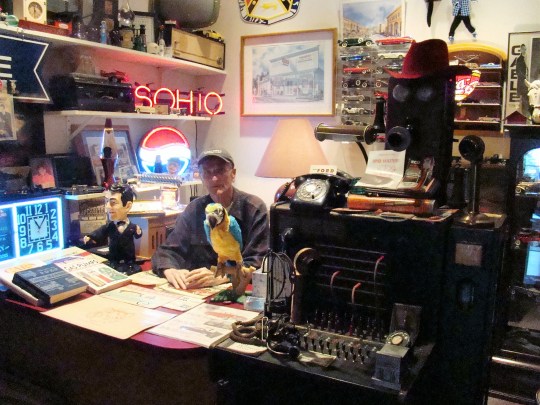
Gas RogerAmerican Gas Pump Heaven Museum contains favorite memorabilia that remind him and visitors of the happy days of their youth. He has a little bit of everything and can’t think of anything that he really wants. But he always seems to be ready to make a deal on something that appeals to his fancy. Quite often he would point out a recent purchase and say, “I’m not sure what I’m going to do with this.”
 

Gas Mural

A mural of how it “used to be” covers an outside wall.

Everyone has memories of a favorite gas station when they were growing up. Our small town had a gas station/grocery store. There was only one pump but the Sinclair sign proudly displayed their signature Brontosaurus.

Gas stations provided neighbors with much more than fuel for their cars. Here you met your neighbors and caught up on local news over a cup of coffee or two cent bottle of pop – Orange Whistle was a favorite of mine

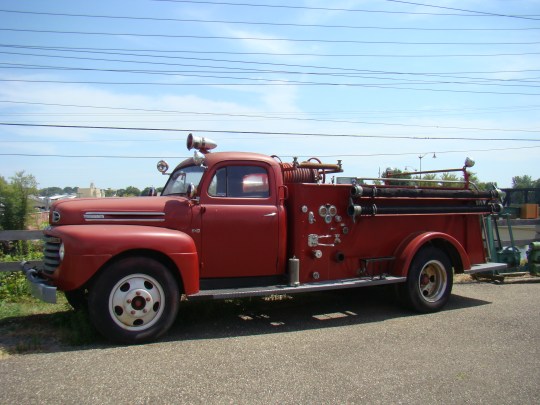
Gas FiretruckYou’ll definitely be surprised by the variety of items you see even from the outside. Since Roger is retired, he can’t be there all the time, but if the parking lot intrigues you, give Roger a call at (330) 343-6883. and he will find the time to stop down and unlock the door to a room filled with treasures of yesteryear. It’s what keeps him going!
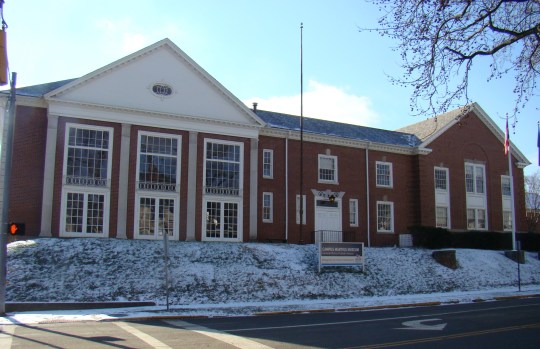
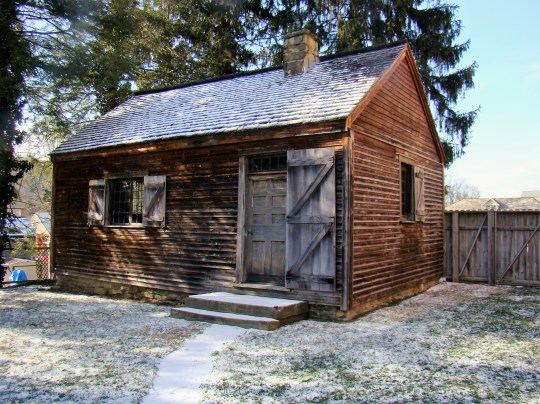
The American Gas Pump Heaven Museum can be found easily off I-77 at Exit 83 to Dover OH Route 211. Follow 211 for a couple miles and on the left hand side you will see the museum just before you cross the bridge over the Tuscarawas River. Admission is well worth the price of  $5.00.

Ohio Beginnings with Rufus Putnam

Putnam Museum Front

Campus Martius Museum in Marietta contains interesting early Ohio history.

How is The Bunch of Grapes Tavern in Boston, Massachusetts connected to Campus Martius Museum in Marietta, Ohio?

After the Revolutionary War, in March, 1786, a group of men met at The Bunch of Grapes Tavern in Boston to purchase land in the Northwest Territory.  Rufus Putnam, Benjamin Tupper, Samuel Parsons, and Rev. Manasseh Cutler formed the Ohio Company of Associates, also known as The Ohio Company, and purchased what was to become about one-fifth of the state of Ohio.

Putnam Land Office

The Ohio Company Land Office, where Rufus Putnam and his partners worked, is the oldest known building in Ohio. Built in 1788, many hopeful land owners walked the path to its door.

These Revolutionary war soldiers were given land grants in lieu of payment for services rendered during the war. They purchased approximately 1,500,000 acres at roughly eight and a half cents per acre along the Ohio River in southeastern Ohio.

Provisions in this land grant were made for two sections in the center to be set aside for an educational institution. The first land grant college was to be called American Western University, but before opening changed its name to Ohio University.

Putnam Portrait

Rufus Putnam served as a member of the Ohio Company, which laid out the plans for Marietta.

Even though Rufus Putnam. the leader of the Ohio Company, was a self-educated man and did not have any formal schooling after the age of nine, he promoted higher education by serving as a trustee at Ohio University. He also claims a connection to West Point. where he built a fort during the Revolutionary War. Fort Putnam is today being preserved and operated by the United States Army Garrison, West Point.

In his memoirs, which are today at Marietta College, he shared his wish for a better education. One line said, “hence neglecting Spelling and gramer when young I have suffered much through life on that account.” But that didn’t keep him from recording records of all his correspondence, while he also kept a daily journal.

Putnam Sugar

An interesting item on the kitchen table was a cone of sugar wrapped in blue paper from the West Indies, with sugar nippers close by to get the perfect amount of sugar for a cup of coffee or tea. The blue paper had a second use as Persis could use it to dye her spun thread.

Rufus Putnam established the first Ohio Company settlement on the banks of the Ohio River in 1788. This became the first settlement in the Northwest Territory. Adelphia, meaning brotherhood, became its first name, but that was soon changed to Marietta in honor of Queen Marie Antoinette of France.

There the Ohio Company built a fortification to protect themselves from the Indians. They called their stockade, Campus Martius. Rufus Putman’s home was one of a row of plank houses inside this stockade.

A few years later, fortification was no longer needed, so the stockade was disassembled. However, the Putnam house remained at the original site, but with added rooms. He purchased the corner blockhouse for $70 and used its lumber for his house addition.

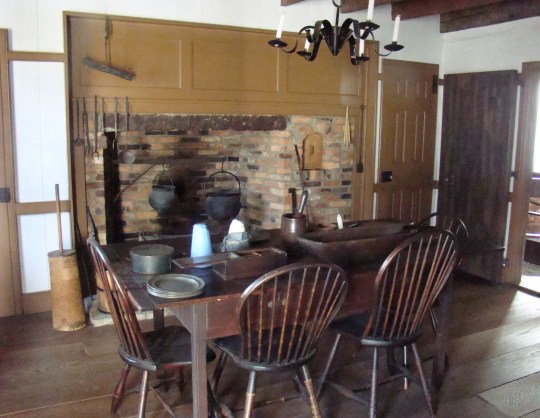
Putnam Kitchen

This is the original kitchen where the Putnam family prepared and ate their meals.

His wife, Persis and eight children, joined him in Ohio at their new home on the bluff of the Muskingum River. Their home here contained a kitchen, sewing/sitting room and two bedrooms upstairs. Now you can see the need for an addition.

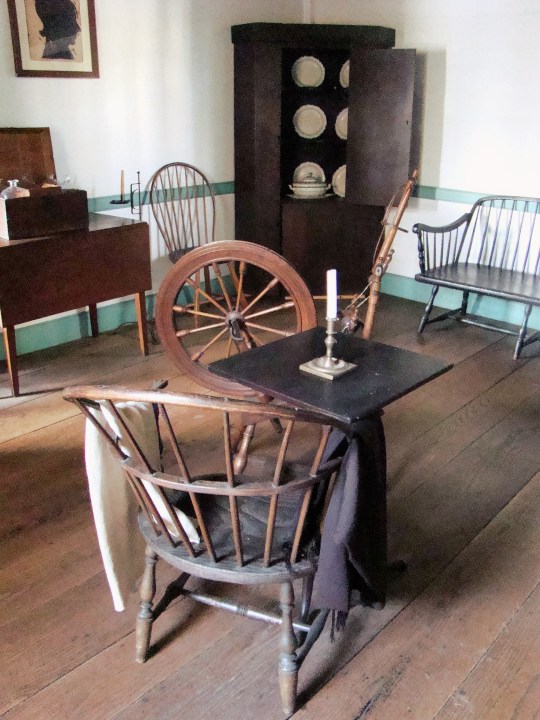
Putnam Spinning Wheel

Mrs. Putnam used the spinning wheel frequently as her seamstress abilities were well known. When Rufus was on his trips for the country, she often had to earn money for essentials by sewing.

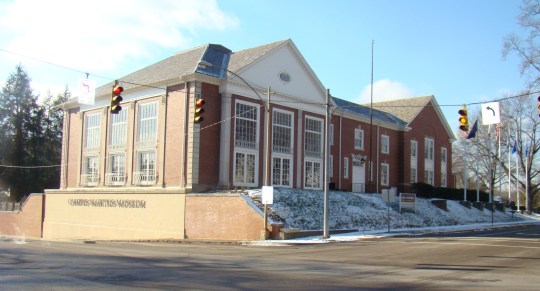
Putnam Museum

Treasures of early Ohio can be found inside this building in Marietta.

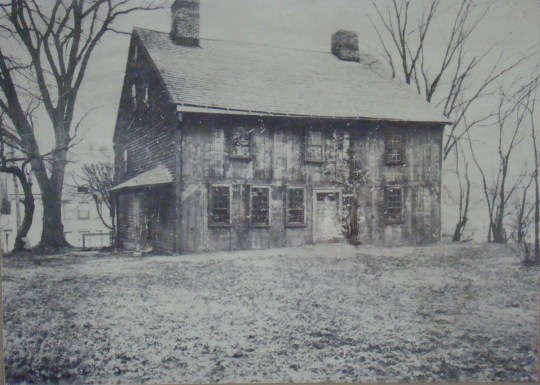
What’s behind all those windows at Campus Martius Museum in Marietta, Ohio today? Inside is the full size house of Rufus Putnam and it still stands where it was built back in 1788. The museum was built around the house in 1931 after the Daughters of American Revolution with assistance from the state of Ohio saved it from destruction.

Putnam 1931

The house is pictured as it was in 1931 before preservation began.

Rufus Putnam served his country faithfully and was respected by his superiors, especially by his favorite leader, George Washington.  It has been said that so long as the history of his country shall be written and read, the part Rufus Putnam played in that history will be found occupying one of its broadest and brightest pages.

Visit Campus Martius Museum to see where the Putnam family lived and learn more about their new life in Ohio. The museum overflows with Ohio history.

Campus Martius Museum is located at 601 Second Street, Marietta, Ohio, on Ohio State Route 7, and minutes from I-77. Plenty of free parking is available and cost of admission is very reasonable.

Wild Heart Brings Spirit Alive


Mindi at Opening

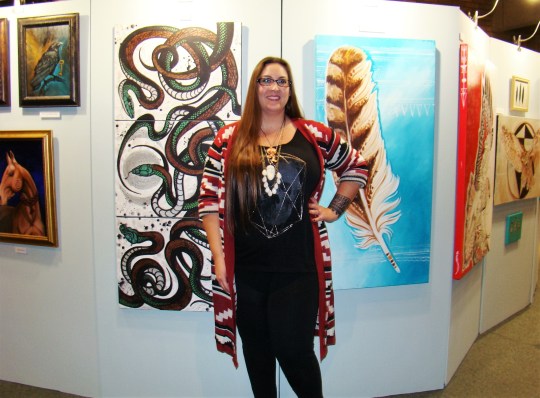
Mindi Yarbrough, artist Wild Heart, recently had her Opening Night at the Grave Creek Mound Archaeological Complex in Moundsville, WV.

Artists work in many different ways. Some paint exactly what they see, while others add a little imagination to their pictures. Mindi Yarbrough has an added element in her paintings. She captures the spirit of the person or animal. Mindi portrays herself as “a self taught and self described outsider artist.”

Mindi started drawing at the age of five. Her love of nature shines forth in everything she does. As a little girl, she enjoyed playing in the creek, where she would enjoy nature and catch snakes (and just about any other animal, insect or amphibian she could get her hands on).

“All kinds of snakes,” she explains, “but I was never afraid of them, despite being bitten many times, and often kept them as pets.” Snakes are Mindi’s power animal. She even has tattoos of them on her arms. Snakes have been associated with shamans. In fact in some cultures, snake bites are an initiation and pre-requisite into shamanism.

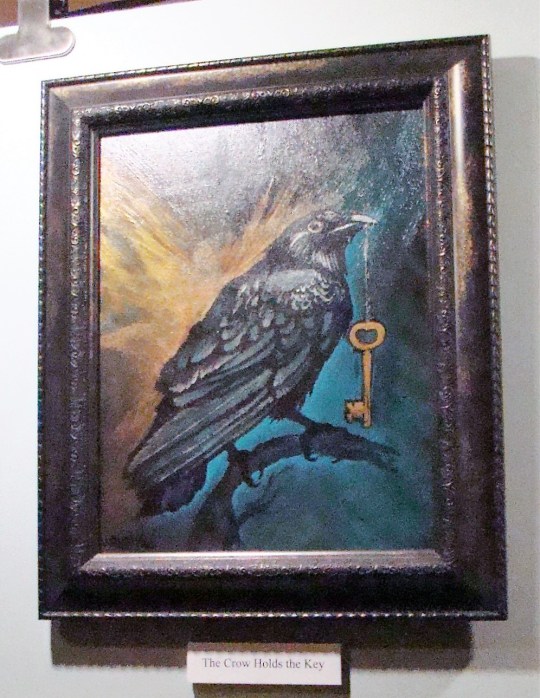
Mindi's The Crow Holds the KeyThe crow holds a special attraction to her as she feels it has a magical quality. It holds the magical key to the womb of fundamental energy where all possibilities exist. Crows live all around the world, reminding us that magic can be found everywhere. They often are associated with healing and the universal law.
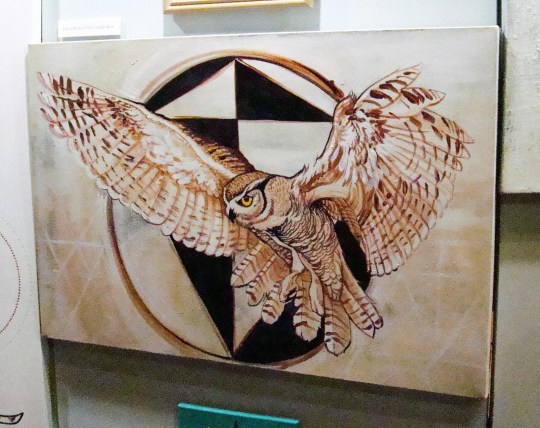
Mindi's OwlOwl is Mindi’s dream-time guide helping to navigate the unconscious world.  The Owl serves as the keeper of ancient wisdom and can see the secrets and agendas of others. The Owl is a prophet who can see, hear, and feel events before they transpire. 
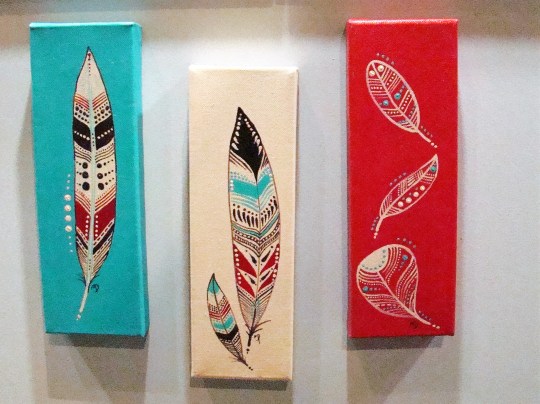
Mindi Dream CatchersHer dream catchers are up-cycled art with the center web being a doily, with a hand macrame hoop and fringe made with cotton twine and yarn. Dream catchers have been part of Native American culture for generations. They are usually hung by the bed at night to catch bad dreams before they disturb your sleep. There is a hole in the center to let the good dreams slip through.Mindi FeathersFeathers are important in the Native American tradition also, as they are seen as gifts from the sky, the sea and the trees. Often a feather has a message as it lands on or near someone. It reminds them of a spiritual connection that we all have to our creator and with passed loved ones. The gift of the feather is represented by passion – passion for your gift from the Creator – Mindi’s passion being artistic vision.Mindi's Bear Woman
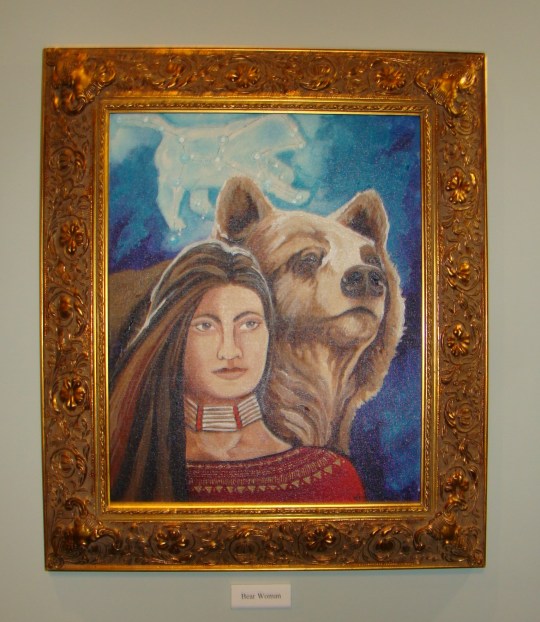
This painting of Bear Woman makes me smile. It tells a great Blackfoot Legend of the older sister and her bear. Mindi has even added the end of that legend as she shows the star constellation of Ursa Major in the background. All of her work shows depth and meaning.

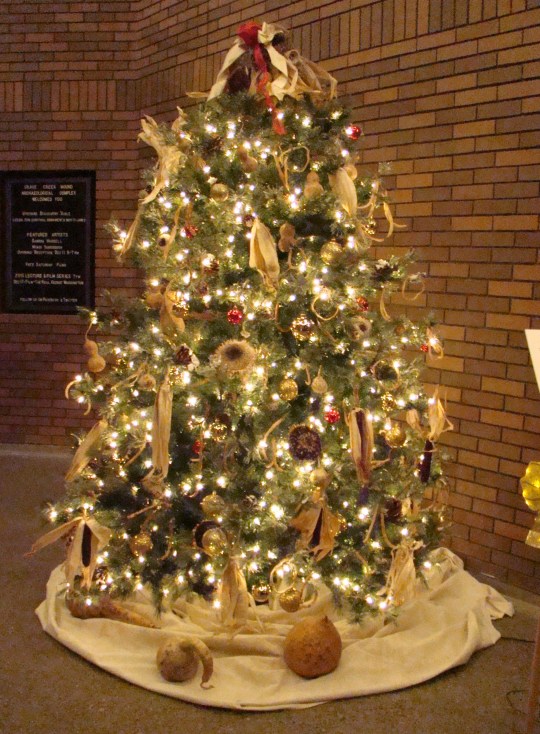
Mindi Christmas treeUpon leaving the art show, a beautifully decorated Christmas tree glowed in the hallway. The Mound Museum Christmas tree is decorated with plants that were important to those prehistoric Native Americans living in the area. The people who built Grave Creek Mound probably grew small gardens, which included squash, sunflowers, pumpkins, gourds, and goosefoot – the decorations on this tree.
It’s no surprise that Mindi works in the field of art on a daily basis. At present she is Art Director and Senior Graphic Designer at Beyond Marketing in Wheeling, WV. Her expertise lies in designing just what the customer desires.

Mindi has been drawing and painting since childhood. She smiles as she tells others, “I have never wanted to be anything other than an artist, except maybe a mermaid.” Mindi would definitely be a very special mermaid!


Lincoln Funeral Car Travels Original Route 150 Years Later

UNITED STATES, Lincoln's Funeral Car stopped in Dover, Ohio at Warther's Museum in 2015.

Lincoln’s Funeral Car stopped in Dover, Ohio at Warther Museum

Now he belongs to the ages – or maybe to the angels.

At the time of Lincoln’s death,  these words are sometimes credited to Edwin Stanton, Lincoln’s Secretary of War, but whether they are his or not, the words connect Lincoln to his peers and also to those above them.

Warther Museum recently hosted one of the stops for the 2015 Lincoln Funeral Train. It traveled from Washington D.C. to Springfield, IL in honor of the 150th Anniversary of Lincoln’s death. Over 50,000 visitors toured the Lincoln Funeral Car on its journey.

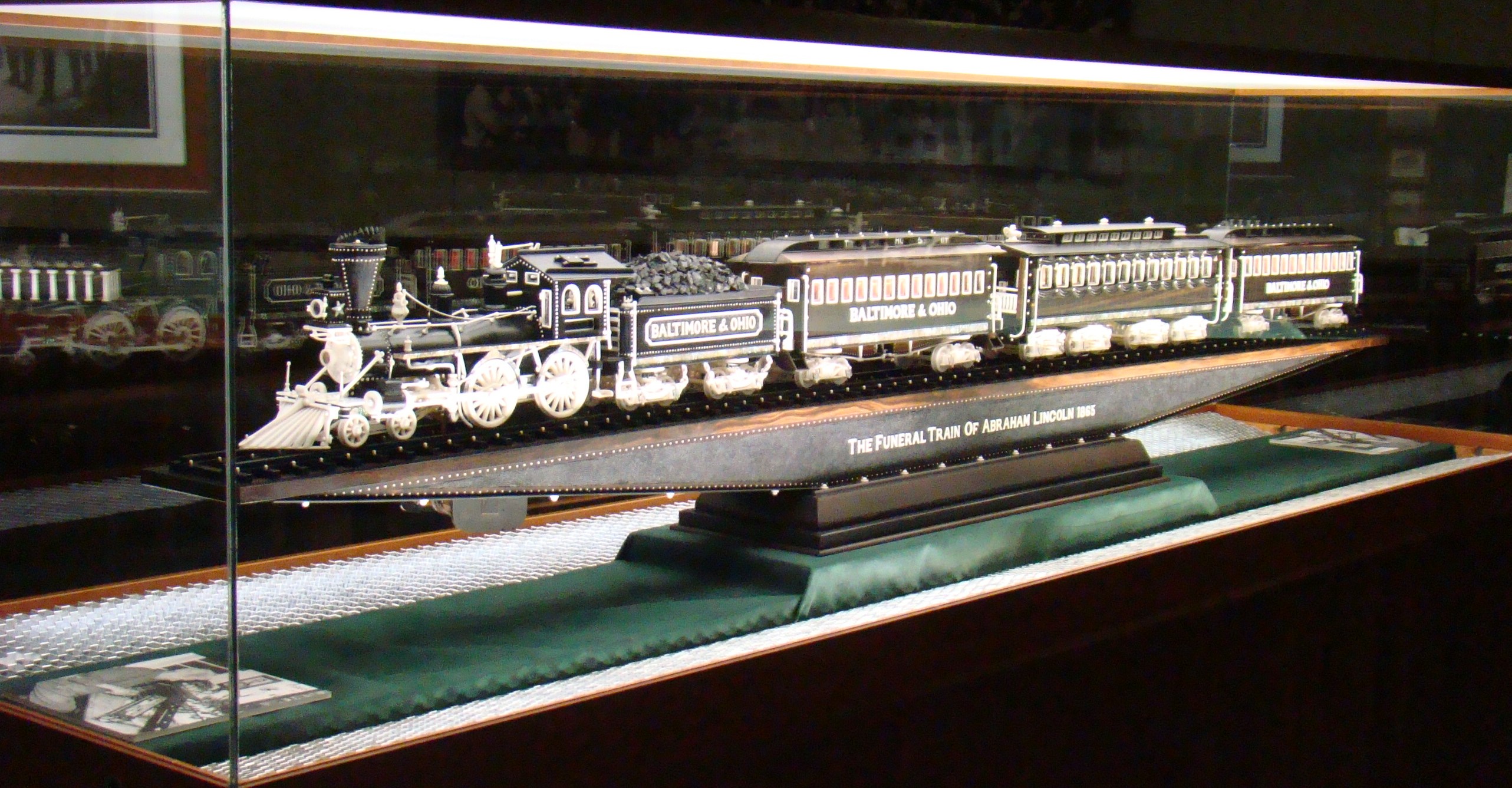
Warther carved this ivory replica train at the age of 80.

Warther carved this ivory replica train when he was 80.

People have always been fascinated with Lincoln’s Funeral since 1865. Ernest Warther carved Lincoln’s funeral train out of ivory to celebrate the 100th Anniversary of his death. Therefore, they thought it would be fitting to have the replica of the original, stop by Warther Museum on its journey across America.

The ivory carving was finished in 1975 when Earnest Warther was 80 years old. A hippo’s ivory eye tooth was used because it is the very best grade of ivory. Warther commented, “Nothing but the best for Lincoln” as Lincoln was his hero.

Warther admired Abraham Lincoln and had a vast collection relating to the president.

Warther admired Abraham Lincoln and had a vast collection relating to the president.

For the 150th Anniversary, outside the museum sat a wooden replica car, which they tried to keep as close as possible to the original.  The train car traveled as the trailer of a semi with highway wheels attached.

Dave Kloke of Kloke Locomotive Works in Elgin, IL and a staff of craftsmen were responsible for most of the work on this replica, which took four years to finish. Along the way he had a great deal of help from researchers in construction and history. One of those was a chemist and model train maker, Wayne Wesolowski of University of Arizona. All Wesolowski could find of the original train car was a pencil sized piece of wood. From this the chemist in him determined the original color and type of wood used. He wanted everything to match the original car.

This armored car was compared to Air Force One in regards to security and its design equaled the opulence of railroad cars used by European Royalty. This “Presidential Car” contained three rooms: parlor, stateroom, and sitting room.

The Lincoln coffin was 6'8

The Lincoln coffin was 6’8″ long with handles made by the same company that made the original ones.

Upon entering the car, a 6’8″ casket appeared before your eyes. This long casket was made especially for Lincoln, a tall man for his time. The handles were made by the same company that made the original ones for Lincoln’s coffin. Chairs were for the soldiers to sit as they guarded the coffin during its entire journey.

Lincoln felt this train too luxurious when the country suffering from the effects of the Civil War.

Lincoln felt this train too luxurious when the country suffered from the Civil War.

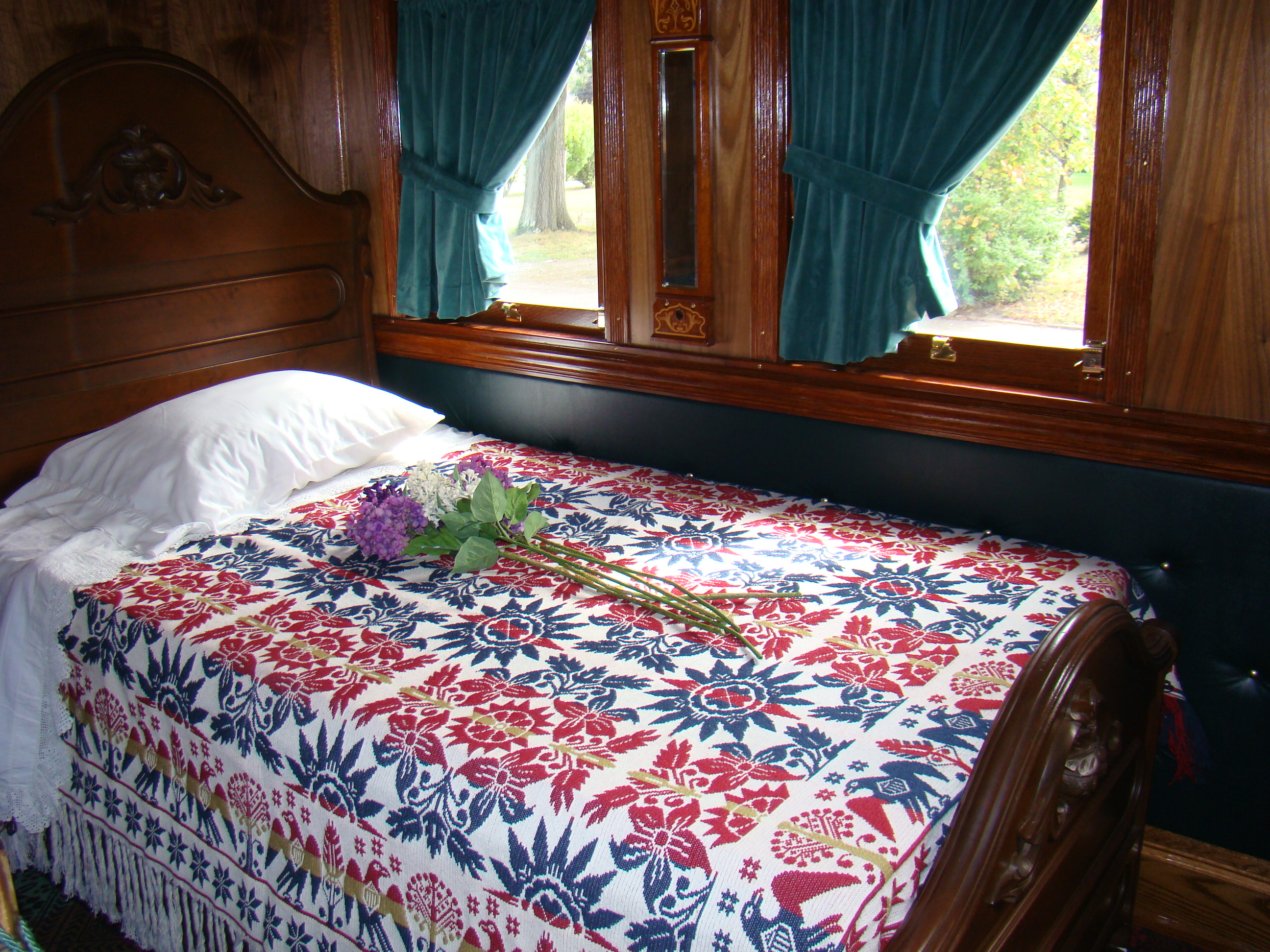
The presidential bedroom had never been used as President Lincoln felt this Presidential Car was too luxurious when many in the country were living in poverty. This funeral car, draped in black crepe, was one of nine cars in the funeral procession and was always the second to last in line.

Young Willie's coffin was carried at the place there is a sofa today.

Young Willie’s coffin was carried at the place a sofa sets today.

Son Willy’s coffin was also on this train even though he had died three years previously. It was in the living room section where it replaced the couch. Lincoln’s wife did not go on this trip as she was too distraught.

Even the wheels of the train were patriotic.

Even the wheels of the train were patriotic.

This car was never used for anything else or by any other presidents. The following year, it sold for $6850 to Union Pacific Railroad, where it became an officers’ car while building the Transcontinental Railroad. After being displayed at the Worlds Fair in 1904, a grass fire destroyed the train car at Minneapolis in 1911.

One of the main purposes of this excursion was to help young people learn about history. Many local schools took advantage of this unique educational stop in Dover, Ohio to give their students a close look at an oft told story in United States history.

Lincoln would have been pleased as he felt education very important. When speaking to a university he remarked, “A capacity and taste for reading gives access to whatever has already been discovered by others. It is the key, or one of the keys, to the already solved problems. And not only so. It gives a relish and facility for successfully pursuing the yet unsolved ones.”

Happy Trails Lead to Roy Rogers Festival

Every August western fans hit the trail to Portsmouth, Ohio to honor an old favorite, Roy Rogers, King of the Cowboys, and his wife, Dale Evans, Queen of the West. 2015 made the 32nd year the Roy Rogers Festival has been held there.

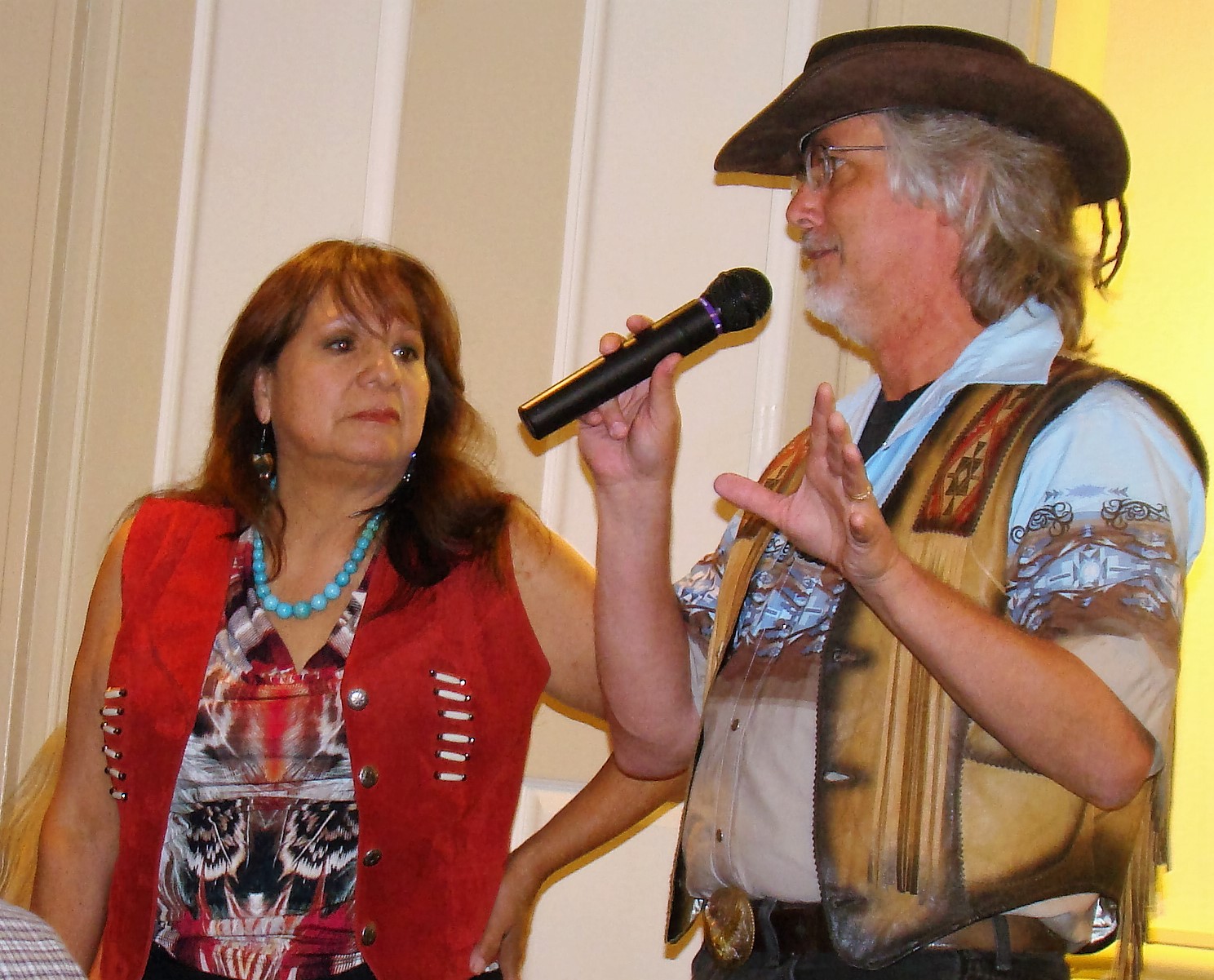
Roy and Dale's youngest daughter, Dodie, and her husband, John Patterson.

Roy and Dale’s youngest daughter, Dodie, and her husband, Jon Patterson.

Meeting Dodie Rogers Patterson, the daughter of Roy Rogers, had to be a highlight of the day for many. Her husband, Jon, provided entertainment as well. Dodie is the youngest of Roy and Dale’s nine multi-cultural children. She is of the Choctaw tribe, which also ran in Roy’s blood.

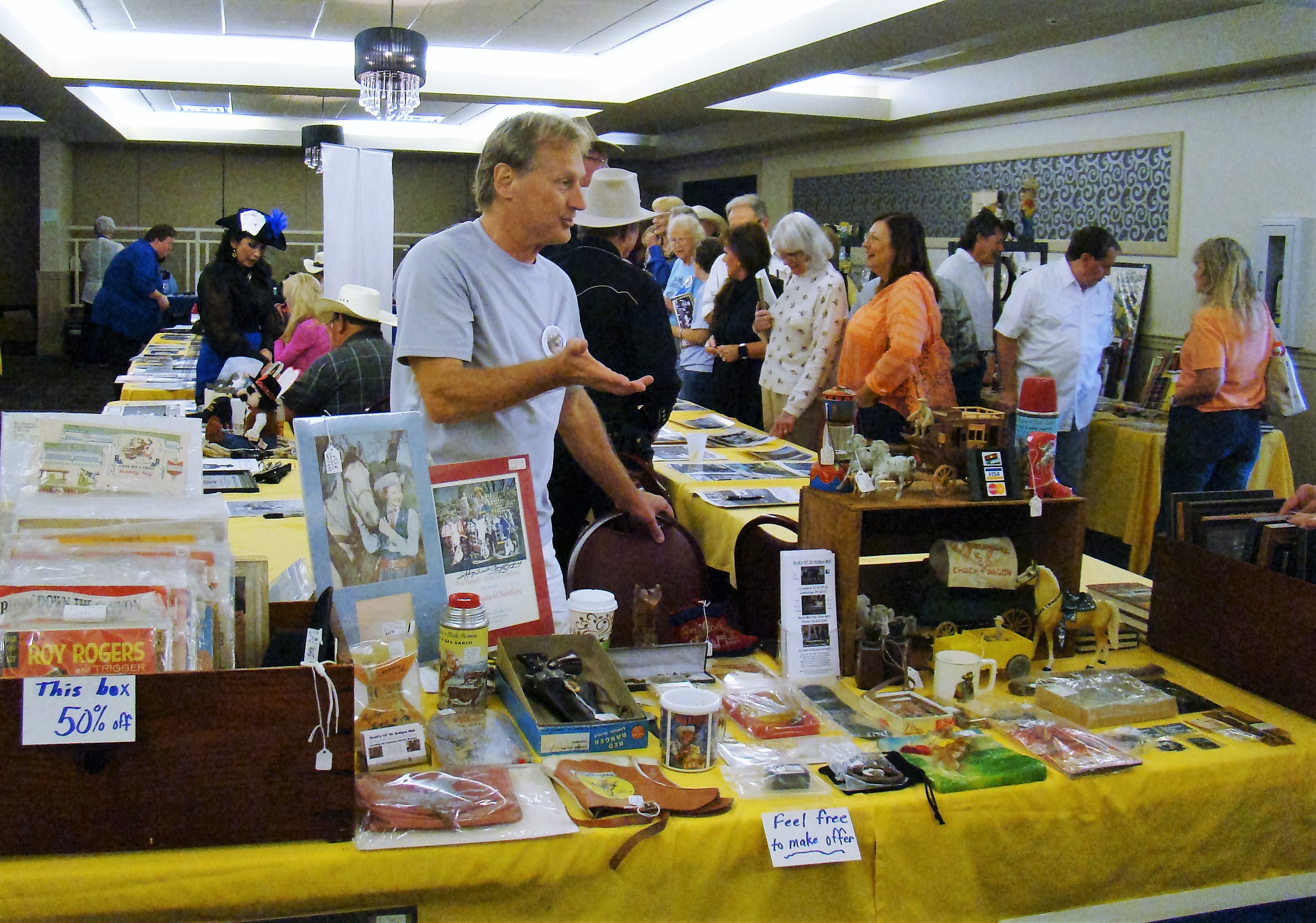
It was a pleasant surprise to find hometown dealer, Dave Scott, with Roy Rogers memorabilia.

It was a pleasant surprise to find hometown dealer, Dave Scott, with Roy memorabilia.

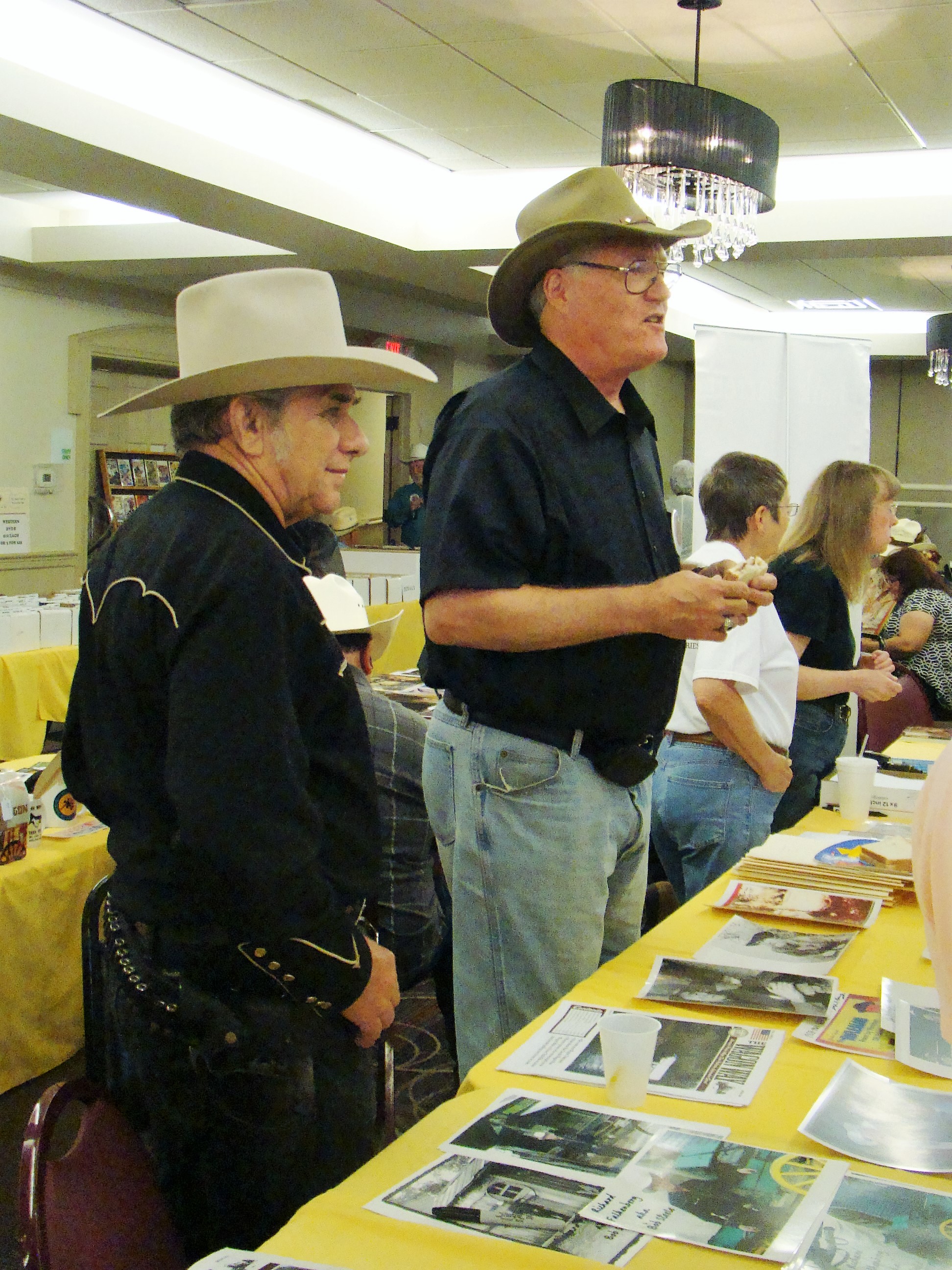
Activities centered around the dealers’ room where items could be viewed and purchased from many sellers. In the afternoon, there was a question and answer session with the stars that provided an inside look at their lives and what they had overcome. Being a star is not always as glamorous as it may seem.

Steve Connors, son o Chuck Connors from the Rifleman, certainly had the image of his father.

Steve Connors, son o Chuck Connors from the Rifleman, certainly had the image of his father.

Many stars were in attendance, and several of them had also been at a recent Hopalong Cassidy Festival. Fuzzy took a fall but came back stronger than he was before.  Steve Connors, son of Chuck Connors, who was The Rifleman and Johnny Crawford, who also starred in that show as a young lad, both had a great sense of humor.

Roy Rogers home on Duck Creek near Portsmouth.

Roy Rogers home on Duck Creek near Portsmouth.

The boyhood home of Roy Rogers was located at Duck Creek about twelve miles from Portsmouth. There is an Ohio Historical Marker at his home as well as a marble marker. Roy lived here until he was a teenager at which time they moved to California.

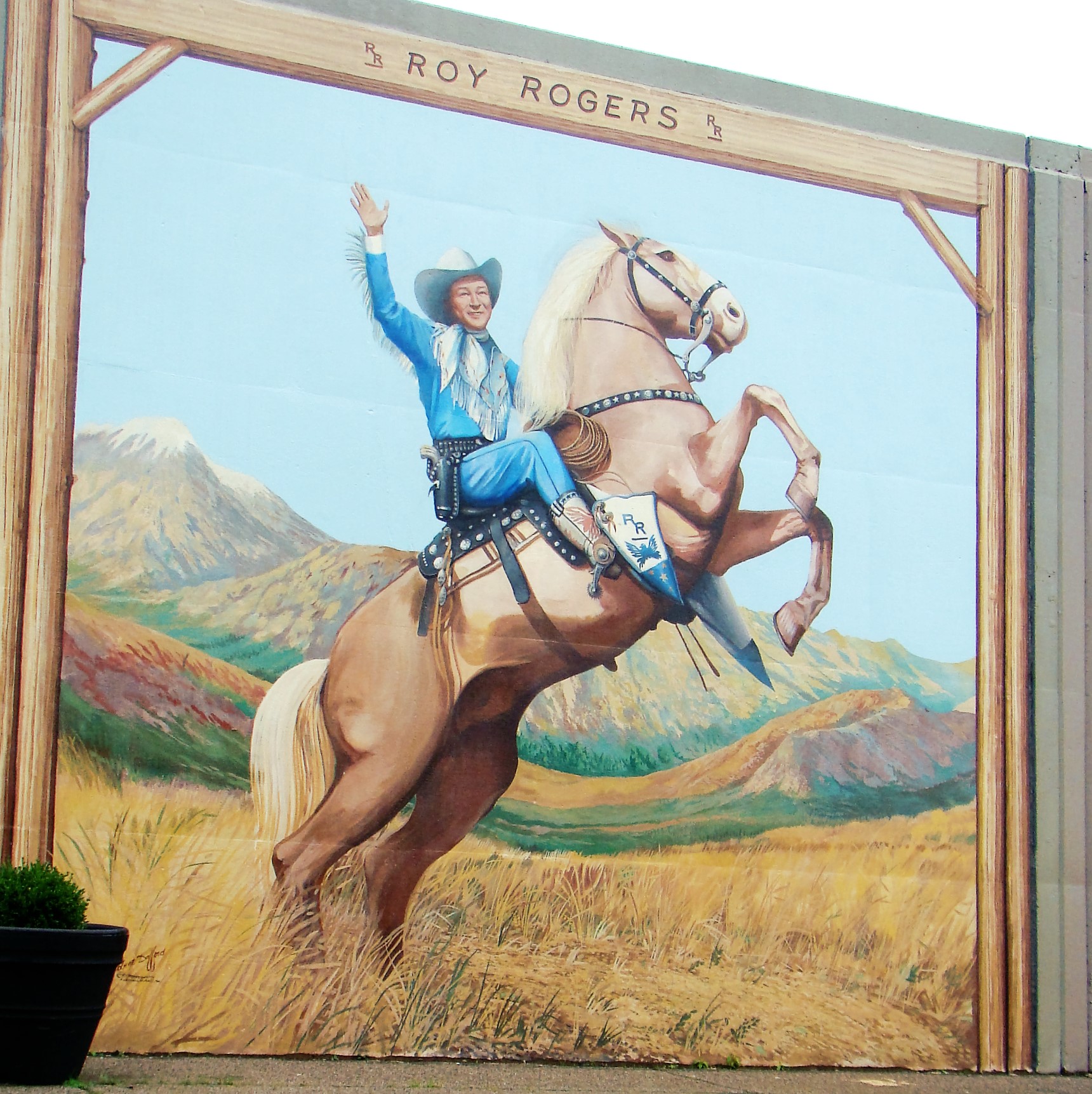
Roy Rogers painting on the Portsmouth Flood Wall.

Roy Rogers painting on the Portsmouth Flood Wall.

The Portsmouth Floodwall by Robert Dafford  contains 2,200 feet of artwork, the largest by any single artist. This mural along the Ohio River displays a 160′ section called “King of the Cowboys”, dedicated to Roy Rogers, a legend in his time.

Roy and Dale were the most loved western couple of all time and were proud of the US flag and our country. As Roy and Dale would sing, “Happy trails to you, ’til we meet again.”

The Cambridge Glass Museum Sparkles with Memories

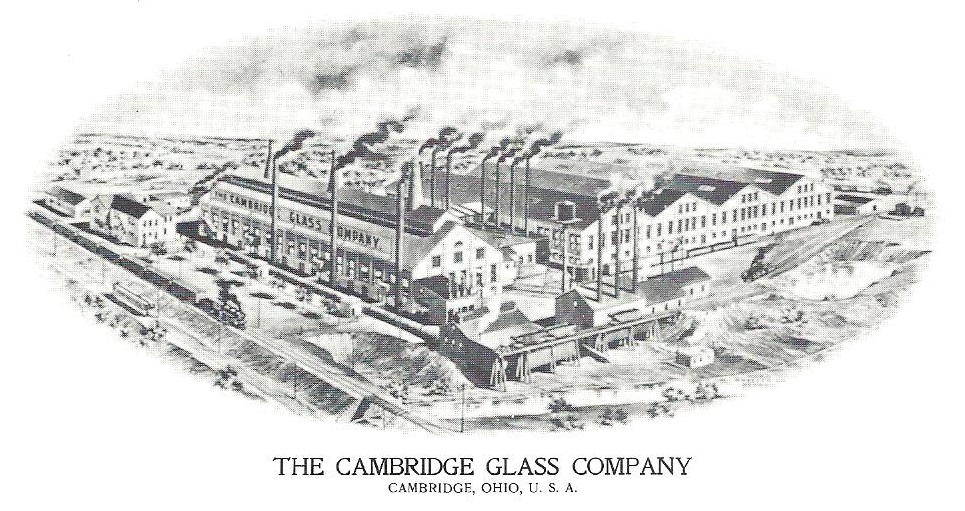
Picture of the original Cambridge Glass Company in 1909

Picture of the original Cambridge Glass Company in 1909

Stepping inside the National Museum of Cambridge Glass in Cambridge, Ohio makes former employees and their families feel a great sense of pride in the fine work displayed within its walls. Visitor after visitor marvels at the fine workmanship that has stood the test of time. Over 6,000 pieces of the finest glass in the world are on display.

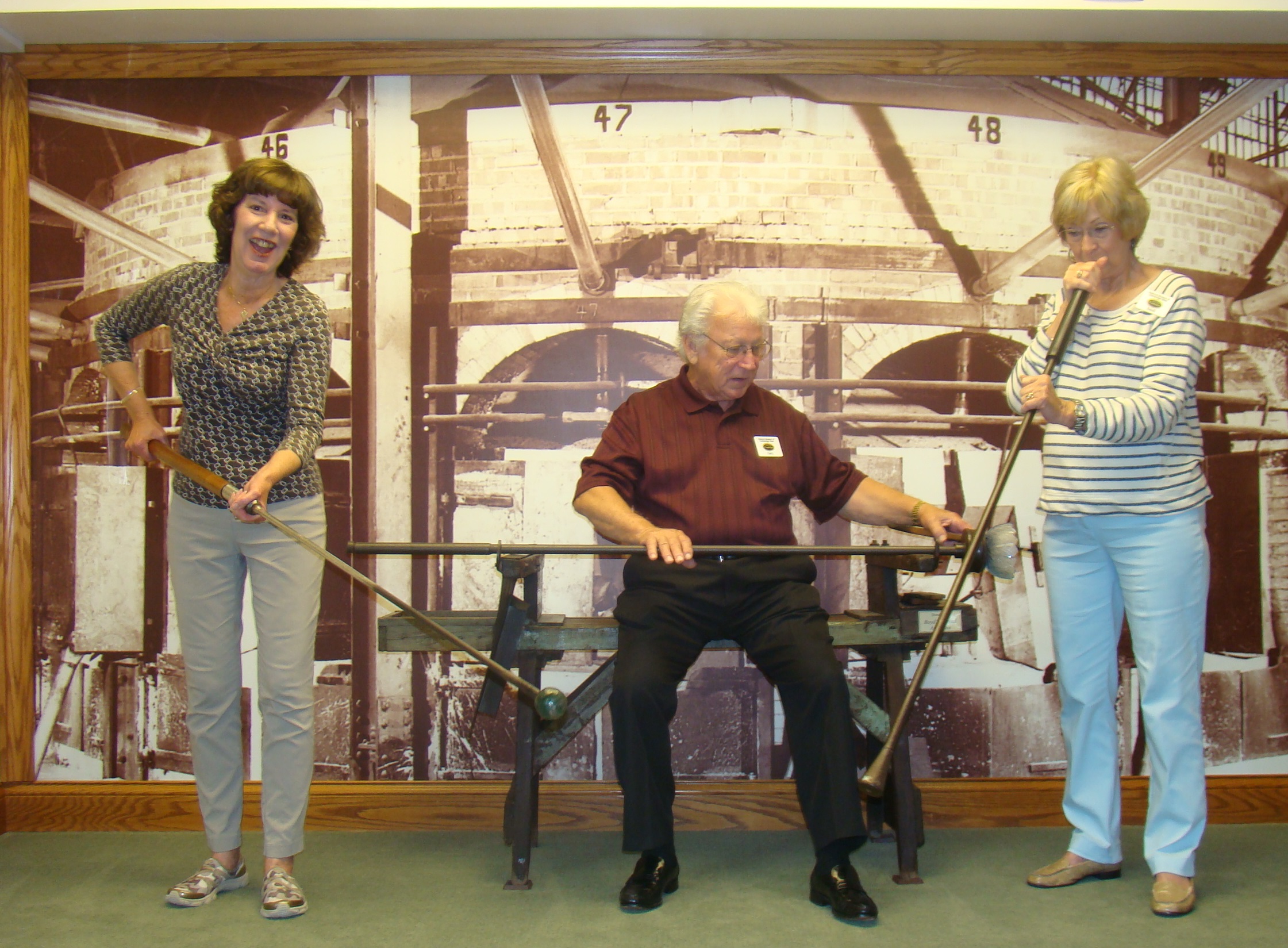
Original finishing bench from Cambridge Glass. Dad could have sat here.

Volunteers Cindy, Gary, and Sandi demonstrate making glass around an original finishing bench from Cambridge Glass. Dad might have sat on that bench.

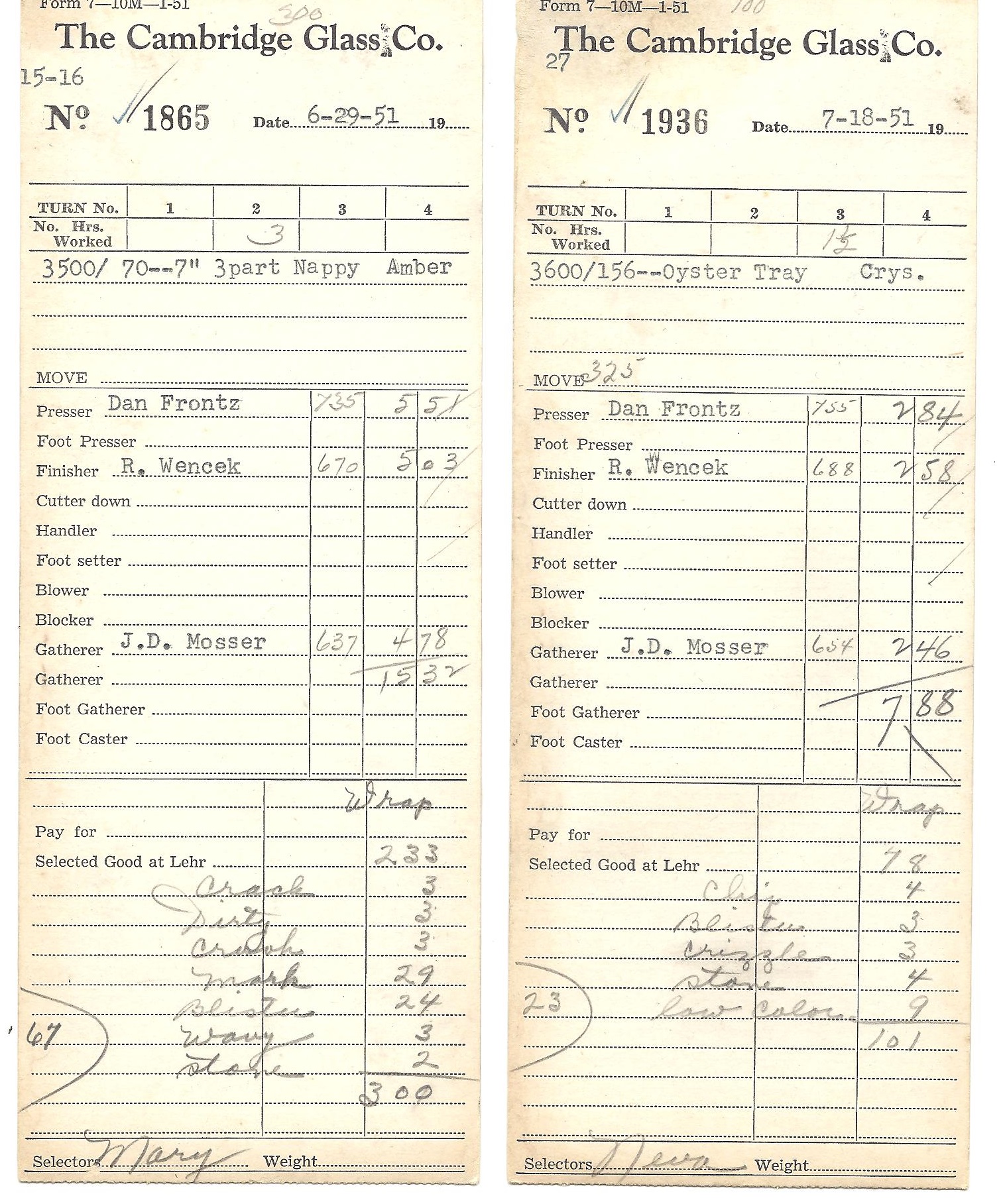
My thoughts always turn to Dad and Mom when I enter its doors. Working at Cambridge Glass Co. for over thirty years, my dad, Rudy Wencek, learned to do many different jobs: carrying-in boy, presser, finisher, and blower. Mom, known as Kate to her friends, only worked there a few years in the packing department.

Two of Dad's turncards show he was finisher, the item being made, and amount paid.

Two of Dad’s turncards show he was finisher, the item being made, and amount paid.

All of the employees remember it being a great place to work. Since times were tough during many of those years, the company provided a factory restaurant, where employees could get an economical meal and have it deducted from their pay.  They also were able to get coal to heat their homes at a reduced rate from Cambridge Glass’s Near Cut Coal Mine. Insurance was even provided for their employees.

Our long driveway was covered, not with gravel, but with ashes from the furnaces of Cambridge Glass. Many recall employees’ sidewalks and driveways having a coating of Cambridge Glass ash.

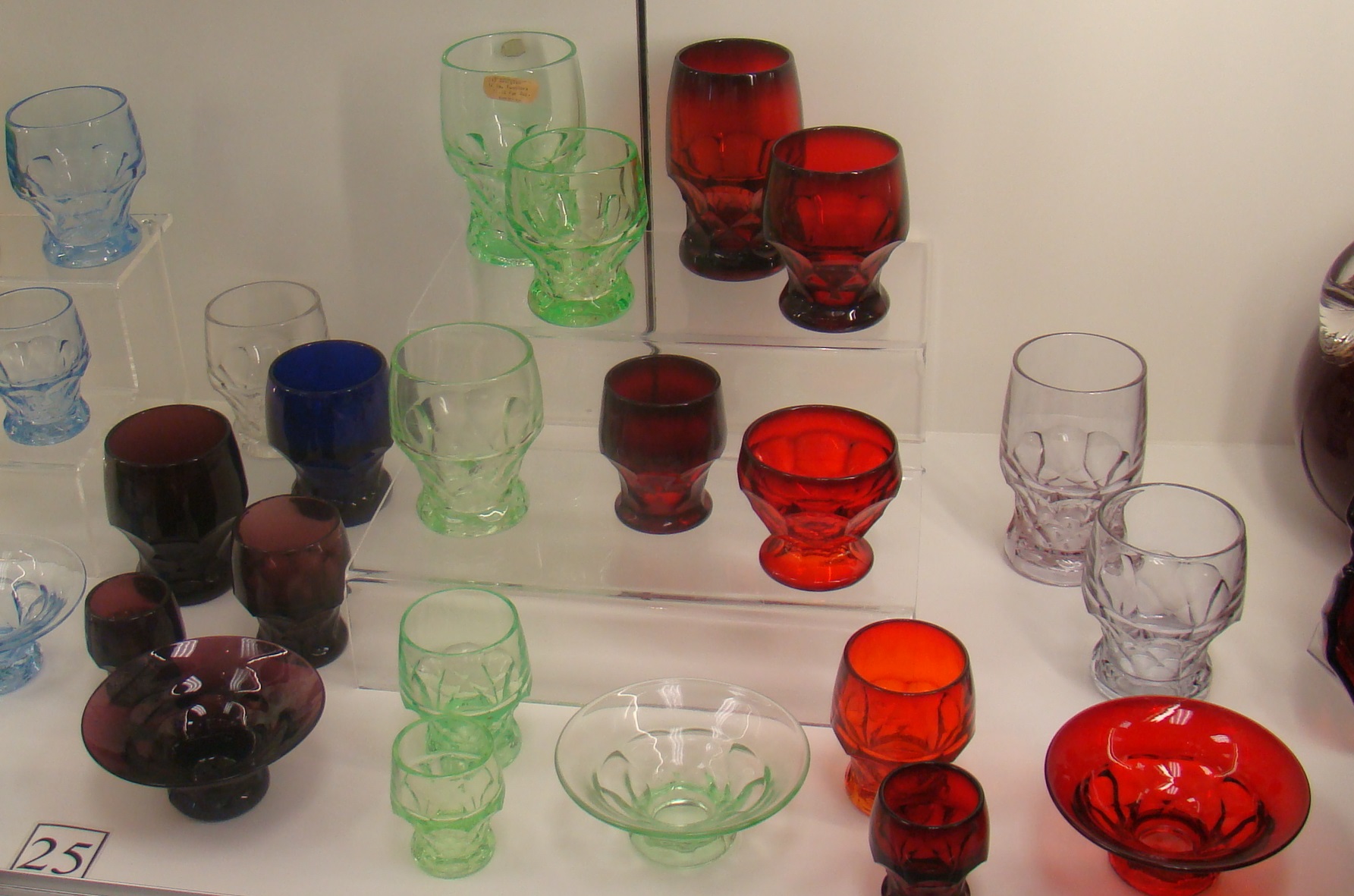
These popular Georgian tumblers were used daily at my parents'home.

These popular Georgian tumblers were used daily at my parents’ home.

When the plant closed in 1958, glass enthusiasts wanted to preserve its history, so in 1983 they opened the first National Museum of Cambridge Glass. Today their museum is on 9th Street just off Wheeling Avenue in downtown Cambridge.

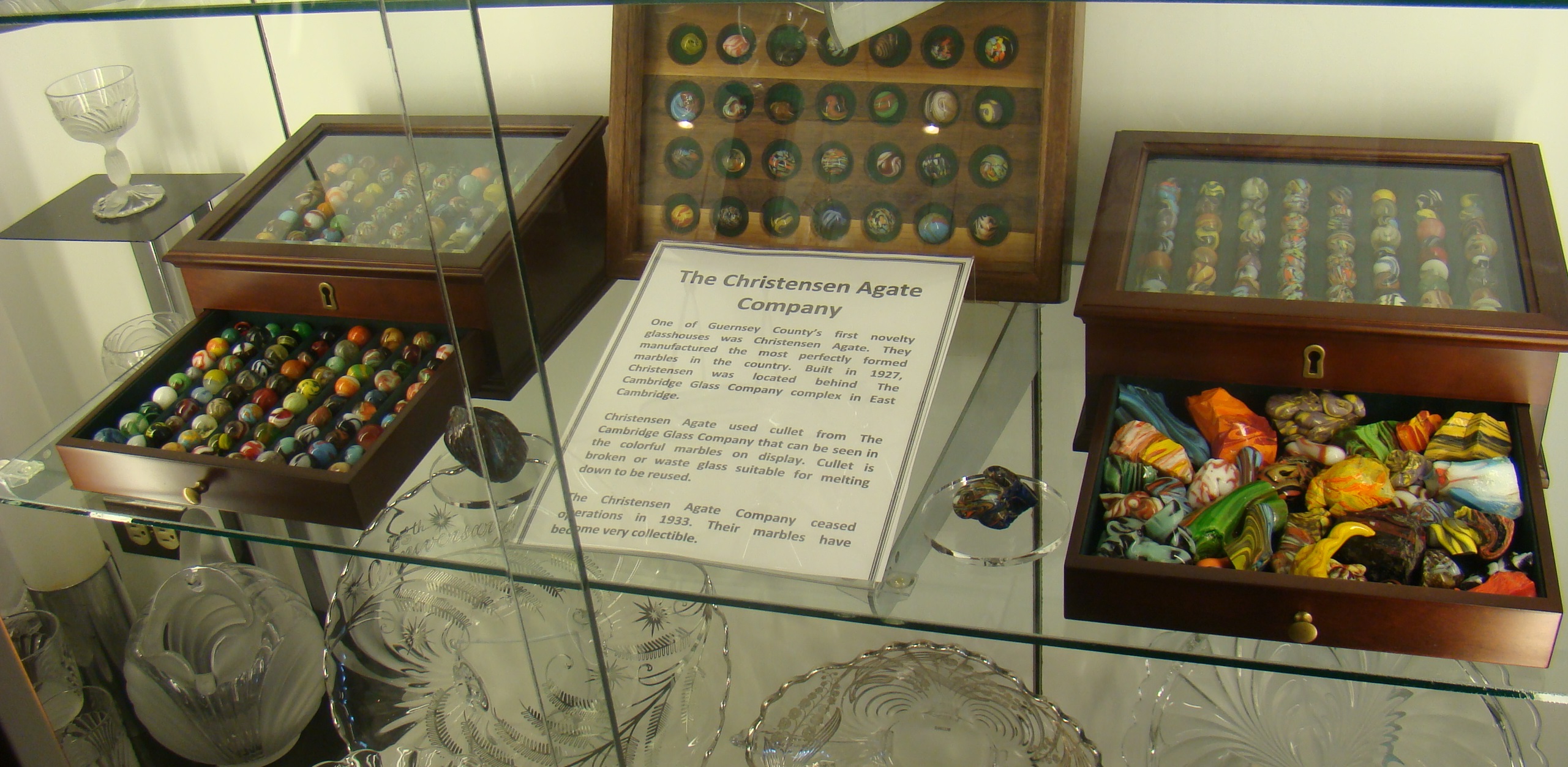
These marbles from Christensen Agate Co. were made from Cambridge cullet glass.

These marbles from Christensen Agate Co. were made from Cambridge cullet.

This past year they have created two new displays that are fascinating. One involves marbles. The Christensen Agate Co. made “the world’s most perfectly formed marbles.” They were located right behind the Cambridge Glass Company. To make the beautiful colors in their marbles, they used Cambridge Glass Company’s broken or waste glass called cullet, which they remelted to form the marbles..

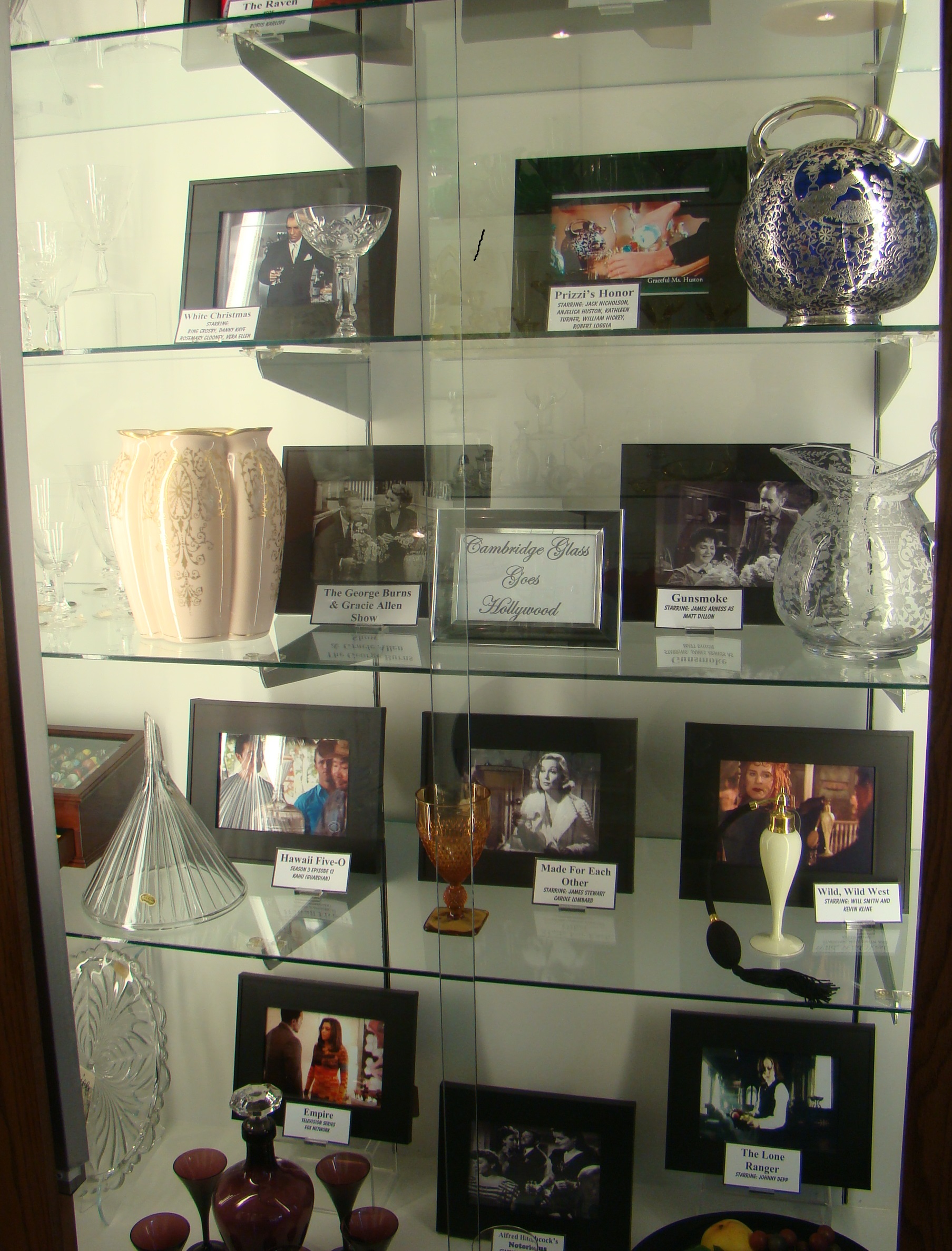
This display shows some of the Cambridge Glass used in movies or television shows.

This display shows some of the Cambridge Glass used in movies or television shows.

A larger display is called Hollywood Glass. Here you can spot Cambridge Glass pieces that have actually been used in movies and television shows. It’s quite impressive to realize that the things made in this small town are considered fine enough quality to be used in such manner as: a wine glass in White Christmas, an etched pitcher in Gunsmoke, a funnel on Hawaii Five-O, plus many more.

School and bus groups frequently tour the museum. Beginning with a short video actually filmed at the Cambridge Glass Company in the 1940s, visitors are then given a quiz regarding the video. Those with the correct answers are dressed in working gear as the process is reviewed.

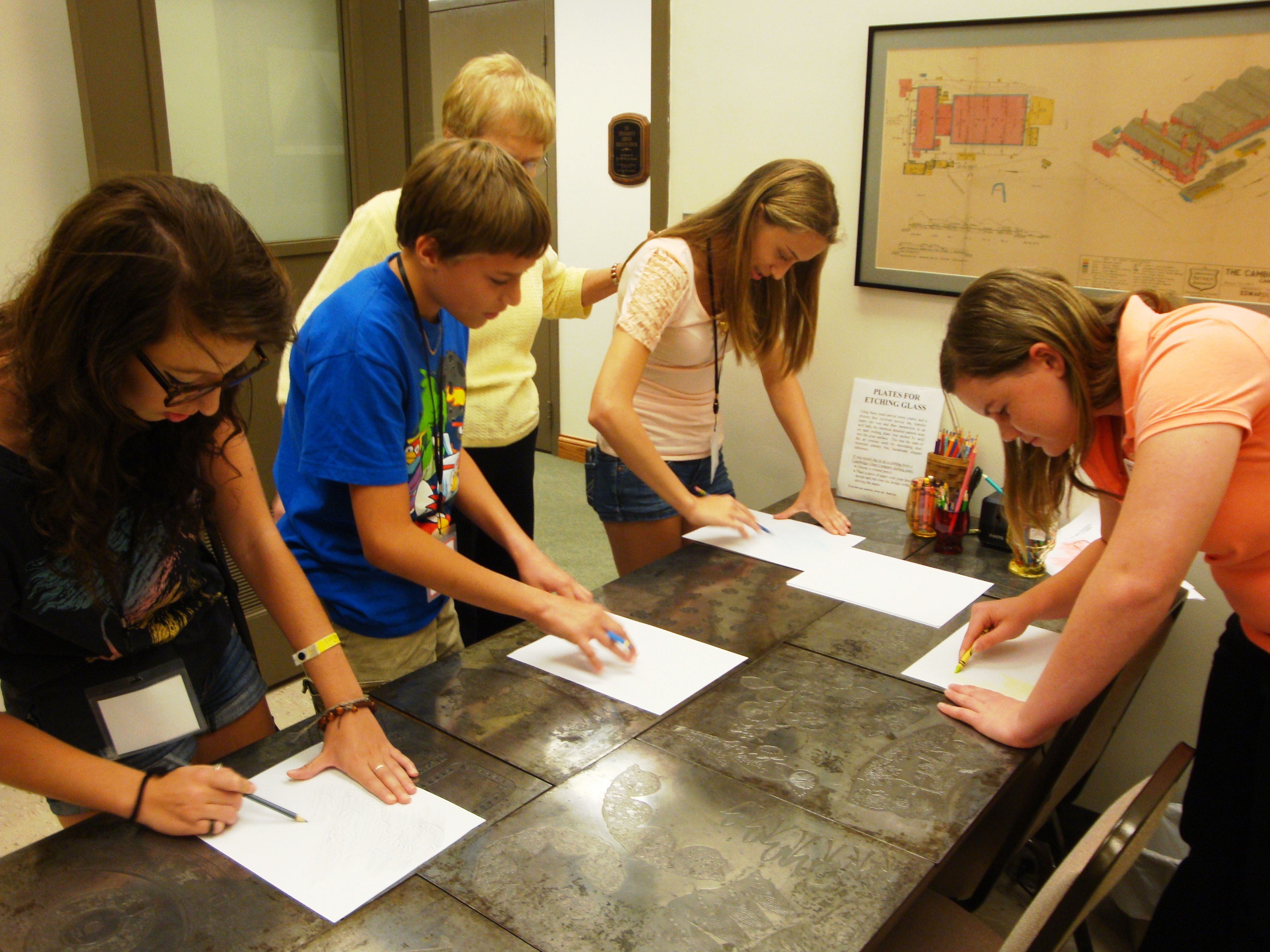
Students enjoy using the etching plates.

Students enjoy using the etching plates.

Another aspect that greatly interests adults and students happens in the etching department. Here they are given actual Cambridge Glass etching plates, for such patterns as Rose Point, Dragon, or Chantilly, and can see the patterns emerge on a paper trail rather than glass. Of course, beautiful, etched glass creations are visible throughout the museum.

Hopefully, someday you will take the time to see these pieces of glass artwork made by friends and family right here in Guernsey County. Dad and his co-workers should feel great pride in the beautiful gems they have created. Part of them lives on in their handiwork.

The National Museum of Cambridge Glass is located in Cambridge, Ohio at 136 S 9th Street, just a half block off its main street, Wheeling Avenue – also called old Route 40. Admission is a reasonable $6 for adults, $5 for seniors, and children under 12 are admitted free.